An immersion blender makes the most sense when the food is already in a pot, bowl, or tall cup and avoiding a transfer is part of the value. A countertop blender is the stronger starting point when the routine centers on frozen smoothies, repeated ice work, larger contained batches, or textures that depend on strong circulation through a dedicated jar. Hot-liquid use is not a class-wide permission, so the exact manual still decides what can safely go into a particular wand, pitcher, or accessory cup. Choose by where the blend begins, what the normal load looks like, and which cleanup and storage burden you will actually tolerate.
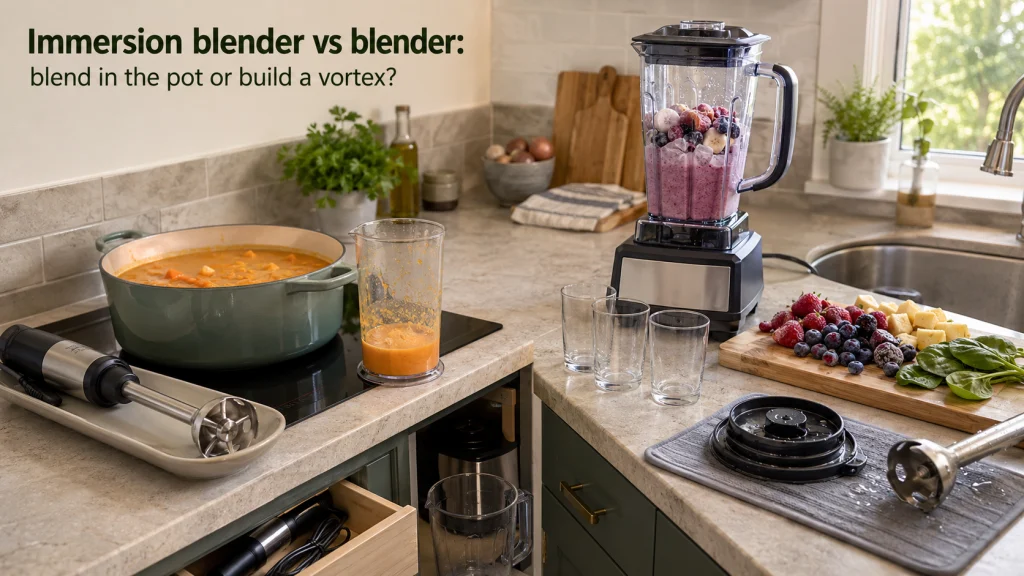
Blend in the pot or build the blend inside a jar
Immersion blender vs blender becomes much easier to decide once you stop treating both tools as motors with blades. One brings the blade to food that is already sitting in cookware or another container, while the other asks you to move the food into a jar designed around the blade system. For soup, sauce, and small purees, that difference can remove an entire transfer and one large vessel from cleanup. For frozen drinks and demanding blends, the dedicated jar may be exactly what makes the extra appliance worth its space.
The choice therefore starts with the path the food takes through your kitchen. If dinner is already in a saucepan and you only need to change its texture, carrying it across the counter may be needless work. If breakfast starts with frozen fruit, ice, and several servings, a fixed jar that repeatedly moves ingredients through the cutting zone is a more natural setup to investigate. The better class is the one whose vessel and workflow already match the job you repeat.

This 600-watt personal blender uses a 24-ounce cup and a removable extractor blade for compact countertop blending. The cup can go directly from blending to a to-go lid, which suits small fixed-vessel routines. The cup is top-rack dishwasher safe, while the blade rinses separately.
Check On AmazonIf you click this link and buy, we earn a commission at no additional cost to you.
The mechanical difference starts with who controls the vessel
An immersion blender is a handheld motor and shaft with a guarded blade at the working end, so the user controls where the cutting zone moves through the food. A countertop blender fixes the blade inside its own jar and depends on the jar shape, blade design, ingredient movement, and speed control as one system. That is why a simple wattage comparison is weak evidence. More electrical input does not prove that one design will create a better vortex, handle hard frozen ingredients, or produce the texture you want.
You may see the same choice searched as hand blender vs blender or stick blender vs blender, but the buying logic stays the same. The handheld tool gives you freedom to use an existing vessel, while the countertop machine gives you a vessel engineered as part of the appliance. That freedom is useful only when the container is suitable for the blending head, the batch is deep enough to control splashing, and the exact instructions allow the task. The jar system takes up more room, but it also removes much of the guesswork about where the blade operates.
Key point: Treat motor power as one specification, not the verdict. Blade design, guard design, jar geometry, ingredient load, speed control, and the manufacturer’s stated capability all affect what the machine can actually do. A larger number on the box cannot prove ice capability, hot-liquid approval, or texture quality.
This distinction also explains why two machines that appear close on paper can behave very differently in independent testing. Consumer Reports evaluates full-size blenders with separate ice-crushing, icy-drink, and puree tests rather than reducing performance to motor ratings. Its immersion testing uses different tasks, including soup puree and blends containing frozen fruit, because the class solves a different set of problems. Start with the vessel and the repeated task, then use performance evidence to compare models inside the class.
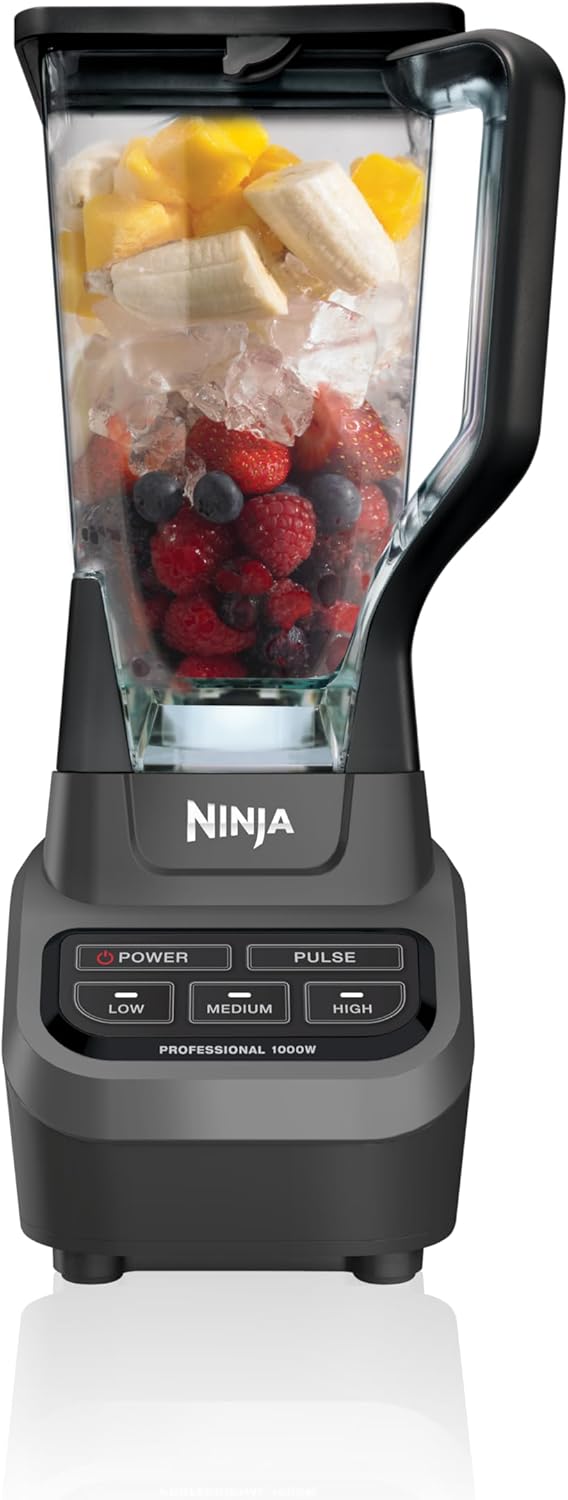
The BL610 pairs a 1000-watt base with a 72-ounce Total Crushing pitcher, with a 64-ounce maximum liquid capacity. Its stacked blade system is designed for ice, frozen fruit, smoothies, and purees. The pitcher is BPA-free and dishwasher safe for simpler cleanup after larger batches.
Check On AmazonIf you click this link and buy, we earn a commission at no additional cost to you.
Soups and sauces turn the decision into a transfer problem
When a soup or sauce is already in a suitable pot, an immersion blender can eliminate the step of ladling or pouring that food into another container. That saves handling, reduces the number of large parts that need washing, and lets you stop as soon as the texture is where you want it. The advantage is especially clear for smaller finishing jobs, such as smoothing part of a sauce or breaking down cooked vegetables without emptying the cookware. It is a workflow advantage, not proof that every wand will create a smoother result than every countertop blender.
A countertop blender earns the extra transfer when its jar system gives you something you actually care about in return. That may be a more uniform puree, easier handling of fibrous ingredients, or a repeatable texture that is harder to achieve while moving a handheld blade through a wide pot. Good Housekeeping’s testing shows why model evidence matters here: some immersion blenders produced very smooth soup, while performance still varied across the models tested. If the texture target is demanding, compare actual test results instead of assuming the compact tool is automatically enough.
| Repeated workflow | Immersion blender | Countertop blender | What should decide it |
|---|---|---|---|
| Puree food already in cookware | Usually avoids a transfer | Requires moving food into the jar | Desired texture and exact hot-food instructions |
| Finish a small sauce or puree | Works naturally in a suitable narrow vessel | May need enough volume for good circulation | Batch depth and vessel geometry |
| Chase a very uniform texture | Depends strongly on model and technique | Dedicated jar can favor repeatable circulation | Independent performance evidence |
| Minimize cleanup after cooking | Often leaves fewer large parts | Adds jar, lid, and blade-area cleaning | Exact cleaning instructions and dishwasher guidance |
The table is most useful when you apply it to the dish you make repeatedly, not the one you imagine making someday. A household that often finishes soft soups may gain more from eliminating transfer than from owning a larger motor base. Someone who notices every bit of fiber in a puree may willingly wash a pitcher for the texture payoff. Once the ingredients get colder, harder, and thicker, the balance begins to shift.

The Obliterator uses a 48-ounce Tritan jar, a 1380-watt motor, and a stainless-steel blade system for smoothies, soups, sauces, and ice. Its Auto Blend function adjusts the cycle to the ingredients, while the included tamper and scraper help with thicker mixtures. A dedicated Clean preset and dishwasher-safe accessories simplify cleanup.
Check On AmazonIf you click this link and buy, we earn a commission at no additional cost to you.
Smoothies, ice, and frozen loads expose the class limits
An immersion blender can make smoothies, and current independent testing confirms that some models handle frozen fruit surprisingly well. Good Housekeeping has tested immersion models with ice and frozen strawberries, while Consumer Reports uses frozen fruit in its yogurt-blend testing. That evidence is useful because it prevents an equally bad assumption in the other direction: handheld does not automatically mean soft ingredients only. What it still does not prove is that every immersion blender should be used for loose ice cubes or repeated hard frozen loads.
For a household that regularly blends frozen fruit, several servings, thick mixtures, or ice, a countertop blender is the stronger class to investigate first. Consumer Reports specifically evaluates full-size machines for ice crushing and icy drinks, and the better performers are judged by how uniformly they break down the load. The jar contains the ingredients and keeps feeding them back toward a fixed blade system, which is a very different workload from manually moving a guarded blade through a cup. If frozen performance is central to the purchase, verify it directly instead of inferring it from wattage or speed count.
| Texture or load | Immersion blender fit | Countertop blender fit |
|---|---|---|
| Soft cooked soup or sauce | Strong when in-vessel blending matters | Strong when a highly uniform puree matters |
| Small soft-fruit smoothie | Reasonable if the exact model supports it | Easy class fit |
| Frozen fruit-heavy smoothie | Needs model-specific evidence | Usually the better starting class |
| Repeated ice crushing | Never assume capability | Look for explicit ice-crushing performance |
| Very smooth fibrous puree | Possible, but model and movement matter | Dedicated circulation can be an advantage |
This is where buying by class first saves money. If the hardest job you actually repeat is a banana-and-yogurt drink, you may not need a large full-size machine merely because it can pulverize ice. If the routine includes dense frozen fruit and ice every morning, buying the smaller tool for storage convenience can create a daily compromise. Match the machine to the hardest common load, not the easiest recipe it can technically complete.

The BN701 combines a 72-ounce Total Crushing pitcher with a 1400-peak-watt motor for larger frozen-drink and smoothie batches. Three Auto-iQ programs cover smoothies, frozen drinks, and nutrient extractions using preset pulse, blend, and pause patterns. The pitcher, lid, and stacked blade assembly are dishwasher safe.
Check On AmazonIf you click this link and buy, we earn a commission at no additional cost to you.
Batch size is really about depth, circulation, and usable space
Capacity looks simple on a product page, but the two classes express it differently. A countertop blender has a stated jar capacity, yet the usable amount for a particular recipe can be lower because ingredients need room to move and some tasks have their own fill limits. An immersion blender has no built-in jar capacity, but that does not make its capacity unlimited in practice. The blending head still needs enough depth to stay controlled in the mixture, and the shaft must reach the working area without putting the motor body where it does not belong.
Container shape matters just as much as volume for a handheld blender. A small amount in a broad skillet may be harder to keep around the blade than the same amount in a tall cup, while a very deep stockpot can make a short shaft awkward to position. KitchenAid’s hand-blender guidance for applicable models tells users not to immerse beyond the seam of the blending attachment and to leave room for the mixture to rise. That is a good example of why “use any pot” is too loose a buying rule.
A countertop jar has the opposite trade-off. The vessel is less flexible, but the geometry is known and built into the system, so the next check becomes whether your normal batch sits comfortably inside that jar under the task-specific limits in the manual. A family-sized smoothie and a single serving can both fit the broad label “smoothie,” yet one may favor a larger jar while the other makes that appliance feel wasteful. Compare the batch you make most often, not the maximum number printed on the carton.

The Hamilton Beach Power Elite is a practical countertop blender for everyday smoothies, shakes, sauces, and other basic blending tasks. Its 700-watt peak-power motor and Wave Action system are designed to pull ingredients toward the blades, while the 40-ounce glass jar suits small household batches. Multiple blending functions provide flexibility for pureeing, mixing, and crushing ice when used according to the instructions. The pouring spout makes serving easier, and the removable jar simplifies cleanup. It is a useful alternative for readers looking for a conventional glass-jar blender rather than a personal smoothie cup.
Check On AmazonIf you click this link and buy, we earn a commission at no additional cost to you.
Hot-liquid safety belongs to the exact model and container
This is the part of the comparison where class-level shortcuts become unsafe. An immersion blender is convenient for soup because it can work in the cooking vessel, but that does not mean every model should be used in boiling liquid or in a pot that is still over heat. KitchenAid’s current support guidance for applicable hand blenders says to remove the saucepan from the heating element, avoid blending boiling liquids, keep the motor body out of the mixture, and stay within the immersion limit of the attachment. Those instructions support the workflow advantage while also showing why “immersion is always safer for hot soup” is too broad.
Countertop machines vary just as much. KitchenAid’s current operating guidance for its Pure Power blender allows hot ingredients under a specific lid and speed procedure, while other blender systems and accessory cups may use different restrictions. Nutribullet’s comparison guidance likewise distinguishes full-size hot-food use from enclosed cups that should not be used for hot food. The correct rule is simple: read the exact manual for the jar or accessory you will use, and do not borrow hot-liquid instructions from another model that merely looks similar.
Warning: Stop at the manufacturer’s instructions for hot liquids, fill limits, lid configuration, vessel compatibility, and whether cookware should be removed from heat. Do not improvise around a sealed cup, damaged lid, warped jar, loose attachment, or any condition the manual treats as unsafe. Hot-liquid convenience is never worth replacing a model-specific rule with a generic internet shortcut.
That boundary also changes the buying decision. If soup is a major reason for the purchase, look up the manual before you buy rather than discovering the hot-liquid limitation after the appliance is on your counter. A model that fits your storage space but conflicts with your actual soup workflow is not a good fit. Safety instructions are part of product compatibility, not fine print to check later.

The Vitamix 5200 pairs a 64-ounce classic container with variable speeds and a tamper for moving dense blends toward the blades. Vitamix specifies the container for purees, sauces, soups, and other hot or cold dishes. It can also self-clean with warm water and dish soap without disassembling the container.
Check On AmazonIf you click this link and buy, we earn a commission at no additional cost to you.
Storage and cleanup matter because they decide whether the tool gets used
An immersion blender usually asks for less storage space because the core tool is narrow and can often live in a drawer or small cabinet area. That advantage is strongest when the wand is the part you actually use and it is easy to reach without unpacking a bundle of accessories. A countertop blender needs space for the base and jar, and its height can matter under upper cabinets or on a shelf. Measure the stored footprint, but also picture the retrieval path from storage to the place where you blend.
Cleanup follows the same logic. Blending directly in cookware can mean washing the cooking vessel you already used plus the detachable blending shaft, rather than adding a large jar and lid to the sink. Countertop blenders can still be easy to clean, and independent testing often scores convenience separately because jar design, controls, removable parts, and dishwasher guidance vary. The practical question is not which class has fewer parts in theory, but which machine creates less friction after your normal recipe.
A compact tool can lose its advantage if its attachments scatter across two drawers, while a larger blender can earn permanent counter space if it is used every day. Storage therefore deserves to be treated as part of performance. An appliance that is awkward to retrieve has to be unusually valuable once it is running to justify that friction. If both classes can handle your actual load, cleanup and retrieval can reasonably become the deciding factors.

The BN301 is a compact 900-peak-watt personal blender that blends directly in three included 20-ounce cups. Two spout lids and one storage lid let the same cups handle serving or short-term storage after blending. The cups, lids, and blade assembly are top-rack dishwasher safe.
Check On AmazonIf you click this link and buy, we earn a commission at no additional cost to you.
Whisks and choppers add jobs, but they do not change the core class
Many immersion blenders are sold with whisk, chopper, beaker, or frothing attachments, and those extras can make a compact system more useful. They should still be judged as separate capabilities rather than evidence that the wand replaces every neighboring appliance. A small chopper can solve a quick prep job without turning the motor into a full food processor, and a whisk can add aeration without making it equivalent to a dedicated mixer. Count the attachments you will use repeatedly and ignore the rest when judging value.
This boundary matters because an accessory list can make a small appliance look more capable than its main workflow really is. If your bigger question is mixing rather than blending, the site’s hand mixer vs immersion blender comparison keeps those two jobs separate. Compatibility also needs exact verification, because visually similar accessories are not proof of fit. Match attachments, replacement parts, and accessory bowls to the exact model or system named by the manufacturer.
- Count an attachment only if it removes a repeated task from another appliance.
- Verify exact model compatibility before buying replacement or add-on parts.
- Check how every extra piece will be stored and cleaned.
- Do not let a whisk or chopper distract from whether the main blending class fits your routine.
A smaller bundle can therefore be the better purchase even when a larger bundle looks more versatile. The useful feature is the one that changes work you actually do. Once the optional extras are stripped away, the decision should still make sense on the strength of the blender itself.

The MQ7035 combines Braun's immersion blending shaft with a 500-watt motor and variable-speed control. This 3-in-1 set also includes a whisk, a 2-cup chopper, and a blending beaker, so the accessories cover several small prep jobs. Detachable accessories separate from the motor body for cleaning.
Check On AmazonIf you click this link and buy, we earn a commission at no additional cost to you.
Choose immersion, countertop, or both from the jobs you repeat
Choose an immersion blender first when most of the food is already in cookware or a small suitable container, the normal ingredients are within the exact model’s capability, and avoiding transfer matters more than having a dedicated blending jar. It is especially logical when soups, sauces, soft purees, dressings, and small batches dominate the routine. Compact storage strengthens the case, but it should not be the only reason. If the jobs you care about are mostly frozen and demanding, the smaller footprint can become a false economy.
Choose a countertop blender first when smoothies, frozen ingredients, ice-capable work, larger contained batches, or highly uniform textures are the recurring reason you need a blender. Its jar takes space, but that space is paying for a controlled vessel and a class built around repeated circulation. If you only make those loads occasionally, a full-size machine may be more capability than the household actually needs. A simpler or smaller choice is valid when it covers the routine without forcing a meaningful compromise.
Choose both only when the workload is genuinely split. A person who regularly purees food in cookware and also makes demanding frozen drinks is solving two different vessel problems, not merely collecting duplicate appliances. Before buying two tools, write down the blends you make often enough to justify permanent storage and cleanup. If one side of the list is mostly hypothetical, buy for the routine that already exists.
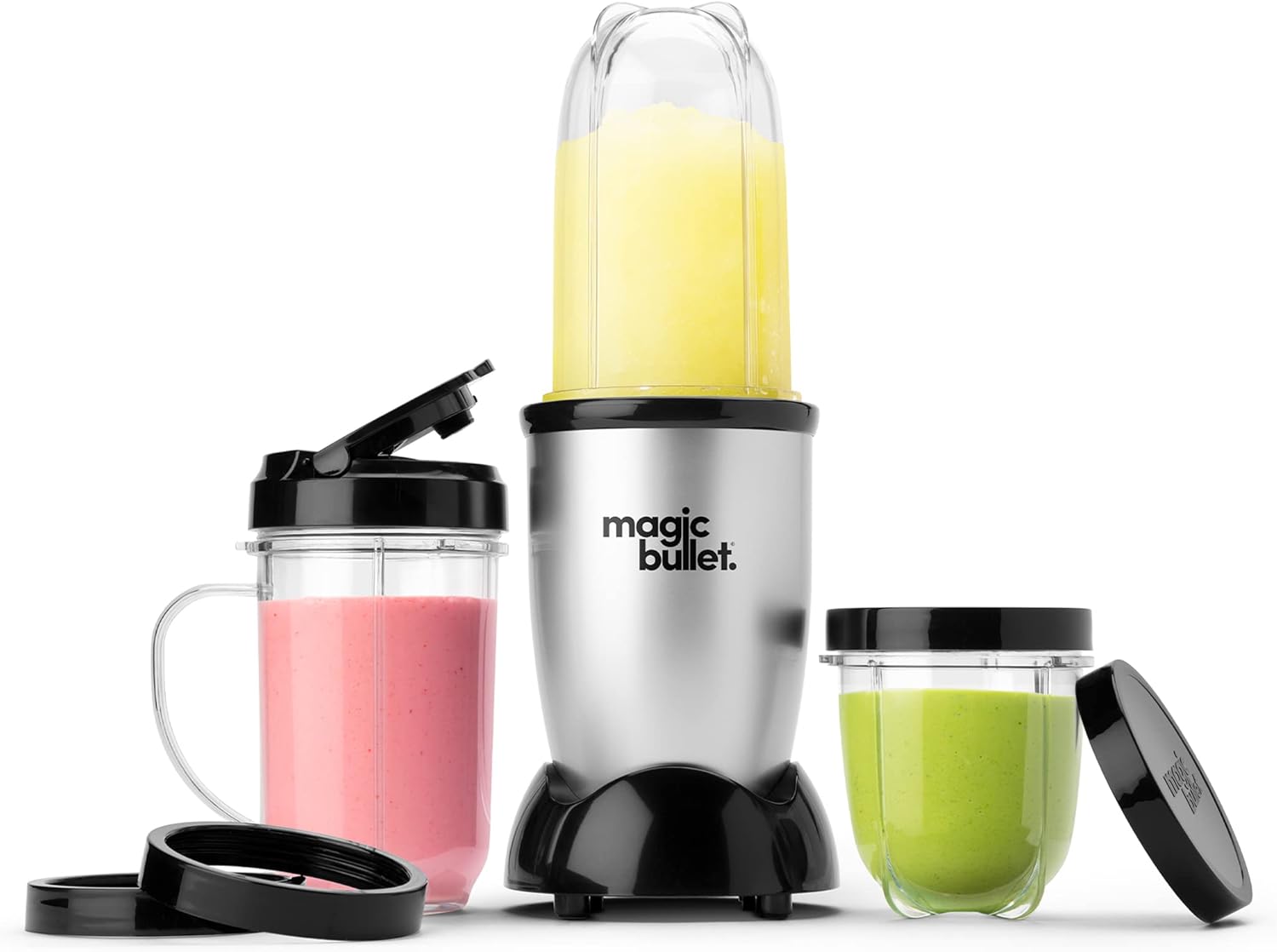
This 250-watt Magic Bullet set uses compact blending cups rather than a full-size pitcher, making it suited to small portions and limited counter space. The 11-piece package includes a tall cup, short cup, party mug, lids, lip rings, and cross blade. Its removable attachments are top-rack dishwasher safe.
Check On AmazonIf you click this link and buy, we earn a commission at no additional cost to you.
Compare models only after the class choice is clear
Once the workflow points clearly toward a countertop machine, move to the site’s best blenders coverage and compare the exact jar, usable batch size, frozen-load performance, cleanup, noise, and hot-liquid rules that matter to your household. If the workflow points toward a wand, use the current immersion blender comparison for model-level differences such as shaft design, controls, tested texture, attachments, and cleaning. That order keeps a class decision from getting hijacked by whichever product has the longest feature list. It also makes model comparisons much more meaningful because every candidate is being asked to solve the same job.
If you are not yet sure which blender class belongs in the kitchen, step back to how to choose a blender and define the recurring load before comparing products. The wider small kitchen appliances section is useful when the real question is whether a blender deserves storage space at all. The sequence is simple: identify the job, choose the class, then verify the exact model. That is far less likely to end with an appliance that is impressive on paper and irritating in daily use.

The SS151 uses a 1600-peak-watt motor, a 34-ounce high-speed pitcher, and a built-in Twist Tamper for dense blends. Five Auto-iQ programs handle one-touch processing, while the Hybrid Edge blade assembly is intended for whole fruits, nuts, and other ingredients. The package also includes two single-serve cups with spout lids.
Check On AmazonIf you click this link and buy, we earn a commission at no additional cost to you.
Final Thoughts: choose by where the food is and what the load demands
An immersion blender is the cleaner fit when the blade needs to travel to food that is already in a suitable vessel, while a countertop blender earns its footprint when a dedicated jar and repeatable circulation better match the texture and load. Frozen ingredients, ice, batch geometry, storage, cleanup, and retrieval can all move the answer. Hot-liquid use remains model-specific, so convenience never replaces the exact manual. There is no universal winner because the two designs solve different workflow problems.
Before buying, list the two or three blends you make most often and note their normal vessel, temperature, batch shape, and texture target. Then check whether the class you prefer handles those jobs without awkward transfers, unsupported frozen loads, or storage you will resent. If one tool covers the routine cleanly, there is no need to own both.

The QB3001SS is a compact 700-watt push-to-blend personal blender with two 16-ounce to-go cups. It is designed for smoothies, shakes, ice, and frozen ingredients without the footprint of a full-size pitcher blender. The cups travel with spout lids, making the system practical when a small fixed-vessel workflow covers the routine.
Check On AmazonIf you click this link and buy, we earn a commission at no additional cost to you.
FAQs
🥣 Can an immersion blender replace a countertop blender?
It can for many soups, sauces, soft purees, dressings, and small blends when the exact model supports the task. It is a weaker replacement when you regularly need repeated ice crushing, heavy frozen loads, larger smoothie batches, or very uniform textures.
🧊 Can an immersion blender crush ice?
Do not assume it can. Some tested immersion models handle frozen ingredients well, but ice capability needs exact model approval and evidence rather than a guess based on motor power.
🥤 Is an immersion blender good for smoothies?
It can be good for smaller smoothies when the ingredients and container suit the model. A countertop blender is the stronger class to investigate when the blend is large, thick, heavily frozen, or built around ice.
🔥 Which type is better for hot soup?
Neither class gets universal hot-liquid permission. Check the exact manual for the blender, jar, accessory, fill level, heat condition, and operating method before using it with hot food.
📦 Which blender type is easier to store?
An immersion blender usually requires less storage space, although bundles with several attachments can spread out quickly. A countertop blender needs room for both the base and jar, so measure the actual storage location and retrieval path.
🧼 Which blender is easier to clean?
An immersion blender often leaves fewer large parts to wash when the food stays in its original vessel. Exact cleaning effort still depends on detachable shafts, jar design, lids, blade areas, seals, and dishwasher guidance.
References and Sources
- Consumer Reports blender testing: Supports evaluating full-size blenders with separate icy-drink, ice-crushing, puree, convenience, durability, and noise evidence instead of motor power alone.
- Consumer Reports immersion testing: Supports the model-dependent performance of immersion blenders on soup puree and frozen-fruit blending tasks.
- Good Housekeeping immersion testing: Supports model-specific differences in soup, smoothie, ice, comfort, attachments, and cleanup performance.
- KitchenAid hand-blender guidance: Supports limits around immersion depth, saucepan heat, boiling liquids, splashing, and keeping the motor body out of the mixture.
- KitchenAid countertop-blender guidance: Shows that hot-liquid operation can depend on a specific lid and speed procedure for the exact blender.
- nutribullet blender comparison: Supports the vessel, frozen-load, batch, cleanup, and hot-food distinctions between the two blender classes.