A full-size food processor is worth buying only when it removes enough repeated prep work to justify retrieval, assembly, washing, drying, and storage. Slicing and shredding often strengthen the case because they can replace long stretches of repetitive hand work, while tiny chopping jobs often do not. The right decision depends on the jobs you already repeat, the quantities you usually prep, the tools you already own, and whether the processor can live somewhere easy to reach. By the end, you should be able to make a clear buy, wait, or skip decision before worrying about capacity or current models.
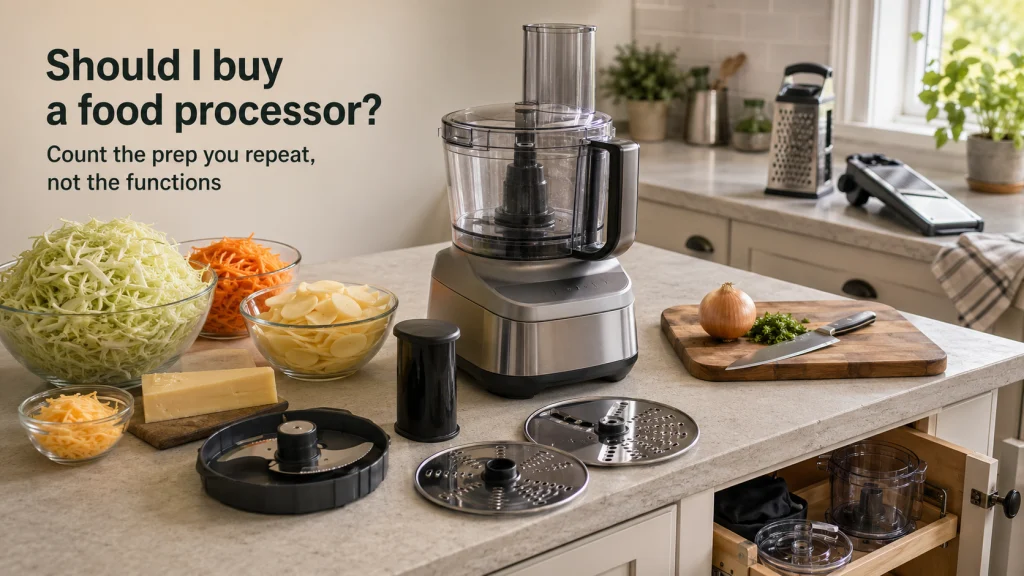
Should I buy a food processor? Start with net work saved
A food processor can wipe out a long stretch of repetitive slicing or shredding, then hand some of that time right back when you retrieve the base, lock on the bowl and lid, choose a blade or disc, and wash everything afterward. That contradiction is the useful starting point for deciding whether you should buy a food processor. The machine earns its place only when the work it removes from jobs you actually repeat is greater than the setup, cleanup, drying, storage, and purchase burden it adds. A long function list cannot answer that for you.
Think about the prep that regularly makes dinner feel slower than it should, not the recipes that merely mention a processor. A small onion, a few herbs, or an occasional sauce may be finished with a knife or compact tool before a full-size machine has paid back its setup. Repeated larger amounts of slicing, shredding, chopping, or mixing can change the balance because the saved hand work grows while much of the setup stays the same. The decision here is therefore whether the full-size format earns money and storage space at all, with capacity and model selection left for later. That buy-or-skip test is especially useful for small kitchen appliances, where a capable machine still needs to earn its storage space through repeated use.

The Cuisinart DFP-14BCNY has a 14-cup work bowl and 720-watt motor for full-size food prep. Its blade and two discs support mincing, shredding, pureeing, and dough work, and the listing identifies dishwasher-safe parts. The large bowl and disc-based functions make it a concrete fit for repeated prep that needs to remove substantial hand work.
Check On AmazonIf you click this link and buy, we earn a commission at no additional cost to you.
Count the prep jobs you already repeat
Start with your normal cooking pattern, not a list of impressive processor capabilities. Chopping vegetables, shredding cheese, slicing produce, making crumb mixtures, and processing larger batches of dips or spreads can all be legitimate uses, but only the recurring ones matter to this decision. A function used rarely has much less ownership value than a modest function that removes an annoying step from ordinary meals. The first useful test is therefore a repeated-prep audit based on what already happens in your kitchen.
| Prep job | What you do now | Typical quantity | What feels repetitive | Would a full processor remove real work? |
|---|---|---|---|---|
| Slicing vegetables | Knife or mandoline | Small, medium, or large | Repeated uniform cuts | Often, when quantity is substantial |
| Shredding cheese or vegetables | Box grater or handheld grater | Small, medium, or large | Repetitive grating motion | Often, especially for larger batches |
| Chopping onions or herbs | Knife or small chopper | Usually small | Fine chopping | Sometimes, but setup can erase the gain |
| Dips, spreads, or crumb mixtures | Blender, bowl, or hand method | Depends on the recipe | Repeated mixing or breaking down | Depends on texture and batch size |
Independent testing is also a useful reality check on which jobs deserve attention. Consumer Reports evaluates full-size food processors on tasks that include slicing, shredding, and grating instead of collapsing every capability into one vague versatility claim. That supports a practical distinction: repeated cut work deserves more weight than a long feature list that duplicates tools you already use comfortably. If your audit produces only rare or tiny jobs, waiting is already a reasonable outcome.

The OXO Good Grips Etched Box Grater is a four-sided grater with a removable zester and non-slip grip. The Amazon listing identifies it as dishwasher safe for routine cleanup. It gives the section a realistic manual benchmark for judging whether repeated shredding is substantial enough to justify a full-size processor.
Check On AmazonIf you click this link and buy, we earn a commission at no additional cost to you.
Give slicing and shredding extra weight when they are the real burden
Slicing and shredding can make a stronger ownership case than occasional chopping because the manual alternative often involves the same motion over and over. A knife can be pleasant and efficient for a few cuts, but a longer run of uniform slices asks for more handling and attention. A box grater works perfectly well for modest amounts, yet larger quantities make the repetitive motion more noticeable. Those are the situations where a disc-based processor function can change the workflow instead of merely changing the tool.
This does not mean slicing and shredding automatically justify a purchase. A mandoline may already handle thin slices with less equipment to wash, and a box grater may remain faster for the amount you normally prepare. The processor becomes more persuasive when you repeatedly need enough output that the manual method feels like a separate prep project. The point is not that powered cutting is automatically better, but that the machine has to remove enough repetitive work to justify becoming another full-size appliance.

The OXO Good Grips Handheld Mandoline offers adjustable slice settings at 1 mm, 2.5 mm, and 4 mm. It includes a food holder and is listed as dishwasher safe. Its compact slicing format makes it a useful lower-equipment comparison when uniform slices are the main burden.
Check On AmazonIf you click this link and buy, we earn a commission at no additional cost to you.
Small batches can erase the advantage
Quantity changes the calculation because the processor has a fixed amount of setup and washing whether the job is large or small. For a tiny amount of garlic, herbs, nuts, or vegetables, reaching for a knife or compact tool can finish the task before a full-size machine has earned its place on the counter. As quantity grows, the fixed setup becomes a smaller share of the total job. That is why the same household may reasonably use a processor for batch prep and skip it for ordinary small chopping.
| Step | What to count | What favors buying | What favors waiting or skipping |
|---|---|---|---|
| Retrieve | How easy the machine and parts are to reach | Accessible shelf or counter location | Heavy lift or awkward deep storage |
| Assemble | Bowl, lid, blade, disc, and feed parts needed | Routine feels simple | Job is too small to justify assembly |
| Process | How much repetitive hand work disappears | Large or repeated prep load | Only a few quick cuts are needed |
| Clean and dry | Parts that need washing, drying, and safe handling | Cleanup fits the normal kitchen routine | Cleanup feels larger than the prep job |
| Store | Base, bowl, lid, discs, blades, and accessories | Dedicated accessible space | Parts compete with frequently used equipment |
Use the worksheet on one or two meals you already make regularly. Do not estimate value from a special project you might try someday, because occasional ambition is a poor reason to give permanent cabinet space to a large appliance. If the processing step clearly removes the largest part of the prep burden, the machine has a real job. If retrieval, assembly, cleanup, and storage feel larger than the cutting itself, the full-size format is probably solving the wrong problem.

The Cuisinart Mini-Prep Plus DLC-2A uses a 3-cup work bowl and a reversible stainless-steel blade for small food-prep jobs. The listing specifically positions it for chopping herbs, vegetables, and hard cheese. Its compact capacity makes it a direct alternative to a full-size processor when batch size is the deciding factor.
Check On AmazonIf you click this link and buy, we earn a commission at no additional cost to you.
Compare the processor with the tools you already own
A food processor should be judged against your actual alternatives, not against doing everything by hand. A sharp knife, box grater, mandoline, blender, stand mixer, or small chopper may already cover much of the proposed workload with less storage or cleanup. The goal is not to prove that one tool can do everything the others do. It is to find the jobs where the processor changes effort enough to deserve an additional appliance.
- Knife: keep it as the baseline for small chopping, trimming, and jobs that already feel quick.
- Box grater: compare it directly with the quantity of cheese or vegetables you normally shred.
- Mandoline: count it as a serious alternative when uniform slicing is the main job.
- Blender: separate liquid-heavy blending from chopping, slicing, and shredding; see blender vs. food processor for that boundary.
- Stand mixer: do not count dough or mixing as processor-only value if your mixer already owns that work; compare the overlap in stand mixer vs. food processor.
- Small chopper: treat it as a lower-friction option for small powered chopping rather than a miniature replacement for every full-size function; the food chopper vs. food processor comparison is the better next step when compact powered chopping is the real need.
After the overlap check, cross out any processor function that merely duplicates a tool you already prefer. What remains is the machine’s true incremental value, and that list is usually shorter than the packaging suggests. If the remaining jobs are mainly slicing, shredding, or larger-volume processing, a full-size unit still has a clear role. If almost everything disappears from the list, the sensible decision may be to keep the tools you already own. That keeps the decision focused on unique work rather than feature count.
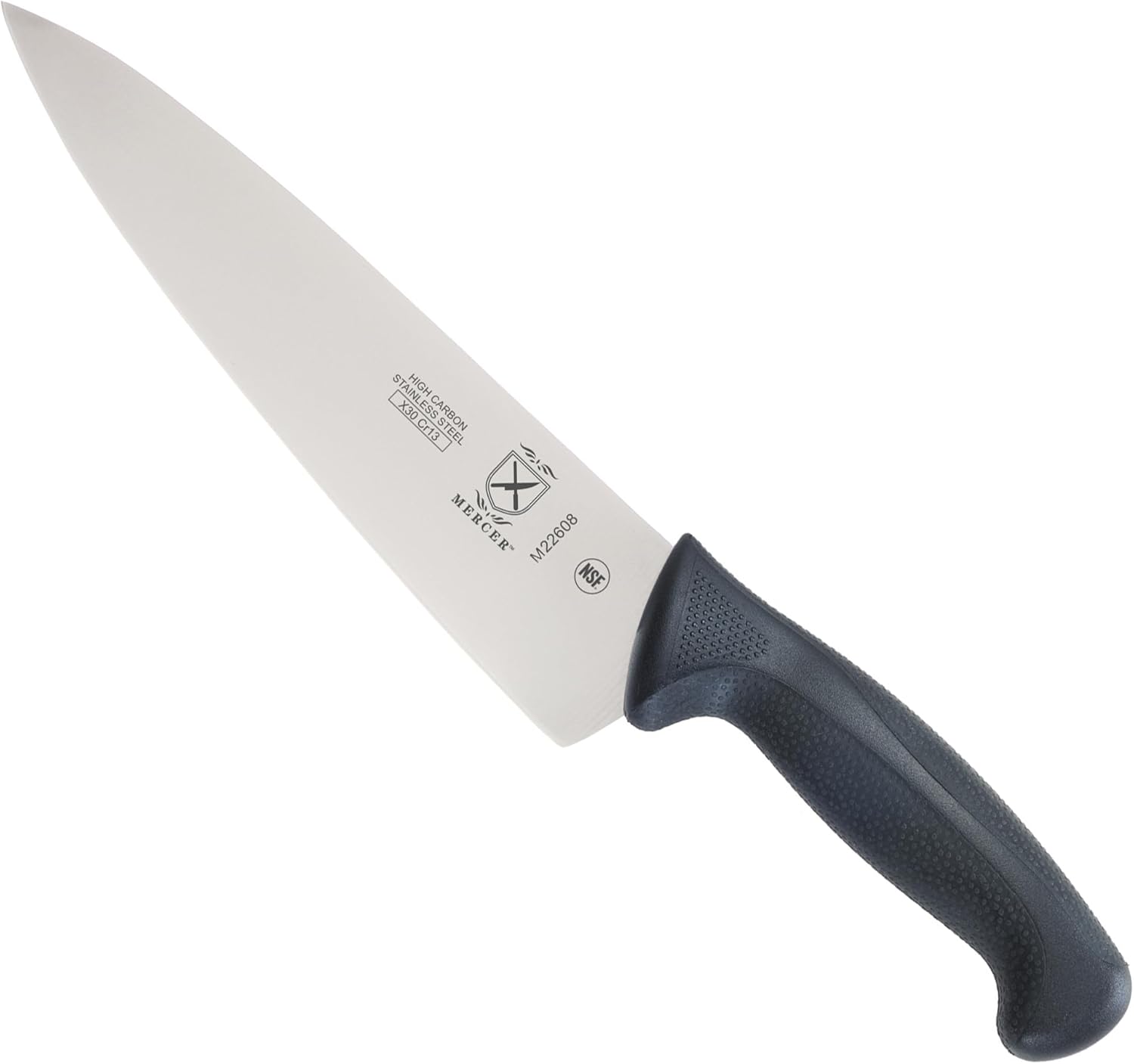
The Mercer Culinary M22608 is an 8-inch chef's knife made with one-piece high-carbon Japanese steel. Its black handle uses textured Santoprene for a slip-resistant grip and comfortable handling. The knife provides a capable manual baseline for small chopping and slicing jobs that may not justify processor setup and cleanup.
Check On AmazonIf you click this link and buy, we earn a commission at no additional cost to you.
Accessible storage matters more than theoretical storage
Finding a place where a processor technically fits is not the same as making it easy to use. A machine stored behind other appliances, on a difficult shelf, or with discs and blades scattered in another cabinet creates retrieval friction before prep begins. That friction matters most on ordinary meals, because those are the meals that must justify the purchase. A processor that only feels convenient when you have extra motivation is less valuable than one that fits the normal kitchen route.
Before buying, identify where the base, bowl, lid, feed parts, blades, discs, and any storage case will live. Check whether you can reach the main components without moving unrelated equipment, and think about where washed parts can dry before they go back. Counter storage can reduce retrieval work, but it spends permanent work surface instead of cabinet space. If storage is the uncertainty rather than usefulness, the broader food processor guide can help you separate ownership fit from the later size and feature decisions.

The HauSun Handy Sliding Tray is a countertop moving caddy designed for appliances including food processors, blenders, stand mixers, and coffee makers. It provides a sliding platform so an appliance can move forward for use and back for storage. That directly supports the section's focus on reducing retrieval friction for a processor kept on the counter.
Check On AmazonIf you click this link and buy, we earn a commission at no additional cost to you.
Count cleanup as part of the job, not an afterthought
A full-size processor turns one prep task into a short chain of equipment handling. The bowl, lid, blade or disc, feed components, and pusher may all need attention, and sharp parts require deliberate handling during washing and storage. Some households are comfortable folding those parts into the normal dish routine, while others will avoid the machine when the sink is already busy. Neither response is wrong, but pretending cleanup does not matter is a reliable way to overestimate how often the appliance will be used.
Read the exact model manual before buying if dishwasher placement, removable seals, blade handling, or assembly instructions could affect your routine. Do not use unsafe shortcuts to save washing effort, and do not assume a visually similar part is interchangeable with another model’s component. The useful question is whether normal, manual-compliant cleanup feels proportionate to the prep work the machine removes. If cleanup is your main objection and most jobs are small, that objection is a decision signal rather than a minor inconvenience.

The OXO Good Grips Soap Dispensing Dish Brush stores soap in its handle and releases it at the touch of a button. It also has a built-in scraper, durable nylon bristles, and a contoured non-slip grip. Those features make it a practical cleanup aid for processor bowls, lids, and other non-sharp washable parts.
Check On AmazonIf you click this link and buy, we earn a commission at no additional cost to you.
Only count replacement value when another job truly disappears
Versatility can reduce clutter, but only when the new appliance genuinely replaces work or equipment that would otherwise remain. A processor that can mix dough adds little replacement value if a stand mixer already handles every dough you make and you plan to keep it. A puree function does not replace a blender if you still need the blender for the textures and liquid-heavy jobs you prefer. The same logic applies to specialty discs and accessories that sound useful but do not remove a recurring task.
Make replacement value concrete by asking what you would actually stop using, storing, buying, or doing by hand after the purchase. If the answer is nothing, treat the processor as an additional appliance and make its purchase cost earn a return through work removed from ordinary prep, not through a longer list of possible functions. A lower-priced machine is not automatically better value if it still duplicates everything you own, while a more expensive purchase can make sense when it repeatedly replaces substantial hand work or another appliance you no longer need. Buying nothing remains the lowest-cost answer when your present tools already cover the work without much friction.

The Cuisinart DLC-8SY pairs an 11-cup capacity with a 625-watt motor and an extra-large feed tube. It is configured to chop, slice, shred, and puree and includes three discs, one blade, and two pushers. That broad task set makes it relevant to replacement value only when those recurring jobs would genuinely move to the processor.
Check On AmazonIf you click this link and buy, we earn a commission at no additional cost to you.
Is a food processor worth it? Use a buy, wait, or skip verdict
Turn the value question into a conditional verdict instead of looking for a universal yes. Buy when repeated prep is substantial, the processor’s strongest functions match that prep, accessible storage is available, cleanup fits the household routine, and the amount of work removed feels worth the money being spent. Wait when the jobs are real but irregular, storage is unresolved, the budget would crowd out equipment you need more, or you are still unsure whether a smaller tool already covers most of the work. Skip when the machine would mostly duplicate tools you like and the remaining jobs are too small or infrequent to repay its cost, setup, cleanup, and storage.
| Verdict | What your routine looks like | What to do next |
|---|---|---|
| Buy | Repeated medium-to-large prep, useful slicing or shredding, accessible storage, acceptable cleanup, and a purchase cost justified by work removed | Move on to capacity and current-model selection |
| Wait | Some useful jobs, but frequency, quantity, storage, tool overlap, or budget priority is still unclear | Track real prep and test the existing-tool workflow first |
| Skip | Mostly small jobs, heavy overlap with existing tools, awkward storage, cleanup larger than the benefit, or too little value for the spending | Keep the simpler tools that already solve the work |
Notice that none of these outcomes depends on a universal use-frequency rule. One demanding recurring prep job can justify more than several trivial ones, and one household may tolerate cleanup that another reasonably avoids. The decision also changes if space, physical handling, or the tool mix changes later. A wait or skip verdict is not a failure to buy; it is a successful decision when the appliance would not remove enough work.

The Hamilton Beach 70730 has a 10-cup bowl for slicing, shredding, mincing, and pureeing. Its listing includes an Easy Clean Bowl Scraper as part of the processor setup. The capacity and core functions make it a concrete buy-case example without assuming that the largest available bowl is necessary.
Check On AmazonIf you click this link and buy, we earn a commission at no additional cost to you.
If the answer is buy, separate size from model selection
Once the ownership threshold is clear, do not jump straight from “buy” to the first well-reviewed machine. Capacity affects usable batch size, footprint, weight, and storage, so it deserves its own decision before brand or feature comparisons. A household that needs repeated slicing and shredding may require a different bowl size from one that mainly processes larger mixtures. Work through food processor sizes before treating a larger bowl as an automatic upgrade.
After capacity and storage are settled, current recommendations become useful because you finally know what evidence matters for your household. Look for performance on your priority tasks, the included blade and disc set, controls, feed-tube design, cleaning requirements, accessory storage, and the physical dimensions you have already measured for. That is the right point to compare best food processors rather than using a ranking to decide whether you needed the appliance in the first place. The sequence keeps the buying decision tied to repeated work instead of letting features manufacture a need.

The Ninja Professional Plus BN601 uses a 9-cup bowl and a 1000-peak-watt motor with Auto-iQ preset programs. It supports chopping, slicing, pureeing, and dough mixing and includes a feed chute, pusher, and multiple blades. Those specifications make it useful for model selection after capacity and priority tasks have already been decided.
Check On AmazonIf you click this link and buy, we earn a commission at no additional cost to you.
Final thoughts: let repeated prep decide
A food processor is worth owning when it repeatedly removes more work than it creates. The strongest case usually comes from meaningful quantities, repetitive cutting or shredding, and a storage location that makes the machine easy to retrieve. Cleanup and accessory handling are part of the ownership cost, so they belong in the decision before purchase rather than after. If those conditions line up, the processor has a defined job instead of a vague promise of versatility.
If the audit points the other way, keep the knife, grater, mandoline, blender, mixer, or small chopper that already solves the work efficiently. Waiting also makes sense when you can name useful jobs but cannot yet show that they repeat enough to justify a full-size machine. The goal is not to own every useful kitchen appliance. It is to own the equipment that removes a real household burden often enough to earn its space.

The Cuisinart FP-8SV is an 8-cup food processor with a 350-watt motor and medium-to-fine slicing discs. Its capacity is smaller than the 9-, 10-, 11-, and 14-cup processors also evaluated for this article. It provides a concrete example of matching capacity to meaningful repeated prep instead of defaulting to the largest full-size machine.
Check On AmazonIf you click this link and buy, we earn a commission at no additional cost to you.
FAQs
🥕 Is a food processor worth it for small batches?
Often not if most jobs are genuinely small, because setup and washing can outweigh the prep saved. A knife or small chopper may be the better fit when the quantity does not make full-size slicing, shredding, or processing useful.
🥤 Do I need a food processor if I already have a blender?
Possibly, because a blender does not replace disc-based slicing or shredding and handles a different set of textures well. Buy only if those processor-specific jobs are part of your real routine rather than occasional possibilities.
🧼 Is food processor cleanup worth the effort?
It is worth it when the machine removes enough repetitive prep to make the bowl, lid, blade, and disc cleanup feel proportionate. Follow the exact model manual for cleaning and blade handling instead of using shortcuts.
📦 What if I have very little cabinet space?
Storage should be treated as part of the purchase decision, not a problem to solve afterward. If the base and accessories cannot live somewhere accessible, a smaller tool or no new appliance may be the more useful choice.
🔪 Should I buy a food chopper instead?
A small chopper can make more sense when powered chopping is the main need and quantities stay modest. A full-size processor becomes more defensible when slicing, shredding, or larger batch work is the reason for buying.
References and Sources
- Consumer Reports food processor buying guide: Supports the article’s use of slicing, shredding, grating, capacity, and storage as practical decision fields.