A microwave stand should be chosen around the exact microwave, not around the furniture label. The support surface has to fit the appliance, carry its weight on the correct shelf, preserve required ventilation, and leave a workable path to a suitable outlet. Fixed stands, rolling carts, and baker’s racks solve different space problems, so the useful choice is the one that fits the room and daily handling routine without creating new stability, cord, or cleanup problems.
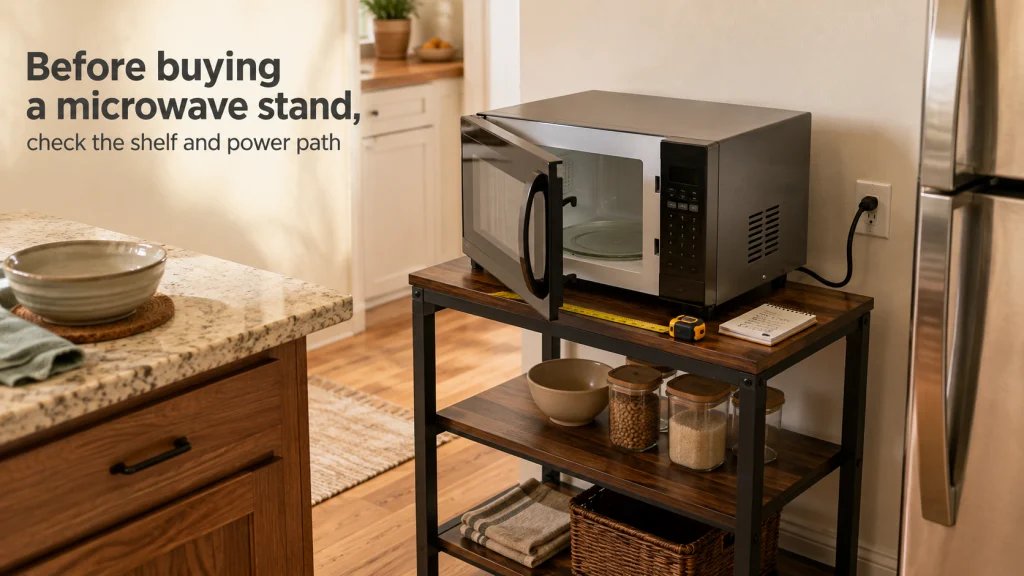
Measure the microwave before shopping for the stand
A microwave stand can look roomy in a listing photo and still be wrong for the appliance that needs to sit on it. Start with the microwave itself: outside width, depth, height, weight, feet, vents, door movement, and plug path. A shelf that is merely wider than the oven is not automatically usable if the feet sit near an edge, required airflow is blocked, or the cord has to cross a walkway. Appliance fit should come before finish, drawer count, or how neatly the furniture photographs.
This matters most in a tight kitchen, where the new furniture is supposed to recover useful counter space rather than trade one problem for another. A narrow stand may fit the floor but make the microwave door awkward, while a deep rack can intrude into the route between nearby appliances. The same logic applies to a microwave stand with storage: extra shelves help only when the microwave remains stable, ventilated, reachable, and easy to use. For the broader room-level decision, see household equipment storage and organization.

This STANLEY FATMAX tape measure has a 25-foot measuring range for checking appliance and room dimensions. Its portable case makes repeated width, depth, height, and footprint checks straightforward. The long tape is useful when the same measuring session needs to cover both the microwave and the surrounding kitchen space.
Check On AmazonIf you click this link and buy, we earn a commission at no additional cost to you.
Know which kind of support furniture you are actually choosing
This article covers freestanding floor furniture used to support a countertop microwave or another frequently used small appliance. That includes fixed microwave stands, rolling microwave carts, and open baker’s-rack style systems with a suitable appliance shelf. It does not cover wall brackets, countertop risers, built-in microwave cabinetry, or remodeling a cabinet opening around a countertop model. Those are different installation decisions with different structural and manufacturer requirements.
Retail labels overlap enough to make this boundary useful. A product may be called a kitchen cart, utility cabinet, baker’s rack, coffee station, microwave cart, or microwave oven stand even when the basic household job is similar. The name tells you where a retailer placed the item, not whether the microwave can operate there correctly. If you are still choosing the appliance itself, start with choosing a countertop microwave before selecting furniture around it.
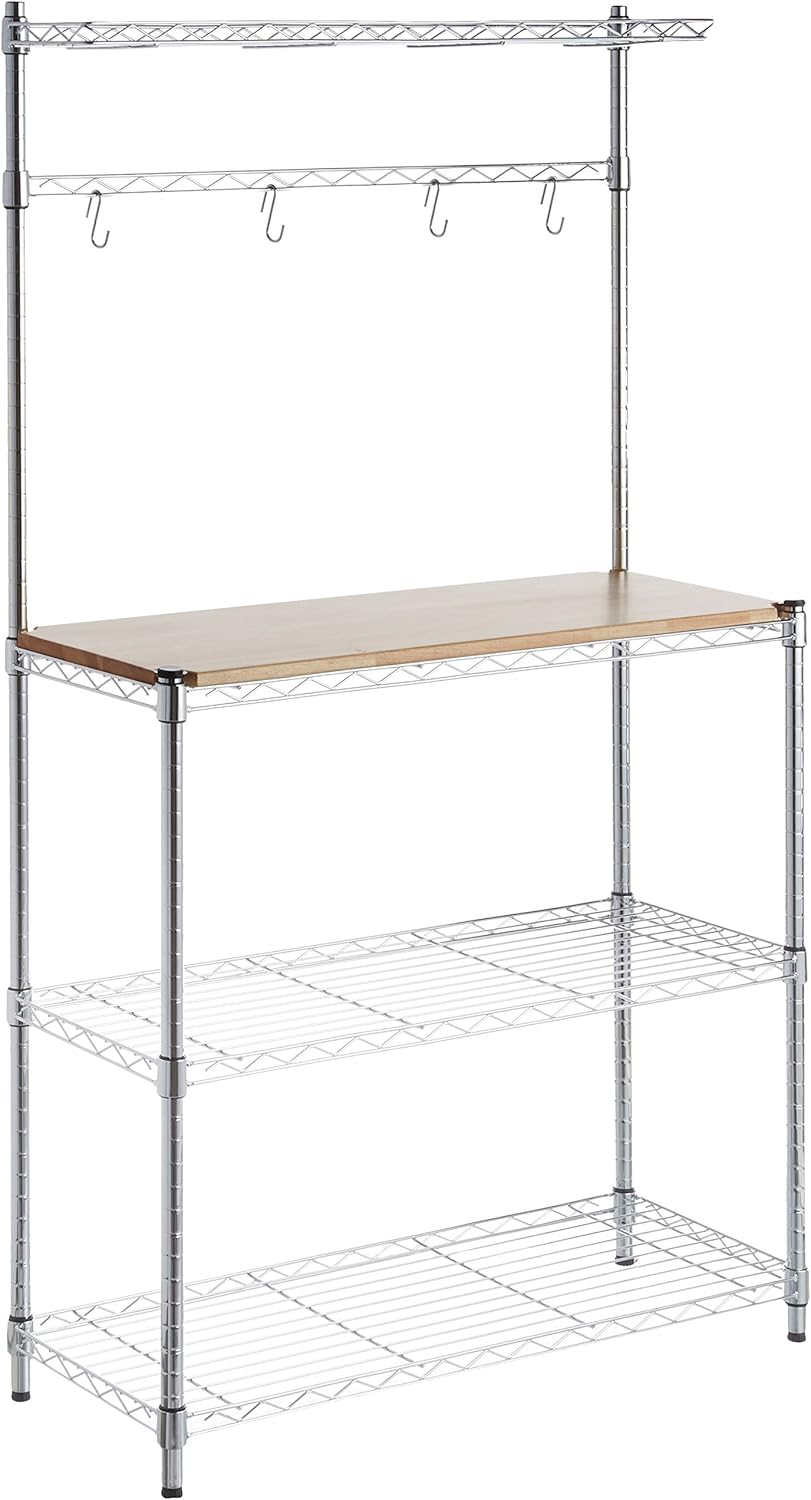
This Amazon Basics baker's rack combines two wire shelves, one wood shelf, a wire half shelf, a hanging bar, and four removable hooks. The shelves and bar adjust in 1-inch increments. Its published capacities separate the half shelf, wood-top shelf, wire shelves, and overall rack load.
Check On AmazonIf you click this link and buy, we earn a commission at no additional cost to you.
Record the appliance dimensions, weight, feet, and vent locations
The useful measurement is not the microwave’s advertised cooking capacity but the exterior geometry that has to coexist with the shelf. Record the full width, depth, height, and listed product weight from the exact model documentation, then note where the feet contact the surface and where intake and exhaust openings sit. The cabinet shell can appear to fit while a rear foot, side vent, or cord bend creates the real conflict. These details define the support profile before furniture dimensions enter the comparison.
Separate appliance depth from usable shelf depth as well. A shelf can be deep enough on paper yet still fail if the microwave must sit too far forward or a foot lands outside the support area. GE’s countertop guidance combines airflow clearance with a front-edge setback for its countertop models. Use that as a reminder to check the exact manual, not as a universal rule.
| Compatibility check | Appliance or manual value | Furniture value | Pass condition |
|---|---|---|---|
| Width | Exact microwave exterior width | Usable flat shelf width between frames, rails, or side panels | The appliance and its feet fit fully within the intended support area. |
| Depth | Exact microwave exterior depth plus any placement requirement from the manual | Usable flat shelf depth, not overall furniture depth | The microwave can sit in the required front-to-back position without a foot hanging off the shelf. |
| Height and clearance | Microwave height plus model-required top and side clearance | Clear vertical and side space around the microwave shelf | Upper shelves, posts, stored items, and walls do not intrude into required operating clearance. |
| Weight | Listed microwave product weight | Load rating for the exact supporting shelf | The shelf-specific rating meets or exceeds the appliance load without relying on total-unit capacity. |
| Feet and vents | Footprint contact points plus intake and exhaust locations | Flat support area and surrounding open space | All feet remain supported and no furniture part blocks a required vent path. |
| Power path | Plug type, cord direction, and exact model outlet instructions | Wall-outlet location and any furniture electrical feature | The microwave can follow its own power instructions without an extension-cord or power-strip workaround. |
Once these facts are written down, unsuitable furniture becomes much easier to reject. The aim is a support surface that fits the appliance and its operating requirements.

The FastCap ProCarpenter Standard Reverse tape provides a 16-foot measuring range in a compact hand tool. Its reverse-read format is designed so measurements can be read from either direction. It is suited to recording appliance dimensions and checking the usable shelf geometry around feet, vents, and cabinet edges.
Check On AmazonIf you click this link and buy, we earn a commission at no additional cost to you.
Verify the actual support shelf instead of trusting the furniture label
A furniture listing may publish overall width and depth while the microwave sits on a smaller inset shelf between side frames, rails, or upper supports. Measure the usable flat surface, not the outer frame. The appliance feet should remain on the intended support area, and the door should open without contacting a post or forcing the oven into an odd forward position. If the listing does not provide enough geometry to confirm that, the fit remains unknown.
Weight ratings need the same discipline. Retail pages often show total furniture capacity, but the controlling number for the microwave is the permitted load on the shelf that actually carries it. A large total can be divided across several shelves while one panel has a lower limit. Compare the microwave weight with the shelf-specific rating when one is provided, not with the whole-unit total.
Key point: The useful question is not “Is this sold as a microwave stand?” It is “Does the exact support shelf fit the appliance, support the load, and preserve the microwave maker’s placement rules?”
That distinction keeps a marketing category from becoming a compatibility claim. When shelf dimensions or ratings are missing, treat the missing evidence as a reason to keep looking rather than a detail to guess.

The Klein Tools 935RBLT is a 9-inch torpedo level with illuminated vials and a magnetic body. It includes vial positions for level, 45-degree, and 90-degree checks. The compact format makes it practical for checking whether an assembled appliance shelf is level before a microwave is loaded onto it.
Check On AmazonIf you click this link and buy, we earn a commission at no additional cost to you.
Choose fixed, rolling, or open-rack furniture from the household workflow
After fit is established, decide what the furniture needs to do during ordinary use. A fixed stand makes sense when the microwave will live in one location and the goal is dependable support plus nearby storage. A rolling cart earns its wheels when movement solves a real space or cleaning problem, while a baker’s rack makes sense when vertical open storage is valuable. Each architecture can work, but each adds a different handling and maintenance burden.
Do not pay for mobility or extra tiers merely because they look versatile. A cart may stay parked because of its cord, loaded weight, or floor transitions, while an open rack exposes more surfaces to dust and cooking residue. Choose the design that removes a real friction. If wheels are the deciding feature, continue with how to choose a microwave cart; if vertical storage is the goal, use how to choose a baker’s rack.
| Furniture type | Good fit when | Main check |
|---|---|---|
| Fixed stand | The microwave stays in one location. | Shelf fit, stability, access, and cleaning space. |
| Rolling cart | Movement solves a real room problem. | Caster locks, loaded stability, floor transitions, and cord handling. |
| Baker’s rack | Vertical open storage earns the extra height. | Frame stability, shelf geometry, ventilation, and cleanup. |
Architecture comes after compatibility because no furniture format can compensate for a shelf that does not support or ventilate the microwave correctly. Once the format is settled, the remaining comparisons become much more specific.

This Amazon Basics utility cart uses three recessed metal bins with mesh bottoms in a vertical rolling layout. Rubber caster wheels pivot for mobility, and the cart includes a curved push handle for steering. The three-tier format provides a concrete rolling-furniture option when mobility is part of the kitchen workflow.
Check On AmazonIf you click this link and buy, we earn a commission at no additional cost to you.
Map the floor footprint, door movement, and hot-dish path
A stand can fit the measured wall space and still be irritating in use. Check the full furniture depth against baseboards, refrigerator doors, dishwasher doors, drawers, and the walking route through the kitchen. Then picture the microwave door open and a hot bowl moving from the oven to the nearest stable landing surface. The clearance that matters is the one the household uses while cooking, not the empty rectangle available before the furniture arrives.
Height changes the handling path too, but there is no single correct shelf height for every household. Controls should be visible enough to use normally, and removing hot food should not require an awkward overhead or low reach. A tall rack may save floor area while making access worse, while a low cart can hide the controls. Judge height from the primary users and the actual dish path, not a staged photo.
- Mark the full furniture footprint at floor level, including feet or casters, and check whether baseboards change where the unit can actually sit.
- Open the microwave door, nearby cabinet doors, refrigerator door, dishwasher door, and drawers through their normal travel to see where movements overlap.
- Walk the normal kitchen route past the marked footprint and confirm that the stand does not create a pinch point when another door is open.
- Trace the hot-dish path from microwave cavity to the nearest stable landing surface and check that the user does not have to turn around an open door or cross a cord.
- Check control visibility and comfortable dish handling for the people who use the microwave most rather than copying a listing-photo shelf height.
This is where a compact kitchen microwave stand can prove too deep, too tall, or too intrusive. Good fit preserves circulation and handling space instead of simply moving the microwave off the counter.

This ScotchBlue pack contains three rolls of 1.88-inch-wide multi-surface painter's tape, each 60 yards long. The tape is made for temporary masking on multiple indoor and outdoor surfaces and is designed for clean removal. It can mark a proposed stand footprint on the floor while doors, drawers, and walking routes are checked.
Check On AmazonIf you click this link and buy, we earn a commission at no additional cost to you.
Treat ventilation as a microwave requirement, not a furniture feature
Open shelving is not automatically enough ventilation. The microwave still needs the clearances and unobstructed vent areas specified by its manufacturer. LG’s countertop guidance calls for a firm, level surface and published clearance around the oven, while GE publishes different countertop clearance guidance for its models. Panasonic also directs owners back to the exact model manual because spacing and vent arrangements can vary.
This matters when a rack has an upper shelf close above the microwave or side frames near an intake or exhaust area. The furniture can look open from the front while still crowding important airflow areas. Do not remove appliance feet, block vents, or push the oven against a panel just to make it fit. When guidance differs, the exact model instructions control the setup.
Warning: Do not turn a countertop microwave into an enclosed installation unless the exact model and manufacturer instructions explicitly support that configuration.
Put required clearance into the measurement sheet before furniture shopping. A shelf that fits the metal cabinet but not the operating clearance is not a compatible support surface.

The Komelon SL2825 is a 25-foot tape measure with a self-locking blade mechanism. Its measuring range is long enough for appliance clearances as well as nearby wall and furniture spacing. The self-locking format helps hold a measurement while top, side, and rear clearance dimensions are compared with the microwave manual.
Check On AmazonIf you click this link and buy, we earn a commission at no additional cost to you.
Treat the outlet and cord route as part of compatibility
The outlet belongs in the plan before the furniture is ordered because the power path can eliminate an otherwise attractive location. LG advises connecting a countertop microwave to a grounded wall socket and cautions against using a power bar, while Panasonic likewise tells owners to avoid extension cords or power strips in its placement guidance. Those examples show why furniture electrical features cannot override the microwave’s own instructions. The exact model manual remains the final check.
An outlet strip built into a baker’s rack may be useful for equipment the furniture maker allows, but its presence does not prove that the microwave should be powered through it. Verify the microwave’s grounding and outlet requirements, the furniture electrical rating, and the wall receptacle separately. Do not plan around daisy-chaining, extension cords, or a cord across a traffic path. If the location conflicts with the appliance’s power instructions, change the location or support arrangement.
Key point: An integrated rack outlet does not automatically equal microwave approval. Verify the microwave manual and the furniture electrical documentation separately.
A clean power path is not an optional finishing detail. It is one of the conditions that decides whether the furniture can support normal microwave use in that location.

The Klein Tools RT110 is a receptacle tester for 110/125V AC three-wire outlets. Its light sequence identifies correct wiring and several common receptacle wiring problems. The tester conforms to UL 1436 and is certified to CSA C22.2 No. 160.
Check On AmazonIf you click this link and buy, we earn a commission at no additional cost to you.
Decide whether rolling will actually mean mobile in your kitchen
Wheels are useful only when the cart can move under real loaded conditions and the movement fits the room. Check whether the casters lock, whether the floor has thresholds or uneven transitions, and whether there is enough room to turn the cart without striking cabinets or appliances. The cord must also be dealt with before movement, rather than treated as something that will somehow follow the cart. A microwave cart is not automatically a practical mobile workstation just because it has casters.
Many carts end up parked most of the time, which can be perfectly reasonable. Compare that reality with a fixed stand instead of paying for mobility you will rarely use. Small-kitchen discussions repeatedly return to counter space and outlet placement. If movement is occasional, weigh caster hardware against the stability and simplicity of a fixed setup.

This charcoal Amazon Basics cart has three recessed metal bins with mesh bottoms and a curved push handle. Pivoting rubber caster wheels provide the rolling function that defines the cart. Its mobile three-tier layout gives a practical way to judge whether a wheeled storage unit can actually maneuver through the intended kitchen path.
Check On AmazonIf you click this link and buy, we earn a commission at no additional cost to you.
Check leveling, frame stability, and required anti-tip hardware before loading
Support furniture is only as good as its assembled structure on the actual floor. Verify that the frame is square, fasteners are installed as directed, leveling feet or casters are adjusted correctly, and any required anti-tip or wall-restraint hardware is used. Do not assume that a wide base guarantees stability, especially when upper shelves carry additional heavy equipment. Tall open racks deserve extra attention because a meaningful part of the load may sit well above the microwave shelf.
Independent rack testing can reveal differences that dimensions alone do not show. TechGearLab evaluated assembly plus loaded and unloaded stability across several baker’s-rack designs and found meaningful differences between configurations. That supports treating caster design, frame rigidity, and assembly quality as real decision factors. If a stand rocks after assembly, correct the leveling or assembly issue according to its instructions rather than adding weight.

The QuakeHold 4162 kit uses nylon furniture straps and wall anchors to restrain compatible furniture. The straps are intended for items such as cabinets, shelves, bookcases, and dressers. It is a relevant safety accessory when a furniture manufacturer's instructions call for wall restraint or anti-tip hardware.
Check On AmazonIf you click this link and buy, we earn a commission at no additional cost to you.
Compare open shelves, drawers, and cabinets by access and cleanup
Storage type changes what the stand is like to live with after the first week. Open shelves keep frequently used items visible and easy to grab, but they expose more surfaces, cords, and equipment to dust and cooking residue. Drawers contain small accessories, while lower cabinets hide clutter but can make a heavy appliance less convenient to retrieve. None is automatically better; the useful choice depends on what must stay ready to use and what can tolerate slower access.
Prioritize the microwave’s support and access requirements first, then assign the remaining storage around that job. Cookware below the oven may be reasonable, while another heat-producing appliance beside it may complicate airflow and cords. More shelves are not free capacity if they increase instability or cleanup. Storage should organize equipment without changing the microwave’s operating conditions.
| Storage format | Main benefit | Ownership trade-off |
|---|---|---|
| Open shelves | Fast access and visibility. | More exposed surfaces to wipe. |
| Drawers | Contains small accessories. | Drawer travel needs clear standing space. |
| Lower cabinets | Hides less-used items. | Heavy equipment can be awkward to retrieve. |
Think of storage capacity as usable only when the load, access, airflow, and stability all remain acceptable. That keeps a high shelf count from becoming the only reason to choose a larger piece of furniture.

This GORILLA GRIP liner comes in a 12-inch by 20-foot roll for shelves, drawers, cabinets, and cupboards. The non-adhesive material can be trimmed to fit different storage surfaces. It adds a removable protective layer where stored accessories or cookware contact the furniture.
Check On AmazonIf you click this link and buy, we earn a commission at no additional cost to you.
Place frequently used heavy appliances where access is realistic
A microwave is an appliance from which people regularly remove hot containers, so access height belongs in the support decision. The shelf should let the primary users see the controls, open the door normally, and move a dish to a nearby counter or table with a stable motion. There is no responsible universal mounting height because user height, microwave size, and room layout vary. Use actual handling rather than a decorative rule.
The same reasoning applies to other heavy appliances stored on the unit. A rarely used machine may be acceptable on a lower shelf, while a frequently used heavy machine stored too low can make the system self-defeating. Keep recurring heavy tasks in the most practical access zone that still respects shelf ratings and appliance requirements. Storage should reduce handling.

A 165-foot green-beam laser distance measure designed for fast indoor and jobsite measurements. The bright green laser improves visibility compared with standard red beams, while the color display keeps readings easy to check. It supports straightforward distance measuring in a compact handheld format and provides a longer working range than the Bosch GLM100-23 it replaces.
Check On AmazonIf you click this link and buy, we earn a commission at no additional cost to you.
Count assembly, retightening, wipe-down, and floor access as ownership work
The stand creates its own maintenance routine. Flat-pack furniture needs correct assembly, and some designs may require periodic checks or retightening according to their instructions. Open frames expose more surfaces to dust and grease, while casters collect debris. Tall racks can also create shelves that are useful for storage but inconvenient to wipe.
Think about what must move when you clean around the microwave and whether routine cleaning tempts you to compromise its clearances. If the oven must be shifted, handle it only as its manual allows and never treat hot or operating equipment casually. A simpler stand can beat a more elaborate one when wheels, upper hooks, extra outlets, or several tiers do not solve a recurring need. Features that add assembly points and cleaning surfaces should earn their place through actual use.

This MR.SIGA pack includes 24 reusable microfiber cleaning cloths for household surfaces. The cloths are color coded and sized for routine wiping tasks around kitchens and other rooms. The reusable microfiber format fits the recurring shelf, frame, and nearby-surface cleanup that open appliance storage creates.
Check On AmazonIf you click this link and buy, we earn a commission at no additional cost to you.
Know when a freestanding microwave stand is the wrong architecture
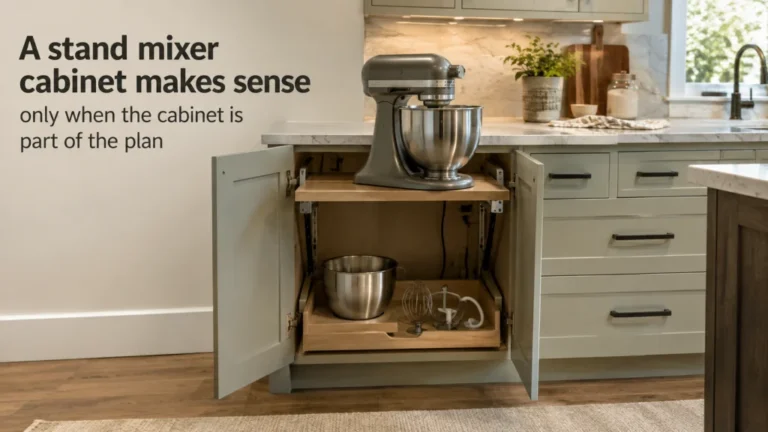
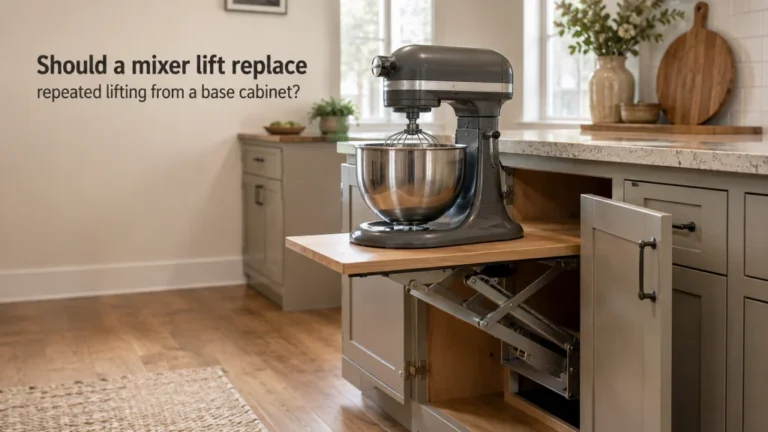
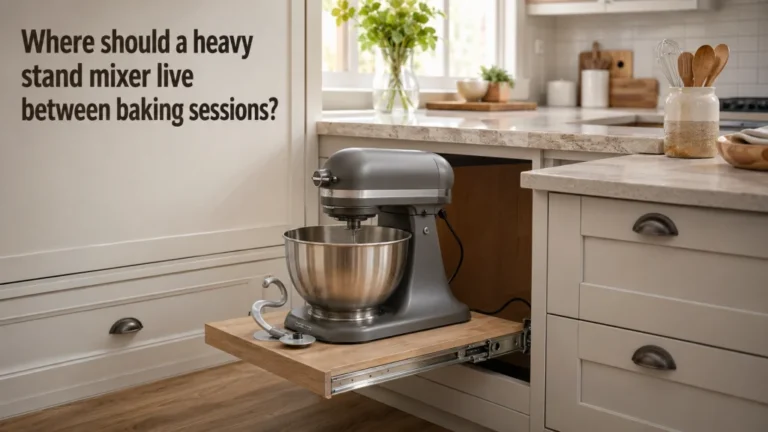
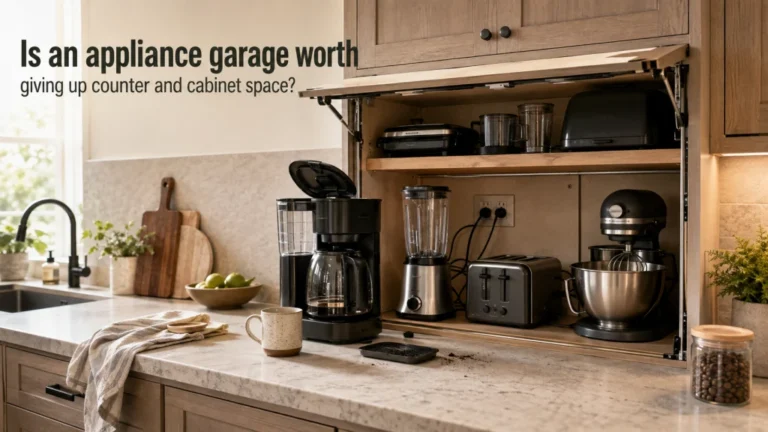
A freestanding stand is not the answer to every appliance-storage problem. If the real goal is enclosed countertop-height storage, an appliance-garage approach is a different furniture and ventilation decision. If the difficult item is a stand mixer that needs a lift or pull-out mechanism, that belongs to stand-mixer-specific storage rather than a microwave support system. If the real question is microwave size or type, solve that appliance decision before buying furniture around it.
It is also reasonable to skip the stand if the room has no floor footprint that preserves circulation and outlet access. Recovering counter space is not a win if a rack blocks a door, narrows a walkway, or forces a poor power route. In a very small room, a smaller appliance or different placement may solve more than another piece of furniture. For the broader scope, household utility and organization topics stay focused on systems that support appliance use.

A heavy-duty cabinet appliance lift designed for stand mixers and other bulky kitchen appliances. It uses a spring-assisted mechanism with soft-close dampening and a locking system to make raising and lowering stored appliances easier and more controlled. The lift mounts inside a full-height base cabinet and is intended to free countertop space while keeping heavier appliances accessible.
Check On AmazonIf you click this link and buy, we earn a commission at no additional cost to you.
Use current product pages only after the support profile is complete
Product browsing becomes useful after you can describe the required support profile without referring to a style photo. Know the minimum usable shelf dimensions, microwave weight, required clearances, outlet location, acceptable furniture footprint, preferred fixed or rolling format, and whether open storage is a benefit or a burden. That turns a broad furniture category into a compatibility screen. It also prevents a finish or storage feature from hiding a basic fit failure.
Current listings can then help compare dimensions, shelf layouts, materials, casters, doors, and published capacities, but each field still needs to be read at the level that matters. A “microwave shelf” filter narrows the catalog without proving compatibility, and an integrated outlet does not change the microwave maker’s instructions. Use listings to identify candidates, then verify the furniture documentation. After that, use current microwave stand comparisons or current baker’s rack comparisons.

This Amazon Basics kitchen rack has a wood top, two chrome shelves, and four caster wheels, two of which lock. Each chrome shelf is rated for up to 50 pounds, and the complete unit has a published 175-pound total capacity. The shelf height adjusts in 1-inch increments for different storage layouts.
Check On AmazonIf you click this link and buy, we earn a commission at no additional cost to you.
Final Thoughts: buy the support system for the appliance and room
The strongest microwave-stand decision starts with the appliance and ends with the household workflow. Verify the real support surface, shelf-specific load, required ventilation, outlet path, floor footprint, access height, stability hardware, and cleanup burden before treating storage count or style as decisive. If one of those checks fails, the furniture label does not rescue the setup. Compatibility comes from evidence.
A good stand should make the microwave easier to live with without creating a new problem around heat, cords, movement, or handling. Choose fixed furniture when mobility has little value, a cart when movement genuinely solves the room problem, and an open rack when vertical storage is worth the extra exposure and stability checks. When the exact microwave manual conflicts with the preferred layout, change the layout rather than trying to make the warning disappear. That is the point where a practical support system separates itself from furniture that merely looks suitable.

This SUPERJARE baker's rack uses a four-tier open storage layout in a rustic-brown finish. The listing includes six S-shaped hooks and an integrated power outlet as furniture features. Its vertical rack format combines a main appliance area with additional open storage for kitchen items.
Check On AmazonIf you click this link and buy, we earn a commission at no additional cost to you.
Continue with the microwave stand decision you still need to resolve
Once the appliance, room, and power path are defined, the remaining question is usually furniture architecture or current shopping. A wheeled cart still needs a mobility decision, while an open rack still needs a geometry and stability decision. If the furniture type is already settled, the current-shopping pages are the next useful step rather than another broad storage search. Use the article that matches the unresolved decision so the measurements and compatibility work you already completed stay in control.
| Topic | What you’ll find |
|---|---|
| Microwave carts | How to judge casters, loaded stability, cord reach, and real mobility. |
| Baker’s racks | How to judge open vertical storage, rack geometry, stability, and appliance shelf space. |
| Best microwave stands | Current stand options to compare after dimensions, load, clearance, and room fit are known. |
| Best baker’s racks | Current open-rack options after the vertical rack format has already been chosen. |
The useful next step is the narrowest one because each article assumes a different decision has already been made. Choose the cart route only when mobility still matters, and choose the baker’s-rack route only when vertical open storage is already the preferred format. Move to a current comparison only after the shelf, load, ventilation, outlet, and room-fit checks are settled. That sequence keeps a good-looking product from reopening a compatibility question that should already be closed.

The Whitmor Supreme Baker's Rack uses a chrome open-frame design with vertical wire shelving. It includes a removable wood cutting board described as food safe. The combination of open shelves and a removable work surface makes it a concrete baker's-rack format to compare after the room and appliance requirements are already defined.
Check On AmazonIf you click this link and buy, we earn a commission at no additional cost to you.
FAQs
📏 How do I know if my microwave will fit on a stand?
Compare the microwave’s exterior dimensions and foot placement with the usable shelf, then add the clearances required by its manual. Do not rely on overall furniture width alone.
⚖️ Can I use the stand’s total weight capacity for the microwave shelf?
Not unless the manufacturer states that the total figure also applies to that individual shelf. When a shelf-specific rating exists, compare the microwave weight with that rating instead.
🔌 Can I plug a microwave into the power strip built into a baker’s rack?
Do not assume so. Check the microwave’s power and grounding instructions and the furniture electrical documentation separately.
🛞 Is a rolling microwave cart better than a fixed stand?
Only when movement solves a real space or cleaning problem. If the cart will remain parked because of cord reach, loaded weight, or floor transitions, a fixed stand may be simpler.
🌬️ Does an open baker’s rack provide enough microwave ventilation?
Only if the exact required clearances and vent locations remain unobstructed. Upper shelves, side frames, walls, and stored items can still crowd the airflow path.
🍲 How high should a microwave sit on a stand?
Use a height that lets the primary users see the controls and remove hot dishes with a stable motion while maintaining required clearances. There is no single shelf height that fits every household.
References and Sources
- LG countertop microwave installation: Supports the firm-surface, ventilation-clearance, grounded-outlet, and power-bar cautions used in the placement checks.
- GE countertop microwave air clearance: Supports the clearance, front-edge placement, foot, and enclosed-space examples.
- Panasonic microwave placement guidance: Supports the model-specific ventilation, sturdy-surface, accessibility, and outlet checks.
- Home Depot microwave cart category: Supports the current retail distinction for carts and common furniture specification fields.
- Home Depot baker’s rack category: Supports the current open-rack category and microwave-shelf, material, shelf, and capacity fields.
- TechGearLab baker’s rack testing: Supports the discussion of assembly and loaded and unloaded stability differences.