Home storage and organization works better when the storage system is chosen for the job it must perform, not for how many bins, shelves, drawers, or compartments it offers. For household equipment, the useful question is whether something needs stable support, concealment, easier access, transport, sorting, a work surface, appliance elevation, or vertical storage. The right setup should reduce repeated handling without creating a larger footprint, awkward reach, blocked controls, or compatibility problems. This page focuses only on storage and utility systems that directly affect how household equipment is stored, moved, accessed, or used.
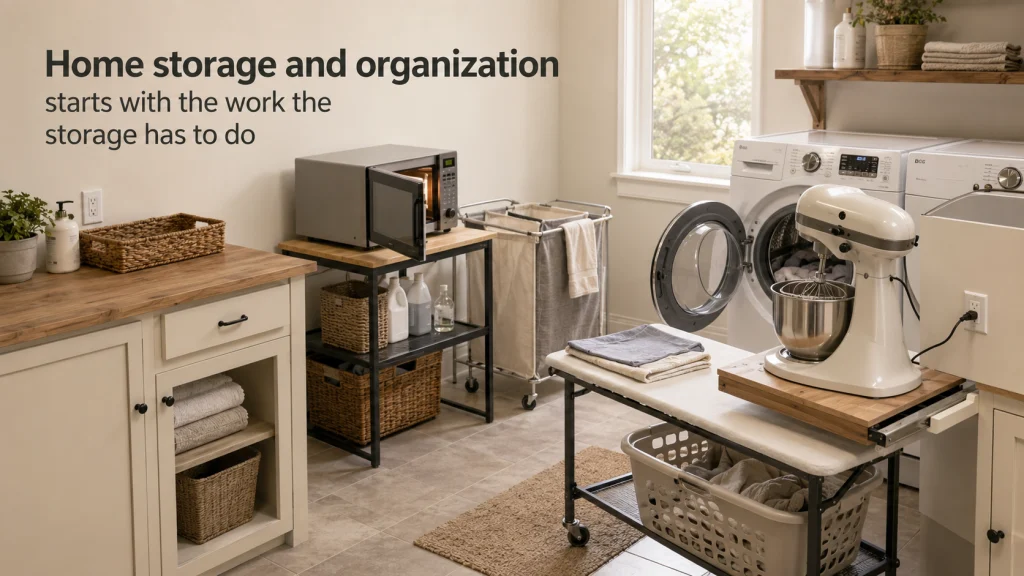
Buying storage before defining the job creates more storage to manage
Home storage and organization can go wrong in a familiar way: a crowded counter or laundry corner gets another bin, shelf, or cart before anyone defines the failing step. The new piece may hold more, yet the mixer is still hard to lift or the hamper is still awkward to carry. Capacity increased, but the task did not improve. The organizer simply became another object that needs space.
Start by asking what the stored item must do between uses. Does it stay put, move, lift into position, remain accessible, separate a load, or create a work surface? Those answers narrow the choice faster than shopping by room or compartment count. They also make it easier to skip home organization products that solve the wrong problem.

This CRAFTSMAN tape measure has a 25-foot retractable blade with fraction markings. Its self-locking blade is designed to stay extended during measurement. It gives the reader a simple way to record appliance, opening, and room dimensions before choosing a storage system.
Check On AmazonIf you click this link and buy, we earn a commission at no additional cost to you.
The useful scope here is equipment-centered storage
The general storage market is much broader than the part that matters on Home Appliance Logic. This page is not a complete system for closets, pantry food containers, toy rooms, bathroom decor, bedroom storage, garage tools, or whole-home decluttering. It focuses on storage that changes the use of household equipment or a repeated equipment-related workflow. That boundary keeps the decision practical instead of turning every household object into an organization project.
Within that boundary, home storage solutions include support furniture for kitchen appliances, countertop concealment, heavy-appliance access systems, laundry collection and sorting, laundry work surfaces, appliance pedestals and stacking accessories, and storage above washers or dryers. These systems may look unrelated in a store, but they all change movement, access, clearance, or workflow around equipment. The important distinction is not which room they belong to. It is which physical job the system must perform without making the next step harder.

This three-tier utility cart uses recessed storage bins with mesh bottoms. Rubber caster wheels let the cart move between work areas, and the wheels can lock for stationary use. Its mobile layout fits an equipment-centered storage workflow because it combines containment with a defined movement and access function.
Check On AmazonIf you click this link and buy, we earn a commission at no additional cost to you.
Diagnose the storage job before choosing a product type
A storage problem is easier to solve when it becomes a physical job. A microwave needing a stable working height is different from a mixer that must rise from a low cabinet. A basket carried between floors is different from a sorter parked beside the washer. Equipment, route, and frequency determine which setup makes sense.
Before comparing features, follow the item through one normal use cycle. Note where it starts, how it is reached, whether it moves, where work happens, and what must be reset afterward. Repeated lifting, blocked doors, extra trips, and temporary piles point to a specific failure. That is more useful than deciding the room simply needs more storage.
Support an appliance at a usable location
Some equipment simply needs a stable place where it can stay ready for use. Support area, height, clearance, control access, and cord routing matter more than extra shelves. More storage is not better if it pushes the appliance into an awkward position.
Conceal equipment without making access worse
Concealment helps only when the appliance remains easy to reach and use. Doors, panels, trays, and cabinet depth can reduce visual clutter or add setup work. Count the actions between storage and operation, especially when the appliance must move forward before use.
Move or carry items between stages
Mobility problems are about route and load, not just capacity. A basket needs manageable handling for stairs, while a cart needs a clear path through doors and corners. Wheels add little when thresholds, rugs, or floor changes interrupt that path.
Pre-sort a repeated workflow
Sorting systems earn their footprint when they remove a frequent step. Extra laundry compartments do little when the household combines those loads anyway. The right number and size of divisions should follow the actual wash routine.
Add a folding or staging surface
A work surface can matter more than another cabinet when the repeated problem is where laundry or baskets go during the task. It should not block appliance doors, controls, or walking space. Occasional work may justify a fold-down or movable surface instead of a permanent table.
Raise or vertically stack compatible appliances
Elevation and stacking are equipment decisions before they are storage decisions. A pedestal changes loading height, while stacking changes the appliance arrangement itself. Exact compatibility and installation requirements must be settled before counting any storage benefit.
Use vertical space above an appliance
Wall area above laundry equipment may hold shelves or cabinets, but empty space is not automatically usable space. Lids, doors, controls, connections, reach height, and service access can claim part of it. Measure the operating space, not just the blank wall.

This DTK cart has three metal mesh trays, a removable tabletop, and a side storage bag. Four swivel wheels support movement, with two lockable casters for parking the cart. Its layout is useful for comparing how route, load, access, and parking space affect a repeated storage workflow.
Check On AmazonIf you click this link and buy, we earn a commission at no additional cost to you.
Price storage in space as well as money
The purchase price is only one cost of a storage system. A rack consumes floor area, an appliance garage uses cabinet or counter volume, and a deep shelf can make part of its capacity hard to reach. Larger systems can also add weight and cleaning surfaces. Ask whether the system earns the space it occupies every day.
This matters most in compact kitchens and laundry areas. A cart may add staging space but narrow the walking path, while a tall cabinet may put frequent items above comfortable reach. Countertop concealment may consume depth needed for other work. Compare those tradeoffs before a storage improvement simply moves the inconvenience elsewhere.
| Space being used | What it can solve | What to verify first |
|---|---|---|
| Floor space | Support, rolling storage, sorting, staging | Walking path, door swing, route, footprint |
| Counter space | Access, concealment, temporary work | Depth, operating clearance, work surface |
| Cabinet volume | Concealment, protected storage, heavy equipment | Opening, retrieval path, support, compatibility |
| Vertical space | Overhead storage, stacking, elevation | Reach, operation, door travel, service access |
A useful comparison treats the space column like part of the price tag. If the system saves one repeated step while creating two new obstacles, the extra storage is not really free. Measure the footprint and operating envelope in the room before treating listed capacity as a benefit. The goal is usable access, not the largest amount of material that can be fitted into a corner.

A 165-foot green-beam laser distance measure designed for fast indoor and jobsite measurements. The bright green laser improves visibility compared with standard red beams, while the color display keeps readings easy to check. It supports straightforward distance measuring in a compact handheld format and provides a longer working range than the Bosch GLM100-23 it replaces.
Check On AmazonIf you click this link and buy, we earn a commission at no additional cost to you.
Use microwave support furniture when the problem is location and work height
A microwave stand, cart, or baker’s rack belongs in the decision when the appliance needs a stable home outside the existing counter layout. The main problem is usually support plus access: the appliance needs enough surface area, a comfortable operating position, and clearance that does not conflict with doors, nearby walls, or the household traffic path. Extra shelving can be useful for related equipment or supplies, but it should not be the reason to accept an awkward microwave position. The appliance must work first as an appliance, not as an excuse to buy more shelves.
The choice between a stationary stand and a movable cart also depends on whether movement is genuinely part of the routine. A cart that never moves should be judged mainly as furniture, while a cart that moves needs a clear route, stable casters, and a plan for the cord before and after movement. If this is the unresolved job, the detailed comparison belongs with microwave stands, carts, and baker’s racks. That keeps the decision centered on support, usable location, clearance, and ownership fit rather than generic kitchen organization.

The Hodedah cart provides an open center shelf for a microwave, with additional storage above and below. It also includes a drawer and an enclosed cabinet for related kitchen items. The dedicated appliance shelf gives a microwave a defined support location while keeping routine access separate from general storage capacity.
Check On AmazonIf you click this link and buy, we earn a commission at no additional cost to you.
Use an appliance garage when concealment must preserve countertop access
An appliance garage addresses a different problem: equipment already belongs near the counter, but the household wants it visually contained between uses. The key tradeoff is whether the enclosure allows fast retrieval and enough usable space for the exact appliance. A door or panel can make a counter look calmer while adding a movement that becomes annoying several times a day. Concealment is valuable only when the stored position and the practical use position work together.
Depth, opening shape, door mechanism, nearby outlets, and the appliance’s operating needs can all matter more than the nominal interior volume. A generous cabinet cavity is not useful if the opening pinches access or the appliance must be removed completely before every use. For that specific decision, see appliance garage storage and access. The deeper question is not how much can be hidden, but how little extra handling the hiding system creates.

This appliance slider expands from 6 by 11 inches to 11 by 20 inches to accommodate different countertop footprints. Its rolling platform is designed to move countertop appliances forward and back, and locking brakes help hold the tray in place. That movement supports concealment setups where the stored appliance needs easier access without being lifted for every use.
Check On AmazonIf you click this link and buy, we earn a commission at no additional cost to you.
Treat heavy stand-mixer storage as an access problem, not a hiding problem
A heavy countertop appliance can fit neatly in a lower cabinet and still be stored badly if lifting it discourages use. For stand mixers, the important path is from stored position to working position and back again. Cabinet height, shelf access, lift hardware, counter landing space, and the user’s comfortable handling range all affect whether the setup reduces effort. Hiding the mixer is secondary if retrieval remains the step everyone avoids.
Some households may prefer a permanent counter position, while others need a cabinet solution because counter space is scarce. A lift or specialized cabinet arrangement only makes sense when its exact hardware, appliance fit, load requirements, and installation conditions are verified. The detailed decision path is covered in how to store a stand mixer. The right solution is the one that removes the repeated lifting or access problem without creating a larger clearance or cabinet problem.

The Rev-A-Shelf RAS-ML-HDCR is a spring-loaded lift for small countertop appliances in kitchen base cabinets. The listing specifies a minimum cabinet opening width of 12 inches. It directly addresses the mixer section's access problem by moving the appliance between stored and working positions, while cabinet opening and appliance fit still need verification before installation.
Check On AmazonIf you click this link and buy, we earn a commission at no additional cost to you.
Use hampers, baskets, and sorters when collection or pre-sorting is the failing step
Laundry storage starts before the washer, and the first question is whether clothing needs to be collected, carried, or separated before washing. A hamper that stays in one room has a different job from a basket that travels between floors. A sorter adds value only when its compartments match the way loads are actually divided. Choosing by total capacity alone can miss the part that affects the routine most.
Handle position, loaded size, stair clearance, compartment balance, ventilation needs, and where the container waits between loads can all change the decision. A very large basket may reduce trips but become awkward when full, while a multi-section sorter may occupy more floor space than the sorting step justifies. If the recurring friction happens before washing, use the laundry hamper, basket, and sorter decision framework. That separates transport and sorting needs from the storage questions that happen around the washer and dryer.
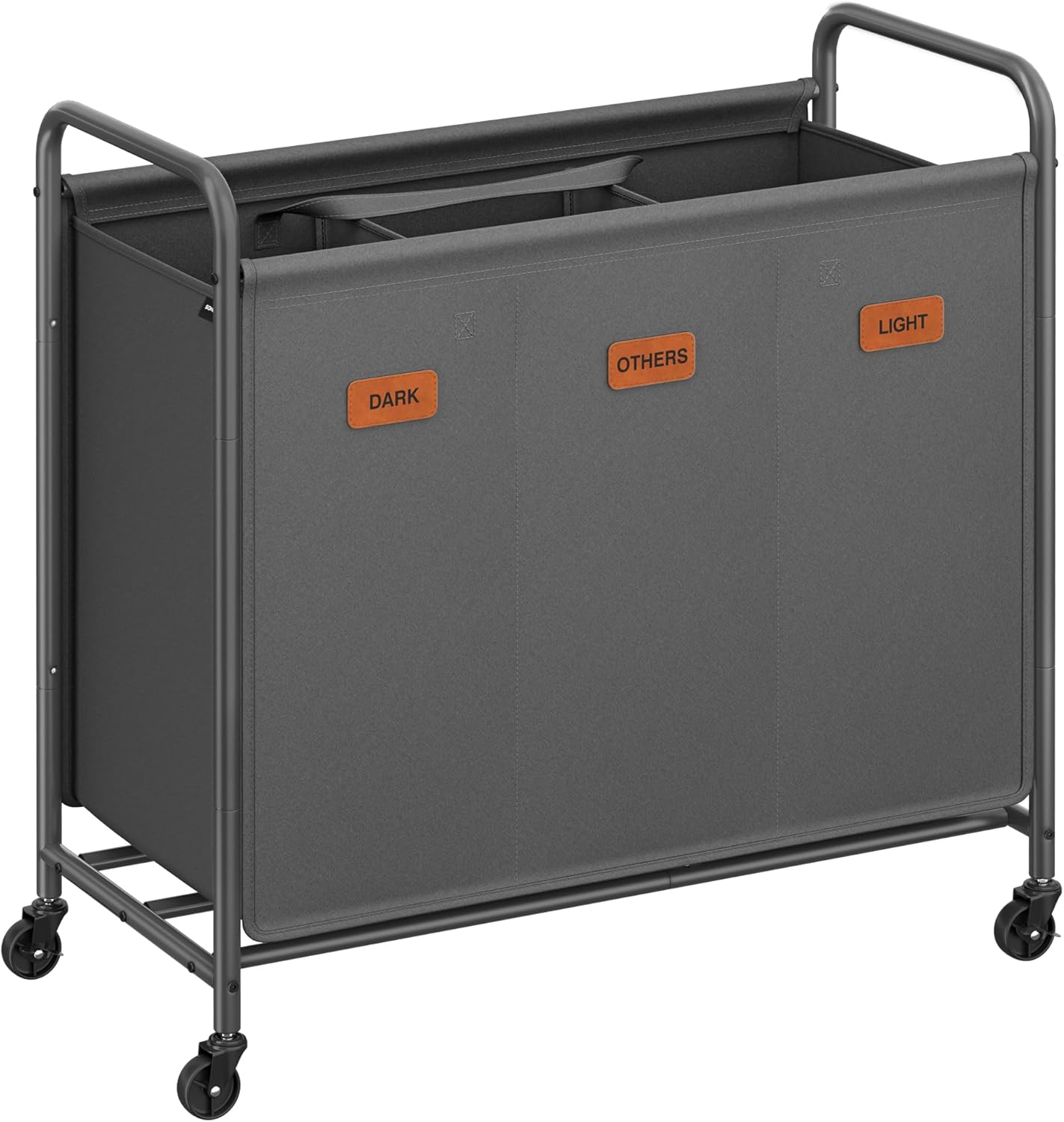
This SONGMICS sorter separates laundry into three sections before washing. Removable bags let individual loads be lifted out, while the wheeled frame supports movement within the laundry area. The combination of sorting and mobility matches a section that distinguishes collection, carrying, and pre-sorting as different parts of the laundry workflow.
Check On AmazonIf you click this link and buy, we earn a commission at no additional cost to you.
Use a laundry station when movement, folding, or staging breaks the workflow
After washing, the storage problem often changes from collection to movement and temporary work. Clean clothing needs somewhere to land, folding needs a surface, hang-dry items need a short-term place, and baskets may need to move between the machines and another room. A laundry station, rolling cart, or folding surface can connect those steps when the room otherwise forces repeated trips or floor piles. The best setup follows the sequence of the chore instead of maximizing shelves.
A permanent table makes sense only if the room can afford its footprint and the surface will be used often. A rolling cart needs a realistic parking place when it is not moving, and a fold-down surface needs clear space to open without blocking equipment or passage. For that workflow, the more focused comparison is laundry stations, rolling carts, and folding surfaces. This is where storage becomes useful because it supports the work being done rather than merely containing supplies.

This wall-mounted folding table provides a 47-inch by 20.5-inch work surface for folding or staging laundry. Its fold-down design lets the surface close against the wall when the workspace is not needed. That makes it relevant where the repeated problem is temporary work space rather than a need for another permanent cabinet or floor-standing table.
Check On AmazonIf you click this link and buy, we earn a commission at no additional cost to you.
Use pedestals and stacking accessories only after appliance compatibility is settled
Pedestals and stacking accessories look like space tools, but they interact directly with the appliance installation. A pedestal can raise a front-loading machine and may provide storage below, while a stacking kit changes two machines from side-by-side equipment into a vertical pair. Those benefits are meaningful only when the exact washer, dryer, accessory, and installation combination is approved for one another. Similar width or appearance is not enough evidence of compatibility.
This is also where generic organization advice should stop. Connections, venting, door access, controls, service clearance, and manufacturer installation rules can all affect whether a proposed arrangement is workable. The detailed fit questions belong in laundry pedestal and washer-dryer stacking decisions. Storage gained from a drawer or vertical layout is a secondary benefit after the appliance system itself is correctly configured.

This white metal laundry pedestal is 16 inches high and 28 inches wide, with a listed 440-pound load capacity. It includes a storage drawer and anti-vibration mats for the supported appliance. Because pedestal fit is model- and installation-dependent, the appliance footprint and manufacturer installation requirements should be verified before treating the listed universal size as compatible.
Check On AmazonIf you click this link and buy, we earn a commission at no additional cost to you.
Use over-washer and dryer storage when the wall area is truly usable
Shelves and cabinets above laundry equipment can reclaim vertical space without adding another object to the floor, which makes them appealing in tight rooms. The catch is that visible wall area and usable wall area are not the same thing. Top-loading lids, front controls, doors, hoses, valves, outlets, and the need to reach behind equipment can consume part of the space that looks empty. Reach height also determines whether a shelf becomes everyday storage or a place for items that are rarely touched.
The system should be planned from the appliances outward rather than from the wall inward. Measure the equipment’s operating envelope, identify what needs routine access, and keep service or utility access available where required. If this is the unresolved problem, continue with over-washer and dryer storage, shelves, and cabinets. Vertical storage works best when it uses genuinely spare space without stealing the clearance needed to operate or maintain the appliances.
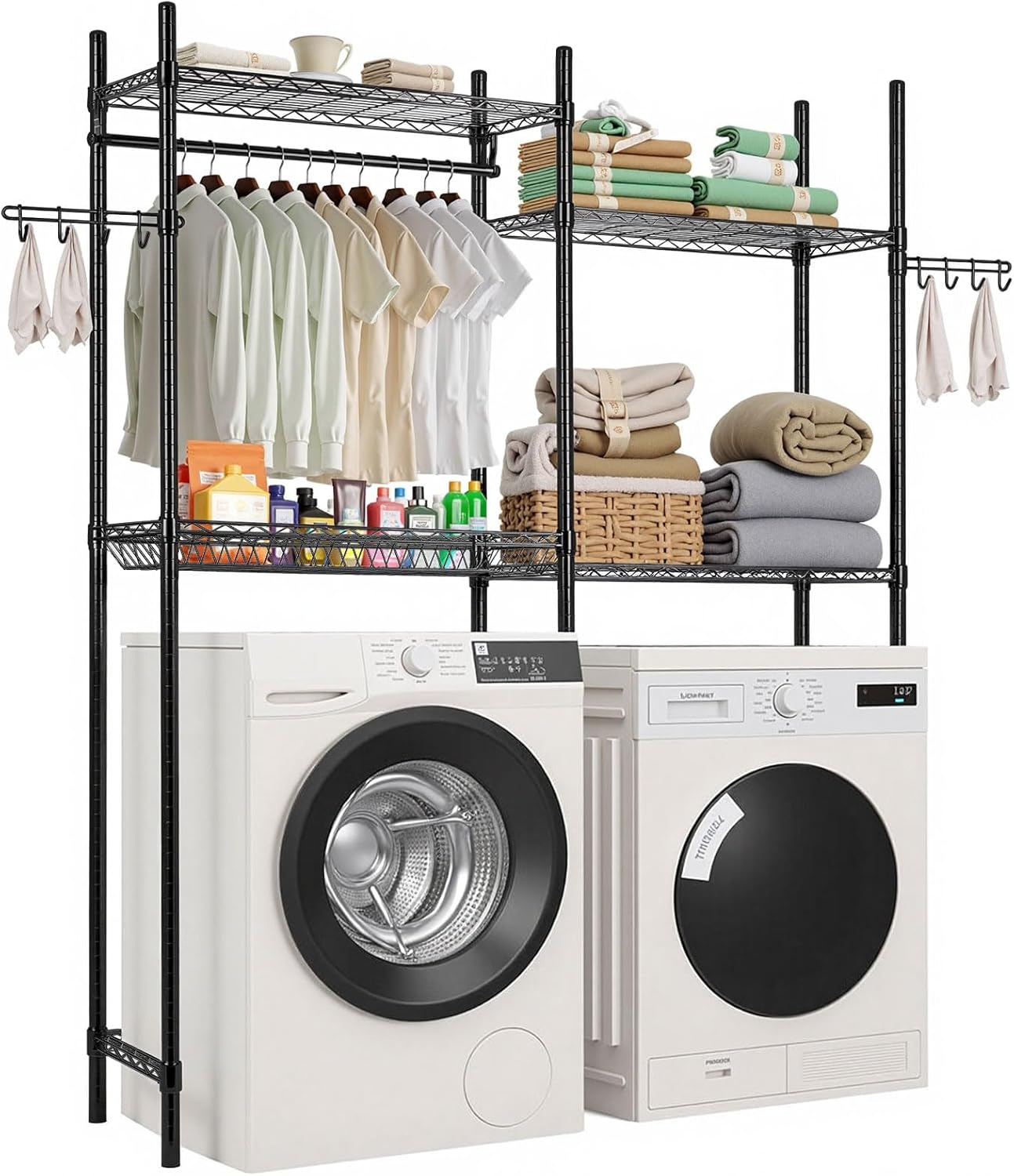
This black VEVOR system uses four tiers, hanger rods, and hooks to add storage above laundry appliances. The shelves and leveling feet are adjustable, and the frame is designed as an over-washer and dryer storage rack. Before installation, the appliance operating envelope, controls, hoses, lids, and service access still need to be measured.
Check On AmazonIf you click this link and buy, we earn a commission at no additional cost to you.
Separate storage capacity from usable access
More shelves, drawers, or compartments can look like an upgrade while making everyday retrieval slower. Deep shelves hide items behind one another, tightly divided drawers can force awkward sorting, and tall cabinets can shift frequently used supplies beyond comfortable reach. Nominal capacity describes what can fit, not how easily the household can get to it. Usable access is the capacity that can be reached without repeated unloading, lifting, or rearranging.
A simple test is to imagine the most frequent item in the least convenient position the system allows. If reaching it means moving three other objects, opening multiple panels, or dragging a loaded cart out of another room, the system may have optimized storage density instead of household use. This is why smaller or simpler storage can outperform a larger unit in a busy routine. The best capacity is the amount that remains practical to access, clean around, and return to order after use.
- Check how many actions are required to reach the item used most often.
- Check whether stored equipment can move to its working position without clearing unrelated items first.
- Check whether doors, drawers, lids, and appliance controls can all open in their real operating positions.
- Check whether the system still works when baskets, shelves, or compartments are normally loaded rather than empty.
- Check whether the storage adds a new cleaning, moving, or resetting chore after each use.
That checklist turns “more storage” into a better question: usable storage for which repeated task? A system earns its place when the everyday path becomes easier. If capacity rises while access gets worse, little has been gained. Storage and organization should reduce friction rather than hide it.

This black Ibyx appliance slider measures 16 by 13 inches and is made from bamboo. The listing gives it a 40-pound capacity and describes it as an easy-slide platform for countertop appliances. The sliding format improves usable access by bringing an appliance forward without requiring unrelated items to be unloaded first.
Check On AmazonIf you click this link and buy, we earn a commission at no additional cost to you.
Keep model-specific clearance, load, stacking, and installation rules at the manufacturer boundary
General storage planning can identify the job, but it cannot prove that a specific appliance, shelf, lift, pedestal, stacking accessory, or cabinet arrangement is compatible. Exact dimensions, mounting conditions, load limits, operating clearances, electrical access, plumbing access, venting, and approved accessory interfaces can vary by model. When any of those details control safety or fit, use the exact appliance manual and the documentation for the storage or installation system. Visual similarity and generic size labels are not enough.
This boundary is especially important when a storage change affects the appliance rather than merely sitting nearby. Do not improvise stacking hardware, block required ventilation, cover service access, or assume a shelf can carry an appliance because the top surface looks large enough. Stop and use qualified service or installation help when the work falls outside owner-level setup or the documentation reserves it for trained personnel. The storage plan should adapt to the equipment requirements, not force the equipment into a preferred layout.

This STANLEY PowerLock has a 16-foot by 3/4-inch blade for checking appliance, opening, and installation dimensions. The blade has a positive lock designed to hold it in place while taking measurements. Those measurements complement, rather than replace, the exact model documentation that controls approved clearances, loads, stacking hardware, and installation.
Check On AmazonIf you click this link and buy, we earn a commission at no additional cost to you.
Choose the next storage path from the unresolved workflow problem
Narrow the choice by describing the failure in one sentence without naming a product. “The microwave has no stable working location,” “the mixer is hard to retrieve,” and “clean laundry has nowhere to be folded” lead to different solutions. This prevents comparison across unrelated products that share a storage label. It also leaves room for no purchase when relocation solves the problem.
Use the table as a directory, not a shopping list. Start with the repeated action that is slow, awkward, blocked, or wasteful. If two problems exist, solve the one that prevents normal equipment use before appearance or extra capacity. A clear workflow problem should lead to a clear storage architecture.
| Decision step | If yes | If no |
|---|---|---|
| Does the item need to move between storage and another work area? | Choose the movement branch. Decide whether the real job is carrying a load by hand or rolling it along a clear route. | Keep it in the stay-put branch and ask whether it can remain usable where it is stored. |
| Can the equipment stay in place while it is used? | Prioritize stable support, working height, operating clearance, control access, and nearby connections before extra storage capacity. | Move to the access branch. The system must make retrieval and return easier without adding another heavy or awkward handling step. |
| Is the main access problem concealment rather than lifting or carrying? | Check doors, cabinet depth, pull-forward space, and the number of actions between storage and operation. | Check whether a lift, accessible cabinet position, basket, sorter, or cart better matches the actual movement required. |
| After solving stay-put, movement, or access, is another repeated step still failing? | Route that remaining problem separately, such as sorting, folding, elevation, stacking, or storage above an appliance. | Stop adding storage. The current setup may already solve the household job without another organizer. |
This stay-put, move, or access sequence prevents one storage purchase from being asked to solve unrelated problems. A stationary support surface should not be judged like a transport cart, and a concealment system should not be expected to fix difficult lifting. Follow the first branch that describes what the equipment must physically do, then check whether a second workflow problem remains. If nothing remains unresolved, more storage is unlikely to improve the routine.
| Unresolved household problem | Continue with | What that topic helps decide |
|---|---|---|
| A microwave needs a stable working location. | Microwave stands, carts, and baker’s racks | Support, height, footprint, mobility, and access. |
| A countertop appliance needs concealment without difficult retrieval. | Appliance garage storage and access | Concealment, opening, depth, and retrieval. |
| A stand mixer is difficult to move into working position. | Stand mixer storage and access | Storage, lifts, handling, and fit. |
| Dirty laundry needs collection, carrying, or pre-sorting. | Laundry hampers, baskets, and sorters | Transport, capacity, sorting, and footprint. |
| Clean laundry needs staging, movement, or folding space. | Laundry stations, rolling carts, and folding surfaces | Movement, work surfaces, parking, and flow. |
| Front-load appliances need elevation or vertical arrangement. | Laundry pedestals and washer-dryer stacking | Compatibility, configuration, access, and storage. |
| Usable storage may exist above the laundry appliances. | Over-washer and dryer storage | Reach, clearance, shelves, and cabinets. |
The common thread is that the product class comes after the household job. A rack is not interchangeable with a cart just because both have shelves, and a basket is not a sorter just because both hold laundry. The right branch should remove a repeated point of friction while respecting the room, equipment, and user’s normal movement. Once that is clear, size and feature comparisons become much more meaningful.

The COSCO Shifter converts between a two-wheel upright hand truck and a four-wheel cart without pins or tools. It folds flat for transport or storage and has a listed 300-pound weight capacity. That makes it a useful example when the unresolved workflow question is whether an item should be carried, rolled, or left in a stay-put storage branch.
Check On AmazonIf you click this link and buy, we earn a commission at no additional cost to you.
Final thoughts: buy the storage system only after the repeated job is clear
Good storage makes household equipment easier to live with, not merely easier to hide. Start with the repeated action that is failing, then check the real footprint, access path, operating clearance, handling burden, and compatibility limits before comparing capacity or features. That sequence makes it easier to choose a smaller or simpler system when it does the job. It also makes skipping a purchase a valid outcome when relocation or a changed routine solves the problem.
Before buying, stand in the actual space and trace one normal use from storage to operation and back again. Measure the space the system will occupy, but also measure the space needed to open, move, lift, carry, fold, load, unload, or service what lives there. If the proposed setup shortens that path without blocking another one, it is doing useful work. If it only adds compartments, the household may be paying for storage that creates another storage problem.

These reusable oval sliders measure 5 3/4 by 9 1/2 inches and are made for hard-surface floors. The four-pack is designed to help move furniture while protecting the floor surface. They are relevant to the final workflow check because storage furniture may need repositioning during setup, while the final footprint and operating clearance still need to be measured.
Check On AmazonIf you click this link and buy, we earn a commission at no additional cost to you.
FAQs
Storage questions are usually less about maximum capacity than whether the system works in the real room. Measurements, access, movement, and compatibility often settle the decision faster than feature count. Keep those variables separate when comparing options. Use exact model documentation when storage affects appliance installation or required clearance.
Also separate problems that happen before, during, and after a task. Laundry collection differs from folding, just as appliance support differs from concealment. Those jobs can share a room without needing the same solution. Match the system to the failed step before comparing products.
📏 Should I measure the storage unit or the appliance first?
Measure the appliance and its operating space first, then the storage location. Include doors, lids, controls, connections, and the retrieval path.
🧺 Is a larger hamper always better for a family?
No. A larger hamper helps only if it stays manageable when loaded and fits the route to the washer. Stairs, handles, and wash frequency matter too.
🗄️ Does hiding countertop equipment always save useful space?
No. Concealment can add retrieval steps or consume cabinet space. Check whether the appliance can move into use without clearing unrelated items.
↕️ Can I stack a washer and dryer if they are the same width?
Matching width does not prove stacking compatibility. Verify the exact washer, dryer, approved accessory, and installation instructions first.
🧱 Is wall space above a washer or dryer automatically usable for shelves?
No. Doors, lids, controls, connections, reach, and service access reduce usable area. Measure the operating envelope first.
🛒 When does a rolling cart make more sense than a stationary rack?
A rolling cart makes sense when movement is part of the task and the route is clear. If it stays parked, judge footprint, support, access, and stability instead.