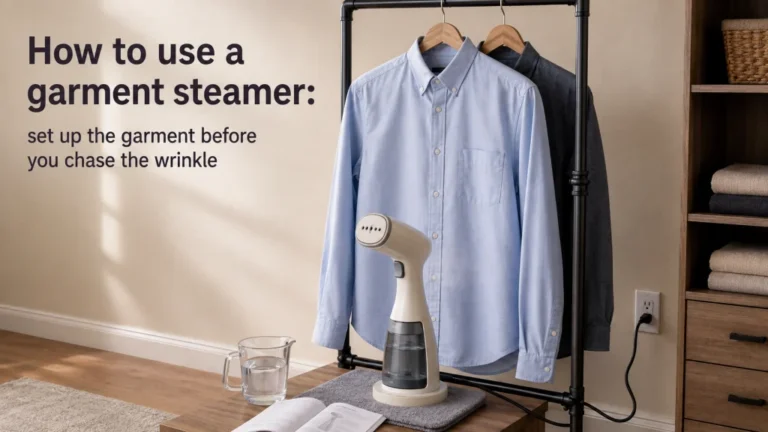
A garment steamer works best when its size and workflow match how you remove wrinkles. Quick touchups, several-garment sessions, and batches place different demands on tank capacity, filled weight, storage, and refill frequency. The choice also depends on whether you want relaxed wrinkle release or the sharper finish created by heat and pressure. Use those needs to build a requirement profile before comparing current models.
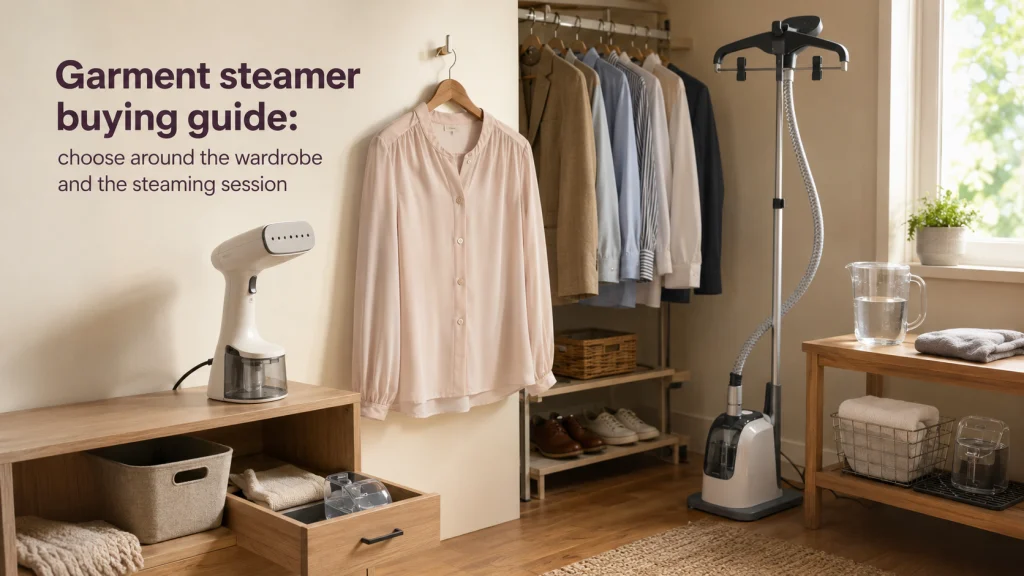
Start with the steaming session, not the specification card
A useful garment steamer buying guide starts with the session: one blouse before work is not the same job as ten garments waiting together. The quick session rewards easy retrieval, fast setup, and comfortable handling. A batch puts more pressure on tank endurance, refill interruptions, hanging space, and fatigue. Define that repeated job first, and impressive specifications become easier to judge.
Before comparing models, write down how many garments you normally treat, which fabrics appear most often, and how smooth you expect them to look. Add where the steamer will live, whether a refill is acceptable, and how much post-use draining or scale care you will tolerate. Include filled weight for handheld use because water becomes part of what your arm carries. This short profile is more useful than choosing the largest tank and hoping the routine adapts.
| Typical session | What usually matters most | Likely burden |
|---|---|---|
| Quick touchup | Fast setup and storage | Oversized format |
| Several garments | Endurance and easy refill | Refills or weight |
| Regular batch | Stable support | Small tank or weak setup |
The table is not a universal sizing rule. It shows which friction deserves attention in each kind of session. A household treating one shirt can reasonably choose a different architecture from a household steaming a weekly batch. Once the session is clear, the buying decision becomes much less abstract.

This handheld Conair model uses a 1875-watt steam generator and offers five steam settings. Amazon lists a 40-second heat-up and up to 20 minutes of steam time, giving concrete startup and endurance figures for a normal session. The included 3-in-1 attachment combines a silicone band, fabric spacer, and bristle brush.
Check On AmazonIf you click this link and buy, we earn a commission at no additional cost to you.
Know what counts as a garment steamer and what belongs to another system
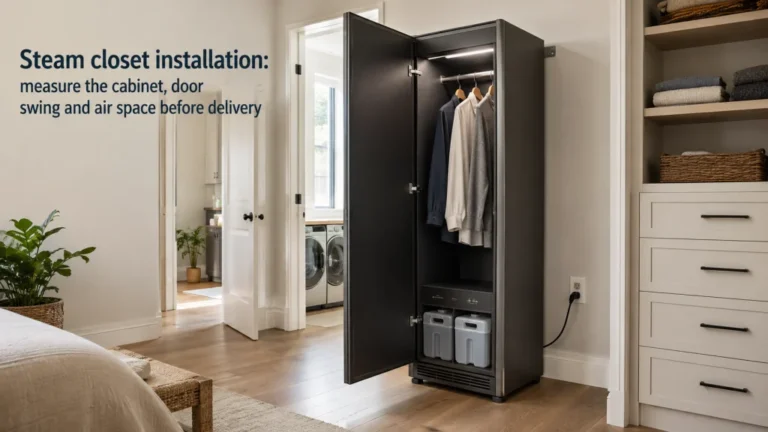
This article covers manually guided steamers that send steam through a head you move over hanging clothing or compatible household textiles. That includes handheld units, floor-standing designs, and travel-capable steamers that still require manual guidance. It excludes automated garment-care cabinets, steam irons, separate-base steam stations, and pressing machines because those systems change the physical job. Keeping that boundary clear prevents comparisons between equipment that produces different kinds of finishing.
If you are trying to understand how to choose a garment steamer, first confirm that manual steaming is the equipment path you actually want. If you are still choosing the broader equipment family, start with garment care products. If an enclosed automated cycle sounds preferable, the steam closet article owns that path. If you want a heated soleplate and direct pressure, use how to choose a steam iron.
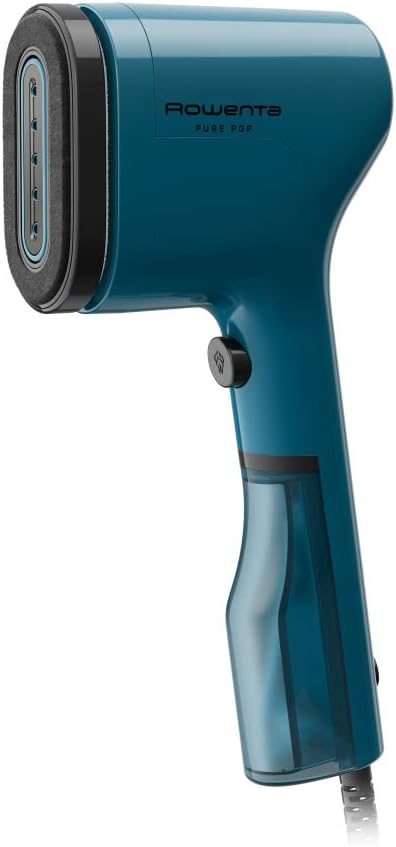
The Rowenta PurePop is a compact handheld garment steamer rated at 1150 watts with a 2.3-ounce water tank. Amazon lists a 15-second heat-up time and a lightweight 1.5-pound design suited to quick garment touchups and compact storage. Its reversible pad provides separate surfaces for lint removal and gentler fabric steaming.
Check On AmazonIf you click this link and buy, we earn a commission at no additional cost to you.
Decide whether a garment steamer deserves a place in the routine
The convenience is simple: hang a garment and work on wrinkles without setting up a full ironing board. That can be valuable when quick wrinkle release is the goal and setup friction is what usually stops the chore from happening. It is less convincing when the wardrobe regularly needs sharp creases, firm collars, or heavy pressing. Independent garment-care guidance also treats steaming and ironing as different finishing methods rather than universal substitutes.
Frequency matters just as much as finish. A steamer that saves setup time but sits unused for months can still be a poor fit, especially when storage is tight or water care is bothersome. A small recurring touchup job can justify a simple device if the routine becomes noticeably easier. If the buy-or-skip threshold remains unclear, work through whether a garment steamer is worth it for your routine before comparing more specifications.

This BEAUTURAL handheld steamer uses 1200 watts and heats in about 30 seconds. Its detachable 8.79-ounce tank is rated for up to 15 minutes of continuous steam. The leak-resistant design supports vertical or horizontal steaming, and a fabric brush is included.
Check On AmazonIf you click this link and buy, we earn a commission at no additional cost to you.
Decide when targeted manual steaming beats an automated cabinet cycle
Manual steaming is strongest when the job is selective. You can work a wrinkled sleeve, dress panel, or a few problem areas without running a larger system. That keeps the session short when garment count is low and avoids dedicating permanent floor space to an enclosed appliance. The tradeoff is that your hand, arm, and attention remain part of the process throughout the session.
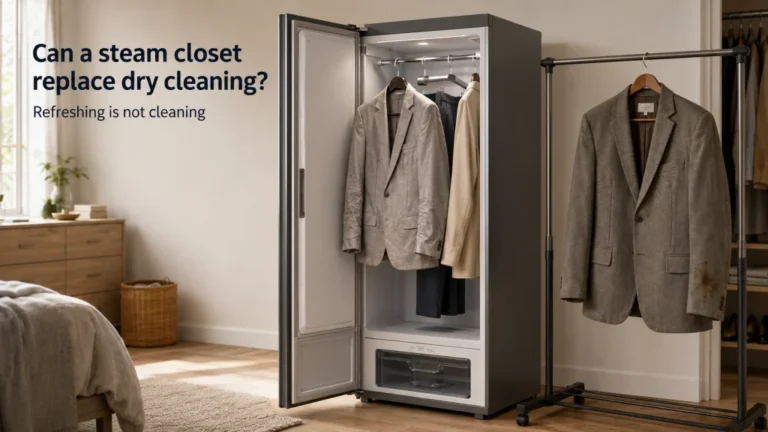
An automated cabinet changes that workload, but it also changes footprint, installation expectations, purchase cost, and cycle behavior. It is not simply a stronger version of a handheld or upright steamer. If those two approaches are competing for the same household job, use the steam closet vs garment steamer comparison. For this decision, focus on whether manual guidance remains comfortable for the number of garments you expect to treat.

This adjustable garment steaming stand provides a dedicated place to hang clothing while using a separate handheld steamer. Its telescoping pole reaches about 63 inches, while the 360-degree rotating hanger and garment clips help keep shirts, dresses, trousers, and skirts positioned for easier wrinkle removal. The lightweight stand folds down for compact storage or travel, and the included heat-resistant hand pad provides a firm backing surface when steaming smaller or more detailed areas.
Check On AmazonIf you click this link and buy, we earn a commission at no additional cost to you.
Choose between relaxed wrinkle release and crisp heat-and-pressure pressing
A steamer can smooth fabric without reproducing the finish of direct pressing. Steam relaxes fibers, while an iron adds contact and pressure that can create sharper lines. That difference matters on collars, cuffs, trouser creases, plackets, and dense woven panels. If “presentable and less wrinkled” is enough, steaming may fit; if “crisp and pressed” is the standard, the mechanism may be wrong.
This is an easy first-time buyer mistake because speed and convenience often get more attention than the desired finish. A soft blouse or flowing dress creates a different expectation from a heavy shirt that needs a firm pressed look. The garment steamer vs iron comparison is the next step when finish quality is still unresolved. Do not spend more on steam output to solve a problem that actually requires pressure.
| Decision step | If yes | If no |
|---|---|---|
| Do you mainly want relaxed wrinkle release rather than a sharply pressed finish? | A garment steamer remains a good mechanism to consider. | Compare steaming with ironing or another pressing system before choosing a steamer. |
| Does the garment’s care label and construction allow steaming under the model’s instructions? | Move on to session size, architecture, and handling. | Do not use steaming as the default treatment for that garment. |
| Will you usually treat only one or a few garments at a time? | Compact retrieval and comfortable handheld use can deserve more weight. | Give more weight to endurance, refill frequency, garment support, and longer-session comfort. |
Follow the tree in order because each answer can eliminate the wrong mechanism before you compare hardware. If you need crisp pressure-based finishing, solve that first instead of paying for a stronger steamer. If steaming remains appropriate, fabric compatibility becomes the next gate before tank or architecture. Only after those two questions are settled should convenience specifications begin to influence the purchase.

This 1875-watt Conair combines handheld steaming with an iron function for vertical or horizontal use. It offers four steam levels and an 8-foot cord. The dual-function design provides both steam delivery and a contact ironing option in one appliance.
Check On AmazonIf you click this link and buy, we earn a commission at no additional cost to you.
Choose handheld or standing architecture from session size and storage
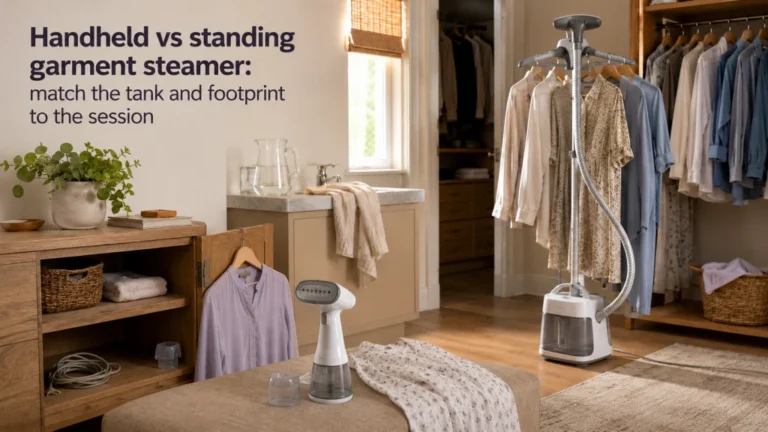
Handheld designs place the tank, heater, and steam head in the device you carry, which simplifies storage but makes filled weight part of every pass. Upright designs move much of the water and hardware to a floor base, then send steam through a hose to the head. That can suit longer sessions, but the base, pole, hose, and hanger still need room. Neither architecture is automatically stronger, easier, or more durable for every household.
Measure where the unit will actually live before choosing the larger format. A clothes steamer buying guide should separate storage fit from session comfort instead of assuming one architecture wins. A standing unit can fit a laundry corner yet remain irritating if it blocks access, while a handheld can frustrate with frequent refills or tiring filled weight. Use handheld vs standing garment steamer once you know which burden matters more.
| Architecture | Main advantage | Ownership check |
|---|---|---|
| Handheld | Compact storage | Weight, grip, tank, cord |
| Standing | Longer sessions | Floor space, pole, hose |
| Travel handheld | Packability | Voltage, plug, draining |
The architecture should reduce the burden you notice most often. Compact storage is useful only if carrying and refilling remain tolerable. A larger base is worthwhile only if longer sessions happen often enough to justify its space. Choose the ownership shape before choosing the model.

This HiLIFE handheld steamer has a 240 ml tank, a 700-watt rating, and a 9-foot power cord. The selected blue model is specified for 120V use only. Its portable handheld format keeps the water tank and steam head together in the unit being carried.
Check On AmazonIf you click this link and buy, we earn a commission at no additional cost to you.
Check fabric, garment construction, embellishments, and care-label limits before steaming
Fabric compatibility is an exact-garment question, not a blanket claim that steam is gentle enough for everything. Start with the care label, then consider linings, adhesives, coatings, prints, interfacing, beads, sequins, and glued trims. Those details can react differently from the main fabric. Manufacturer instructions matter too because some steam heads permit direct contact while others require a different position or accessory.
This is why broad “safe for delicates” wording is not enough to prove fit. One steamer design may allow plate contact under its instructions while another has different operating limits. If your wardrobe includes mixed materials or delicate construction, review what fabrics can you steam before buying around a generic fabric claim. When the care label or exact appliance manual sets a limit, that documented limit should control the decision.

This Conair CompleteSteam handheld model uses 1100 watts and provides up to 10 minutes of continuous steam. Its compact format is designed for home, office, and travel garment touchups. The selected white model is a manually guided clothes steamer rather than an automated garment-care system.
Check On AmazonIf you click this link and buy, we earn a commission at no additional cost to you.
Convert session size into tank, refill, and runtime requirements
Tank capacity matters only when it is translated into the session you expect to complete before refilling. A larger reservoir can reduce interruptions, but on a handheld it also adds water weight to the tool you carry. Runtime is incomplete by itself because output setting, pauses, fabric, and test conditions can change practical endurance. There is no honest universal minimum tank size for every household.
Compare capacity and stated runtime together, then ask whether both match your normal session. One-shirt users may care more about easy filling and draining than long operation. Batch users may accept more size or weight if fewer refills make the session smoother. If a listing gives a tank number without useful runtime context, treat the field as incomplete rather than inventing an answer.
| Session question | What to verify | Why it matters |
|---|---|---|
| One fill enough? | Capacity plus runtime | Refill frequency |
| Too heavy? | Weight plus water | Carrying burden |
| Easy refill? | Tank and restart steps | Interruption |
| After use? | Drain and store steps | Cleanup |
The worksheet forces capacity back into the household routine. Extra water is valuable only when it removes a real interruption. Bigger is not automatically better if the added weight becomes the new problem. Choose enough endurance for the repeated session, not for an imaginary maximum.

This OGHom handheld steamer uses a 240 ml water tank and 700 watts. Amazon lists up to 15 minutes of continuous steam from the tank. The selected model is for 110-120V use, making its electrical range another defined model constraint.
Check On AmazonIf you click this link and buy, we earn a commission at no additional cost to you.
Read steam output, heat-up time, and wattage as model-specific fields
Wattage is an electrical input figure, not a universal score for wrinkle removal. Steam output can be more relevant, but nozzle design, steam consistency, fabric, garment tension, and operating method still affect results. Heat-up time matters most for quick touchups, while longer sessions can make endurance and handling more important. Independent testing is useful because it observes performance and usability beyond a single number.
Compare like with like within the model type and session you need. Do not assume the highest wattage must produce the best finish or the largest steam figure must feel easiest in use. Fast heat-up can matter greatly for one-garment mornings and barely matter for a batch that already requires sorting and hanging. Specifications become meaningful only after the workflow gives each field a job.
| Field | What it helps judge | What it cannot prove alone |
|---|---|---|
| Wattage | Electrical input | Wrinkle-removal quality |
| Steam output | Steam delivery | Every-fabric finish |
| Heat-up time | Start delay | Long-session ease |
| Runtime | Potential endurance | Garments per fill |
Use these figures as evidence fields, not winner badges. Prioritize the number that changes your repeated task. Treat unmatched claims cautiously when test conditions are unclear. A specification matters only when you can explain what household work it changes.

A powerful 1875-watt handheld garment steamer designed for removing wrinkles from clothing, curtains, upholstery, and other household fabrics. It heats in about 40 seconds and uses a 7.3-ounce water tank to provide up to approximately 20 minutes of steaming time. The heated plate and included fabric attachments add more control when working with delicate materials or heavier fabrics.
Check On AmazonIf you click this link and buy, we earn a commission at no additional cost to you.
Add filled weight, grip, hose management, stability, and storage footprint
Handling can decide whether a steamer gets used even when its performance looks strong. For a handheld, start with empty weight and remember that tank water becomes part of every lift. Grip shape, trigger position, head angle, and cord routing can become noticeable during repeated passes. A compact unit that strains the wrist during a normal session is not truly convenient.
For an upright design, move the handling check to the base, pole, hose, and garment support. The base should remain stable, the hose should reach naturally, and the pole should suit the garments you expect to hang. Measure the stored footprint with the required parts, not only the main body dimensions. A unit can fit the room on paper and still fail the routine when retrieval and storage are awkward.
- Check empty weight and water capacity for handheld use.
- Confirm the grip and trigger feel suitable for repeated passes.
- Check whether the cord or hose crosses your working path.
- Measure stored height and required floor or shelf space.
- For upright units, verify base stability and garment support.
These checks are ordinary because ordinary friction controls repeated use. A listing can call a device compact, but only your storage space proves that claim useful. Good fit includes retrieving, operating, draining, and putting the steamer away. Handling belongs beside performance in the final comparison.

This chrome steel garment rack has an extendable hanging rod from 42 to 67 inches and supports up to 150 pounds. Four-inch swivel casters let the rack roll, and the frame collapses for storage. Amazon lists folded dimensions of 18.5 by 23 by 2.5 inches, giving a concrete stored footprint.
Check On AmazonIf you click this link and buy, we earn a commission at no additional cost to you.
Treat continuous steam, trigger control, heated plates, boards, and attachments as workflow features
A feature is valuable when it removes a repeated step or makes a repeated garment easier to handle. Continuous steam can reduce trigger fatigue during longer sessions, while trigger control can limit steam to active passes. A heated plate or support board may help when fabric needs contact or tension. None of those features deserves a premium simply because it appears on the box.
Attachments should pass the same test. A brush, spacer, crease tool, or special head matters only when the exact instructions define its use and your wardrobe creates that need often enough. Extra pieces also need storage and can create replacement-compatibility questions later. If a feature does not remove work from a real session, a simpler model can be the better household choice.

This garment-steamer mitt uses a thick sponge layer intended to isolate heat from the hand. Its outer surface is waterproof to help block steam moisture. The accessory is designed to be used as a hand-protection aid while working with a garment steamer.
Check On AmazonIf you click this link and buy, we earn a commission at no additional cost to you.
Check the exact water rule before filling the tank
Do not assume every garment steamer wants the same water. Official guidance varies by brand and model, and hard water can add another condition. Philips support, for example, allows tap water for specified steamers but gives different guidance when mineral buildup is likely, while warning against perfumed water and several additives. Rowenta also publishes model-specific water instructions, which is why “always use distilled water” is too broad.
Check the manual or official support page for the model before assuming the filling routine will suit your household. If approved water is inconvenient to source, or local conditions create frequent scale care, that is part of ownership burden. The detailed can you use tap water in a garment steamer article handles that question separately. Never add fragrance, descaler, or another liquid unless the exact instructions explicitly permit it.

This Varify kit includes 150 strips for checking water hardness. The listing identifies calcium and magnesium among the hardness factors measured and gives a 0 to 425 ppm range. The kit is intended for household water, wells, pools, spas, softeners, dishwashers, and other water-hardness checks.
Check On AmazonIf you click this link and buy, we earn a commission at no additional cost to you.
Count filling, draining, scale care, and fault handling before buying
The session does not end when the garment looks smooth. Depending on the model, you may need to drain the tank, let hot parts cool, manage condensation, rinse components, or perform scale care. Those chores are not reasons to avoid a steamer, but they belong in the convenience calculation. A device that saves setup time can give some of that time back if its water path is awkward to maintain.
Spitting, dripping, weak steam, or no steam can also have several owner-level causes, and the exact checks differ by model. For routine care, follow the separate steps for cleaning a garment steamer; when a symptom needs diagnosis at owner level, use the garment steamer troubleshooting path. Follow the manual rather than improvising descaling chemistry or opening the appliance. Stop using it and follow the service path for damaged cords, smoke, burning odor, overheating, uncontrolled operation, or water entering electrical areas.

This Amazon Basics pack contains 24 reusable microfiber cleaning cloths measuring 16 by 12 inches. The cloths are listed as lint-free, streak-free, non-abrasive, washable, and absorbent. They provide a simple cloth option for wiping accessible cooled surfaces or handling residual water during routine cleanup.
Check On AmazonIf you click this link and buy, we earn a commission at no additional cost to you.
Make sure the normal operating routine fits the space where you will use it
A steamer needs more than an outlet and a hanger. You need clear working space, safe garment support, and room to keep hot steam away from skin, people, pets, and unsuitable surfaces. The manufacturer’s operating position matters, especially when the head is intended to stay upright or has specific contact instructions. A convenient storage spot does not help if the actual steaming position creates a cord hazard or unstable hanging setup.
Mentally run the whole process from retrieval to storage before buying. Decide where the garment hangs, where the tank gets filled, where the hot unit rests, and where it cools afterward. If the operating sequence is the uncertain part, check the practical steps for using a garment steamer safely and efficiently before comparing more hardware. A good purchase should simplify that routine rather than require a new room arrangement for every wrinkle.

This Utopia Home set includes 50 white plastic hangers, each about 16 by 9.4 inches. Built-in shoulder notches can hold garments with straps. The hangers provide a simple support option for keeping clothing suspended during a normal steaming setup.
Check On AmazonIf you click this link and buy, we earn a commission at no additional cost to you.
Add voltage, plug, and packing constraints when the steamer will travel
Small size does not automatically make a handheld steamer suitable for international travel. Verify voltage support on the exact model because a plug adapter changes plug shape without necessarily changing voltage. Some travel models are designed for more than one voltage range, while ordinary home units may not be. Check the rating label and manual before using the appliance on a different electrical system.
Then check whether the tank drains fully, the head can be packed safely after cooling, and the cord or accessories make the packed shape larger than expected. A compact body can still be awkward once every required piece is included. If travel is a primary use case, compare those constraints in best travel garment steamer. Do not treat “portable” as proof of electrical compatibility or practical suitcase fit.

This Jack & Rose 2-in-1 travel unit is rated for 100-220V operation and combines steaming with an iron function. The listing gives a 15-second heat-up and a compact body about 10.23 by 3.9 inches. Its wide-voltage specification directly addresses an electrical constraint that matters for international travel.
Check On AmazonIf you click this link and buy, we earn a commission at no additional cost to you.
Compare current home models only after the requirement profile is clear
Once session size, finish, architecture, fabric limits, water routine, handling tolerance, and storage are defined, current model comparison becomes easier. You are checking which models satisfy household conditions rather than asking which has the biggest number. Eliminate options that fail a true constraint such as storage dimensions, filled-weight tolerance, voltage needs, or required controls. Only then should convenience extras and price break the tie.
That order also makes independent testing more useful. Test results can show how specific models handled wrinkle removal, steam consistency, or usability under stated conditions, but those observations still need your wardrobe and routine for context. Use best garment steamers only after you know what “best” must mean for your session. A model should earn its place by matching the requirement profile, not by collecting the longest feature list.

The Conair Power Steam GSC24 is a 1200-watt handheld garment steamer with selectable dual-voltage operation. It folds flat for packing and is designed to steam in multiple positions. Those model-specific power, voltage, and form-factor details provide concrete fields for comparing a current model against a defined requirement profile.
Check On AmazonIf you click this link and buy, we earn a commission at no additional cost to you.
Use the unresolved decision to choose the next detailed garment-steamer article
Before leaving the buying framework, turn the requirement profile into a short elimination list. Mark which conditions are non-negotiable, such as storage dimensions, fabric compatibility, voltage needs, filled-weight tolerance, or a specific water rule. Then separate preferences such as faster heat-up or extra attachments from conditions that can actually disqualify a model. This prevents a convenient feature from pulling an unsuitable steamer back into consideration.
Use that elimination list when you open current product pages or independent tests. Reject models that miss a non-negotiable condition before comparing price or smaller conveniences. The detailed articles collected after Final thoughts remain available when one technical question needs deeper checking. At this stage, however, the important job is to keep the model comparison anchored to the requirements you already defined.
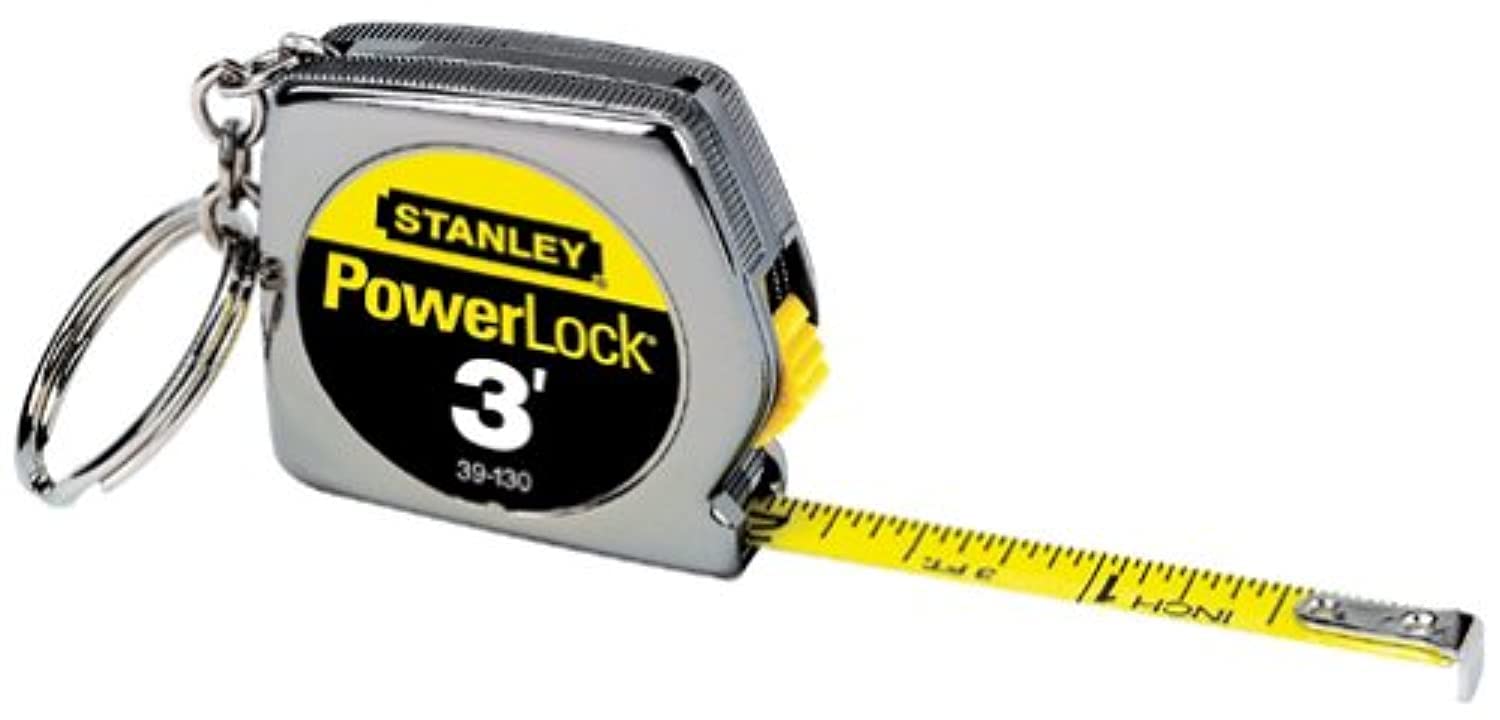
The STANLEY PowerLock Key Tape is a compact 3-foot tape measure. Its key-size format keeps a basic measuring tool easy to carry or store near a closet or laundry area. It can record shelf, cabinet, or floor-space dimensions before steamer formats that do not fit are eliminated.
Check On AmazonIf you click this link and buy, we earn a commission at no additional cost to you.
Final thoughts: buy for the steaming session you repeat, not the strongest-looking specification
The right steamer fits the finish, session size, storage, handling, water routine, and maintenance that repeat. Quick-touchup users may value compact retrieval, while batch users may value endurance and support. Neither household needs every premium feature. The goal is a steamer that earns regular use.
Before buying, separate constraints from preferences. Verify dimensions, weight, water rules, electrical requirements, operating guidance, and fabric limits on the exact model. If the real problem is crisp pressing or automated care, choose that equipment path instead. Buy for the session you repeat, not the strongest-looking specification.
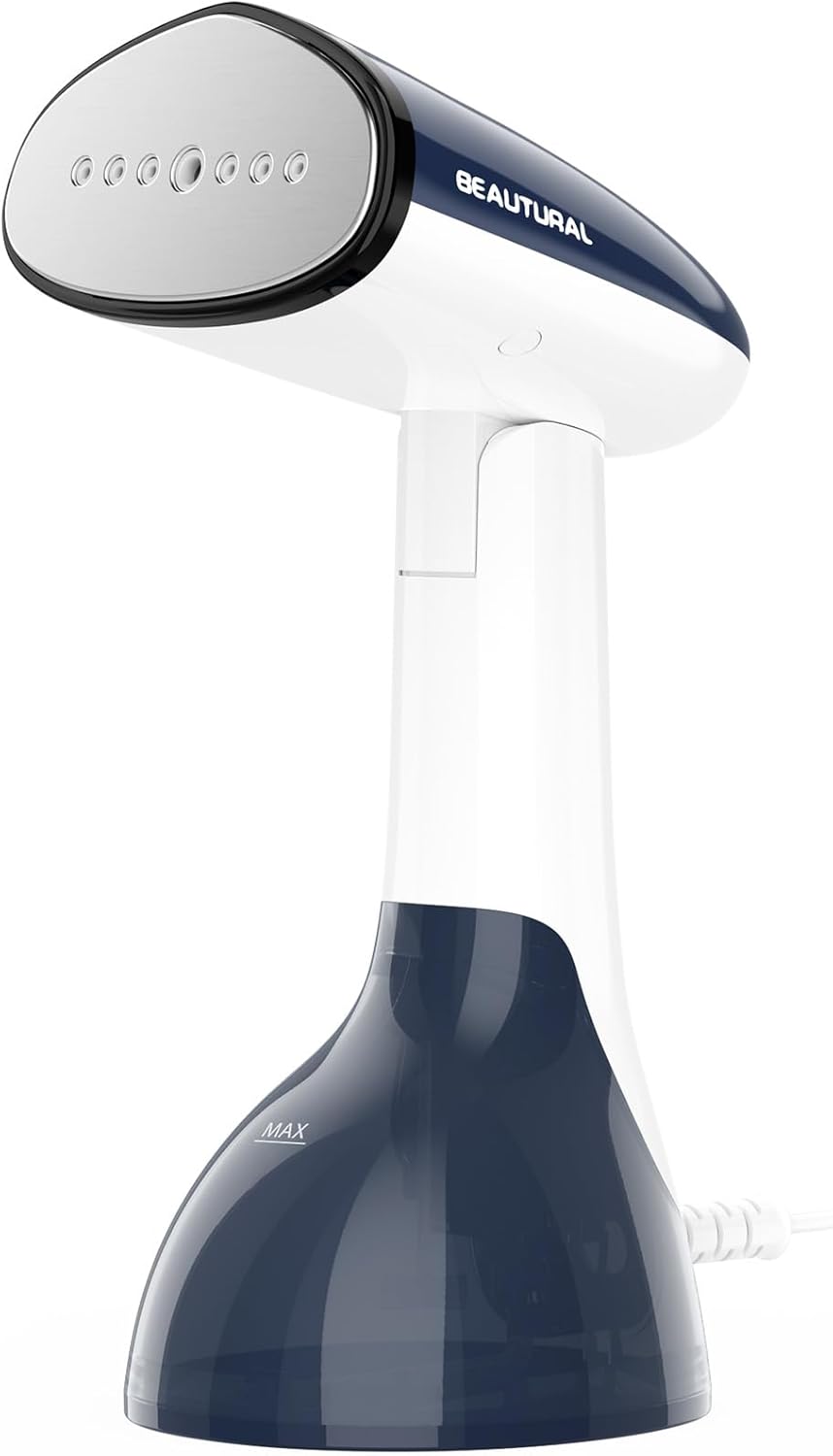
This BEAUTURAL handheld steamer uses 1200 watts and a 260 ml removable water tank. Amazon lists about a 35-second heat-up, an aluminum heating plate, and an 8-foot power cord. The electronic pump supports use at different angles, combining capacity, startup, cord, and handling features in one current model.
Check On AmazonIf you click this link and buy, we earn a commission at no additional cost to you.
Continue with the garment-steamer decision that is still unresolved
Each article below takes one unresolved question further. Start with the issue that could still change what you buy. Resolve mechanism and architecture before maintenance when both remain uncertain. You do not need every article.
Keep research attached to the actual constraint. A model list should not define your needs. Use only the articles needed to remove uncertainty. Then compare products against the same profile.
| Topic | What you’ll find |
|---|---|
| Are garment steamers worth it? | Buy, wait, or skip based on the recurring chore. |
| Garment steamer vs iron | Wrinkle release versus crisp pressing. |
| Handheld vs standing garment steamer | Portability, weight, endurance, hose, and storage. |
| What fabrics can you steam? | Fabric, construction, embellishment, and care-label checks. |
| Can you use tap water in a garment steamer? | Water instructions and hard-water implications. |
| How to use a garment steamer | Setup, support, steaming, cooling, and storage. |
| How to clean a garment steamer | Draining, cleaning, and scale-care boundaries. |
| Garment steamer not working | Owner-level checks for common steam problems. |
| Best garment steamers | Current home-model comparison after requirements are clear. |
| Best travel garment steamer | Travel comparison with electrical and packing constraints. |
Choose the article that can still eliminate a poor fit. Return to your profile after that question is settled. Do not let one feature reset the decision. The sequence should make comparison clearer.

This Trubetter set contains 10 folding travel hangers with a tri-fold design. The hangers collapse for packing and expand to support clothing when in use. They are a compact garment-support accessory when the unresolved steamer decision involves travel or limited storage.
Check On AmazonIf you click this link and buy, we earn a commission at no additional cost to you.
Frequently asked questions
👕 Can a garment steamer replace an iron?
It can replace some ironing when relaxed wrinkle removal is enough. If sharp creases, firm collars, or dense woven fabrics matter, compare the two mechanisms first.
💧 Should I always use distilled water?
No. Water guidance varies by model, so check the exact manual or official support page before filling the tank.
🧥 Is a handheld steamer enough for several garments?
Possibly. Compare filled weight, tank capacity, stated runtime, and refill convenience against your normal batch.
🧳 Does a compact steamer work for international travel?
Not automatically. Verify voltage and destination requirements because a plug adapter does not necessarily convert voltage.
🪡 Can I steam any fabric from farther away?
Do not use distance as a substitute for compatibility guidance. Check the care label, garment construction, and exact steamer instructions.
References and sources
- CHOICE garment-care comparison: Supports the distinction between steaming and heat-and-pressure ironing.
- Good Housekeeping steamer testing: Supports comparing fabric performance, steam consistency, and usability.
- Philips water guidance: Verifies model- and water-condition-specific filling guidance.
- Conair travel steamer manual: Supports model-specific safety, operating-position, and voltage checks.