A dehumidifier should be chosen around the moisture load, the space it must serve, and the way collected water will leave the machine. Capacity matters, but it does not solve poor drainage, cool-room operation, awkward bucket handling, or unacceptable noise. Portable and whole-home systems also solve different installation problems. The useful choice is the one that can keep removing moisture in the actual room without creating a routine the household will avoid.
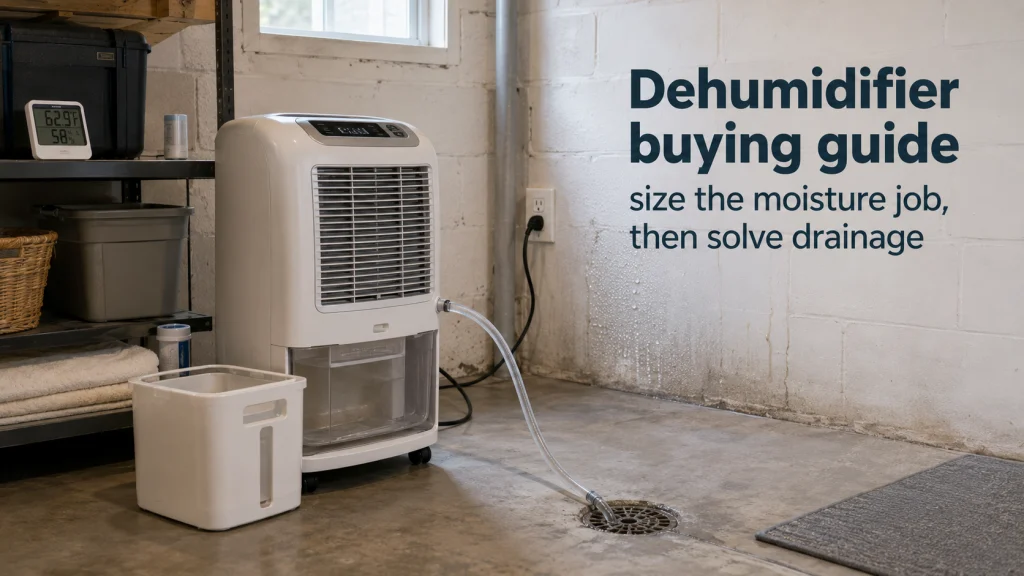
The same capacity can create very different household outcomes
A dehumidifier buying guide becomes useful only when it gets past the pint number on the box. Two machines can carry the same capacity while one sits beside a usable floor drain and the other depends on a bucket that must be carried across the room. One may work in a cool basement, while the other sits in a living area where fan noise and warm exhaust matter more. The label matters, but it does not prove that the machine fits the room.
The practical order is moisture problem first, system type second, capacity third, then drainage before smaller convenience features. That order prevents a common first-time mistake: treating advertised square footage as proof that a machine will control any space of that size. Dampness, temperature, room boundaries, airflow, and interruptions all change the job. If you are deciding how to choose a dehumidifier, begin with those conditions before comparing control panels.

This GE portable dehumidifier is rated at 35 pints and listed for spaces up to 3,000 square feet. It includes a drain hose and supports continuous drainage. The listing also identifies Smart Dry technology, humidistat control, a bucket-full alarm, and auto restart.
Check On AmazonIf you click this link and buy, we earn a commission at no additional cost to you.
Confirm that excess airborne moisture is the problem before shopping
A dehumidifier removes water vapor from indoor air, but it does not repair a leak, stop water entering a foundation, or replace flood restoration. A powerful unit can make the air feel drier while the underlying water source continues. Active leakage, standing water, electrical exposure, or damaged materials need the appropriate source correction first. The appliance belongs after the problem has been defined as an indoor humidity job.
If that decision is still unclear, start with whether a dehumidifier is actually needed before comparing size or features. This keeps musty odor, condensation, and humidity readings from being treated as interchangeable evidence. The broader heating, cooling, and air quality decision framework is the better starting point when the physical job is still uncertain. This page assumes moisture removal has already been identified as the job.

The TempPro TP50 is a digital indoor hygrometer and thermometer. It displays both room temperature and humidity on one compact monitor. The listing positions it for indoor settings including homes, offices, cellars, greenhouses, and RVs.
Check On AmazonIf you click this link and buy, we earn a commission at no additional cost to you.
Choose portable room treatment or whole-home dehumidification before comparing features
Portable and whole-home dehumidifiers should be separated before you compare capacity, controls, or price. A portable unit works inside the space being treated, so airflow, drainage, sound, heat, and maintenance access become part of ordinary ownership. A whole-home unit normally connects to ductwork and belongs to an HVAC installation decision. Treating it as merely a larger portable machine hides the installation and distribution questions that actually control fit.
The dividing line is not simply house size. A portable machine can make sense in a large but clearly bounded basement, while a smaller home can still have a distribution problem that one room unit cannot solve well. Detailed duct, electrical, and condensate design belongs with qualified HVAC work rather than owner improvisation. Use the whole-house versus portable dehumidifier comparison when that system decision is still open.

The AprilAire E130 Pro is a professional-grade whole-house dehumidifier for managing persistent humidity in larger residential spaces, basements, and appropriately configured crawl spaces. Its automatic humidity sensing and continuous drain arrangement make it suitable for situations where emptying a portable collection bucket is impractical. This is a substantially higher-capacity alternative to the AprilAire E080, so it is not a direct size-for-size replacement. Check moisture-removal requirements, physical dimensions, electrical supply, drainage, and any ducting or control connections before choosing it. Follow installation instructions and consult a qualified installer for integrated whole-house setups.
Check On AmazonIf you click this link and buy, we earn a commission at no additional cost to you.
Decode pints per day before treating the capacity label as room coverage
Capacity is the amount of water a dehumidifier can remove under defined test conditions, expressed in pints per day. It is not bucket volume, and it is not a guaranteed real-room extraction amount. A higher-capacity machine can still have a relatively small bucket because the bucket is only a collection container. When that bucket fills and the unit shuts off, moisture removal stops until the water is handled.
Advertised square footage is also different from standardized capacity. Floor area matters, but dampness, temperature, room boundaries, and moisture entry matter too. The same floor area can still create a very different moisture job. Use the fields below together rather than trusting one number.
| Specification | What it tells you | What it does not prove |
|---|---|---|
| Pints per day | Standardized moisture-removal capacity | Bucket size or guaranteed room output |
| Bucket volume | Water held before emptying | Daily removal capacity |
| Square-foot claim | Coverage orientation | Fit across every moisture condition |
| IEF | Moisture removal relative to energy use | Noise, drainage, or handling quality |
| Operating range | Documented temperature limits | Equal performance in every room |
These specifications answer different questions. Capacity describes the moisture-removal job, while bucket, efficiency, and operating limits describe how usable that capacity may be. Product pages often place them together without explaining those differences. Once they are separated, sizing and drainage are much easier to judge.
Current ratings use a cooler test basis than older labels
Current DOE-based portable testing uses cooler conditions than the older test method, so newer pint labels are not directly interchangeable with older ones. A current machine can therefore show a lower printed capacity without being directly equivalent to the older number. ENERGY STAR publishes comparison guidance for this rating shift. Compare the rating basis before matching an older pint number.
Capacity-label note: An older higher-pint label and a current lower-pint label may reflect different test procedures, so the numbers should not be matched one for one.
For a new purchase, start with the current capacity label and the conditions it represents. Then size for the space and moisture load you have now rather than trying to recreate an old label. Chasing the historical number can lead to unnecessary cabinet size, cost, and handling. The older rating is useful context, not a shopping target.
Keep square-foot claims secondary to served area and moisture load
Coverage claims are convenient because they reduce a messy decision to one number. A mildly damp room and a persistently wet space do not create the same load. Connected rooms and continuing moisture entry can expand the job beyond the floor plan. Use square footage as an input, then let dampness and the real room boundary control the capacity decision.

This Frigidaire portable dehumidifier has a 22-pint rating and Energy Star certification. It includes Wi-Fi, custom humidity control, automatic shutoff, and both bucket and continuous-drain options. The listing also specifies low-temperature operation down to 41°F and an easy-to-clean washable filter.
Check On AmazonIf you click this link and buy, we earn a commission at no additional cost to you.
Size from area and moisture condition instead of choosing the largest pint rating
Once the served space is defined, sizing should combine its area with how damp it is before dehumidification. Wetter spaces need more removal capacity than mildly damp spaces of the same size. More capacity can also bring a larger cabinet, stronger airflow, more weight, and more heat into the room. The goal is enough capacity for the load without creating a new handling or placement problem.
Exact calculations belong in the dehumidifier sizing tables and calculations. For this buying decision, measure the room and classify the moisture condition honestly before comparing current capacity ranges. Do not compensate for an unknown moisture source by automatically choosing the largest portable unit. If the load is spread through the house, return to the system-type decision instead.

This Midea dehumidifier has a 35-pint rating and is listed for spaces up to 3,000 square feet. It supports continuous drainage and uses a reusable air filter. The listing also identifies Wi-Fi control, Alexa compatibility, Energy Star status, and quiet operation.
Check On AmazonIf you click this link and buy, we earn a commission at no additional cost to you.
Check room temperature and frost behavior before trusting a basement label
Cool rooms change dehumidifier behavior because the refrigeration process depends on air conditions. ENERGY STAR notes that frost can form on coils as temperatures fall, reducing useful moisture removal. Some machines include automatic frost-control behavior, but exact operating limits still come from the model documentation. A product page calling a unit suitable for basements does not replace the manual.
| Room situation | Fit questions that move up the list | What to verify |
|---|---|---|
| Living room or occupied area | Sound, warm exhaust, footprint, control access | Placement clearance, noise evidence, airflow path, and whether heat is acceptable where people spend time |
| Cool basement or utility space | Low-temperature behavior, drainage, unattended runtime, access for cleaning | Documented operating range, frost control, drain route, bucket shutoff, and service access |
That comparison explains why similar square footage can produce different priorities. A living room can reject an otherwise capable machine because its sound or exhaust makes the room unpleasant, while a basement may tolerate those traits but expose weak low-temperature behavior or an impractical bucket routine. Neither room label tells you the answer by itself. Match the documented operating conditions and ownership demands to the place where the machine will actually run.

This portable dehumidifier removes up to 34 pints of moisture per day and is designed for spaces up to about 2,000 square feet. It supports both manual tank collection and continuous gravity drainage, making it suitable for basements, living areas, laundry rooms, and other damp spaces. The unit also includes adjustable humidity control, a 24-hour timer, auto defrost, caster wheels, and a washable filter for everyday residential use.
Check On AmazonIf you click this link and buy, we earn a commission at no additional cost to you.
Decide the water path before paying for convenience features
A capable dehumidifier can still fail the household if collected water has nowhere practical to go. A machine that stops at a full bucket cannot keep helping while it is off. Before comparing extra controls, identify the realistic condensate destination. Drainage should be safe, repeatable, and compatible with the exact model.
The common choices are a removable bucket, a gravity hose to a lower drain, or a built-in pump when water must be lifted. Each changes ownership work. The right option depends on elevation, access, routing, and the manual. When deciding what to look for in a dehumidifier, drainage belongs near the top of the list.
Manual bucket drainage trades simple setup for repeated handling
A bucket needs no permanent drain path and works where a hose would be awkward. The trade-off is carrying water and losing runtime after full-bucket shutoff. Check the handle, removal direction, spill risk, and the weight you are willing to carry. A larger bucket reduces emptying frequency but can be harder to handle when full.
Gravity drainage works only when the route can stay downhill
Gravity drainage sends water through a hose to a lower drain. It requires a descending route and the hose setup allowed by the manufacturer. A hose that must climb, sag badly, or cross a walkway is not a good gravity path. Verify placement and drain height before treating “continuous drain” as unattended operation.
A built-in pump earns its cost when the drain location requires lift
A pump is useful when the practical drain point sits above the dehumidifier. That extra component should solve a real placement problem. Pump lift, hose type, routing, and cleaning vary by model. Verify those limits in the exact manual instead of assuming every continuous-drain feature can move water uphill.
| Start with this question | If yes | If no |
|---|---|---|
| Can someone realistically empty the bucket whenever it fills? | A bucket can be the simplest workable choice. | Look for a continuous drain route. |
| Can an approved hose run continuously downhill to a safe drain? | Gravity drainage avoids bucket interruptions without adding a pump. | Check whether water must be lifted. |
| Is the practical drain point above the unit? | Consider a built-in pump and verify its model-specific lift and hose limits. | Do not pay for pump capability just to add another feature. |
| Can the route avoid electrical areas, trip hazards, pinched hose runs, and improvised plumbing? | The location may be workable after the manual is checked. | Move the unit or reconsider the system rather than forcing the route. |
This is a decision path, not a ranking of drainage features. The best option is the simplest one that lets the machine keep running without creating a handling or safety problem. If the location cannot support a safe route, move the machine or reconsider the system type. Water management should be settled before smart controls, extra modes, or cosmetic features enter the comparison.
This Midea model has a 50-pint rating and a built-in pump. It is listed for spaces up to 4,500 square feet and carries an Energy Star designation. The selected Amazon variant is the 4,500-square-foot pump-equipped Wi-Fi configuration.
Check On AmazonIf you click this link and buy, we earn a commission at no additional cost to you.
Compare efficiency through IEF and current certification instead of wattage alone
Wattage describes electrical input, but it does not show how much moisture removal that energy produces. Integrated Energy Factor, or IEF, compares moisture removed with energy consumed under the standardized test procedure. A higher IEF generally means more moisture removal per unit of energy under those conditions. That makes IEF more useful than wattage alone when comparing machines with an appropriate capacity range.
Once the basic fit is established, efficiency can separate otherwise plausible choices. Current ENERGY STAR information is useful here because it keeps the comparison tied to a defined efficiency measure instead of a raw power number. Still, IEF does not tell you how loud the machine is, whether the bucket is pleasant to handle, or whether a hose can reach the drain. Read it as one buying field, not a verdict on the whole appliance.

This Frigidaire model is the 35-pint 2026 Energy Star variant in the listing family. The listing describes it as portable, quiet, and energy efficient for home and medium-room use. It is presented for areas including bedrooms, bathrooms, living rooms, garages, and attics.
Check On AmazonIf you click this link and buy, we earn a commission at no additional cost to you.
Treat warm exhaust, noise, and clearance as room-fit variables
Portable dehumidifiers can make the air around the machine feel warmer while they remove moisture. That may be acceptable in a utility basement but annoying beside a desk or sitting area. Fan and compressor sound create a similar difference between rooms. These are fit questions, not reasons to choose capacity blindly.
Placement also has to follow the airflow and clearance instructions for the exact model. A unit blocked by furniture or stored items can be hard to use even when its capacity is adequate. Measure the footprint and the access needed for the bucket, filter, hose, and controls. The best location leaves room for airflow, drainage, cleaning, and moving the machine when necessary.
This Midea dehumidifier has a 50-pint rating and is listed for spaces up to 4,500 square feet. It supports continuous drainage and uses a reusable air filter. The listing also specifies Wi-Fi control, Alexa compatibility, Energy Star status, and quiet operation.
Check On AmazonIf you click this link and buy, we earn a commission at no additional cost to you.
Compare controls by how much repeated checking they remove
A humidistat lets the machine respond to room humidity instead of relying on repeated manual switching. Fan modes can balance airflow and sound, while auto restart can matter in a space that is rarely visited. Timers and connected controls can also help when they solve a real routine. A long feature list is not valuable if only two controls change daily use.
Ask what each premium feature prevents you from doing. Remote status may save trips to a basement, while the same feature may add little value in a nearby room. A pump can change ownership more than an extra display mode if it removes bucket carrying. Controls should earn their cost by reducing checking, interruption, or setup.

This Midea model has a 60-pint rating, a built-in pump, and a drain hose included. It is listed for spaces up to 5,500 square feet. The selected variant also includes Wi-Fi control, Alexa compatibility, a reusable filter, continuous drainage, and quiet-operation claims in the listing.
Check On AmazonIf you click this link and buy, we earn a commission at no additional cost to you.
Compare cleaning access, handling, and storage before the machine arrives
Owner-level care is easier when the filter, bucket, drain connection, and controls are easy to reach. A machine may look compact until it needs extra space to slide out a filter, remove the bucket, attach a hose, or turn for seasonal storage. Casters help on a clear floor but do little for stairs, raised thresholds, or a storage shelf that still requires lifting. Those small access details often decide whether routine care actually gets done.
- Can the filter and bucket come out without moving furniture or disconnecting the whole setup?
- If bucket drainage is used, is the full container manageable along the real carrying route?
- Can the household roll or lift the unit to its storage location without treating the listed empty weight as the whole story?
- Will the hose, cord, drain connection, and control panel remain reachable in the planned position?
- Are fan noise and warm exhaust acceptable for the hours and room in which the unit will run?
- Are normal cleaning instructions, replacement parts, and service information available for the exact model?
That checklist is the ownership side of the purchase. Filters, hoses, cleaning supplies, energy, replacement parts, and service can add recurring cost, while awkward access adds recurring effort even when no extra part is purchased. A machine that clears the capacity test but fails the handling test may spend more time stored or shut off than expected. Compare the routine you will live with, not just the specification sheet you will read once.

The Frigidaire Gallery model is a 35-pint smart dehumidifier. Its product title specifies a MERV 14 air filter. The selected listing is the 35 Pint Gallery variant in Frigidaire's current dehumidifier family.
Check On AmazonIf you click this link and buy, we earn a commission at no additional cost to you.
Check recall status, warranty, support, and return practicality before a live purchase
Dehumidifiers have a meaningful recall history, including fire-related recalls, so exact model identity matters. Check the model number against current CPSC recall information rather than relying on brand familiarity. If a unit is recalled, follow the remedy instructions in the notice instead of continuing to use it. Safety information is not a place for approximate model matching.
Then check warranty terms, replacement support, service options, and the retailer’s return process for the exact unit. Those details do not prove long-term durability, but they show what options exist if the machine arrives damaged or develops a covered problem. Do not infer reliability from warranty length alone. If documentation is unclear, stop at what can actually be verified.

This Frigidaire model is the 50-pint 2026 Energy Star variant in the listing family. The product summary identifies Wi-Fi capability plus portable, quiet, and energy-efficient operation. It also lists an easy-to-clean washable filter and custom humidity control.
Check On AmazonIf you click this link and buy, we earn a commission at no additional cost to you.
Separate dehumidification from equipment that solves a different air problem
A dehumidifier removes moisture from air, but that does not make it interchangeable with a humidifier, air conditioner, or air purifier. A humidifier adds moisture, an air conditioner primarily cools while often removing some moisture, and an air purifier targets airborne contaminants according to its filtration system. If the physical job is wrong, a more capable dehumidifier will not fix the mismatch. Selection should begin with the variable the household is trying to change.
Use the humidifier versus dehumidifier comparison when the question is adding versus removing moisture. Use the dehumidifier versus air conditioner comparison when cooling and moisture removal are being confused. Use the dehumidifier versus air purifier comparison when the problem is moisture versus airborne contaminants. Those boundaries keep one appliance type from being treated as a cure-all.

This AcuRite pack includes two digital indoor temperature and humidity monitors. The display includes a humidity-level indicator for high, low, or ideal indoor conditions. It also records high and low temperature and humidity readings over the recent monitoring period.
Check On AmazonIf you click this link and buy, we earn a commission at no additional cost to you.
Move operation, cleaning, and poor water collection to the owner-level checks that belong there
Many questions that look like buying problems are actually setup or maintenance problems. After purchase, use the dehumidifier operating steps for placement, settings, and routine use. Use the dehumidifier cleaning process for owner-level filter, bucket, and drainage care. Keeping those jobs separate prevents this buying page from becoming a maintenance manual.
If a unit runs but collects little water, do not jump immediately to replacement. Humidity, temperature, setpoint, frost, bucket seating, drainage, filter condition, and faults can all change behavior. Start with the checks for a dehumidifier that is not collecting water. Damaged cords, sparks, smoke, burning odor, overheating, exposed wiring, or water entering electrical areas require stopping use and following the manual or qualified service guidance.
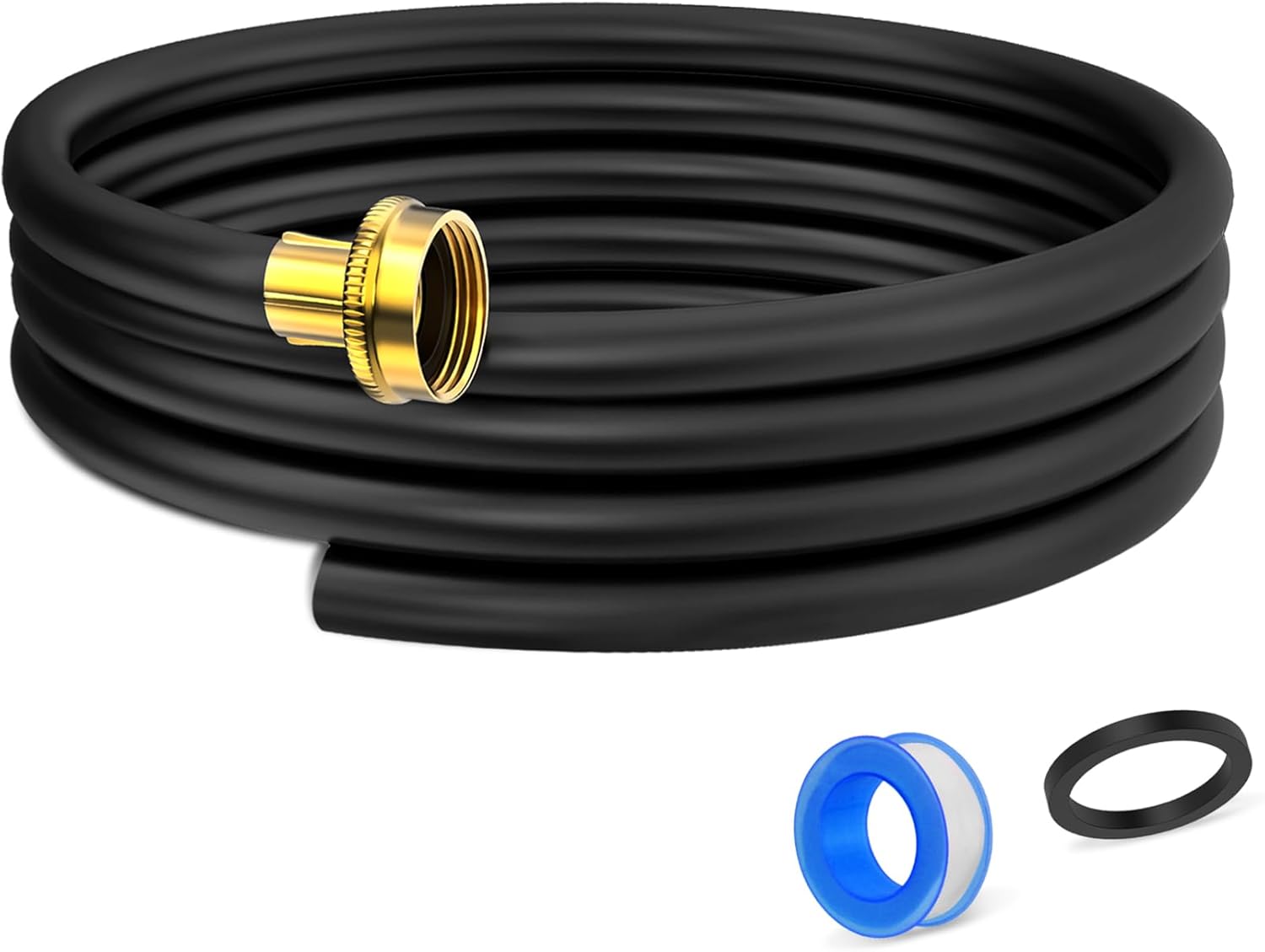
This dehumidifier drain hose is the 12-foot black variant with a 3/4-inch FHT connector. The listing specifies a brass interface with a rubber seal and corrosion-resistant rubber construction. It can be cut to a shorter length and is designed for dehumidifier drainage plus other hose applications.
Check On AmazonIf you click this link and buy, we earn a commission at no additional cost to you.
Use current independent testing only after the household requirements are fixed
Independent testing is most useful when it answers a question you have already defined. Measured moisture removal, sound, energy use, heat, and usability can separate current models that otherwise look similar on paper. What a lab cannot know is whether a particular cabinet blocks your filter access, whether a drain route works in your basement, or whether the person emptying the bucket finds it manageable. Those are household facts that have to come from the planned setup.
Use the current dehumidifier recommendations when you are ready to compare live models against that setup. For a cool or utility basement, the current dehumidifier options for basements narrow the comparison around conditions that matter more there. Keeping model selection at the end prevents a test winner from deciding the problem for you. The shortlist should answer your requirements, not create them.

The Govee H5075 is an indoor hygrometer and thermometer with Bluetooth app control. The listing specifies remote monitoring up to 164 feet and smart alerts. It also lists two years of data storage and export for recorded temperature and humidity readings.
Check On AmazonIf you click this link and buy, we earn a commission at no additional cost to you.
Final thoughts: choose the machine that can keep working in the actual room
A good purchase is one you can place correctly, drain realistically, maintain without a fight, and run under the conditions the manufacturer documents. Pint capacity, IEF, controls, and coverage claims help compare candidates, but none of them replaces that household check. Verify the exact manual where operating limits, hose setup, pump capability, clearances, cleaning, or safety instructions can vary. The useful specification is the one that survives contact with the actual room.
That may point to a straightforward portable unit, a pump-equipped design because water must move upward, or a whole-home system because the moisture problem is distributed. It can also point to no purchase until an active water source is corrected. The goal is not to collect the most features. It is to choose a moisture-removal setup that the household can realistically keep operating.

This Frigidaire portable dehumidifier has a 50-pint rating and a built-in pump. The listing describes quiet and energy-efficient operation along with custom humidity control. It also specifies an easy-to-clean washable filter for routine owner maintenance.
Check On AmazonIf you click this link and buy, we earn a commission at no additional cost to you.

This Midea model has a 22-pint dehumidification rating. It is listed for basements and spaces up to 1,500 square feet. The selected Amazon variant carries an Energy Star designation.
Check On AmazonIf you click this link and buy, we earn a commission at no additional cost to you.
FAQs
Most dehumidifier questions return to capacity, drainage, temperature, and served space. Settle those points before smaller features. Exact setup details still depend on the model. Use these as buying checks, not universal specifications.
For room questions, start with served area and moisture condition. For machine questions, check the current manual. Safety and recall questions require exact model identification. That keeps buying advice separate from unsafe repair work.
💧 Does a dehumidifier need a drain hose?
No. A portable unit can use a bucket, while an approved hose can drain to a safe lower point. If water must move upward, verify the exact model’s pump capability.
📏 How do I know what size dehumidifier to buy?
Use served area plus moisture condition, then compare current pint-per-day ratings. Do not size from advertised square footage alone.
🪣 Is bucket size the same as dehumidifier capacity?
No. Capacity describes moisture removed under test conditions; bucket volume describes stored water. A high-capacity machine can still need frequent bucket emptying.
🏠 Can one portable dehumidifier handle multiple rooms?
Sometimes, but floor plan, airflow, doors, and moisture load change the served area. Do not assume one coverage claim proves even control across separate rooms or floors.
❄️ Do I need a special dehumidifier for a cool basement?
Choose a model whose operating range and frost behavior match the basement temperature. Check the manual rather than relying only on a basement marketing label.
⚙️ Is a built-in pump worth paying for?
It can be when the practical drain point is above the machine and gravity cannot work. With a safe lower drain, a pump may add cost without solving a problem.
References and sources
This article uses primary US sources for technical claims that affect buying decisions. ENERGY STAR and DOE material support capacity, IEF, system definitions, test procedures, temperature guidance, and drainage. CPSC information supports checking exact models for recalls. Household fit judgments are editorial rather than manufacturer performance claims.
Exact model limits can differ for pumps, hoses, clearances, temperature, cleaning, and stop conditions. Check those details in the current manual for the exact machine being considered. These sources are included because the article relies on their technical or safety information. Live product recommendations are intentionally kept outside this article.
- ENERGY STAR dehumidifier guidance: Supports capacity, drainage, temperature, placement, and IEF.
- ENERGY STAR testing and capacity: Explains the current test basis and older-versus-current rating issue.
- ENERGY STAR efficiency criteria: Defines IEF and efficiency criteria.
- US Department of Energy dehumidifier standards: Provides the federal product and test framework.
- CPSC dehumidifier recalls: Provides recall and remedy information for affected models.