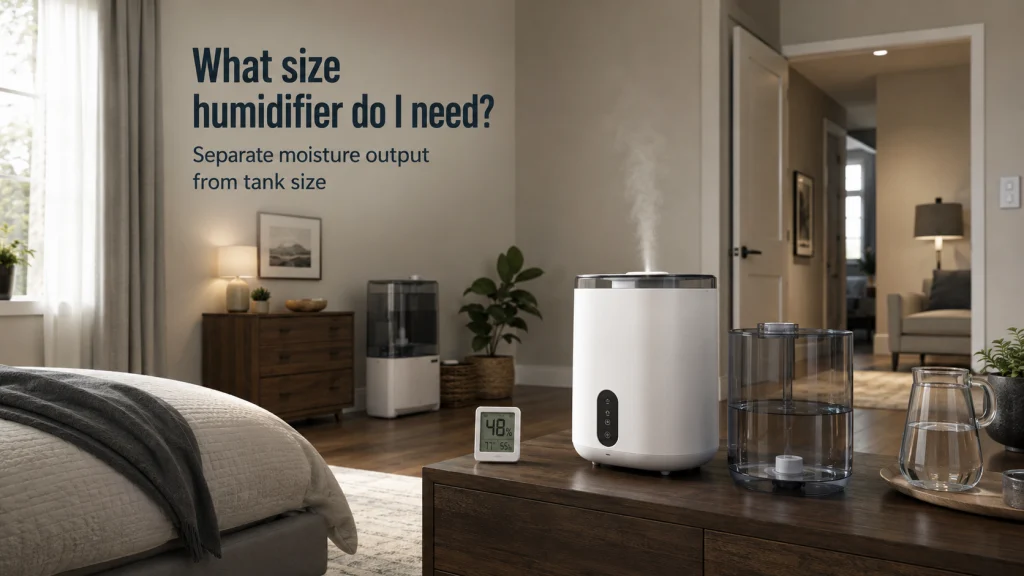
A humidifier’s tank size tells you how much water it can hold, not how much moisture it can add to a room. Size the machine first by the space you actually want to serve and by credible moisture-output or room-coverage evidence, then use tank capacity and runtime to judge refill burden. Higher ceilings, open doors, connected rooms, starting humidity, and air leakage can all make a square-foot label less dependable. The practical goal is enough output to maintain the intended space without buying a reservoir that is awkward to carry, fill, clean, or keep under control.
A large tank is not the same thing as a large humidifier
If you are asking, “what size humidifier do I need,” ignore the reservoir label for a moment. A 6-liter tank holds more water than a 4-liter tank, but that comparison only describes storage between refills. It does not show how quickly either unit adds moisture, how much space it can maintain, or how accurately it stops at the set level. A roomy reservoir can make a modest-output machine run longer without making it suitable for a larger room.
Use output first, served space second, and refill convenience after both look credible. Independent tests often treat moisture output separately from claimed coverage, which is more useful than equating tank liters with humidification power. A larger reservoir can reduce sink trips, but only after the machine has enough capacity for the job. For the broader feature and ownership framework, the humidifier buying guide puts sizing alongside controls, cleaning, noise, and maintenance. Humidifier sizing also sits within the wider air quality appliances decision, where output and served space matter before reservoir convenience.
| Number on the listing | What it actually tells you | What it does not prove |
|---|---|---|
| Physical dimensions | How much shelf, floor, or furniture space the unit occupies | How much moisture it can add to the air |
| Reservoir capacity | How much water the tank can hold before refilling | Room coverage or moisture output |
| Moisture output or tested capacity | How much water the machine can put into the air under stated test conditions | How often you will personally refill it in every setting and room |
| Claimed coverage | The area the maker says the unit is intended to serve | Equivalent performance in every ceiling height, layout, or starting humidity |
Keep those numbers separate while shopping. Output and credible coverage evidence address room suitability, while tank capacity addresses refill burden.

This 6-liter top-fill ultrasonic humidifier supports app and voice control for adjusting mist and humidity settings. Its rated mist output is 300 mL per hour, with coverage listed up to 505 square feet. The large reservoir supports longer operation between refills without treating tank size itself as proof of room capacity.
Check On AmazonIf you click this link and buy, we earn a commission at no additional cost to you.
Measure the space one unit is actually expected to serve
Start with the room or connected area where the humidifier will operate, not total home square footage unless air can mix through that whole space. For a closed bedroom, length multiplied by width gives a useful first floor-area measurement. In a living room open to a kitchen or dining area, measuring only the furniture zone can understate the job. The served area is a layout question before it becomes a product-spec question.
A simple worksheet is enough; there is no need to invent a precision calculator. Record room dimensions, open doors, high ceilings, and open stairs that connect to more air volume. Also note where the unit can actually sit, because a suitable machine still fails the household fit test if placement is impractical or the sink is too far away. That gives you a more honest humidifier room size than a bedroom label or one square-foot estimate.
| Measurement check | What to record | Why it changes the decision |
|---|---|---|
| Floor area | Room length x room width | Creates the basic area you can compare with credible coverage evidence |
| Connected openings | Open kitchen, hallway, doorway, or stair connection | The unit may be serving more air than the named room suggests |
| Ceiling condition | Standard, high, vaulted, or double-height | More air volume can make floor area alone less descriptive |
| Placement | Real operating location and path to the sink | Controls refill effort, carrying distance, and practical use |
Use the worksheet as a filter, not a formula. Its job is to expose the real served space before you compare output evidence.

A compact laser distance measure with a working range up to 165 feet and accuracy up to plus or minus 1/16 inch. It provides real-time measurement, a backlit color display, and multiple measuring functions for distance, area, volume, and indirect measurements. The IP65-rated housing and included belt clip and pouch make it suitable for both household measuring tasks and more demanding jobsite use.
Check On AmazonIf you click this link and buy, we earn a commission at no additional cost to you.
Use output evidence instead of the biggest coverage claim
Coverage labels are a starting screen, not a common standard across brands. A stronger comparison uses measured moisture output, disclosed independent testing, or a clearly stated manufacturer coverage figure checked against the space you measured. Consumer Reports tests whether models release enough moisture for their intended area instead of using tank volume as the size metric. RTINGS also separates advertised coverage from tested humidification capacity.
You do not need to turn shopping into a laboratory exercise. The point is to keep an aggressive square-foot badge from outranking clearer performance evidence. When independent output data is unavailable, treat manufacturer coverage as a claim for that model rather than a universal sizing rule. A candidate becomes more credible when its output evidence, stated area, and your measured space agree.
| Served-space benchmark | RTINGS tested-output band to look for | How to use it |
|---|---|---|
| 100 to 300 sq. ft. | 2.0 to 3.5 LPD | A useful small-room screening band when the test method is comparable |
| 300 to 500 sq. ft. | 3.5 to 6.0 LPD | A practical medium-room benchmark for shortlisting tested units |
| 500 to 1,000 sq. ft. | 6.0 to 9.0 LPD | A large-room benchmark that should still be checked against layout and starting conditions |
| Over 1,000 sq. ft. | More than 9.0 LPD | A signal that you are moving into very large-space or console territory |
These bands come from one independent test framework, so do not treat them as a universal conversion. Consumer Reports also groups humidifiers by room size but judges whether each model produces enough moisture for its intended area. Use the table to identify an output class worth shortlisting, then favor the stronger end of the evidence when ceilings, openings, or air exchange make the room harder to serve. For spaces below the table’s range, use exact model coverage or tested evidence rather than extrapolating downward.
- Prefer measured moisture output when a credible independent test publishes it.
- Treat manufacturer coverage as a claim for that exact model.
- Do not infer output from tank liters, mist plume size, or price.
- Reject a borderline match when the real served space is more demanding than the test case.
The benchmark gives you a class to shortlist without pretending every room behaves the same. Compare candidates using evidence produced under stated conditions.

This evaporative console humidifier has a 3.6-gallon reservoir and is designed for large-space humidification. It provides four fan speeds plus automatic humidistat control for maintaining a selected humidity setting. AIRCARE lists coverage up to 3,600 square feet, making it a concrete large-output-class example rather than a tank-size proxy.
Check On AmazonIf you click this link and buy, we earn a commission at no additional cost to you.
Adjust for ceilings, open doors, and air that does not stay put
Square footage describes the floor, while the humidifier works against the air volume and movement in the space. A high or vaulted ceiling adds air volume without changing floor area. An open doorway or stair lets moisture spread beyond the named room. Those conditions make a borderline coverage match less convincing without justifying a fixed correction multiplier.
Starting humidity and air leakage change the workload because the machine may be replacing moisture that keeps leaving. A closed room that begins mildly dry is easier to serve than an open living area connected to a drafty hall. Instead of adding a fixed number to advertised coverage, move away from a just-enough candidate toward stronger documented output. That keeps the adjustment practical without pretending every tall ceiling or open door has the same effect.
Key point: Treat room geometry and leakage as reasons to question a borderline match, not as permission to invent a universal correction factor.
For a borderline room, compare candidates under the same conditions and favor the one with stronger documented output. A larger reservoir does not compensate for a weak capacity match.

This digital hygrometer shows room temperature and relative humidity on a large LCD. It records high and low readings and includes a comfort indicator for quick condition checks. The unit has both a tabletop stand and a magnetic back for flexible placement around the room.
Check On AmazonIf you click this link and buy, we earn a commission at no additional cost to you.
Separate raising humidity from maintaining it
A small machine can make the humidity reading move in a large room without being able to maintain that space. Visible mist or a short-term sensor change can therefore give a false sense of adequate sizing. The harder test is whether the unit keeps up while normal air movement and ventilation remove moisture. Capacity is about sustained workload, not whether the reading rises once.
Think of the difference as recovery versus holding power. If a candidate runs continuously at its highest setting and still cannot hold the room near the selected level, the workload may exceed its practical capacity. A very strong unit in a small closed room creates the opposite problem and needs dependable control. A good size match can maintain the room without constant maximum operation or repeated manual correction.
Note: This is an equipment-sizing framework, not a medical recommendation. The appropriate indoor humidity target can depend on climate, building conditions, condensation risk, and other household factors outside the question of which humidifier size to buy.
Runtime is supporting evidence here, not a substitute for capacity. A long run at low output can still leave a demanding room undersized.

This Bluetooth hygrometer tracks room temperature and humidity and displays both on its LCD. The companion app supports alerts plus stored history and data export for reviewing changes over time. Govee specifies humidity accuracy of about plus or minus 3 percent RH, which helps compare short-term rises with sustained room conditions.
Check On AmazonIf you click this link and buy, we earn a commission at no additional cost to you.
Choose tank size and runtime for the refill routine after output is adequate
Once output is adequate, tank capacity becomes a practical ownership decision. A larger reservoir can reduce sink trips, but it also adds water weight, bulk, and handling effort when full. Runtime matters only when the setting behind it is known because a long low-output run is not the same as sustained higher output. The useful tank is the one that fits your normal operating pattern without making refilling a chore you avoid.
Imagine two candidates with credible capacity for the same room. One has a smaller tank that fits easily under the faucet, while the other reduces refills but needs a wider grip and more sink clearance. Neither is automatically better because fewer refills matter only if the larger tank is still comfortable to lift, drain, and clean. This is where humidifier size becomes a workflow choice rather than a performance contest.
| Refill pattern | What it usually favors | Tradeoff to check |
|---|---|---|
| You are comfortable refilling more often | Smaller, easier-to-handle reservoir | More sink trips during heavy use |
| You want fewer interruptions | Larger reservoir after output is sufficient | More filled weight and storage bulk |
| The sink is far from the operating location | Tank that balances capacity with secure carrying | Spill risk and awkward transport |
| Cleaning access is limited | Reservoir shape you can fully reach and drain | A larger tank may create more cleaning friction |
Choose the smallest handling burden that still gives you an acceptable refill routine. Fewer sink trips are useful only when the full tank remains practical to carry and clean.

This 3-liter cool-mist humidifier uses a top-fill tank with a wide opening for easier refilling and cleaning. Levoit lists up to 25 hours of runtime on the minimum mist setting and coverage up to 290 square feet. It uses a simple control knob to adjust mist output and includes automatic shutoff when water runs low.
Check On AmazonIf you click this link and buy, we earn a commission at no additional cost to you.
Check the full tank, not just the empty machine
Product dimensions and empty weight tell only part of the ownership story because water becomes part of the load. A tank that looks manageable on a shelf can feel different when it is full, wet, and being turned under a faucet. Wide tanks need sink clearance, while tall ones can be awkward under low fixtures. Capacity therefore has to fit the person who will carry, fill, drain, and reinstall the tank.
Cleaning access matters because more capacity can mean deeper corners or more awkward handling. Check the opening, whether a hand or cleaning tool can reach inside, how completely the tank drains, and whether parts need different cleaning treatment. Follow the exact manual when those details vary by model instead of assuming one method fits every humidifier. A tank that reduces refills but makes cleaning frustrating may not be an upgrade for your household.
- Picture the tank filled with water, not displayed empty on a product page.
- Check faucet height, sink depth, grip points, and the path back to the humidifier.
- Confirm that the reservoir opening and interior shape are practical to clean.
- Check the exact manual for cleaning, draining, and water-quality instructions.
A larger reservoir earns its space only when it stays manageable through filling, carrying, draining, and cleaning. That is the ownership test the empty product photo cannot show.

This bottle brush combines a long flexible neck with two bristle types to reach inside bottles, pitchers, and narrow openings. Its soft non-slip handle is designed for a secure grip during wet cleaning. The brush is dishwasher safe for easier cleanup after use.
Check On AmazonIf you click this link and buy, we earn a commission at no additional cost to you.
Add automatic control after capacity is sufficient
Output tells you whether the machine can do the job, while control determines how well it backs off afterward. A humidistat or automatic setting matters more once the unit has enough capacity to change the room noticeably. Accuracy is more useful than the mere presence of an automatic mode, so independent control testing is valuable when available. Treat control as a companion to proper sizing, not a substitute for it.
This is also why “bigger is safer” is the wrong default for humidifiers. A very powerful unit can create more monitoring work in a small or closed room if its controls are crude, while a properly sized machine with dependable automatic behavior can be easier to live with. Watch the room itself as well as the display, especially for condensation or damp surfaces that suggest the moisture load is exceeding what the space should comfortably accept. If the manual gives model-specific placement, control, or shutdown instructions, those instructions take priority over generic advice.
Warning: If you see persistent condensation, wet surfaces, leaking into electrical areas, damaged cords, smoke, a burning odor, overheating, or uncontrolled operation, stop using the unit and follow the manual or qualified-service guidance appropriate to the problem.
Automatic control is most useful after the capacity match is sound. Treat output and control as separate checks rather than letting one stand in for the other.

This 6-liter smart humidifier provides both warm and cool mist and supports app control. Auto mode can maintain a selected humidity target, while Manual and Sleep modes offer different control behavior. Dreo lists warm-mist output up to 500 mL per hour, so capacity and automatic control can be evaluated as separate parts of the fit.
Check On AmazonIf you click this link and buy, we earn a commission at no additional cost to you.
Know when one portable unit is being asked to do too much
A portable humidifier is easiest to size for one room or one genuinely connected living area. The match becomes less convincing when the same unit must push moisture through closed bedrooms, around corners, or between floors. At that point, distribution matters as much as output. More reservoir volume cannot fix a layout that keeps treated air from reaching separate spaces.
This is the point to stop chasing ever larger portable labels and reconsider the system boundary. Multiple room units may make sense when different spaces need independent control, while a house-wide goal may warrant comparing a central solution instead of expecting one console to behave like ducted equipment. The whole-house versus portable humidification comparison is the better next step when the job has expanded beyond one room or connected zone. Exact ducted-system sizing and installation, however, belong with qualified HVAC assessment rather than a portable-humidifier calculator.
Stop point: If your sizing worksheet includes several closed rooms, separate floors, or a whole-home target, stop treating one portable unit’s tank size as the answer and reassess the type of system you need.
Once distribution across separate rooms becomes the problem, increasing portable tank size is the wrong upgrade path. Reassess the system type instead.
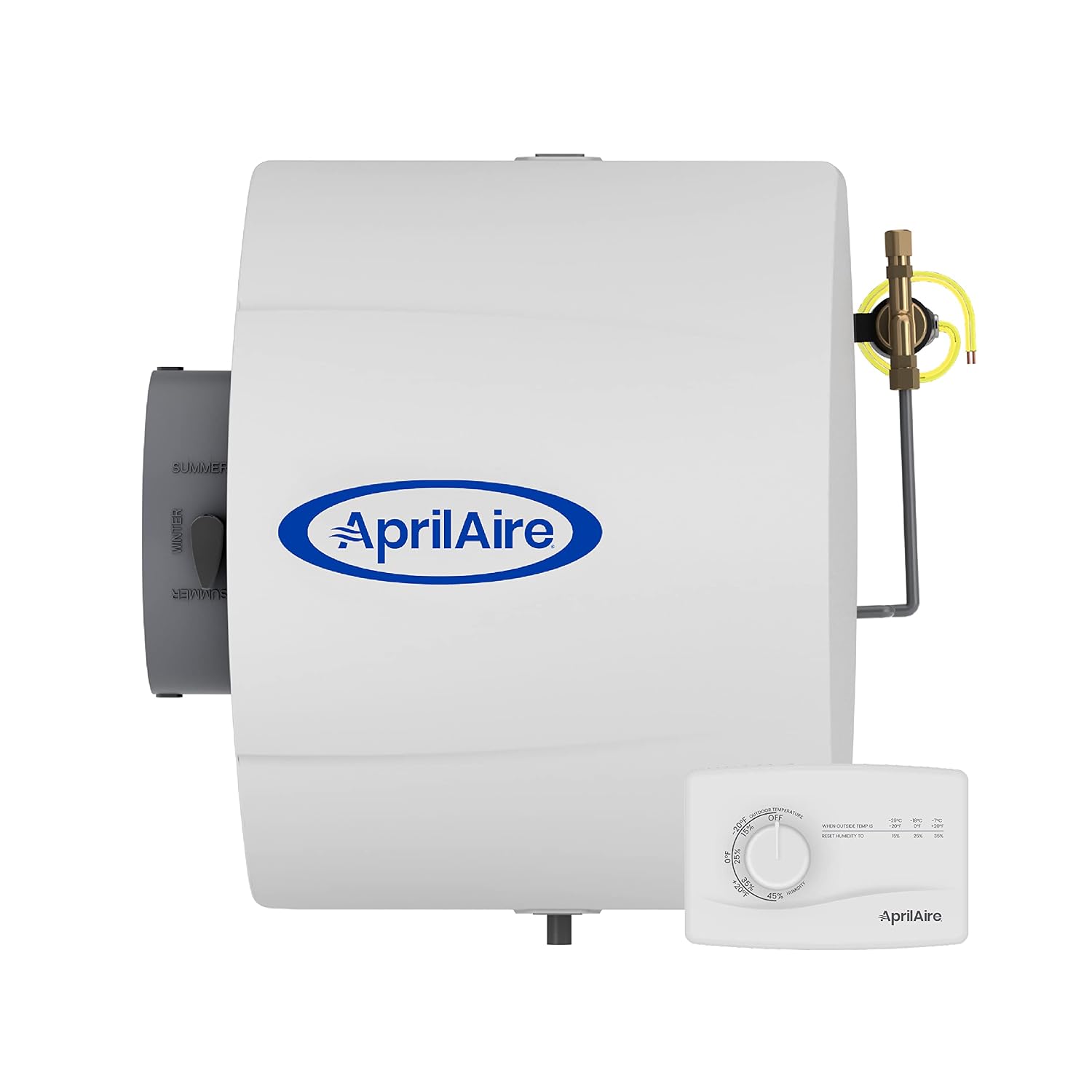
This whole-house bypass evaporative humidifier is designed for installation with a central HVAC system rather than portable room use. AprilAire rates the 600M at 17 gallons per day and pairs it with manual humidity control. The package includes the humidifier, manual humidistat, water panel, outdoor sensor, saddle valve, and drain tubing.
Check On AmazonIf you click this link and buy, we earn a commission at no additional cost to you.
Move from sizing to actual humidifier selection
Once you know the served area, harder room conditions, and the output evidence you want, the shopping list becomes easier to control. Reject units that are too weak before app features, lighting, mist modes, or oversized reservoirs distract from the workload. Also reject capable machines that create a tank, cleaning, or carrying routine you do not want. This is more useful than relying on small, medium, or large marketing labels alone.
For a bedroom or other overnight room, let the sizing work feed into a quieter, easier-to-refill ownership profile instead of restarting from zero. For broader shopping, use the current humidifier recommendations only after identifying the output class and refill burden that fit your room. That keeps model selection downstream from the sizing logic instead of letting a popular model define the job. Reach the shortlist knowing what evidence makes a candidate suitable and what tradeoff makes you skip it.
- Keep only candidates with credible output or coverage evidence for the served space.
- Prefer stronger evidence when your layout is open, high-ceilinged, or otherwise demanding.
- Choose a reservoir that fits your refill and carrying tolerance after output is adequate.
- Check automatic control, cleaning access, noise, and placement before paying for extra features.
That turns a vague “what size humidifier for my room” search into a shortlist with a defined output class, room condition, and refill burden. Product choices can change without changing those filters.

This 6-liter smart ultrasonic humidifier uses a top-fill reservoir and is rated for up to 60 hours of runtime. It supports app, touch, and voice control, with automatic humidity control and a real-time display. Dreo lists coverage up to 500 square feet, so output class, tank handling, controls, and room claim can be checked together.
Check On AmazonIf you click this link and buy, we earn a commission at no additional cost to you.
Final Thoughts: Buy enough output, then choose the tank you can live with
The right humidifier size is not the biggest reservoir you can fit on a shelf. Start with the room or connected area the machine must actually serve, then look for credible output or coverage evidence that matches that workload. Treat high ceilings, open layouts, and dry air leakage as reasons to be cautious with a borderline match rather than reasons to use a made-up multiplier. Once capacity is adequate, tank size becomes a question of how often you want to refill and how much water you are comfortable carrying and cleaning around.
That order keeps the decision grounded in household use. A modest tank on a capable machine can be a better fit than a huge tank on a weaker one, while a larger reservoir can be worthwhile when it genuinely reduces refill friction without becoming awkward. Automatic control and sensible placement then help keep adequate output manageable instead of turning extra capacity into extra monitoring. Buy enough moisture output for the job, then choose the reservoir and controls that make you willing to use the machine consistently.

This 6-liter hybrid ultrasonic humidifier offers both warm and cool mist with smart app control. Levoit lists coverage up to 753 square feet, while Auto Mode uses humidity feedback to adjust operation. Its top-fill design and scheduled controls combine output, reservoir handling, and automatic operation in one model for a final fit check.
Check On AmazonIf you click this link and buy, we earn a commission at no additional cost to you.
FAQs
Product pages often place tank liters beside square-foot coverage, which makes humidifier sizing look simpler than it is. Separate those numbers into output, served space, and refill burden. Room measurements narrow the field, while layout and control refine the choice. The questions below cover the checks that most often change the decision.
These answers do not replace the exact model manual or a qualified whole-home assessment. Use them to identify the evidence you need and the point where a portable unit stops fitting the job. Verify any model-specific number under its stated conditions. That keeps the process practical without inventing one universal conversion chart.
💧 Does a bigger humidifier tank mean it covers a bigger room?
No. Tank capacity mainly affects water storage between refills. Room suitability depends on moisture output, credible coverage evidence, the served space, and room conditions.
📏 Should I size a humidifier by square footage?
Use square footage as the starting measurement for a defined room or connected area. Then account qualitatively for high ceilings, open doors, stairs, and air leakage instead of applying an invented universal multiplier.
🚪 Does leaving the bedroom door open change the size I need?
It can. An open door lets moisture mix into adjacent space, so the unit may serve more air than the bedroom area suggests. Treat a borderline coverage match more cautiously.
🪣 Is a larger tank worth it if I hate refilling?
It can be, after output is adequate. Check filled weight, faucet clearance, grip, drainage, and cleaning access before assuming fewer refills make a larger tank easier to own.
🎛️ Can an automatic humidistat make an oversized unit safe?
Automatic control can reduce overshoot, but it does not erase poor sizing. Choose adequate capacity first, then prefer control that can maintain the selected level without constant adjustment.
🏠 When should I stop looking at portable humidifiers?
Reconsider the system type for several closed rooms, separate floors, or a whole-home target. Distribution matters as much as output, and one larger portable reservoir does not solve it.
References and Sources
The sources below support the room-size categories, tested-output benchmark, and the separation of moisture output from reservoir volume. They are used for sizing evidence, not for a specific product recommendation.
Coverage still varies by model, test method, and room conditions. Use the exact model manual for placement, cleaning, water, and operating instructions.
- Consumer Reports room-size guidance: Supports room-size categories and testing whether a humidifier releases enough moisture for its intended area.
- RTINGS humidifier testing: Supports the tested humidification-capacity bands used as the non-universal output benchmark.