Small countertop machines are useful when they remove enough work from a task you repeat to justify the space, handling, cleanup, and maintenance they add. The right choice is rarely the appliance with the longest feature list; it is the one that fits your normal batch size, available counter or cabinet space, and actual routine. This page helps you sort appliance families by job, test whether a dedicated machine earns ownership, and decide which product type deserves a closer look next.
Convenience has to survive the whole kitchen routine
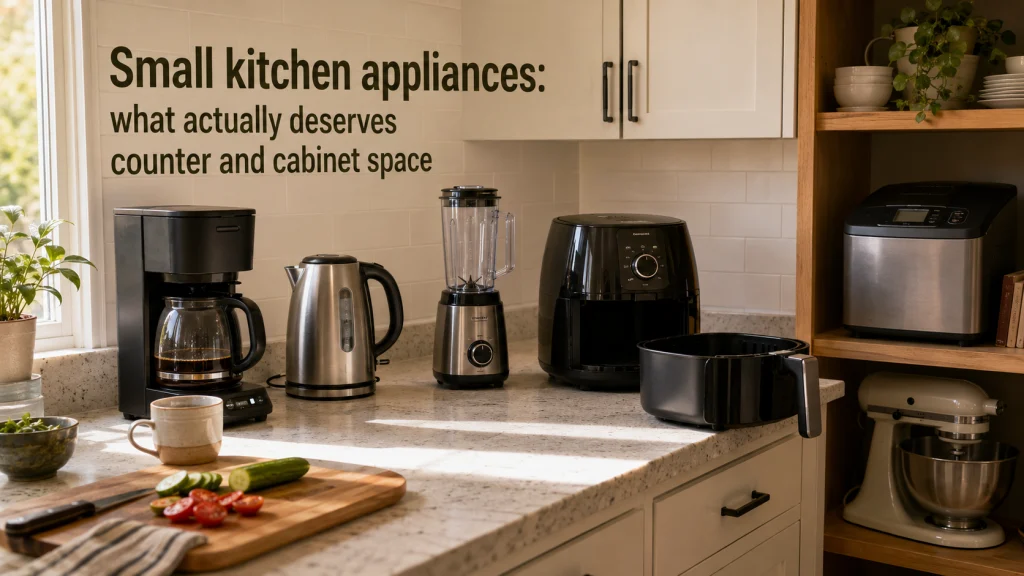
Small kitchen appliances are usually sold around a simple promise: give one job to a machine and get time or effort back. That promise can be real, but the machine also needs somewhere to live, enough room to operate, and a cleanup routine you will tolerate. A shortcut becomes less convincing when it permanently occupies prep space or has to be hauled out of a crowded cabinet for every use. The real question is not whether the appliance can do the job, but whether it improves a job your household repeats often enough to earn ownership.
That is why feature lists are a poor starting point. A specialized machine can be a smart purchase when it removes work you regularly dislike, while a more versatile machine can still become clutter if its extra modes rarely matter. The decision starts with frequency, current alternatives, physical fit, usable capacity, and the work that happens after the button is pressed. Once those are clear, it becomes much easier to tell which appliance family deserves a closer comparison and which attractive possibility can stay at the store.

This 1.7-liter Cosori kettle uses a borosilicate-glass body and 1500 watts for boiling water. The black model has a wide opening designed for easier cleaning. Automatic shutoff and boil-dry protection are built into the kettle.
Check On AmazonIf you click this link and buy, we earn a commission at no additional cost to you.
What counts as a small kitchen appliance here
Small kitchen appliances are most useful to think about as dedicated machines for recurring kitchen jobs, not as a retailer department full of things a household is supposed to own. A useful small kitchen appliance guide should help you decide whether a machine improves a task enough to deserve the money and physical space it takes. That means starting with what you mix, chop, heat, brew, preserve, or prepare regularly, then checking what you already use for the same job. Countertop appliances that solve an occasional possibility but complicate everyday prep can still be poor fits.
This page stays at that decision level. It covers compact and countertop equipment for food prep, cooking, beverages, preservation, and a few specialty jobs, but it does not turn into a ranking of individual models. Major built-in appliances, broad cookware advice, recipes, kitchen decor, and professional repair work sit outside this scope. When operating clearances, electrical requirements, cleaning procedures, or other safety details depend on an exact model, the manufacturer instructions for that model control the decision.

The Ninja BN701 combines a 72-ounce pitcher with a 1400-peak-watt motor. Three Auto-iQ presets cover smoothies, frozen drinks, and ice cream. The listing identifies Total Crushing blades and dishwasher-safe components.
Check On AmazonIf you click this link and buy, we earn a commission at no additional cost to you.
Start with the kitchen job you repeat
The easiest way to overbuy is to start with an appealing machine and invent uses afterward. Reverse the order and name the repeated job first. Identify what handles that work now, how often it happens, and which part of it is actually inconvenient. Then ask whether a dedicated machine removes enough effort to justify setup, washing, storage, and maintenance.
The map makes that question practical. Match the recurring job to the next decision, not straight to models. A blender and a rice cooker may share a counter, but their fit evidence differs. Once the job is clear, the appliance-specific page handles class, size, and ownership choices.
| Repeated job | Next decision | Appliance topic |
|---|---|---|
| Mix, whip, or knead | Mixer format | Types of mixers |
| Chop, slice, or shred | Processor workload | Food processor guide |
| Blend drinks or purees | Blender class | How to choose a blender |
| Crisp small heated batches | Air-fryer format | Types of air fryers |
| Slow cook or pressure cook | Modes and capacity | What to know before buying a multi cooker |
| Seal food | Format and consumables | How to choose a vacuum sealer |
| Dry food | Tray area and cleanup | What to look for in a food dehydrator |
| Bake pizza indoors | Footprint value | Indoor pizza oven |
| Brew coffee | Brewer class | Types of coffee makers |
| Make espresso | Machine type | Espresso machine guide |
| Grind coffee | Grinder architecture | Choosing a coffee grinder |
| Toast or compact-bake | Slots or oven | Toasters and toaster ovens |
| Reheat by microwave | Size and clearance | Countertop microwave |
| Cook rice or grains | Capacity | Choosing a rice cooker |
| Juice produce | Type and cleanup | Types of juicers |
| Boil water | Useful controls | What to look for in an electric kettle |
| Make bread | Workflow value | Bread machine guide |
| Cook broad flat batches | Surface and storage | What to look for in an electric griddle |
| Grill indoors | Grill layout | Types of indoor grills |
| Add a deep electric pan | Added cooking surface | Electric skillet guide |
| Make frozen desserts | Freezing workflow | What to know before buying an ice cream maker |
| Make countertop ice | Ice and cleaning | What to look for in a countertop ice maker |
| Carbonate drinks | Cylinder system | How to choose a soda maker |
| Add induction capacity | Compatibility and placement | Portable induction cooktop |
| Make waffles | Plate format | Types of waffle makers |
This map is a routing tool, not a shopping list. A weak or occasional job may still point back to the tool you already own. A strong repeated job gives the linked appliance page a clear question to solve. That keeps the next comparison focused on household fit instead of feature count.

The Cuisinart DLC-10SYP1 uses a 7-cup work bowl and a 600-watt motor. The food processor is listed for mincing, dicing, shredding, pureeing, and kneading dough. This selected variant is the white DLC-10SYP1 model.
Check On AmazonIf you click this link and buy, we earn a commission at no additional cost to you.
Separate frequent appliances from occasional project machines
Frequency is the first filter because ownership friction repeats even when the purchase price does not. A machine used every morning can justify a permanent counter position that would be wasteful for something used a few times a year. An occasional appliance can still be worth owning, but it needs a stronger reason, such as replacing an expensive service, making a food you cannot easily buy, or handling a batch that existing tools manage poorly. Without that reason, the machine has to be stored, moved, cleaned, and remembered for very little return.
Do not turn frequency into a rigid rule such as “weekly is good, monthly is bad.” The better question is how much work the machine removes each time it is used. Then compare that benefit with the work ownership adds between uses. A kettle used several times a day and a bread machine used on weekends can both make sense in different homes.
| Use pattern | What usually matters most | Question to ask before buying |
|---|---|---|
| Daily or near-daily | Counter access, quick cleanup, reliable workflow | Does this reduce enough repeated work to deserve permanent space? |
| Weekly | Easy retrieval, useful capacity, manageable cleanup | Can I reach, use, wash, and put it away without rearranging the kitchen? |
| Occasional project use | Storage, replacement value, specialized capability | Does it do something important that my current tools cannot do reasonably well? |
The table is not a scorecard. It exposes the question that matters more as frequency drops. Ask what specifically justifies keeping the machine available. If the answer is only that you might use it someday, the purchase case is still weak.

The Hamilton Beach 49980A combines a single-serve brewer with a 12-cup coffee pot in one countertop unit. The selected model has a black and stainless-steel finish and includes a carafe. The listing also specifies an Auto Pause and Pour function.
Check On AmazonIf you click this link and buy, we earn a commission at no additional cost to you.
Price an appliance in space and handling, not only dollars
The sticker price is visible, but physical cost is what a kitchen keeps paying after the receipt is gone. Measure the actual place where the appliance will live, including the space needed to open a lid, remove a bowl, load a basket, reach controls, route a cord, or move the unit for cleaning. A machine that technically fits under a cabinet can still be a poor fit if it must be dragged forward every time it runs. The same is true of a “compact” appliance that leaves too little prep surface beside it.
Weight and handling belong in the same calculation because cabinet storage only works when retrieval is realistic. A heavier machine stored below the counter can be perfectly manageable for one household and enough friction to stop another household from using it. Before buying, picture the full movement path from storage to use to cleanup, not just the footprint shown on a product page. If that path collides with dishes, pantry items, a sink, or another frequently used machine, the storage plan is not finished.
- Measure the planned counter or cabinet footprint, not an empty area in isolation.
- Check vertical clearance for lids, bowls, hoppers, and anything removed from the top.
- Check how far doors, drawers, baskets, or handles extend during normal use.
- Decide whether the appliance stays out or must be lifted and stored after each use.
- Make sure the normal setup leaves useful prep space nearby instead of consuming it.
A good fit is not just “it can be placed there.” The appliance also needs to be usable without disrupting another routine. Loading, unloading, cleaning, and putting it away all count. In a small kitchen, blocked prep space can matter every day.

This AIEVE set includes eight small appliance sliders for countertop use. Each piece uses a self-adhesive caster-wheel design for moving a supported appliance. The listing identifies mixers, coffee makers, and air fryers among the intended appliance types.
Check On AmazonIf you click this link and buy, we earn a commission at no additional cost to you.
Match usable capacity to normal batches
Capacity is useful only when it describes the amount you can realistically process, cook, brew, or store in the way you normally use the machine. A larger bowl, basket, reservoir, or cooking vessel can reduce batch splitting, but it can also make the appliance wider, heavier, slower to clean, and harder to store. The household that cooks for two should not automatically buy around the biggest gathering it can imagine. Start with the batch that happens most often, then decide how much occasional inconvenience you are willing to accept.
Usable capacity also depends on geometry and the task. Two appliances with similar headline capacity can behave differently when one needs space around food, one has a narrow vessel, or one loses practical room to an internal component. This is why product-family pages need to examine capacity in context rather than treating one number as a universal comparison. At this overview level, the rule is simple: size for repeated work first, then verify the exact model’s usable dimensions before you buy.

The Zojirushi NS-ZCC10 is the 5.5-cup uncooked-rice variant of the Neuro Fuzzy rice cooker and warmer. It includes automatic keep-warm operation. A delay timer is also listed for the selected model.
Check On AmazonIf you click this link and buy, we earn a commission at no additional cost to you.
Treat multifunctionality as replacement value, not feature count
A machine with more modes is not automatically a better use of space. Multifunctionality matters when several functions replace tools, appliances, or manual steps the household already uses often enough to notice. If an extra mode sounds interesting but does not displace anything, it is just another feature to learn and possibly clean around. The most useful question is not “How many things can it do?” but “Which things will I stop doing another way?”
Overlap can also be partial. A toaster oven may cover some small oven jobs without replacing a microwave, while a multi-cooker may take over some slow-cooking duties without replacing a dedicated appliance for a household that uses both at the same time. Write down the current method before assuming replacement. If the new machine creates a second workflow instead of removing the old one, the space-saving argument is much weaker.
| New function | Current tool or method | Would the old method actually disappear? | New setup or cleanup added |
|---|---|---|---|
| Function you expect to use often | Write the appliance, tool, or manual step you use now | Yes, partly, or no | List bowls, baskets, attachments, accessories, or extra washing |
| Function that sounds convenient | Write what already handles it | Be realistic about whether you would switch | Note any storage or maintenance the function introduces |
This worksheet forces every claimed function to earn its place. Mark which functions would replace work you already do. If only one mode matters, compare the machine with a simpler appliance built for that job. Simpler can be the better household choice when it reduces cost, storage, and cleanup.
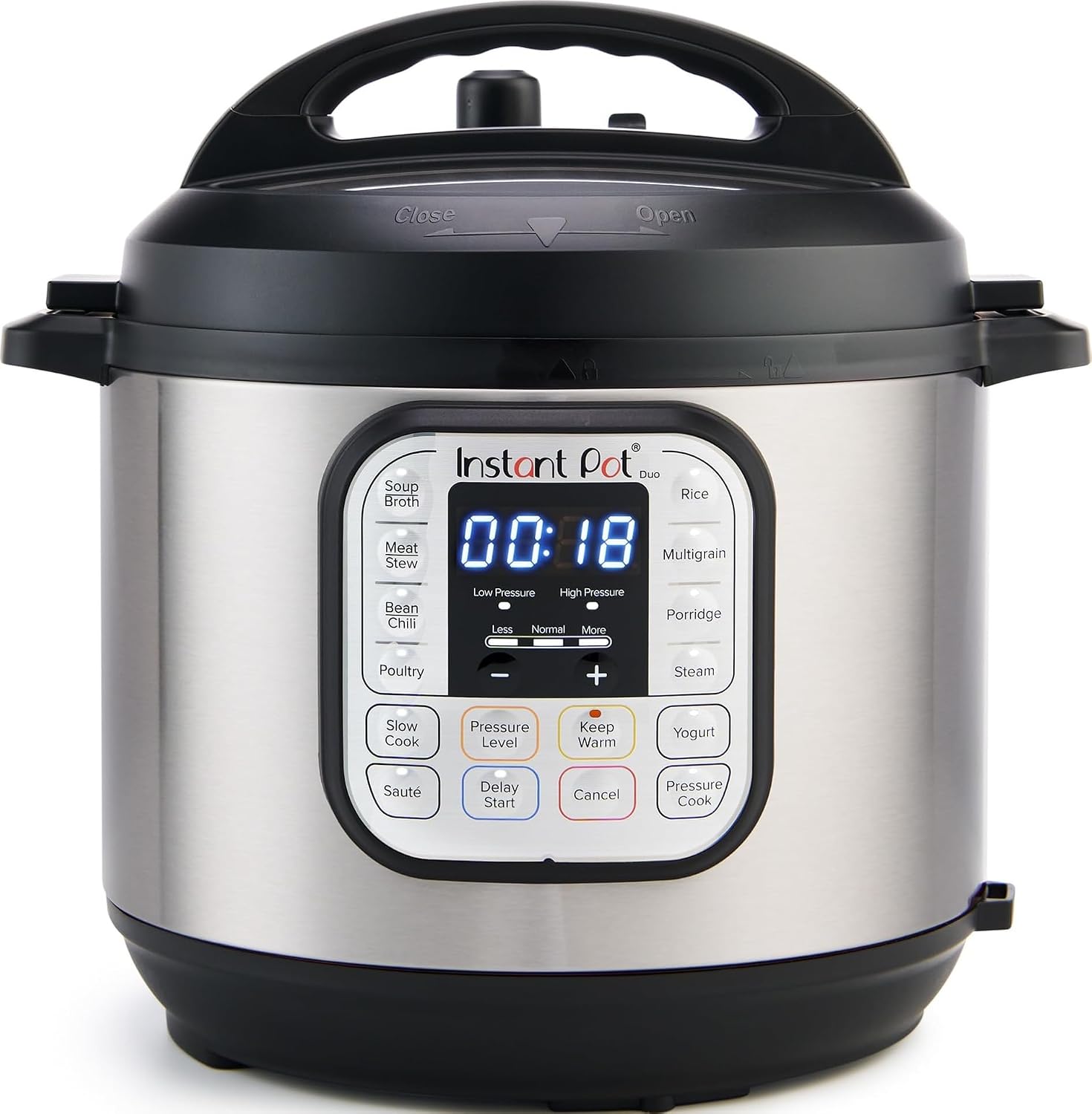
The 6-quart Instant Pot Duo combines pressure cooking, slow cooking, rice cooking, steaming, sauteing, yogurt making, and warming in one appliance. The selected model uses stainless steel. The listing identifies it as the Duo 7-in-1 model and includes app access with more than 800 recipes.
Check On AmazonIf you click this link and buy, we earn a commission at no additional cost to you.
Count cleanup, attachments, consumables, and maintenance
Convenience is the whole workflow, not just the minutes when the motor or heater is running. A machine can save active prep time and still lose that advantage if it creates several awkward parts to wash, a drip tray that needs frequent attention, accessories that need separate storage, or consumables that must be kept on hand. These costs are not reasons to reject an appliance. They are part of deciding whether the machine still feels convenient after the novelty wears off.
Look for the recurring work around the main task: emptying grounds or pulp, washing parts, descaling, replacing filters, buying consumables, drying removable pieces, and storing attachments. Exact requirements vary by product and model. Verify the manual and product documentation when maintenance details control the decision. Make that ownership burden visible before assuming a faster active cycle means less total kitchen work over weeks of normal use.

This IMPRESA coffee-machine descaler is sold as a two-pack described as a one-year supply. The solution is listed for use with Keurig, Nespresso, Breville, DeLonghi, Jura, and Ninja machines. It is made in the USA and intended to remove limescale from coffee equipment.
Check On AmazonIf you click this link and buy, we earn a commission at no additional cost to you.
Use specifications to narrow choices, not to promise performance
Specifications are valuable when they answer a concrete fit or workflow question. Exterior dimensions can eliminate a machine that will not fit the planned space, capacity can identify obviously undersized options, and included accessories can tell you whether the setup needs extra parts. Those facts are useful because they describe what the product is, what comes with it, or what physical constraints it has. They do not automatically prove that the machine will be faster, quieter, easier to clean, or better at the result you care about.
Performance claims need evidence that matches the task and conditions being discussed. A wattage number, mode count, premium label, or marketing name can help describe a product, but it should not become a shortcut for quality unless independent testing or clear product-specific evidence supports the connection. Use specifications to narrow the shortlist, then move to the appliance-specific page for the performance questions that actually belong to that product family. That keeps a cross-category comparison from pretending that one generic spec can judge twenty-five different kinds of machines.

The CRAFTSMAN CMHT37225 has a 25-foot measuring range. Fraction markings are printed on the tape for quick reading. Its retractable blade uses a self-locking mechanism.
Check On AmazonIf you click this link and buy, we earn a commission at no additional cost to you.
Build a keep, buy, or skip shortlist before comparing models
Once the job, frequency, space, capacity, overlap, and ownership burden are visible, the decision usually becomes simpler. “Keep” means the current tool already handles the job well enough that a new purchase adds little. “Buy” means a dedicated appliance solves a repeated problem, fits the kitchen, and improves the workflow enough to justify ownership. “Skip” means the job is too rare, the fit is poor, the cleanup is disproportionate, or the purchase mostly duplicates something that already works.
This is also where budget becomes more useful. Instead of asking how much appliance you can afford, ask how much improvement the household is buying over the current method. A cheaper, smaller, simpler machine can be the better choice when it handles the normal workload without creating unnecessary storage or maintenance. Buying nothing is also a valid outcome when the existing method is already good enough.
| Decision | Evidence that supports it | What to verify next |
|---|---|---|
| Keep what you have | The current tool handles the repeated job with acceptable time, effort, and results | Nothing unless the task or household changes |
| Buy a dedicated appliance | The job repeats, the machine removes meaningful work, and the fit and cleanup are acceptable | Exact dimensions, usable capacity, model features, maintenance, and operating requirements |
| Skip for now | The job is rare, overlap is high, storage is poor, or ownership burden exceeds the benefit | Revisit only if the routine changes enough to create a real problem |
Only after that decision should model comparison begin. Choose the appliance family that still solves an unresolved problem. Then use the linked page to check the details that determine fit and performance. This keeps a vague possibility from turning into a purchase before the household has decided it needs the appliance type at all.

The red DASH Mini Waffle Maker has a 4-inch nonstick cooking surface. Its compact format is marketed for small settings including dorms and RVs. The listing identifies it as a mini waffle and chaffle maker for individual-size cooking.
Check On AmazonIf you click this link and buy, we earn a commission at no additional cost to you.
Final thoughts: let repeated work decide what earns space
A useful kitchen is not the one with the most specialized equipment. It is the one where the tools and machines support the work that actually happens without consuming more space, cleanup, money, and attention than they return. Start with the repeated task, test the current alternative, and measure the physical fit before feature lists start making the decision for you. That sequence makes both simple appliances and premium ones easier to judge on their actual household value.
If a machine solves a frequent problem, fits the space, handles the normal batch, and keeps its ownership burden reasonable, it has a strong case for staying. If the benefit depends on an occasional fantasy version of how the kitchen might be used, the cabinet space may be more valuable. The goal is not to own fewer appliances for its own sake. The goal is to make every appliance you add easier to justify in the routine you already have.

This Amazon Basics toaster has two extra-wide slots and six browning settings. Dedicated defrost, cancel, and bagel buttons provide separate controls for common toast tasks. The 900-watt black-and-silver unit includes a removable crumb tray and cord wrap.
Check On AmazonIf you click this link and buy, we earn a commission at no additional cost to you.
FAQs
📏 How do I know whether a countertop appliance will actually fit?
Measure the full operating space, not just the product footprint. Include vertical clearance, doors or lids, removable parts, cord access, and the prep space you still need around it.
🧺 Should I keep appliances I use only a few times a year?
Keep one when its occasional job is important enough to justify the storage and retrieval burden. If an existing tool handles the job reasonably well, low frequency is a strong reason to skip the extra machine.
⚖️ Is a multifunction appliance always better for a small kitchen?
No. It saves space only when its functions replace equipment or steps you would otherwise use, rather than adding modes that sound useful but never change your routine.
🧼 How much should cleanup affect an appliance purchase?
Enough to include it in the total workflow. If a machine saves preparation time but creates more washing, drying, accessory handling, or maintenance than you are willing to do regularly, the convenience can disappear quickly.
🍽️ Should I size an appliance for guests or for everyday use?
Start with the batch you make most often. Size up for guests only when the larger capacity is useful often enough to justify the extra footprint, weight, storage, and cleanup.
💵 When is a more expensive small appliance worth considering?
When the added cost buys a feature, capacity, build choice, or workflow improvement you will actually use. A premium feature that does not remove work or solve a repeated problem is not automatically better value.