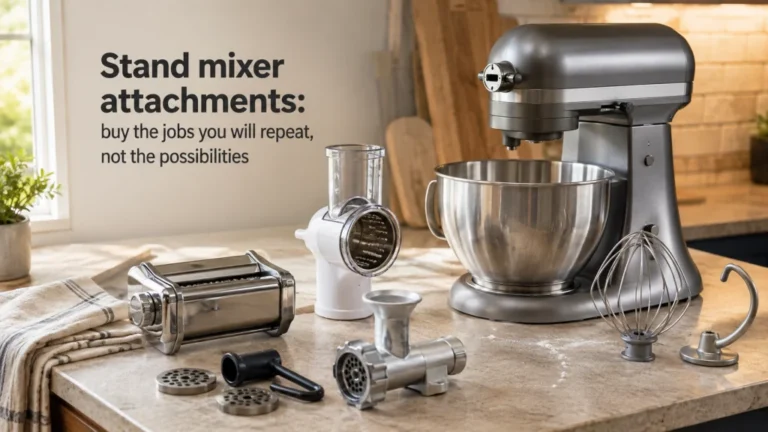
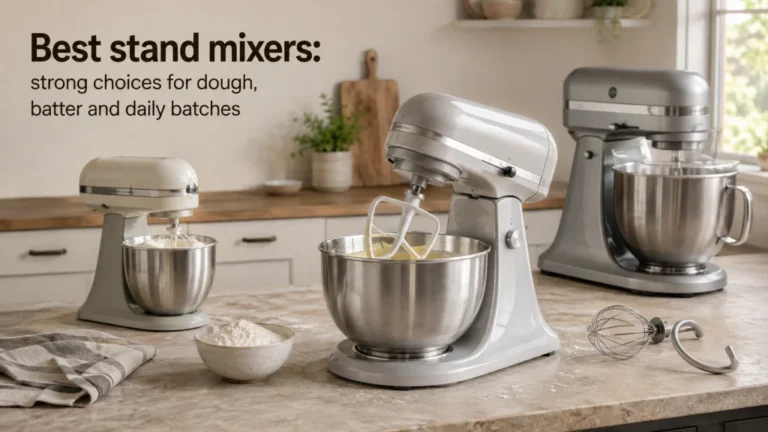
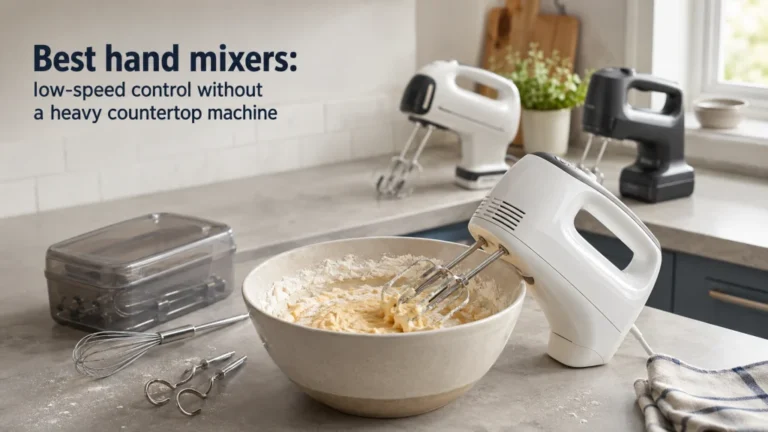
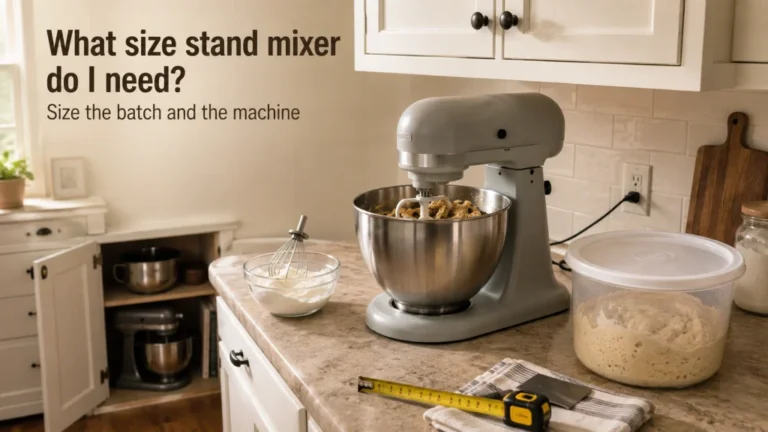
A useful food processor guide should start with the prep work you repeat, not with bowl capacity, wattage, or the longest attachment list. Small chopping jobs often point toward a compact chopper, while repeated slicing, shredding, larger batches, and feed-tube work make a full-size processor easier to justify. The right choice also depends on where the machine will live, how much pre-cutting it requires, how much cleanup follows each use, and whether its accessories solve jobs you actually do. By the end, you should know which processor class fits your workload and which deeper comparison to make next.
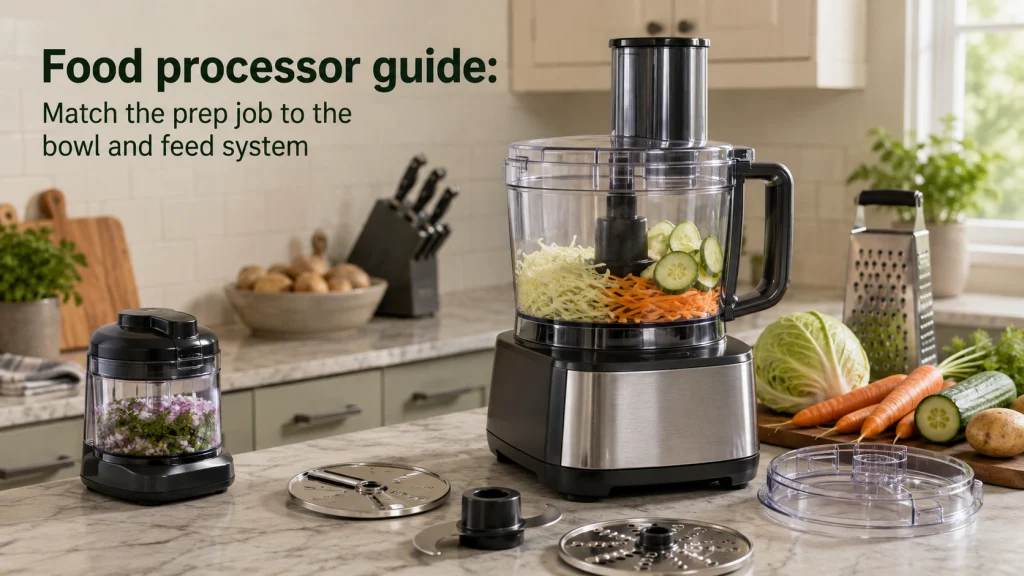
Start with repeated prep work, not feature count
You want faster chopping, slicing, or shredding, then shopping pages throw mini choppers, full-size processors, bowl sizes, feed tubes, discs, and accessory sets into the same comparison. A useful food processor guide has to sort that mess by prep job before asking which machine has more features. Someone mincing a small amount of herbs faces a different decision from someone slicing vegetables for several meals or shredding larger batches. The machine that looks more capable on paper can still be the worse fit if its size, setup, or cleanup outweighs the work it saves.
Write down the prep jobs that regularly slow you down, then note how much food is involved and how often the job appears. Include the work before processing, such as trimming or pre-cutting ingredients, and the work after processing, such as washing the lid, bowl, blade, disc, pusher, and storage pieces. If a knife, box grater, or other simple tool already handles the job quickly, the processor has to save enough repeated effort to justify taking up space. That same practical test applies across small kitchen appliances: capability matters, but the machine earns its place only when it improves a real household routine.
- Job: What do you want to chop, slice, shred, mix, or puree?
- Batch: Is the job a handful of ingredients, one meal, or repeated larger batches?
- Frequency: Will you retrieve the machine several times a week, occasionally, or only for special prep?
- Before-use work: How much trimming, peeling, or pre-cutting is still required?
- After-use work: How many parts need washing, drying, and putting away?
- Storage: Can the base, bowl, lid, pushers, blades, and discs live together without becoming a cabinet scavenger hunt?
That checklist keeps the first decision focused on labor saved rather than features owned. It also makes weak use cases obvious before you spend time comparing machines. Once the repeated jobs are clear, the next question is whether those jobs need a compact chopping machine or the feed system and discs of a larger processor. Resolve that class choice before moving into bowl size or current models.

Compact 3-cup capacity suits small chopping, mincing, and pureeing jobs. Its stack-and-press design uses a 350-watt motor with stainless steel blades. The removable bowl, lid, and blades are dishwasher safe for cleanup after short prep tasks.
Check On AmazonIf you click this link and buy, we earn a commission at no additional cost to you.
Separate compact choppers from full-size processors
One of the most useful distinctions among food processor types is whether you mainly need bowl-based chopping and pureeing or whether you also want feed-tube slicing and shredding. A mini food processor or electric chopper is usually built around a compact bowl and a multipurpose blade, which can make it convenient for smaller batches and short jobs. A full-size food processor generally adds a larger work bowl plus a feed tube and interchangeable discs, so ingredients can be sliced or shredded as they enter the bowl. Those differences change both what the machine can do and how much setup, washing, and storage come with it.
| Repeated workload | Class to investigate first | Main reason | What can make it a poor fit |
|---|---|---|---|
| Small chopping and pureeing jobs | Compact electric chopper | Less equipment for a small batch | Limited slicing and shredding capability |
| Repeated slicing or shredding | Full-size processor | Feed tube and disc workflow | More parts and more storage |
| Large chopping batches | Full-size processor | More usable batch room | May be excessive for everyday small jobs |
| Occasional tiny prep jobs | Simple hand tool or compact chopper | Lower setup burden | A powered appliance may save little time |
The table is a routing tool, not a universal verdict. Do not treat compact as the beginner option and full-size as the automatic upgrade. A small machine can be the better fit for modest bowl jobs, while a larger processor makes more sense when slicing, shredding, or bigger batches recur often. If this class decision is still unresolved, use the food chopper vs. food processor comparison before comparing models.
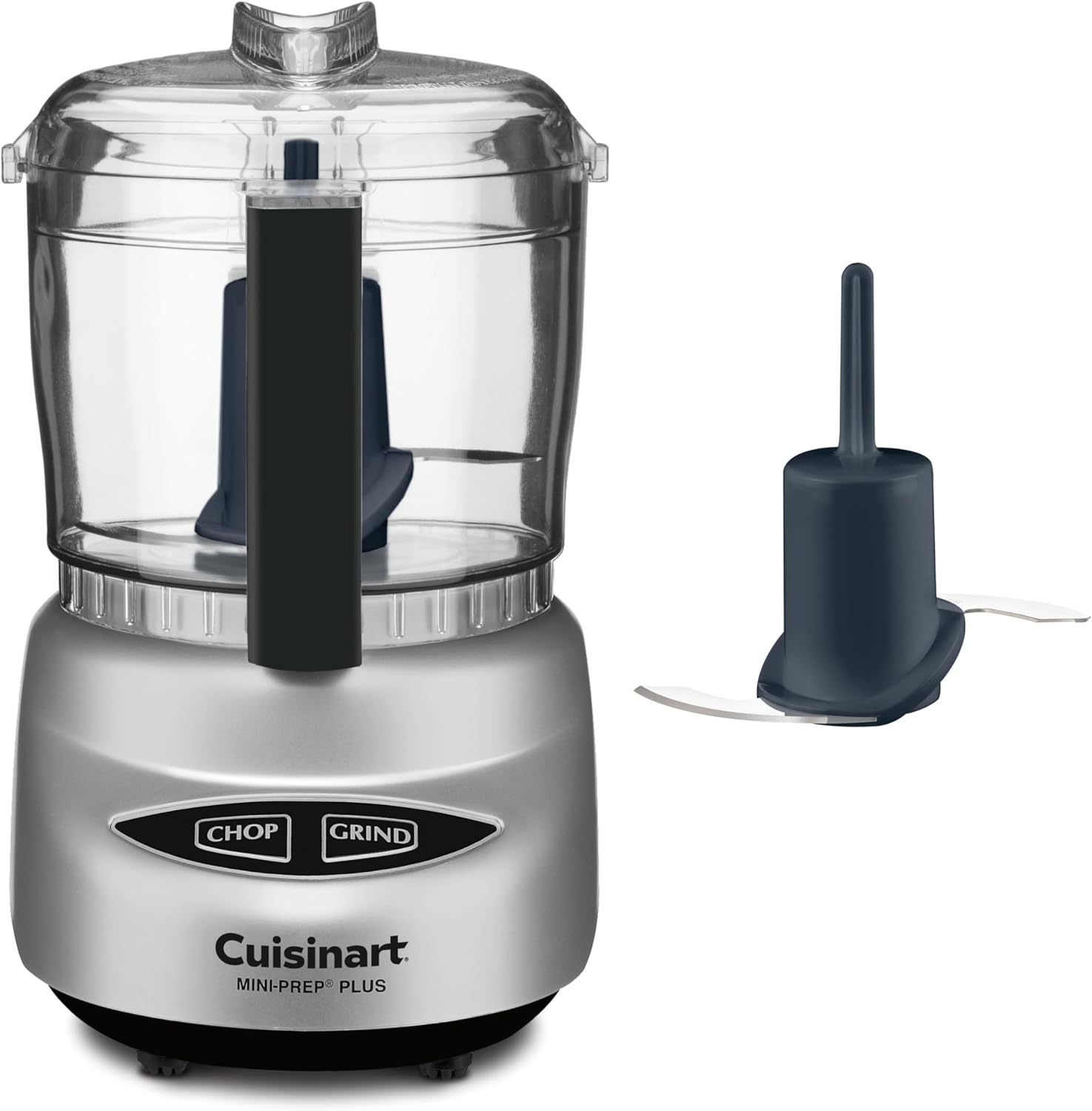
This 3-cup mini processor uses a reversible stainless steel blade for chop and grind tasks. A 250-watt motor and push-button controls keep the setup focused on small-batch prep. The work bowl and lid are dishwasher safe, making it a practical compact-class example.
Check On AmazonIf you click this link and buy, we earn a commission at no additional cost to you.
Decide whether a full-size processor earns its space
Knowing that a larger processor can handle more kinds of prep does not answer whether you should own one. The practical question is how often its strongest jobs replace work you currently dislike or repeat in meaningful volume. Slicing several vegetables, shredding a block of cheese, processing a larger batch, or preparing ingredients for multiple meals can create a clear labor advantage. Chopping one onion for dinner may not, especially if retrieving the base, assembling the bowl, and washing several parts takes longer than the knife work.
This is where frequency, storage, and cleanup can reverse the expected answer. A processor stored behind heavier equipment or with discs scattered across another cabinet creates friction before the prep even starts. A common first-time mistake is assuming that cooking often automatically means needing a large processor, when the real issue is whether its strongest jobs occur often enough to offset setup and cleanup. If you are still weighing purchase versus no purchase, use should I buy a food processor before moving on to size.
Key point: A processor earns its space when the work it removes is larger than the retrieval, assembly, washing, drying, and storage it adds. Frequency matters because a small saving repeated often can be meaningful. Batch size matters because larger jobs can make powered prep more useful. If those conditions are weak, a simpler tool may still be the better choice.

The 14-cup work bowl provides room for larger batches and repeated full-size prep. Its 720-watt motor works with a chopping blade plus slicing and shredding discs. The removable parts are dishwasher safe, supporting cleanup after higher-volume processing.
Check On AmazonIf you click this link and buy, we earn a commission at no additional cost to you.
Match bowl size and physical fit after class choice
Bowl capacity is useful only after you know which processor class you need. A larger stated capacity can reduce batch splitting, but it also tends to come with a larger bowl, lid, base, and accessory footprint that must fit your counter and storage path. Nominal bowl size does not by itself prove how much of a particular ingredient can be processed comfortably or safely, because working limits vary by food, blade, disc, and exact model instructions. Treat capacity as one evidence field, not as a guarantee that the largest bowl is the most capable choice for your kitchen.
| Fit evidence | What to verify | Why it changes the decision |
|---|---|---|
| Work bowl | Usable batch needs and model-specific limits | Prevents oversizing or constant batch splitting |
| Base footprint | Actual counter or shelf dimensions | Determines whether the machine can stay accessible |
| Working height | Space for lid, feed tube, and pusher handling | Prevents a nominal fit that is awkward to operate |
| Accessory storage | Safe location for blades, discs, and pushers | Changes retrieval time and handling safety |
The practical goal is not to buy the most bowl volume your cabinet can tolerate. Measure the storage shelf, counter landing area, working height, and the space needed to keep sharp accessories safely organized. Compare those measurements with the exact product dimensions, then use food processor sizes to resolve capacity in detail. Choose enough usable room for the batches that matter while keeping the machine easy enough to retrieve and operate regularly.

This 7-cup processor pairs a 600-watt motor with an extra-large feed tube and a smaller feed-tube insert. It includes a slicing disc, shredding disc, and chopping, mixing, and dough blade. The mid-size bowl gives a concrete capacity point to compare against counter, cabinet, and accessory-storage space.
Check On AmazonIf you click this link and buy, we earn a commission at no additional cost to you.
Judge blades, discs, and attachments by the jobs they replace
Accessory count is one of the easiest ways to overbuy a food processor. A standard chopping blade, slicing disc, or shredding disc can be valuable because each corresponds to a clear prep job, but extra pieces matter only if you can name the work they will replace. A specialty disc that stays in its case is not added capability in any meaningful household sense. It is another part to store, identify, wash, and avoid losing.
Match each repeated job to the cutting system it actually needs. If you mainly chop and puree, a large disc collection may add little, while frequent slicing or shredding makes disc design, feed-tube fit, pusher handling, and storage much more important. Use the exact model manual for safe blade and disc handling, keep interlocks intact, and never reach into an assembled machine to clear food. The food processor attachments article can then separate useful pieces from accessories that mostly add washing and storage.

The KFP0718 includes a 7-cup work bowl, multipurpose blade, and reversible medium slicing and shredding disc. The blade and disc can be stored inside the bowl between uses. Three speed controls and a 2-in-1 feed tube support different prep workflows.
Check On AmazonIf you click this link and buy, we earn a commission at no additional cost to you.
Treat wattage as a technical clue, not a ranking
Wattage is easy to compare because it is a single number, but that does not make it a complete performance score. Two machines can list different input-power figures and still differ in blade geometry, gearing, control behavior, bowl design, feed system, and how effectively they handle a particular task. A higher number also does not tell you whether the processor slices evenly, shreds cleanly, handles small quantities well, or is pleasant to live with. Those outcomes need evidence tied to the actual task and model rather than a simple wattage hierarchy.
Use power information as one part of a larger evidence check. For demanding work, look for model-specific instructions, operating limits, and independent testing that actually performs the task you care about under disclosed conditions. Capacity still has to match batch size, and attachments still have to match repeated jobs, so a larger motor claim cannot rescue the wrong machine. The food processor wattage article handles that technical question without letting one number dominate the purchase.

This 12-cup Stack & Snap processor uses a 450-watt two-speed motor. It includes a chopping and pureeing blade plus a reversible stainless steel slicing and shredding disc. Dishwasher-safe removable parts make it useful for judging wattage alongside capacity, attachments, and cleanup rather than as a standalone score.
Check On AmazonIf you click this link and buy, we earn a commission at no additional cost to you.
Separate processor work from blender and stand-mixer work
Food processors overlap with other kitchen equipment, but overlap is not the same as replacement. A processor is built around a wide bowl, cutting blade, and often discs that are well suited to chopping, slicing, shredding, and certain mixing jobs. A blender is shaped around a different flow pattern and is usually the more relevant comparison when the goal is a smooth, pourable mixture. A stand mixer uses yet another system for mixing, whipping, and dough work, so the right machine depends on the result and batch rather than whether two appliances can technically touch the same ingredient.
| Primary job | Question to resolve | Why the distinction matters |
|---|---|---|
| Chopping, slicing, shredding | Processor class, feed system, and discs | These are core processor workflow questions |
| Smooth wet blending | Processor versus blender | Container and blade workflow differ |
| Mixing, whipping, or repeated dough work | Processor versus stand mixer | Batch handling and tool action differ |
Use that separation to protect both budget and storage space. For smooth wet blending, compare a blender vs. food processor; for repeated dough, mixing, or whipping work, compare a stand mixer vs. food processor. If an appliance you already own handles the target job well enough, the processor needs another recurring workload to justify becoming one more base, bowl, cord, and accessory set. Replacement value should come from work removed, not from theoretical overlap.

This 40-ounce glass-jar blender uses 700 watts of peak blending power. Its 12 functions include puree and ice-crushing modes, with Wave Action designed to circulate ingredients toward the blades. The jar, lid, and removable blades are dishwasher safe for cleanup after wet-blending tasks.
Check On AmazonIf you click this link and buy, we earn a commission at no additional cost to you.
Compare current models only after class, size, and workload are clear
Model rankings become useful late in the process. Once you know the processor class, batch range, and blades or discs you will use, a current comparison can focus on evidence that changes ownership. Before that point, a highly rated machine may simply fit somebody else’s workload. Shopping by rank first makes it easy to pay for capacity or attachments that never solve a recurring prep problem.
Controls deserve their own check because pulse behavior and button layout can affect short, controlled jobs even when two machines look similar on paper. Noise also matters when the processor runs often or the kitchen opens into living space, but compare it only from testing with clear conditions. Price should be judged against useful capacity, included parts, workflow, and task-specific evidence rather than feature count alone. Manufacturer information can verify dimensions, controls, included parts, and operating limits, while independent testing should show what was processed and how the result was judged; use the best food processors page for current candidates after the earlier decisions are settled.

The 70730 combines a 10-cup work bowl with an integrated bowl scraper. Its processing functions cover slicing, shredding, mincing, and pureeing. The bowl-scraper design gives readers a current model to compare on workflow and useful functionality rather than feature count alone.
Check On AmazonIf you click this link and buy, we earn a commission at no additional cost to you.
Use a prep-workload sheet before you shop
If you are still unsure how to choose a food processor, put the decision on one page before opening another product listing. List the three prep jobs you most want to speed up, the usual batch size, and whether each job needs a bowl blade or feed-tube disc. Add the work before loading and after processing so a fast cutting step does not hide a slow routine. This should leave you with a processor class and a short list of evidence to verify.
| Decision field | Your answer | What it changes |
|---|---|---|
| Repeated jobs | Three jobs to speed up | Whether a processor is relevant |
| Batch size | Small, moderate, or larger repeated batches | Class and bowl-size research |
| Cut type | Chop, puree, slice, shred, mix, or another supported task | Blade, disc, or competing appliance |
| Pre-cutting | Work required before loading | Feed-tube value |
| Cleanup | Parts to wash and dry | Whether prep savings survive afterward |
| Storage | Base, bowl, lid, pushers, blades, and discs | Whether the machine stays accessible |
Prep-workflow timeline: Follow one real job from retrieval to storage and look for the stage that cancels the time saved during processing. A processor that cuts quickly can still be a poor fit if it requires extensive pre-cutting, too many loads, or awkward cleanup. The sequence below keeps that friction visible without turning the workflow into a performance score. Use it to compare the full job, not just motor time.
| Stage | What to check | Main friction |
|---|---|---|
| Retrieval | Base and required parts are easy to reach | Heavy lifting or scattered parts |
| Trim and pre-cut | Ingredients fit with reasonable prep | Too much knife work first |
| Assemble | Correct bowl, lid, blade or disc fits easily | Too many pieces for a short job |
| Load and process | Batch, feed tube, and controls suit the task | Frequent stops or repeated loads |
| Wash and dry | Used parts are practical to clean | Fiddly or sharp parts for little time saved |
| Store | Base and accessories return safely | Loose or buried parts |
Evidence-field checklist: After the workflow makes sense, verify the fields a listing headline cannot settle. Use exact model documentation for specifications and operating limits, and task-specific testing when performance is the question. Do not fill gaps with assumptions based on bowl size, wattage, price, or attachment count. The evidence should answer the job you already identified.
- Dimensions: Footprint, height, feed-tube access, and working clearance.
- Included parts: Bowl, lid, pushers, blades, discs, and needed storage pieces.
- Controls: Button functions, pulse behavior, and task fit.
- Task evidence: Relevant chopping, slicing, shredding, or other tested results under clear conditions.
- Noise: Comparable observations or measurements when sound matters in your household.
- Operating limits: Model-specific batch, ingredient, assembly, and run guidance.
- Cleaning and storage: Washing burden, sharp-part handling, and safe accessory storage.
- Price: What the added cost buys in useful capacity, workflow, parts, or verified performance.
If the evidence supports the same class and workload, you are ready for a model comparison. If it reveals awkward clearance, unnecessary parts, weak task evidence, or a price premium with no useful payoff, revise the shortlist instead. Separating workload from evidence prevents specifications from deciding the purchase before the household need is clear. One tells you what to look for; the other tests whether a machine can prove it fits.

This digital kitchen scale measures in grams and ounces with an 11-pound capacity. Its tare function helps separate ingredient weight from the container. The 304 stainless steel platform makes it useful for recording typical batch amounts before choosing processor capacity.
Check On AmazonIf you click this link and buy, we earn a commission at no additional cost to you.
Final thoughts: Choose the prep class before the product
A food processor becomes easier to choose when you stop asking which machine does the most and decide which class matches the work first. Separate small bowl-based chopping from feed-tube slicing and shredding, then verify capacity, physical fit, useful attachments, controls, and the evidence behind the tasks you care about. Wattage, noise, price, and model rankings make more sense after that foundation is settled. This keeps a larger or more expensive machine from winning simply because its specification sheet is longer.
The best outcome may still be a compact chopper, a full-size processor, an appliance you already own, or no additional machine. The important part is that you can explain why the choice fits the batch, cut type, frequency, space, and ownership burden that matter in your kitchen. From here, move to the one unresolved question rather than reopening the entire category. A narrower next step makes the final comparison easier to defend and easier to live with.

This compact chopper has a 1.5-cup bowl and a 150-watt motor for small prep jobs. One-touch pulse control drives bi-level stainless steel blades for chopping and mincing. Dishwasher-safe removable parts keep cleanup aligned with the small-batch use case.
Check On AmazonIf you click this link and buy, we earn a commission at no additional cost to you.
Take the next food processor decision one step at a time
The remaining question should now be specific enough to hand off cleanly. Choose the article that matches what is still unresolved, whether that is processor class, ownership value, physical size, overlapping appliances, attachment usefulness, wattage, or current models. Each topic below takes one decision further without turning this page into eight separate buying articles. That keeps the deeper comparison focused instead of repeating the same broad checklist.
| Topic | What you’ll find |
|---|---|
| Food chopper vs. food processor | Choose between compact bowl-based prep and a larger feed-tube and disc workflow. |
| Should I buy a food processor? | Decide whether repeated prep savings justify the space, cleanup, and ownership burden. |
| Food processor sizes | Match bowl needs and physical dimensions to batches, counters, cabinets, and storage. |
| Best food processors | Compare current candidates after processor class, workload, and fit are already clear. |
| Blender vs. food processor | Separate chopping and slicing work from smooth wet-blending tasks and texture goals. |
| Stand mixer vs. food processor | Compare dough, mixing, whipping, and prep workflows without assuming one appliance replaces the other. |
| Food processor attachments | Judge blades, discs, and specialty pieces by the recurring work they actually replace. |
| Food processor wattage | Interpret power claims alongside task evidence instead of ranking machines by one number. |
If several questions remain, start with class and ownership value because either answer can remove unnecessary size, feature, or model research. Keep the exact product manual in the final verification step for operating limits, assembly, cleaning, and safety instructions that vary by model. Current comparisons are most useful only after those earlier choices have reduced the field. The result should be a shorter, more relevant shortlist rather than a larger pile of specifications.
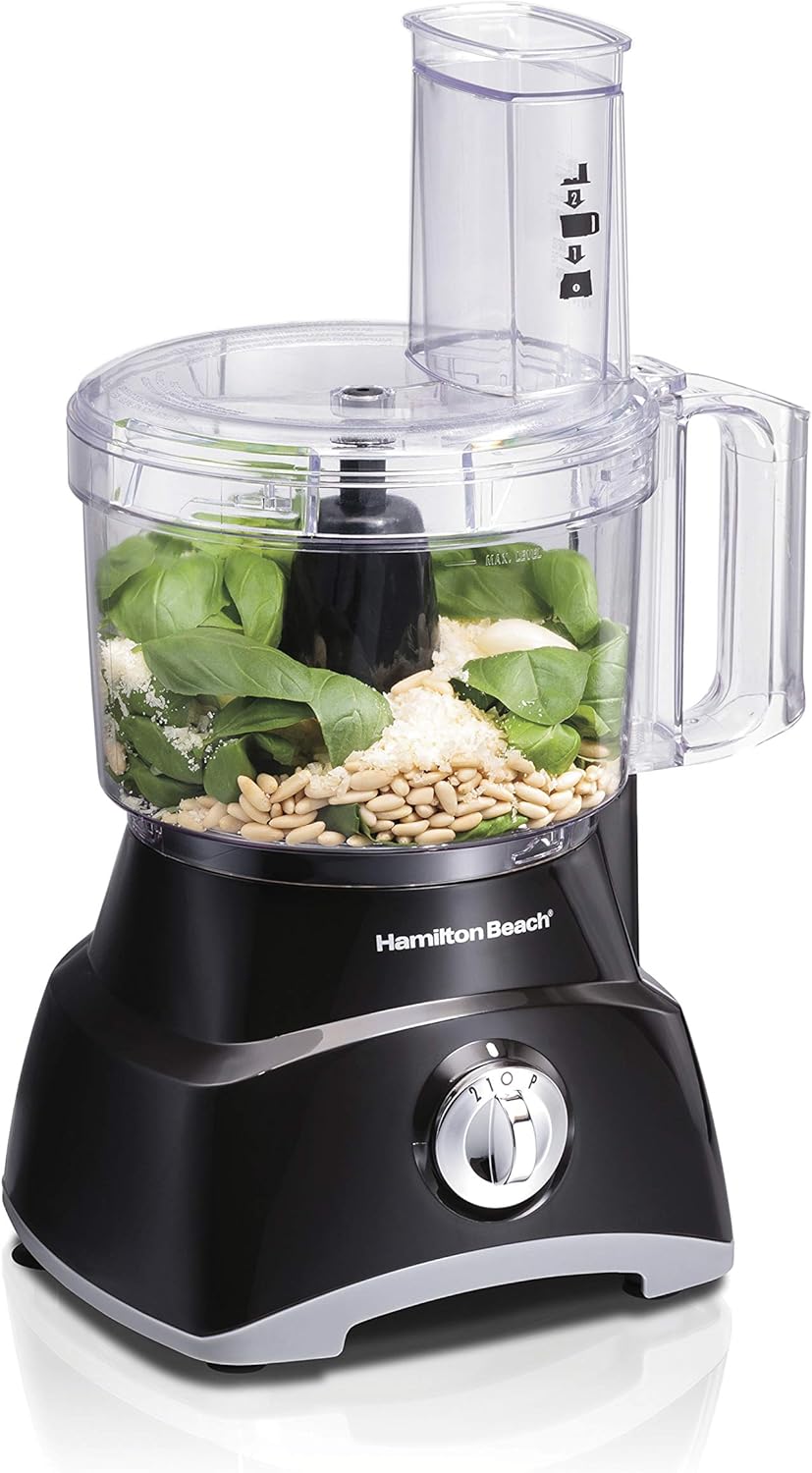
This 8-cup processor combines a large feed chute with a 450-watt motor. A stainless steel S-blade handles chopping and pureeing, while the reversible disc handles slicing and shredding. Two speeds plus pulse and dishwasher-safe removable parts make it a practical full-size candidate for a next-step model comparison.
Check On AmazonIf you click this link and buy, we earn a commission at no additional cost to you.
FAQs
Most food processor questions sound simple because they are phrased around size, power, or versatility. The useful answer usually depends on the job, batch, storage path, and amount of cleanup you are willing to accept. The questions below keep those variables visible instead of giving one-size-fits-all rules. Use them as a final check before you narrow the purchase to a specific class or model.
If your question depends on an exact machine, verify the manufacturer’s dimensions, included parts, operating limits, and cleaning instructions before buying or using it. Do not assume that two processors with similar labels have the same bowl limits, feed systems, accessories, or safe handling steps. Sharp blades and discs should be handled only as the exact manual directs, with safety interlocks left intact. The goal is a machine that fits both the prep job and the routine required to own it safely.
🔪 What is the main difference between a food chopper and a food processor?
An electric chopper is usually centered on small bowl-based chopping and pureeing, while a full-size processor typically adds a feed tube and discs for jobs such as slicing and shredding. Choose by the repeated job, not by assuming the larger machine is automatically better.
📏 What size food processor should I buy?
Start with the batch you regularly process, then check the machine’s actual dimensions, working height, and accessory storage. A larger bowl is useful only when the extra capacity offsets the added space and handling.
🥕 Do I need a food processor if I mostly chop vegetables?
Not necessarily. A processor becomes more compelling when the vegetable prep is frequent, high-volume, or includes repeated slicing and shredding that a feed tube and discs can speed up.
🧼 Is food processor cleanup worth it for small jobs?
Sometimes it is not. Compare the time saved during prep with the time needed to retrieve, assemble, wash, dry, and store the parts for the exact job you do most often.
⚡ Does higher wattage mean a better food processor?
No single wattage number proves overall performance. Use it alongside task-specific testing, exact operating guidance, blade and disc design, controls, bowl fit, and the workload you actually need to handle.
🥤 Can a food processor replace a blender?
Not universally. The appliances overlap on some mixing and pureeing jobs, but smooth wet blending and processor-style chopping, slicing, and shredding involve different container and blade workflows.
🥣 Can a food processor replace a stand mixer?
Only for certain overlapping tasks and only when the exact model supports them. Repeated dough, mixing, and whipping needs should be compared by batch, tool action, cleanup, and manufacturer limits rather than by a generic versatility claim.
📦 Where should I store food processor blades and discs?
Use the storage method supplied or permitted for the exact machine, and keep sharp edges protected from blind hand contact. Storage should also keep the accessories close enough to the base that retrieval does not become a reason to avoid using the processor.