A dedicated stand mixer cabinet can be a smart remodel choice when the mixer is used often enough to earn permanent base-cabinet space. The key is to treat the cabinet, lift or platform, mixer dimensions, accessory storage, and nearby work surface as one system rather than assuming any cabinet labeled for a mixer will fit any machine. A complete mixer cabinet is also a different commitment from adding lift hardware later or hiding a mixer in an appliance garage. Before the cabinet order is finalized, verify the exact mixer, clear opening, load limits, movement path, approved work surface, and how much useful storage the cabinet displaces.
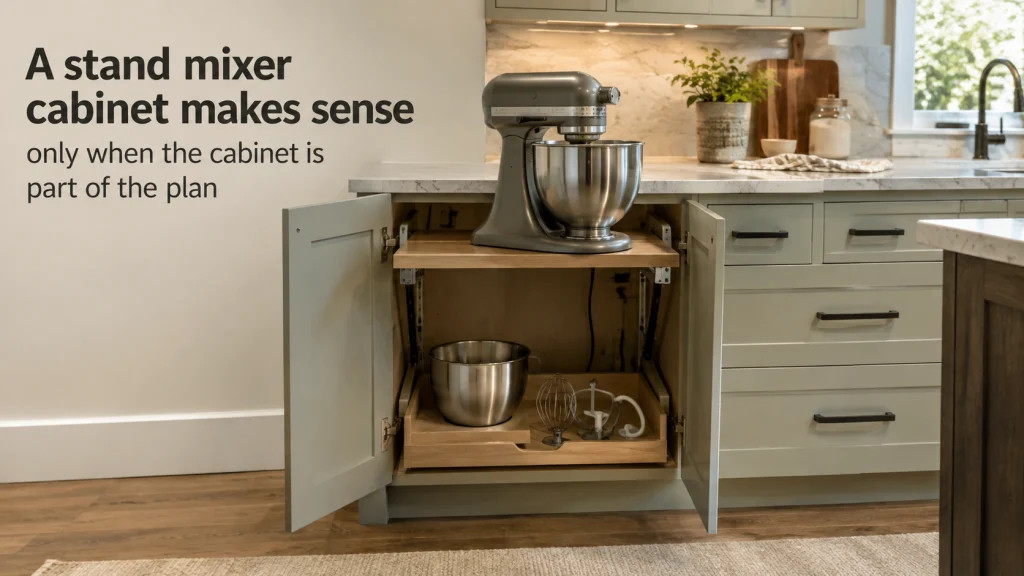
Reserve a whole cabinet only when the mixer earns the space
A stand mixer cabinet is easiest to justify before cabinetry is ordered, because that is when the real tradeoff is still visible. You are not simply buying a shelf that moves; you are assigning part of the base-cabinet run to one heavy appliance and the mechanism that stores it. That can remove repeated lifting and clear a crowded counter, but it can also consume space that might otherwise hold cookware, pantry items, trays, or other daily-use equipment. The right decision starts with how often the mixer is actually used and what currently makes using it inconvenient.
If the mixer comes out several times a week and moving it is the main reason it stays unused, dedicated storage may solve a real workflow problem. If it is used only a few times a year, giving it permanent prime cabinet space can be an expensive way to store an occasional appliance. Households still deciding among storage methods should first compare the broader options for how to store a stand mixer before locking one solution into the cabinetry plan. This article stays at the planning and selection level, not cabinet construction, lift installation, spring adjustment, or electrical work. That workflow-first approach applies across home storage solutions, especially when one container has to serve both collection and transport.

This fitted KitchenAid cover is sized at 14.4 by 18 by 10 inches for tilt-head stand mixers. It is made from quilted 100 percent cotton and includes a storage pocket. It gives a counter-stored mixer a dedicated cover when the household does not want to commit an entire base cabinet to the appliance.
Check On AmazonIf you click this link and buy, we earn a commission at no additional cost to you.
A mixer cabinet is a complete cabinet architecture, not just lift hardware
Current cabinet manufacturers show why the distinction matters. Omega describes a mixer cabinet with a platform and a storage tray below for attachments, while Decora describes a pop-up shelf that brings the mixer to counter level and stores it below when it is not needed. Kemper and Schrock also market base mixer cabinets as complete cabinet products rather than loose organizers. In other words, the cabinet box, opening, lift or platform, door arrangement, and interior storage are planned together.
That is different from buying retrofit mixer-lift hardware after the kitchen already exists. Retrofit hardware has to work inside the clear dimensions and construction of an existing cabinet, while a complete cabinet can be specified around the storage function from the start. The complete-cabinet approach may be cleaner when the kitchen is already being remodeled, but it also makes the dedicated footprint more permanent. Do not call every base cabinet with a sliding shelf a mixer cabinet, because a pull-out tray that stays low does not perform the same job as a platform designed to raise the appliance.

This KSM55SXXX uses a 5.5-quart bowl-lift design with 11 speeds. The exact Amazon variant is Porcelain White. Its bowl-lift configuration gives planners a concrete appliance shape to measure around instead of assuming the cabinet box, opening, platform, and storage can be selected independently.
Check On AmazonIf you click this link and buy, we earn a commission at no additional cost to you.
Use frequency should justify permanent base-cabinet width
The easiest planning mistake is to judge the cabinet by how elegant it looks with the mixer hidden. A better test is whether the storage change will alter what happens in the kitchen each week. Someone who mixes bread dough, cookies, cakes, or other batches frequently may value having the machine stored low but accessible, especially when the current alternative is carrying it from a pantry or upper shelf. Someone who rarely uses the mixer may get more value from flexible cabinet storage and a simpler place for the appliance.
Think in routines rather than aspirations. Count the occasions when the mixer was actually used, how far it was moved, whether an attachment or bowl had to be fetched from another cabinet, and whether the machine was skipped because setup felt like too much work. Also consider whether the mixer could simply stay on the counter without creating a real space problem, because no cabinet mechanism is automatically better than leaving a frequently used appliance in place. A dedicated cabinet makes the most sense when it removes a recurring obstacle, not when it merely creates a clever hiding place.

These eight self-adhesive sliders are designed to sit under small countertop appliances such as mixers and coffee makers. Their low-profile format lets the appliance slide across a suitable counter instead of being repeatedly lifted. They offer a simple way to reduce handling friction for a frequently used mixer without dedicating a base cabinet to a lift system.
Check On AmazonIf you click this link and buy, we earn a commission at no additional cost to you.
Record the mixer, cabinet opening, and movement path before specification
Exterior cabinet width is not enough to prove fit. The mixer has to clear the usable interior opening, door hardware, lift arms, platform edges, and any other obstruction through the full path from stored position to raised position. Measure the mixer itself with the bowl and any permanently stored part in place, then note what changes when the head tilts, the bowl lifts, or an attachment is installed. Weight matters too, because the cabinet system and platform must be rated for the actual appliance load rather than a generic idea of what a stand mixer weighs.
A first-time buyer can easily assume that a cabinet sold for mixers will fit a future mixer automatically. It may not, especially if a compact tilt-head machine is later replaced by a taller or wider bowl-lift model. The worksheet below is meant to keep the cabinet discussion tied to the exact appliance and exact opening. Bring these measurements to the cabinet manufacturer or designer and use their current specifications as the final authority.
| What to record | Why it controls fit |
|---|---|
| Mixer width, depth, and stored height | Confirms the appliance fits the usable interior, not just the nominal cabinet width. |
| Maximum height during normal movement | Accounts for head, bowl, or attachment movement above stored height. |
| Actual appliance weight with stored parts | Checks the platform rating against the real stored load. |
| Clear cabinet opening | Captures space left after frames, hinges, and hardware. |
| Raised platform position | Shows where the mixer lands relative to the counter and aisle. |
| Power-cord path | Confirms the cord route follows manufacturer requirements. |
Do not substitute a photo, cabinet catalog name, or dealer shorthand for these checks. Two cabinets with similar exterior dimensions can have different usable openings once doors, frames, shelves, and lift components are installed. The same is true of two mixers sold in the same broad size class. Fit is an exact system question.

The CMHT37225 provides a 25-foot tape for recording appliance, cabinet-opening, and surrounding clearances. Its self-locking blade stays extended while measurements are taken. That makes it suitable for the article checklist of mixer dimensions, clear opening, raised position, and other fit measurements that should be documented before specification.
Check On AmazonIf you click this link and buy, we earn a commission at no additional cost to you.
Compare a complete mixer cabinet with a retrofit mixer lift before ordering
A complete cabinet and a retrofit lift can produce a similar visible result, but they solve the planning problem from opposite directions. The complete cabinet is specified as part of the cabinetry order, so the interior geometry and storage function can be coordinated before fabrication. A retrofit system starts with the cabinet that already exists, which makes the clear opening, side construction, hinges, and available depth the constraints. Neither approach is automatically superior.
The choice usually comes down to timing and flexibility. If the kitchen is already being rebuilt and the mixer is a permanent part of the routine, a factory or semi-custom cabinet can make sense because the storage purpose is decided early. If the cabinetry already exists or the household is not ready to dedicate a whole cabinet to one appliance, mixer lift hardware may be the more relevant decision. The comparison below focuses on household planning rather than installation.
| Decision point | Complete mixer cabinet | Retrofit lift |
|---|---|---|
| When it is chosen | During cabinet specification or remodel planning | After a suitable cabinet already exists |
| Interior geometry | Planned as part of the cabinet product | Must fit the existing clear opening |
| Storage commitment | Dedicates the cabinet to the appliance system | Uses an existing cabinet and can preserve layout flexibility |
| Fit proof | Exact cabinet line, mixer dimensions, and load | Exact hardware, cabinet, and mixer dimensions |
| Best planning question | Does the mixer deserve permanent cabinet space? | Can the existing cabinet accept the system correctly? |
The table is not a quality ranking. A complete cabinet can suit a remodel and still waste space for an occasional baker. A retrofit lift can preserve flexibility and still fail when the opening is wrong. The decision should follow the kitchen and mixer you actually have.
Cabinet-order integration versus later retrofit
Choosing the cabinet during the order lets mixer storage compete openly with drawers, shelves, and other base-cabinet uses. The space tradeoff is visible before the kitchen is built. A later retrofit starts with a box that may impose dimensions or construction limits on the lift. Timing changes which constraints can still be changed.
Dedicated interior geometry versus fitting hardware into an existing opening
A complete cabinet can allocate interior space around the mechanism and appliance, but the exact mixer still needs measuring. Retrofit hardware reverses the process: hardware and mixer must fit the existing clear opening, not the nominal width. Hinges, face frames, panels, and the travel path can reduce usable space. The practical difference is whether the storage system shapes the cabinet or the cabinet limits the system.

The RAS-ML-HDCR is a spring-loaded appliance-lift mechanism rated for loads up to 60 pounds. It is designed for full-height base cabinets and the shelf itself is not included. Because it is retrofit hardware rather than a complete mixer cabinet, the existing cabinet opening, side construction, and appliance fit still need to be checked separately.
Check On AmazonIf you click this link and buy, we earn a commission at no additional cost to you.
Compare a base mixer cabinet with an appliance garage before giving up lower storage
An appliance garage solves a different problem. It usually keeps the appliance at or near countertop height and hides it behind a door, so the mixer does not have to rise from a base cabinet before use. That can be attractive for very frequent use, but it consumes counter-depth space and may affect how much working surface remains in front of or beside the appliance. The base mixer cabinet instead spends lower cabinet volume and relies on a lift or moving platform to bring the mixer up.
Neither location is automatically more space-efficient because they spend different kinds of space. A small kitchen with scarce drawers and base cabinets may value lower storage more than a portion of the back counter, while another kitchen may have abundant cabinetry but very limited visible counter area. Door swing, appliance height, access to the bowl, and the nearby outlet also change the answer. Compare the whole working zone, not just how well each option hides the mixer.
Base-cabinet lift access versus countertop-height concealment
A base-cabinet system moves the appliance from storage to an accessible height. A countertop-height enclosure keeps it near working level while doors and surrounding cabinetry clear the appliance. The first can preserve open counter space, while the second can reduce movement when operation in place is approved. The better fit depends on layout, mixer movement, and which storage zone the household can surrender.
- If open counter space is the tighter constraint: favor a base mixer cabinet when the household can spare the lower cabinet volume and the exact lift or platform is approved for the intended use.
- If lower cabinets are already scarce: favor an appliance garage when giving up counter-depth space creates less disruption than losing drawers, shelves, or cookware storage below.
- If the mixer is used very frequently: compare how many movements each option still requires, including doors, platform travel, bowl access, cord handling, and the need for a nearby landing surface.
- If neither storage zone is easy to surrender: keep ordinary storage or a permanent counter position in the comparison instead of forcing specialized cabinetry into the plan.
This branch test is meant to narrow the storage architecture, not prove fit by itself. Once one option looks better for the room, return to exact mixer dimensions, clearances, manufacturer limits, and the approved operating position before the cabinet order is finalized. A space-saving idea stops being useful when it transfers the same friction to another part of the kitchen. The stronger choice is the one that gives up the less valuable storage zone while keeping the mixer practical to use.

This bamboo sliding base is made for KitchenAid 4.5- to 5-quart tilt-head stand mixers. It keeps the mixer at countertop height while providing a tray that can slide the appliance forward for access. Compatibility is limited to the specified tilt-head size range, so it should not be treated as a universal stand-mixer tray.
Check On AmazonIf you click this link and buy, we earn a commission at no additional cost to you.
Verify the exact platform behavior and whether the mixer may operate there
A raised platform reaching counter height does not automatically prove that it is an approved work surface. Some cabinet pages describe lifting the mixer into reach, some describe it as ready to use, and others provide little detail beyond storage and movement. Treat the exact cabinet manufacturer’s current instructions as the boundary, especially for load, locking behavior, platform size, and whether the appliance is intended to run on the raised shelf. If the documentation only proves access, do not turn that into a claim of use-in-place.
KraftMaid’s current Base Mixer Shelf listing is a useful example of why exact documentation matters: it states a maximum appliance height of 16 inches and an adjustable load rating up to 60 pounds for that specific system. Those numbers are evidence for that cabinet accessory, not a universal standard for every base mixer cabinet. Another cabinet line can use different hardware, geometry, load limits, or operating instructions. Verify the exact line being ordered instead of carrying a number from one manufacturer into another design.

The Accuteck 8250 weighs loads up to 50 pounds and reads in kilograms, pounds and ounces, or ounces. Its tare and hold functions help capture a reading when the item obscures the display. It can document the actual mixer weight when that weight is within the scale’s 50-pound limit, which can then be compared with the exact platform rating.
Check On AmazonIf you click this link and buy, we earn a commission at no additional cost to you.
Plan bowl and attachment storage as part of the mixer cabinet, not leftover space
A mixer is rarely stored alone. Bowls, flat beaters, dough hooks, wire whips, splash guards, and optional attachments can consume enough room that a cabinet sized only around the machine still creates a scattered routine. Omega, for example, explicitly describes a storage tray below the mixer platform for attachments, which shows that accessory storage can be part of the cabinet architecture rather than an afterthought. That does not mean every cabinet will provide the same usable space or arrangement.
List the parts that are used with the mixer most often and decide which ones need to stay in the same zone. A deep shelf below the lift may look useful in a catalog but become awkward if the mechanism blocks access or if the stored items have to be removed before the mixer can move. Large bowls may need more diameter than a narrow accessory tray provides, and tall attachments may interfere with the platform path. Empty volume only becomes useful storage when the items can be reached without disrupting the mixer.

This four-pack of clear pull-out drawers measures 7.5 inches deep by 6 inches wide by 4.4 inches high per outer box. The units are stackable and use pull handles plus non-slip silicone feet. Their narrow footprint can keep small mixer attachments together inside a cabinet zone, provided the drawers do not interfere with the lift or platform path.
Check On AmazonIf you click this link and buy, we earn a commission at no additional cost to you.
Keep an adjacent prep and landing surface in the plan
Even when a manufacturer permits the mixer to operate on the raised platform, the work does not happen on the mixer alone. Ingredients need a place to land, a bowl may need to be removed, flour or sugar bags need temporary space, and finished mixtures have to move to pans or another appliance. A cabinet that hides the mixer beautifully can still create a frustrating workflow if the raised shelf occupies the only convenient landing area. The best location is therefore tied to the surrounding counter, not just the empty base cabinet below it.
KraftMaid’s baking-station example pairs the lift area with an adjacent lower counter, which reinforces the planning point without making that layout mandatory. In another kitchen, ordinary counter height beside the cabinet may be more practical. Check where the user will stand, whether open doors or the raised platform project into the aisle, and whether frequently used ingredients are within a sensible reach. The cabinet should shorten the setup path rather than simply move the mixer to a clever location.
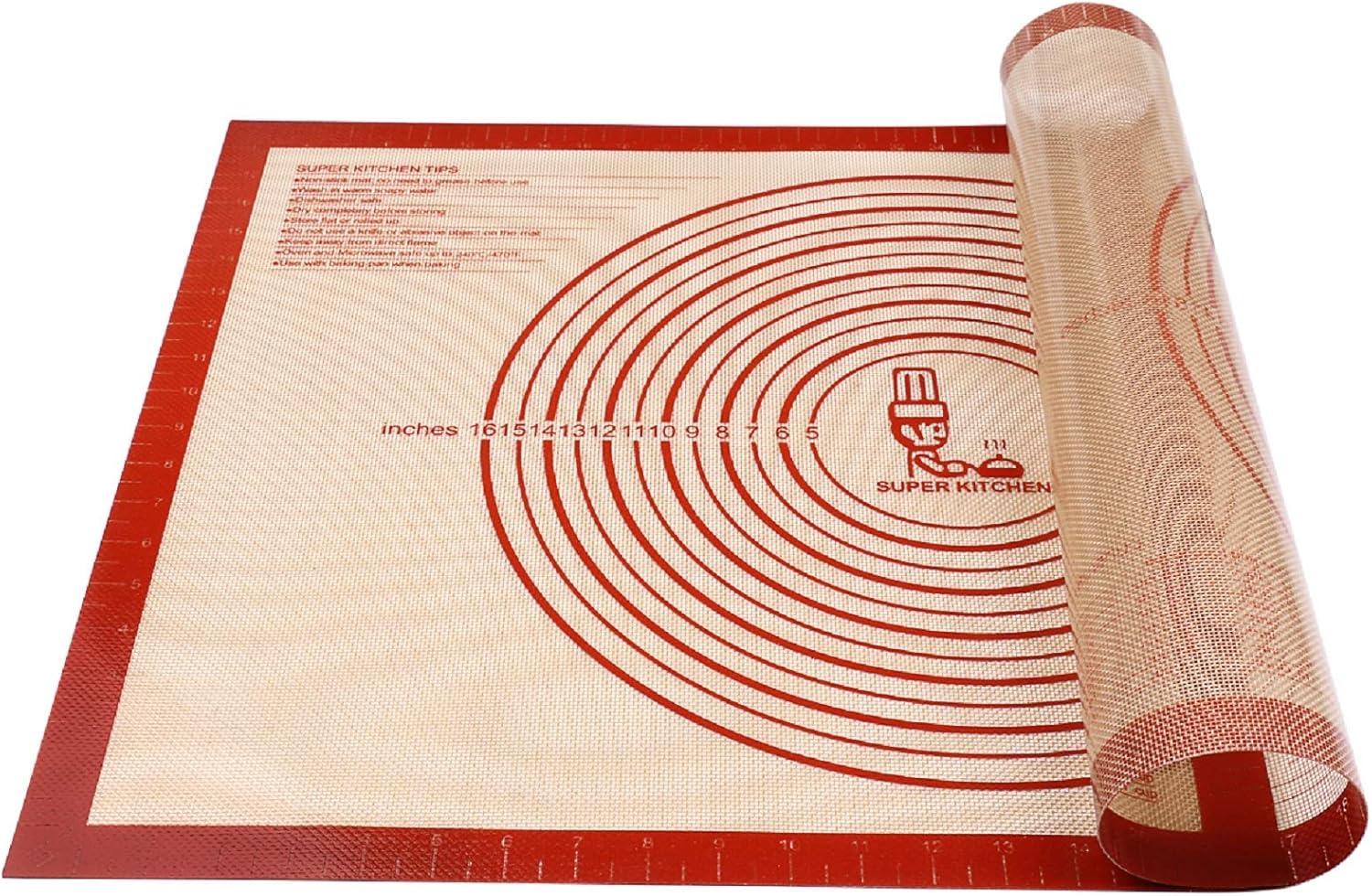
This red silicone pastry mat provides a 28-by-20-inch work area with printed measurements. It is designed as a non-slip surface for rolling dough and other pastry preparation. Used on the adjacent counter, it gives ingredients and dough a defined landing and prep zone without assuming the mixer platform itself is the only useful work surface.
Check On AmazonIf you click this link and buy, we earn a commission at no additional cost to you.
Leave enough tolerance for the mixer you may own next
Customizing the cabinet tightly around one mixer can make the current kitchen look precise, but it also ties future replacement choices to today’s dimensions. Stand mixers vary in width, depth, height, head movement, bowl arrangement, and weight, even within the same brand family. A replacement that is only slightly taller may fail to clear the cabinet during storage or movement, while a heavier model may exceed the platform rating. The cabinet is likely to remain in the kitchen longer than the appliance it was first designed around.
Ask how much extra clearance can be preserved without making the cabinet unnecessarily large. Also ask whether the platform, shelf, or other components can accommodate a different footprint within the manufacturer’s allowed range. If the household already expects to move from a compact tilt-head mixer to a larger bowl-lift machine, size the decision around that likely future use rather than the smaller temporary appliance. Flexibility has value because replacing a mixer should not automatically create a cabinetry problem.

A 165-foot green-beam laser distance measure designed for fast indoor and jobsite measurements. The bright green laser improves visibility compared with standard red beams, while the color display keeps readings easy to check. It supports straightforward distance measuring in a compact handheld format and provides a longer working range than the Bosch GLM100-23 it replaces.
Check On AmazonIf you click this link and buy, we earn a commission at no additional cost to you.
Price the cabinet in lost storage volume as well as purchase cost
The visible price of a mixer cabinet is only one part of its cost. The cabinet also claims base-cabinet width, vertical volume, and some portion of the interior for the lift mechanism and movement path. That lost storage can matter more than the hardware price in a compact kitchen where drawers, cookware storage, or pantry capacity are already tight. A useful comparison therefore asks what the same cabinet space would do if it were not dedicated to the mixer.
Key point: Treat the cabinet footprint as an opportunity cost. Compare it with drawers, shelves, tray storage, or other equipment storage that could occupy the same location. Compare which option removes more daily friction. Decide which function earns the space.
Do not count every empty cubic inch inside the cabinet as recovered storage. Some space may need to remain clear for the platform, arms, hinges, or appliance travel, and some may be too awkward to access regularly. A household that bakes often may happily trade flexible storage for easier mixer access, while a household with limited cookware storage may regret the same choice. The better value is the layout that supports the real routine rather than the one with the most specialized hardware.

Each clear Vtopmart drawer measures 12 inches deep by 7.5 inches wide by 7 inches high, and the set includes four units. The drawers use sliding rails, stacking grooves, and anti-slip pads. Comparing this kind of flexible cabinet storage with a dedicated mixer footprint makes the lost storage volume easier to visualize before committing the cabinet.
Check On AmazonIf you click this link and buy, we earn a commission at no additional cost to you.
Keep construction, spring adjustment, and electrical work outside the storage decision
This article does not provide instructions for building a cabinet box, modifying structural panels, installing a lift mechanism, adjusting springs or gas assists, or adding electrical wiring. Those details are system-specific and can affect safe operation, load support, clearances, and warranty requirements. Use the exact cabinet and hardware manufacturer’s installation documentation and the appropriate qualified trade when work goes beyond owner-level planning. A planning article cannot turn a generic cabinet into an approved mixer-lift installation.
The same boundary applies after installation. Stop using the system if the platform no longer locks or moves as documented, if fasteners or structural parts appear loose, if the cabinet is damaged, or if an electrical issue such as a damaged cord, sparking, smoke, burning odor, exposed wiring, or leakage into electrical areas is present. Do not defeat a lock, prop a mechanism open, or improvise a heavier load than the system allows. The practical owner-level job is to notice the problem and move to the manufacturer’s service path, not to redesign the mechanism.

The Coast G20 is a 54-lumen inspection-beam LED penlight with an adjustable pocket clip. Its slim beam is intended for close visual inspection and the listed runtime is up to 10 hours. It can help illuminate hinges, fasteners, and cabinet interiors for owner-level observation, but it is not an electrical tester and should not be used to diagnose or repair wiring.
Check On AmazonIf you click this link and buy, we earn a commission at no additional cost to you.
Choose the storage question before shopping for lift hardware
If the kitchen is already built and the real question is how to add a lifting mechanism to an existing cabinet, the decision has moved away from complete cabinetry. Start with the mixer lift selection factors that control retrofit fit, cabinet requirements, load, and platform behavior. If the cabinet has already been confirmed suitable and the next step is comparing currently available hardware, move to current mixer lift options. Keeping those decisions separate prevents a complete cabinet article from turning into a hardware shopping list.
If the mixer will stay at counter height and the main goal is visual concealment, revisit the appliance garage planning tradeoffs instead. If none of these storage systems solve a real routine problem, ordinary cabinet storage or leaving the mixer on the counter may be enough. A specialized cabinet is most defensible when it changes how often and how easily the appliance gets used. That is the point at which permanent cabinet real estate starts to earn its keep.

This Zipcase lift is specified for cabinets at least 20 inches high, 13 inches wide, and 15 inches deep. Its listed load capacity is up to 45 pounds and it uses dual springs with a soft-close mechanism. Those exact cabinet and load requirements make it a concrete retrofit option to compare only after the existing cabinet and mixer have been measured.
Check On AmazonIf you click this link and buy, we earn a commission at no additional cost to you.
Final Thoughts: dedicate a mixer cabinet only when the mixer earns permanent space
A stand mixer cabinet is not just a nicer place to hide a heavy appliance. It is a long-term layout choice that should be based on exact mixer fit, verified platform limits, the full movement path, accessory storage, adjacent work surface, and the value of the base-cabinet space being surrendered. A frequent mixer user can reasonably decide that the dedicated cabinet removes enough handling and counter clutter to justify that trade. An occasional user may be better served by a simpler and more flexible storage location.
Before the cabinet order is finalized, put the actual mixer dimensions, weight, likely future replacement size, and manufacturer requirements beside the cabinet specification. Then compare the complete cabinet with retrofit hardware, countertop-height concealment, and ordinary storage using the same household routine. That keeps the decision grounded in what the kitchen needs to do rather than how specialized the cabinet looks. Permanent cabinetry should solve a permanent enough problem.

This KitchenAid Artisan KSM150PS is a 5-quart tilt-head stand mixer with 10 speeds in the Almond Cream variant. The Amazon listing gives dimensions of about 9.3 inches deep, 14.3 inches wide, and 14 inches high. Those exact appliance dimensions reinforce the article’s final point that cabinet fit should be planned around the real mixer rather than a generic stand-mixer category.
Check On AmazonIf you click this link and buy, we earn a commission at no additional cost to you.
FAQs
📏 How do I know whether my stand mixer will fit a mixer cabinet?
Compare mixer dimensions, movement height, and weight with the cabinet’s clear opening and platform limits. Include hinges, frames, lift arms, and other obstructions.
⚖️ Can every mixer cabinet hold a heavy bowl-lift mixer?
No. Load ratings and platform dimensions vary by exact system, so verify the cabinet manufacturer’s current limit against the actual mixer weight and footprint.
🧁 Is a mixer cabinet worth it if I bake only occasionally?
Only when moving or storing the mixer is a recurring enough problem to justify permanent cabinet space. Occasional users may get more value from flexible storage.
🗄️ What is the difference between a mixer cabinet and an appliance garage?
A mixer cabinet usually raises the appliance from a base cabinet, while an appliance garage conceals it at or near countertop height. They spend different storage zones.
🔄 Should I size the cabinet around my current mixer or a future replacement?
Plan around the likely replacement range, especially if the next mixer may be taller, wider, or heavier. Tight cabinetry can restrict future choices.
🔌 Can I add an outlet inside the mixer cabinet?
Follow the cabinet and appliance manufacturers’ requirements and applicable electrical rules. This article does not provide wiring instructions.
References and Sources
- Omega Mixer Cabinet: Confirms a complete mixer-cabinet product with a mixer platform and attachment storage below.
- Decora Mixer Cabinet: Confirms a cabinet design using a pop-up shelf that raises the mixer to counter level for access.
- Kemper Base Mixer Cabinet: Confirms a current base-cabinet product built around raising and storing a stand mixer.
- Schrock Base Mixer Cabinet: Confirms a complete base mixer cabinet and its manufacturer-specific storage architecture.
- KraftMaid Base Mixer Shelf: Supports the manufacturer-specific appliance-height and load-limit example used in the article.
- KraftMaid Baking Station: Supports the example of pairing mixer-lift storage with a nearby work surface.