A baker’s rack is useful only when its main appliance shelf works as real support, not merely when the furniture has many tiers. Check usable shelf dimensions, shelf-specific load limits, ventilation, stability, power access, reach, and cleaning before valuing extra storage. Hooks, baskets, cabinets, adjustable shelves, and built-in outlets matter only after those basics are verified. The goal is to count usable appliance positions and decide whether this layout fits better than a simpler stand or cart.
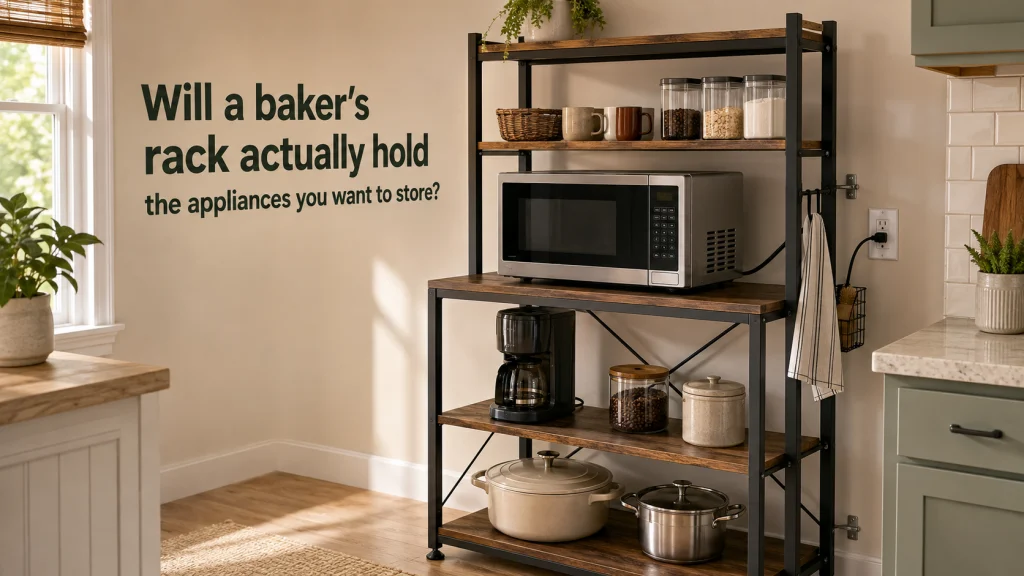
Turn advertised shelf count into usable appliance storage
Picture a six-tier baker’s rack and cross out every shelf that cannot safely support the appliance you want to store, cannot leave enough working clearance, or sits where you would not realistically use it. The six advertised tiers may quickly become one dependable appliance shelf, a few light-storage levels, and several spaces that do not solve the job you bought the rack for. A shelf can also look large enough while having the wrong load limit or blocking required airflow. Count usable appliance positions, not advertised tiers.
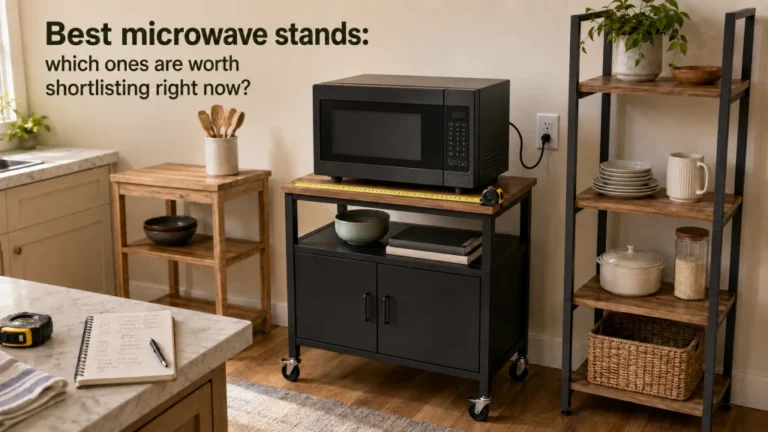
Start with equipment that will stay on the rack every day, then treat the remaining levels as bonus storage. A coffee maker may need lid clearance, a mixer needs lifting space, and a microwave needs stable support plus model-specific clearance. This prevents buying the tallest rack first and discovering that the main surface fails. If you are still comparing furniture types, the microwave stand comparison helps define the support format first. Both options belong within home storage solutions, but the better choice depends on whether the container mainly waits in place or travels with the load.

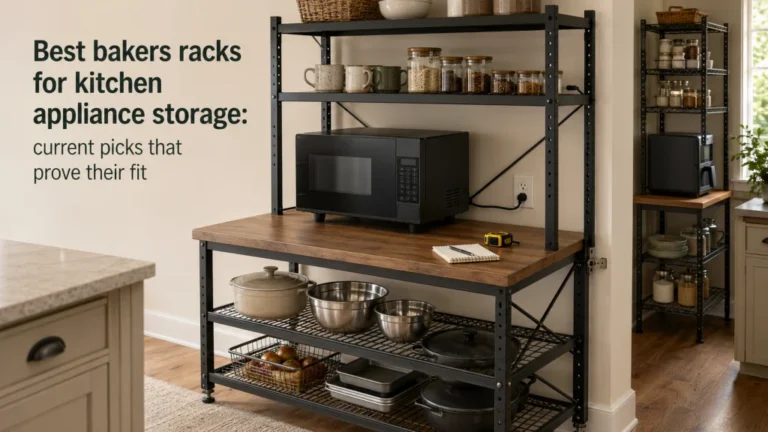
Four tiers combine an appliance surface with additional open storage. The rack includes two power outlets, six S-shaped hooks, and a removable shelf with multiple height positions. Its layout is designed to hold a microwave, coffee maker, spices, pots, and pans in one vertical footprint.
Check On AmazonIf you click this link and buy, we earn a commission at no additional cost to you.
Define the modern kitchen baker’s rack before judging the design
A modern kitchen baker’s rack is usually a freestanding vertical unit with open shelves and one appliance surface. Designs may combine steel frames, engineered wood, wire shelves, hooks, baskets, cabinets, levelers, or built-in power. The name covers layouts that differ greatly in support, access, cleaning, and fit. Judge the architecture and documented specifications, not the label.
This article excludes commercial cooling racks, display-only shelving, wall shelves, full pantry cabinets, appliance garages, and rolling islands. A baker’s rack for the kitchen belongs here when open vertical storage and appliance support are the main jobs. Decorative shelves can resemble appliance furniture without being designed for the same load or workflow. The next checks assume the rack is intended to carry real kitchen equipment.

This four-tier kitchen rack combines a microwave stand, open storage, a power outlet, and six S hooks. The listing presents it as a coffee bar and appliance-storage shelf for spices and cookware. It uses a freestanding open-shelf format rather than enclosed cabinetry.
Check On AmazonIf you click this link and buy, we earn a commission at no additional cost to you.
Decide what the rack must hold before choosing the number of tiers
List permanent and frequently used items before comparing rack sizes. Put the largest and heaviest appliance first, then add anything that opens upward, vents, slides forward, or must be lifted. Plan the main surface around the most demanding appliance. Mugs, spice jars, and decor should not control the layout.
Separate permanent appliance positions from light storage. Pantry bins move easily, while a microwave or mixer usually controls depth, height, stability, and access. This prevents loading every tier merely because space exists. Vertical storage helps only when it reduces counter crowding without harder handling.
Identify the heaviest or most frequently used appliance first
Record width, depth, height, foot placement, cord location, and door or lid movement. Add required clearance and any space needed to pull the appliance forward. A shelf that leaves feet near an edge is not a successful fit. Measure the operating position, not only the parked outline.
Separate appliance support from light pantry and accessory storage
Upper shelves, hooks, and baskets often suit light pantry items better than powered equipment. A baker’s rack with storage adds value when those levels have repeated jobs. Keep heavy or frequently handled equipment on easier-to-reach surfaces. Let light storage support the appliance layout instead of dictating it.

This six-tier rack pairs a microwave stand with open shelves, a built-in power outlet, and twelve S-shaped hooks. The listing positions the shelves for spices, pots, pans, and countertop appliances. Its multiple levels support separating appliance positions from lighter accessory storage.
Check On AmazonIf you click this link and buy, we earn a commission at no additional cost to you.
Verify usable shelf width, depth, and vertical opening against the exact appliance
Overall furniture dimensions do not prove that the appliance shelf is large enough. Posts, rails, upper shelves, wire lips, and trim can reduce the usable opening. Measure where the appliance feet will sit, then check space for doors, lids, cords, controls, and vents. For a microwave, the shelf must support the unit as its manual requires.
Compare exact appliance measurements with usable shelf dimensions, not the rack’s overall footprint. If a needed dimension is missing, treat that as an unresolved fit question instead of estimating from a photo. A close fit fails when the cord is crushed, feet are unsupported, or required airflow disappears. The appliance must operate normally.
| Check | Appliance requirement | Rack evidence |
|---|---|---|
| Width | Body, handles, door swing | Usable width between posts |
| Depth | Feet, cord, vents, safe front position | Usable shelf depth |
| Height | Body plus lid or clearance | Clear opening above |
| Power path | Plug and manual rules | Unobstructed outlet route |
Use the table as a pass-or-fail filter. One failed critical measurement means another shelf or rack is needed. Vents, upward-opening parts, and forward movement make this especially important. A rack fits only when normal operation still works.

This two-pack uses stackable metal shelves that expand to a listed maximum length of 20.5 inches. The adjustable format changes the usable width while adding a raised storage level. The listing describes the shelves for kitchen cabinets and countertops.
Check On AmazonIf you click this link and buy, we earn a commission at no additional cost to you.
Verify the load rating for each loaded shelf and the model’s total limit
Weight capacity is easy to misread because a listing may show one large number without explaining distribution. Some racks give different limits for upper shelves, the main worktop, lower shelves, hooks, or baskets. Total capacity therefore cannot be assumed to apply to every level. The appliance must fit within the documented limit for the exact supporting shelf.
Include everything that normally shares that surface, not only the empty appliance. A microwave adds cookware and food, while a mixer shelf may also hold bowls or ingredients. Keep heavy equipment lower when the design and instructions allow it, but do not invent a loading pattern. Build a documented shelf-by-shelf load plan instead.
- Verify the exact shelf limit, not only total furniture capacity.
- Include cookware, stored items, and normal temporary loads.
- Check separate limits for hooks, baskets, and adjustable shelves.
If the product page and manual disagree, use the more authoritative documentation or ask the manufacturer. Appearance does not replace a published limit. Tall furniture makes high loading especially important because it can affect stability. Treat shelf capacity as a requirement, not a visual judgment.

This three-tier portable kitchen rack lists a 175-pound capacity and measures 21 by 15 by 36.7 inches. It uses caster wheels and two adjustable shelves beneath a wood top. The published capacity and dimensions provide concrete values for comparing a loaded storage setup.
Check On AmazonIf you click this link and buy, we earn a commission at no additional cost to you.
Apply the appliance’s ventilation and power instructions before accepting compatibility claims
Words such as microwave compatible or appliance shelf do not override the appliance manual. Countertop equipment may require open space around vents, a particular support position, or a specific electrical connection. Those requirements belong to the appliance, so the furniture must accommodate them. A shelf can be wide and strong enough yet still fail because airflow or power access is wrong.
For countertop microwaves, compare the exact placement instructions with the rack opening before deciding that the appliance belongs there. The countertop microwave requirements help when you need the appliance side in more detail. Furniture marketing can describe the rack, but it cannot change appliance placement rules. Both sides must agree before the setup is acceptable.
Key point: The rack must provide proper support and power access, while the appliance must be allowed to operate with that surface, clearance, and connection.
Do not pinch a cord or assume a furniture outlet suits every appliance. Check the rack instructions, then check the appliance manual. If either side is unclear, stop until the connection is verified. A promotional appliance icon is not enough evidence.

This countertop microwave has a 1.5-cubic-foot cavity and 1000-watt rated cooking power. The model combines microwave, air-fry, convection, and combination cooking functions. Its appliance-specific dimensions, venting instructions, and electrical requirements are the values a rack must accommodate.
Check On AmazonIf you click this link and buy, we earn a commission at no additional cost to you.
Compare solid surfaces with wire shelves for appliance feet and cleanup
Solid and wire shelves can both work, but they create different ownership problems. A solid panel gives appliance feet continuous support and keeps small items from dropping through. Wire shelves can leave narrow feet sitting awkwardly over openings and create more intersections to clean. Choose by the actual items placed on the shelf.
Solid engineered-wood or laminated surfaces still need to stay within their documented load limits and care instructions. Wire construction may offer flexible storage, but foot placement must remain stable. If an appliance rocks because one foot lands poorly on the wire pattern, the surface is a poor match. Surface fit and cleaning effort both repeat throughout ownership.
| Surface | Advantage | Check first |
|---|---|---|
| Solid shelf | Continuous support, easier wipe-down | Depth, finish, load rating |
| Wire shelf | Open construction, flexible storage | Foot placement, spacing, cleaning access |
Use the main appliance level for the surface that supports every foot securely. Lighter upper storage can use a different material. A mixed-material rack can work when each level has the right job. Evaluate shelves individually instead of assuming the whole rack behaves alike.

This two-tier microwave rack uses a carbon-steel frame and an expandable countertop format. It adds a raised storage shelf above the appliance and includes three hooks for utensils. The metal construction provides a direct reference point when comparing support surfaces and cleanup around appliance feet.
Check On AmazonIf you click this link and buy, we earn a commission at no additional cost to you.
Compare fixed feet, adjustable levelers, and casters by the way the rack will actually be used
Fixed feet are simple, while adjustable levelers can help when the floor is slightly uneven and the instructions allow adjustment. Casters change the decision because the furniture is now expected to move, stop, and remain stable while loaded. A tall unit with wheels should not be treated as mobile merely because it rolls empty. Loaded behavior is what matters.
If the goal is moving a microwave or coffee station for cleaning or serving, evaluate a purpose-built microwave cart instead. Mobility adds cord management, thresholds, wheel locks, and a different center-of-gravity problem. A parked baker’s rack can focus on vertical storage, reach, and open access. Decide whether loaded movement is a repeated task before valuing casters.
Choose by the repeated job: A parked rack suits vertical storage and open access. A mobile format makes sense only when loaded movement is genuinely useful.
Think about the rack after appliances are loaded and plugged in. If weight or cords make movement inconvenient, casters may add complexity without useful mobility. A parked rack may benefit more from levelers. Features matter only when they reduce repeated friction.

This three-tier microwave cart is built on caster wheels and includes lockable wheels for parking. It combines a top appliance surface with lower storage shelves in a compact rolling format. The product is marketed as a kitchen utility cart and small coffee-cart shelf rack.
Check On AmazonIf you click this link and buy, we earn a commission at no additional cost to you.
Treat anti-tip hardware and wall attachment as model-specific safety requirements
Tall furniture needs a different stability check from a low stand because height, loading position, pulling forces, and uneven floors all matter. Many racks include anti-tip hardware, levelers, or bracing, but the exact requirement varies by model. If the manual says the rack must be secured, that step is part of correct use. Do not replace it with an improvised method.
Assemble the rack on the intended floor, level it as instructed, and verify fasteners before adding appliances. Wall construction and attachment instructions differ, so there is no universal anchoring method. If the required attachment cannot be completed safely, resolve that issue before loading the rack. Stability depends on the frame, floor, loading, assembly, and specified anti-tip system working together.
Safety check: Follow the exact rack manual for leveling, fasteners, load placement, and anti-tip requirements. Do not improvise around missing hardware, damaged parts, or a visibly unstable frame.
Recheck the rack after loading because heavy equipment changes the structure. Pulled baskets and projecting doors can add new forces. If normal use makes the frame unstable, remove the load and correct the setup. Appliance furniture should remain stable during ordinary use.
Check overall height and upper-shelf reach before assigning everyday items
A tall rack can save floor space while making frequently used items harder to reach. The highest shelf may suit lightweight overflow but not bulky cookware or equipment lifted above shoulder level. Product photos rarely show how reach changes when a main appliance projects forward below. Assign shelf jobs by comfortable access, not only available space.
Keep everyday appliances and heavier items where they can be handled with both hands without reaching across hot equipment. Reserve the highest positions for light, infrequently used items. If the rack pushes a frequently used appliance onto an awkward tier, the vertical storage gain may not be worthwhile. Useful height is the height people can safely use and clean.
- Keep heavy and frequent items within comfortable reach.
- Keep hot-food paths clear of hooks and hanging utensils.
- Avoid storage that requires leaning across another appliance.
Reach also affects maintenance because upper shelves still collect dust. A rarely used or cleaned level has less value than the photo suggests. A shorter rack can outperform a taller one with ignored upper tiers. Count reachable storage rather than theoretical capacity.

This expandable appliance slider adjusts from 6 by 11 inches up to 11 by 20 inches. It uses a 360-degree rolling base with locking brakes and is marketed for coffee makers, mixers, and other countertop appliances. The design lets an appliance move forward on the counter instead of relying on a high storage position.
Check On AmazonIf you click this link and buy, we earn a commission at no additional cost to you.
Compare open storage with drawers and cabinets by cleanup and retrieval speed
Open shelves make appliances easy to see, reach, and return, which helps in kitchens short on counter space. The trade-off is more exposure to dust, grease, crumbs, splashes, and visual clutter. Partly enclosed racks shield supplies but add doors, hardware, and another access step. Choose by what you store and how often you use it.
Use open levels for equipment that benefits from quick access, then use enclosed areas for small accessories or backup supplies. A cabinet does not make a rack better for a microwave if support, ventilation, or power still fails. An open rack is not maintenance-free because exposed surfaces need regular wipe-down. The right mix balances retrieval speed against cleaning burden.
| Storage style | Best fit | Main trade-off |
|---|---|---|
| Mostly open | Frequently used appliances | More dust, grease, and clutter |
| Partly enclosed | Accessories and backup supplies | More hardware and interior cleaning |
Think in retrieval cycles rather than appearance. A frequently used coffee setup may benefit from open access. Occasional accessories may be better inside a cabinet. Let frequency decide what stays exposed.

This coffee bar cabinet combines open shelving with drawers and enclosed cabinet storage. The listing positions it as a multipurpose kitchen or living-room station for coffee supplies and small-space storage. Its mixed open-and-enclosed layout directly contrasts visible quick-access storage with concealed storage.
Check On AmazonIf you click this link and buy, we earn a commission at no additional cost to you.
Evaluate hooks, baskets, panels, and adjustable shelves only when they solve repeated jobs
Accessory count is easy to overvalue because hooks, baskets, panels, and adjustable shelves make a rack look versatile before anything is stored. Their value depends on reducing a repeated task without interfering with appliance access. A towel hook beside a coffee maker can help, while utensils beside a microwave door can create clutter. Each accessory should solve a storage problem you already have.
Adjustable shelves deserve the same test because the adjustment range may be small or the shelf may have its own load limit. Measure the appliance first, then confirm that a documented position creates the needed opening. Baskets should move without making the loaded rack unstable or blocking another appliance. A feature that creates a new obstruction is not an upgrade.
Feature test: Name the repeated item or task each accessory will handle before counting it as a benefit. If you cannot assign a clear job, treat it as optional.
Structural mistakes are harder to fix than missing accessories. Depth, load, stability, ventilation, and reach come first. You can add organizers later, but you cannot easily make a shallow shelf deeper. Let accessories refine a good fit rather than rescue a bad one.
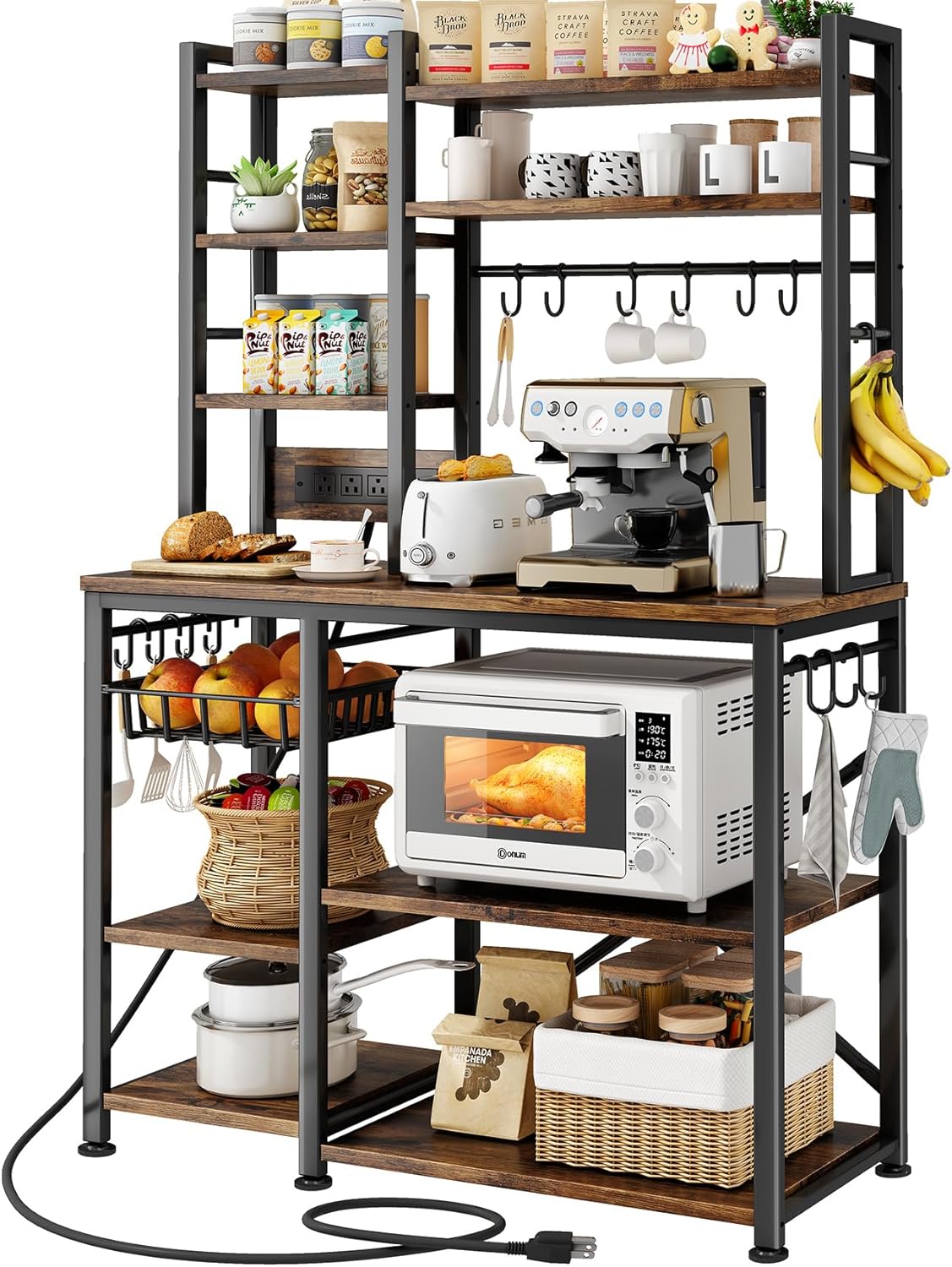
This large baker rack includes a power outlet, fourteen hooks, and open metal-framed storage for spices and cookware. The listing presents it as both a microwave stand and a coffee bar station. Its large accessory count makes hooks and hanging storage a visible part of the rack design.
Check On AmazonIf you click this link and buy, we earn a commission at no additional cost to you.
Treat integrated outlets as furniture features, not automatic appliance approval
Built-in outlets can shorten visible cord travel, but their presence does not prove that every appliance should use them. The rack has its own voltage, current, power, grounding, cord, and use instructions. The appliance has separate electrical requirements. Both sets of instructions need to permit the intended setup.
Find the rack’s documented outlet rating and restrictions, then compare them with the exact appliance manual. If the appliance requires a particular grounded supply or connection method, follow that requirement even when the furniture outlet is convenient. Also check the rack’s own cord path so it is not crushed, stretched, or routed against heat. Integrated power is useful only when it simplifies a compliant setup.
If the appliance location creates a poor power path, treat that as a placement problem. Move the rack or choose another layout. Convenience alone is not enough evidence for an electrical connection. Power features belong after shelf fit and safety checks.

This 23.6-inch four-tier rack includes a reversible power outlet, a top shelf, and six S hooks. It is marketed as both a microwave stand and a kitchen coffee bar. The reversible outlet configuration makes the furniture's own power hardware an explicit part of the storage layout.
Check On AmazonIf you click this link and buy, we earn a commission at no additional cost to you.
Count assembly, fastener checks, and cleaning as part of the ownership burden
A baker’s rack arrives as furniture, not as free vertical storage. Assembly affects whether shelves sit level, braces align, baskets move correctly, and the frame carries loads as intended. Some manuals also call for periodic fastener checks because connections can loosen. That work should count when comparing a complex tall rack with a simpler stand.
Open storage creates another recurring task because exposed shelves, wire intersections, hooks, and items around appliances collect kitchen residue. Cleaning becomes slower when shelves are packed tightly or cords block access. Partly enclosed storage may shield some items but adds doors, corners, and hardware. The lowest-effort option matches how often you are willing to clear and wipe it.
- Confirm all required parts before loading the rack.
- Follow the exact assembly and tightening sequence.
- Leave enough access to clean around appliance feet and cords.
An overfilled rack is harder to inspect and clean. Leave room to see shelf edges, hardware, cords, and appliance feet. This keeps routine checks easier and storage usable. Good ownership fit remains manageable after assembly day.

This 35.4-inch baker's rack combines open storage shelves, a wire basket, six S-shaped hooks, and a power outlet. Product data lists assembly as required and adjustable feet as a feature. Its frame, basket, shelves, hooks, and exposed surfaces create several areas that need assembly access and routine cleaning.
Check On AmazonIf you click this link and buy, we earn a commission at no additional cost to you.
Compare a baker’s rack with a fixed microwave stand when vertical storage is not essential
A baker’s rack makes the strongest case when the household needs appliance support plus useful storage above and below it. If the real problem is simply finding a stable home for one microwave, a shorter fixed stand may be easier to access and clean. Extra frame height, shelves, hooks, and baskets should solve actual storage problems. Otherwise, vertical capacity becomes unused furniture.
A fixed stand can simplify reach because the appliance surface is usually the focus. The same checks for dimensions, load, ventilation, and stability still apply, but fewer shelves often mean less exposed cleaning. Choose the rack when vertical storage earns its footprint. If you are still comparing formats, return to the broader microwave stand decision first.
| Format | Best fit | Trade-off |
|---|---|---|
| Open baker’s rack | Appliance support plus vertical storage | More exposed surfaces and reach decisions |
| Fixed microwave stand | Stable support with simpler storage | Less vertical capacity |
Define the support job before looking at current products. This keeps attractive photos from hiding depth, reach, or cleaning problems. Compare products only inside a format that already fits. The routine should control the furniture choice.

This three-tier metal organizer measures 18 by 12 by 30 inches and uses adjustable leveling feet. The listing positions it for pantry, laundry, and kitchen storage without a tall hutch or built-in power section. Its simpler fixed format provides a compact comparison point against a full-height baker's rack.
Check On AmazonIf you click this link and buy, we earn a commission at no additional cost to you.
Move to current product selection only after the support profile is clear
Once you know required width, depth, opening height, load, stability, reach, surface type, and power path, current products become easier to filter. Use those requirements as pass-or-fail checks before considering finish, hooks, cabinets, or style. This removes unsuitable racks quickly and keeps feature count from taking over. Support fit comes first.
For open vertical designs, compare current baker’s rack options against the profile built here. If other forms still fit, the current microwave stand options keep the search broader. Product comparison does not replace checking the exact manual before loading appliances or using built-in power. Selection starts with the list, but verification ends with the exact model.
- Reject a rack whose usable appliance surface is too small.
- Reject a rack whose exact shelf load is unverified.
- Reject a layout that conflicts with appliance clearance or power instructions.
This order turns a style-heavy category into a practical decision. It prevents paying for features that do not improve the routine. The strongest candidate meets support requirements with minimal friction. Appearance can matter once household fit is sound.

This large six-tier rack measures 39.4 by 14.6 by 66.9 inches. It combines power outlets, twelve S-shaped hooks, a wire basket, and multiple open storage levels around a microwave-stand layout. Those published dimensions and features give a concrete current model to compare against a pre-defined support profile.
Check On AmazonIf you click this link and buy, we earn a commission at no additional cost to you.
Final Thoughts: choose the rack around the loaded main shelf, then use the extra tiers
A baker’s rack earns its place when the main appliance shelf is correctly sized, properly rated, stable, reachable, and compatible with ventilation and power instructions. Everything above and below that surface is secondary. A tall rack can still be a poor appliance stand if depth is wrong or the shelf rating is unclear. Start with the loaded main shelf and let the remaining furniture prove its usefulness.
If extra vertical storage solves repeated pantry, coffee, cookware, or accessory problems, the open rack can remove real counter pressure. If those levels stay decorative, collect dust, or push equipment out of comfortable reach, a simpler stand may fit better. Verify the exact rack manual and appliance instructions before loading or powering the setup. The right choice makes the kitchen routine simpler.

This six-tier baker's rack combines a microwave stand, a built-in power outlet, ten S-shaped hooks, and open storage shelves. The listing positions it for spices, pots, and other kitchen storage around the main appliance area. Its layout reflects the article's final priority of supporting the appliance first and using extra tiers for secondary storage.
Check On AmazonIf you click this link and buy, we earn a commission at no additional cost to you.
FAQs
📏 How deep should a baker’s rack be for a microwave?
Deep enough to support the exact microwave while preserving its required clearance and safe front position. Compare microwave feet and placement instructions with usable shelf depth, not overall furniture depth.
⚖️ How much weight can each baker’s rack shelf hold?
It varies by model and can vary by shelf within the same rack. Use the documented limit for the exact shelf carrying the appliance and include items that normally share that surface.
🧱 Does a baker’s rack need to be anchored to the wall?
Follow the exact rack manual. If the manufacturer requires anti-tip attachment or wall securing, treat it as part of correct setup and do not improvise another method.
🔌 Can I plug a microwave into the outlet built into a baker’s rack?
Only when the rack’s outlet instructions and rating are compatible with the exact microwave’s electrical requirements. The microwave manual still controls.
🛒 Should I choose a baker’s rack or a microwave cart?
Choose a baker’s rack when the main goal is parked vertical storage. Choose a cart when loaded movement is a repeated job and the cart is designed for that use.
References and Sources
- VASAGLE rack manual: documents anti-tip attachment, fastener checks, and a stated load limit.
- GE countertop microwave clearance guidance: explains required ventilation clearances and stable countertop placement.
- Panasonic microwave electrical guidance: supports checking grounded supply and appliance connection instructions before using furniture power features.
- Home Depot powered baker’s rack listing: shows a current rack combining outlets, adjustable feet, anti-tip hardware, hooks, and storage tiers.