The strongest microwave stand is not the one with the most shelves, wheels, or decorative features. It is the one that clears the microwave’s support, load, ventilation, cord-path, and access checks before storage or mobility is counted as a benefit. This shortlist keeps only a few current U.S. options with enough published evidence to evaluate and treats every recommendation as conditional on the exact microwave manual. You should finish with a small group of furniture candidates that are easier to verify, not a long ranking of look-alike listings.
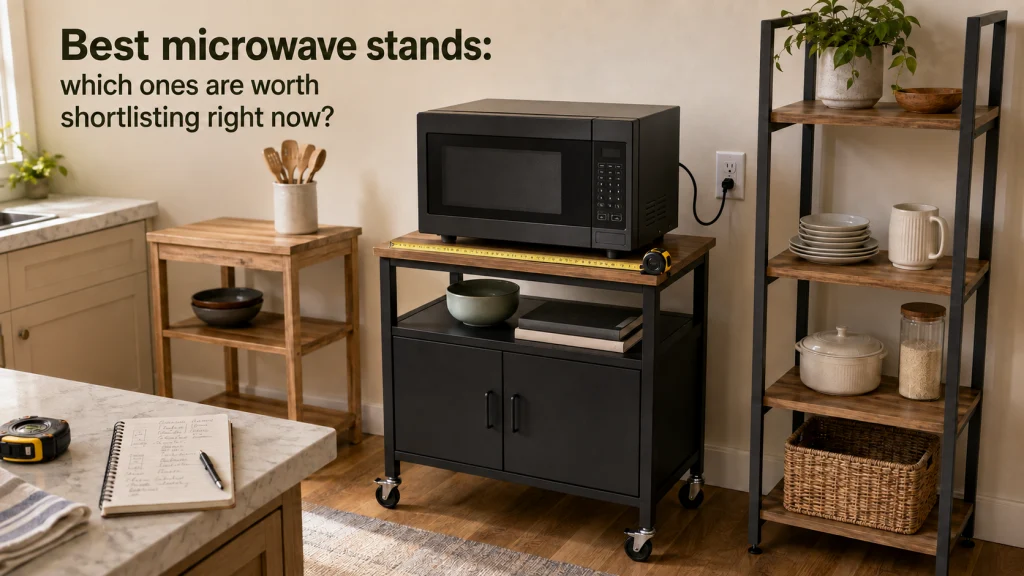
Start with a fit gate before you compare current stands
The best microwave stands become much easier to sort once you stop treating every product labeled for a microwave as automatically eligible. A stand can look wide enough and still be too shallow once the appliance feet, rear clearance, cord bend, and front setback are counted. A large total weight rating can also mislead when the microwave sits on one shelf with a lower rating. The first job is elimination, not ranking.
Before comparing style, drawers, hooks, or outlets, match the microwave manual to the exact supporting surface. GE’s countertop guidance shows why by requiring air space around countertop models and a front setback on the supporting surface, while Panasonic also tells owners to follow the exact model manual and keep vents unobstructed. Those instructions are examples, not universal dimensions for every brand. If the stand cannot meet the exact appliance requirements, it is out. Sorting systems are one part of home storage solutions, where the number of compartments should match recurring categories rather than maximize features.
Require a current U.S. listing and exact model identity
A useful shortlist starts with a traceable model number or product code. Near-identical names and finish variants can carry different measurements or load claims, so the exact item matters. If the listing does not clearly identify the product being evaluated, it is not ready for a recommendation.
Require usable support dimensions and a relevant load rating
Overall furniture dimensions do not prove that the microwave shelf is large enough. The appliance needs the actual supporting width and depth, plus room for its feet and required clearances. The load figure should apply to that surface rather than only to the whole unit.
Require a design that can follow ventilation and power instructions
Open furniture is usually easier to measure, but an open rack can still be too shallow or too close to a wall. Enclosed cubbies need extra scrutiny because the opening and the microwave’s ventilation requirement must both be satisfied. A built-in furniture outlet also does not override the microwave manual’s power instructions.
Separate published facts from testing and editorial judgment
Manufacturer and retailer pages establish model identity, dimensions, listed capacities, features, and current availability. Independent testing can add assembly or stability observations when the exact tested product matches, while owner comments can expose repeated workflow frustrations. The recommendation itself is editorial judgment built on those evidence types, not a substitute for missing specifications.
| Evidence type | What it can establish | What it cannot establish by itself |
|---|---|---|
| Manufacturer or current retailer documentation | Exact model, dimensions, listed load, features, availability | Real-world convenience or stability feel |
| Independent testing | Assembly, observed stability, material quality, handling | Current availability or revised specs unless rechecked |
| Owner discussion | Repeated placement and workflow frustrations | Technical load, ventilation, or safety proof |
| Editorial judgment | Which household profile the verified facts suit | Any missing fact the source does not publish |
That separation matters because the stand is supporting a heavy electrical appliance, not just storing dishes. A product becomes eligible only after its sourced facts are good enough to compare with the actual microwave. A star score cannot fill in a missing shelf rating. The stricter screen is what keeps a short list useful.

This 25-foot tape measure uses a manual blade lock and printed fractional markings for quick furniture measurements. Its compact case has a rubber overmold for grip and impact resistance. Use the blade to check the microwave footprint, supporting surface, wall clearance, and cord path before comparing stands.
Check On AmazonIf you click this link and buy, we earn a commission at no additional cost to you.
Use this eligibility check before any stand earns a place on the shortlist
A stand should remain in the running only when you can verify the facts that control real use. Measure the microwave, identify the feet and vent locations, check the manual, and then match those requirements to the furniture surface. Do not assume that the phrase “microwave shelf” proves compatibility. It is a product label, not a fit certificate.
The same logic applies to mobility and storage. Wheels help only when the loaded cart can be parked securely and the cord path remains sensible, while cabinets help only when they do not reduce appliance clearance or access. The best microwave stand with storage is the one whose storage remains useful after the microwave is placed correctly. Shelf count comes after appliance fit.
- Eligible: exact model identity is clear and the item is currently sold in the U.S.
- Eligible: the microwave-support surface can be measured and has a relevant published load rating.
- Eligible: the stand can follow the exact microwave manual’s clearance and power rules.
- Eligible: drawers, shelves, casters, and wall placement still work after the appliance is loaded.
- Not eligible yet: only overall furniture dimensions or an unexplained total load are published.
- Not eligible yet: the listing relies on ratings or “heavy duty” language without traceable support data.
Keep that list next to the microwave measurements while shopping. It prevents the common first-time mistake of buying furniture first and trying to make the appliance fit afterward. If you need the full measurement sequence, how to choose a microwave stand covers the fit process in more depth. This page assumes that groundwork is already done.

This self-locking tape measures up to 33 feet and shows both inch and metric scales. A push-button release controls retraction, while the belt clip and wrist strap make it easy to keep nearby. It is useful for checking the exact microwave-support width, depth, opening size, and room clearances before a stand is considered eligible.
Check On AmazonIf you click this link and buy, we earn a commission at no additional cost to you.
A short current list is more useful than fifteen nearly identical winners
Three current products are worth keeping on the comparison sheet, but they do not all carry the same evidence status. Shelving Inc. can be evaluated against a shelf-specific load figure because its microwave stand includes an 18-by-24-inch wire shelf, and that shelf line is rated for up to 800 pounds evenly distributed. Hodedah publishes a microwave opening and a 50-pound capacity but does not map that capacity to the appliance shelf, while BYBLIGHT publishes tier loads without naming the microwave-support tier in the same evidence. Treat those last two as conditional finalists rather than cleared winners.
All three still have active U.S. product pages, so they remain useful for a current comparison. The Hodedah listing is the lowest-priced of the three, BYBLIGHT sits above it, and the Shelving Inc. stand is substantially more expensive, but those relative positions can change. Price therefore works only after the evidence status is clear. Recheck the exact variant, seller, price, and stock before ordering.
| Role | Current finalist | Published support evidence | Main reason to shortlist | Main reason to skip |
|---|---|---|---|---|
| Fixed and simple | Shelving Inc. SI-WVSTD | 18 in. deep by 23.625 in. wide outer footprint; included 18 in. by 24 in. wire shelf line rated up to 800 lb evenly distributed | Hardwood insert over a rated wire shelf, leveling feet, open structure | The 18 in. depth still has to support the exact microwave footprint and required air space |
| Rolling with storage | Hodedah HIK74 | Microwave opening up to 18 in. W by 12 in. D by 10 in. H; listing also shows 50 lb capacity but does not map it to the microwave shelf | Compact microwave opening, locking casters, lower cabinet | Not fully eligible until the load rating for the microwave shelf is confirmed |
| Open vertical storage | BYBLIGHT Melai GG-HDF1496 | 15.7 in. shelf depth; Q&A lists 40 lb for the top two tiers and 90 lb for the bottom three, without naming the microwave-support tier | Open layout with published shelf depth, spacing, and tier-specific load figures | Load evidence remains conditional until the intended microwave shelf is matched to its tier rating |
This is deliberately not a three-winner table. A current product can stay in the comparison as a conditional finalist without being recommended for purchase. That distinction is more useful than pretending a generic total capacity proves appliance support. If the missing surface-specific evidence becomes available, the status can change.

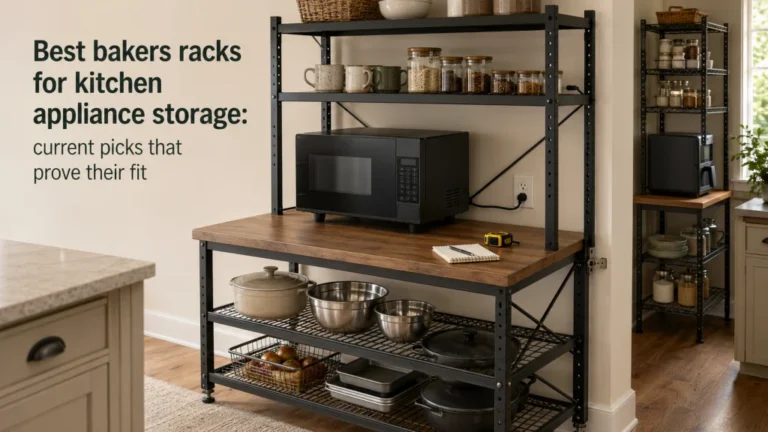
This freestanding bakers rack measures 16.5 inches deep, 23.6 inches wide, and 50.6 inches high. Its published shelf capacity is 80 pounds per shelf, and the frame includes adjustable feet plus an anti-tip device. The open layout makes the support surface and surrounding clearance easier to inspect against an exact microwave manual.
Check On AmazonIf you click this link and buy, we earn a commission at no additional cost to you.
The strongest fixed choice is the simplest stand that still proves its support
The Shelving Inc. SI-WVSTD is the clearest fixed candidate because its support evidence can be traced to the surface architecture instead of stopping at a whole-unit number. The microwave-stand page lists an 18-inch-deep by 23.625-inch-wide outer footprint and includes an 18-by-24-inch wire shelf with a hardwood insert. Shelving Inc. separately rates its 18-inch-deep wire shelves from 18 to 54 inches wide for up to 800 pounds evenly distributed, which covers the included 24-inch shelf size. Leveling feet and the open frame also make clearance and placement easier to inspect.
That rating still does not prove that a particular microwave fits. The appliance feet must sit fully on the support surface, the 18-inch depth has to leave the manual-required placement space, and the cord still needs a sensible path to the permitted receptacle. I would shortlist this fixed format for a household that wants a permanent appliance station and does not need mobility. Its advantage is not the large number by itself, but the fact that the load evidence can be connected to the included support shelf.

This fixed freestanding rack measures 15.6 inches deep, 35.4 inches wide, and 60.4 inches high. The metal-and-engineered-wood structure uses adjustable feet and an open appliance area rather than casters. Its wider format gives you a clear surface to measure, but the exact microwave footprint, shelf rating, and required clearances still need to be matched before use.
Check On AmazonIf you click this link and buy, we earn a commission at no additional cost to you.
Choose a rolling cart only when mobility solves a real household problem
The Hodedah HIK74 is a conditional rolling candidate rather than a cleared recommendation. Home Depot publishes a maximum microwave opening of 18 inches wide by 12 inches deep by 10 inches high and also lists a 50-pound capacity. The problem is that the listing does not state that the 50-pound figure applies specifically to the shelf supporting the microwave. Its appliance dimensions can therefore be screened, but the relevant-load gate remains open.
That compact opening is not automatically a flaw because some households own small microwaves and have very little floor space. The problem starts when the product label or 50-pound figure is treated as proof that the microwave shelf itself has been verified. A loaded cart may also be more practical as a parked station with occasional repositioning once the cord path and stored items are considered. If wheels are central to your decision, when a microwave cart makes sense explains that parked-versus-mobile trade-off more directly.

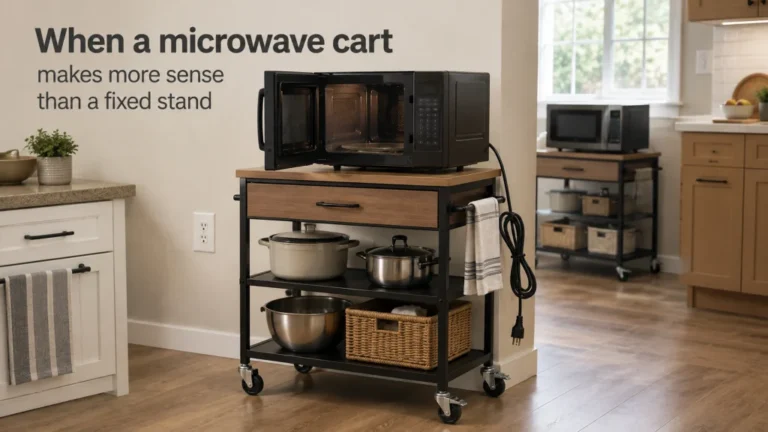
This three-tier cart measures 23.62 inches wide, 15.75 inches deep, and 30 inches high. Its top shelf is rated for 90 pounds, while the middle and bottom shelves are rated for 60 pounds each. Four rotating casters provide mobility and two can lock, making it suitable for a parked appliance station that is repositioned only when needed.
Check On AmazonIf you click this link and buy, we earn a commission at no additional cost to you.
Use an open vertical rack when added shelf area matters more than concealed storage
The BYBLIGHT Melai GG-HDF1496 is also a conditional candidate because its current listing provides useful load detail without fully mapping that detail to microwave placement. Home Depot lists a 15.74-inch product depth, and the product Q&A states that the top two tiers can hold up to 40 pounds each while the bottom three can hold up to 90 pounds each. That is better evidence than one unexplained total capacity, but the published wording does not identify the microwave-support shelf by tier. Do not silently assign the 90-pound figure to the pictured microwave position without confirming that mapping.
Depth remains the other constraint. A shelf just under 16 inches deep can look generous in a photo, yet the microwave body, feet, required clearance, cord bend, and front position can use that space quickly. If the seller or manufacturer can match the microwave-support board to the correct tier rating, the rack becomes a much stronger finalist for open vertical storage. For a narrower rack comparison, how a baker’s rack works as appliance storage explains the architecture, while current baker’s rack options is the better comparison when the rack itself is the main purchase.

This open vertical rack measures 15.7 inches deep, 47.2 inches wide, and 66.6 inches high. The main shelf is rated for 110 pounds, and the frame combines engineered wood with metal plus adjustable feet. Its broad multi-level layout adds visible storage while leaving the microwave-support area accessible for footprint, clearance, and cord-path checks.
Check On AmazonIf you click this link and buy, we earn a commission at no additional cost to you.
There is no separate value winner when the cheaper evidence gets weaker
A low price matters only after the stand passes the same support test as the more expensive candidates. Many cheaper current listings advertise heavy-duty frames, outlets, wheels, or large total capacities without making the microwave shelf dimensions and shelf-specific load equally clear. That creates false value because the price comparison happens before compatibility is established. I would rather leave the value slot empty than reward missing evidence.
This does not mean a cheaper alternative cannot beat the shortlist for your household. If another stand publishes a usable support surface, relevant load, exact model identity, and a layout that follows the microwave manual, it can be the better buy. Returning a partially assembled stand or replacing furniture after discovering the appliance will not fit can erase a modest saving quickly. Compare price last, after support, clearance, access, and storage are settled.

This rolling kitchen rack measures about 21 inches wide, 15 inches deep, and 36.7 inches high. It has two adjustable wire shelves rated for 50 pounds each, a wood top, and four casters with two locking wheels. Its published dimensions and load information give useful evidence to compare, but the exact microwave-support surface still has to pass the appliance fit and clearance checks.
Check On AmazonIf you click this link and buy, we earn a commission at no additional cost to you.
Compare finalists by the surface you use, not the furniture you can see
Once two or three products survive the fit gate, compare the dimensions that affect the microwave rather than the measurements that make the furniture sound large. A wide rack with a shallow appliance surface may be less useful than a narrower stand with enough depth. A high total capacity is not automatically better than a lower, clearly stated shelf capacity. Storage architecture, assembly, and stability enter after appliance support is adequate.
The current U.S. pages keep all three models available to compare, but their evidence status is not equal. Hodedah is the lowest-priced listing of the three, BYBLIGHT occupies the middle position, and Shelving Inc. is substantially more expensive. That price order is useful only after the support evidence is sorted, because Hodedah and BYBLIGHT still need load mapping that the fixed Shelving Inc. candidate can document more directly. Use price as a tie-breaker among products that clear the same fit and load gate, not as a reason to lower the gate.
| Decision factor | Fixed simple stand | Rolling storage cart | Open vertical rack |
|---|---|---|---|
| Best fit for | Permanent appliance station | Compact microwave plus lower storage | Microwave plus broader visible storage |
| Primary verification | 18 in. shelf depth, microwave footprint, clearance | 18 x 12 x 10 in. opening plus microwave-shelf load confirmation | 15.7 in. shelf depth plus mapping the microwave shelf to its 40 or 90 lb tier rating |
| Main ownership friction | Open, utilitarian storage | Cord management and limited appliance space | Visual clutter and shallow shelf risk |
Use the table as a final comparison tool, not as a substitute for measurement. The right role should be obvious once you know whether the stand will stay parked, whether concealed storage matters, and how much surrounding shelf space you actually use. A product that wins on features but loses on microwave fit should be removed rather than rationalized. That is where a short list becomes useful.

This 25-foot measuring tape uses a self-locking blade that stays extended until released. The compact case provides a straightforward way to compare the dimensions that actually affect appliance placement. Measure each finalist's usable support depth, width, wall setback, and nearby obstructions rather than relying on overall furniture size.
Check On AmazonIf you click this link and buy, we earn a commission at no additional cost to you.
Verify clearance and the power path after you choose the furniture finalist
Furniture selection does not finish the job because the microwave’s own instructions still control placement. GE’s general countertop guidance specifies air space around the appliance, a rear gap, and a front setback, while Panasonic also tells owners to keep vents clear and use a sturdy, level surface near a grounded outlet. Your exact manual can differ, so the numbers from one brand should not be copied onto another appliance. The stand has to work with the microwave you actually own.
Final compatibility check: Confirm that the exact microwave’s feet are fully supported, required air space remains open, the door and controls are unobstructed, and the cord reaches the permitted receptacle without an improvised extension. If any one of those checks fails, reject the furniture even if its listed load is sufficient.
Measure with the stand in its real location because baseboards, plugs, cord bends, and nearby cabinets can reduce usable depth. Open the microwave door fully and check the path for removing a hot bowl or plate. Keep the appliance’s factory feet in place unless the exact manual says otherwise, and do not improvise extensions or overhang to create clearance. If fit requires modification, choose a different stand.

This receptacle tester is designed for standard North American 110 to 125-volt AC outlets and detects common wiring problems. It also checks operation of GFCI protection on compatible receptacles. It can screen the wall outlet as part of a power-path check, but it does not replace the microwave manual or determine whether a circuit is suitable for the appliance load.
Check On AmazonIf you click this link and buy, we earn a commission at no additional cost to you.
Treat built-in outlets as conditional features, not automatic advantages
Built-in outlets look convenient because they shorten visible cord runs and let several devices share one furniture station. The problem is that microwave power instructions can be stricter than furniture marketing. Panasonic’s general placement guidance tells owners to use a grounded outlet and avoid extension cords or power strips, while the exact model manual may add more requirements. A furniture outlet should therefore be treated as unapproved for the microwave until both sets of instructions support that use.
This is why an outlet feature should not decide the ranking. A stand without integrated power can be better when the wall receptacle is already suitable and the microwave cord reaches without strain. Do not chain extensions, route power through moving drawers or caster paths, or ignore a direct-connection instruction because the rack was advertised as an appliance station. Choose the stand for support, access, and storage first, then verify power separately.

This receptacle tester checks common wiring faults and can test both AFCI and GFCI protective devices. It is intended for North American AC receptacles and uses indicator functions to evaluate outlet conditions. The tester can help inspect an outlet, but it cannot make a furniture power strip acceptable for a microwave when the appliance or furniture instructions do not permit that setup.
Check On AmazonIf you click this link and buy, we earn a commission at no additional cost to you.
Skip this broad list when the furniture architecture is already decided
A broad shortlist helps when the microwave is measured but the household has not committed to fixed shelving, a cart, or a taller rack. It is less useful when wheels are non-negotiable or open vertical storage is clearly the goal. In those cases, compare products within that narrower job instead of keeping unrelated furniture in the same race. The furniture type should match the room plan before model details are weighed.
You should also leave this list if the household needs an appliance garage or built-in cabinet solution rather than freestanding furniture. Those installations create different clearance, door, electrical, and cabinetry questions. Likewise, if the microwave itself has not been chosen, select the appliance before the furniture so the stand does not artificially limit size or features. This page is the endpoint of a known fit problem, not the starting point for a whole kitchen layout.

This carbon-steel countertop rack is an over-microwave storage organizer rather than a freestanding appliance stand. Its width is expandable and the design adds an upper shelf plus hooks without supporting the microwave itself. It fits a narrower countertop-storage architecture when that job is already decided, while the microwave must remain on its own suitable supporting surface.
Check On AmazonIf you click this link and buy, we earn a commission at no additional cost to you.
Choose the microwave before you let furniture narrow the appliance decision
This shortlist assumes the microwave is already known. If you are still deciding capacity, controls, footprint, or cooking features, choose the appliance first and fit furniture around the exact model. A compact cart bought too early can quietly force the later appliance choice into an unnecessarily small opening. That reverses the decision and can make the household accept the wrong microwave because the furniture is already assembled.
The better sequence is appliance job, appliance model, manual requirements, then furniture. Our article on choosing a countertop microwave handles the machine decision itself. Once that choice is settled, bring the exact dimensions, weight, feet, vents, and cord location back to the stand comparison. At that point, furniture shopping becomes verification instead of guesswork.
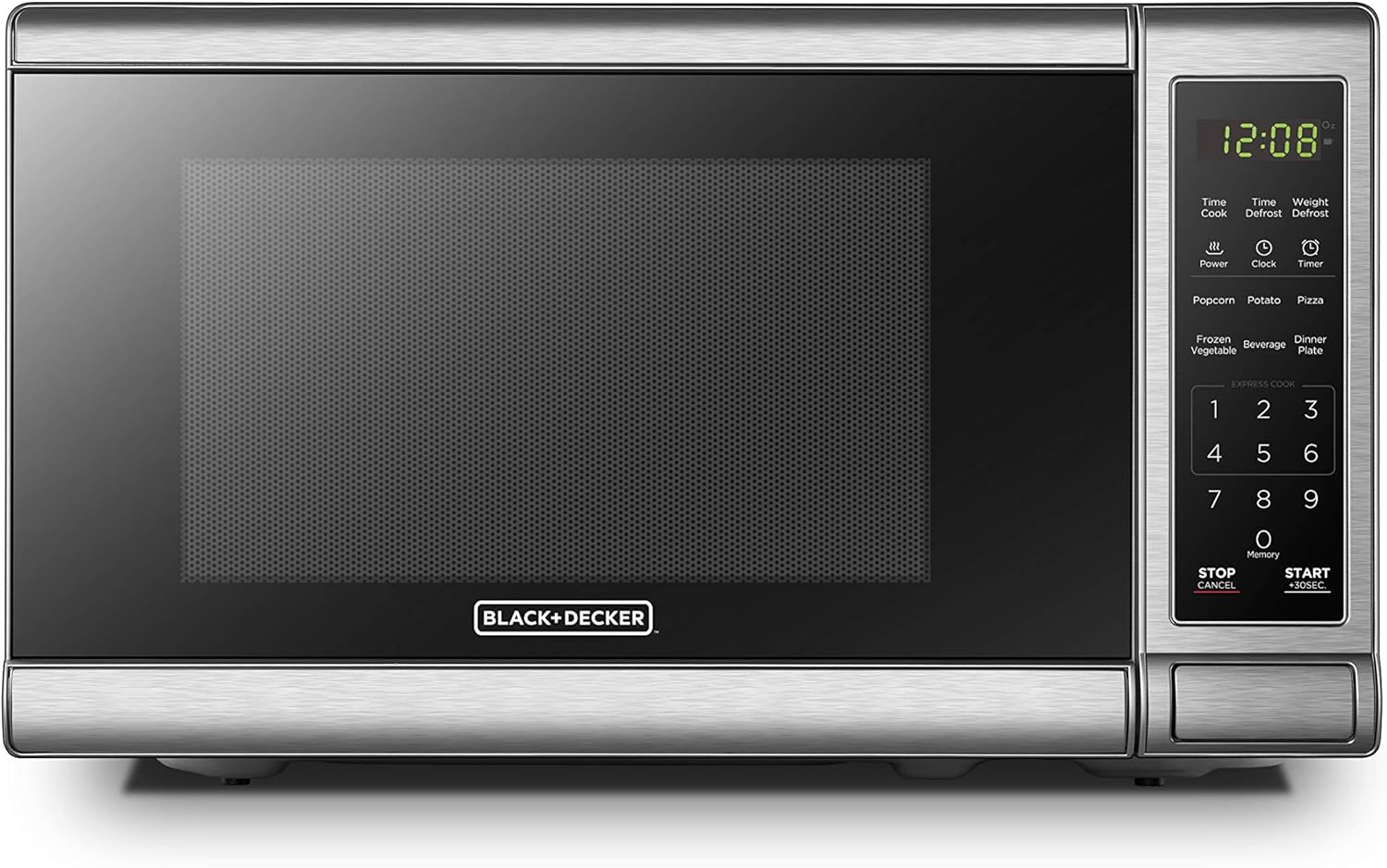
This countertop microwave has a 0.7-cubic-foot cavity, 700 watts of cooking power, and ten power levels. The cabinet measures about 17.3 inches wide, 13 inches deep, and 10.2 inches high, with a removable 10-inch turntable. Choosing the appliance first gives you a known footprint and feature set to bring back to the furniture fit check.
Check On AmazonIf you click this link and buy, we earn a commission at no additional cost to you.
Final Thoughts: choose the stand that survives your exact fit test
The fixed Shelving Inc. stand is the strongest evidence-backed finalist in this group because its included wire support shelf can be tied to a published shelf rating. The compact Hodedah cart and wider BYBLIGHT rack still represent useful household roles, but their current published load information needs one more step of mapping before either should be treated as fully cleared for a microwave. After that evidence check, decide whether fixed support, wheels, concealed storage, or open vertical storage actually helps the room. Price, style, and built-in power belong after that decision.
Do not let a current price or feature badge undo that sequence. Recheck the exact product page before ordering because variants and availability can change, then compare the furniture against the microwave manual once more. If a cheaper or simpler stand passes the same checks, there is no reason to pay for storage or mobility you will not use. A shortlist has done its job when it leaves you with fewer products and a clearer reason for choosing one.

This self-locking tape measures up to 16 feet and includes both inch and metric scales. The push-button release, belt clip, and wrist strap make repeated fit checks easy around a kitchen setup. Use it for one final measurement of the microwave footprint, supporting surface, wall spacing, and access path before committing to the stand.
Check On AmazonIf you click this link and buy, we earn a commission at no additional cost to you.
FAQs
📏 How much bigger should a microwave stand be than the microwave?
There is no universal extra-size rule. Use the exact microwave manual for side, rear, top, and front placement requirements, then confirm the feet sit fully on the support surface.
⚖️ Is the stand’s total weight capacity enough to prove it can hold my microwave?
Not always. The useful number is the rating for the specific shelf or surface that supports the microwave, so treat an unexplained total capacity as incomplete evidence.
🛞 Should I buy a microwave stand with wheels?
Choose wheels when occasional repositioning or cleaning access solves a real problem. Do not assume the loaded cart should move while the microwave is operating or plugged in.
🔌 Can I plug a microwave into the outlet built into a baker’s rack?
Only if the microwave manual and the furniture’s electrical instructions both allow that setup. Do not assume an integrated outlet is equivalent to the grounded receptacle specified by the appliance manufacturer.
📦 Are enclosed microwave cubbies better than open shelves?
They hide clutter, but they can make ventilation and cord routing harder to verify. An enclosed opening works only when the exact microwave’s clearance and access requirements still fit.
💵 Is a cheaper microwave stand usually a better value?
Only after it passes the same fit, load, stability, and power checks as a more expensive stand. A low price does not compensate for missing shelf dimensions or an unsuitable appliance opening.
References and Sources
- Shelving Inc. microwave stand: verifies the SI-WVSTD identity, outer dimensions, included 18-inch-deep wire shelf, hardwood insert, and current listing status.
- Hodedah HIK74 microwave cart: verifies the current HIK74 identity, wheel and storage configuration, and overall dimensions.
- Home Depot Hodedah HIK74 listing: verifies the 18-by-12-by-10-inch maximum microwave opening, listed 50-pound capacity, current price position, and active U.S. listing.
- Home Depot BYBLIGHT Melai listing: verifies the GG-HDF1496 dimensions, shelf depth, current listing status, and Q&A figures of 40 pounds for the top two tiers and 90 pounds for the bottom three.
- GE countertop microwave clearance guidance: supports the clearance and support-depth checks used in the article.
- Panasonic microwave placement guidance: supports the sturdy-surface, ventilation, grounded-outlet, and exact-manual checks.
- Shelving Inc. 18-inch wire shelves: verifies that 18-inch-deep shelves from 18 to 54 inches wide, including the 24-inch size used by the SI-WVSTD, are rated up to 800 pounds evenly distributed.