Heating, cooling and air quality is a useful shopping label, but it hides several different household jobs. A room that feels uncomfortable may need heat removed, air moved, moisture removed or added, particles filtered, or localized heat added, and those jobs are not interchangeable. First identify what is wrong in the room, then compare the equipment class that changes it without unnecessary ownership burden. This page gives you that decision map before you start comparing sizes, features, controls, or prices.
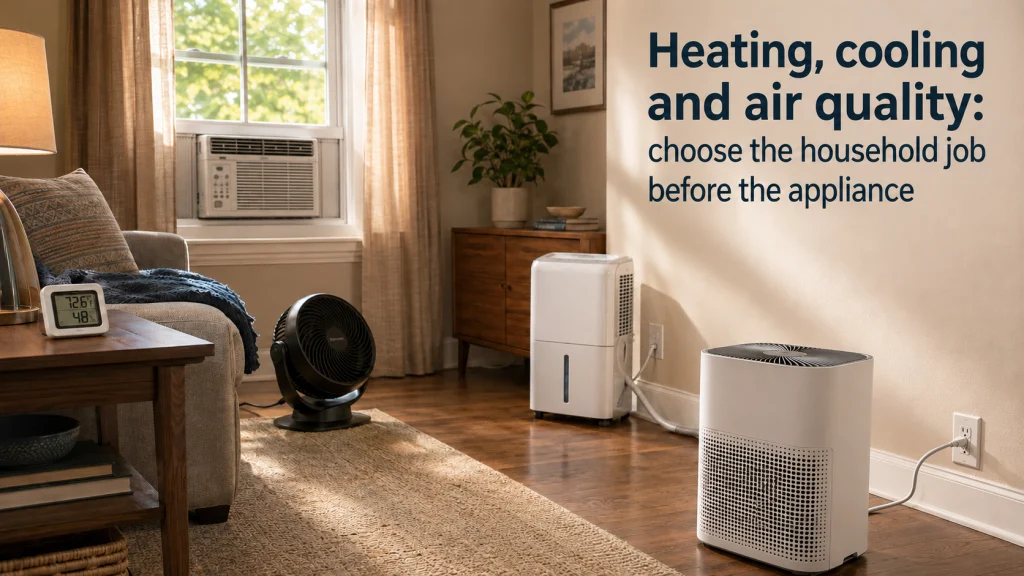
Treat heating, cooling and air quality as a shopping category, not one household system
A retailer can make heating, cooling, and air quality look like one problem by placing air conditioners, fans, heaters, humidifiers, dehumidifiers, and air purifiers under one menu. In a real room, “the air feels bad” is not a diagnosis. A warm room can have normal humidity, a cool room can feel clammy, and a comfortable room can still contain particles you want to filter. The first decision is not which machine has more features, but which condition you need to change.
That matters because heating, cooling, and air quality appliances act on different variables. A fan moves air, a dehumidifier removes moisture, a purifier filters air, and an air conditioner provides refrigerant cooling. Crossing those boundaries can leave the problem untouched while adding noise, floor space, filters, water handling, or electrical load. Sort the job first, then compare equipment carefully within the correct family using room fit, maintenance, and ownership cost.

The TP50 combines an indoor thermometer and hygrometer in one room monitor. It displays temperature and humidity so both conditions can be checked from the same device. Amazon lists it for indoor spaces including homes, offices, cellars, greenhouses, and RVs.
Check On AmazonIf you click this link and buy, we earn a commission at no additional cost to you.
Start with the physical job before the product name
Narrow the store by describing the change you need in plain language. Do you need to remove heat, move air, remove moisture, add moisture, filter particles, or add localized heat? Evaporative cooling needs its own route because it uses water evaporation and depends on climate and ventilation. Once the job is clear, compare room fit, ownership burden, and controls within that equipment family.
Ignore brand names for a moment and imagine every machine has a blank front panel. If you cannot state its physical job, comparing wattage, modes, apps, or “coverage” is premature. The seven routes below stay separate because a capable machine can still be the wrong tool. A room can need two routes, but that should follow two distinct conditions, not one vague complaint.
| Physical job | Equipment route | First fit check |
|---|---|---|
| Remove heat | Window or portable AC | Room, opening or exhaust, electrical fit |
| Cool by evaporation | Evaporative cooler | Dry climate, ventilation, water routine |
| Move air | Portable or ceiling fan | Airflow path, placement, noise |
| Remove moisture | Dehumidifier | Measured humidity, drainage, moisture source |
| Add moisture | Humidifier | Measured dryness, refills, cleaning |
| Filter particles | Air purifier | Room fit, filtration performance, filters |
| Add localized heat | Space heater or electric fireplace | Clearances, electrical fit, placement |
Use this as a routing table, not a ranking. Name the job first, then move to the equipment family whose mechanism changes that condition. The detailed checks come after that first match.
Remove heat with refrigerant cooling
Choose this route when room temperature is too high and mechanical cooling is required. Window and portable air conditioners both use refrigeration, but window fit, exhaust setup, noise, and storage differ. Continue with the window air conditioner buying guide or the portable air conditioner decision process.
Use water evaporation only where the climate and ventilation support it
Evaporative coolers use water evaporation, so cooling also adds moisture. Dry conditions and workable ventilation are basic fit requirements before airflow or tank size matters. If that mechanism fits the setting, use the evaporative cooler buying guide for airflow, water handling, and maintenance.
Move air without pretending that movement is refrigeration
A fan can improve occupied comfort through air movement without removing heat like an air conditioner. Check airflow path, noise, footprint, and whether the unit must move between rooms. Use the room fan and air circulator comparison or the ceiling fan selection article when fixed mounting changes the choice.
Remove excess moisture when humidity is the actual problem
If measurements point to excess moisture, a dehumidifier is designed to remove water from the air. Condensate handling, filter cleaning, noise, and unresolved moisture sources still matter. Use the dehumidifier buying guide for sizing, drainage, efficiency, and ownership checks.
Add moisture only when the room is actually too dry
A humidifier works in the opposite direction from a dehumidifier even though retailers may group them together. Refills, water quality, tank cleaning, and output control belong in the decision. If measured conditions support adding moisture, use the humidifier buying guide to compare types and upkeep.
Filter airborne particles without promising a health outcome
A portable air purifier is a filtration tool, not a humidity-control device or room air conditioner. EPA guidance says CADR should fit the room and no air cleaner removes every pollutant. Use the air purifier buying guide for room fit, filters, noise, and operating burden.
Add localized heat with the safety boundary in front
Space heaters and electric fireplaces can provide supplemental heat, but their form factors change placement and clearance decisions. A compact heater centers on localized heat, while a fireplace also brings visual and installation considerations. Use the space heater buying guide or the electric fireplace buying guide for the matching form factor.

The H5075 monitors indoor temperature and humidity and connects to the Govee app by Bluetooth. Its listing specifies remote monitoring up to 164 feet plus smart alerts. It also supports two years of stored data with export from the app.
Check On AmazonIf you click this link and buy, we earn a commission at no additional cost to you.
Separate “temperature feels wrong” from “humidity feels wrong”
A room can be cool enough and still feel damp, or warm enough in winter and still be dry. Sensation alone is therefore a weak basis for choosing cooling or moisture-control equipment. Read temperature and humidity separately, then note conditions such as condensation or persistent dampness without turning them into a medical diagnosis. Measurement will not choose the machine for you, but it prevents a temperature-control purchase from being mistaken for moisture control.
The same logic works in reverse. If the room is too hot, a dehumidifier may remove moisture while leaving the temperature problem unresolved. If the room is cool but clammy, more fan speed can change how air feels without removing the measured moisture. Separate temperature from relative humidity first, then choose the mechanism that matches the problem.
- Check room temperature and humidity separately instead of describing both as “bad air.”
- Look for a repeatable room condition, not one momentary sensation after cooking, showering, or opening a door.
- If moisture is coming from a leak or persistent water intrusion, correct the source rather than relying on a dehumidifier to hide it.
- If the exact product manual gives a model-specific operating range or placement rule, follow that instruction over generic advice.
First-time buyers often assume a colder setting automatically means a drier-feeling room. Cooling and moisture removal can interact, but sizing, run behavior, outdoor conditions, and design affect the result. Reaching a temperature target does not prove every humidity issue is solved. Measure both conditions instead of treating comfort as one number.

This AcuRite monitor displays indoor temperature and relative humidity. Amazon lists an operating humidity range of 16% to 98% RH for this Classic version. The unit measures about 2.5 inches wide by 3 inches high and weighs 3.2 ounces.
Check On AmazonIf you click this link and buy, we earn a commission at no additional cost to you.
Separate air movement from cooling capacity
Fans are useful because they do not need to be miniature air conditioners. DOE describes a wind-chill effect that can make occupants more comfortable without mechanically removing heat from the room. Fan value therefore depends on occupied location, airflow path, noise, and whether moving air is enough. If room temperature itself must drop, the decision has moved into air conditioning.
This also prevents a feature-list trap. Speeds, oscillation, smart controls, and airflow figures are not refrigerant cooling capacity. An air conditioner contains fans too, but refrigeration changes its job class. Compare fan metrics with fans and AC metrics with air conditioners rather than treating one category as a stronger version of the other.
| Same room, different problem | First route | Wrong shortcut |
|---|---|---|
| Warm, normal humidity | Fan if airflow is enough; otherwise AC | Using moisture control for heat |
| Cool but clammy | Measure humidity, then dehumidify if needed | Expecting airflow to remove moisture |
| Comfortable but stagnant | Portable or ceiling fan | Buying unnecessary AC capacity |
| Temperature and humidity are fine; filtration is the goal | Air purifier | Using humidity equipment for particles |
The same room can therefore lead to different equipment depending on what is actually wrong. Use measurements where they apply, then separate airflow, temperature, moisture, and filtration instead of folding them into one comfort complaint. A simpler route can be the correct one when it changes the variable that matters. If two conditions are present, evaluate both without pretending one mechanism automatically solves the other.
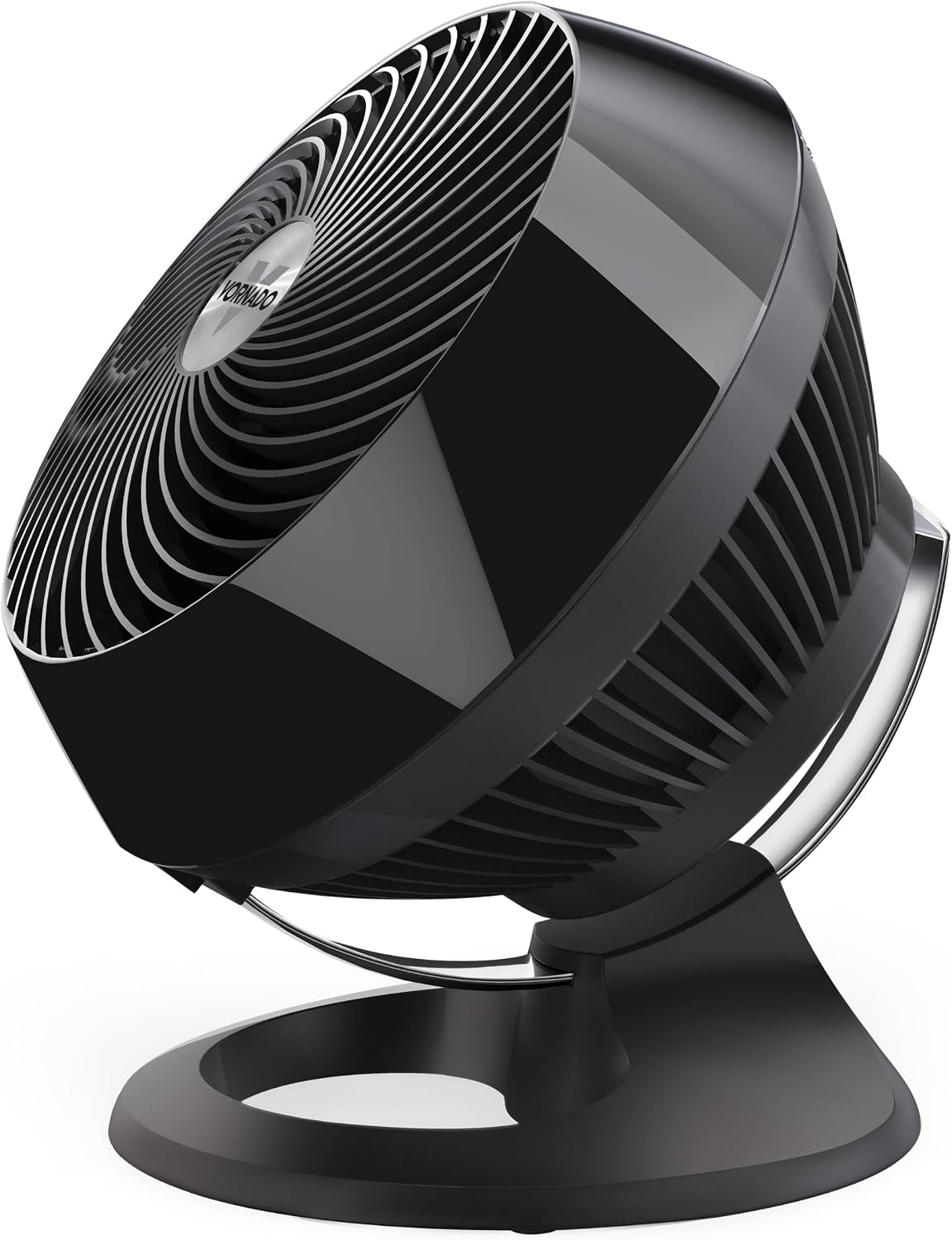
The Vornado 660 is a large whole-room air circulator with four speed settings. Its head has adjustable tilt using a chrome glide bar. It is designed to move room air, making it an airflow tool rather than a refrigerant cooling appliance.
Check On AmazonIf you click this link and buy, we earn a commission at no additional cost to you.
Separate filtration from moisture control
Air purifiers, humidifiers, and dehumidifiers are often grouped together because all three interact with indoor air, but they do not remove the same thing. A particle filter is intended to capture particles from the air passing through it, while a dehumidifier condenses and removes water and a humidifier adds water. EPA also notes that portable air cleaners cannot remove all pollutants, which is another reason to define the filtration job narrowly rather than treating a purifier as a universal indoor-air fix. If your measurement says humidity is the problem, a filter rating does not answer that problem.
The ownership routines are different too. A purifier can require replacement filters and enough clear airflow around its intake and outlet, a dehumidifier needs condensate handling and periodic filter cleaning, and a humidifier needs water management plus careful cleaning according to the exact design. Combination products exist, but a combined housing does not erase the need to verify each function separately. Check the room rating, maintenance path, consumables, and operating instructions for every function you expect to use rather than assuming one “air care” label proves equal capability across all jobs.

The Core 300-P uses a True HEPA filtration system for airborne particle filtration. Amazon lists Sleep Mode operation at 24 dB and AHAM verification for this model. The listing gives room coverage up to 1,073 square feet under its stated rating.
Check On AmazonIf you click this link and buy, we earn a commission at no additional cost to you.
Decide whether the problem belongs to room-level equipment or fixed infrastructure
This page stays at the room and consumer-equipment level. If one bedroom needs airflow, one room needs moisture removal, or one window can support a room AC, a room product may fit. If the complaint affects the whole house, follows ductwork, or requires electrical, refrigeration, combustion, structural, or ventilation-design work, the decision has moved beyond another portable box. Several room devices can become an expensive workaround for an infrastructure problem.
Ceiling fans are the main fixed-installation exception here, and mounting conditions still matter. Whole-home dehumidifiers, central HVAC, ducted ventilation, furnaces, boilers, heat pumps, mini-splits, and installed cooling systems need different sizing and service decisions. Renters can face additional limits on windows, mounting, drainage, and electrical changes. Before shopping, confirm that the equipment class you need can actually be installed and used in the space.
| Situation | Usually stays in this equipment decision | Usually moves beyond it |
|---|---|---|
| One room has a specific comfort problem | Portable fan, room AC, portable dehumidifier, humidifier, purifier, space heater | Whole-house redesign without building-wide evidence |
| A fixed overhead fan is being considered | Ceiling-fan selection and room fit | Unsafe electrical or mounting work |
| Persistent problem across multiple rooms | Documenting conditions and symptoms | Duct, system, refrigeration, combustion, or professional sizing work |
Use this boundary before buying a second or third room appliance for the same unresolved condition. The extra machine may be easier to order, but that does not prove it addresses the root cause. Owner-level checks can tell you what the room is doing and what a portable product requires. They should not be stretched into professional system diagnosis or repair.

The Whynter NEX ARC-1230WN is a dual-hose portable air conditioner for households that need movable cooling where a conventional window unit is unsuitable. Its inverter-driven compressor helps vary cooling output, while the dual-hose design separates outdoor air intake and exhaust paths. The unit also supports fan and dehumidifying operation, with smart controls offered for additional convenience. It is a modern alternative to the older Whynter ARC-14S but not an identical model, so compare room sizing, power requirements, venting parts, noise specifications, and drainage instructions. Proper window installation is essential for efficient cooling.
Check On AmazonIf you click this link and buy, we earn a commission at no additional cost to you.
Compare the ownership burden that follows each equipment type
Once two equipment types could plausibly help, ownership friction becomes part of the choice. A portable AC needs floor space, exhaust setup, storage, and may require condensate handling. A dehumidifier brings a tank or drain, a humidifier brings refilling and cleaning, and a purifier brings filter cost. Even a fan needs space, dust cleaning, acceptable noise, and a useful airflow path.
Those burdens are not reasons to avoid the equipment. Compare the work the machine removes with the work it creates, especially for occasional problems. Frequent use may justify more setup, while a seasonal machine can spend much of the year occupying storage. The better fit does an important recurring job with a routine the household can realistically maintain.
| Equipment route | Space and noise | Water or drainage | Filters or cleaning | Installation or storage |
|---|---|---|---|---|
| Window AC | Window space, noise | Condensate as specified | Filter care | Fit, sealing, storage |
| Portable AC | Floor space, noise | Condensate as specified | Filter care | Exhaust kit, storage |
| Dehumidifier | Floor space, noise | Tank or drain | Filter, water-path care | Drain route, storage |
| Humidifier | Placement, noise | Refilling | Tank care, consumables | Dry storage |
| Air purifier | Airflow space, noise | None | Filter replacement | Outlet, filter storage |
| Portable fan | Footprint, noise | None | Dust removal | Placement, storage |
| Space heater | Clearance, noise | None | Dust care | Electrical fit, storage |
| Ceiling fan | Overhead clearance, noise | None | Dust care | Mounting, controls |
| Electric fireplace | Space, heat clearance | None | Surface care | Form factor, electrical fit |
| Evaporative cooler | Floor space, noise | Water supply | Media, mineral cleaning | Ventilation, storage |
This matrix does not replace the exact manual. Water handling, clearances, filters, electrical requirements, and storage can vary by model. Use it as a pre-purchase checklist for chores that listings often compress into a few icons. A recurring task that does not fit your household is worth discovering before purchase.

The Classic 160 is a 2.5-liter top-fill ultrasonic cool-mist humidifier. Amazon lists runtime up to 25 hours on low and noise as low as 26 dB. Its wide opening supports tank cleaning, while a single knob controls mist output and a 360-degree nozzle adjusts direction.
Check On AmazonIf you click this link and buy, we earn a commission at no additional cost to you.
Treat energy labels and capacity metrics as category-specific
Numbers become useful only after you know what they measure. Room air conditioners may be compared by cooling capacity and efficiency measures, dehumidifiers by moisture-removal capacity and efficiency, air purifiers by airflow-related cleaning performance such as CADR, and fans by airflow and speed information that still does not equal refrigeration capacity. A larger number in one product family cannot be ranked against a larger number in another as though both represent “more air power.” The metric has to match the physical job and the test conditions behind it.
Even within one family, bigger is not automatically better. ENERGY STAR explicitly warns that an oversized room air conditioner can cost more and does not provide better cooling simply because its capacity is larger, which is a useful reminder for every part of this category. Dehumidifier capacity also describes moisture removal under specified test conditions, not a promise that any unit with a larger tank is automatically more capable. Start with room conditions and the correct metric, then check usable placement, electrical requirements, noise, controls, and maintenance before paying for extra capacity.

The P4460 plugs between a wall outlet and an appliance to monitor electricity use. Its LCD reports consumption by the kilowatt-hour and the unit can calculate projected cost by week, month, or year. It also monitors voltage, line frequency, and power factor.
Check On AmazonIf you click this link and buy, we earn a commission at no additional cost to you.
Keep safety, service, and medical boundaries outside the shopping shortcut
Some decisions in this broad equipment category involve water, high electrical loads, hot surfaces, moving parts, refrigerants, and indoor-air concerns, so the equipment boundary matters. Do not bypass tip-over or overheat protection, modify cords, open energized equipment, or improvise refrigerant work. CPSC advises keeping portable heaters at least three feet from beds, sofas, curtains, and other combustible materials and plugging electric space heaters directly into a wall outlet rather than an extension cord or power strip. Placement and operating requirements still come from the current manual for the exact model.
Indoor-air equipment needs a health boundary too. A purifier may reduce some airborne particles when properly selected and operated, but EPA does not say portable air cleaners remove every pollutant, and this site does not treat them as medical treatment. A dehumidifier should not disguise an unresolved water leak, and a humidifier should not be run from symptoms alone without checking room conditions. Stop at owner-level checks when there is smoke, sparking, a burning odor, overheating, damaged wiring, leaking into electrical areas, uncontrolled operation, or work reserved for qualified service.

The Atom One uses a 1,500-watt PTC ceramic heating element. It includes 70-degree oscillation, a digital thermostat, and remote control. Amazon also lists a 12-hour timer for scheduled operation.
Check On AmazonIf you click this link and buy, we earn a commission at no additional cost to you.
Keep evaporative coolers separate from both fans and portable air conditioners
An evaporative cooler can resemble a large fan or a portable appliance with a water tank, which makes it easy to misclassify. DOE describes the mechanism as cooling air through water evaporation and points to arid climates as the stronger fit, so outdoor moisture conditions matter before product features. A fan only moves air, while a portable air conditioner uses refrigeration and exhausts heat through its configured venting system. Similar wheels, louvers, remotes, or airflow claims do not make the three categories equivalent.
The ownership pattern is different as well. Evaporative equipment brings water, wetted media, mineral buildup, cleaning, and ventilation into the routine, while portable AC brings an exhaust setup and refrigeration-based capacity metrics. In humid conditions, adding moisture may work against the comfort problem, so climate and ventilation should be checked before price or airflow. Treat portable evaporative cooling as its own route rather than a bargain AC or a fan with an extra feature.
| Climate and ventilation gate | Decision |
|---|---|
| Hot, generally dry conditions | Continue to room fit, airflow, water, and maintenance checks |
| Air is already humid | Do not assume evaporation is a useful AC substitute |
| Required ventilation is practical | Continue the product comparison |
| Required ventilation is not practical | Move back to another cooling route |
| Regular water and media care is unacceptable | Treat ownership burden as a skip condition |
This gate comes before CFM, tank size, controls, or price because it tests whether the mechanism belongs in the room at all. Later specifications help choose among viable products, but they cannot fix a climate or ventilation mismatch. If the gate fails, return to refrigerant cooling or airflow and evaluate that route on its own terms. If it passes, the detailed evaporative-cooler checks become worth doing.
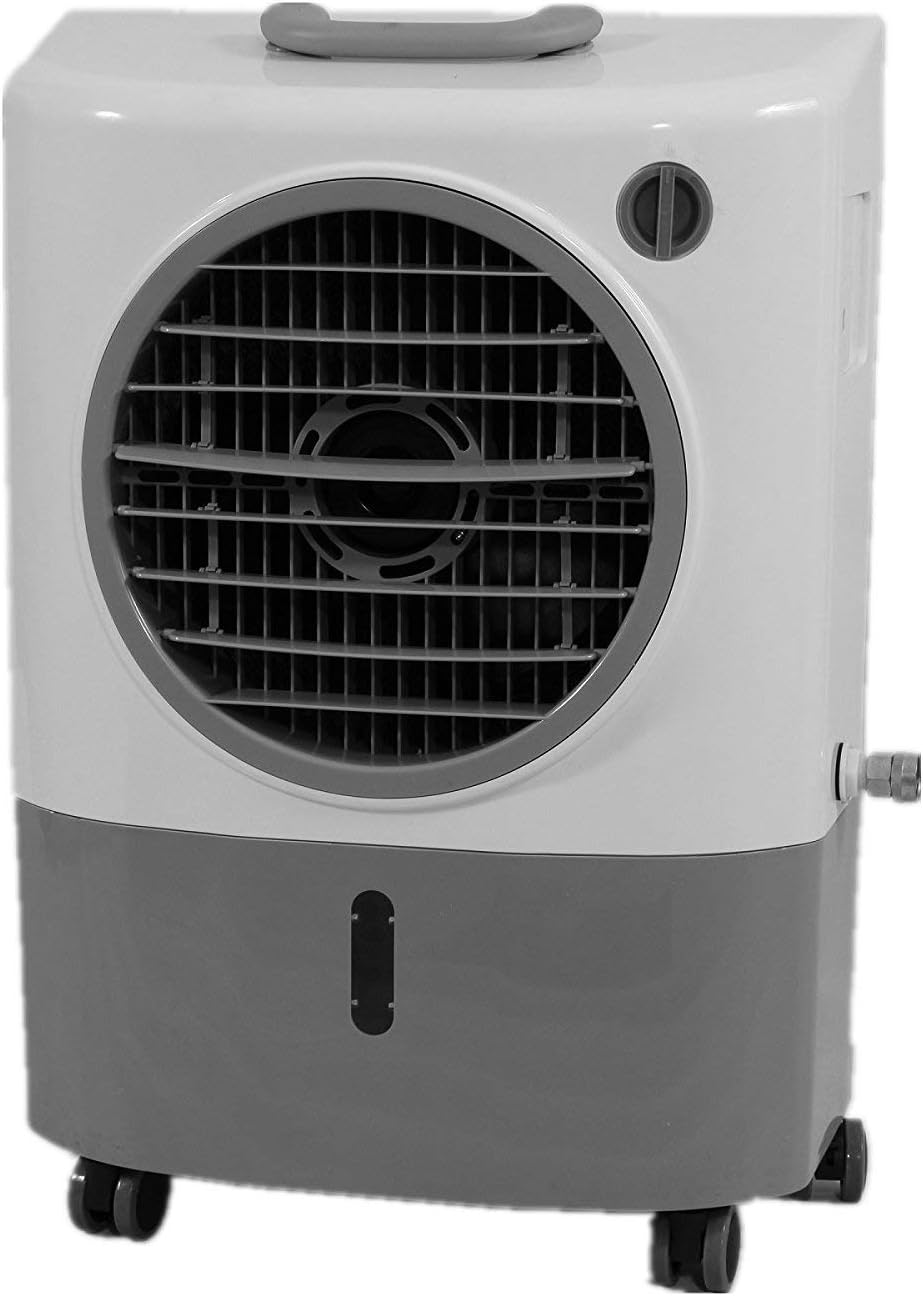
The Hessaire MC18M is a portable evaporative air cooler rated at 1,300 CFM. Its listing specifies two fan speeds, 53.4 dB operation, and coverage up to 500 square feet. Its water-based evaporative mechanism keeps it in a different equipment class from a portable refrigerant air conditioner.
Check On AmazonIf you click this link and buy, we earn a commission at no additional cost to you.
Use the current home comfort route map to choose the next detailed article
Once you can name the physical job, move into the article for that equipment family. The links below are organized by mechanism because fit, maintenance, safety, and recurring cost differ. You do not need to read every article. Choose the row matching the condition you measured, then verify the exact model against that article’s checks.
If two rows seem relevant, keep the jobs separate while you investigate. A hot and humid room can involve both cooling and moisture control, while a dusty room may need filtration without cooling. Two machines sharing a room does not mean they solve the same problem. Keeping the jobs separate prevents one wrong assumption from becoming two purchases.
| Equipment decision | What the detailed article helps you decide |
|---|---|
| Dehumidifier buying guide | Capacity, drainage, fit, and upkeep. |
| Humidifier buying guide | Type, output, water, cleaning, and fit. |
| Room fans and air circulators | Airflow, placement, noise, and controls. |
| How to choose a ceiling fan | Geometry, mounting, size, and controls. |
| Window air conditioner buying guide | Window fit, capacity, efficiency, and installation. |
| How to choose a portable air conditioner | Exhaust, capacity, drainage, noise, and storage. |
| Space heater buying guide | Heat, controls, clearances, electrical fit, and skip conditions. |
| Electric fireplace buying guide | Heat, form factor, placement, and installation. |
| Air purifier buying guide | Room fit, CADR, filters, noise, and cost. |
| Evaporative cooler buying guide | Climate, ventilation, water, upkeep, and limits. |
This route keeps the no-purchase option visible. If the room is already comfortable, or the real problem belongs to a leak, duct, building, or service issue, another appliance may add work without solving it. The goal is not to fill the room with equipment. Any machine you bring home should have a specific job worth doing.

This freestanding Duraflame electric fireplace uses a 1,500-watt electric heater with a 3D flame effect. Amazon lists heating coverage up to 1,000 square feet and an adjustable thermostat. The product details also list automatic timed shut-off and a vent-free indoor design.
Check On AmazonIf you click this link and buy, we earn a commission at no additional cost to you.
Final thoughts: solve the physical comfort job before buying the appliance
The useful question is not “Which machine is best?” but “What must change in this room?” Heat removal, air movement, moisture removal, moisture addition, particle filtration, evaporative cooling, and localized heat are different jobs. Naming the job first removes irrelevant products before model comparison begins. That smaller candidate list is easier to verify properly.
Then check the room, available space or opening, electrical requirements, water or drainage routine, filters, noise, maintenance, storage, and exact manual. A simpler machine can be the better fit when it solves the recurring job with less burden. If the problem belongs to building infrastructure, water intrusion, or qualified service, another portable appliance is not the same thing as solving it. Buy only after the mechanism and the household routine both make sense.
FAQs
🌡️ How do I know whether I need an air conditioner or a dehumidifier?
Measure temperature and humidity separately. Choose AC when heat removal is the job and a dehumidifier when measured excess moisture is the job.
💨 Can a fan cool a room the same way an air conditioner does?
No. A fan moves air and can improve occupied comfort, while an air conditioner mechanically removes heat. Use AC when room temperature itself needs to come down.
💧 Should I buy a humidifier or a dehumidifier?
Check measured room humidity rather than guessing from sensation. A humidifier adds moisture and a dehumidifier removes it, so the correct direction comes first.
🧹 Is an air purifier the same thing as a dehumidifier?
No. A purifier filters selected airborne contaminants, while a dehumidifier removes water from the air. Combined products still require separate fit and maintenance checks for each function.
References and sources
- Walmart heating, cooling and air quality: Verifies the broad retail grouping.
- U.S. Department of Energy home cooling: Supports household cooling distinctions.
- DOE home cooling overview: Supports fan and evaporative-cooling distinctions.
- ENERGY STAR room air conditioners: Supports room-AC sizing.
- ENERGY STAR dehumidifiers: Supports dehumidifier capacity and efficiency.
- EPA guide to air cleaners: Supports CADR, room sizing, and filtration limits.
- EPA home humidifier guidance: Supports humidifier water and cleaning guidance.
- CPSC space-heater safety guidance: Supports heater clearance and direct-wall-outlet guidance.