A humidifier is a water-and-maintenance appliance before it is a feature list. The useful decision is which type can serve the space while fitting the home’s water quality, refilling, cleaning, noise, safety, and placement. Tank size and visible mist can be useful clues, but neither proves room fit or easy upkeep. Choose the mechanism and moisture output first, then compare the ongoing work the unit creates.
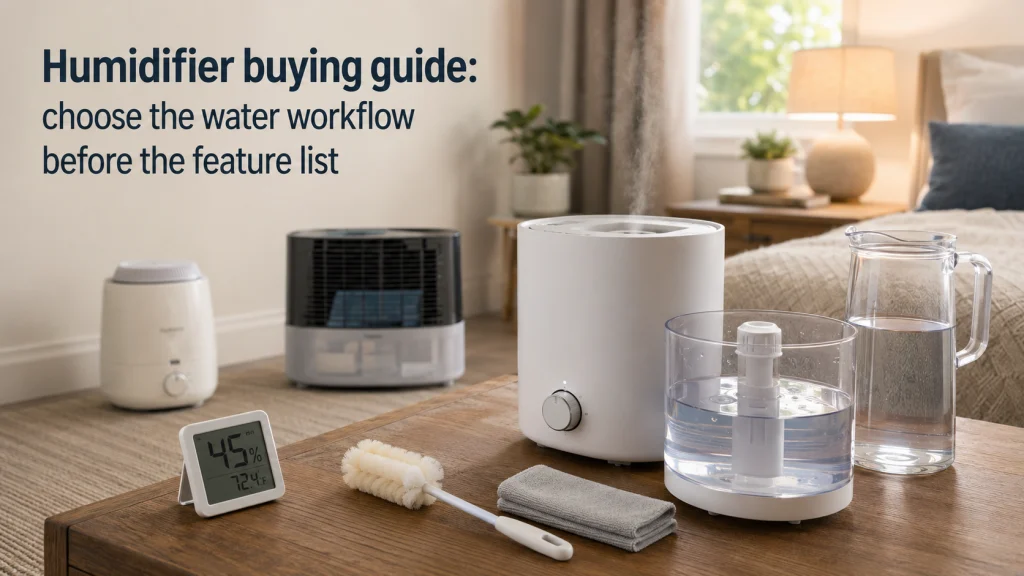
Treat the water routine as part of the appliance
A humidifier buying guide is only useful if it accounts for the work that repeats after purchase. Water has to be sourced, the tank has to be filled, wet surfaces have to be cleaned, and some designs add a wick, filter, fan, or heat source. Those differences often matter more in regular use than app controls or extra mist settings. A model that looks effortless can become inconvenient when its daily water path does not fit the sink, storage area, or person maintaining it.
- Where will the fill water come from, and how far must a full tank travel?
- Can the tank opening and wet surfaces be reached with normal cleaning tools?
- Does the design require a wick, filter, cartridge, or low-mineral water?
- Will noise, heat, or footprint change where the unit can operate?
If you are deciding how to choose a humidifier, treat the purchase as a maintenance loop rather than a feature contest. Define the served room, available placement, expected water source, and acceptable cleaning effort before comparing extras. Then account for recurring purchases such as distilled water, wicks, filters, or cartridges when they apply. Once that pattern works, convenience features can improve a good fit instead of disguising a bad one.
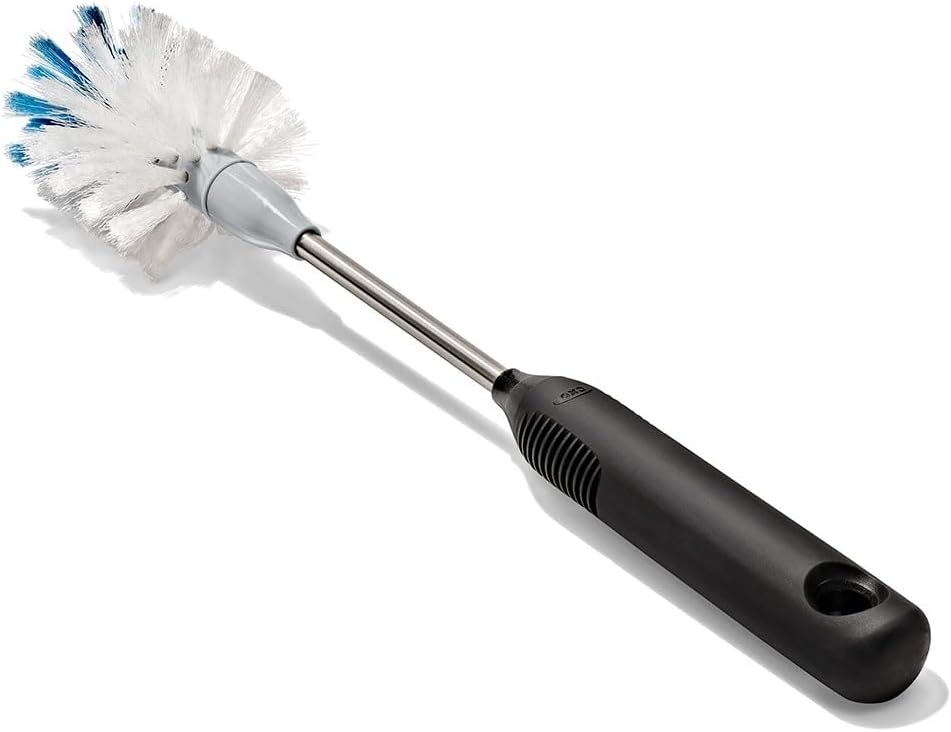
The OXO Good Grips Stainless Steel Bottle Brush uses a long flexible neck and dual-function nylon bristles to reach inside bottles, pitchers, and carafes. Stiffer upper bristles scrub hard-to-reach corners while softer side bristles handle gentler cleaning. Its non-slip handle and replaceable twist-off head make it practical for recurring humidifier cleaning when the manufacturer permits brushing.
Check On AmazonIf you click this link and buy, we earn a commission at no additional cost to you.
Separate room units, consoles, and installed systems
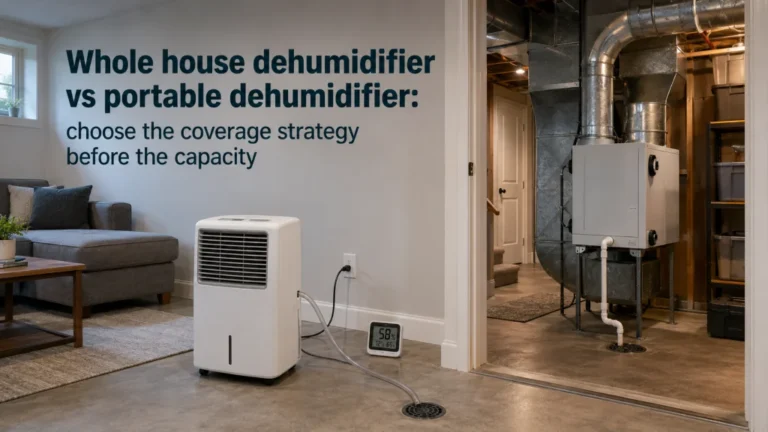
Portable tabletop units, larger console humidifiers, and whole-home systems all add moisture, but they belong to different equipment scales. A tabletop unit serves a room-level job, while a console remains portable equipment despite using more floor space and water. A whole-home unit instead connects humidification to the heating and air-conditioning system. This section defines that boundary; the buying trade-offs between portable and installed equipment come later. For buying purposes, those are three different planning scales rather than sizes of the same appliance.
This article stays at the household-selection level rather than professional HVAC design, load calculation, duct modification, or installation planning. If the real question is whether adding moisture is appropriate, start with whether you need a humidifier. If you are unsure whether the room needs added or removed moisture, use the humidifier versus dehumidifier comparison. The broader heating, cooling, and air quality equipment page keeps this moisture decision connected to the rest of the home system.

The AIRCARE MA1201 is a console-style evaporative humidifier with a 3.6-gallon tank and four fan speeds. It includes an adjustable humidistat, automatic shutoff, one MAF1 wick, and four casters. Those features make it a concrete example of larger portable equipment that sits between small tabletop units and an installed HVAC humidifier.
Check On AmazonIf you click this link and buy, we earn a commission at no additional cost to you.
Confirm the room needs added moisture before shopping by feature
A humidifier should solve a measured moisture problem, not simply make a room produce more visible mist. A humidity gauge is more useful than judging the air by a plume or a vague dry feeling. Official guidance also warns against excessive moisture because condensation, damp finishes, and wet nearby materials can create their own household problems. If nearby surfaces become wet or condensation appears, reducing output matters more than buying a larger unit for regular use.
This need check also keeps the decision away from unsupported medical promises. A humidifier changes indoor moisture, but this article does not recommend one to treat asthma, allergies, colds, sinus problems, or other health conditions. The useful question is whether the space needs added moisture and whether the equipment can be controlled, positioned, cleaned, and maintained safely in that room. Once that is established, technology and sizing comparisons become much more meaningful in practice.

The TempPro TP50 displays indoor relative humidity and temperature with a 10-second refresh rate. Its humidity specification is ±2% RH from 30% to 80% RH and ±3% outside that range. A tabletop stand, magnetic back, and hanging mount make it easy to keep as an independent room reference.
Check On AmazonIf you click this link and buy, we earn a commission at no additional cost to you.
Choose the humidification mechanism before choosing a model
Humidifier type determines how water becomes moisture in the room. Ultrasonic designs create a fine aerosol, evaporative designs move air through a wet medium, and warm-mist or steam designs heat water. That architecture sets the broad direction for sound, heat, consumables, and maintenance. Use it to narrow the field, not to settle the purchase by type name alone.
| Mechanism | What changes in use | Next practical check |
|---|---|---|
| Ultrasonic | A fine aerosol is produced without a fan-driven wick. | Water quality and cleaning burden. |
| Evaporative | A fan moves air through a wet wick or filter. | Sound level and consumable access. |
| Warm mist or steam | Water is heated before moisture enters the room. | Heat, placement, and energy use. |
The mechanism decision should narrow the field, not finish it. EPA guidance shows why the categories matter: some designs can disperse minerals from tank water, some depend on wet wicks and fans, and heated designs add a hot-water safety consideration. The detailed consequences depend on the water source, room, and exact model. Let the later water, cleaning, noise, and handling sections do the deeper work.
Cool mist versus warm mist is partly a heat and safety decision
Warm-mist and steam designs use heated water, so placement and burn safety become part of the type decision. Cool-mist designs avoid that heat, but they still split into mechanisms with different maintenance demands. The point here is only to identify whether heated output belongs in the candidate set. Compare the full trade-off in cool mist versus warm mist humidifiers.
Evaporative versus ultrasonic is a water, noise, and consumables decision
Ultrasonic and evaporative units reach the same moisture goal through different equipment paths. One relies on aerosol generation, while the other relies on a fan and wet medium, so the next questions are water behavior, sound, and consumables. This section only separates those architectures before the deeper maintenance comparison. Compare them in evaporative versus ultrasonic humidifiers.

The LEVOIT Classic 300S is a 6-liter top-fill ultrasonic humidifier with smart app control. Its ultrasonic mechanism provides a clear example of an aerosol-generating design to compare against evaporative and heated humidifiers. The top-fill tank also gives you a concrete refill and cleaning workflow to evaluate alongside the mechanism.
Check On AmazonIf you click this link and buy, we earn a commission at no additional cost to you.
Size the humidifier by served space and moisture output, not tank liters alone
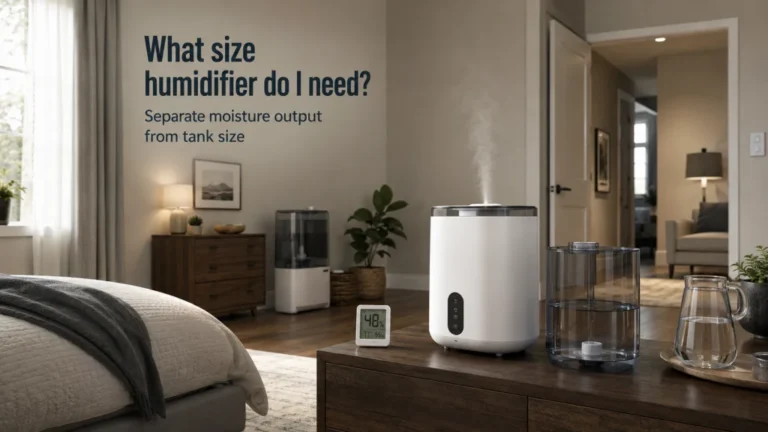
A large tank tells you how much water the machine can store, not how quickly it can add moisture to a room. Independent testing is useful because it separates storage capacity from measured moisture output and checks whether room-size claims are realistic. Ceiling height, open doors, air exchange, heating, and starting room conditions can also change how much moisture the unit must supply. A compact unit can be easy to carry yet still lack the output needed for the served space.
The opposite mistake is paying for a large tank that reduces refills but creates an awkward footprint or heavy carry. Compare manufacturer coverage claims with independent output evidence when available, then treat tank capacity as a separate workflow field. Measure the surface or floor area, follow required clearances, and check the path used to remove or fill the tank. For the full sizing process, use what size humidifier you need.

The STANLEY 33-425 PowerLock provides a 25-foot measuring range with a 1-inch blade. Its blade lock and Tru-Zero end hook support room, surface, and appliance-clearance measurements. Using a real tape measure keeps served-space and footprint decisions separate from tank-capacity claims.
Check On AmazonIf you click this link and buy, we earn a commission at no additional cost to you.
Decide portable versus whole-home before comparing smart features
A portable humidifier keeps the moisture job local and lets you choose exactly which room receives added moisture. You fill the unit, clean it, store it, and replace model-specific consumables without altering the home’s HVAC system. That can be sensible when only one or two spaces need attention or when an installed system is not practical. The trade-off is recurring work with tanks, wet parts, cords, refill water, drying space, and seasonal storage. Cord placement and off-season storage still need a practical home, especially when the unit runs daily.
A whole-home system shifts the workload rather than removing maintenance. It can use the home’s water supply and HVAC system, but it adds installation and service needs. Consumer Reports notes that these systems generally require professional installation, so the choice also brings service access and installed-system maintenance into the household decision. The detailed scale decision belongs in whole-house versus portable humidifiers.
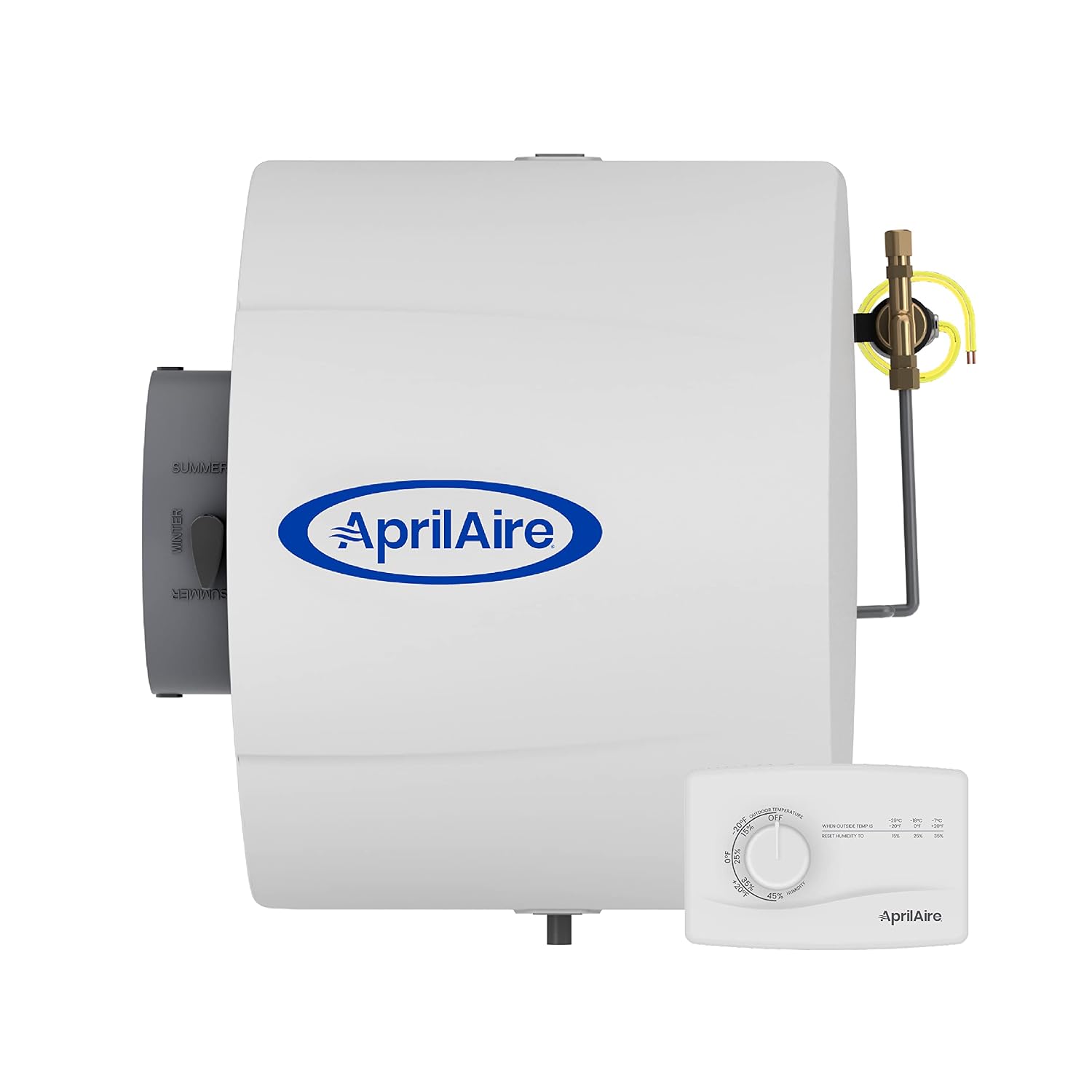
The AprilAire 600M is a manual-control whole-house evaporative humidifier designed for a furnace or HVAC system. Amazon lists coverage up to 5,000 square feet in tightly built homes and a capacity of 17 gallons per day. It provides a direct installed-system comparison when deciding whether whole-home equipment fits better than refillable portable units.
Check On AmazonIf you click this link and buy, we earn a commission at no additional cost to you.
Treat water quality as a purchase variable, not an afterthought
Water can change the ongoing cost of a humidifier even when the purchase price stays the same. EPA guidance explains that ultrasonic and impeller humidifiers can disperse minerals from tank water, which is why white residue may appear on nearby surfaces with mineral-rich water. Lower-mineral water can reduce that pathway, but sourcing it can become a recurring cost and carrying task. Local water quality belongs in the buying decision before an ultrasonic unit becomes the obvious quiet choice.
| Type | Water and maintenance trade-off | Noise or heat trade-off |
|---|---|---|
| Ultrasonic | Minerals can become white dust, so low-mineral water may add cost. | Often very quiet. |
| Evaporative | A wick retains mineral material but becomes a consumable. | Fan noise can rise with output. |
| Warm mist or steam | Scale can remain in the heated water path and require cleaning. | Heat and energy use matter more. |
Water quality also affects deposits inside the appliance, making narrow crevices harder to clean. Do not assume a filter pitcher, cartridge, or generic water treatment performs the same job as distillation or a model-approved demineralization system. Exact water, cartridge, filter, and descaling requirements belong to the manufacturer instructions for the model being considered. The better mechanism is the one whose water requirements you can realistically maintain over time.
Ultrasonic buyers should price the water routine before the machine
RTINGS testing found more particle output from ultrasonic humidification with harder water. Exact instructions and local water still control the practical choice. See humidifier white dust for the residue problem.
Evaporative buyers should price the wick and listen to the fan
An evaporative wick needs model-specific care and eventual replacement. Higher fan speed can also create more noise. Compare both before calling the design low-maintenance.
Warm-mist buyers should account for heat, scale, and placement
Heating water changes the mineral pathway but introduces burn hazards. EPA warns that steam and boiling water can burn, so placement matters. Scale and energy use still belong in the decision.

The HM Digital TDS-EZ measures total dissolved solids across a 0 to 9990 ppm range. It provides 1 ppm resolution through 999 ppm and has a specified accuracy of ±3 percent. That makes it useful for comparing dissolved-mineral levels in candidate water sources before following the humidifier manufacturer's exact water instructions.
Check On AmazonIf you click this link and buy, we earn a commission at no additional cost to you.
Compare the refill path, not just the advertised runtime
Runtime claims depend on output setting, room demand, tank capacity, and the test method behind the number. A long claim can simply mean the machine runs for a long period at a low setting, not that it can serve a demanding room at full output. The practical question is how often your expected operating setting sends the tank back to the sink during normal use. Evaluate that frequency together with tank weight, grip, cap design, fill opening, sink clearance, and carrying distance.
- Check whether the removable tank fits under the faucet.
- Look for a secure handle and a stable route from sink to appliance.
- Confirm the opening is wide enough for permitted cleaning tools.
- Compare runtime at the output level you are likely to use.
A larger tank can reduce refills but become awkward when full. Top-fill access may simplify pouring in place, while a removable tank can be easier to rinse if it fits the sink and can be carried securely. Neither layout wins automatically because sink clearance, lifting, spill risk, and cleaning access differ by household. Tank capacity should therefore be treated as a handling variable as well as a storage number.

The OXO Good Grips 4-Cup Angled Measuring Cup has a 4-cup capacity, a non-slip handle, and a generous pouring spout. Its angled surface lets cup, ounce, and milliliter markings be read from above. For top-fill equipment, the handled spout provides a controlled way to evaluate the practical sink-to-tank refill path.
Check On AmazonIf you click this link and buy, we earn a commission at no additional cost to you.
Compare cleaning geometry before convenience features
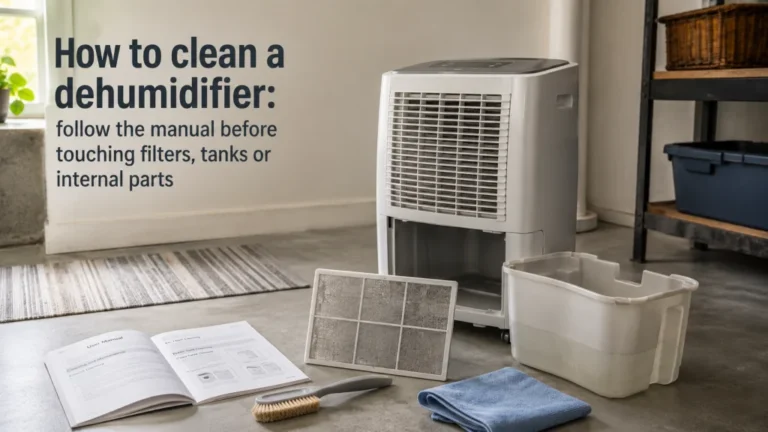
Humidifier cleaning is not a side task because water touches the same interior surfaces repeatedly. EPA guidance calls for frequent emptying, drying, and cleaning of portable units, while the exact manufacturer instructions control the permitted method for a specific model. A wide tank opening, removable water-contact parts, reachable corners, and a base that drains cleanly can make that routine much easier. Narrow channels and fixed internal pieces can add scrubbing work even when the exterior looks simple.
Before buying, inspect the manual or cleaning instructions instead of trusting an easy-clean label. Identify which parts are owner-removable, which are washable, what must stay dry, how the base drains, and where cleaned parts can dry before reassembly. If those details are unclear, treat the maintenance burden as unknown rather than assuming the easiest interpretation from the product page alone. For the full owner-level process, use how to clean a humidifier safely and fully.

The OXO Good Grips Deep Clean Brush Set includes a larger brush and a smaller detail brush for tight spaces. Durable nylon bristles provide scrubbing action, while the smaller brush includes a wiper blade for crevices. The two sizes are useful for checking whether corners, seams, and removable humidifier parts are realistically reachable during routine cleaning.
Check On AmazonIf you click this link and buy, we earn a commission at no additional cost to you.
Know what to look for in a humidifier after maintenance fit is clear
Once type, output, water, refill, and cleaning are acceptable, controls can improve the experience. A humidistat can help the unit respond to room conditions, but displaying a humidity number does not prove the sensor is accurate enough for useful automatic control. Consumer Reports tests humidistat accuracy separately, which is a useful reminder to distinguish having a sensor from controlling moisture well. An independent humidity gauge can provide a useful second reference if the built-in reading seems clearly inconsistent.
| Priority | Verify |
|---|---|
| 1 | Mechanism and system scale |
| 2 | Measured output and room fit |
| 3 | Water, refill, and cleaning routine |
| 4 | Humidity control and sensor behavior |
| 5 | App, display, lighting, and other extras |
Smart controls, display dimming, scheduling, and night modes should be judged by the work they remove. Remote control can be genuinely useful, but it does not solve poor cleaning access or the wrong water requirement. A feature earns its place when it reduces a repeated household task without adding more setup or maintenance than it saves. Any humidifier guide that starts with Wi-Fi before mechanism, output, and maintenance has the priorities backward.

The Govee H5075 shows temperature and relative humidity on a 3-inch LCD and refreshes readings every 2 seconds. Its Bluetooth connection supports app monitoring, alerts, and historical data export. Used beside a humidifier, it provides an independent humidity reference instead of relying only on the appliance's built-in display.
Check On AmazonIf you click this link and buy, we earn a commission at no additional cost to you.
Separate noise from visible mist when judging performance
Visible mist is a poor shorthand for moisture performance because evaporative humidifiers can add water vapor without producing a plume. Ultrasonic units often create an obvious cloud and can be very quiet, which makes them feel powerful before room humidity is measured. Evaporative units may sound louder because a fan is doing the work, yet that noise does not prove poorer moisture output. Judge the result in the served space rather than ranking technologies by what can be seen.
Noise also needs context because an acceptable living-room sound can be distracting beside a bed. A very quiet ultrasonic unit may still create a water-quality routine the household dislikes, while a noisier evaporative design may simplify the mineral problem. Compare sound at the output level you expect to use, not only at the quietest setting. Overnight use can give extra weight to noise, runtime, footprint, and display behavior without changing the underlying type and maintenance logic.

The VLIKE VL6708 is a handheld digital sound level meter with a 30 to 130 dB measurement range and A/C frequency weighting. It includes fast and slow response modes, maximum and minimum capture, data hold, and a backlit LCD for reviewing readings. The meter provides a practical way to compare appliance operating noise from the same position and distance instead of relying only on broad quiet or low-noise claims.
Check On AmazonIf you click this link and buy, we earn a commission at no additional cost to you.

The Coway Airmega AP-1512HH uses a multi-stage air-cleaning system with a pre-filter, deodorization filter, True HEPA filter, and Vital Ion stage. It includes real-time air-quality monitoring, automatic fan control, a timer, and a filter indicator. As a dedicated air purifier, it is a clear example of an appliance that performs a different household job from humidification.
Check On AmazonIf you click this link and buy, we earn a commission at no additional cost to you.
Route post-purchase questions to the exact owner task
Buying well does not eliminate maintenance, so the next step is identifying the specific question you are solving. Setup and normal operation belong in how to use a humidifier, while routine tank and component care belongs in the cleaning article. White mineral residue is a water-and-mechanism issue, not a reason to improvise chemicals or open electrical areas. A unit that stops producing visible mist also needs symptom-based checks rather than an assumption that internal parts have failed.
Keep troubleshooting at owner level, follow the exact manual, and do not turn a no-output symptom into internal disassembly. Stop if there is a damaged cord, exposed wiring, smoke, a burning odor, uncontrolled heating, leaking into electrical areas, or work reserved for service personnel. For a focused owner-level path, use humidifier not producing mist. A sound purchase decision should therefore preview the practical tasks that continue after checkout, not just compare specifications alone.

The AcuRite Classic combines an indoor thermometer and hygrometer in one compact display. It tracks room temperature and relative humidity and includes a comfort-level indicator for quick reference. Keeping a separate room monitor nearby supports normal setup and operation without opening or modifying the humidifier.
Check On AmazonIf you click this link and buy, we earn a commission at no additional cost to you.
Use current model testing only after the workflow is settled
Specific models change too quickly for the type decision to depend on a permanent shortlist. Once you know the required mechanism, served-space output, water routine, refill tolerance, cleaning access, noise limit, and control needs, current independent testing becomes more useful. Consumer Reports evaluates moisture output, convenience, noise, energy efficiency, humidistat accuracy, and performance with hard water. RTINGS also publishes measured comparisons that help separate output, cleaning, noise, and water-related trade-offs from marketing language.
The current-model endpoint on this site is best humidifiers for different household profiles. Use it after the architecture decision, then verify the exact manufacturer instructions for water, filters or wicks, additives, washable parts, clearances, controls, and installation requirements. If current evidence does not confirm one of those details, treat it as unknown instead of filling the gap with a generic assumption or a similar model’s specification. A test winner is useful only when its operating demands also fit the home.

The P3 Kill A Watt EZ P4460 measures household-appliance electricity use and displays kilowatt-hours on its LCD. It also shows operating cost and can project cost by week, month, and year after a utility rate is entered. That makes it useful for checking real electrical consumption after humidifier mechanism, output, and maintenance fit have already been narrowed.
Check On AmazonIf you click this link and buy, we earn a commission at no additional cost to you.
Final thoughts: choose the routine you will actually maintain
The strongest humidifier choice is not the one with the largest tank, most visible mist, quietest marketing claim, or longest feature list. It is the one that can add enough moisture to the intended space while fitting the home’s water quality, refill path, cleaning tolerance, noise limit, placement, and safety needs. Start with mechanism and system scale, then confirm output and handling. Only after those pieces fit should humidistats, apps, lighting, and other convenience features influence the final choice.
Before buying, read the exact manual and picture the appliance already in use rather than clean on a product page. Imagine the filled tank at the sink, the wet parts during cleaning, the replacement wick or water supply if one is required, and the space needed for safe operation and drying. If that routine already looks unreasonable, a simpler type or smaller scope may be the better purchase. The goal is controlled household moisture with a maintenance routine realistic enough to keep doing.

The S&T INC XL Dish Drying Mat measures 18 by 24 inches and uses absorbent microfiber to create a dedicated wet-item landing area. It is reversible, reusable, machine washable, and designed to dry thoroughly between uses. For washable humidifier parts, it gives the recurring cleaning routine a defined drying space without turning the recommendation into another appliance.
Check On AmazonIf you click this link and buy, we earn a commission at no additional cost to you.
Explore the next humidifier decision
Handle each unresolved question separately. The articles below cover need, size, mechanism, scale, residue, care, and testing. Start with the question still blocking a type or routine choice. This keeps one feature from deciding the purchase too early.
If you know the type and room, move to the matching care or testing article. If you are comparing technologies, handle mechanism and scale before model lists. Keep the purchase tied to the room, water, and maintenance routine. You do not need every topic.
| Topic | What you’ll find |
|---|---|
| Do I need a humidifier? | Confirm that adding moisture is the right job. |
| What size humidifier do I need? | Match output to the served space. |
| Cool mist vs warm mist humidifier | Compare heat, safety, energy, and routine. |
| Evaporative vs ultrasonic humidifier | Compare minerals, fan noise, white dust, and wicks. |
| Whole-house humidifier vs portable humidifier | Compare portable upkeep with installed-system demands. |
| Humidifier vs air purifier | Separate moisture control from air cleaning. |
| Humidifier vs diffuser | Separate moisture control from scenting. |
| How to use a humidifier | Follow setup, placement, water, and controls. |
| How to clean a humidifier | Handle tanks, wet parts, scale, and storage. |
| Humidifier white dust | Trace mineral residue to water and mechanism. |
| Humidifier not producing mist | Use safe checks for no-output symptoms. |
| Best humidifiers | Compare tested options after needs are defined. |
Use the table to route the uncertainty you still have. If several topics apply, type and sizing come before controls or model comparisons. Care articles help preview maintenance. Keep the sequence centered on fit.

The Dreo HM311 is a 4-liter top-fill ultrasonic cool-mist humidifier designed for rooms up to 300 square feet. Dreo specifies 28 dB operation, three mist levels, and a removable tank designed for easier filling and cleaning. It is a current portable model to compare only after room, water, refill, and maintenance requirements are already defined.
Check On AmazonIf you click this link and buy, we earn a commission at no additional cost to you.
Frequently asked questions
💧 Can I use tap water in a humidifier?
It depends on the type, local minerals, and instructions. Ultrasonic units can disperse minerals as white dust, so water matters.
📏 Does a bigger humidifier tank cover a bigger room?
Not necessarily. Tank size affects stored water, while room coverage depends more on moisture output and room conditions.
🌫️ Is visible mist a sign that a humidifier is working better?
No. Evaporative units can add moisture without a visible plume, so measured room humidity is a better check.
🔇 Are ultrasonic humidifiers always the best choice for bedrooms?
No. Low noise helps, but water quality, cleaning, runtime, refilling, and footprint still matter.
🧽 How much should cleaning affect which humidifier I buy?
A lot, because water-contact surfaces need recurring care. Favor a design with a practical tank, parts, consumables, and drying routine.
🏠 When does a whole-home humidifier make more sense than a portable one?
It makes more sense when several spaces need humidification and professional installation plus maintenance are acceptable. Portable equipment can be simpler locally.
References and sources
- EPA home humidifier use and care: Supports technology, mineral dispersion, water, cleaning, excess moisture, and steam-burn safety.
- Consumer Reports humidifier buying guide: Supports output, noise, humidistat accuracy, hard-water performance, and whole-home installation context.
- RTINGS humidifier white-dust testing: Supports ultrasonic water-mineral output and evaporative trade-offs.