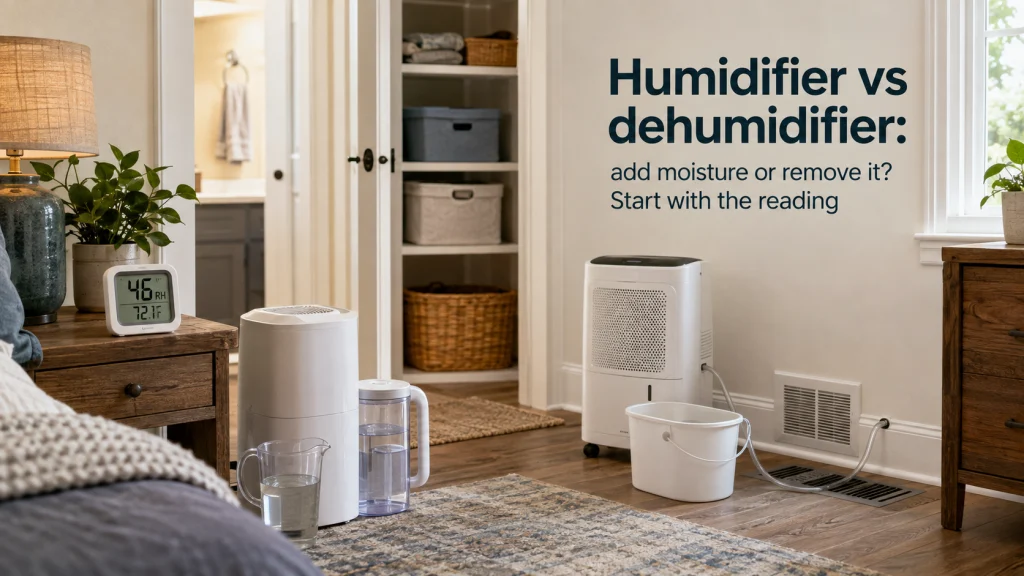
A humidifier adds moisture to indoor air, while a dehumidifier removes it, so the right choice depends on the direction your room actually needs to move. Start with a measured relative humidity reading and the room context instead of trying to diagnose the problem from how the air feels. Then compare the chores each appliance creates, including refilling, draining, cleaning, floor or counter space, noise, and seasonal storage. The result may be a humidifier, a dehumidifier, different tools in different seasons, or no humidity-control appliance at all.
Start with the reading, not the appliance name
The humidifier vs dehumidifier decision is simple only after you know which direction the room needs to move. The names differ by a few letters, but the jobs are opposites: one puts water into the air and the other takes water out. Choosing from discomfort, a musty impression, or a dry feeling alone can send you toward the wrong machine because those clues can have more than one cause. A basic humidity reading gives the decision a measurable starting point instead of turning it into guesswork.
That does not mean one number tells the whole story. Relative humidity changes with temperature, ventilation, weather, cooking, bathing, laundry, air-conditioning, heating, leaks, and the location of the meter, so one unusual reading should be read in context. The useful question is whether the room is repeatedly too dry, repeatedly too damp, or generally within a reasonable indoor range while another problem is creating the discomfort. Once that is clear, product features such as tank size, drainage, controls, and capacity finally become relevant. That direction-first rule is useful across air quality appliances, because adding moisture and removing moisture solve opposite household conditions.

This digital hygrometer displays indoor temperature and relative humidity together. Its comfort indicator labels conditions as dry, comfortable, or wet, and it records high and low readings for comparison. The TP50 refreshes measurements every 10 seconds and includes a tabletop stand and magnetic back for flexible room placement.
Check On AmazonIf you click this link and buy, we earn a commission at no additional cost to you.
Understand the two opposite moisture jobs
The difference between humidifier and dehumidifier equipment begins with what happens to water. A humidifier uses a water supply to increase moisture in indoor air, while a dehumidifier pulls moisture from indoor air and collects or drains the condensed water. That distinction sounds obvious, but it changes nearly every ownership task that follows. One appliance asks where clean water will come from, and the other asks where removed water will go.
The mechanical details vary by type, so class labels should not be treated as proof of exact performance. Humidifiers can use evaporation, ultrasonic vibration, warm mist, or other methods, while common portable dehumidifiers often condense moisture from air and return drier air to the room. Whole-home systems can be integrated with HVAC equipment and have different controls, drainage, service needs, and operating conditions than portable room units. For any exact model, the manual remains the authority on setup, cleaning, clearances, filters, water handling, and service boundaries.
| Decision point | Humidifier | Dehumidifier |
|---|---|---|
| Moisture direction | Adds moisture to indoor air | Removes moisture from indoor air |
| Water routine | Water must be supplied to the unit or system | Collected water must be emptied or drained |
| Typical room problem | Verified overly dry indoor air | Verified excess airborne moisture |
| Main ownership question | Can you keep the water side clean and refilled? | Can you manage drainage, heat, noise, and water removal? |
That table is more useful than a feature comparison because it starts with the actual household job. If you have not established whether the air needs more moisture or less, comparing tank capacities or control panels is premature. The right class of appliance should solve a measured direction problem first, then fit the room and routine second. A larger or more sophisticated machine does not correct a wrong diagnosis of the room.

The H5075 measures indoor temperature and humidity and connects to the Govee Home app over Bluetooth. The listing specifies ±0.54°F temperature accuracy, ±3% RH humidity accuracy, and a 2-second refresh rate. Its 3-inch LCD shows current readings plus high and low records and comfort indicators.
Check On AmazonIf you click this link and buy, we earn a commission at no additional cost to you.
Use relative humidity and room context before symptoms
EPA indoor-air guidance commonly uses 30% to 50% relative humidity as a practical indoor range, which is useful as a general building and comfort reference rather than a medical target. A reading below that range can support the case for adding moisture, while a reading above it can support the case for removing moisture, but repeated readings matter more than a brief excursion. The room also matters because a basement, bedroom, laundry area, and open living space can behave very differently inside the same house. Treat the number as evidence about the air, then check what is happening around it.
Physical sensations should not be the first routing tool. Dry skin, congestion, an odor, static, or a clammy feeling can coexist with other causes, so they do not prove which appliance belongs in the room. A visible water leak, wet building material, or persistent condensation also deserves source investigation because a dehumidifier can manage airborne moisture without repairing the condition that is feeding it. Likewise, running a humidifier harder is not a sensible response if nearby surfaces are already becoming damp.
| Reading pattern | Room context to check | Decision route |
|---|---|---|
| Repeatedly below the practical indoor range | Heating, ventilation, room use, and whether nearby surfaces remain dry | Move toward humidification selection if the dry-air pattern is persistent |
| Repeatedly above the practical indoor range | Room temperature, ventilation, laundry, bathing, cooking, and other moisture loads | Move toward dehumidification selection if excess airborne moisture is the verified problem |
| Generally within the practical range | Check whether the original complaint has another source | Choose neither until humidity is shown to be the problem |
| Brief spike or unusually variable reading | Recent showering, cooking, laundry, open windows, HVAC cycling, or meter location | Recheck under normal conditions before buying another appliance |
| Moisture source remains unexplained | Leaks, wet materials, repeated condensation, or abnormal room behavior | Investigate the source before relying on humidity control alone |
The routing is intentionally conservative because a humidity reading is a direction signal, not a complete diagnosis of the room. A repeated low pattern can justify moving toward humidification, while a repeated high pattern can justify moving toward dehumidification, but both still need a context check. A short-lived spike calls for another reading instead of an immediate purchase, and an unexplained water source calls for source investigation first. This keeps the appliance decision behind the evidence without turning one number into a universal rule.
- Measure the room instead of choosing from a symptom list.
- Check whether the reading is repeated under normal household use.
- Look for moisture sources such as leaks, showers, cooking, drying laundry, or poor ventilation.
- Notice whether heating or air-conditioning is creating a seasonal swing.
- Do not use one appliance to fight another appliance that is actively moving humidity in the opposite direction.
This is also where first-time buyers often overreact to one dramatic number. Humidity can jump for a short period after a shower or a pot of boiling water and then settle as ventilation or HVAC operation catches up. If the problem appears only during one predictable activity, local ventilation or source control may deserve attention before another appliance is added. The more persistent the reading and room pattern, the stronger the case for dedicated humidity control.

The HT.w tracks temperature and relative humidity and sends readings to the SensorPush app over Bluetooth. The listing specifies typical accuracy of ±0.2°C for temperature and ±2% RH for humidity. It stores up to 45 days of readings on the sensor, supporting repeated room checks instead of a single snapshot.
Check On AmazonIf you click this link and buy, we earn a commission at no additional cost to you.
Choose dehumidification when excess airborne moisture is verified
A dehumidifier makes sense when repeated room measurements show that airborne moisture is staying too high and the problem is not better explained by a temporary event alone. The decision should still include the room size, temperature, layout, drainage path, and how often the unit will need to run. A basement that stays damp for long periods presents a different ownership job from a bedroom that only rises after a nearby shower. The appliance class may be the same, but the capacity and drainage burden can be very different.
Do not treat musty odor, visible mold, or condensation as automatic proof that a portable dehumidifier is the complete solution. Those clues can point toward excess moisture, but leaks, water intrusion, ventilation problems, and cold surfaces may need separate attention. If the room clearly has a moisture source that should not be there, removing water from the air while leaving the source untouched can turn the appliance into a permanent cleanup machine. The better question is whether dehumidification is controlling normal airborne moisture or merely compensating for a problem that needs correction.
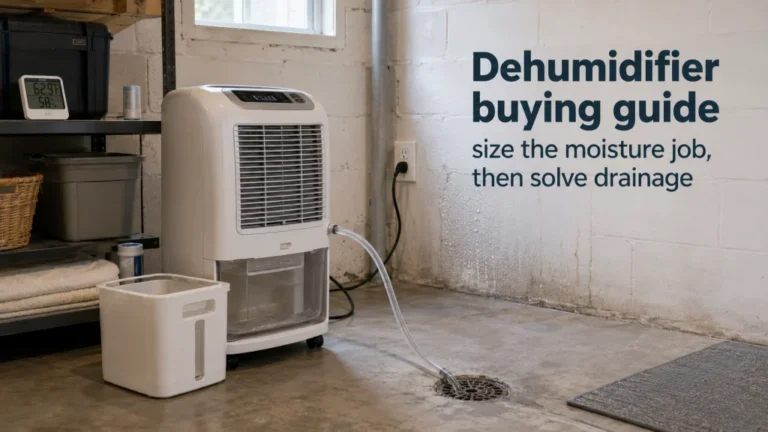
Once the need for moisture removal is established, move to capacity, operating temperature, drainage, noise, and placement rather than buying from a room-size badge alone. The site’s dehumidifier buying guide covers that selection step in more detail, while do I need a dehumidifier? goes deeper into the need check itself. Those decisions should be separated because proving that moisture removal is useful does not prove that every dehumidifier size or layout will fit the job. This page stays focused on choosing the direction of moisture control, not ranking individual machines.

The Midea Cube is a 20-pint dehumidifier listed for spaces up to 1,500 square feet. Its cube-style reservoir can collect removed water, and the model also supports continuous drainage with a hose. Built-in Wi-Fi control allows remote adjustment after the room has been verified as needing moisture removal.
Check On AmazonIf you click this link and buy, we earn a commission at no additional cost to you.
Choose humidification when indoor air is consistently too dry
A humidifier is the logical direction when repeated measurements show that indoor air is consistently too dry for the household’s comfort and building context. Heating season can push indoor relative humidity downward, but climate, ventilation, air leakage, and thermostat use all influence the result. The important point is that the measured pattern should come before a list of features or a symptom-based purchase. If the room is already within a reasonable range, adding more moisture can create a new problem rather than solve the old one.
Water management becomes part of the purchase immediately. Portable humidifiers need a practical fill routine, regular cleaning, and enough attention that standing water, mineral buildup, or damp surrounding surfaces do not become normal. EPA guidance specifically warns against humidifying above 50% relative humidity and advises reducing output if moisture begins condensing on nearby surfaces. That makes a controllable, measurable routine more important than simply choosing the machine that can put the most water into the air.
After the need is established, the next decision is which humidifier type, capacity, controls, and maintenance routine fit the room. The site’s humidifier buying guide is the place to continue into that selection work. A small room used overnight, a large shared living area, and a whole-home approach create different water, cleaning, noise, and control questions. The right purchase is the one that can maintain the needed direction without making water handling or cleaning so inconvenient that the unit is neglected.

The Classic 300S is a 6-liter top-fill cool-mist humidifier with smart-app control. Its listing includes Auto Mode and Sleep Mode for adjusting operation to the room and routine. The listing also specifies up to 60 hours of runtime and a 26 dB sound level.
Check On AmazonIf you click this link and buy, we earn a commission at no additional cost to you.
Compare room-level and whole-home control without confusing the jobs
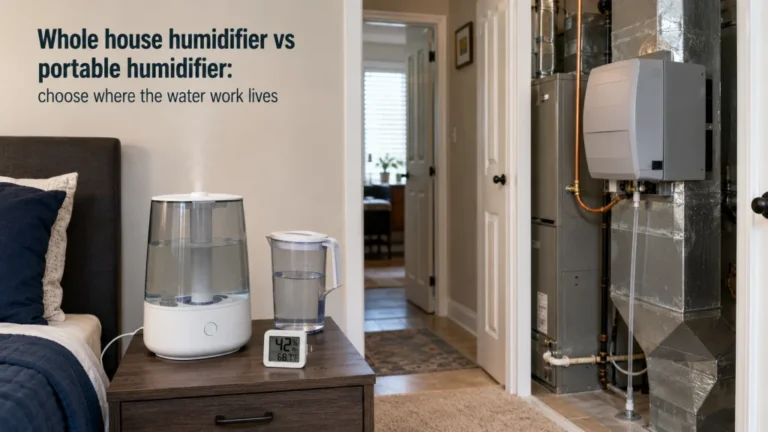
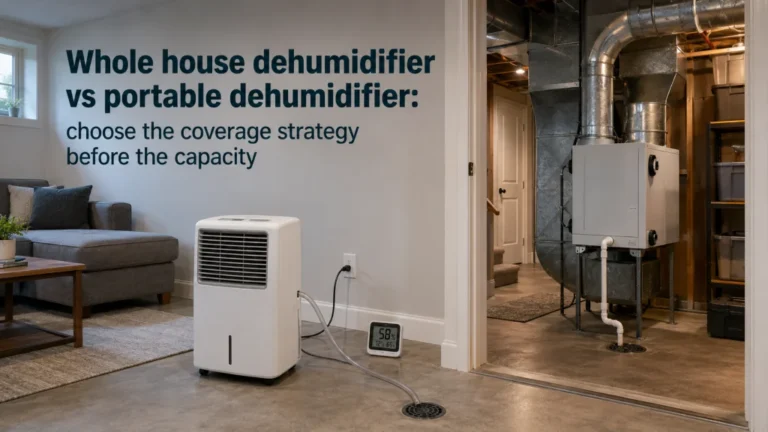
Portable and whole-home systems solve the same directional problem at different scales. A room humidifier or dehumidifier can target a specific space, move with household needs, and avoid changing humidity everywhere, but it also occupies usable space and creates local water-handling chores. A whole-home system can coordinate with HVAC equipment and affect a broader area, but selection and installation depend on the existing system, home layout, climate, controls, and service requirements. The comparison is therefore not simply small versus large.
Room-level control is easier to justify when the moisture problem is truly local. A basement can stay damp while upper floors remain reasonable, and a heated bedroom can become dry while other parts of the house do not need added moisture. Whole-home control deserves consideration when the measured pattern is broad and persistent, not merely because a centralized system sounds more complete. The larger the scope, the more important it becomes to verify compatibility and use qualified HVAC guidance rather than assuming a generic add-on will fit. Installation and system modification remain outside this comparison because exact HVAC equipment, controls, drainage, and manufacturer requirements determine those steps.
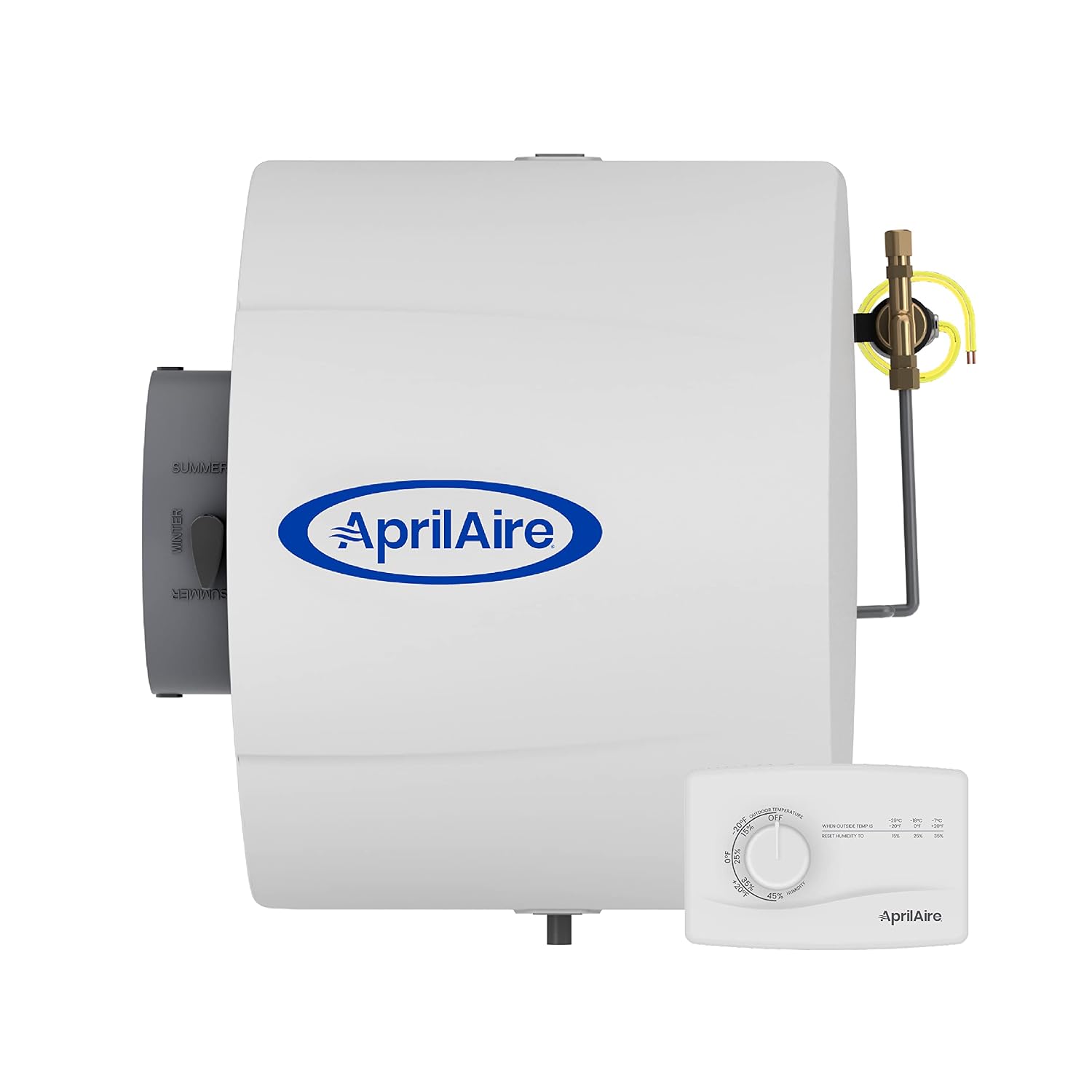
The AprilAire 600M is a manual whole-house furnace humidifier intended for centralized humidity control. Its Amazon listing rates the model for homes up to 5,000 square feet. It is built as an HVAC-connected whole-home option, so exact equipment compatibility and installation requirements remain system-specific.
Check On AmazonIf you click this link and buy, we earn a commission at no additional cost to you.
Compare daily ownership: refill water or remove it
Ownership often separates two appliances that look equally easy on a product page. A humidifier asks you to bring water to the machine, while a dehumidifier asks you to take water away from it unless continuous drainage is available and appropriate for the exact model. Tank size changes the frequency of that chore, but a bigger tank also changes weight, carrying, sink clearance, and cleaning access. The easier appliance is the one whose water routine fits the room and the person maintaining it.
Dehumidifier ownership can include bucket emptying, hose routing, filter cleaning, warmer discharge air, fan noise, and enough clearance for airflow. Humidifier ownership can include refilling, tank rinsing, scale or mineral management, wick or cartridge replacement on applicable designs, and keeping wet surfaces clean. Neither list makes one class universally worse because the chores follow opposite moisture jobs. What matters is which routine you can perform consistently without defeating the purpose of the machine.
Operating cost also belongs in this comparison because both appliance classes use electricity whenever they run. The meaningful check is the exact model’s power draw together with expected runtime, control setting, room conditions, and the local electricity rate, not wattage by itself. Humidifier ownership can also include the household water supply and replacement media or other consumables when the exact design uses them, while dehumidifier ownership can include filters, drain accessories, or pump-related hardware where applicable. A machine that runs for many hours or needs recurring consumables can cost more to own even when its purchase price looks modest, so compare the routine you expect rather than assuming one appliance class is always cheaper.
| Ownership task | Humidifier side | Dehumidifier side |
|---|---|---|
| Water movement | Carry or supply water to the unit | Empty collected water or manage a drain path |
| Routine cleaning | Clean wet reservoir and water-contact parts as directed | Clean filter, bucket, drain components, and accessible surfaces as directed |
| Placement concern | Avoid dampening nearby surfaces and keep safe clearance | Maintain airflow clearance and a workable drainage or emptying route |
| Common friction | Refilling and mineral or water-side maintenance | Noise, heat, bucket handling, and drainage |
| Operating burden | Electricity based on exact model and runtime, plus water and applicable replacement media | Electricity based on exact model and runtime, plus applicable filters or drainage hardware |
Before buying, mentally walk the water route rather than just measuring the appliance footprint. Ask where the tank will be filled or emptied, whether it fits under the faucet, whether stairs are involved, and whether a hose would cross a walkway. A machine that technically controls humidity can still be a poor household fit if the water routine is annoying enough to be skipped. Convenience belongs in the decision because neglected maintenance changes both performance and cleanliness.

This plug-in meter tracks appliance power, energy use, voltage, current, frequency, and power factor. Seven display modes let you review different electrical measurements while the connected appliance is operating. Its data-memory function stores consumption data after the plug or appliance is disconnected, supporting a longer usage check instead of relying on wattage alone.
Check On AmazonIf you click this link and buy, we earn a commission at no additional cost to you.
Treat cleaning and maintenance as part of humidity control
Neither appliance is set and forget because both interact with moisture, surfaces, airflow, and components that collect residue. Humidifiers deserve especially careful water-side maintenance because the water that sits in the tank or passes through the device becomes part of the operating environment. Dehumidifiers also need routine attention to filters, buckets, drains, coils or accessible air paths as specified by the exact manual. A maintenance schedule that is realistic for your household is a purchase criterion, not an afterthought.
Cleaning methods should come from the model manual rather than from a universal recipe. Materials, filters, wicks, cartridges, drain fittings, accessible components, and approved cleaners vary across products, and a method that is harmless on one design may damage another. Unplugging, draining, drying, and seasonal storage instructions can also differ, especially between portable and installed equipment. If the unit has electrical damage, overheating, smoke, burning odor, leaking into electrical areas, or behavior the manual reserves for service, stop using it and move to qualified service.

This Holikme set includes multiple bottle, straw, sponge, and spout brushes for cleaning containers and narrow openings. The set includes a 16-inch long-handle bottle brush, a 14-inch sports-bottle brush, a 10-inch sponge brush, and smaller detail brushes. Use any brush on appliance parts only when the exact model manual permits that cleaning method.
Check On AmazonIf you click this link and buy, we earn a commission at no additional cost to you.
Compare noise, room space, and seasonal storage
A humidity-control appliance can be correct on paper and irritating in the room. Portable dehumidifiers usually combine a fan with a moisture-removal system, so their sound and warm discharge can be noticeable in bedrooms, offices, or small closed spaces. Humidifier noise varies widely by design, but fan noise, bubbling, water movement, or control sounds can still matter when the unit runs near sleep or work areas. Published sound data can help when available, but exact operating mode and room acoustics still affect what you hear.
Floor and counter space should be measured as usable operating space, not just the appliance footprint. Air inlets and outlets may need clearance, tanks need room to lift out, doors or drawers may need room to open, and cords or drain hoses need a safe route. A compact unit can become inconvenient if it blocks a walkway or has to be moved every time the tank is serviced. Placement should support both airflow and maintenance without turning the machine into furniture that is constantly in the way.
Seasonal storage is easy to ignore because humidity problems often feel urgent at purchase time. A household may use a humidifier mainly during dry heating periods and a dehumidifier mainly during humid periods, which means one or both units can spend part of the year in storage. Before buying, check where the appliance, hose, filters, accessories, and cleaned dry tank will actually go. Seasonal usefulness is not the same as year-round convenience, so storage burden belongs in the ownership calculation.

The TS-501B measures sound from 30 to 130 dB and supports both A and C weighting. Its 2.25-inch backlit LCD shows readings clearly, while MAX, MIN, and Data Hold functions help capture changing noise levels. The package includes three AAA batteries and a carry case, making it practical for spot checks around different appliance locations.
Check On AmazonIf you click this link and buy, we earn a commission at no additional cost to you.
You may own both, but not to make them fight each other
Some homes genuinely move in opposite directions during different seasons or in different rooms. Dry heated air in one period and persistent basement moisture in another can make a humidifier and a dehumidifier useful in the same household. That does not mean both should run against each other in the same space by default. If one machine is adding moisture while the other removes it, the household is paying for two appliances to cancel part of each other’s work.
Separate the problem by time and location. A bedroom may need added moisture during a dry period while a lower level needs moisture removal under different conditions, or the same room may need different control at different points in the year. Measure the active space, verify the direction, then run only the tool that supports that direction unless a specific whole-home control strategy says otherwise. This keeps the decision tied to the room instead of turning ownership into a permanent contest between two machines.

The H5179 uses Wi-Fi and Bluetooth with the Govee Home app to monitor temperature and humidity. The listing specifies ±0.54°F temperature accuracy, ±3% RH humidity accuracy, and a 2-second refresh rate. App alerts and up to two years of exportable data make it useful for checking rooms or seasons separately instead of running opposing appliances together.
Check On AmazonIf you click this link and buy, we earn a commission at no additional cost to you.
Choose among four outcomes instead of forcing a purchase
If you are comparing dehumidifier vs humidifier options, the decision does not have to end with buying one of them. The room may point clearly toward adding moisture, clearly toward removing it, remain reasonable enough that neither appliance is justified, or reveal a moisture source that should be investigated first. Treating all four outcomes as legitimate prevents the comparison from becoming a sales funnel. It also keeps an appliance from being asked to solve a leak, ventilation issue, or temporary humidity spike it cannot fix.
Once the room pattern is clear, the remaining question is whether the ownership routine fits the job. Dry indoor air supports humidification only if you can manage water, cleaning, placement, and output without creating damp surfaces. Persistent excess airborne moisture supports dehumidification only if capacity, drainage, airflow, temperature, noise, and expected operating burden fit the space. If humidity is already reasonable, the better move is to investigate the original complaint instead of adding equipment.
| Outcome | What points there | Next household decision |
|---|---|---|
| Humidifier | Repeatedly dry indoor air with a room context that supports adding moisture | Choose a type and capacity that fit water handling, cleaning, placement, and control |
| Dehumidifier | Repeatedly high indoor moisture with no unresolved source that makes appliance-only control inappropriate | Choose capacity, drainage, operating conditions, noise, and placement for the exact room |
| Neither | Humidity is generally reasonable and the complaint points elsewhere | Avoid adding another appliance until the actual problem is identified |
| Investigate the source | Leaks, wet materials, persistent condensation, unusual room behavior, or unexplained moisture remain | Address the source or get appropriate building or HVAC help before relying on humidity control alone |
This four-way decision is more useful than a simple pros-and-cons list because it allows the answer to be no purchase. Humidity control is valuable when it changes the air in the needed direction and fits the household routine. It is poor value when the reading does not support the job or when the appliance merely hides an unresolved moisture source. Measure, verify, then buy only if the room gives you a clear reason.

The TP49 is a compact digital hygrometer that displays indoor temperature and relative humidity together. Its face-icon comfort indicator identifies dry, comfortable, and wet conditions at a glance. The compact display has large digits and offers tabletop, magnetic, and hanging placement options for simple room checks.
Check On AmazonIf you click this link and buy, we earn a commission at no additional cost to you.
Final Thoughts: choose the direction of moisture change from evidence
The useful answer to humidifier or dehumidifier is not hidden in a symptom checklist or a feature comparison. Establish whether the room needs moisture added, moisture removed, or no humidity-control appliance at all, then check whether an abnormal moisture source changes that conclusion. Dry air points toward humidification, excess airborne moisture points toward dehumidification, and a reasonable room pattern points away from an unnecessary purchase. Leaks, wet materials, or other unexplained moisture deserve attention before appliance capacity becomes the main discussion.
After the direction is clear, judge the ownership work with the same seriousness as performance. Refilling, draining, cleaning, carrying, electricity use, recurring consumables, noise, clearances, cords, hoses, seasonal storage, and exact manual requirements all affect long-term fit. A smaller or simpler solution can be enough when it matches the actual job, and no purchase can be the right result when humidity is not the real issue. The best decision changes the air in the correct direction without creating more household work or operating burden than the problem justifies.

The H5074 is a compact Bluetooth thermometer-hygrometer for ongoing temperature and humidity checks. Its listing includes app alerts, a connection range up to 262 feet, and two years of exportable data. The portable sensor supports repeated checks before changing humidity-control equipment, which fits an evidence-first decision process.
Check On AmazonIf you click this link and buy, we earn a commission at no additional cost to you.
FAQs
These questions come up because the two appliance names sound similar while the ownership routines are very different. The shortest reliable answer is usually to measure the room first, then match the appliance to the direction the air needs to move. Symptoms and seasonal assumptions can support the context, but they should not replace the reading. Exact setup, cleaning, drainage, and safety requirements still belong to the manual for the model you own or are considering.
💧 How do I know whether I need a humidifier or dehumidifier?
Measure indoor relative humidity in the room you want to control and look for a repeated pattern. Use a humidifier for verified dry air, a dehumidifier for verified excess moisture, and consider neither if the reading is generally reasonable.
📏 What humidity reading should I use as a starting point?
EPA guidance commonly uses 30% to 50% relative humidity as a practical indoor range. Treat it as general building and comfort guidance, then consider the room, season, temperature, and moisture sources around the reading.
🏠 Can one house need both a humidifier and a dehumidifier?
Yes, different rooms or seasons can move in opposite humidity directions. Measure the active space and avoid running both in the same room simply to counteract each other.
🪟 Does condensation automatically mean I need a dehumidifier?
No. Condensation can support the case for excess moisture, but cold surfaces, ventilation, leaks, and other room conditions can also matter, so check the humidity reading and moisture source before buying.
🧼 Which appliance is easier to maintain?
Neither class is automatically easier because the chores are different. Humidifiers center on supplying and cleaning water, while dehumidifiers center on collected water or drainage, filters, airflow, and the exact maintenance steps in the model manual.
References and Sources
- EPA indoor air guide: Supports the general 30% to 50% indoor relative humidity range and the use of a humidity gauge.
- EPA humidifier care guidance: Supports the 50% humidification ceiling, dampness caution, cleaning, and manufacturer-instruction boundaries.
- Carrier humidity-control overview: Supports the class-level distinction between adding moisture with a humidifier and removing moisture with a dehumidifier.