A dehumidifier makes sense when excess airborne moisture is a measured, recurring problem that the appliance can actually remove. A damp feeling, one high reading, condensation, or a musty odor is a clue to investigate, not automatic proof that another machine belongs in the room. Check the humidity pattern, rule out active water sources, and decide whether the problem is local, widespread, or tied to air-conditioning behavior before shopping. The goal is to end with a clear no-purchase, portable dehumidifier, whole-home assessment, or different-action decision.
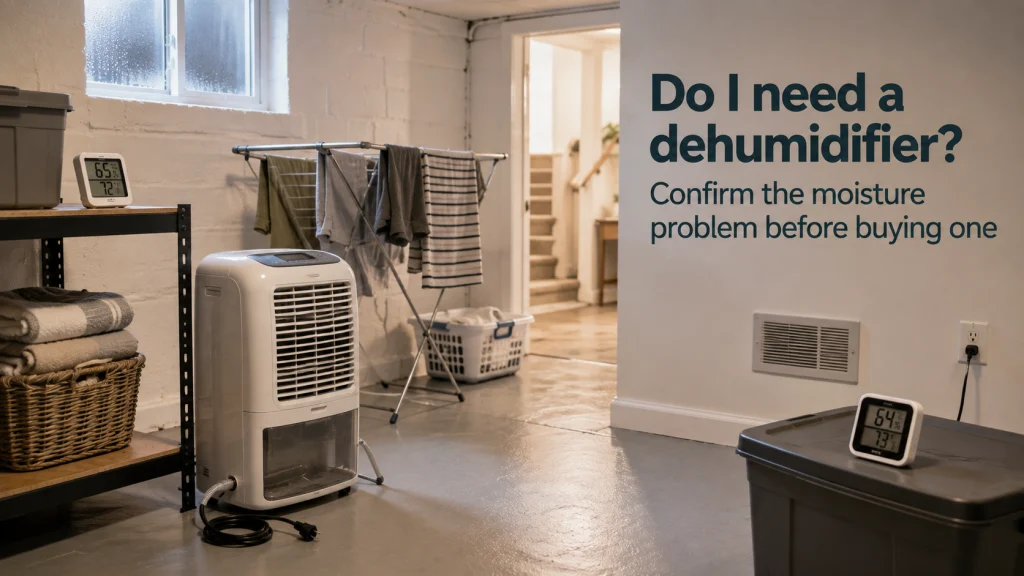
A dehumidifier is not automatically the first purchase when a room feels damp
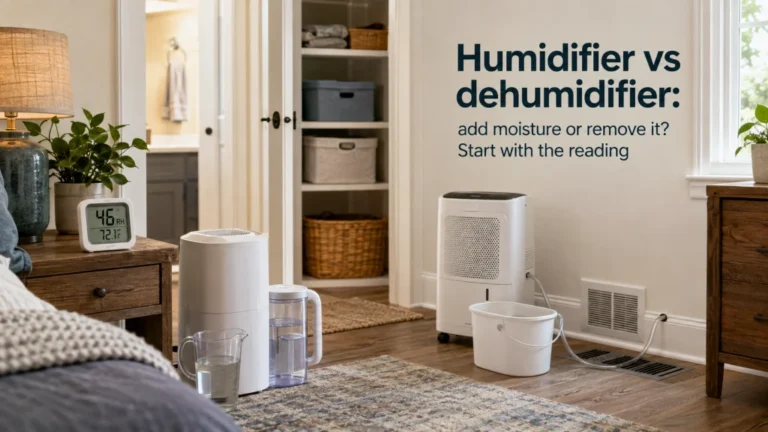
Do I need a dehumidifier? Start by confirming that excess water vapor in the air is actually the problem. A clammy room can coincide with high relative humidity, but it can also appear around a cold surface, after moisture-producing household activity, near a water source, or when cooling and ventilation are not behaving as expected. If the problem is persistent airborne moisture, dehumidification can be useful; if water is actively entering the space, the appliance can reduce symptoms without correcting the source. The first decision is therefore not which unit to buy, but whether moisture removal is the job that needs doing.
That distinction matters because a dehumidifier becomes another machine to place, hear, drain, clean, and pay to operate. A household that only sees a brief humidity rise after cooking or showering may need better source ventilation rather than continuous moisture removal. A basement that repeatedly stays damp across otherwise normal conditions is a different case, and a house with several humid rooms is different again. Keep this page at the need gate: it will help you decide whether dehumidification belongs in the solution, while exact capacity and model selection come later. That same problem-first check applies across air quality appliances, where the right machine depends on whether moisture is actually the condition that needs changing.

This digital hygrometer shows temperature and relative humidity together and records high and low readings for comparison. Its sensor is rated to plus or minus 2 to 3 percent RH and plus or minus 1 degree Fahrenheit, with readings refreshed every 10 seconds. A tabletop stand and magnetic back make it easy to place a second meter where the room conditions need confirmation.
Check On AmazonIf you click this link and buy, we earn a commission at no additional cost to you.
A dehumidifier has one core job: remove water vapor from indoor air
A dehumidifier’s core job is to remove water vapor from indoor air and collect or drain the resulting water. In a common refrigerant design, moist room air passes across a cooled surface so some water condenses before drier air returns to the room. It is not a leak repair, a roof or foundation fix, a substitute for a bathroom exhaust fan, or a diagnosis of why an HVAC system is leaving the home humid. Keeping that job narrow prevents a common buying mistake: treating every sign of dampness as proof that dehumidification is the primary fix.
The practical effect is also different from what some shoppers expect. ENERGY STAR dehumidifier guidance notes that the air directly around a unit can be somewhat warmer because moisture removal is not the same thing as room cooling. The machine also has to put the collected water somewhere, either in a bucket or through a drainage arrangement supported by the exact model. Those details matter later, but they already tell you something important now: the appliance is worthwhile only when dedicated moisture removal solves a real recurring problem strongly enough to justify the extra heat, water handling, space, noise, and maintenance.

This portable dehumidifier is rated to remove up to 22 pints of moisture per day and is listed for spaces up to 1,500 square feet. Its humidity setting adjusts from 35 to 85 percent, and the reusable filter supports routine maintenance. Collected water can be emptied from the tank or routed through a standard hose for supported continuous drainage.
Check On AmazonIf you click this link and buy, we earn a commission at no additional cost to you.
Verify the humidity reading before treating one number as proof
Relative humidity is affected by air temperature, so a percentage reading is not a fixed description of how much water is in the room under every condition. EPA moisture-control guidance explains that cooler air holds less moisture, which is also why water can condense on colder surfaces. A thermostat or humidity display in one location therefore tells you what that sensor is seeing, not automatically what every room is experiencing. Before spending money, compare the reading with the room conditions and, when possible, with a separate humidity meter rather than trusting a single display in isolation.
Look for consistency rather than chasing one momentary number. If one meter reports a much higher value beside a kitchen, bathroom, supply register, sunny window, or cold exterior surface than another part of the room, the location itself may be shaping the reading. If several reasonable readings across the same space point in the same direction and the pattern keeps returning under ordinary household use, the evidence for a real airborne-moisture load becomes stronger. Measurement should narrow the decision, not create a false sense that one percentage automatically equals one purchase.
| What you notice | What it may mean | What to check next |
|---|---|---|
| One high thermostat reading | A local reading, a real humidity problem, or both | Compare with another reasonable reading and another location |
| Humidity rises after cooking or showering | A temporary indoor moisture source | See whether the level falls again when source ventilation is working |
| Several rooms stay humid repeatedly | A broader moisture-control problem | Compare room patterns and consider HVAC or whole-home factors |
| Condensation appears on one cold surface | Local surface temperature may be part of the clue | Check room humidity and whether moisture appears elsewhere |
The table is a way to slow the purchase decision down by one useful step. A reading gains meaning when it agrees with the room pattern, the moisture source, and what happens across more than one location. If the evidence does not line up, keep investigating instead of treating the highest number as the whole story. That simple habit can prevent buying a machine for a problem that belongs to ventilation, water control, or HVAC assessment instead.

The H5075 measures room temperature and humidity with a sensor rated to plus or minus 0.54 degree Fahrenheit and plus or minus 3 percent RH. It refreshes readings every 2 seconds and shows max and min records on its 3-inch display. Bluetooth app history, alerts, and data export help compare a one-time reading with the pattern that develops over time.
Check On AmazonIf you click this link and buy, we earn a commission at no additional cost to you.
When do you need a dehumidifier? Look for a persistent airborne-moisture pattern
The case for dehumidification gets stronger when multiple clues point to moisture in the air and those clues keep returning. Repeated elevated humidity readings, a consistently clammy feel, slow indoor drying, and recurring condensation can support that pattern, but none of them should stand alone as a diagnosis. EPA guidance says indoor relative humidity should be kept below 60 percent if possible, with 30 to 50 percent presented as an ideal range, but that guidance is a moisture-control target rather than a command to buy a dehumidifier whenever a display crosses one number. The right question is whether the home has a recurring airborne-moisture load that source control and normal ventilation are not adequately handling.
Context changes the meaning of the same signal. A laundry area may become noticeably more humid while damp clothes are drying indoors, then return to the rest of the home’s normal pattern once that moisture source is gone. A basement that repeatedly stays much more humid than adjacent spaces under routine conditions is more persuasive evidence that dedicated moisture removal may have a real job. A musty odor can be part of the pattern, but it does not identify the source by itself and should not be treated as proof of mold, a building defect, or a need for one specific appliance.

This WiFi and Bluetooth sensor tracks temperature and relative humidity in the Govee Home app from a fixed room location. Its sensor is rated to plus or minus 0.54 degree Fahrenheit and plus or minus 3 percent RH, with readings refreshed every 2 seconds. App alerts and historical data export make recurring humidity easier to distinguish from a brief moisture spike.
Check On AmazonIf you click this link and buy, we earn a commission at no additional cost to you.
Separate airborne humidity from water that is entering the home
A dehumidifier removes water vapor after that moisture is in the air, so it should not be used as a substitute for correcting active water entry. The EPA’s moisture guidance puts source control first when leaks, seepage, or other water problems are present. If you can see water entering from plumbing, a roof or foundation area, flooding, or another active source, the buying decision changes immediately because the source needs appropriate attention before an appliance is treated as the answer. The same caution applies when water is near electrical equipment or when the situation is beyond normal owner-level moisture management.
Condensation sits between those two categories because it is a symptom, not a complete explanation. Water on a cold window or pipe can occur when humid air meets a cold surface, so you still need to know whether the room itself stays humid and whether the moisture appears in other places. If the only wet area tracks a specific leak or seepage path, drying the air does not remove the source. If moisture is primarily airborne and persistent after obvious sources are controlled, then a dehumidifier has a clearer role.

The MMD4E uses stainless steel pins to check moisture in wood and building materials such as drywall and concrete. Its ranges are 5 to 50 percent for wood and 1.5 to 33 percent for building materials, with low, medium, and high indicators. A backlit display and reading-hold function help document whether a suspicious wet area is still carrying material moisture.
Check On AmazonIf you click this link and buy, we earn a commission at no additional cost to you.
Separate a localized moisture load from a multi-room pattern
A single damp zone does not automatically justify equipment intended to influence the whole house. Start by comparing the problem room with nearby spaces and asking whether the moisture follows one activity, one lower level, one closed-off room, or a much broader pattern. A laundry room with indoor drying, a bathroom with weak source ventilation, and a basement with little air exchange can each create a local situation that behaves differently from the main living area. When the same elevated pattern appears across several rooms or levels, the decision begins to move beyond one portable machine in one corner.
- Compare readings in the problem room with at least one nearby room under ordinary use.
- Notice whether the moisture follows a specific activity or remains after that activity ends.
- Check whether doors, room separation, or limited air movement make one zone behave differently.
- Look for a repeated pattern across several rooms before treating the issue as whole-home.
This local-versus-broad distinction controls what kind of next step makes sense. A persistent room-level problem may support portable dehumidification once source issues are ruled out, while repeated humidity throughout the home can justify a broader assessment of moisture sources, ventilation, and HVAC behavior. If you reach that point, the comparison in whole-house dehumidifier vs portable dehumidifier explains what changes when you move from one-room treatment to a ducted or multi-room approach. Do not make that architecture choice until the pattern itself is clear.

The TP49 is a compact temperature and humidity monitor with large digits and a 10-second refresh rate. Its humidity sensor is rated to plus or minus 2 to 3 percent RH, and the face icon marks dry, comfort, or wet conditions. Tabletop, magnetic, and hanging placement options make it practical for comparing a problem room with a nearby room under similar conditions.
Check On AmazonIf you click this link and buy, we earn a commission at no additional cost to you.
Ask whether the air conditioner belongs in the decision
Air conditioning and dehumidification overlap because cooling equipment normally removes some moisture while it runs, but the two systems do not have the same primary job. A home can reach its temperature target while still having a humidity problem, especially when the moisture load and the need for cooling do not line up. The reverse can also happen: a room can feel damp for a short period even though the cooling system is behaving normally and the moisture source is temporary. That is why hot-and-humid cases should not be reduced to the advice to add another appliance without looking at how the existing cooling system fits the pattern.
If the home is repeatedly humid while the air conditioner is operating, treat that as a reason to separate the cooling question from the dehumidifier question rather than guessing at internal HVAC adjustments. The comparison in dehumidifier vs air conditioner helps identify when the competing need is cooling, moisture removal, or both. When system operation appears abnormal, use the exact equipment documentation and qualified HVAC service rather than using a portable dehumidifier as a permanent workaround for an unresolved system problem. Dedicated dehumidification makes the strongest case after you understand what the cooling system is and is not accomplishing.
Is a dehumidifier worth it after you count the ownership work?
A dehumidifier can solve a real moisture problem and still be a poor household fit if the daily ownership burden is larger than the benefit. Portable units take floor space, make operating noise, warm the nearby air somewhat, need filter care, and require a workable plan for collected water. Bucket emptying is simple when the unit is easy to reach and the household is willing to do it, but it becomes a recurring nuisance when the machine is tucked into a basement corner or used frequently. Continuous drainage can reduce that burden only when the exact model supports it and the hose or pump arrangement can be routed safely and correctly.
Electricity matters for the same reason: a machine that runs often creates an ongoing operating cost, so frequency of need should be part of the purchase decision. A unit that solves a seasonal or recurring damp-room problem may justify that cost, while a machine bought for a brief, self-correcting humidity spike may spend more time being stored than solving anything. Noise and warm exhaust also matter more in a bedroom or frequently occupied room than in a utility area. The appliance is worth considering when the moisture problem is persistent enough that these ownership costs buy a meaningful improvement rather than just a lower number on a display.
Ownership check: Before buying, identify the floor location, water-removal routine, expected noise tolerance, filter access, storage plan, and whether the unit would run often enough to justify its space and electricity use.
This is also where permission not to buy becomes useful. If ventilation or source control solves the recurring problem without adding another machine, that is the simpler outcome. If the moisture comes back despite those checks and the room genuinely benefits from dedicated removal, the ownership burden has something concrete to pay for. That is a much stronger definition of value than asking whether dehumidifiers are generally useful.
Use four outcomes instead of forcing every damp room into a purchase
Once you have checked the readings, the moisture source, the room pattern, and the role of the air conditioner, work through the decision in order rather than choosing an outcome from a list. Each answer either stops the purchase or moves you to the next check. That matters because a confirmed humidity problem can still lead to a different action if water is actively entering the space, while a real airborne-moisture load can point to different equipment depending on how widely it appears. The result should come from the sequence of evidence, not from whichever symptom feels most convincing.
- First, is the humidity problem confirmed? If the reading is unverified, the increase is temporary, or the pattern disappears after normal source control, stop at no dehumidifier yet. If repeated measurements and room conditions support persistent excess airborne moisture, continue to the next check.
- Next, is there an active water source or another problem that the appliance cannot fix? If you find leaking, seepage, flooding, wet electrical areas, or abnormal HVAC behavior that needs assessment, choose different action first. If no such source explains the pattern, continue.
- Then, is the confirmed moisture problem mainly limited to one room or zone? If yes, and the space can reasonably accommodate the noise, drainage, warm exhaust, cleaning, and placement requirements, a portable dehumidifier becomes the most direct equipment path. If the same pattern keeps appearing well beyond that area, do not assume that adding more portable units is the next logical step.
- Finally, does the pattern extend across several rooms or levels? If yes, move to a whole-home assessment so moisture sources, ventilation, and HVAC behavior can be considered before choosing broader equipment. If the pattern is not widespread, return to the local-room evidence rather than escalating the solution without a clear reason.
This sequence gives each outcome a stop condition and a reason to move forward. The no-purchase and different-action paths prevent a dehumidifier from being used as a substitute for measurement or source correction, while the portable and whole-home paths begin only after recurring airborne moisture has been established. If you get stuck between two branches, revisit the specific check that separates them instead of defaulting to the larger or more expensive option. A good need decision should narrow the next step before any sizing or model comparison begins.
If the answer is yes, move from need to size and selection
Once you have confirmed a persistent airborne-moisture problem, sizing becomes the next separate decision. Rated moisture-removal capacity should be matched to the space and the conditions that exist there, not chosen only because a larger machine sounds safer. The article on what size dehumidifier do I need takes over at that point and keeps the capacity question from being mixed into the need decision. That separation matters because the right answer to whether you need a dehumidifier can be yes even when the right size, drainage method, or product format is still unresolved.
After size is clear, use the dehumidifier buying guide to compare the ownership features that affect daily use, including drainage, controls, operating conditions, noise, storage, and maintenance. Check the exact model documentation for dimensions, drainage support, filter care, temperature limits, and any setup requirement that changes fit. Do not assume that a feature with the same label works identically across models, and do not let extra capacity or extra controls substitute for a verified household need. By this stage, shopping should feel narrower because the moisture problem, scope, and ownership routine have already been defined.
Final thoughts: confirm the moisture problem before buying the moisture-removal machine
The strongest reason to buy a dehumidifier is not that a room feels damp once, but that repeated evidence points to excess airborne moisture that needs dedicated removal. Confirm the reading, look for a pattern, separate air humidity from active water entry, and decide whether the problem is local or widespread. Then check whether air conditioning or source ventilation already owns part of the problem before adding another appliance. This sequence keeps the purchase tied to a job the machine can actually perform.
If the evidence stays weak, there is no penalty for leaving the shopping decision open. If the evidence points to a leak, seepage, flooding, abnormal HVAC behavior, or another source problem, address that path instead of asking a dehumidifier to serve as a repair. If the evidence clearly supports recurring airborne moisture, move on to size, architecture, and ownership fit with a much cleaner set of requirements. A good dehumidifier decision begins with permission to buy nothing until the moisture problem earns the machine.
FAQs
🌡️ What humidity level means I need a dehumidifier?
No single reading should be used as an automatic purchase trigger. EPA guidance favors keeping indoor relative humidity below 60 percent if possible, ideally in the 30 to 50 percent range, but the decision should also consider repeated measurements, moisture sources, room conditions, and whether the problem persists.
🪟 Does window condensation mean I need a dehumidifier?
Not by itself. Condensation can appear where humid air meets a cold surface, so check the room humidity, the surface condition, and whether similar moisture appears elsewhere before deciding that dedicated dehumidification is needed.
👃 Does a musty smell prove my home is too humid?
No. A musty odor is a reason to investigate moisture, but it does not identify the source or prove that a dehumidifier is the right fix. Use measurements and visible moisture patterns instead of treating odor alone as a diagnosis.
❄️ Can my air conditioner handle humidity instead?
An air conditioner normally removes some moisture while it cools, but its main job is temperature control. If humidity remains elevated while the system is operating, compare the cooling and moisture-control roles before adding equipment, and use qualified service when HVAC behavior appears abnormal.
🏠 Should I use a portable or whole-house dehumidifier?
Start with the pattern, not the equipment type. A localized recurring problem may fit portable treatment, while repeated humidity across several rooms can justify a broader whole-home assessment before choosing a ducted system.
💧 Can a dehumidifier fix a leak or water intrusion?
No. It can remove some moisture from the air, but active leaks, seepage, flooding, and other water-entry problems need source correction or qualified assessment rather than being treated as a dehumidifier problem.
References and sources
- EPA moisture control guidance: Supports the source-control boundary, the effect of temperature on relative humidity, and the role of dehumidifiers and air conditioners in moisture control.
- ENERGY STAR dehumidifier guidance: Supports the portable-versus-whole-home distinction, drainage and operating considerations, relative-humidity guidance, and the note that dehumidifiers can warm nearby air.