A dehumidifier and an air conditioner can both remove moisture, but they solve different primary problems. Use cooling equipment when room temperature is still too high, and use dedicated dehumidification when temperature is acceptable but measured relative humidity remains higher than you want in the served area. A standalone dehumidifier can dry the air while adding some heat to the room, so it is not a substitute for cooling. The useful decision is whether heat, moisture, or both are still out of control.
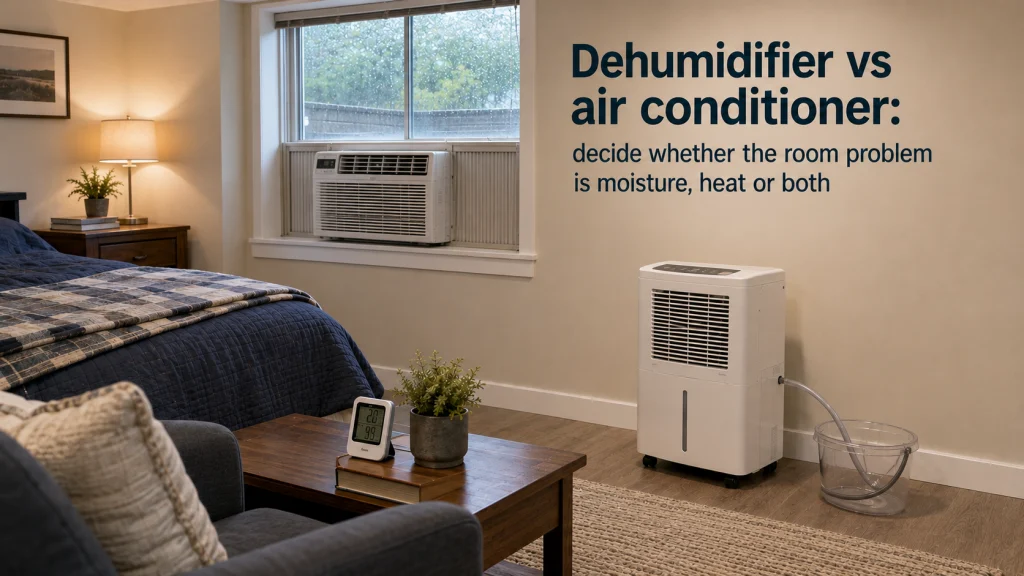
Start with the primary job of each machine
The simplest way to frame a dehumidifier vs air conditioner decision is to separate temperature from moisture. A room can reach the thermostat setting and still feel sticky, while another room can have acceptable RH and still be plainly too warm. More cooling is not automatically the answer to clamminess, and moisture removal is not a substitute for needed cooling. Start by identifying which room condition is actually unsatisfactory.
An air conditioner’s main household job is temperature reduction, with moisture removal occurring during the cooling process. A dehumidifier targets moisture through its humidistat and returns warmer, drier air to the room rather than exporting heat outdoors. Both machines can produce condensate, but their controls and intended outcomes are different. That difference is why temperature and relative humidity should be checked before choosing equipment. Both machines fall within air quality appliances, but cooling and moisture removal should still be treated as separate primary jobs.
Consider a bedroom that is too warm but only moderately humid. A dehumidifier may collect water there, yet it still leaves the cooling requirement unresolved and can add some heat to the room. A cool basement with repeatedly high RH is much closer to the job a dehumidifier is designed to handle. Our decision on whether a dehumidifier is actually needed goes deeper into that moisture-first question.
| Equipment | Primary target | Moisture effect | Heat effect |
|---|---|---|---|
| Air conditioner | Indoor temperature | Removes some moisture during cooling | Rejects collected heat outside the conditioned space |
| Standalone dehumidifier | Relative humidity | Collects or drains condensed water | Returns warmer, drier air to the room |
The table keeps the decision tied to the household job instead of the appliance name. It does not mean every AC controls humidity equally well or every dehumidifier fits every room. Capacity, operating range, drainage, placement, and controls still depend on the exact equipment. Choose the job first, then verify whether the exact machine can perform it in the intended space.

The TP50 displays indoor temperature and relative humidity in one digital monitor. It is designed as a humidity meter and room thermometer for household spaces. That makes it useful for checking both room conditions before deciding whether cooling or dedicated moisture control is the better next step.
Check On AmazonIf you click this link and buy, we earn a commission at no additional cost to you.
Why air conditioners also remove moisture
Cooling air across a cold evaporator coil can cause water vapor to condense, so an air conditioner does not work on temperature alone. ENERGY STAR notes that room air conditioners remove both heat and humidity. The limitation is that moisture removal happens while the system is cooling under conditions that call for cooling. Once the temperature target is satisfied, the thermostat may reduce cooling runtime even if the room still feels damp.
This is where an air conditioner vs dehumidifier comparison becomes more useful than a feature checklist. The AC is not a failed dehumidifier because it cycles according to temperature, and the dehumidifier is not a weak AC because it responds to moisture. Some air conditioners include a dry or dehumidify mode, but exact behavior varies by model and should be checked in that model’s manual. Do not treat a mode name as proof that every AC can replace dedicated moisture control.

This Frigidaire window unit provides 5,000 BTU of cooling for rooms up to 150 square feet. It has two fan speeds and effortless temperature control for simple room cooling. Its listed features also include quiet operation and auto restart.
Check On AmazonIf you click this link and buy, we earn a commission at no additional cost to you.
Why a standalone dehumidifier returns warmer air
A refrigerant dehumidifier cools air enough to condense moisture, then reheats the dried air before returning it to the room. Because the refrigeration system stays inside the conditioned space, the appliance does not export heat outdoors the way an AC does. ENERGY STAR notes that air around a running dehumidifier can be warmer than the surrounding area. That household consequence matters more than a large water-removal number when the room is already warm.
In a cool basement, the added warmth may be unimportant. In a bedroom that is already too warm, the unit can improve RH while making the temperature problem more noticeable. That result is not a contradiction because moisture removal and cooling are separate outcomes. Judge success by room temperature and RH away from the immediate discharge stream, not by how the outlet air feels.
Key point: An air conditioner cools by rejecting collected heat outside the conditioned space. A standalone dehumidifier keeps that heat in the room while removing moisture. If heat is the unmet load, the dehumidifier does not remove the need for cooling. If moisture is the unmet load, the warmer discharge is an ownership trade-off to plan around.
Measure the room rather than the grille. If RH improves while temperature becomes uncomfortable, the two readings are telling you that moisture control is working while cooling is still needed. If temperature was already acceptable, the same warmer discharge may be a minor trade-off. The correct interpretation depends on which variable was wrong before the machine started.

This Waykar dehumidifier is rated for 80 pints and spaces up to 5,000 square feet. It provides 30% to 80% humidity control, 90-degree auto swing, and auto-defrost. Continuous drainage support gives owners an alternative to relying only on manual water handling when the installation provides a suitable drain path.
Check On AmazonIf you click this link and buy, we earn a commission at no additional cost to you.
Use temperature and relative humidity as two separate readings
Words such as sticky, muggy, cool, and hot are useful clues, but they are not enough to choose equipment. A thermometer or thermostat gives the temperature side, while a hygrometer or reliable humidity sensor gives the RH side. ENERGY STAR says roughly 30% to 50% RH is generally considered an optimal building range, although the useful target can vary with conditions. The main point is to stop treating temperature as a substitute for moisture measurement.
Take readings where the room is actually occupied, away from the immediate discharge of an AC or dehumidifier. If different parts of the home behave differently, compare the served area rather than assuming one thermostat represents every room. A basement can have an acceptable temperature and a moisture problem while an upstairs room has the opposite condition. The matrix below turns those two measurements into a practical first move without pretending to diagnose the building.
| Room condition | What is still wrong | First equipment direction | What to verify next |
|---|---|---|---|
| Temperature acceptable, RH acceptable | No clear heat or moisture problem | Do not add equipment yet | Sensor placement and other comfort factors |
| Temperature high, RH acceptable | Heat | AC-first | Cooling capacity, installation, and room fit |
| Temperature acceptable, RH remains high | Moisture | Dehumidifier-first | Served area, capacity, drainage, and placement |
| Temperature high, RH remains high | Heat and moisture | Cooling is necessary; separate dehumidification may also be considered | Normal AC operation and the remaining moisture load |
The matrix is a starting point, not proof that an AC is undersized, oversized, damaged, or poorly installed. Those conclusions require more evidence than two room readings provide. Its value is narrower and more practical: it keeps a purchase from being based on the wrong room condition. Technical diagnosis still requires evidence beyond temperature and RH alone.

The TP49 combines an indoor thermometer and hygrometer in one digital monitor. It lets the reader check temperature and relative humidity instead of relying only on comfort words such as hot or muggy. Those two readings directly support the article's temperature-and-RH decision matrix.
Check On AmazonIf you click this link and buy, we earn a commission at no additional cost to you.
Choose AC first when heat is the unmet problem
If the room is still too hot, an air conditioner directly addresses that condition. A dehumidifier may make humid air feel less oppressive, but it cannot carry room heat outdoors and lower air temperature like cooling equipment. This remains true even when the dehumidifier removes a large amount of water. Moisture-removal capacity should not distract from a room that still needs cooling.
Once cooling is clearly needed, the next decision moves to AC type, room fit, installation, and capacity. Window and portable units can both cool a room, but they impose different window, floor-space, exhaust, noise, and handling requirements. If you are choosing between those formats, use our portable air conditioner versus window air conditioner comparison. From there, compare cooling equipment on the constraints that actually apply to the room.

This SereneLife portable air conditioner provides 10,000 BTU of cooling for rooms up to 450 square feet. Its listing includes a built-in dehumidifier, remote control, and window-mount exhaust kit. The combination keeps the primary purchase centered on cooling while also providing model-specific moisture handling.
Check On AmazonIf you click this link and buy, we earn a commission at no additional cost to you.
Choose a dehumidifier first when temperature is acceptable but humidity remains high
A dedicated dehumidifier makes the strongest case when the room is already cool enough and repeated RH readings still show a moisture problem in the served area. Lowering the thermostat just to force more AC runtime can overcool the room without giving independent humidity control. A dehumidifier can respond to its own humidity setting whether or not more cooling is needed. That is when dedicated moisture control becomes a separate household function rather than duplicate equipment.
Do not jump from that conclusion straight to a capacity label. Check served area, drainage routine, operating temperature range, placement, noise, and the space the unit will occupy. Larger water-removal capacity can also bring more size, airflow, or handling burden. A continuous drain can reduce bucket work, but only when the exact model supports it and the hose path is practical. Our dehumidifier buying guide covers those within-class choices after the moisture-first decision is made.
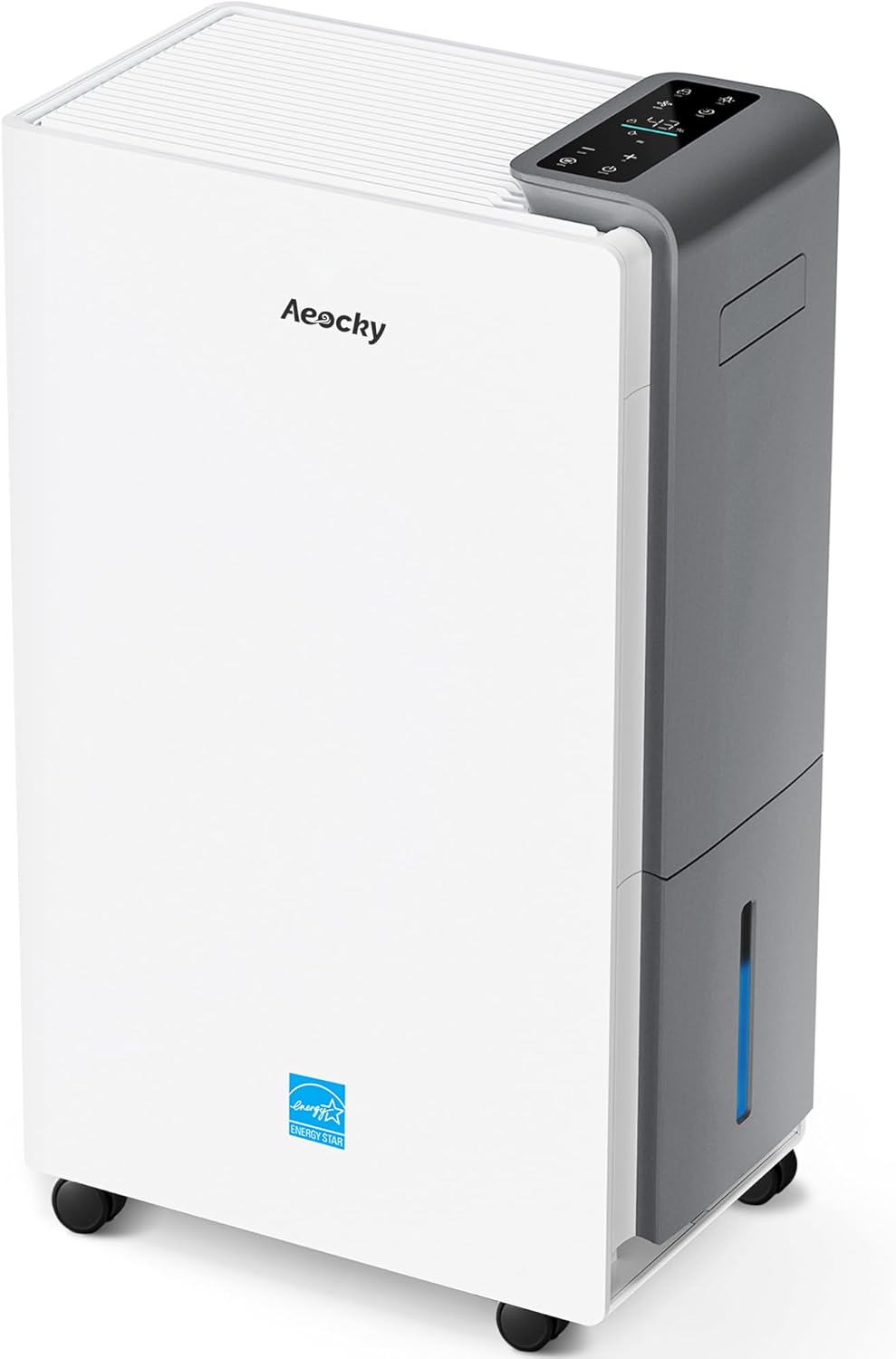
This AEOCKY dehumidifier is listed for spaces up to 4,500 square feet with a maximum 80-pint-per-day rating. It includes an intelligent humidistat and a drain hose for dedicated humidity control and continuous-drain planning. Its ENERGY STAR Most Efficient 2025 designation makes it relevant once moisture, rather than heat, is the remaining room problem.
Check On AmazonIf you click this link and buy, we earn a commission at no additional cost to you.
Treat persistent humidity with the AC running as a diagnostic boundary
A room that reaches its cooling setpoint while humidity stays high does not prove that you need a second appliance. ENERGY STAR and the Department of Energy note that an oversized room AC can cool too quickly for good humidity removal, but that is only one possible explanation. Moisture entry, installation, airflow, drainage, equipment faults, sensor location, and building conditions can also affect what you observe. High RH alone is not enough evidence to label an AC oversized or prescribe a technical adjustment.
Keep owner-level checks simple and tied to the exact manual. Confirm accessible filters, required window or exhaust setup, and obvious condensate handling without opening energized equipment or changing internal HVAC settings. Stop for leaking into electrical areas, overheating, burning odor, repeated tripping, exposed wiring, or other abnormal operation that the manual reserves for service. Do not adjust refrigerant, blower settings, ductwork, or electrical components based on an online humidity diagnosis.
Professional assessment stop: Persistent high RH while an AC operates can have multiple causes. Do not diagnose refrigerant charge, system sizing, internal drainage faults, duct problems, or blower settings from a humidity reading alone. Use the manual for safe owner-level checks and qualified service for internal HVAC diagnosis or abnormal operation. A dehumidifier can manage moisture, but it should not hide a cooling-system problem that needs attention.
Community discussions are useful mainly because they show how often cool-and-clammy rooms trigger a leap to one assumed HVAC fault. That confusion is real, but the technical cause still needs evidence. Measure the room, check safe basics, and separate temporary moisture control from the question of whether the AC is operating correctly. That keeps an appliance comparison from turning into unsupported repair advice.

The Govee H5075 measures room temperature and humidity and connects to its app over Bluetooth. Its listing specifies remote monitoring up to 164 feet, smart alerts, and up to two years of data storage and export. That history can help document persistent room conditions before anyone treats a high-humidity reading as proof of a specific HVAC fault.
Check On AmazonIf you click this link and buy, we earn a commission at no additional cost to you.
Compare drainage, exhaust, noise, space, and maintenance
The better appliance on paper can be the worse appliance in a real room if its setup creates a routine you will not tolerate. A portable dehumidifier may need a bucket emptied or a hose routed to a suitable drain, while window and portable ACs have installation or exhaust requirements that depend on the exact design. Noise matters more beside a bed or desk than in a utility area. These ownership details should be checked before capacity or feature count settles the purchase.
Space is equally practical. A window AC occupies an opening, a portable AC uses floor space plus a hose path, and a dehumidifier needs floor space plus airflow clearance and water handling. Filters, grilles, and accessible drain paths also need maintenance according to the manual. A machine that technically fits but blocks a walkway or creates an awkward hose route can be a poor household choice.
| Ownership factor | Standalone dehumidifier | Room air conditioner |
|---|---|---|
| Water handling | Bucket, pump, or continuous drain depending on model | Condensate behavior varies by design |
| Heat path | Warmer, drier air stays in the room | Heat is rejected outside the conditioned space |
| Space claim | Floor space plus airflow clearance | Window, wall, or floor space plus required exhaust path |
| Control target | Relative humidity | Temperature |
| Routine care | Filter, water system, drain path, and cleaning | Filter, condensate path, seals, and cleaning |
Use this comparison after the room condition is clear. Exact clearances, drainage, electrical requirements, and maintenance still come from the specific manual. A technically suitable machine can remain a poor fit if its hose path, bucket routine, noise, or space claim is impractical. Account for that ownership routine before purchase rather than treating it as an afterthought.

This Plumb Craft hose is 12 feet long with a 1/2-inch size for dehumidifier drainage. It can support a continuous-drain setup when the exact dehumidifier accepts this hose size and the drain path is suitable. That makes it directly relevant to the ownership trade-offs around bucket emptying, hose routing, and routine water handling.
Check On AmazonIf you click this link and buy, we earn a commission at no additional cost to you.
What an AC vs dehumidifier energy comparison can and cannot tell you
Wattage by itself is a poor way to compare unlike equipment. ENERGY STAR uses Integrated Energy Factor for dehumidifiers, describing water removed per unit of electricity under specified test conditions, while room air conditioners use cooling-efficiency measures such as CEER. Those metrics answer different questions because one appliance is judged for moisture removal and the other for cooling. Compare energy only after deciding which job the room actually requires.
If the room is hot, the relevant cost is the cooling needed to control temperature, plus any separate moisture control that remains necessary. If the room is already cool, running AC only to chase moisture can create unwanted cooling, while a dehumidifier can target RH directly. Do not assume adding a dehumidifier always reduces total AC energy because the dehumidifier consumes electricity and adds heat to the room. Runtime, efficiency, local electricity price, controls, room conditions, and equipment fit determine the real operating cost.

The P3 P4400 measures appliance electricity use and displays consumption by the kilowatt-hour. It also monitors voltage, line frequency, current, and power factor for connected loads. Its listed electrical limits are 115 VAC operation, 15 amps maximum current, and 125 VAC maximum voltage.
Check On AmazonIf you click this link and buy, we earn a commission at no additional cost to you.
When both machines may make sense
Using both can make sense when cooling is genuinely required and measured humidity still needs separate control in the served area. The AC handles room heat, while the dehumidifier responds to moisture with its own humidistat. This is most defensible when the two loads do not rise and fall together. The goal is not to run more equipment, but to give each machine a distinct job.
Before adding the second machine, confirm that the first is being used according to its manual and is not showing signs that call for service. Poor cooling, abnormal leaking, repeated tripping, icing, burning odor, or other unusual behavior should not be covered up by a dehumidifier. If the AC cools normally and RH remains a separate verified problem, supplemental dehumidification becomes easier to justify. That distinction keeps a comfort purchase from becoming a substitute for necessary service.
- Use AC because the room is too warm, not just to force moisture removal.
- Add a dehumidifier only when humidity remains a separate measured problem.
- Plan for added heat, water handling, floor space, noise, and electricity.
- Follow exact manuals for drainage, clearances, filters, outlets, and operating limits.
- Escalate unexplained HVAC behavior instead of making internal adjustments.
The checklist is stricter than a generic recommendation to run both. Two machines can improve comfort while also increasing ownership burden. The second appliance earns its place only when it controls a problem that remains after the first machine is doing its own job normally. More equipment is not automatically better control.

The TempPro TempAir combines an indoor hygrometer and thermometer with a touchscreen interface. It keeps temperature and humidity visible together while cooling and dehumidification are being used for separate jobs. That makes it useful for checking whether both room variables are moving in the intended direction.
Check On AmazonIf you click this link and buy, we earn a commission at no additional cost to you.
Move to the right equipment path after the room problem is clear
Stop comparing unlike machines once the room condition points clearly toward cooling or dehumidification. For moisture control, compare dehumidifier capacity, served area, drainage, operating range, noise, and placement. If cooling is required and a window unit is practical, our window air conditioner buying guide covers the room-fit questions that matter next. This is where the buying process becomes specific to one equipment class.
Portable cooling has a different ownership pattern because the unit uses floor space and routes hot exhaust outdoors. If that format fits better, use our portable air conditioner selection process to check capacity, exhaust, window compatibility, noise, drainage, and handling. Do not use a dry-mode label as a shortcut around those cooling decisions because mode behavior is model-specific. The remaining work is fit, capacity, setup, and ownership within the correct class.

The AC-160 is a heavy-duty support designed for window air conditioners and is listed to hold up to 160 pounds. Its heavy-gauge steel construction is epoxy coated for the installation role. The exact window, air conditioner, and support requirements should still be checked before use.
Check On AmazonIf you click this link and buy, we earn a commission at no additional cost to you.
Final thoughts: match the appliance to the room condition you can verify
Temperature and RH give you a cleaner starting point than comfort words alone. A hot room needs cooling, while an acceptably cool room with repeatedly high RH may justify dedicated dehumidification. When both are elevated, separate cooling and moisture control may be reasonable if each machine has a distinct purpose. That is enough to choose a direction without pretending two readings can diagnose the HVAC system.
Before buying, check the ownership details that can turn a technically correct choice into a bad fit. Drainage, exhaust, window access, floor space, noise, maintenance, electrical requirements, and added room heat all matter. If an AC operates abnormally or humidity remains unexpectedly high, use safe owner-level checks and professional assessment when needed. A sound purchase should solve the measured room problem without creating a setup or maintenance burden you already know will not work.

This ECOHomes clear sealing tape is 2 inches wide and 90 feet long for window gaps and areas around AC units. It gives readers a practical setup item to consider when window sealing is part of a cooling installation. The tape can be trimmed to fit the intended window gap or AC-unit area.
Check On AmazonIf you click this link and buy, we earn a commission at no additional cost to you.
Frequently asked questions
These questions recur because both appliance types can produce condensate, which makes them look more interchangeable than they are. The short answers below focus on where that overlap stops. Temperature and RH are still the useful first checks, but setup and exact model behavior can change what happens in a particular room. Use them to narrow the equipment choice rather than to diagnose the HVAC system.
Exact model behavior still matters after that choice. Dry mode, drainage, operating limits, fan behavior, and clearances can differ widely. Use the specific manual whenever those details affect setup or operation. Move to qualified service when the issue involves internal HVAC faults, refrigerant, electrical work, or abnormal operation.
💧 Is a dehumidifier better than an air conditioner for humidity?
A dehumidifier is the more direct tool when temperature is acceptable and moisture is the remaining problem. An AC removes some humidity while cooling, so it may be enough when heat and humidity rise together.
❄️ Does an air conditioner work as a dehumidifier?
An AC removes moisture as part of cooling, but its primary control target is temperature. Whether that moisture removal is enough depends on the room, runtime, equipment, and conditions.
🌡️ Does a dehumidifier cool a room?
No. A standalone dehumidifier removes moisture but returns warmer, drier air to the room, so it should not be chosen when lower air temperature is the missing job.
🔄 Can I run a dehumidifier and an air conditioner at the same time?
Yes, when the room genuinely needs cooling and measured humidity still needs separate control. Account for the dehumidifier’s added heat and electricity use instead of assuming the combination automatically saves energy.
📏 What humidity reading should make me consider a dehumidifier?
ENERGY STAR says roughly 30% to 50% RH is generally considered an optimal building range. Use repeated room readings and avoid treating one brief sensor reading as a diagnosis.
🛠️ Does high humidity prove my air conditioner is oversized?
No. Oversizing can contribute to poor humidity removal in room ACs, but high RH alone does not prove sizing, refrigerant, airflow, drainage, or another specific HVAC fault.
References and sources
The technical distinctions here rely mainly on ENERGY STAR and Department of Energy guidance. Those sources support dehumidifier humidity control, dehumidifier room warming, AC moisture removal, sizing effects, and the efficiency metrics used for each equipment class. Lennox is included for its consumer-level explanation of the heat-versus-moisture distinction. None of these sources can diagnose an individual home’s HVAC system from a humidity reading.
Exact installation and maintenance still come from the manual for the equipment in the home. That includes drainage, clearances, electrical requirements, operating limits, and dry-mode behavior. If a general source and a model manual differ on a model-specific requirement, follow the manual. The list is limited to sources used for the published claims rather than loosely related reading.
- ENERGY STAR dehumidifier guidance: Supports the general RH range, humidistat use, and the fact that a dehumidifier can warm the surrounding space.
- ENERGY STAR dehumidifier testing and capacity: Explains water-removal capacity and Integrated Energy Factor.
- ENERGY STAR room air conditioner guidance: Supports AC heat and humidity removal and the humidity penalty of oversizing.
- U.S. Department of Energy room air conditioner guidance: Supports room sizing, cycling, efficiency, and humidity-removal considerations.
- Lennox dehumidifier and air conditioner comparison: Supports the consumer-level distinction between dedicated moisture removal and primary temperature control.