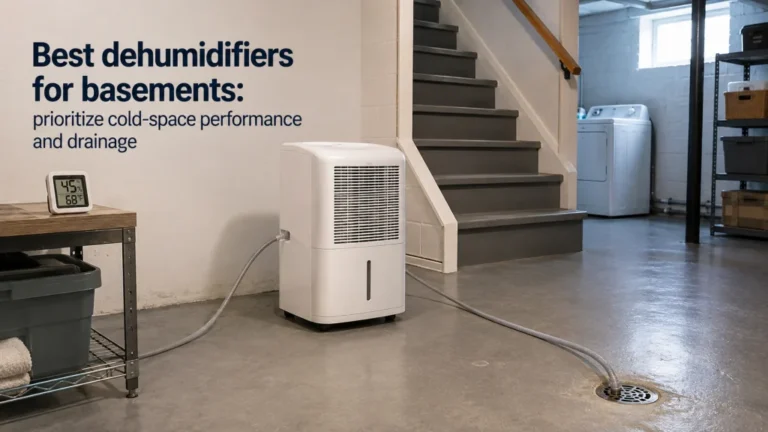
The strongest portable dehumidifier is not simply the machine that removes water fastest. Capacity has to match the moisture workload, while drainage, noise, warm-air output, bucket handling, and exact model status determine whether that performance works in a real home. This shortlist separates independent test results from manufacturer specifications and standardized efficiency data, then matches four current models to different household jobs. You should finish with a short list you can check against your room, drain location, storage space, and tolerance for noise before buying.
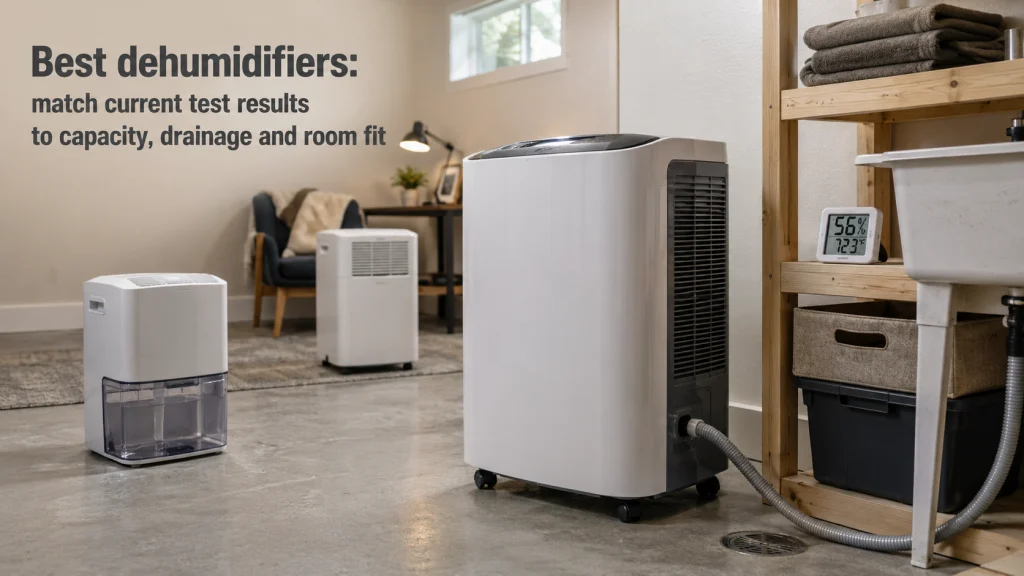
A winner badge matters less than the water path
The best dehumidifiers are not interchangeable because the ownership chore starts after water leaves the air. A powerful unit can still be a poor fit if its bucket becomes a frequent carry or its hose cannot reach a usable lower drain. Noise and warm exhaust can also make a strong performer irritating in a bedroom, office, or family room. Measured moisture removal should therefore start the decision, not finish it.
I would compare capacity first, then drainage, noise, heat, handling, cleaning access, efficiency, exact-model availability, and recall status. That order prevents a common mistake: treating top dehumidifiers as a square-foot ranking before checking comparable water-removal capacity and the actual room workload. Smart controls come later because an app cannot fix an undersized machine or move water uphill without a pump in daily household use. If you are still choosing the product class, use the portable dehumidifier buying guide before this shortlist. Choosing among air quality appliances should therefore keep moisture removal, drainage, noise, heat, and maintenance in the same ownership decision.

TempPro TempAir displays indoor temperature and relative humidity in a compact digital meter. The black unit is designed for room monitoring and can sit near the space where a dehumidifier operates. Use the reading to confirm the actual humidity load before deciding whether capacity, drainage, or quieter operation matters most.
Check On AmazonIf you click this link and buy, we earn a commission at no additional cost to you.
The evidence rules come before the shortlist
A current recommendation needs more than a model name that once tested well. Independent tests carry performance questions, manufacturer documents carry hardware details, and standardized records carry certified capacity and efficiency. Retail listings are useful for stock and price, not performance. Keeping those jobs separate stops a stale ranking or near-match variant from inheriting evidence it never earned.
Safety status is separate because dehumidifiers have a meaningful recall history. Check the model against U.S. Consumer Product Safety Commission records instead of clearing it by brand reputation. Recalls can apply to specific model groups. The manual still controls drainage, electrical setup, cleaning, operating limits, and service boundaries.
Require the exact U.S. model, not a family resemblance
A suffix can change the pump, controls, efficiency record, or retailer channel while the cabinet looks almost identical. Confirm the model number before carrying test results across variants. Similar names are not compatibility evidence. If the exact model cannot be matched, use the test only as comparison context.
Measured performance outranks marketing coverage
Independent tests matter when the conditions and exact unit are clear. RTINGS measures dehumidification, noise, airflow, and temperature behavior, while Good Housekeeping adds controlled moisture and usability checks. Manufacturer coverage claims may use different assumptions. A large square-foot number therefore does not outrank comparable water-removal data.
Efficiency records and recall checks answer different questions
ENERGY STAR data verifies standardized capacity and efficiency for listed models. It does not show which unit is quieter or easier to drain. CPSC records answer the safety question, while manufacturer pages verify model-specific hardware. Each source should be used only for the question it can support.
- Match the exact model number and suffix to the test and specification page.
- Confirm the model is still available through a reputable U.S. seller.
- Verify drainage hardware and standardized capacity before comparing roles.
- Check the exact model against current CPSC recall information before purchase.
These checks intentionally keep the list short. Four roles cover distinct capacity and livability trade-offs. Drain height, room size, or noise tolerance can change the ranking. That is more useful than pretending one model wins every household.

The TS-501B measures sound from 30 to 130 dB and supports A- and C-weighted readings. Its 2.25-inch backlit LCD also supports MAX/MIN and data-hold functions. It gives you a direct way to compare appliance noise instead of treating quiet-operation language as measurement evidence.
Check On AmazonIf you click this link and buy, we earn a commission at no additional cost to you.
A short list with jobs, not invented award categories
TCL W50D9P3 is the strongest all-around candidate when high capacity and a built-in pump both matter. Waykar PD160B fits a lower-cost, lighter workload, while Midea MAD35S1QWT better balances capacity with occupied-room noise and heat. Midea MAD50PS1AWT-C shifts the balance back toward high-capacity work in larger spaces. These are conditional roles, not a universal ranking.
The table also shows why labels need context. Waykar publishes a larger moisture-removal figure under hot, very humid conditions than comparable standardized and independent figures. A 50-pint machine can create the opposite problem by adding bulk, noise, and heat that a small room never needed. Start with workload, then decide which role still fits.
| Role | Model | Why it fits | Main reason to skip |
|---|---|---|---|
| Best overall fit for a common high-moisture portable workload | TCL W50D9P3 | Strong moisture-removal evidence, built-in pump, and standardized 50-pint-class capacity. | High fan noise and a smaller bucket weaken manual use in quiet rooms. |
| Best value for a lighter workload | Waykar PD160B | Low noise, little added heat, compact size, and adequate smaller-room performance. | Much lower comparable capacity and no pump. |
| Best fit for smaller living areas | Midea MAD35S1QWT | 35-pint class, moderate heat, collapsible storage, and smart control. | Heavy compressor section and gravity-only drainage. |
| Best fit for larger living areas and open spaces | Midea MAD50PS1AWT-C | High capacity, built-in pump, app control, and practical side bucket. | Loud operation, noticeable heat, and a narrower retail channel. |
The shortlist is intentionally narrow because the useful comparison is not four spec sheets side by side. It is four different combinations of capacity, water handling, occupied-room comfort, storage burden, and price. A model earns its role only when the household uses the advantage enough to accept the friction that comes with it. That is the standard to carry into the individual picks below.
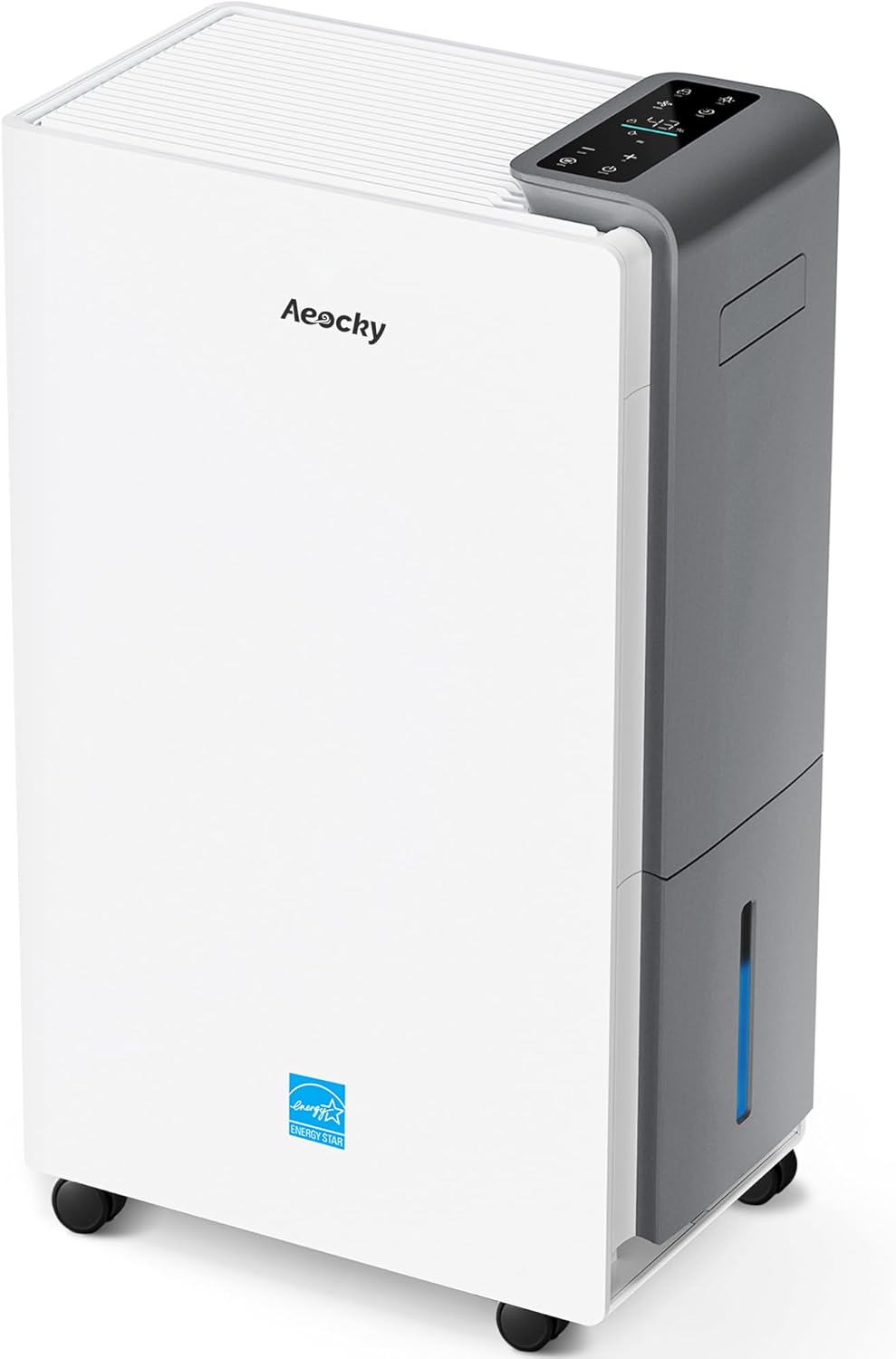
AEOCKY lists this compressor dehumidifier with a maximum 80-pint-per-day rating, a drain hose, and an intelligent humidistat. The listing identifies it as an ENERGY STAR Most Efficient 2025 model for large residential spaces. It is a useful high-capacity comparison when the shortlist is organized by moisture workload and drainage rather than a single winner badge.
Check On AmazonIf you click this link and buy, we earn a commission at no additional cost to you.
Best overall fit: TCL W50D9P3 when the pump solves a real problem
The TCL W50D9P3 is my overall pick for a common high-moisture portable workload because its evidence lines up with work that matters. Good Housekeeping found the TCL 50-pint model effective in moisture removal and energy use, while TCL confirms that W50D9P3 includes a built-in pump. ENERGY STAR lists the exact model at 49.66 pints of standardized daily water-removal capacity with an integrated energy factor of 2.01 L/kWh. That gives the recommendation a cleaner basis than a manufacturer square-foot claim alone.
The pump is the deciding feature when the practical drain sits higher than the machine. Its value falls sharply beside a floor drain, where a gravity hose can remove the same bucket-carrying chore with less hardware. Good Housekeeping also found the unit noisy on high and noted the relatively small bucket, so manual-only use in a quiet room is less convincing. Choose this role for high capacity plus useful pumped drainage, not because an overall badge should beat every other household condition.
Decision point: The TCL role makes sense when 50-pint-class capacity and pumped drainage both remove real work. If gravity drainage is already easy, compare quieter or simpler alternatives before paying for the pump.
At checkout, confirm W50D9P3 because the pump is central to this role. A near-match without it changes the drainage calculation even if capacity looks similar. The pump matters because it can remove a recurring bucket chore. If the drain route does not need it, this pick becomes much harder to justify.

The VCMA-20ULS is an automatic condensate removal pump intended for equipment including dehumidifiers. It uses a 1/30-horsepower motor, a 3/8-inch barbed check valve, and a 6-foot power cord. For a compatible setup, it provides an external pumping option when gravity cannot reach the intended drain.
Check On AmazonIf you click this link and buy, we earn a commission at no additional cost to you.
Best value: Waykar PD160B only for the lighter job it can handle
The Waykar PD160B earns a value role because it has a real price anchor and a lighter ownership profile. Waykar’s direct listing puts it at $175.99, while RTINGS found it quiet, compact, and relatively cool-running. Comparable capacity remains far below the 35-pint and 50-pint roles, and drainage is gravity-only. The value case is specific: spend under $200 when the room does not need more capacity, a pump, or a larger machine.
That price does not make the PD160B an automatic bargain. Waykar’s 34-pint claim uses hotter, more humid conditions than standardized comparisons, so it is not equivalent to a standardized 35-pint class. A sale on a larger unit can also narrow the price gap. The value survives only when the smaller workload is real and the gravity drain route works.
Capacity check: When two dehumidifiers advertise similar pint numbers, confirm that the figures use comparable test conditions before treating the machines as equivalent.
The PD160B can be a best dehumidifier for home use only when that lighter workload is real. RTINGS measured lower noise and much less room-temperature rise than on many larger units, while Waykar also publishes its warranty and support path. Those are useful ownership advantages, not proof of brand-wide reliability. A persistently wet or large room still needs more removal headroom because low purchase cost stops being value when capacity misses the job.

VEAGASO lists this dehumidifier at 34 pints per day for spaces up to 2,500 square feet and includes a drain hose. The listing specifies three modes, a 24-hour timer, a 0.53-gallon water tank, and intelligent humidity control. Its 40 dB claim makes it a relevant lighter-duty comparison when value depends on both capacity and occupied-room comfort.
Check On AmazonIf you click this link and buy, we earn a commission at no additional cost to you.
Best fit for smaller living areas: Midea MAD35S1QWT balances capacity with livability
The Midea MAD35S1QWT is the more balanced choice when a smaller occupied room needs meaningful capacity without jumping to a 50-pint machine. RTINGS recommends it for medium-sized rooms and found less heat output than larger high-capacity alternatives in its comparisons. Midea confirms the exact model as a 35-pint Cube with smart control, a collapsible format, and no built-in pump. Those traits suit an office or compact living area where the machine remains close to people.
The design still creates trade-offs because the compressor section is heavy and the lift-and-twist storage idea adds a handling step. Gravity drainage works when a suitable lower drain is available but cannot send water upward by itself. Smart controls can reduce trips to the machine, yet they do not change drain height, lifting weight, or operating footprint. I would favor this Midea when 35-pint-class capacity is enough and lower noise and heat matter more than maximum removal speed or a pump.

The Midea Cube 20 Pint is listed for spaces up to 1,500 square feet and includes a drain hose. Its Amazon listing also identifies ENERGY STAR certification, Wi-Fi control, Alexa compatibility, and a large-capacity water tank. The combination makes it a useful smaller-room comparison when storage, drainage, and connected controls matter alongside capacity.
Check On AmazonIf you click this link and buy, we earn a commission at no additional cost to you.
Best fit for larger living areas: Midea MAD50PS1AWT-C favors capacity over quiet
The Midea MAD50PS1AWT-C fits larger living areas when removal speed and sustained capacity matter more than quiet operation. RTINGS includes this exact model in its current recommendations and describes high capacity, a built-in pump, app control, and a practical side bucket. ENERGY STAR records list the exact model at about 50 pints of standardized daily removal capacity. The trade-off is straightforward because RTINGS also found it loud and noted noticeable heat output.
I would reserve this role for a genuinely large or consistently damp living area, not treat 50 pints as the default answer. A colder or persistently wet basement should use the separate comparison of dehumidifiers for basements, while a wider moisture problem belongs in the whole-house versus portable dehumidifier comparison. The narrower retail channel matters because availability and price can move enough to change the value calculation. Buy this role for capacity and pumped drainage, not because the larger number looks safer.

This AEOCKY model is listed at 74 pints per day for spaces up to 4,500 square feet and includes a drain hose. The listing identifies ENERGY STAR Version 6.0 and an intelligent humidistat. It suits a larger-space workload where removal capacity and continuous drainage matter more than choosing the quietest compact machine.
Check On AmazonIf you click this link and buy, we earn a commission at no additional cost to you.
Drainage can reverse the ranking after the moisture test
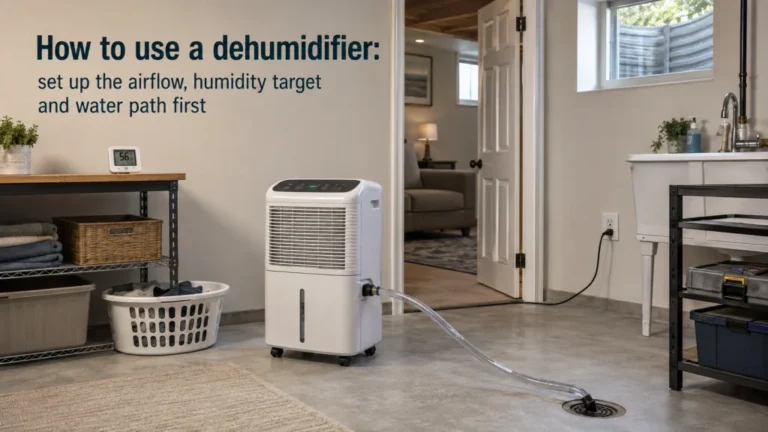
Every pint collected still has to leave the machine. Bucket mode offers placement freedom but creates lifting and carrying, while gravity drainage removes that chore only when a hose can slope continuously to a lower drain. A built-in pump becomes valuable when the practical destination is an elevated sink or another point gravity cannot reach. That plumbing reality can matter more than Wi-Fi or another convenience feature.
The useful question is not whether a product says “continuous drain” but whether its drain method matches the route in your home. A hose that must climb needs a pump, and similar model variants may not share the same pump hardware. Bucket size also matters when no hose route is practical because the real burden is how often and how heavily you must carry water. Choose the water path before breaking a tie between otherwise close models.
| Model | Gravity drain | Built-in pump | Practical implication |
|---|---|---|---|
| TCL W50D9P3 | Yes | Yes | Strong fit when water must reach an elevated drain. |
| Waykar PD160B | Yes | No | Best when a lower drain is nearby or manual emptying stays easy. |
| Midea MAD35S1QWT | Yes | No | Flexible gravity setup, with separate lifting considerations from the Cube design. |
| Midea MAD50PS1AWT-C | Yes | Yes | Useful for elevated drainage while retaining manual bucket use. |
Drainage is also a placement and storage decision because hoses still need a safe route. A permanent hose is easy in a utility area but awkward across a finished room, while a pump does not remove the need to manage tubing. Manual bucket use can remain the simplest option when collected volume is modest and the sink is close. The best drainage setup is the one you can maintain without creating a carrying, leaking, or tripping problem.
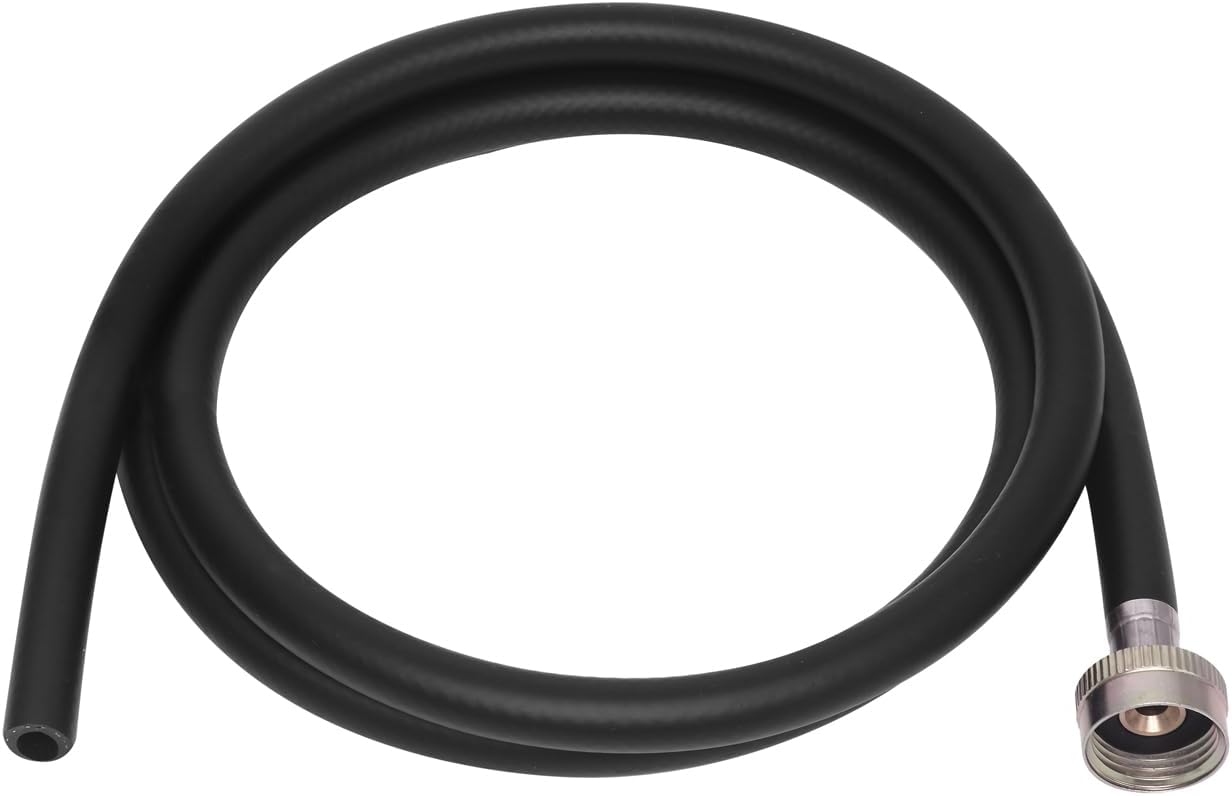
This black drain hose is 5 feet long and uses a 3/4-inch FHT connection. The listing describes a no-kink design for compatible dehumidifier drainage setups. Confirm the appliance fitting and maintain a continuous downward route when using it for gravity drainage.
Check On AmazonIf you click this link and buy, we earn a commission at no additional cost to you.
Noise, warm air, tank handling, controls, and cleaning decide livability
Two dehumidifiers with similar nominal capacity can feel very different in an occupied room. RTINGS measured the Midea MAD35S1QWT at about 52 dBA on high and found a 3.2°F temperature rise in its test, while the smaller Waykar PD160B was quieter and added much less heat but removed less moisture. Larger units generally buy capacity by accepting a bigger compressor and more airflow. A high-capacity winner for an open area can therefore be a poor bedroom or office choice.
Tank design creates a different trade-off. A large bucket reduces emptying frequency but can become heavier, while a smaller one may demand more trips. Storage and support matter too: a collapsible cabinet helps only if the heavy section remains manageable, and support information must match the model bought. These details rarely change a capacity score, but they can change the cost and irritation of ownership.
| Model | Main ownership friction | What makes the trade-off worthwhile |
|---|---|---|
| TCL W50D9P3 | High fan noise, a relatively small bucket, plus pump tubing to route and manage. | 50-pint-class capacity and pumped drainage remove enough recurring work to justify the extra hardware. |
| Waykar PD160B | Lower comparable capacity and no pump, so gravity drainage or manual emptying must fit the room. | An under-$200 direct price, lower noise, compact size, and lower heat fit a genuinely lighter workload. |
| Midea MAD35S1QWT | The Cube stores compactly, but the compressor section remains heavy and drainage is gravity-only. | Moderate capacity with better occupied-room comfort is more useful than paying for a 50-pint pump model. |
| Midea MAD50PS1AWT-C | Louder, warmer operation and a narrower retail channel add ownership and availability friction. | High capacity, a side bucket, and a built-in pump matter in a larger or consistently damp space. |
Support and price should stay in proportion. A lower checkout price matters only if the model still meets the workload, while a warranty or parts path does not prove long-term reliability. Recheck stock and price before purchase because both can move quickly. The better fit is the model whose capacity advantage still outweighs carrying, drainage, noise, heat, storage, and support friction.

The Govee H5075 combines an indoor temperature and humidity display with Bluetooth app monitoring. Its Amazon listing specifies a 10 to 90 percent relative-humidity operating range and temperature accuracy of plus or minus 0.54 degrees Fahrenheit. It is useful for watching both humidity and room-temperature changes when warm-air output affects livability.
Check On AmazonIf you click this link and buy, we earn a commission at no additional cost to you.
Efficiency labels are useful, but certified does not mean best-performing
ENERGY STAR certification gives a standardized efficiency reference instead of unrelated marketing claims. The integrated energy factor helps within a comparable capacity class. It does not tell you whether the drain route works, the fan is tolerable beside a desk, or the bucket is awkward to carry. Those are separate ownership questions.
Capacity labels need the same restraint because water-removal figures can use different temperature and humidity conditions. The Waykar PD160B shows the problem because its marketing and comparable test figures describe different conditions. Compare like with like before judging the size class, then use independent testing for behavior the label misses. That keeps a headline pint number from distorting value.
Use the label correctly: Certification supports standardized efficiency and capacity fields for the listed model. It does not replace drainage, noise, heat, handling, or room-fit checks.
Efficiency also interacts with sizing because an undersized unit may run hard without enough removal headroom. Oversizing brings its own costs in purchase price, floor space, noise, and heat. That is why I would not sort this list by efficiency number alone. The label informs the household decision, but it does not make the decision.

The P3 P4400 plugs between a standard 115-volt outlet and an appliance to measure electrical use. Its display can show volts, amps, watts, and kilowatt-hour consumption. That lets you compare real operating draw with an efficiency label instead of treating certification as the entire ownership picture.
Check On AmazonIf you click this link and buy, we earn a commission at no additional cost to you.
Skip this broad shortlist when the room changes the job
A general portable list stops being useful when the environment imposes a more specific requirement. A cold or persistently damp basement may care more about operating temperature and permanent drainage than living-room noise, so use the basement dehumidifier comparison for that workload. If one portable unit no longer matches the scale of the problem, the whole-house and portable comparison is the better next step. A portable unit also does not repair water intrusion, plumbing leaks, failed drainage, or building-envelope problems.
This article does not treat dehumidifier choice as a medical treatment or a guaranteed solution for mold-related problems. Stop using a unit if you encounter damaged electrical parts, smoke, a burning odor, leaking into electrical areas, or uncontrolled operation. Follow the exact manual and qualified service guidance when the issue moves beyond normal owner-level setup or maintenance. A favorable performance test never overrides a recall or a manufacturer safety instruction.

The Klein Tools ET140 is a pinless moisture meter for non-destructive checks on drywall, wood, and masonry. Its listing says it can detect moisture up to 3/4 inch below the surface. It helps identify when a room has a broader material-moisture or leak problem that a portable dehumidifier alone may not solve.
Check On AmazonIf you click this link and buy, we earn a commission at no additional cost to you.
Do the sizing check before checkout, not after the first full bucket
Room size helps, but it is not enough by itself to choose capacity. Moisture load changes with how damp the space is, air movement through connected rooms, and whether the unit must recover a wet room or maintain a stable condition. Manufacturer square-foot claims can create false precision when those conditions differ. Match comparable capacity to the workload, then confirm that the collected water has a practical exit route.
A first-time buyer may treat extra capacity as cheap insurance, but a larger machine can add floor space, weight, fan noise, heat, and cost. Undersizing creates the opposite problem when a small unit runs hard without enough removal headroom. Work through what size dehumidifier do I need, then check the drain route, operating footprint, bucket handling, noise, heat, and current price. The right purchase is the one whose paid features remove real household work instead of merely extending the specification list.

This CRAFTSMAN tape measure has a 25-foot retractable blade with fraction markings. The CMHT37225 listing specifies a self-locking blade for holding a measurement in place. It gives a first-time buyer a simple way to verify room dimensions and drain-route distances before choosing dehumidifier capacity or placement.
Check On AmazonIf you click this link and buy, we earn a commission at no additional cost to you.
Final thoughts: match the test winner to the household workload
Independent testing is the right starting point because it separates measured moisture removal, noise, heat, and usability from marketing language. After that, the ranking changes with drainage, room tolerance, handling, and price. TCL W50D9P3 is the strongest all-around fit when high capacity and a pump are both useful, while Midea MAD35S1QWT is easier to justify in smaller occupied rooms. Waykar PD160B makes the clearest value case for a lighter workload, and Midea MAD50PS1AWT-C earns its role when larger-space capacity matters more than quiet.
I would make the final choice with a tape measure, a drain route, and a realistic idea of how often you are willing to carry water. Compare the current checkout price only after the capacity and drainage job is clear, because a cheaper machine that runs out of headroom is not good value. Check current safety information before buying, then follow the manual for setup, drainage, cleaning, and service limits. A good choice removes the required moisture without creating a water-handling, noise, heat, storage, or ownership-cost problem you will resent.

Midea lists this 22-pint dehumidifier for spaces up to 1,500 square feet with a reusable air filter and continuous drainage. The Amazon listing also identifies ENERGY STAR certification, Wi-Fi control, Alexa compatibility, and quiet operation. It is a useful final-check option when the household needs a lower-capacity machine and the drainage route is straightforward.
Check On AmazonIf you click this link and buy, we earn a commission at no additional cost to you.
FAQs
💧 Is a 50-pint dehumidifier always better than a 35-pint model?
No. A 50-pint unit provides more capacity, but it can also add bulk, noise, heat, and cost that a smaller room does not need. Match capacity to the moisture workload before comparing features.
🚰 Do I need a built-in pump if the dehumidifier has continuous drainage?
Only when water must reach an elevated drain or another route gravity cannot serve. A gravity hose is simpler when it can maintain a continuous downward path to a suitable drain.
🔊 Which dehumidifier is easier to live with in a bedroom or office?
Prioritize measured noise and heat along with enough capacity for the room. A lower-capacity model can be more comfortable than a louder 50-pint machine when the moisture load allows it.
📐 Can I choose a dehumidifier from the manufacturer’s square-foot rating?
Not from that number alone. Coverage claims may use different assumptions, so comparable capacity and the room’s actual moisture workload are more useful for sizing.
⚡ Does ENERGY STAR certification mean a dehumidifier performs better?
It supports standardized efficiency and capacity comparisons for the exact certified model, not a universal performance ranking. Independent tests are more useful for noise, heat, moisture removal, and usability.
🧾 Should I check for recalls even when the model is on a current best list?
Yes. Check the exact model number in CPSC recall information before purchase because safety actions can apply to specific products or production groups.
References and sources
- RTINGS dehumidifier testing: Supports measured performance, current shortlist roles, drainage differences, noise, heat, and exact-model findings.
- Good Housekeeping dehumidifier testing: Supports the TCL test role, controlled moisture-removal methodology, usability findings, and noise observations.
- TCL W50D9P3 specifications: Verifies the exact model, capacity class, built-in pump, controls, and operating features.
- ENERGY STAR TCL W50D9P3 record: Verifies standardized capacity, integrated energy factor, and certification for the exact TCL model.
- Midea MAD35S1QWT specifications: Verifies the exact Cube model, capacity class, dimensions, weight, smart control, and pump status.
- ENERGY STAR Midea MAD50PS1AWT-C record: Verifies standardized capacity and certification for the exact 50-pint Midea model.
- Waykar PD160B specifications: Verifies the current direct price, manufacturer’s test condition, drainage configuration, tank, dimensions, warranty, and support details.
- CPSC dehumidifier recalls: Provides the safety-recall information used to check model status before purchase.