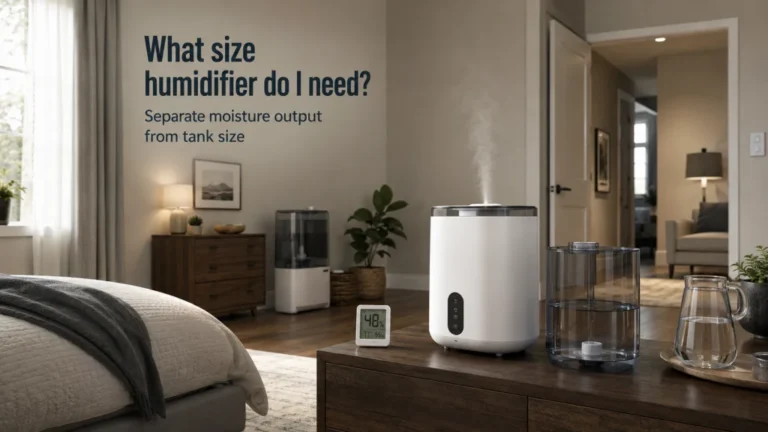
Dehumidifier size is the amount of water the unit can remove in 24 hours under specified test conditions, not the bucket size or a simple square-foot coverage promise. For a portable unit, start with the current pint-per-day rating, combine the served area with how damp the space is, and then check drainage, temperature, and room layout before buying. Older capacity labels can look larger than current labels because the test conditions changed, so replacing an old unit by matching the printed pint number can lead to unnecessary oversizing. By the end, you should have a minimum capacity band and a short list of operating conditions that the machine still has to fit.
Start with the current capacity label, not the old number you remember
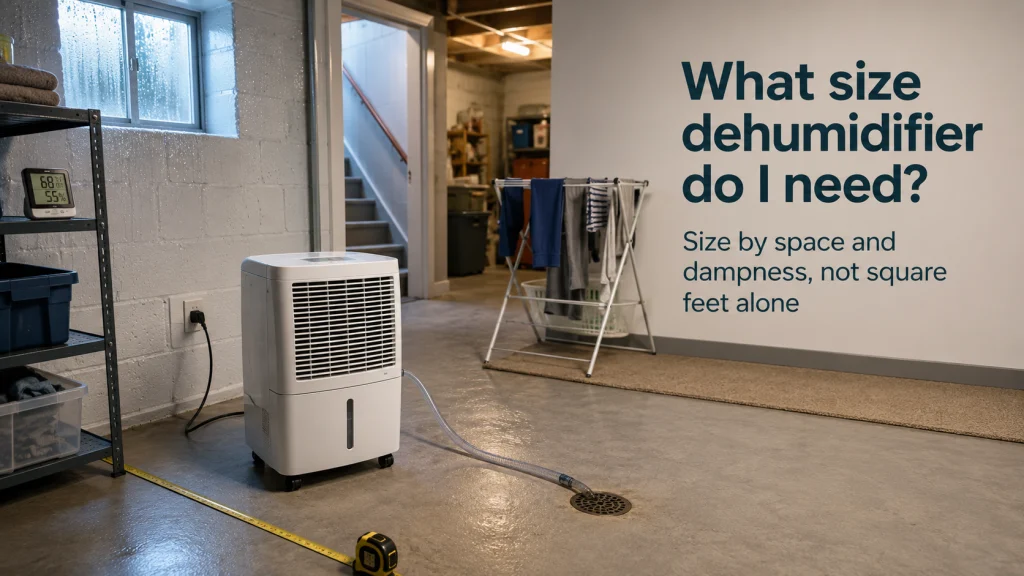
If you are replacing an older 70-pint machine, the lower number on a current label can look like a downgrade when it may not be. The question “what size dehumidifier do I need?” becomes much easier once you stop treating that old number as the target. Start with current pint-per-day capacity, then pair the served area with how damp the space actually is. Square footage alone does not tell you the moisture load.
The rating system matters because the federal test procedure moved portable dehumidifier testing to cooler conditions, which generally produces a lower reported capacity for comparable moisture-removal hardware. ENERGY STAR explains that a current lower-looking label can therefore be an appropriate replacement for an older higher-looking label. That is why an old 70-pint label should not automatically send you hunting for a current 70-pint portable unit. If you have not yet confirmed that a dehumidifier is the right tool for the moisture problem, start with whether you actually need a dehumidifier before sizing one. Sizing also belongs within the broader air quality appliances decision, where current ratings should be matched to the actual room condition rather than an old label.

This Midea portable dehumidifier is rated to remove 22 pints of moisture per day and is listed for spaces up to 1,500 square feet. It includes a reusable air filter and supports continuous operation. Its current 22-pint label gives replacement shoppers a concrete modern capacity reference instead of simply matching an older printed pint number.
Check On AmazonIf you click this link and buy, we earn a commission at no additional cost to you.
What dehumidifier size actually measures
For portable dehumidifiers, capacity is expressed as pints of water removed per 24 hours under specified test conditions. It is a performance rating that lets you compare the relative moisture-removal capability of units tested under the same procedure. It is not a promise that the machine will pull that exact amount from your room every day. Real removal changes with the room’s temperature, humidity, air exchange, moisture sources, and how often the unit can keep running.
This distinction is useful because a household rarely lives inside a laboratory condition. A mildly damp bedroom can give a capable machine much less water to collect than a wet basement with recurring moisture entering the space. The rating still gives you a useful common comparison point, but the room determines how hard that capacity has to work. Good dehumidifier sizing therefore starts with the rating and immediately moves back to the actual space.

This Midea Cube is rated at 20 pints per day and is listed for spaces up to 1,500 square feet. Its Cube design provides drain-hose support, smart controls, and Alexa compatibility. It is a useful example of why the pint-per-day moisture-removal rating should be read separately from collection and ownership features.
Check On AmazonIf you click this link and buy, we earn a commission at no additional cost to you.
Separate the four numbers that shoppers commonly confuse
A dehumidifier listing can put several large numbers close together, and they do not describe the same thing. Pint-per-day capacity is the moisture-removal rating, while bucket volume tells you how much collected water the reservoir can hold before it needs to be emptied. Advertised square-foot coverage is a seller or manufacturer claim that may be based on assumptions that are not obvious on the shopping page. Electrical power is another separate specification and does not replace the capacity rating.
That separation prevents a common first-time buyer mistake: treating a large bucket as proof of a larger dehumidifier size. A unit can have a relatively modest reservoir while still carrying a higher pint-per-day rating because the bucket is only the temporary collection container. The opposite can also happen, so bucket size should be judged as an ownership and emptying issue rather than the main sizing number. Use the table below as a quick decoder before comparing listings.
| Number on the listing | What it tells you | What it does not prove |
|---|---|---|
| Pints per 24 hours | Rated moisture-removal capacity under specified test conditions | Exact daily water removal in your room |
| Bucket volume | How much condensate the reservoir can hold | Dehumidification capacity |
| Advertised coverage | The seller’s or maker’s stated area target | Fit for every room with that square footage |
| Electrical power | Input or operating power information when specified | A substitute for pint-per-day capacity |
Once those numbers are separated, the sizing problem becomes much cleaner. The next job is to measure the space the machine will actually serve, not the entire floor plan by habit. Then you can pair that area with moisture severity instead of letting one marketing number make the decision. That order keeps the comparison tied to the household job rather than the largest number on the box.

The P3 P4400 plugs into a 115-volt AC outlet and measures appliance electricity use. Its LCD can display volts, amps, watts, and accumulated kilowatt-hour consumption. It helps separate electrical power from a dehumidifier's pint-per-day moisture-removal rating when comparing product-page numbers.
Check On AmazonIf you click this link and buy, we earn a commission at no additional cost to you.
Measure the served area, but do not stop at square feet
Measure the floor area of the room or connected area you genuinely expect one portable unit to manage. A closed basement room, an open unfinished basement, and two rooms connected by a doorway are different air-moving situations even when the arithmetic produces the same square footage. ENERGY STAR recommends keeping doors and windows to the dehumidified space closed while the unit runs, which is a useful reminder that room boundaries affect the workload. If doors are normally open to additional rooms, treat that as added uncertainty rather than pretending the first room’s measurement tells the whole story.
For a simple rectangular room, length multiplied by width is enough to establish the basic area. Irregular spaces can be divided into smaller rectangles and added together, but the calculation is only the first half of the decision. A 900-square-foot space that is only intermittently musty is not the same job as a 900-square-foot space with visible damp spots or recurring laundry moisture. That is why a good dehumidifier size decision combines area with condition instead of relying on a one-number coverage badge.

A 165-foot green-beam laser distance measure designed for fast indoor and jobsite measurements. The bright green laser improves visibility compared with standard red beams, while the color display keeps readings easy to check. It supports straightforward distance measuring in a compact handheld format and provides a longer working range than the Bosch GLM100-23 it replaces.
Check On AmazonIf you click this link and buy, we earn a commission at no additional cost to you.
Classify the space by moisture condition before choosing capacity
ENERGY STAR’s buying guidance separates spaces by how damp they are without dehumidification, which is more useful than inventing a rule such as one pint for every fixed amount of floor area. Its lower condition band describes spaces that feel damp or have an intermittent musty odor, while higher bands move through persistent dampness, damp spots, sweating surfaces, seepage, and other high-load conditions. The guidance also associates those conditions with broad relative-humidity ranges, giving you another observation to compare with a hygrometer. The important point is that severity changes the capacity range even when the room size does not.
Use the condition description that best matches the room before the machine starts altering it. If a basement only looks dry because an existing dehumidifier has been running continuously, the current reading alone can hide the untreated load. An older unit’s collection rate and run pattern can add context, but they should not be turned into an exact engineering calculation. Active leaks, standing water, or ongoing water intrusion need source correction rather than a larger portable dehumidifier being treated as the repair.

The TempPro TP50 displays indoor temperature and relative humidity on one screen. It records high and low temperature and humidity values and provides a simple comfort indicator. A standalone hygrometer helps you classify an untreated room's moisture condition before a running dehumidifier changes the reading.
Check On AmazonIf you click this link and buy, we earn a commission at no additional cost to you.
Use the current area and dampness bands as a minimum starting point
ENERGY STAR’s current portable-dehumidifier guidance combines two broad area groups with three moisture conditions. For a small to medium space below 2,000 square feet, its recommended ranges rise as the room moves from slightly or moderately damp to very damp and then wet. For a space above 2,000 square feet, the minimum recommendation also rises with severity. This is a practical starting point because it makes dampness part of the sizing decision instead of hiding it behind one coverage number.
The table below follows those official capacity bands rather than creating finer increments that the source does not support. If your room sits near a boundary, do not pretend there is a magic line at which the correct machine suddenly changes. Use the lower end only when the condition and layout support it, and leave yourself more capacity when the room is clearly carrying a heavier moisture load. After that, move on to drainage, temperature, and layout because a capacity number can be adequate on paper and still be awkward in the room.
| Condition without dehumidification | Below 2,000 sq. ft. | Above 2,000 sq. ft. |
|---|---|---|
| Slightly to moderately damp, roughly 50% to 75% RH | 20 to 30 pints per day | 30+ pints per day |
| Very damp, roughly 75% to 90% RH | 25 to 40 pints per day | 40+ pints per day |
| Wet or high-load, roughly 90% to 100% RH | 30 to 50 pints per day | 50+ pints per day |
These are minimum selection bands, not a guarantee that every machine at the listed capacity will control every room in that band. The exact model still has to operate in the room’s temperature range, drain in a workable way, and move enough air through the intended space. Treat the table as the capacity gate, not the end of the buying process. A model that clears that gate can still be a poor household fit if the ownership conditions do not work.

This Midea portable dehumidifier is rated to remove 35 pints of moisture per day and is listed for spaces up to 3,000 square feet. It supports adjustable humidity control and continuous drainage through a hose connection. The 35-pint class provides a concrete current-capacity option to compare with the article's area-and-dampness minimum bands.
Check On AmazonIf you click this link and buy, we earn a commission at no additional cost to you.
Bridge older and current pint labels before replacing a machine
The confusing replacement problem is real because the DOE test procedure changed from a warmer test condition to a cooler one. Under the cooler procedure, a comparable portable dehumidifier can receive a lower capacity number even though the lower label does not automatically mean the machine became proportionally weaker in household use. ENERGY STAR publishes rough correlations specifically to help shoppers compare older and current labels. It also warns that the actual change can vary by model, so the table is a bridge rather than a universal conversion formula.
This is why matching an old printed number can lead you past the capacity you actually need. An older 70-pint portable unit roughly corresponds to a current 40- to 45-pint label in ENERGY STAR’s comparison, while an older 50-pint unit roughly corresponds to a current 30-pint label. If you know the exact old model, manufacturer documentation can be a better comparison than relying only on the class-level bridge. Use the older label as context, then size the replacement against the room’s present area and moisture condition.
| Older portable capacity label | Approximate current portable label |
|---|---|
| 30 pints per day | 20 pints per day |
| 40 pints per day | 25 pints per day |
| 50 pints per day | 30 pints per day |
| 55 pints per day | 30 to 35 pints per day |
| 60 pints per day | 35 pints per day |
| 70 pints per day | 40 to 45 pints per day |
| 90 pints per day | 55 pints per day |
Notice what the table does not do: it does not tell you which current model to buy. It only stops an old rating from distorting the new decision. Once that confusion is removed, present moisture load and household workflow should take over. That keeps an old label from becoming a shopping target long after the test basis has changed.
This Midea portable dehumidifier is rated at 50 pints per day and is listed for spaces up to 4,500 square feet. It supports continuous drainage, a reusable air filter, Wi-Fi control, and Alexa compatibility. Its current 50-pint label gives replacement shoppers a modern reference point instead of matching an old printed pint number automatically.
Check On AmazonIf you click this link and buy, we earn a commission at no additional cost to you.
Adjust the decision for recurring moisture, layout, and room use without inventing multipliers
A sizing table cannot see what happens in the room between measurements. Indoor laundry drying, repeated door opening to humid air, moisture entering from adjacent spaces, or a basement that communicates freely with stairwells and other rooms can all increase the work the machine has to do. If capacity is too low for that recurring load, the unit may run for long stretches and still fail to bring the space to the intended humidity level. Those conditions justify leaning away from the minimum edge of a capacity band, but they do not justify inventing an exact extra-pint formula.
The opposite mistake is buying far more capacity than the room conditions support simply as insurance. Extra capacity can mean a larger chassis, more awkward placement or handling, and higher purchase cost without fixing a poor drain path, a cold operating environment, restricted air movement, or an unresolved moisture source. Layout matters for the same reason: one open room gives the unit a clearer air path than several closed rooms that add up to the same floor area. Treat undersizing as a failure to meet the room’s actual moisture load, and unnecessary oversizing as paying for capacity that does not solve the real constraint; when the job expands to several rooms, multiple floors, or the whole house, the question is moving beyond simple portable dehumidifier sizing.

The General Tools MMD4E uses replaceable pins to measure moisture in materials such as wood and drywall. Its backlit display and low, medium, and high moisture alerts help locate damp material around suspicious spots. It can add context when recurring seepage or wet building materials may be increasing the room's moisture load beyond what square footage alone suggests.
Check On AmazonIf you click this link and buy, we earn a commission at no additional cost to you.
Check drainage and tank handling after capacity
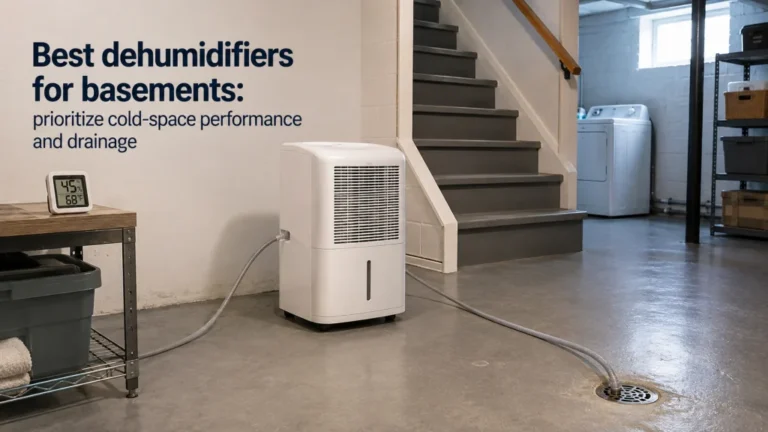
A correctly sized unit still cannot remove moisture while it is sitting shut off behind a full bucket. ENERGY STAR notes that portable units commonly use a removable reservoir with automatic shutoff when the bucket fills, while many models also provide a hose connection for continuous drainage. That makes drainage part of effective household capacity, especially in a damp basement where the machine may collect water for long stretches. A high pint-per-day label is less useful if the owner can only empty the reservoir occasionally.
Decide the water path before choosing between otherwise similar capacity classes. Gravity drainage needs a suitable drain location and hose path, while a setup that must move water upward may require a compatible pumping arrangement specified by the exact model. Bucket use adds carrying weight and a recurring chore, and larger-capacity machines can make that routine more noticeable even when the bucket itself is not especially large. The point is not to avoid capacity, but to make sure the selected capacity can actually stay available in normal use.
- Confirm the minimum pint-per-day band from the served area and untreated dampness condition.
- Verify whether the water path will be a bucket, gravity drain, or model-supported pump setup, including the actual drain and hose route.
- Check the lowest normal room temperature against the exact model’s supported operating range and defrost guidance.
- Define the layout the unit must serve, including open or closed doors, connected rooms, and whether air can circulate back to the machine.
- Check how often you can realistically empty and carry the bucket if manual draining is required.
- Keep drainage routing away from electrical connections and follow the exact model manual.
Once drainage is workable, capacity becomes much more meaningful because the unit can run according to its controls instead of your bucket-emptying schedule. That is particularly important when comparing machines for unattended basement use. It also sets up the next check, because a basement’s temperature can change how a refrigerant dehumidifier behaves. A capacity number should never be separated from the conditions that let the machine keep removing moisture.
This Midea 50-pint dehumidifier includes a built-in pump along with continuous-drain support. It is listed for spaces up to 4,500 square feet and also provides Wi-Fi control with Alexa compatibility. The pump-equipped configuration is relevant when the water path cannot rely only on a bucket or straightforward gravity drainage.
Check On AmazonIf you click this link and buy, we earn a commission at no additional cost to you.
Check low-temperature operation before assuming a bigger basement unit is the answer
Basement sizing is not only a question of square footage and pints. ENERGY STAR advises checking products specified for lower-temperature use when the space commonly falls below 65°F, because frost can form on the condensing coils and interfere with moisture removal. Some units use anti-frost controls or other defrost behavior, but the exact operating range and control logic depend on the model. A bigger capacity label cannot compensate for using a machine outside the conditions its documentation supports.
For a basement, the right dehumidifier size also depends on the temperature where the unit will actually run. Measure or observe that space rather than assuming a warmer room upstairs represents the same conditions, and verify the manufacturer’s low-temperature specification before buying. If the basement stays comfortably within the model’s operating range, use the area-and-dampness capacity decision normally. For a shopping page focused specifically on current basement options, continue to dehumidifiers suited to basement use after you have defined the capacity and drainage requirements.

The TempPro TP60 monitors temperature and relative humidity with a wireless remote sensor and a large LCD display. It supports a wireless range up to 500 feet and records maximum and minimum temperature and humidity readings. Placing the sensor in a basement helps verify the room conditions that should be checked against a dehumidifier's documented operating range.
Check On AmazonIf you click this link and buy, we earn a commission at no additional cost to you.
Know when the sizing question has become a whole-home system question
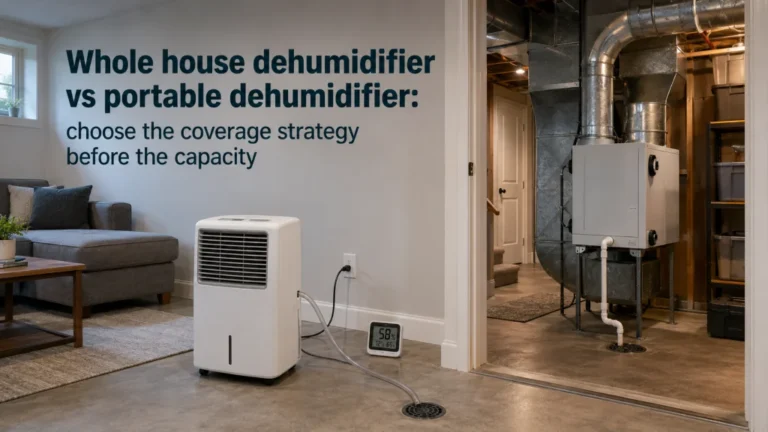
A portable dehumidifier is normally a room or space solution, while a whole-home unit is integrated with a broader air-distribution strategy and requires different sizing and installation thinking. If the real goal is to control humidity across several closed rooms, multiple levels, or a centrally conditioned home, adding more portable capacity to one corner may not solve the distribution problem. The same warning applies when you are trying to compensate for an unresolved building moisture source with appliance capacity alone. At that point, the decision is about system scope as much as pints per day.
Do not extend the portable sizing table into a homemade whole-house load calculation. Whole-home equipment should be sized and installed using current professional and manufacturer guidance, and the exact ducting and installation conditions matter. Our comparison of whole-house and portable dehumidifiers is the better next step when the served area has grown beyond a realistic portable zone. If the task is still one room or one open basement, stay with the portable framework and finish the ownership checks before shopping.
Stop point: If one portable unit is being asked to control several separated rooms, multiple floors, or a centrally ducted home, stop adding capacity on paper. Reconsider whether the equipment type matches the job. More portable capacity in one location does not guarantee good humidity control in closed or distant rooms. Distribution and installation have become part of the decision.
That stop point keeps a sizing article from pretending every moisture-control problem has a portable answer. It also protects you from buying a very large room unit only to discover that the real limitation is air distribution. With the equipment type settled, you can turn the work above into a concise shopping profile. The profile should describe what the machine must do before any current model is allowed onto the shortlist.
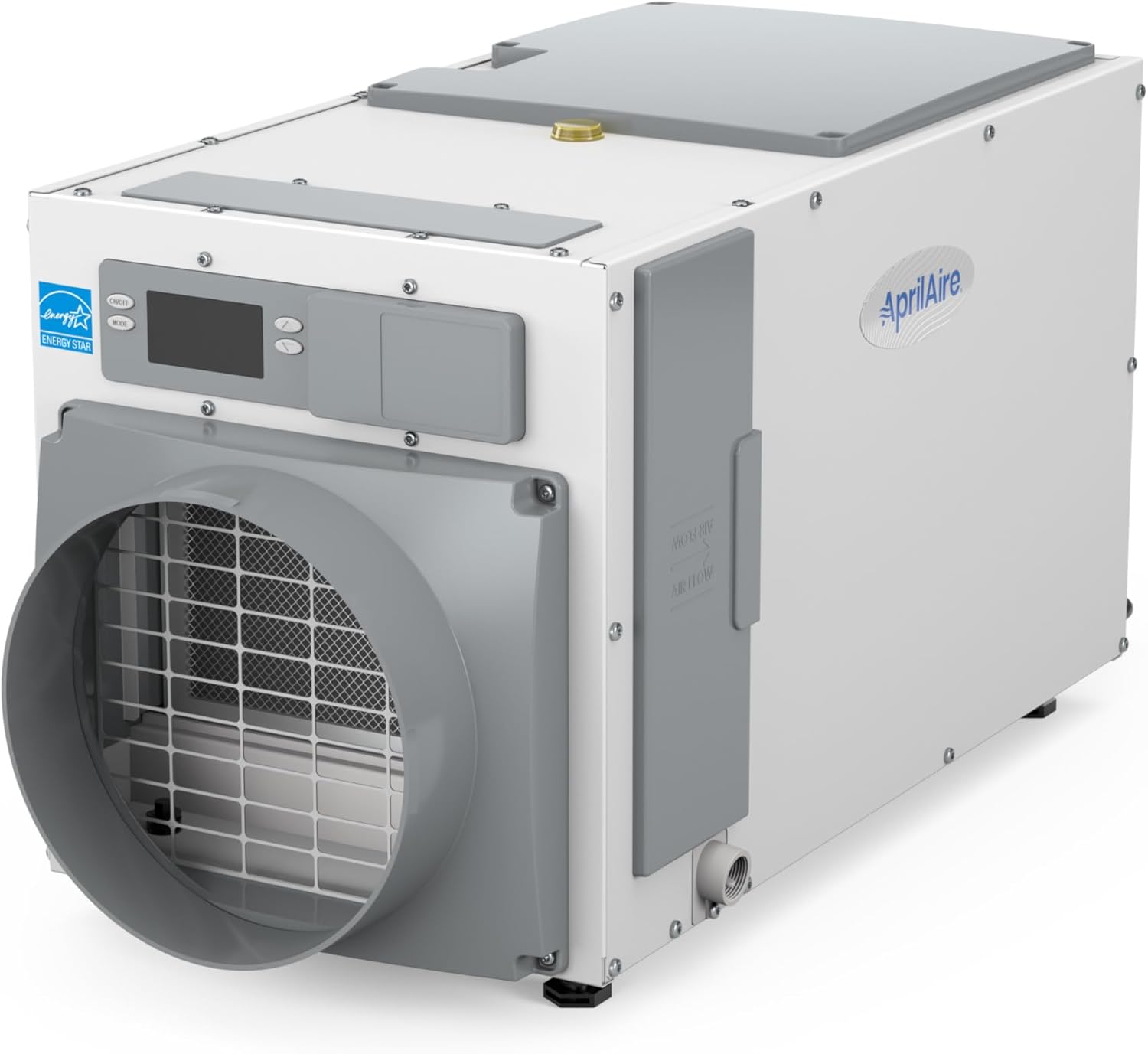
The AprilAire E080 is a whole-house dehumidifier designed for basement, crawlspace, and whole-home applications. Its package includes 10-inch inlet and outlet duct collars, a backdraft damper, continuous-drain hardware, and a washable MERV 8 filter. That ductable, permanently drained configuration illustrates the point where humidity control becomes a system-scope and installation decision rather than simply choosing a larger portable unit.
Check On AmazonIf you click this link and buy, we earn a commission at no additional cost to you.
Turn the sizing result into a shopping profile
By now, the useful output is not simply “buy a 35-pint” or “buy a 50-pint” machine. Your profile should state the minimum current capacity band, the room condition that justified it, the served area, the expected drainage method, the lowest normal room temperature, and whether the layout is one open space or a set of connected rooms. That profile gives you a way to reject models that are impressive on a product page but wrong for the household. It also keeps dehumidifier size from becoming the only specification you compare.
From there, use the broader dehumidifier buying guide to compare ownership details such as controls, noise, efficiency, drainage features, and maintenance without reopening the sizing question. If you are ready to compare current options across the market, the current dehumidifier comparison is the appropriate next stop after your requirements are fixed. Do not move the other direction by picking a model first and then trying to justify its advertised coverage. A capacity profile should narrow shopping, not be rewritten to fit whatever product caught your eye.
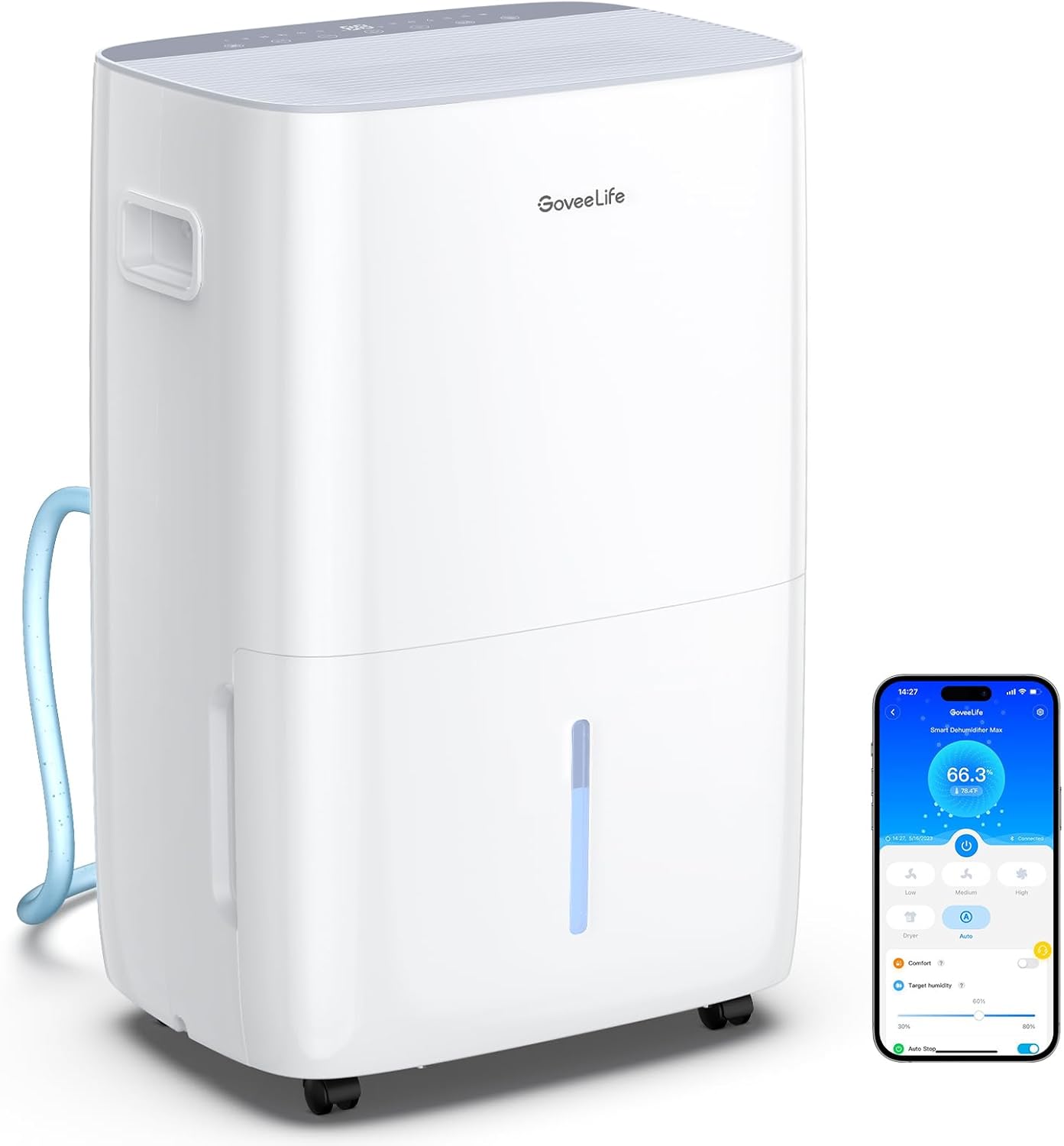
The GoveeLife H7151 combines smart automatic humidity control with a 2.0-gallon bucket and drain-hose support. It also provides Wi-Fi control and automatic shutoff. Those ownership features give a fixed capacity requirement a practical shopping profile that can be checked for drainage, controls, and daily use instead of relying on a coverage number alone.
Check On AmazonIf you click this link and buy, we earn a commission at no additional cost to you.
Final thoughts: size for moisture load, then verify the room workflow
The cleanest answer to dehumidifier sizing is to use the current pint-per-day rating, the actual served area, and the room’s untreated moisture condition together. That avoids the two common traps of matching an older pint label directly or trusting square footage alone. Once you have a defensible minimum capacity band, check whether the unit can drain reliably, operate at the room’s temperature, and serve the layout you actually have. Those checks determine whether the rated capacity can become useful capacity in the household.
A slightly larger capacity choice can be sensible when the room has a heavier recurring load, but “bigger” is not a complete strategy. Extra chassis size, bucket handling, placement, and cost still have to earn their place, and whole-home problems should not be forced into a portable-room framework. Keep the old-versus-current rating bridge as context, not as the final answer. The final answer is the smallest practical capacity class that can handle the real moisture load without creating a drainage, temperature, or placement problem you will regret living with.

This Midea Cube dehumidifier is rated at 50 pints per day and is listed for spaces up to 4,500 square feet. It combines a large-capacity water tank with drain-hose support, Wi-Fi control, and Alexa compatibility. The feature mix makes it a useful final example of matching moisture-removal capacity with drainage and room workflow after the sizing requirement is established.
Check On AmazonIf you click this link and buy, we earn a commission at no additional cost to you.
FAQs
📏 Can I size a dehumidifier by square footage alone?
No. Use square footage together with the room’s dampness or humidity condition, because the same area can impose very different moisture loads.
💧 Is a 50-pint dehumidifier’s bucket 50 pints?
No. The pint rating describes water-removal capacity over 24 hours under specified test conditions, while bucket volume is only the reservoir size.
🔁 Why does my old dehumidifier have a larger pint rating than current models?
The federal test procedure changed to cooler conditions, so comparable portable units can carry lower current capacity labels. Use an official old-versus-current comparison as a rough bridge, then resize against your present room conditions.
🪣 Does continuous drainage let me buy a smaller dehumidifier?
No. Drainage changes how collected water is handled, not the machine’s rated moisture-removal capacity. It can, however, help the unit keep operating instead of shutting off when a bucket fills.
🌡️ Does basement temperature change the size I need?
Temperature changes how a refrigerant dehumidifier can operate, so it affects model suitability as well as the real workload. If the basement commonly runs below 65°F, verify the exact model’s lower-temperature and defrost specifications before relying on capacity alone.
🏠 When should I consider a whole-home dehumidifier instead?
Reconsider the equipment type when the goal extends across several separated rooms, multiple floors, or a centrally ducted home. Whole-home sizing and installation should follow current professional and manufacturer guidance rather than a portable-room chart.
References and sources
- ENERGY STAR dehumidifier testing and capacity: Supports the pint-per-day capacity definition, cooler test conditions, and the approximate older-to-current label bridge.
- ENERGY STAR dehumidifier buying guidance: Supports the area-and-dampness capacity bands, drainage options, operating-temperature guidance, and placement considerations.
- U.S. Department of Energy consumer dehumidifiers: Confirms the current federal test procedure framework used for residential dehumidifiers.