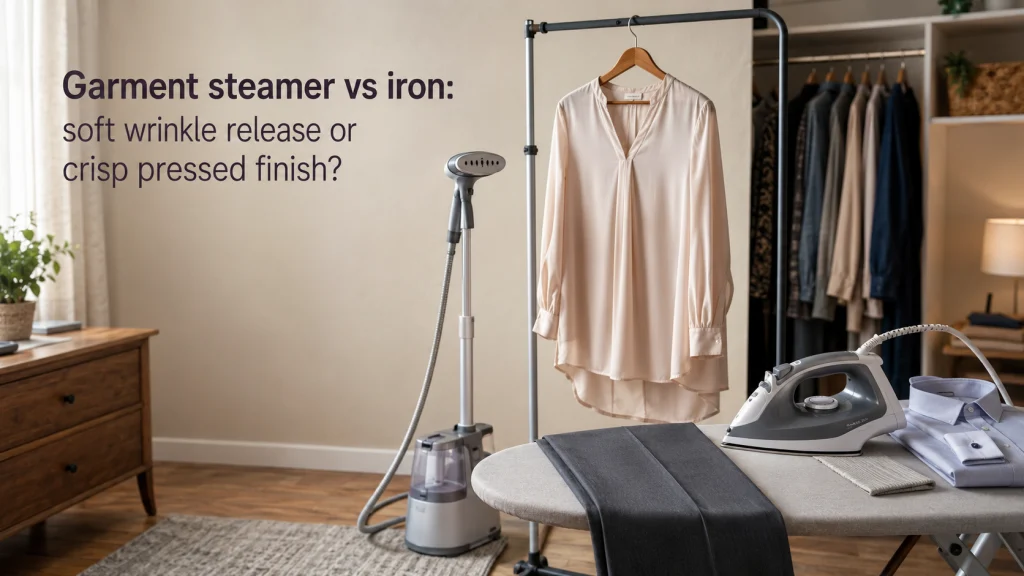
A garment steamer and a standard steam iron can both make wrinkled clothing look better, but they do not create the same finish. Steamers are strongest when the goal is relaxed wrinkle release on hanging, shaped, delicate, or awkward garments, while irons add direct pressure that matters for crisp collars, cuffs, flat panels, pleats, and trouser creases. The better choice depends on the finish you want, the geometry of the garment, how many pieces you handle at once, and how much setup and storage you will tolerate. Some households can comfortably choose one tool, while wardrobes that mix soft drape with deliberately pressed clothing may justify owning both.
Start with the finish you actually want
Put a flowing blouse beside a pair of trousers that needs a sharp center crease and the garment steamer vs iron decision becomes much easier to see. Both pieces can be wrinkled, but the desired result is not the same: the blouse may only need the wrinkles relaxed without flattening its shape, while the trousers may need a deliberate line pressed into the fabric. That is why choosing by claims such as faster, stronger steam, or more convenient can send you toward the wrong tool. The first fork is whether you want the fabric to hang smoother or to look intentionally pressed.
This distinction also keeps the comparison from turning into a contest over which appliance is universally better. A steamer can be the more practical choice for a dress pulled from a crowded closet just before wearing, yet an iron can be the more appropriate tool for a shirt collar that needs definition. If you are still deciding whether a steamer deserves space in the house at all, the broader question is covered in whether garment steamers are worth owning. Here, the assumption is that wrinkle care is already needed and the job is to decide whether a steamer, a standard steam iron, or both fit that job best. Both tools sit within garment care products, but the right choice depends on whether the garment needs relaxed wrinkles or deliberate pressing.

This 1875-watt handheld steamer heats in about 40 seconds and uses a 7.3-ounce tank for up to 20 minutes of continuous steam. Its quilted aluminum plate and built-in creaser add light contact finishing alongside vertical steaming. A silicone band, delicate-fabric spacer, and bristle brush provide options for different garment surfaces.
Check On AmazonIf you click this link and buy, we earn a commission at no additional cost to you.
Understand what steam alone changes and what pressure adds
A garment steamer directs hot steam into hanging fabric so wrinkles can relax while the material remains largely unsupported. A standard steam iron also uses heat and moisture, but its soleplate presses the fabric against a flat surface, adding controlled contact and pressure. That physical difference explains much of the gap in finish between the two tools without relying on vague ideas about one being more powerful. If the job requires flattening a seam, defining an edge, or setting a crease, pressure is part of the result rather than an optional extra.
The same mechanism explains why a steamer can feel more forgiving on shapes that are annoying to spread flat. A curved shoulder, gathered sleeve, soft knit, or embellished front can be approached while the garment hangs instead of repeatedly repositioning it on a board. An iron, however, gives the user a broad, stable contact surface that can work across large flat areas with much more deliberate control over the final shape. Independent comparative testing from Good Housekeeping reaches the same practical split: steaming is well suited to quick de-wrinkling and relaxed finishes, while ironing is better when crispness and pressed structure are the target.

This 1600-watt steam iron pairs a stainless-steel soleplate with adjustable temperature and steam controls for direct contact pressing. A steam-surge function adds extra moisture for tougher wrinkles and broad flat areas. Its auto-clean system helps flush mineral deposits, while three-way automatic shutoff stops heating after inactivity.
Check On AmazonIf you click this link and buy, we earn a commission at no additional cost to you.
Match soft wrinkle release and crisp pressing to the right tool
The most useful comparison is not simply steamer vs iron, but which tool owns each finishing job. A steamer is naturally suited to soft wrinkle release where preserving drape matters more than creating a hard edge. An iron is better equipped for jobs where the fabric should be flattened against a surface and held in a defined shape as it cools. This is especially important with collars, cuffs, plackets, pleats, hems, and trouser creases, because those details are partly about shaping the garment rather than merely removing random wrinkles.
That does not mean every dress shirt automatically requires an iron or every blouse automatically belongs to a steamer. A casual shirt may look perfectly acceptable after steaming if the wearer wants a relaxed finish, while a structured blouse with a crisp collar may still benefit from pressing. Conversely, an iron can smooth many soft garments, but using a board and direct contact may be more setup than a quick touchup deserves. The table below works best as a job-ownership guide, not a rule that overrides the garment label or the exact appliance instructions.
| Finishing job | Steamer fit | Iron fit | Why the difference matters |
|---|---|---|---|
| Soft wrinkle release on hanging clothing | Strong | Possible | Steam can relax wrinkles without requiring a flat pressing surface. |
| Crisp shirt collar or cuff | Limited | Strong | Direct contact and pressure help define the edge. |
| Trouser center crease | Limited | Strong | A deliberate crease is a pressing job, not just wrinkle removal. |
| Pleats that must stay sharply defined | Variable | Strong | Pressure gives more control over where the fold is set. |
| Flowing dress or blouse | Strong | Variable | Hanging treatment can preserve drape and reduce repositioning. |
| Large flat panel | Possible | Strong | A flat board and broad soleplate make systematic pressing easier. |
Use this table to identify the finish that appears most often in your wardrobe, then compare workflow and fabric limits before buying. A tool that wins one job can still be the wrong household choice if its setup, handling, or storage burden makes it unlikely to be used.
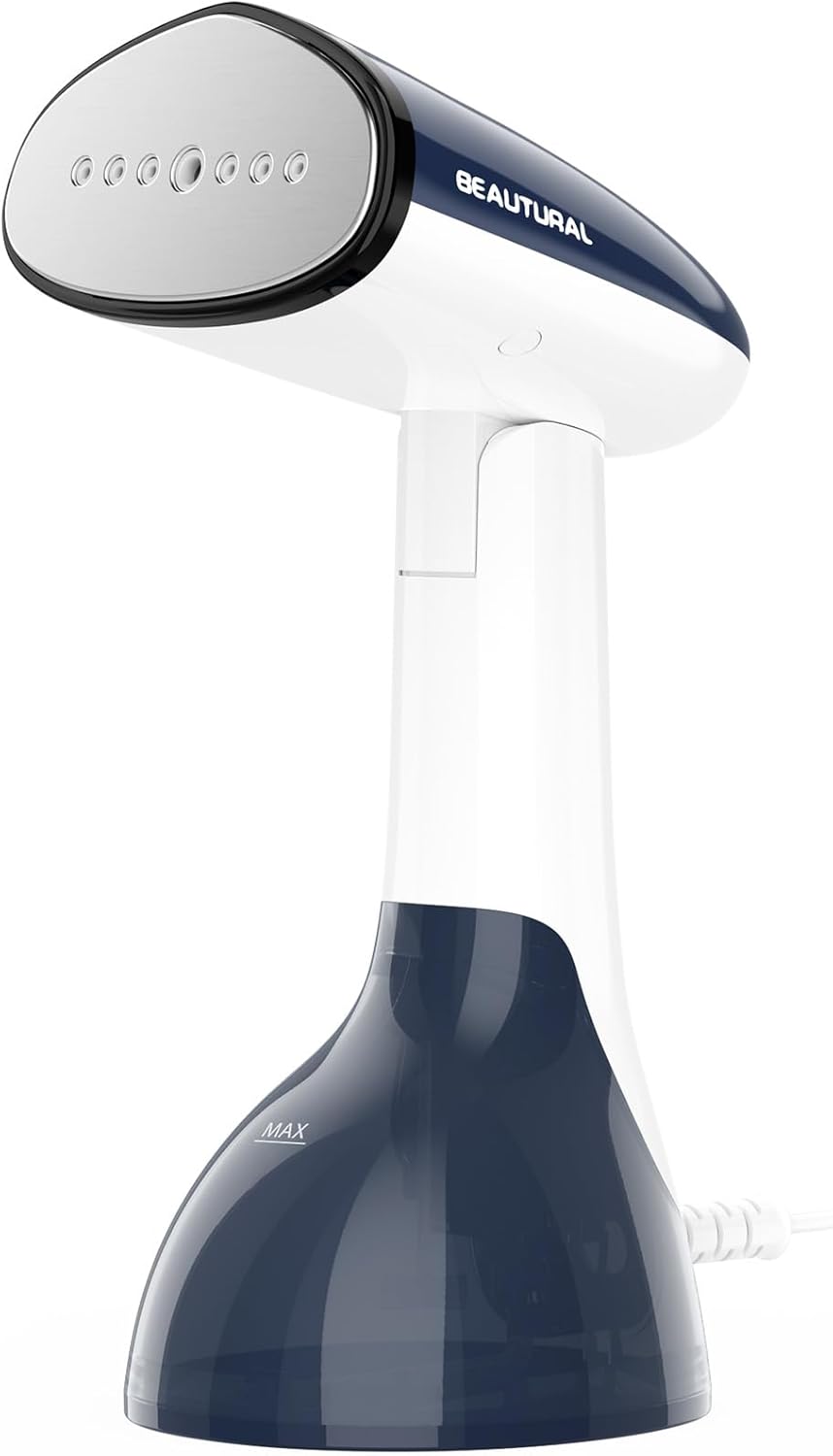
This 1200-watt handheld steamer heats in about 35 seconds and uses a thermostatic aluminum plate for steam or dry contact work. Its electronic pump supports steaming at different angles without relying on gravity. A removable 260-milliliter tank and eight-foot cord support repeated touchups while keeping the tool handheld.
Check On AmazonIf you click this link and buy, we earn a commission at no additional cost to you.
Treat delicate and awkward garments as a geometry problem first
Delicate, embellished, gathered, layered, or heavily shaped garments are where a clothes steamer vs iron comparison often becomes too simplistic. Steamers are commonly easier to maneuver around ruffles, shoulder shaping, beadwork, lace details, and areas that resist being laid flat, but that does not make every steamer safe for every fabric or decoration. Heat-sensitive trims, coatings, adhesives, plastics, and specialty finishes can react badly to heat or steam, and exact care labels still control the decision. The right question is whether the garment can be treated safely and whether its shape benefits from hanging rather than being pressed flat.
An iron can still be useful on delicate garments when the care instructions allow it and when the fabric needs controlled flattening, but contact heat raises the importance of temperature, pressure, and surface protection. Manufacturer guidance for irons commonly varies heat and steam by fabric type, which is why copying a setting from another garment is a poor shortcut. For a deeper fabric-by-fabric decision, use the separate article on which fabrics can be steamed instead of treating this comparison as a universal compatibility chart. The takeaway is simple: garment geometry may favor the steamer, but the care label and exact manual decide whether the method is acceptable.
| Garment geometry | Likely easier with a steamer | Likely easier with an iron | What to verify first |
|---|---|---|---|
| Curved shoulders and shaped jackets | Often | Sometimes | Care label, lining, trim, and whether direct contact is allowed. |
| Ruffles, gathers, and soft drape | Often | Sometimes | Whether the material and decoration tolerate steam. |
| Flat shirt fronts and broad panels | Sometimes | Often | Required finish and fabric temperature guidance. |
| Collars, cuffs, and plackets | For light touchups | Often | Whether a crisp edge is part of the desired result. |
| Decorated or coated areas | Depends | Depends | Exact garment instructions and appliance manual restrictions. |
The matrix is a starting point rather than a safety guarantee. When a care label conflicts with a general rule, follow the garment instructions and the exact appliance manual instead.

This 1200-watt handheld steamer heats in about 30 seconds and uses a detachable 8.79-ounce tank for up to 15 minutes of continuous steaming. Its leak-resistant design supports both vertical and horizontal use, which helps around shaped garments and awkward sections. A fabric brush and soft cushion brush are included for different garment surfaces.
Check On AmazonIf you click this link and buy, we earn a commission at no additional cost to you.
Expect stubborn flat wrinkles to favor controlled pressing
Cotton, linen, and other fabrics that hold deep flat wrinkles expose another weakness in blanket claims that a steamer can replace an iron. Independent testing cited in this article evaluates both appliances across multiple fabric types and finds that irons remain especially useful when the goal is a crisp, flat finish. Heat and steam matter, but the added pressure of the soleplate and support of the board give the user another way to work on a stubborn crease. A steamer may still improve the garment substantially, especially when perfect flatness is not required, but the finish can remain softer.
This is also where individual appliance capability matters more than the product label. Steam output, temperature control, heated plates, steam bursts, soleplate design, and how consistently the appliance maintains its operating state can vary widely. That variation is why it is risky to say that every iron beats every steamer on every cotton shirt, or that a premium steamer makes pressing obsolete. If your wardrobe is dominated by thick woven shirts, linen pieces, uniforms, or trousers where a deliberate pressed look matters, the mechanism of an iron is usually the safer starting point for the decision.
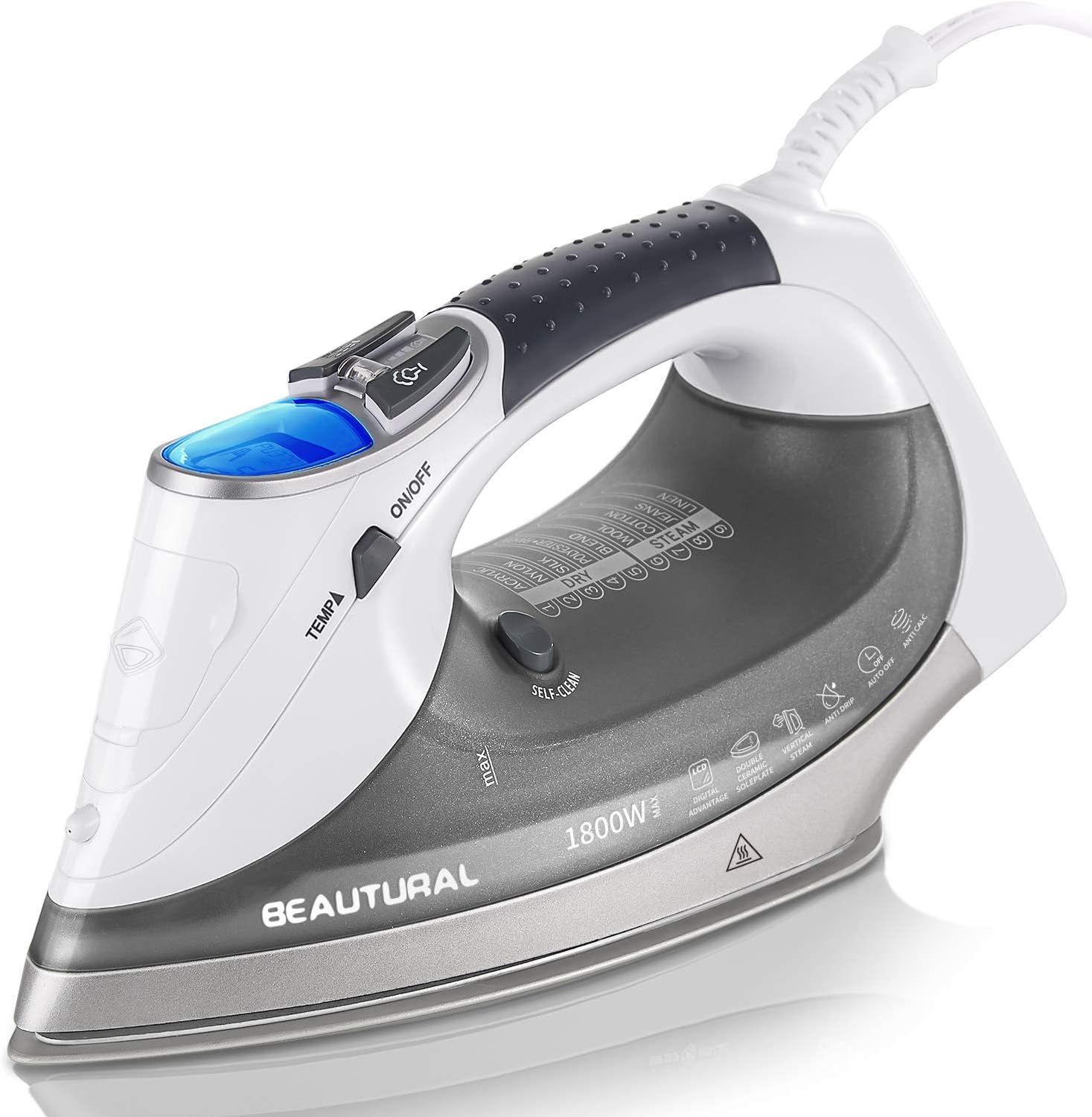
This 1800-watt steam iron uses a double-layer ceramic-coated soleplate and nine preset temperature-and-steam settings for different fabrics. Its LCD controls make the selected fabric mode visible while burst steam helps on deep flat wrinkles. Three-way auto shutoff, anti-drip, and anti-calc features add safety and water-management support.
Check On AmazonIf you click this link and buy, we earn a commission at no additional cost to you.
Compare a one-item touchup with a full batch session
A single wrinkled garment and a basket of clothes create very different workflow costs. For one blouse or dress pulled out just before wearing, a steamer can remove the need to open a board and carefully position several panels, which is one reason owners often associate steamers with convenience. For a larger session, however, the advantage can shrink if a handheld tank needs frequent refilling or if each garment must be steamed slowly while hanging. An iron takes more setup, but once the board is ready it provides a stable work surface for moving through multiple flat garments in sequence.
The same logic applies in reverse when the batch is full of awkward shapes rather than flat shirts and trousers. Repeatedly turning sleeves, shoulders, gathers, and decorative sections on a board can make ironing feel slower even if the appliance itself has strong wrinkle-removal performance. This is why “which is faster” has no useful universal answer without naming the garments and the number of pieces. Count the whole session from setup through refill, repositioning, cooldown, emptying, and storage, then decide which workflow removes more work from the routine you actually have.

This 1100-watt handheld steamer uses a 300-milliliter tank rated for up to 20 minutes of continuous steam. The listing specifies a 1.74-pound body and 360-degree leak-resistant operation for horizontal or vertical garment work. Its compact dimensions and single-button control suit batch touchups without moving to a full ironing board.
Check On AmazonIf you click this link and buy, we earn a commission at no additional cost to you.
Compare board space with safe hanging and steaming space
An iron does not only occupy the space of the iron itself. It also needs a stable pressing surface with enough room to move the garment, manage the cord, reposition fabric, and keep the hot appliance secure between passes. A folding board can be stored compactly, but the household still has to open it somewhere each time pressing is needed. If that setup blocks a hallway, crowds a bedroom, or turns a quick shirt touchup into a furniture shuffle, the friction is real even though the iron is small.
A steamer removes the board from the basic workflow, but it does not eliminate space requirements. The garment needs a safe place to hang where steam, heat, moisture, and the appliance cord will not create a problem for walls, doors, furniture finishes, children, pets, or walkways. Upright steamers also need floor and storage space, while handheld units move more of the burden into hand weight and refill frequency. The useful comparison is therefore not board versus no board, but which complete setup can be used safely and repeatedly in the room where garment care actually happens.
Neither setup is automatically smaller in practical use. Measure the usable path and storage routine, not just the appliance footprint shown on a product page.

This tabletop ironing board measures 23.6 by 14.3 inches and uses folding legs with non-slip feet for a stable compact pressing surface. Its padded heat-resistant surface is designed to dissipate heat and vapor during ironing. The board folds flat for storage, reducing the space required compared with a full-size floor board.
Check On AmazonIf you click this link and buy, we earn a commission at no additional cost to you.
Count hand weight, refills, cord handling, and water care
Convenience claims often ignore what the appliance feels like after several minutes of use. With a handheld steamer, the water tank is part of the weight you hold while working up and down a hanging garment, so a larger tank can reduce refill interruptions while increasing the mass in your hand. Smaller tanks reverse that trade-off: they are easier to hold but may interrupt a longer session more often. Upright units move much of the water weight off the hand, but they add a base, hose, and larger storage footprint that must fit the household.
A steam iron concentrates weight at the pressing surface rather than asking you to hold it vertically for the entire task, but it still creates its own cord, filling, soleplate, and water-maintenance routine. The exact manual matters because acceptable water type, emptying instructions, anti-scale procedures, self-cleaning steps, and storage directions differ among models. Neither category is maintenance-free, and mineral buildup can turn a small convenience appliance into an annoying one if its care routine is ignored. Compare the work you will repeat every week or month, not only the first-use impression in a store or product listing.

This 1500-watt iron uses a ceramic-coated soleplate and precision thermostat dial for fabric-specific heat control. Its steam system includes anti-drip and anti-calcium features, while a self-cleaning function addresses mineral buildup inside the iron. Three-way automatic shutoff adds a safety layer when the appliance is left inactive.
Check On AmazonIf you click this link and buy, we earn a commission at no additional cost to you.
Treat hybrid heated plates as compromises, not category mergers
Some garment steamers add heated plates or surfaces that can touch fabric, and that can make the iron vs steamer boundary look less clear. These designs may improve performance on certain flat areas or allow light pressing while steaming, but the presence of a hot plate does not automatically give a handheld steamer the same pressure, soleplate area, temperature range, or board-supported control as a standard iron. The exact design determines what changes in use. A hybrid feature should therefore be evaluated as a model-specific capability rather than proof that the two appliance categories have become interchangeable.
The same caution applies to irons that advertise vertical steam. An iron may be able to send steam toward hanging fabric, but that does not mean its shape, weight distribution, tank design, or vertical steam behavior will feel like a dedicated garment steamer. Independent testing has also found meaningful differences between appliances used vertically, which reinforces the need to compare the exact operating mode instead of assuming feature labels are equivalent. If a hybrid appeals to you, ask which job it genuinely improves and which compromise remains, especially for hand weight, refill burden, crisp pressing, and storage.

This 1200-watt hybrid combines continuous steam with a thermostatic ceramic plate rated to 310°F for steam or dry contact use. It heats in about 30 seconds, adds a burst-steam control, and supports vertical or horizontal operation with anti-drip protection. The removable 200-milliliter tank, eight-foot cord, and automatic shutoff support short hybrid sessions.
Check On AmazonIf you click this link and buy, we earn a commission at no additional cost to you.
Choose a steamer, choose an iron, or keep separate jobs for both
By this point, the decision should follow the dominant work in your wardrobe rather than a feature-count comparison. Choose a steamer when most of your needs are quick wrinkle release, soft drape, hanging garments, awkward shapes, or one-item touchups and you rarely care about sharp pressed details. Choose an iron when crisp collars, cuffs, pleats, trouser creases, broad flat panels, or stubborn woven wrinkles are regular parts of the routine. Owning both makes sense only when those two finish types appear often enough that switching tools genuinely removes work rather than adding storage clutter.
A household with mostly casual knits, dresses, and soft blouses may have little reason to keep a board available for occasional crisp pressing. A household with office shirts, uniforms, linen, and tailored trousers may find that a steamer saves too little work to replace the iron. A mixed wardrobe can justify both when the steamer handles touchups and awkward pieces while the iron remains responsible for precise pressing. The goal is not to own every possible tool, but to give each recurring job the simplest method that produces the finish you actually care about.
- Fork 1, start with finish: Do you regularly need crisp collars, cuffs, pleats, trouser creases, or deliberately flat woven panels? If yes, continue to Fork 2. If no, continue to Fork 3.
- Fork 2, test whether pressing is enough: Do soft, hanging, embellished, gathered, or awkward garments also create a recurring wrinkle-care job? If no, choose an iron. If yes, continue to Fork 4.
- Fork 3, test whether steaming is enough: Are most of your jobs soft wrinkle release, hanging touchups, and garments that are inconvenient to lay flat? If yes, choose a steamer. If no because crisp pressing still appears regularly, continue to Fork 4.
- Fork 4, justify owning both: Would each tool have a separate recurring job often enough to save real setup or handling work? If yes, owning both can make sense. If no, keep the tool that handles the dominant job and skip the second appliance.
Use those outcomes as a filter, then verify fabric compatibility and the exact model requirements before purchase. A good decision should make the routine simpler after the novelty of the new appliance wears off.

This compact BLACK+DECKER iron uses a stainless-steel soleplate for direct contact pressing and fabric-linked steam control for routine household work. Anti-drip protection and spray mist support wrinkle removal on flat garments. A three-way automatic shutoff adds a safety feature when the iron is left inactive.
Check On AmazonIf you click this link and buy, we earn a commission at no additional cost to you.
After choosing the mechanism, narrow the appliance type separately
Once the mechanism is clear, stop comparing categories and move into the right buying decision. If steaming fits your wardrobe, the next questions are whether you need handheld or upright architecture, how much water capacity makes sense, what the unit weighs in actual use, where it will be stored, and which controls matter for your fabrics. Those trade-offs are handled in the garment steamer buying guide, where steamer selection can be considered without dragging iron-specific criteria back into the decision. If you are ready to compare current options after defining those requirements, use the separate page on current garment steamer choices.
If pressing is the better fit, the next decision belongs to standard steam irons rather than steam-generator stations or other larger systems. Weight, soleplate behavior, temperature control, steam delivery, cord handling, tank design, and maintenance all matter after you have already decided that pressure and a flat surface are useful. The separate article on how to choose a steam iron keeps that selection focused on self-contained household irons. Keeping the steps separate prevents a category comparison from becoming an oversized shopping page that tries to solve every garment-care decision at once.

This 1000-watt handheld steamer heats in about 30 seconds and folds down for compact storage. Its electronic pump supports multi-angle steaming without relying on gravity, while the included storage bag simplifies packing between uses. The 1.43-pound body is intended for 120-volt outlets, making it a clearly handheld architecture rather than an upright steamer.
Check On AmazonIf you click this link and buy, we earn a commission at no additional cost to you.
Final Thoughts: choose finish and garment geometry before convenience claims
The comparison is settled once each recurring garment-care job has a clear owner. If one appliance handles nearly everything you actually wear, there is little value in buying a second tool just to cover an occasional edge case. If two different jobs keep returning and one tool handles each of them more directly, separate roles can be reasonable. That keeps the purchase tied to a real routine instead of a feature list.
Before buying, verify the storage space, setup you will tolerate, fabric care labels, and the exact appliance instructions for contact, steam, water, and maintenance. Those checks matter more than a broad claim that one category is more convenient. The better household choice is the smallest tool set that reliably handles the clothes and finishes you care about. Anything beyond that should earn its space by solving a recurring job.

This 1200-watt compact steam iron uses a nonstick soleplate and a fabric setting control for routine household pressing. Anti-drip protection and a push-button spray mist help manage wrinkles without adding a larger ironing system. Three-way automatic shutoff, a translucent easy-fill tank, and a pivoting cord keep the setup straightforward.
Check On AmazonIf you click this link and buy, we earn a commission at no additional cost to you.
FAQs
👔 Can a garment steamer replace an iron for dress shirts?
It can handle many wrinkles, especially if you prefer a softer finish. If crisp collars, cuffs, plackets, or sharply pressed panels matter, a standard iron usually remains the better fit.
👖 Which is better for trouser creases, a steamer or an iron?
An iron is generally better for a deliberate trouser crease because pressure against a flat surface helps define the line. A steamer is more naturally suited to relaxing unwanted wrinkles than setting a sharp crease.
🧵 Is a steamer safer for delicate fabrics than an iron?
Do not treat that as a universal rule. Delicate materials, trims, coatings, and embellishments vary, so check the garment care label and the exact appliance manual before using either direct heat or steam.
🪄 Is a clothes steamer faster than an iron?
It can be faster for one-item touchups because there is no board to open and less fabric positioning. For larger batches or garments that need crisp pressing, the total workflow may favor an iron instead.
📦 Which tool is easier to store?
A handheld steamer can require less storage than an iron plus a full-size board, but upright steamers can take substantial floor space. Compare the complete setup you would actually own, not just the appliance body.
💧 Do steamers and irons need the same type of water?
Not necessarily. Water recommendations and scale-control instructions vary by model, so follow the exact manual rather than using one water rule for every steamer or iron.
References and Sources
- Good Housekeeping iron vs steamer testing: Supports the comparison between relaxed steaming, crisp pressing, batch use, difficult garment shapes, and the role of heat plus pressure.
- Rowenta fabric temperature guidance: Supports the need to match iron heat and steam settings to fabric type and to check garment care instructions.
- Philips garment care guidance: Supports the distinction between steaming for thin, delicate, or difficult shapes and ironing for results that require conventional pressing.