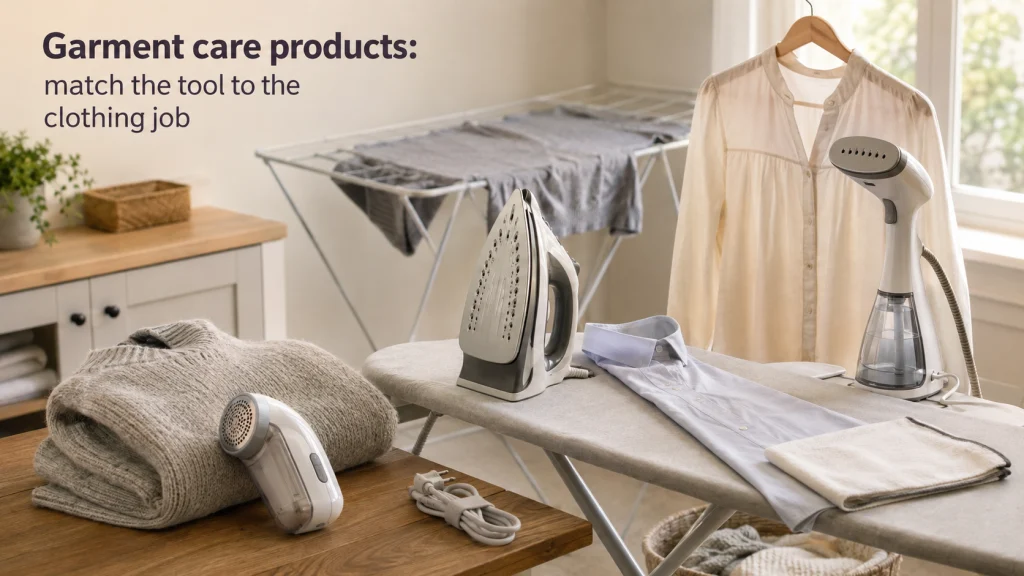
Garment care works better when the tool is matched to the clothing job instead of treated as one broad shopping category. Steamers, irons, steam stations, presses, fabric shavers, pressing surfaces, steam closets, and drying racks solve different physical problems. The useful comparison is not which device has the longest feature list, but which mechanism produces the finish you want on the fabrics you own. By the end, you should be able to narrow the field before comparing individual models.
Start with the clothing job, not the product label
A wrinkled shirt, a pilled sweater, a structured jacket, and a damp hand-washed garment can all send you shopping for garment care products, but they do not need the same equipment. A steamer relaxes wrinkles, an iron adds heat and pressure, a fabric shaver removes pills, and a drying rack supports clothing while moisture leaves it. Retail pages can place these tools side by side, which makes them look more interchangeable than they are. Choosing by product label alone is an easy way to buy equipment that solves the wrong problem.
Start with the physical result the garment needs. Crisp collars require pressure, attached pills require removal, and damp knits need supported drying rather than more heat. Once the job is clear, fabric compatibility, batch size, setup, storage, water handling, cords or batteries, and cleanup become the useful filters. That order keeps feature count from taking over a decision that should begin with household use.

This 2-in-1 travel unit combines garment steaming and ironing in one handheld tool. It supports 100 to 220 volts, heats in 15 seconds, and uses a large ceramic heat panel. The dual-function format covers both relaxed wrinkle removal and direct pressing.
Check On AmazonIf you click this link and buy, we earn a commission at no additional cost to you.
Keep garment-care equipment separate from consumables and washing chemistry
The phrase clothing care products can include appliances, pressing surfaces, lint tools, detergents, stain treatments, fragrance products, hangers, and storage accessories. That may be convenient for shopping, but it mixes powered equipment with consumables that solve different problems. This article stays with household equipment and closely related support systems used to steam, press, depill, refresh, or air-dry clothing. Washing chemistry, stain chemistry, sewing, alteration, professional dry-cleaning machinery, and full-size washers and dryers remain outside that boundary.
Equipment: steamers, irons, steam stations, household presses, fabric shavers, steam closets, pressing surfaces, and unheated drying racks. Consumables: detergent, stain treatments, fragrance products, and other washing chemistry are separate purchase decisions. Outside scope: sewing and alteration, professional dry-cleaning machinery, and full-size washers and tumble dryers belong to different workflows.
The boundary prevents one purchase from being judged against the wrong alternative. A steamer does not replace detergent, a fabric shaver does not remove wrinkles, and a drying rack does not create a pressed finish. Hot steam, heated plates, moving blades, and wet garments also create different handling requirements. When material or operating instructions vary, the exact appliance manual and garment care label take priority.

This rolling garment rack uses two hanging rods and a metal frame for clothing storage and staging. Its portable wardrobe format gives garments a dedicated place to hang before or after care. The black rack is designed for bedroom, laundry-room, and other household clothing-storage setups.
Check On AmazonIf you click this link and buy, we earn a commission at no additional cost to you.
Use the garment job to narrow the equipment before comparing features
Describe the result in plain language before comparing capacity, wattage, presets, or accessories. A hanging blouse that needs a quick touchup is a different job from a stack of dress shirts that needs crisp pressing. The same applies to a pilled sweater or a damp knit that should dry flat. Each result points toward a mechanism, and only then should feature differences inside that equipment type matter.
- For quick wrinkle relaxation on hanging garments, start with a garment steamer.
- For crisp seams, collars, cuffs, and deliberate creases, start with a steam iron or another heat-and-pressure system.
- For larger pressing sessions where refill frequency and sustained steam matter, compare steam generator irons separately from self-contained irons.
- For broad, repeated pressing across larger flat areas, consider whether a household steam press matches the garment shapes you handle.
- For attached pills and surface fuzz, use a fabric shaver or another depilling tool instead of a wrinkle-removal appliance.
- For damp garments that should air-dry, choose a rack or support surface based on wet-load capacity, shape support, airflow, and storage.
This sequence also shows when buying nothing new is reasonable. A household with a working iron and board may gain little from a steamer if nearly every garment still needs crisp pressure. Someone who touches up one shirt at a time may not benefit from a large steam station. The right equipment removes repeated friction without replacing it with a larger setup, storage, or maintenance problem.
| Mechanism | What it is good at | What it does not replace | Main ownership check |
|---|---|---|---|
| Steam-only wrinkle release | Fast touchups on hanging garments and softer wrinkle relaxation | Crisp heat-and-pressure pressing | Tank handling, hanging space, storage, and fabric permission |
| Heat plus pressure | Flat pressing, sharp seams, collars, cuffs, and creases | Surface depilling or air-drying | Pressing surface, temperature control, cord management, and storage |
| Powered shaving | Removing attached pills and surface fuzz | Wrinkle removal or fabric repair | Fabric suitability, blade guard, pressure, battery or cord, and lint cleanup |
| Pressing surface support | Giving an iron or press the stable area needed to work | Heat or steam generation | Usable area, stability, height, heat resistance, and storage footprint |
| Air-drying support | Holding damp garments while moisture leaves naturally | Pressing, wrinkle release, or powered drying | Wet-load stability, airflow, garment shape support, and folded storage size |
The table is a sorting tool, not proof that one device is suitable for every fabric in its row. Garment construction, trim, coatings, care labels, and manufacturer instructions can change what is safe or sensible. When two options solve the same broad job, compare the finish first and the ownership work second. That usually reveals the better household fit faster than feature counts do.

This foldable metal rack provides an unheated surface for indoor air-drying. The chrome-silver model is listed at 14.5 by 29.5 by 41.8 inches. Its folding design fits the article route for damp garments that need airflow rather than pressing.
Check On AmazonIf you click this link and buy, we earn a commission at no additional cost to you.
Garment steamers make the most sense for quick wrinkle release on hanging clothes
A garment steamer makes sense when the recurring job is to relax wrinkles without setting up a full pressing station. It suits one-item touchups, awkward garment shapes, and a smooth but not sharply pressed finish. Its household advantage is often reduced setup rather than a universally better result. That matters because collars, pleats, hems, and deliberate creases can still call for controlled pressure.
Before buying, look past tank size and steam claims to the routine around the device. Check where the garment will hang, how the cord or hose stores, how the tank is filled and emptied, and whether the fabrics permit steaming. Handheld and upright formats also differ in carrying and storage burden. The useful format is the one you can retrieve and put away as easily as the touchup job itself.

This handheld Conair steamer uses 1875 watts and a 7.3-ounce water tank. It offers five steam settings, heats in about 40 seconds, and is listed for up to 20 minutes of runtime. Three included attachments extend the setup for clothing and upholstery.
Check On AmazonIf you click this link and buy, we earn a commission at no additional cost to you.
Steam closets trade manual handling for floor space, cycle time, and a larger ownership system
Cabinet-style garment-care systems put clothing inside an enclosed appliance for a programmed cycle instead of asking the user to move a wand over each area. That can reduce active handling, but it also creates a permanent floor-space commitment. Exact systems may combine steam, movement, drying, or garment-specific functions. They should be evaluated as a garment-care station rather than as an oversized handheld steamer.
Start the fit check with location, clearances, door swing, electrical needs, tank routines where applicable, and usable garment capacity. A household with frequent structured clothing may value the automated workflow more than someone who smooths one occasional shirt. A large cabinet can become expensive storage when the routine rarely uses its full cycle-based approach. Refresh functions should not be treated as a universal replacement for washing, professional dry cleaning, or garment-specific care.
Steam irons remain the straightforward choice when crisp pressing matters
A self-contained steam iron combines a heated soleplate, water reservoir, steam generation, and hand pressure in one tool. It suits households that need to flatten fabric deliberately, sharpen collars and cuffs, or establish creases rather than simply relax wrinkles. That is why an iron and a steamer can coexist without being duplicates. The finish target is different, and heat plus pressure gives more control over where the finish is created.
The buying decision includes the support surface and storage routine, not just the iron. A compact iron is not a compact system if it still requires a full-size board with nowhere convenient to go. A larger reservoir may reduce refills while adding weight to the handheld unit. For occasional pressing, an iron that is easy to retrieve, refill, cool, and store can be more useful than one with rarely used extras.

This BLACK+DECKER steam iron is the Standard Compact Iron variant on the listing. It combines steam with a TrueGlide soleplate for direct heat-and-pressure pressing. Automatic shutoff adds a built-in safety feature for interrupted ironing sessions.
Check On AmazonIf you click this link and buy, we earn a commission at no additional cost to you.
Steam generator irons are a separate system because the base changes the workflow
A steam generator iron, often called a steam station, places the larger water reservoir and steam hardware in a separate base. That design can support longer sessions and sustained steam on models built for it. The advantage matters most when the household regularly handles larger batches, heavier fabrics, or bedding. For a few shirts, the same architecture can mean more equipment to store, carry, maintain, and set up.
The base also changes what you need from the ironing surface. A narrow or lightly built board may not offer stable space for both the garment and a separate station, so board size and support matter. Water requirements and scale-care routines vary by manufacturer and should be checked on the exact model. For households that do not press in sustained batches, the separate base can become more infrastructure than benefit.

This Martisan steam station pairs an 1800-watt iron with a separate 1.9-liter water tank. The listing specifies up to 8 bar pressure, a 550 g/min steam burst, auto shutoff, and a ceramic soleplate. Its separate base is built around longer steam sessions rather than a self-contained handheld reservoir.
Check On AmazonIf you click this link and buy, we earn a commission at no additional cost to you.
Household steam presses change the job by changing how fabric is positioned
A household steam press uses a larger surface that closes over fabric, so the work becomes more about positioning sections than moving a small soleplate. That can help with broad flat areas and repeated pressing when garment shapes suit the platen. The same geometry can be awkward around curves, gathers, small details, or areas that need precise tip control. A press should be chosen for the work it handles well, not treated as an automatic upgrade from an iron.
Space and handling are the quiet costs. A press needs a stable place to open, load, close, unload, cool, and store. Its broader heated surface also makes exact fabric and temperature guidance important. If most pressing is detail work on a few garments, an iron may remain easier; if broad repeated sections dominate, the press architecture may justify its footprint.

This 26-inch digital steam press uses a broad heated pressing surface for garments, linens, and other flat fabric work. It is listed with 1600 watts of power, five fabric settings, touchscreen controls, and automatic shutoff. The large clamshell-style pressing area makes it a direct replacement for the steam-press product in this section rather than a handheld iron or garment steamer.
Check On AmazonIf you click this link and buy, we earn a commission at no additional cost to you.
Fabric shavers solve pilling and surface fuzz, not wrinkles
Fabric shavers remove pills and loose surface fuzz that remain attached to a textile. They use a guarded cutting mechanism rather than heat or steam, so they should not be compared with wrinkle-removal tools as if they did the same job. First decide whether the problem is true pilling rather than loose lint that could be removed another way. A sweater can look smoother after depilling without becoming less wrinkled.
Because the mechanism cuts protruding fibers, fabric condition and technique matter. Guards, depth controls, light pressure, a flat surface, and care around seams, buttons, embroidery, thin knits, and loose threads can reduce snagging risk. The device also creates lint that must be emptied or cleaned from the head. For delicate, damaged, loosely knitted, or hard-to-replace garments, follow the care label and tool instructions instead of assuming every fabric is suitable.

This battery-operated BEAUTURAL fabric shaver is designed to remove fuzz, lint balls, pills, and bobbles. It provides two speeds and includes two replaceable stainless steel blades. The portable format performs surface depilling without adding heat or steam.
Check On AmazonIf you click this link and buy, we earn a commission at no additional cost to you.
Ironing boards and pressing surfaces are part of the system, not an afterthought
An iron can have excellent controls and still be frustrating on a board that wobbles, flexes, sits at the wrong height, or lacks enough usable area. The board affects how much fabric lies flat, how often it must be repositioned, and whether there is stable space for the iron or a steam base. Support geometry is therefore part of normal pressing performance. A larger board can reduce repositioning, but only when the household can open and store it conveniently.
Check folded size as carefully as open size. Height adjustment, leg stability, cover condition, heat resistance, and the size of any iron rest or station platform also matter. Occasional small-item pressing may need only a compact surface. Regular shirts, trousers, linens, or a separate-base steam system can justify more working area and a larger storage footprint.

This full-size Jakeefud ironing board pairs a heat-resistant cover with a thick felt pad. The listing describes heavy sturdy legs and a foldable design in the L-Grey variant. It provides a dedicated pressing surface for garments that need stable support under an iron.
Check On AmazonIf you click this link and buy, we earn a commission at no additional cost to you.
Drying racks solve air-drying, not pressing, and their capacity is physical
An unheated clothes drying rack does not create a pressed finish. Its job is to support damp garments while air moves around them, making shape, spacing, and stability more important than a long feature list. Flat mesh surfaces suit items that should dry with full support, while bars and hanger rails suit garments that can hang. The right format depends on what you air-dry, how heavy it is when wet, and where the rack can stand without blocking the home.
Treat capacity as usable drying area rather than an optimistic item count. Crowding reduces airflow and can create overlap, while a large rack can become a storage problem between loads. Folding size, setup effort, wet-load stability, floor protection, and access to doors or walkways are practical ownership checks. The better rack is the one that can hold the normal wet load without becoming a permanent obstacle once the clothing is dry.

This Amazon Basics rack provides a foldable metal frame for indoor air-drying. The white model supports clothing without using powered heat or tumbling. Its collapsible format lets the drying surface be stored between loads instead of remaining a permanent floor fixture.
Check On AmazonIf you click this link and buy, we earn a commission at no additional cost to you.
Compare the same ownership fields across every garment-care option
Once the mechanism is right, compare equipment through the same recurring household fields. Fabric compatibility comes first because a powerful tool that cannot be used on your garments is not a useful upgrade. Desired finish comes next: relaxed, crisp, depilled, refreshed, or simply dry. Then batch size, setup, storage, water or consumables, power handling, cleaning, and maintenance show whether the device fits the routine.
| Ownership field | What to verify | Common buying mistake |
|---|---|---|
| Fabric compatibility | Garment care label plus exact appliance instructions | Assuming steam, heat, or shaving is safe on every textile |
| Desired finish | Relaxed wrinkles, crisp pressing, surface renewal, or drying | Comparing tools that produce different physical results |
| Batch size | How many garments are normally handled in one session | Buying for the largest imaginable load instead of the repeated load |
| Setup and storage | Open footprint, folded dimensions, clearances, board or hanging needs | Measuring the appliance but not the system around it |
| Water, power, or consumables | Refill, emptying, descaling, battery, cord, filter, or collector routine | Counting purchase price while ignoring recurring handling |
| Maintenance | Cleaning, scale control, lint removal, cooling, and storage after use | Treating maintenance as separate from the chore itself |
This comparison is especially useful when one option looks more capable on paper. A larger tank can reduce refills but add bulk, a wider pressing surface can cover fabric faster but need more space, and automated functions can remove manual steps while adding tanks or cycle management. None of those trade-offs is automatically bad. The question is whether the added capability serves the repeated garment-care load rather than an occasional edge case.

This portable magnetic ironing mat is listed as an ironing-board replacement and alternative cover. Its mat format creates a compact pressing surface without the storage footprint of a freestanding board. That makes setup and put-away requirements easy to compare against larger pressing systems.
Check On AmazonIf you click this link and buy, we earn a commission at no additional cost to you.
Know what stays outside this garment-care equipment decision
Some clothing problems should not be pushed into an equipment purchase simply because the garment looks worse than you want. Stains, soil, and routine washing needs belong to the cleaning process and garment care instructions, not to a promise that steaming or pressing replaces laundering. Alterations, seam repairs, fit changes, and structural repairs belong to sewing or professional clothing service. Professional dry-cleaning machinery also sits outside normal owner-level household equipment decisions.
Full-size washers and tumble dryers are excluded because they own a broader cleaning and drying workflow than the focused tools here. Heated drying appliances should also be evaluated on their own electrical and thermal requirements rather than folded into a general rack discussion. This boundary keeps the decision practical and safer. When a garment label requires professional care or an appliance manual limits a material, stop at that boundary instead of improvising a substitute process.

This pack contains three medium honeycomb mesh laundry bags sized 12 by 16 inches. The bags are intended for delicates during the washing workflow rather than for pressing or steaming. They provide a concrete companion to the section's distinction between garment-care equipment and laundering.
Check On AmazonIf you click this link and buy, we earn a commission at no additional cost to you.
Check compatibility, usable capacity, ownership burden, and stop conditions before buying
Treat this as a final veto check rather than another feature comparison. Stop the purchase if the intended method conflicts with a garment care label, if an exact model or accessory interface cannot be verified, or if the usable capacity does not cover the recurring load you actually handle. Nominal capacity, exterior dimensions, and a familiar-looking connector are not proof of fit by themselves. If the controlling dimension, interface, or operating requirement remains unknown, narrow the choice instead of assuming compatibility.
Ownership burden also becomes a stop condition when the routine cannot support the required water handling, cleaning, scale control, battery care, cooling space, or storage. A premium feature does not rescue equipment that is inconvenient enough to remain unused. Stop using the appliance and turn to qualified service for damaged cords, sparks, smoke, burning odors, overheating, exposed wiring, leaks into electrical areas, uncontrolled operation, or a hard mechanical lock. Those are service boundaries, not reasons to keep troubleshooting at owner level.
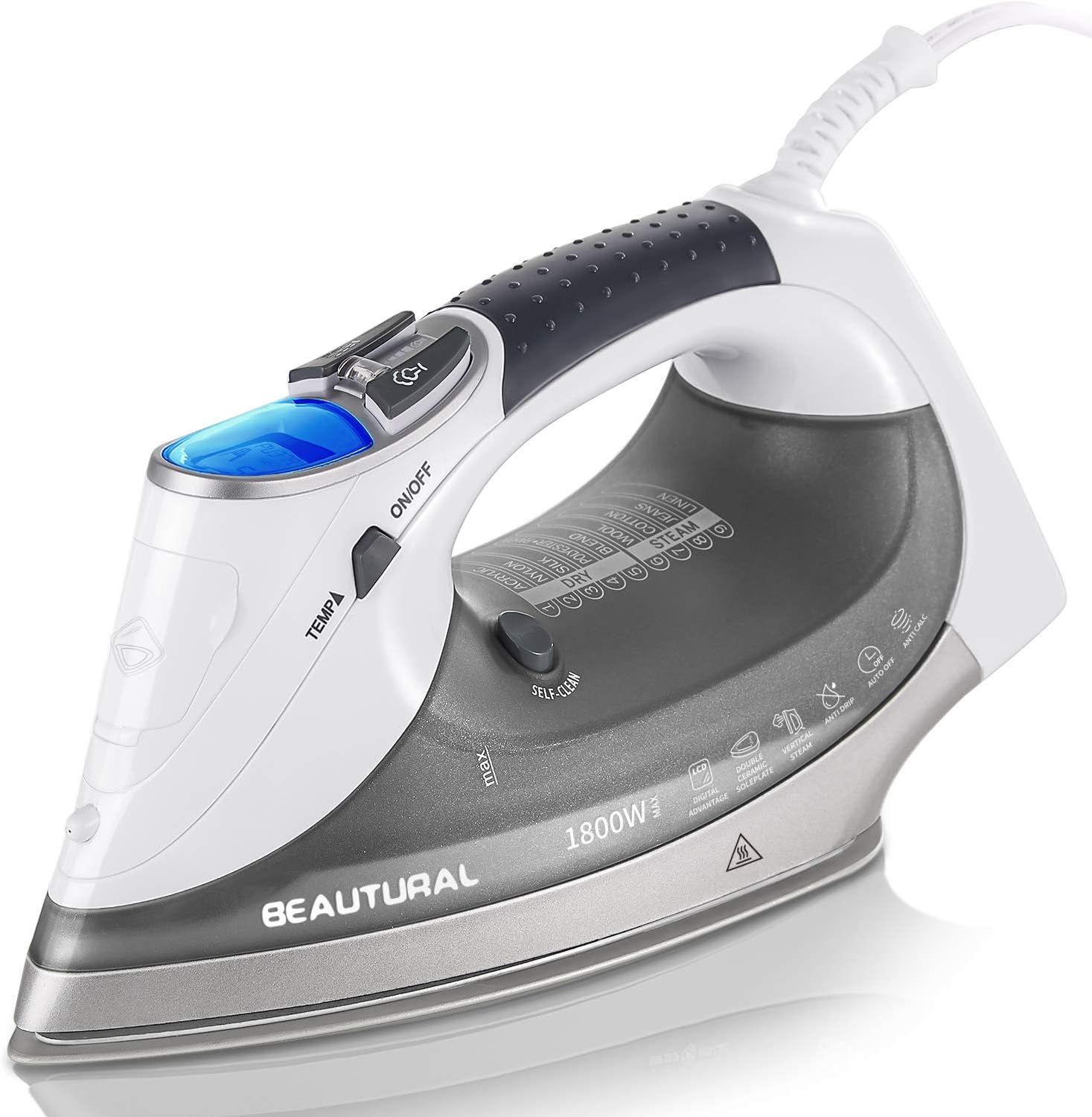
This 1800-watt BEAUTURAL steam iron uses a digital LCD with nine preset temperature modes. Its double-layer ceramic-coated soleplate is paired with anti-drip and anti-calc functions. A 3-way automatic shutoff provides an additional safety control when the iron is left motionless.
Check On AmazonIf you click this link and buy, we earn a commission at no additional cost to you.
Choose the next garment-care topic by the mechanism you actually need
Once you have identified the clothing job, the deeper comparison becomes smaller and more useful. Stay inside that mechanism and compare the fit, capacity, features, storage, maintenance, and stop conditions that matter to it. This prevents a handheld steamer from being judged by steam-station priorities or a drying rack from being treated like a powered appliance. Use the table below to continue from the job you have already defined.
| Topic | What you will find |
|---|---|
| Garment steamer buying guide | How to choose between steamer formats by garment type, batch size, tank handling, storage, and touchup routine. |
| Steam closet | How cabinet-style garment-care systems change floor-space, cycle, water, garment-loading, and maintenance decisions. |
| How to choose a steam iron | How to match a self-contained iron to fabric range, pressing finish, water handling, weight, and board setup. |
| Steam generator iron | How separate-base steam systems change refill frequency, storage, board support, scale care, and large-batch pressing. |
| Steam press for clothes | How a clamshell pressing surface affects garment placement, precision work, batch handling, footprint, and storage. |
| Fabric shaver | How to judge depilling tools by fabric suitability, guard design, handling, power source, and cleanup. |
| Ironing board buying guide | How usable board area, stability, height, heat resistance, support features, and folded size affect pressing. |
| Clothes drying rack | How to choose air-drying support by wet-load capacity, garment shape, airflow, footprint, and folded storage size. |
The best next page is not the most advanced appliance on the list. It is the one that owns the physical job you are trying to solve. If two options still seem plausible, compare the finish first and the setup and storage second. That keeps the decision anchored to real use instead of a shelf full of loosely related garment care tools.

This two-pack BAKON rack hangs over a door and folds away when not in use. It is designed as a compact indoor clothes-drying and hanging support for small spaces. The collapsible format represents the air-drying branch of the article's garment-care router.
Check On AmazonIf you click this link and buy, we earn a commission at no additional cost to you.
Final thoughts: choose the clothing job and ownership workflow before the appliance
Garment care is easier to shop when every tool has a defined job. Steamers relax wrinkles, irons and presses add heat and pressure, fabric shavers remove pills, pressing surfaces support the work, steam closets automate a larger refresh routine, and drying racks support air-drying. Once those mechanisms are separated, feature comparisons stop crossing between unrelated products. You can judge each option by whether it produces the finish you want on the garments you handle.
Then bring the decision back to the home: storage, setup, frequency, handling, cleanup, and maintenance. A smaller tool can be the better purchase when it solves the repeated job with less friction. A larger system can be justified when it removes enough repeated work to earn its footprint. The useful choice is conditional, which is exactly why starting with the clothing job works.

This black HiLIFE handheld steamer uses 700 watts and a 240 mL water tank. It is designed for 120-volt use and targets wrinkle removal with penetrating steam. The portable format keeps setup small for routine garment touchups.
Check On AmazonIf you click this link and buy, we earn a commission at no additional cost to you.
FAQs
👕 Is a garment steamer better than an iron for everyday clothes?
A steamer is better when the repeated job is quick wrinkle relaxation on hanging garments and you do not need a crisp finish. An iron is usually stronger for collars, cuffs, seams, pleats, and deliberate creases.
💨 What is the practical difference between a steam iron and a steam generator iron?
A steam iron keeps its water and steam system in the handheld unit, while a steam generator uses a separate base and reservoir. The separate system can suit larger sessions but needs more setup, storage, support space, and maintenance.
🧥 Does a steam closet replace dry cleaning?
No. A steam closet can refresh or dry certain garments according to the exact model and care instructions, but it is not a universal replacement for washing or professional dry cleaning.
🪒 Can a fabric shaver be used on every sweater?
No. Fabric construction, thickness, loose threads, trim, and the shaver’s guard or depth system matter, so follow the garment and tool instructions.
📏 Do I need a full-size ironing board for a steam iron?
Not always. The right pressing surface depends on the garments you handle, how much fabric must lie flat, and whether you need stable space for the iron or a steam base.
🧺 How large should a clothes drying rack be?
Size it to the amount and type of clothing you regularly air-dry, not the largest load you might handle once. Check wet-load stability, airflow, garment support, open footprint, and folded storage size together.
References and sources
- Philips ironing and garment care: Shows consumer garment-care equipment split into steam irons, garment steamers, and steam generator irons.
- Macy’s garment care: Shows how broad retail garment-care browsing groups steamers, irons, ironing boards, and related accessories under one label.
- LG Styler steam closets: Supports the distinction between cabinet-style garment refresh systems and handheld steamers.
- SINGER household steam press: Supports the large pressing-surface and clamshell-style workflow described for household presses.
- Conair fabric shaver: Supports fabric-shaver functions such as removing lint, fuzz, and pills with guarded depth control.
- Good Housekeeping drying rack testing: Supports the importance of setup, capacity, stability, garment support, and folded storage for air-drying equipment.