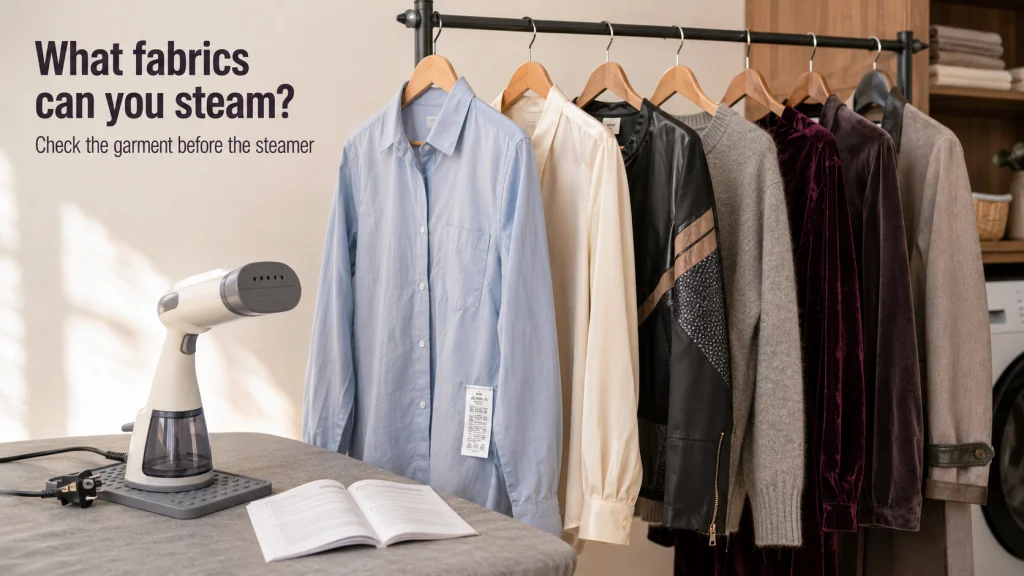
A garment steamer is not approved or rejected by fiber name alone. Cotton, linen, silk, polyester, and wool are often reasonable steaming candidates, but the care label, finish, trim, construction, and exact steamer instructions can change the answer. Pile fabrics, coated materials, plasticized details, leather, and suede need a more conservative check before heat and moisture are applied. The practical goal is to decide whether the whole garment is a good steaming candidate, then use the method the garment label and steamer manual actually support.
Start with the whole garment, not the fiber name
If you are asking what fabrics can you steam, start with the whole garment rather than a one-word fiber label. Two garments can both say polyester while one is a plain woven shirt and the other has a bonded graphic, plastic trim, or structured lining that changes the risk. The same problem appears with silk, wool, cotton, and blends because dyes, coatings, interlinings, embellishments, and construction can react differently to heat and moisture. That is why a generic fabric list is useful as a first screen, not as final permission.
The safest owner-level approach is a four-part check before the steamer is switched on. Start with the permanent care label, then identify the fiber or blend, inspect the finish and added details, and finally read the exact steamer manual for contact, orientation, and fabric instructions. In the United States, care labels are intended to provide regular care instructions and warnings when an expected care method could harm the garment, so they deserve more weight than a general internet list. This article stays at that compatibility level and does not replace textile restoration advice, professional cleaning judgment, or model-specific safety instructions. That same label-first check matters across garment care products, because fabric compatibility depends on the garment and the exact appliance instructions.
- Care label: look for care instructions and any warning that rules out heat, steam, ironing, or a related process.
- Fiber or blend: use the fiber as a starting point for how much caution is reasonable, not as a universal yes or no.
- Finish and construction: inspect prints, coatings, bonding, pleats, pile, linings, interfacings, beads, sequins, and plastic details.
- Steamer manual: follow the exact appliance instructions for contact, distance, orientation, attachments, and delicate materials.
This hierarchy also explains a common first-time mistake: treating a familiar fiber as proof that every garment made from it can be handled the same way. A plain polyester blouse and a polyester dress with a bonded decorative panel do not present the same surface to hot moisture. A wool sweater and a tailored wool jacket can also behave differently because the jacket contains structure that the fiber label does not describe. When any level of the check creates doubt, stop there instead of trying to make the generic fiber answer overrule the garment.

The 80 mm glass lens is paired with 18 LEDs to make small care-label print easier to inspect. Three light modes provide cold, warm, or mixed illumination for different room lighting conditions. The handheld magnifier runs on three AAA batteries, so it can stay near a closet or laundry area for label checks.
Check On AmazonIf you click this link and buy, we earn a commission at no additional cost to you.
Cotton and linen are usually straightforward, but wrinkles can still be stubborn
Plain cotton and linen garments are commonly treated as steam-tolerant, especially when the care label does not restrict the method. That does not mean every cotton or linen item needs the same technique, because weight, weave, finish, and construction still change how easily wrinkles release. A lightweight cotton shirt may relax quickly on a hanger, while a dense linen garment can keep deep creases after several passes. The difference is often wrinkle resistance and desired finish, not basic permission to expose the fabric to steam.
| Fabric or garment type | Quick compatibility read | What controls the final decision |
|---|---|---|
| Plain cotton and linen | Generally compatible when the care label allows steaming | Finish, trim, garment weight, and whether a crisp pressed result is needed |
| Silk and delicate wovens | Caution and model-dependent | Care label, dye, lining, embellishments, surface finish, and steamer contact instructions |
| Polyester and synthetic blends | Often compatible on plain fabric | Heat-transfer prints, bonded layers, plastic trim, coatings, glued details, and mixed-material panels |
| Wool and structured wool garments | Caution, especially as structure increases | Care label, interlining, fused components, shaping, padding, and whether the garment requires professional care |
| Velvet, corduroy, and pile fabrics | Caution and technique-dependent | Pile direction, backing, pressure, direct-contact restrictions, and exact appliance instructions |
| Waxed or heavily coated materials | Stop and verify | Whether heat or moisture can alter the coating and whether garment-specific guidance supports steaming |
| Leather and suede | Stop and verify or use professional care | Material-specific care instructions rather than a general fabric rule |
| Plasticized, bonded, glued, or vinyl-like details | Stop and verify the detail separately | The tolerance of the added component, adhesive, print, or trim that will actually receive heat and moisture |
This matrix is a quick screening layer, not a substitute for the garment-specific checks above it. A plain cotton or linen item usually starts in a lower-caution group, while pile, coatings, bonded details, leather, and suede move the decision toward verification before treatment. If steaming is allowed but the finish goal is sharp rather than relaxed, a pressure-based method may still be the better tool for the job. The sections below explain why each group moves up or down that caution scale.

The 1700-watt DW2360 combines a stainless steel soleplate with 300 micro-holes for distributed steam. It delivers a steam shot up to 180 g/min for stubborn creases and includes automatic shutoff. That combination suits cotton and linen garments that need more pressure and steam when a relaxed hanging-steam finish is not enough.
Check On AmazonIf you click this link and buy, we earn a commission at no additional cost to you.
Silk and delicate wovens need a conservative garment-level check
For anyone asking can you steam silk, the useful answer is that many silk garments can be steamed, but silk is not a universal permission category. The care label still comes first, followed by the weave, dye, finish, lining, and any attached decoration that may react differently from the silk shell. A plain silk blouse and a silk evening garment with beading, bonded support, or mixed-material trim should not be treated as the same steaming job. Delicate woven fabrics also show water spotting, distortion, or surface change more readily than a basic cotton shirt, so a cautious setup matters.
With delicate wovens, the most useful distinction is between a simple garment and a complicated one. A plain blouse with a permissive care label presents fewer unknowns than a lined or embellished piece whose decoration, backing, or dye may react differently from the shell fabric. If the label allows steaming but the surface behavior is uncertain, use only the test method supported by the garment and appliance guidance rather than treating the visible area first. Synthetics raise a related problem because the base fabric may be tolerant while the added finish is the part most likely to set the limit.

These satin hangers use thick foam padding to support delicate dresses, blouses, lingerie, and shirts. Each hanger has a swivel metal hook and a padded exterior intended to help garments keep their shape without hard shoulder bumps. The eight-pack provides a soft hanging surface while a delicate garment is inspected and prepared before steaming.
Check On AmazonIf you click this link and buy, we earn a commission at no additional cost to you.
Polyester and synthetic blends are often steamable, but finishes can be the weak point
If the question is can you steam polyester, a plain polyester garment is commonly a reasonable candidate when its care label and steamer instructions allow it. The mistake is assuming that every surface attached to a polyester garment shares the same tolerance. Heat-transfer graphics, bonded decorative layers, plastic trims, synthetic coatings, glued details, and mixed-fiber panels can create a lower limit than the base fabric itself. A polyester shirt with no special finish is therefore a simpler decision than a costume, performance garment, or dress with multiple bonded components.
Key point: A synthetic fiber can be a normal steaming candidate while a printed, coated, bonded, or plasticized detail on the same garment is not. Check the detail that will actually receive steam instead of relying on the dominant fiber percentage. If that detail has a separate care warning, follow the stricter instruction. The base fabric does not cancel a lower tolerance elsewhere on the garment.
Inspect a synthetic garment by surface rather than by percentage alone. The front panel, transfer print, elastic trim, lining, and glued decoration may each respond differently even when the fiber label is dominated by polyester. A hidden test on plain fabric can tell you something about that fabric area, but it does not clear a separate logo or bonded panel that was never tested. This is why performance wear, costumes, and decorated garments deserve more scrutiny than a plain synthetic shirt.

This 1875-watt handheld steamer has five steam settings, a 7.3-ounce water tank, and a heat-up time of about 40 seconds. It includes a delicate fabric spacer, silicone band, and bristle brush. The adjustable output and attachment options make it a useful fit for plain synthetic garments where the fabric and finish have already been cleared for steaming.
Check On AmazonIf you click this link and buy, we earn a commission at no additional cost to you.
Wool can tolerate steam, while structured garments add another layer of risk
For the common question can you steam wool, many wool garments can be exposed to steam when the care label permits it, but the construction matters as much as the fiber. A simple wool sweater presents a different problem from a tailored jacket with interlining, padding, shaping, or fused components. Steam may help relax surface wrinkles in both, yet the second garment has internal structure that can be affected even when the outer wool looks unchanged. That is why tailored wool should not be reduced to the same yes-or-no answer as an unstructured knit.
Wool also rewards restraint because the goal is usually to relax wrinkles without crushing texture, stretching a knit, or disturbing garment shape. Support the garment properly and avoid pulling warmed or damp wool out of shape while working. A tailored coat or jacket deserves extra caution because fused layers, padding, lapel shaping, and internal supports may matter even when the outer cloth appears ordinary. If the care instructions direct the garment to professional cleaning, that boundary is more useful than trying to generalize from an unstructured wool sweater.

The wide-shoulder wooden design supports coats, suits, and other heavier garments while distributing garment weight across the shoulder area. A screw-reinforced pants bar and grooved non-slip tube hold matching trousers on the same hanger. The 12-pack natural-finish variant is useful for keeping structured wool garments supported without relying on a narrow hanger.
Check On AmazonIf you click this link and buy, we earn a commission at no additional cost to you.
Velvet, corduroy, and other pile fabrics are construction-sensitive
Velvet is a good example of why internet fabric lists can conflict without either side being completely irrational. Steam can help relax wrinkles in some pile fabrics, but pressure, direct contact, or mishandling can flatten the raised surface and change how light reflects from it. Corduroy and other napped or pile constructions raise a similar concern because the visible texture is part of the garment’s finish, not a disposable detail. A yes-or-no answer that ignores pile direction, contact, backing, and manufacturer instructions is too broad to be dependable.
For these fabrics, treat the surface as the controlling constraint even if the fiber itself would normally be steam-tolerant. Avoid assuming that a technique used on a smooth cotton or polyester surface can be transferred to velvet merely because the fiber content overlaps. Some appliance manuals specifically restrict direct steam-head contact with velvet, which is exactly the kind of model-level instruction that should override a generic technique. If the label, garment maker, or appliance manual does not support a clear method, stop before experimenting on a visible pile surface.
Leather, suede, waxed surfaces, and plasticized details belong in the stop-and-verify group
Some materials should not be treated as ordinary garment fabrics just because they appear on clothing. Leather, suede, waxed or coated surfaces, and details made from heat-sensitive plastic can react badly to heat, moisture, or both, and common fabric references treat them as cases for avoidance or added caution. The important owner-level move is not to invent a low setting and hope the material tolerates it. Stop, read the garment instructions, check the material-specific care guidance, and use professional care when the item falls outside ordinary home steaming.
- Leather or suede with no garment-specific instruction supporting home steaming.
- Waxed, heavily coated, or water-resistant surfaces where heat or moisture could alter the finish.
- Thin plastic trim, vinyl-like details, glued decorations, or plasticized prints in the steam path.
- Vintage, specialty, or structured garments whose materials and adhesives are unknown.
- Any garment whose care label or manufacturer guidance warns against the intended heat or steam process.
This list is intentionally conservative because the downside is material damage rather than merely incomplete wrinkle removal. A steamer is a convenience tool, not a reason to override a care restriction or turn a specialty material into an at-home experiment. When the garment falls into this group, the burden of proof should be on a clear garment or manufacturer instruction that supports the method. If that proof is missing, leaving the wrinkle alone is cheaper than damaging the finish.

The four-way brush is designed for suede and nubuck care rather than heat treatment. It combines rubber surfaces, nylon and metal bristles, plus rounded and narrow welt brushes for scuffs, seams, corners, and crevices. That makes it a material-specific maintenance option for suede items that belong in the article's stop-and-verify group.
Check On AmazonIf you click this link and buy, we earn a commission at no additional cost to you.
Steam-head contact and distance are model-specific instructions
A universal rule such as always touch the fabric or always hold the steamer several inches away is not reliable across every design. Philips support for the STH3000/20 tells owners to hold its heated plate against clothing, while the Conair GS7 manual tells users not to directly touch velvet or silk with that steamer head. Those instructions are not interchangeable because the steam heads, heated surfaces, operating designs, and manufacturer assumptions differ. The exact manual therefore controls contact technique before a generic fabric article does.
This model difference also matters when shopping because a heated plate, fabric spacer, brush, or no-contact nozzle changes how the tool is meant to be used. If you are still deciding which type fits your wardrobe, the garment steamer buying guide explains the broader appliance-choice factors without assuming that every design handles delicate materials the same way. Once a steamer is already in the home, keep its manual accessible and use the instructions for that model rather than techniques remembered from another machine. Contact, distance, orientation, and attachments should all be treated as compatibility details, not personal preference.
| Instruction type | What it tells you | Why it cannot be generalized |
|---|---|---|
| Plate may contact garment | The specific model is designed for supported contact | Another model may use a different head, temperature, or steam path |
| Keep head off a delicate surface | The manual sets a no-contact boundary for that use | A different appliance may permit contact under its own instructions |
| Use an attachment or orientation | The design expects a particular interface or operating position | Accessories and permitted orientations vary by exact model |
The practical lesson is simple: do not copy a distance or contact rule from a different steamer just because both devices produce steam. The manufacturer has designed and documented the interface that actually touches or approaches the garment, and that is the evidence that matters. A fabric can be a reasonable candidate while the technique is still wrong for the appliance in your hand. Once both the garment and model instructions agree, then a careful test can add one more check before treating the visible area.
Use an inconspicuous test only when the instructions allow it
A hidden test is useful when the care label and appliance instructions do not prohibit steaming but the garment still has uncertain dye, finish, or texture behavior. Manufacturer manuals may specifically recommend checking colorfastness in an inconspicuous spot before treating the whole item, which gives the test a clear purpose. The test should look for color transfer, spotting, distortion, texture change, adhesive movement, or another visible reaction that would make you stop. It is not permission to override a label that already says the intended treatment should not be used.
Warning: Never use a hidden test to justify steaming a material or garment when its care instructions prohibit the process or when the appliance manual excludes that use. A test can reduce uncertainty only inside an already permitted method. It cannot prove that a warning is unnecessary. If the instructions say to stop, the test stops too.
A successful test narrows uncertainty, but it still does not guarantee that every section of a complicated garment will behave identically. Large panels can carry different tension, backing, seams, or finishes even when they look similar from the front. Treat the test as one layer in the decision hierarchy, not a substitute for the earlier checks. The final step is choosing a wrinkle-removal method that matches both compatibility and the finish the garment actually needs.
After compatibility is confirmed, choose steam or a pressure-based alternative
Compatibility only answers whether steaming is a reasonable candidate method, not whether it will create the finish you want. Flowing dresses, knits, soft blouses, and awkward garment shapes often suit a hanging steamer because the goal is relaxed wrinkle removal without pressing the surface flat. Shirts, trouser creases, collars, cuffs, and some stubborn linen wrinkles may respond better to controlled heat plus pressure when the care label allows ironing. The garment steamer versus iron comparison is the better next step when the real decision is relaxed finish versus crisp pressing.
If steaming is compatible and the garment does not need a pressed finish, the compatibility decision is complete. The garment steamer operating steps pick up from there with setup, garment positioning, and model-specific technique. Keep following the exact appliance instructions for orientation, contact, attachments, and any delicate-material limits instead of carrying a method over from another steamer. This page stops at deciding whether the garment is a suitable candidate and which wrinkle-removal approach makes sense.

This tabletop ironing board uses a steel mesh top with vented holes and a cotton cover for a compact pressing surface. Its steel legs fold flat, and no-skid protectors help stabilize the board on a tabletop while protecting the supporting surface. The 12 by 29 inch board gives collars, cuffs, creases, and other pressure-based work a dedicated surface when ironing is allowed.
Check On AmazonIf you click this link and buy, we earn a commission at no additional cost to you.
Final thoughts: let the care label and construction outrank a generic fabric list
Cotton, linen, silk, polyester, and wool can all appear on garments that are reasonable steaming candidates, but none of those words should function as automatic permission. Check the care label, then inspect the fiber or blend, finish, trim, and construction before turning to the exact steamer manual. Pile fabrics, coated materials, plasticized details, leather, suede, and complicated structured garments deserve a more conservative stop-and-verify approach. When the evidence conflicts, the garment-specific warning and appliance-specific instruction should win.
The most useful habit is to separate fabric tolerance from technique and finish. A garment can tolerate steam while still needing a no-contact method, a particular attachment, a gentler model setting, or an iron for a crisp result. A hidden test can reduce uncertainty only when the instructions already allow the process, and it cannot make an explicit restriction disappear. That approach may feel slower than a one-line fabric list, but it is much faster than trying to undo permanent damage to a finish, trim, or tailored structure.
FAQs
🧵 Can you steam silk without damaging it?
Many silk garments can be steamed when the care label and exact steamer instructions permit it. Check dyes, finishes, linings, and embellishments too. Do not assume that a contact method approved for one steamer applies to another. If the garment is complex or restrictive, professional care is the safer endpoint.
👕 Can you steam polyester clothing?
Plain polyester is commonly a reasonable steaming candidate when its care instructions allow it. Pay extra attention to bonded graphics, plastic trim, coatings, glued details, and mixed-material panels. Those details may set the real limit even when the base polyester is compatible. Follow the strictest relevant garment and steamer instruction.
🧶 Can you steam wool sweaters and jackets?
Many wool garments can be steamed, but a simple sweater and a tailored jacket are not the same compatibility problem. Check the care label and internal structure before choosing the method. Avoid pulling warmed or damp wool out of shape. Use professional care when the garment is highly structured or the instructions are restrictive.
🪡 Is velvet safe to steam?
Velvet is construction-sensitive, so avoid a blanket yes or no. Direct contact can flatten or mark pile on some garments. The exact garment and steamer instructions should control the method. If those instructions do not support a clear technique, stop rather than experimenting on the visible pile.
🏷️ Should the care label override a fabric guide?
Yes, the garment’s care instructions should carry more weight than a generic fiber list. A fabric reference can help you know what to inspect. It cannot account for every finish, trim, lining, coating, or construction detail on the finished garment. Use the label as the first garment-specific boundary.
♨️ Should a garment steamer touch the fabric?
Follow the exact steamer manual because contact rules vary by design and material. Some models are designed for plate contact. Other manuals tell users to keep the head off certain delicate or pile fabrics. Do not transfer a contact distance from one appliance to another without support from the manual.
References and Sources
- FTC care labeling guidance: Explains the role of garment care instructions and warnings for care methods that could cause harm.
- Philips garment contact guidance: Shows that the STH3000/20 is designed to allow its heated plate to contact clothing.
- Conair GS7 instruction manual: Supports the model-specific no-contact instruction for velvet and silk and the recommendation to test colorfastness in an inconspicuous area.
- Brabantia fabric overview: Provides general fabric examples and cautions for delicate, pile, waxed, leather, suede, and plastic materials.
- Good Housekeeping steamer and iron testing: Provides independent context on steaming common natural and synthetic fabrics and on choosing steam versus pressure for different finishes.