A bagged vs bagless vacuum decision is less about which format sounds more advanced and more about what happens when collected dirt has to leave the machine. Bagged systems can make disposal more contained, while bagless bins avoid replacement bags but put more of the emptying and filter-care work on the owner. Cleaning performance still has to be judged on the exact vacuum, floorhead, surface, airflow, and maintenance state rather than on the collection system alone. The useful choice is the routine you can maintain without creating unnecessary cost, mess, storage needs, or neglected filters.
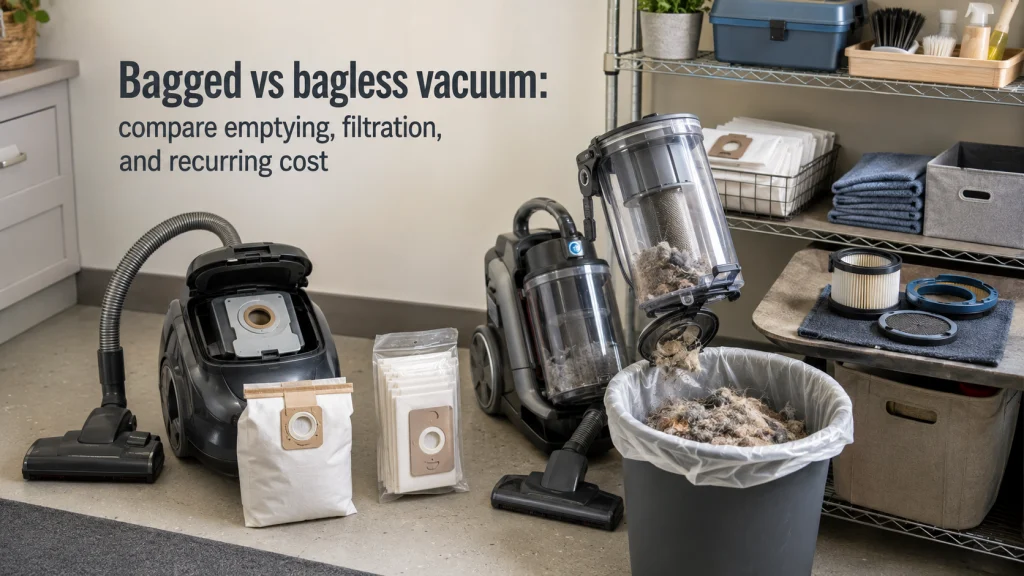
The full bag or bin is where the choice becomes real
The real bagged vs bagless vacuum difference becomes obvious when the machine is full and you have to deal with what it collected. With a bagged vacuum, the usual routine is to remove a filled bag, close or cover its inlet if the design allows it, discard it, and install a compatible replacement. With a bagless vacuum, the routine usually means carrying a reusable bin to the trash, opening it, knocking loose material out if needed, and putting the bin back correctly. Both systems collect dirt, but they create different work at the point when that dirt has to leave the vacuum.
That disposal step matters more than marketing language about one system being universally cleaner, stronger, or more modern. A household that dislikes buying consumables may prefer a reusable bin even if it needs more frequent emptying, while another household may gladly keep spare bags to avoid handling loose debris at the trash can. The decision also changes with pet hair, fine dust, cleaning frequency, storage space for supplies, and how closely the owner is willing to follow filter care. Start with that ownership routine, then judge the exact vacuum’s cleaning ability separately.

Eureka NEN110A is a bagless canister vacuum with a 2.5-liter dust container and washable filters. Integrated airflow control on the handle adjusts for carpet, upholstery, and hard floors. Automatic cord rewind and a one-button dust-cup release simplify storage and emptying.
Check On AmazonIf you click this link and buy, we earn a commission at no additional cost to you.
What bagged and bagless collection systems actually change
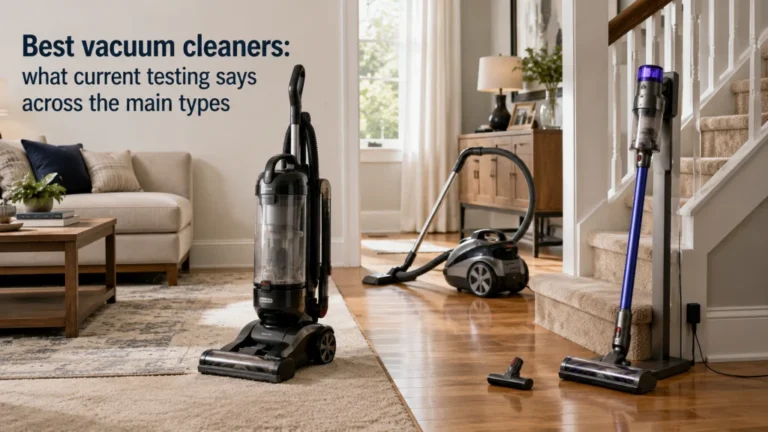
A bagged vacuum collects debris inside a replaceable bag that is part of the dirt path and, on many designs, also contributes to filtration. A bagless vacuum separates debris into a reusable container and relies on its cyclone, screens, pre-motor filtration, post-motor filtration, or some combination of those parts. Within home cleaning appliances, the collection system is only one part of the ownership decision. That distinction does not tell you whether the machine is an upright, canister, stick, or another form factor. If architecture is still undecided, first compare how the main vacuum cleaner types differ because weight, reach, cord handling, and floorhead design can change the ownership experience more than the presence of a bag.
The collection system mainly changes disposal, consumables, visible fill level, and the maintenance path between the dirt inlet and the exhaust. A transparent bin makes the collected debris easy to see, while a bag usually hides the contents and may use a fill indicator or another change cue on the exact model. A bag must be replaced with the correct compatible type, while a reusable bin has to be emptied and may need occasional cleaning according to the manual. Neither design removes maintenance, so the useful comparison is which maintenance you would rather perform and which mistakes you are less likely to make.

Bissell Zing 2154A uses a removable dust bag and includes pre-motor and post-motor filters. Its filters are washable and reusable, while automatic cord rewind stores the cord with a button press. A floor switch changes the nozzle setup between carpet and hard floors.
Check On AmazonIf you click this link and buy, we earn a commission at no additional cost to you.
Compare particle containment during operation separately from emptying
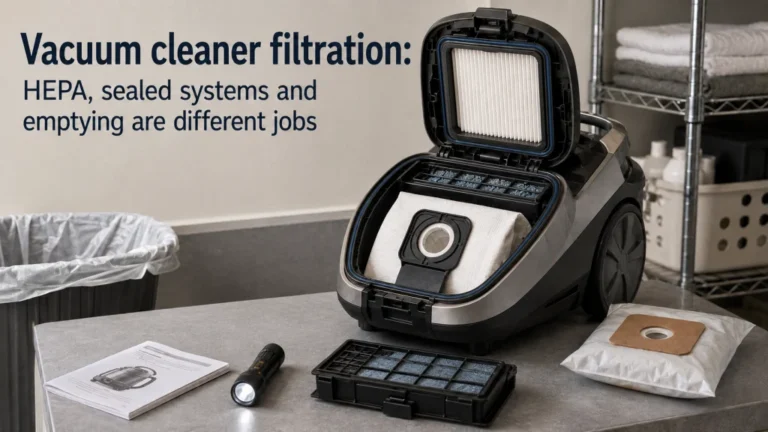
It is easy to collapse filtration into one vague question, but operating containment and emptying containment are different events. During vacuuming, fine-particle control depends on the whole filtration path, including the bag or cyclone system, the pre-motor and post-motor filters, seals, and how well the machine is assembled and maintained. During emptying, the question changes to how much collected material is exposed while the bag or bin is removed and discarded. A well-filtered bagless vacuum can contain particles effectively while running and still release visible dust when its open bin is emptied.
Current independent testing supports keeping those two moments separate rather than assuming that one collection style wins every filtration question. In a direct lab comparison, RTINGS found that operating results depended heavily on the filtration design, while manually emptied bagless bins released more fine material during disposal than the tested bagged systems. A bagless vacuum paired with a self-emptying dock that transfers debris into a bag changes that disposal comparison because the owner is no longer opening the onboard bin directly over a trash can. That exception still has to be verified on the exact system, including how the dock transfers debris, how its bag is removed, and what maintenance the station adds.
| Moment to compare | Bagged system | Bagless system | What to verify |
|---|---|---|---|
| During vacuuming | Bag design works with the rest of the filtration path | Cyclone and filters must control fine material before exhaust | Exact filtration claims, filter type, sealing, and maintenance instructions |
| During emptying | Filled bag is removed and discarded, sometimes with a closing mechanism | Reusable bin opens over a trash container and exposes loose debris | Bag closure, bin release design, owner handling, and disposal location |
Use the table as two checks, not as a single score for the vacuum. If your priority is keeping the disposal step contained, inspect how the exact bag closes or how the exact bin releases its contents instead of stopping at a HEPA label. If your priority is containment while the motor is running, look at the complete filtration system and evidence for the exact model. A collection-system label by itself cannot prove either result.

These genuine iRobot disposal bags come in a three-count pack for compatible Roomba Clean Base systems. The listing names Clean Base models including i1+, i3+, i4+, i5+, i7+, i8+, Combo j8+, and j9+. They are replacement dirt-disposal bags made for the automatic collection station.
Check On AmazonIf you click this link and buy, we earn a commission at no additional cost to you.
Bag sealing and bin emptying create different kinds of mess
Bagged disposal is not automatically dust-free, because bags use different inlets, collars, flaps, seals, and removal methods. The practical advantage is that much of the collected debris can remain inside the bag while the whole container is discarded. A closing inlet can further limit how much loose material escapes during removal, but that is a feature to verify on the exact bag system rather than assume from the word bagged. Damaged, overfilled, poorly fitted, or incompatible bags can also undermine the routine the owner expected.
A bagless bin gives you direct access to the dirt, which is convenient when you want to see what was collected or avoid keeping spare bags. The trade-off appears when light dust clings to the bin, hair bridges across the opening, or debris must be shaken free instead of dropping cleanly into the trash. If disposal is the reason you are comparing the two systems, watch the emptying mechanism more closely than the size of the clear plastic bin. The better fit is the design that you can empty correctly without turning routine maintenance into a task you postpone.

Miele GN HyClean Air replacement bags fit compatible Miele Complete C2, Complete C3, Classic C1, S8, S5, and S2 canister vacuums. The package contains four vacuum bags plus two filters. This genuine GN set keeps the bag format matched to the listed Miele model families.
Check On AmazonIf you click this link and buy, we earn a commission at no additional cost to you.
Compare recurring consumables before calling bagless cheaper
Bagged vacuums create an obvious recurring cost because the machine needs compatible replacement bags. That cost is easy to notice, but the useful number is not simply the price of one bag or one package. You need to know how quickly your household fills bags, how many replacements you want to keep in storage, whether the correct type is easy to source, and whether other filters are also replaced on a schedule. A low purchase price for the vacuum can become less attractive if the consumable system is inconvenient or unusually expensive to keep stocked.
A bagless vacuum removes the routine purchase of dirt bags, but it does not guarantee zero recurring consumables. Some filters are washable, some are replaceable, and some systems use more than one filter with different care instructions, so the exact manual controls the comparison. The bagged or bagless vacuum question is therefore better framed as recurring supplies versus recurring cleaning work, with replacement filters added where the design requires them. Estimate the routine you will actually follow rather than assuming that reusable automatically means maintenance-free.
| Ownership item | What to write down | Why it matters |
|---|---|---|
| Replacement bags | Exact compatible bag type, package size, local storage space, expected replacement frequency | Shows the real recurring supply burden for a bagged model |
| Filters | Which filters are washable, which are replaceable, and what the manual requires | Prevents bagless from being treated as automatically consumable-free |
| Cleaning supplies | Any owner-level bin, screen, or filter cleaning the manual specifies | Captures time and cleanup work that purchase price misses |
| Availability | Whether compatible bags and filters remain easy to obtain | Reduces the risk of owning a vacuum that cannot be maintained conveniently |
This worksheet is more useful than a generic claim that one format costs less over time. A household with heavy shedding pets may consume dirt capacity differently from a lightly used apartment vacuum, while a washable filter can still create drying time and cleaning work. Keep purchase price separate from the ongoing routine, then compare both. If a replacement item is model-specific, confirm its part or compatibility information before buying a supply pack.

Kenmore 53292 Type Q HEPA dust bags come in a six-count pack for compatible Kenmore canister vacuums. The listing names models including 81214, 81414, 81714, 21814, BC2005, BC3005, BC3006, 81615, BC4039, and BC7005. This exact variant uses HEPA filter media.
Check On AmazonIf you click this link and buy, we earn a commission at no additional cost to you.
Capacity matters because it changes how often you interrupt cleaning
Capacity is useful only when it describes the dirt container you will actually fill, not the overall size of the vacuum body. A larger bag or bin can reduce how often cleaning stops for disposal, but the collection system alone does not tell you the usable capacity of a specific machine. Compact bagless designs can fill quickly in homes with pet hair or larger debris, while a larger bagged machine may run through several sessions before the bag needs attention. Compare the exact stated dirt capacity, fill line, bag indicator, and instructions rather than guessing from exterior dimensions.
Emptying frequency also changes the ownership feel of the machine. Someone vacuuming small areas frequently may not care about a modest bin because disposal becomes part of a short routine, while a larger home may make repeated trips to the trash can irritating. A bag can postpone that interruption, but it also means storing replacements and changing the bag correctly when the machine indicates it is time. Capacity should reduce friction in your cleaning pattern, not simply win a bigger-number comparison.
- Check the exact dirt-capacity specification rather than the vacuum’s overall body size.
- Consider how quickly pet hair, lint, or bulky debris occupies that space.
- Look for the model’s fill line, change indicator, or other disposal cue.
- Decide whether frequent emptying or keeping spare bags is the more acceptable interruption.
The first-time buyer mistake here is treating capacity as storage volume with no connection to workflow. A bin that technically holds enough for one small room may become frustrating if your normal route covers several floors, and a large bag may be unnecessary if the vacuum is used only for quick touch-ups. Match the container to the cleaning session you actually perform. That turns capacity into a practical frequency decision instead of another specification to maximize.
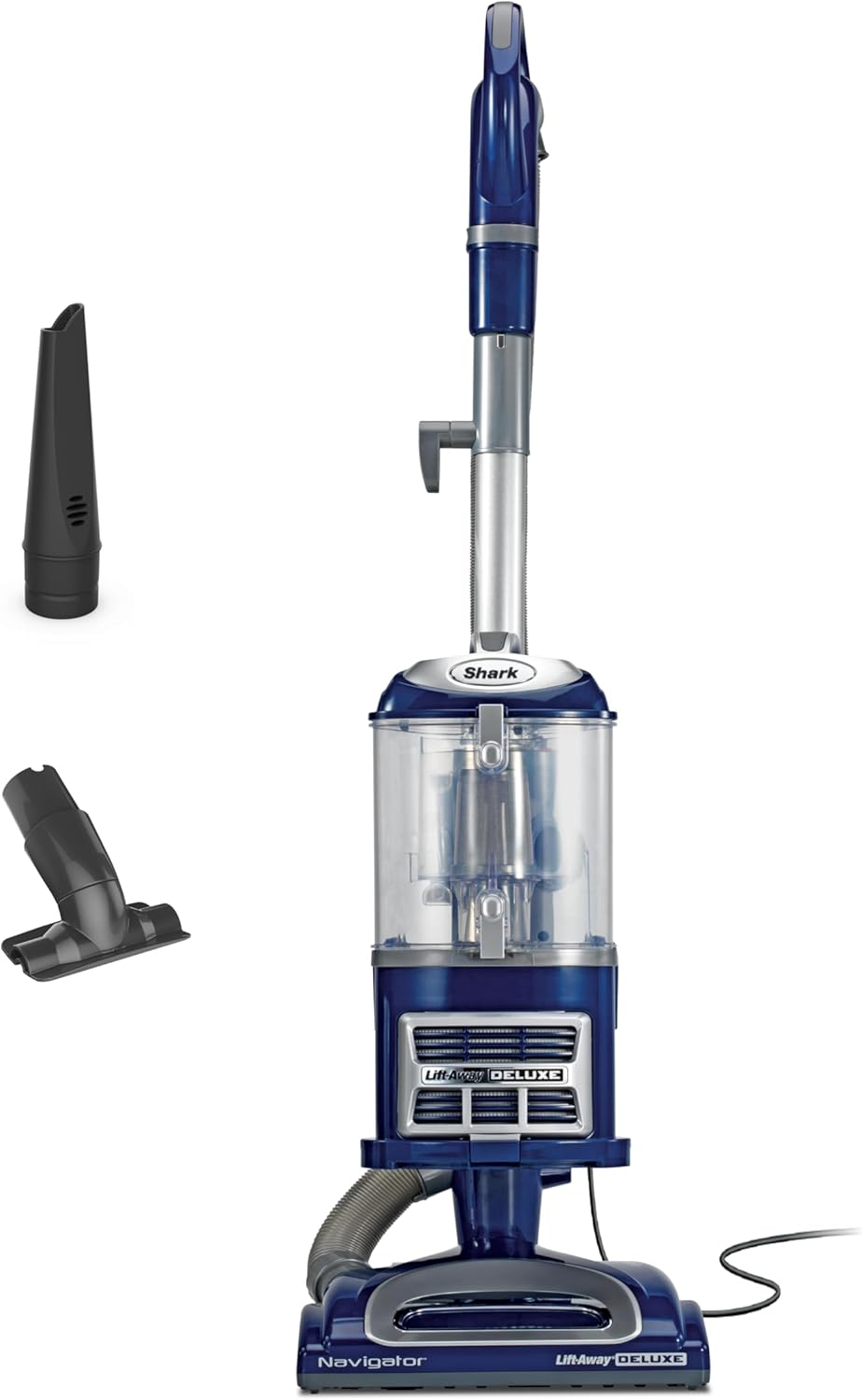
Shark NV360 is a bagless upright with a 0.9-quart dust cup and a detachable Lift-Away pod. Brushroll shutoff supports carpet and hard-floor cleaning, while swivel steering helps maneuver around furniture. Upholstery and crevice tools are included for above-floor jobs.
Check On AmazonIf you click this link and buy, we earn a commission at no additional cost to you.
Filter maintenance is different, not absent
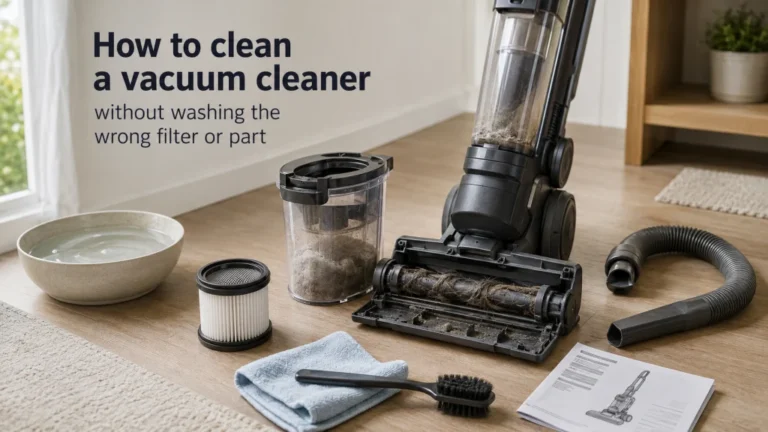
Bagless ownership often makes filter care more visible because collected fine material can reach screens and filters that need regular attention. The correct task may be tapping off debris, rinsing a washable filter, replacing a filter, or doing none of those at a particular interval, depending on the exact manual. Never wash a filter simply because it looks washable, and never reinstall a washable filter before the manufacturer says it is dry enough to use. A neglected filter can restrict airflow and make a capable vacuum feel weaker than it should.
Bagged vacuums still have maintenance points even when the bag captures much of the dirt. The bag itself must be installed correctly, replaced when required, and matched to the machine, while separate motor-protection or exhaust filters may have their own service rules. That is why cleaning a vacuum without skipping the filters and dirt path should follow the exact model instructions rather than a universal schedule copied from another machine. Choose the collection system whose maintenance steps you are realistically willing to remember and perform.

Colorfullife B06XCWWLXQ is a replacement filter kit for Shark Navigator Lift-Away models including NV350, NV352, NV360, NV370, UV440, UV540, ZU503AMZ, CU500, and CU512. The kit includes four foam filters, four felt filters, and two H13 HEPA filters. It is listed as replacing Shark filter parts XFF350 and XHF350.
Check On AmazonIf you click this link and buy, we earn a commission at no additional cost to you.
Bagged does not automatically mean better floor cleaning
The common shortcut is that a bagged vacuum must have stronger suction or better pickup because the dirt stays inside a sealed bag. Current independent testing does not support using the bag-versus-bin choice as a substitute for model-level cleaning evidence. RTINGS’ comparison found that cleaning performance depended more on floorhead design than on whether the vacuum used a bag, which is the distinction that keeps this decision useful. A bag can change disposal and filtration behavior without telling you how well the floorhead agitates carpet, seals to a surface, or picks up debris.
Two vacuums with different collection systems can therefore reverse positions when the surface, floorhead, brushroll, airflow path, or maintenance state changes. If cleaning power is the next question, compare what vacuum suction power does and does not tell you instead of assuming that the collection format decides the result. Also check how the exact floorhead handles your carpet height, hard flooring, edges, and debris types, because a strong motor cannot correct every poor floorhead match. Treat the bag or bin as one ownership variable rather than as a performance rating.

Shark NV752 is a Powered Lift-Away upright with a 0.88-quart dust cup and a HEPA-sealed filtration system. Its fingertip controls switch between hard-floor and carpet modes, while LED headlights illuminate debris at the nozzle. The package includes a Pet Power Brush, upholstery tool, and crevice tool.
Check On AmazonIf you click this link and buy, we earn a commission at no additional cost to you.
Choose bagged or bagless by the routine you can live with
Choose bagged when containing collected debris during disposal matters enough to justify buying and storing compatible bags. It is also a sensible fit when you prefer less frequent dirt-container handling and do not need a clear bin to judge fill level. The choice becomes less attractive when replacements are hard to source, storage is tight, or the correct bag system adds more supply management than you want. In that case, the convenience promised by the bag can disappear between cleaning sessions.
Choose bagless when avoiding replacement bags and seeing the fill level are more useful than enclosed manual disposal. It works best when the bin empties cleanly enough for your routine and the required filter care is something you will actually perform. Frequent emptying can become annoying on larger cleaning routes, although a compatible self-emptying dock can materially change that part of ownership on systems designed for one. The decision is therefore about where you prefer the recurring work to sit: supplies, disposal handling, or dock maintenance.

Eureka NEN110D is a red bagless canister vacuum with HEPA filtration and a 2.5-liter dust container. The listing specifies a 2-in-1 setup for hard floors and carpets. This exact ASIN corresponds to the red NEN110D WhirlWind variant.
Check On AmazonIf you click this link and buy, we earn a commission at no additional cost to you.
Use the collection-system choice before comparing current models
Once the collection system is settled, build the model shortlist from the jobs the vacuum still has to perform. Check the floorhead against your carpet and hard flooring, then look at carrying weight, reach, cord or battery limits, storage, attachments, and credible pickup evidence. A good disposal routine cannot compensate for a machine that is awkward on stairs or poorly matched to the main floor surface. This article stops before model rankings because those details belong to the exact vacuum rather than to bags or bins as a category.
Before buying, verify the dirt capacity, filtration design, replacement bag or filter compatibility, and the maintenance instructions for the specific model. If a self-emptying dock is part of the appeal, verify that the dock works with that exact vacuum, what it empties into, and which extra consumables or cleaning tasks it adds. Those checks turn the collection-system preference into a useful shortlist instead of a shortcut. They also expose models that fit the preferred disposal method but fail the household on another practical requirement.

Kenmore 81214 is a bagged 200 Series canister vacuum with a HEPA filtration system and a two-motor design. The orange model includes three cleaning tools and is intended for carpet and bare-floor cleaning. It also uses an automatic cord rewind for storage between cleaning sessions.
Check On AmazonIf you click this link and buy, we earn a commission at no additional cost to you.
Final Thoughts: choose the disposal routine, then verify cleaning performance
Bagged and bagless vacuums mainly ask you to accept different ownership chores. Bags trade reusable-bin emptying for compatible consumables, while bagless systems trade bag inventory for more direct debris handling and model-specific filter care. Self-emptying docks can blur that line, but only when the exact system transfers debris in a way that meaningfully changes manual disposal. None of those differences proves how well a particular vacuum will clean your floors.
Make the collection choice first, then judge the machine on the evidence that remains: usable capacity, filtration, floorhead fit, maintenance requirements, replacement support, and pickup on the surfaces you own. That order keeps a disposal preference from turning into an unsupported performance assumption. It also makes it easier to reject a poor-fit model even when you like its bag or bin design. The better purchase is the vacuum whose cleaning hardware and ownership routine both fit the household.

Oreck Commercial XL2100RHS is a bagged upright vacuum that weighs about 9 pounds. Its high-speed brush roll agitates carpet, and automatic height adjustment changes the nozzle position as the floor surface changes. Side edge brushes support cleaning along baseboards and corners.
Check On AmazonIf you click this link and buy, we earn a commission at no additional cost to you.
FAQs
The most useful follow-up questions are usually about emptying, suction, filters, capacity, and recurring cost. Those details are related, but none of them can be answered reliably from the words bagged or bagless alone. The exact model and its manual still control maintenance, filter care, compatible consumables, and disposal instructions. Use the answers below as decision checks, then confirm the machine-specific details before buying.
It also helps to keep performance and ownership questions separate. A cleaner disposal routine does not prove better pickup, and avoiding replacement bags does not prove lower total ownership effort. Capacity can reduce interruptions, but only if the dirt container fits the way you clean. Those distinctions keep the comparison practical instead of turning it into a simple pros-and-cons scorecard.
🗑️ Is a bagged or bagless vacuum easier to empty?
A bagged model is usually more contained because the filled bag is removed as a unit, while a bagless bin exposes loose debris when it opens. The exact closure or release design still matters, so inspect that mechanism on the model you are considering.
💨 Do bagged vacuums have better suction?
Not automatically. Pickup depends on the exact machine, floorhead, airflow path, surface, and maintenance state, so bagged versus bagless should not be used as a shortcut for cleaning performance.
🧼 Does a bagless vacuum still need filter maintenance?
Yes, many do, but the task varies by model. Follow the manual for whether each filter is washable, replaceable, or serviced another way.
📦 How should I compare bag and bin capacity?
Compare the exact dirt-capacity specification and the model’s fill or change instructions, not the overall size of the vacuum. Then consider how much debris your normal cleaning session produces before disposal becomes an interruption.
💵 Is bagless always cheaper to own?
No. Bagless removes routine bag purchases, but replacement filters and maintenance still vary by model, while a bagged vacuum adds compatible bags and may also have separate filters.
References and Sources
- RTINGS bagged vs. bagless testing: Supports the separation between operating filtration, manual emptying containment, the self-emptying dock exception, and model-level floorhead performance.