Vacuum filtration is not one feature hidden behind a HEPA badge. Fine-particle containment depends on the filter media, the seals around the airflow path, the way dust is collected, and what happens when the bag or bin is removed. A strong label can describe one component while leaving the rest of the system unproven. The useful buying question is whether the whole vacuum keeps collected particles contained during operation and disposal.
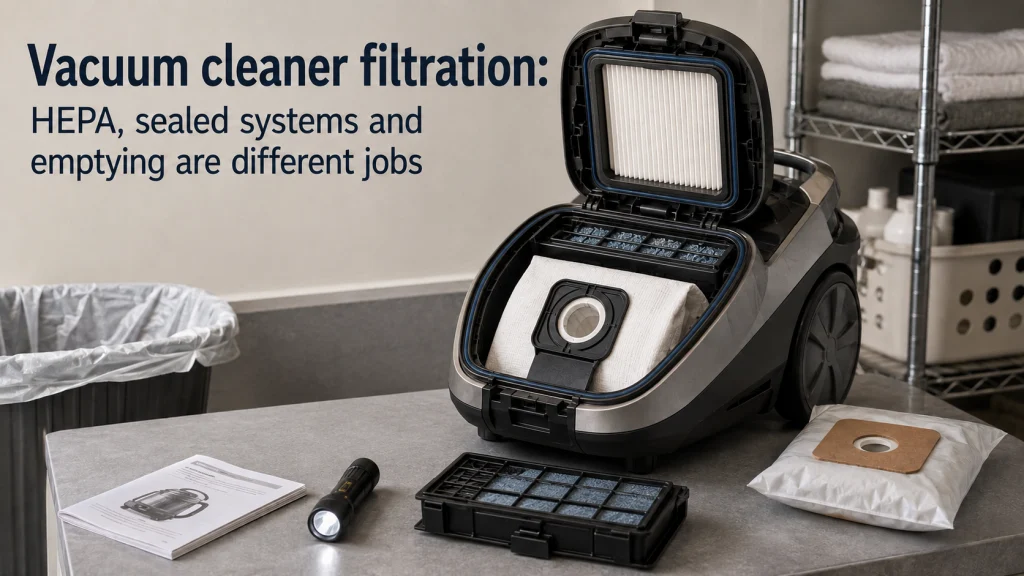
A HEPA filter is not the whole containment system
Vacuum cleaner filtration is easy to oversimplify because the filter label is usually the most visible claim on the box. A vacuum can contain efficient filter media and still depend on gaskets, filter seating, bin seals, bag installation, and housing joints to keep dirty air on the intended path. That is why a HEPA label should start the evaluation rather than end it. The practical question is whether the air entering with dust is actually forced through the filtration stages before it leaves the machine.
This article stays at that equipment level: particle containment, airflow routing, disposal behavior, and the evidence a buyer can verify. It does not treat a vacuum as medical equipment, promise symptom relief, substitute a vacuum for a room air cleaner, or cover hazardous-dust remediation. Those boundaries matter because a particle measurement can show what escaped from a machine without proving a health outcome for a household. Once that distinction is clear, the rest of the specification sheet becomes much easier to read.

The NV352 combines a washable HEPA filter with Shark Anti-Allergen Complete Seal Technology. Its filtration setup also uses foam filters, showing why containment depends on more than a single HEPA element. Lift-Away operation and brushroll shutoff add practical flexibility for floors, stairs, and above-floor cleaning.
Check On AmazonIf you click this link and buy, we earn a commission at no additional cost to you.
Filtration and dust collection are different jobs
Dust collection answers where the debris goes after the floorhead picks it up. Filtration answers what happens to the air that carried that debris through the machine, especially the fine particles that can pass beyond the first collection stage. A bag, bin, cyclone, foam layer, pleated filter, and exhaust filter can all participate in the process, but they do not perform the same job. Treating the dust container as the filtration system hides the points where fine material can continue downstream.
A first-time buyer can easily see a large bin or thick bag and assume that visible capacity tells the containment story. It does not, because large crumbs and hair are much easier to retain than the smallest particles moving with the exhaust air. The useful mental model is a sequence: collect bulk debris, separate smaller material, protect the motor where the design calls for it, then filter the outgoing air. The exact sequence varies by vacuum type, so the manual and whole-system documentation matter more than a generic component name.
| Filtration stage | What happens here | What to verify |
|---|---|---|
| Pickup and collection | Debris and dust enter through the floorhead and move into a bag, bin, or other collection chamber. | The collection format and whether fine material can continue into later filtration stages. |
| Pre-motor filtration | Material that passes the first collection stage encounters filtration before reaching the motor. | The filter type, its position, and the exact manufacturer’s care instructions. |
| Motor and sealed airflow path | Air moves through the machine while seals and housings are supposed to keep it on the intended route. | Whether the maker documents a sealed or whole-machine filtration system rather than only a filter claim. |
| Post-motor or exhaust filtration | The final filtration stage captures fine material that remains before air exits the vacuum. | The efficiency claim, test basis, filter seating, and independent particle-emission results when available. |
| Disposal | Collected debris leaves the vacuum when the bag is removed or the bin is opened. | How contained the removal process is and whether emptying creates a separate dust-release event. |
This sequence also explains why two vacuums with similar filter labels can behave differently in particle testing. One may move nearly all exhaust through a high-efficiency final filter, while another may depend on weaker seals or a different collection path. The label tells you about a component only to the extent that the manufacturer defines and tests it. System architecture determines whether that component gets the chance to do its job.

These genuine Miele GN bags fit select Classic C1, Complete C1, Complete C2, and Complete C3 canister vacuums. Miele states that the AirClean bag system captures more than 99.9 percent of fine dust, while the automatic closure helps keep collected debris contained during removal. The pack includes four bags and two filters.
Check On AmazonIf you click this link and buy, we earn a commission at no additional cost to you.
Pre-motor and post-motor filters protect different parts of the airflow path
A pre-motor filter sits before the motor in the airflow path and helps keep material that passed the first collection stage from reaching downstream components. Its exact construction can be foam, fabric, pleated media, or a multi-part assembly depending on the vacuum. That position makes it important for motor protection and for keeping the internal air path from loading with fine debris. It should not automatically be read as the final statement about what the vacuum exhausts back into the room.
The post-motor or exhaust filter is the last filtration stage before air leaves many vacuum designs. Independent testing is especially useful here because fine particles that pass a bag or cyclone can still be captured at this final stage, while a weak final filter can allow more material to escape. RTINGS’ filtration investigation found that post-motor filter quality made a substantial difference in measured particle emissions across the vacuums it examined. For a buyer, that means the phrase “multi-stage filtration” is useful only after you know what the stages are and where the final high-efficiency stage sits.

The Complete C3 Calima is a bagged canister vacuum that uses Miele AirClean GN bags and a HEPA AirClean exhaust filter. Its filtration setup illustrates how collection media and final exhaust filtration work as separate stages in one machine. Amazon documentation for this model states that its filters are replaced rather than washed.
Check On AmazonIf you click this link and buy, we earn a commission at no additional cost to you.
True HEPA and HEPA-type labels do not mean the same thing
U.S. EPA reference material describes HEPA as high-efficiency particulate air filtration capable of capturing at least 99.97 percent of particles at 0.3 microns under the stated test basis. That gives “HEPA” a technical meaning that is more useful than a vague promise such as fine-dust filtration. Terms such as “HEPA-type,” “HEPA-style,” or similar marketing language should not be assumed to prove the same threshold unless the maker provides a specific standard and test claim. The safest reading is literal: verify exactly what was tested, at what particle size, and whether the claim applies to a filter or the entire vacuum.
There is another trap in numbers that look close enough to be interchangeable. A claim such as “captures 99 percent” can sound almost identical to a HEPA claim in casual shopping, but the missing test details make the comparison incomplete. Particle size, test method, and whether the percentage refers to a single filter or whole-machine emissions all change what the figure means. Good evidence names the standard or method instead of asking the buyer to infer performance from an adjective.
| Claim or evidence | What it can prove | What still needs checking |
|---|---|---|
| HEPA filter specification | The stated filter media meets a defined high-efficiency particle-capture requirement when the claim is properly documented. | Whole-machine sealing, bypass leakage, filter seating, and disposal behavior. |
| HEPA-type or similar wording | The manufacturer is describing a filter as HEPA-like or high efficiency. | The actual standard, particle size, test method, and verified efficiency. |
| Sealed or whole-machine filtration claim | The manufacturer is making a system-level containment claim. | The exact definition, test conditions, and independent particle results when available. |
| Independent particle-emission test | How the tested vacuum behaved under the disclosed operating conditions. | Whether the test also measured emptying and whether the exact model matches the one being purchased. |
The table is useful because each evidence type answers a different question. A filter specification can be excellent and still leave system leakage unanswered, while a whole-machine particle test can reveal containment without telling you whether the filter is washable or how often it must be replaced. No single row should carry the entire buying decision. The strongest case comes from evidence that agrees across the filter, the airflow path, and real particle measurements.

The LVAC-300 uses a HEPA filter with a stated 99.99 percent capture claim for particles as small as 0.3 microns. Amazon ties that claim to ASTM F3150-18, giving the percentage a specific test reference instead of only a HEPA-style adjective. The cordless vacuum provides up to 60 minutes of stated runtime in its longest-runtime configuration.
Check On AmazonIf you click this link and buy, we earn a commission at no additional cost to you.
A sealed vacuum system controls whether air bypasses the filter
A sealed vacuum system is about routing, not simply adding more filter material. If air can leak around a filter, through a poorly seated component, or through a gap after the motor, some of that air can bypass the intended final filtration stage. RTINGS demonstrated the importance of sealing by showing that a sealing problem could sharply worsen measured particle output even when the filtration components themselves were capable. That is the reason a premium filter inside an otherwise uncertain airflow path is not enough evidence on its own.
The term “sealed” also deserves the same skepticism as any other marketing phrase. Look for an explanation of what part of the machine is sealed, whether the claim covers the full exhaust path, and whether a whole-machine filtration percentage is tied to a documented test. Installation matters too, because a bag, filter, or gasket that is not seated correctly can create a bypass that the original design did not intend. A buyer should therefore judge the vacuum filter system as an assembled path rather than as a list of isolated parts.
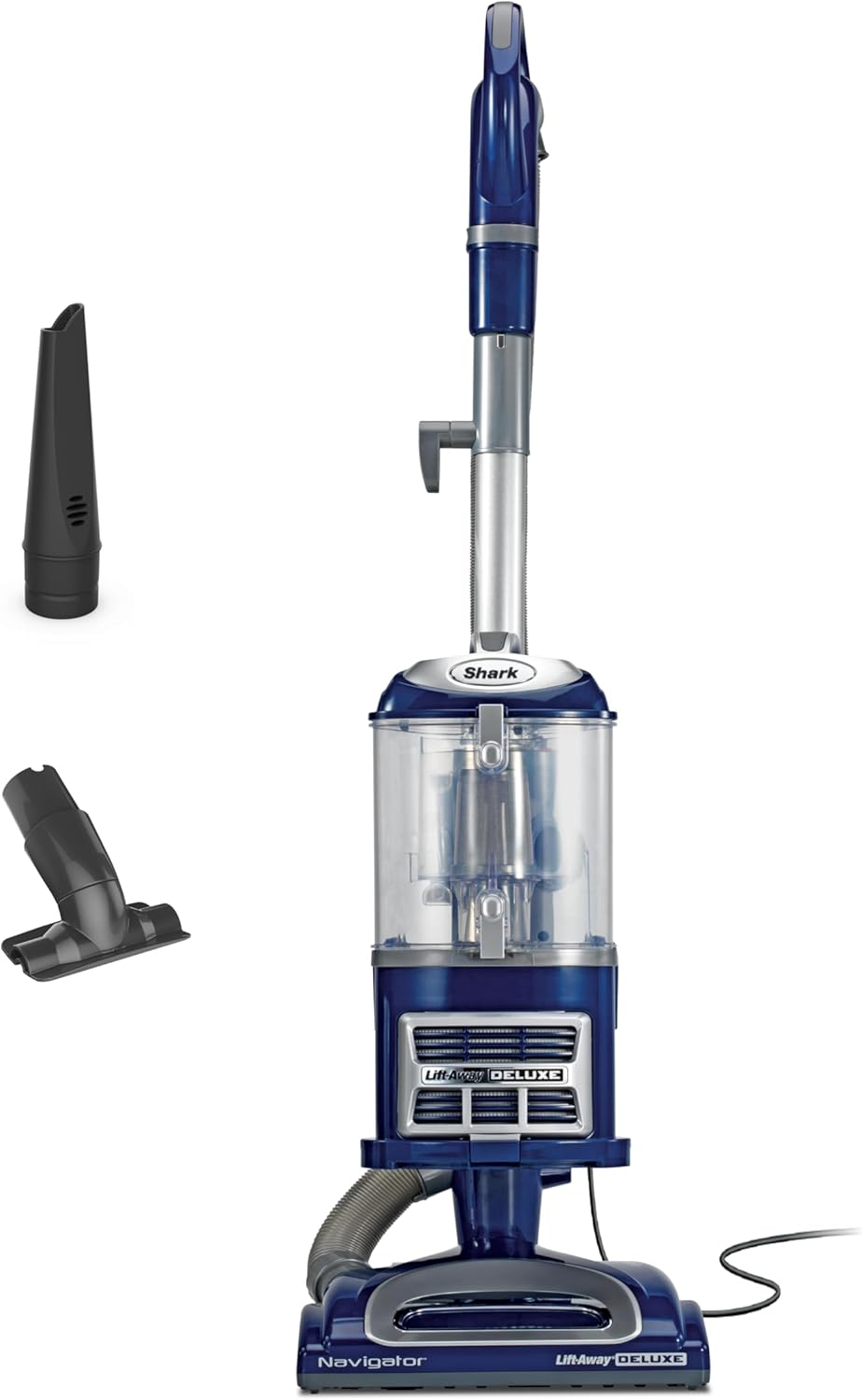
The NV360 pairs a HEPA filter with Shark Anti-Allergen Complete Seal Technology to keep the intended airflow path contained through the machine. It uses a 0.9-quart bagless dust cup and includes Lift-Away capability for above-floor cleaning. The combination is directly relevant when judging bypass risk rather than evaluating filter media alone.
Check On AmazonIf you click this link and buy, we earn a commission at no additional cost to you.
Cleaning and emptying are separate containment tests
A vacuum can contain particles well while the motor is running and still release a visible cloud when the bin is opened. Those are two different events, with different airflow and handling conditions, so operation testing should not be used as a shortcut for disposal performance. RTINGS measured the vacuuming phase and also examined emptying, finding that bagless disposal could release substantial dust even when the machine performed well during operation. That result is a useful reminder that the containment job continues after the floor is clean.
Two separate checks: During cleaning, ask whether the sealed airflow path keeps captured particles moving through the intended filtration stages before exhaust leaves the machine. During emptying, ask how the bag or bin releases collected debris, how much handling is required, and whether fine dust can be disturbed when the collection system is opened.
For household use, the practical difference is how often the collection system must be opened and how much disturbance that creates. A bag that closes when removed can reduce direct contact with collected debris, while an open bin may require the user to release material into a trash can and deal with dust clinging to the container. Neither fact makes every bagged vacuum superior to every bagless vacuum because filtration quality and sealing still vary by model. It does mean that emptying behavior deserves its own line on the comparison sheet instead of being buried under the word “HEPA.”

The BU4050 uses Kenmore No Touch Bag Technology with self-sealing bags to reduce direct handling of collected debris. Its PowerFlow bag chamber is designed to maintain airflow as the bag fills, and the vacuum uses a completely sealed HEPA filtration system. Lift-Up operation also supports stairs and above-floor cleaning.
Check On AmazonIf you click this link and buy, we earn a commission at no additional cost to you.
Bags and bins change disposal, not the definition of filtration
The collection format affects how debris is stored and released, but it does not replace the need to inspect the rest of the airflow path. A bag can serve as a filtration stage and make disposal more contained, while a bagless design can pair cyclonic separation with strong post-motor filtration and effective sealing. That is why the broader bagged versus bagless vacuum comparison should own the disposal-system trade-off rather than turning this filtration question into a universal format verdict. Here, the relevant point is narrower: ask what the collection method contributes before, during, and after the motor runs.
Vacuum format still changes how that architecture is packaged. Within home cleaning appliances, filtration should be judged as part of the complete machine rather than as an isolated label. It also helps to understand the broader vacuum cleaner types before comparing filtration labels across uprights, canisters, sticks, robots, and other designs. A compact machine may have less physical room for large filtration components, but size alone does not prove weak containment. A full-size machine may offer multiple filters, yet that still does not prove the housing is well sealed. Compare the actual airflow and disposal design, not the silhouette of the vacuum.

These genuine Kenmore IB600 replacement bags fit selected Intuition uprights including the BU4022, BU4020, BU4018, BU4050, and BU3040. The bags use HEPA media rated to capture 99.97 percent of particles down to 0.3 micron. They are designed for Kenmore No Touch bag systems, so disposal compatibility stays tied to the exact vacuum family.
Check On AmazonIf you click this link and buy, we earn a commission at no additional cost to you.
Independent particle tests show what labels cannot
Specification sheets are good at telling you what components a vacuum contains, but they cannot always show how much fine material escapes from the assembled machine. Independent particle testing can fill that gap when the method is disclosed clearly enough to understand the chamber, particle sizes, operating sequence, and exact models tested. The strongest tests separate pickup performance from emissions because a vacuum can remove visible debris well while handling fine particles less effectively. They also avoid treating one model’s result as proof for every vacuum sharing the same brand or filter label.
The RTINGS investigation is valuable for this decision because it tested multiple vacuums and examined system changes such as bags, post-motor filters, seal quality, and emptying behavior. Its findings show why the best evidence is layered: a HEPA specification supports the filter claim, while measured particle concentration shows what happened in the tested machine under the disclosed conditions. Even then, independent tests do not prove lifetime sealing, every maintenance state, or every household’s disposal routine. Use them to confirm or challenge the specification, not to replace model-specific documentation.

The Temtop LKC-1000S+ 2nd measures PM2.5, PM10, formaldehyde, VOCs, temperature, humidity, and AQI. It supports data export and a 12-hour PM2.5 histogram, making it useful for collecting observations instead of relying on a label alone. Home measurements can provide useful context, but they do not replace standardized vacuum laboratory testing.
Check On AmazonIf you click this link and buy, we earn a commission at no additional cost to you.
Washable and replacement filters must be checked by exact model
“Washable filter” is not a general instruction for every filter that looks similar. Dyson’s support material for its cordless vacuums specifically describes washing designated filters with water and drying them fully before reinstalling them, while Miele documentation for certain HEPA exhaust filters instructs owners to replace the filter rather than treat it as a washable part. That difference is exactly why care instructions belong to the exact model and filter part, not to the generic word HEPA. Water, detergent, drying method, replacement timing, and filter seating can all be model-specific.
This page stops at that verification rule because detailed care belongs in the vacuum cleaner cleaning process and in the owner’s manual for the exact machine. If a filter is damaged, missing, incorrectly seated, or no longer seals correctly, do not improvise a substitute material or modify the housing to make it fit. The replacement part should match the documented model and interface, especially when the filter frame or gasket is part of the containment path. Maintenance is not separate from filtration performance when a poor fit can create bypass around an otherwise capable filter.

The Miele SF-HA 50 is a genuine HEPA AirClean exhaust filter for compatible Complete C2, Complete C3, Compact C1, and Compact C2 vacuums. Miele specifies HEPA class 13 under DIN EN 1822/2019 for this filter family. It is a replacement filter with a stated annual change interval rather than a generic washable insert.
Check On AmazonIf you click this link and buy, we earn a commission at no additional cost to you.
Use an evidence checklist before buying
A useful filtration comparison begins with claims that can be verified and ends with the ownership steps that can break the system if ignored. Start by reading the exact filter specification, then look for a sealed-system or whole-machine claim, and then check whether independent particle testing exists for the exact model. Add disposal behavior because the cleanest operating result does not tell you what happens when the dirt container is opened. Finally, confirm the replacement-filter path so a strong filtration design does not become difficult or expensive to maintain.
Do not let this checklist crowd out the rest of the vacuum decision. Filtration cannot compensate for a floorhead that performs poorly on your surfaces, awkward weight, insufficient runtime, difficult storage, or a price that does not fit the household budget. Once the filtration evidence is sound, compare those broader factors in current vacuum cleaner comparisons without assuming that the model with the longest feature list is automatically the better fit. The goal is to confirm containment first, then judge the machine as equipment you actually have to use and maintain.
- Verify the exact filter terminology and any stated HEPA standard or efficiency claim.
- Check where the pre-motor and post-motor filters sit in the airflow path.
- Look for a documented sealed-system or whole-machine filtration statement.
- Prefer independent particle-emission testing that names the exact model and test conditions.
- Check emptying behavior separately from operation.
- Confirm whether each filter is washable, replaceable, or both according to the exact manual.
- Check the correct replacement part or filter family before treating ownership cost as settled.
If one of those items is missing, treat it as an unknown rather than filling the gap with marketing language. A vague “advanced filtration” claim may still describe a good system, but it does not prove the same thing as a defined filter standard plus whole-machine evidence. Likewise, an impressive particle test on a different model should not be borrowed for the vacuum in your cart. The checklist works because it keeps each claim attached to the evidence that can actually support it.

The BISSELL 39883 combines a HEPA Sealed Allergen System with a 1-liter bagless dirt tank and a detachable Lift-Off pod. BISSELL states that the filtration system is tested under ASTM F1977 at 0.3 microns, while the tangle-free brush roll supports routine floor cleaning. These features make it useful for comparing filtration, disposal, handling, and maintenance in one machine.
Check On AmazonIf you click this link and buy, we earn a commission at no additional cost to you.
Final thoughts: evaluate the whole airflow and emptying system
The strongest vacuum filtration decision is not “HEPA or no HEPA.” It is a sequence of checks: what the filter standard proves, whether the airflow path is sealed, what independent testing shows during operation, and how much dust is disturbed during disposal. That sequence prevents a single impressive label from standing in for the whole machine. It also makes comparisons fairer when bagged and bagless designs use very different collection and filtration architectures.
Before buying, verify the exact model rather than relying on a family name, a retailer badge, or a filter that merely looks compatible. Confirm the final filtration stage, the seal claim, the emptying method, and the correct maintenance instructions, then weigh those findings against the vacuum’s pickup, handling, storage, and ownership cost. If the evidence stops at the filter media, keep the rest of the containment system marked as unproven. That is a much safer buying rule than assuming the word HEPA settles every particle-containment question.

The Shark Vertex AZ2002 combines Anti-Allergen Complete Seal Technology with a HEPA filter and a 1-quart dust cup. Its filtration claim is tied to ASTM F1977 for particles 0.3 microns or larger, while Powered Lift-Away expands above-floor access. The model is a useful example of weighing containment together with everyday cleaning and handling features.
Check On AmazonIf you click this link and buy, we earn a commission at no additional cost to you.
FAQs
🧹 Does a HEPA filter automatically mean the vacuum is fully sealed?
No. A HEPA filter describes the filtration capability of that filter under its stated standard, while whole-machine sealing determines whether air can bypass it. Check for a documented sealed-system or whole-machine filtration claim and independent particle testing when available.
🔍 What is the difference between HEPA and HEPA-type?
HEPA has a defined high-efficiency particle-capture meaning, while HEPA-type wording does not by itself prove the same test threshold. Look for the stated standard, particle size, and test method instead of assuming the labels are equivalent.
💨 Why does a post-motor filter matter?
It is often the final filtration stage before exhaust air leaves the machine. Fine material that passes earlier collection stages can still be captured there, so its quality and sealing can materially affect particle emissions.
🗑️ Can a vacuum filter well but still release dust when emptied?
Yes. Operation and emptying are separate events, and opening a reusable bin can disturb collected fine dust even when the vacuum contained particles well while running. Compare disposal behavior separately from filtration during cleaning.
🧼 Can I wash any vacuum filter that looks like foam or pleated media?
No. Washability depends on the exact filter and model, and some filters are meant to be replaced instead. Follow the specific manual or manufacturer support instructions before using water or reinstalling a cleaned filter.
References and Sources
- U.S. EPA HEPA definition: Supports the technical definition of HEPA filtration and the 99.97 percent at 0.3 microns reference point.
- RTINGS vacuum filtration research: Supports the discussion of post-motor filtration, system sealing, measured particle emissions, and emptying behavior.
- Vacuum Wars filtration standards overview: Supports the distinction between defined HEPA filtration and HEPA-type marketing language.
- Dyson vacuum filter care: Supports the model-specific example of designated washable vacuum filters.
- Miele filter support: Supports the model-specific example of HEPA exhaust filters that are replaced according to manufacturer instructions.