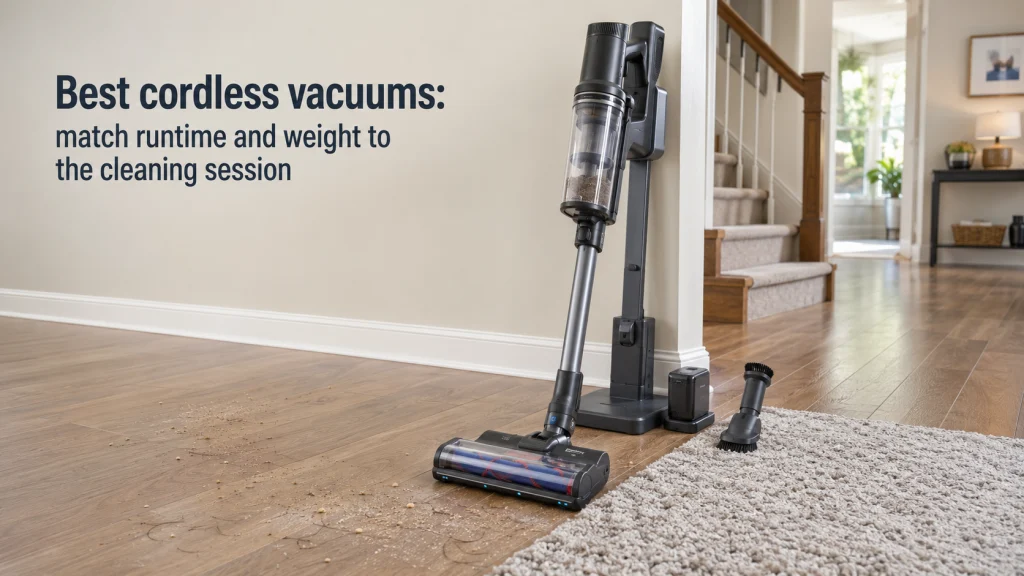
The best cordless vacuums are the models that turn strong pickup into enough usable cleaning time without becoming awkward to carry, empty, charge, or store. Independent tests show why the longest low-power runtime should not be read as the runtime you will get on carpet, pet hair, or concentrated debris. The current shortlist below separates a balanced general-use pick, a lighter hard-floor-friendly option, a pet-hair-focused choice, and a self-emptying option for households that want less direct dust handling. The final choice should come from the floor types, session length, hand weight, bin volume, and ownership routine you will actually repeat.
Start with usable runtime, not the biggest battery claim
A cordless vacuum can advertise a long maximum runtime and still feel short-lived during the cleaning session that matters to you. Maximum figures are commonly tied to lower-power operation, while carpet, embedded debris, pet hair, and stubborn pickup may push you toward a stronger setting. That means battery life only becomes useful when the power mode, floorhead, and cleaning load are considered together. If your normal route depends on higher power for much of the house, the lowest-mode result is not the number that should decide the purchase.
Think in terms of the route you actually clean before the battery returns to the charger. A small hard-floor apartment may need moderate pickup for a relatively short session, while a carpet-heavy home may spend more of that session at a stronger setting. Stairs and handheld work can also extend the session because the vacuum is being lifted, repositioned, and used with smaller tools. The goal is not to buy the longest theoretical battery life, but to leave enough practical margin that the vacuum finishes the route without forcing you to rush.
| Power mode | What it usually tells you | Best way to use the number | Common mistake |
|---|---|---|---|
| Low or eco | Longest available session under lighter demand | Use it for open hard floors and easy debris when pickup remains adequate | Treating it as the runtime you will get on every surface |
| Medium or automatic | A more realistic mixed-cleaning range when the vacuum supports it | Compare it with the amount of carpet, rugs, and repeated debris in your home | Ignoring how often automatic control raises power |
| High, max, or boost | Shorter operation intended for demanding pickup | Reserve it for concentrated messes unless your normal flooring truly requires it | Assuming high power can cover a whole-house route without a battery penalty |

Dyson lists three power modes and up to 60 minutes of runtime for this V15 Detect Plus configuration. Its cleaner heads are designed for hard floors and carpets, while hair-detangling features help manage long and pet hair. The vacuum also converts to handheld use, so the same battery supports floor, stair, and above-floor cleaning.
Check On AmazonIf you click this link and buy, we earn a commission at no additional cost to you.
Use independent pickup and runtime measurements as the first evidence filter
Start with tests that show what the vacuum actually picked up and how battery life changed across power settings. Floorhead-attached runtime is especially useful because a powered brush can shorten the session compared with a bare handheld test. Weight and bin measurements then show whether the machine can stay comfortable and uninterrupted long enough to use that performance. Manufacturer specifications are best used afterward to confirm the battery, charger, included tools, and support for the exact configuration.
This order keeps one large marketing number from deciding the purchase. A long low-power result does not rescue weak carpet pickup, and strong pickup does not rescue a vacuum that becomes tiring or needs constant emptying. The current picks below are therefore labeled by the evidence used for each recommendation instead of being forced into one combined score. When two sources test under different conditions, the conditions stay separate rather than being averaged into a number that neither source measured.
Match the vacuum to one of four practical cleaning profiles
Broad rankings become more useful when you first decide what the vacuum must do in your home. A general-use profile needs balanced pickup and enough runtime for mixed surfaces, while a lightweight profile gives more weight to hand comfort, stairs, and above-floor use. A carpet-capable profile needs stronger agitation and pickup without depending on maximum power for every pass. A maintenance-reduction profile accepts more charging or dock space when that space meaningfully reduces bin handling or makes the machine easier to keep ready.
These profiles are not product categories printed on a retail shelf. They are decision filters that prevent a feature-rich vacuum from looking automatically better than a simpler machine that fits the route more closely. A household can also sit between profiles, such as wanting low hand weight but still needing a capable carpet floorhead. When priorities conflict, favor the constraint you notice during every cleaning session rather than the feature you might use occasionally.
| Cleaning profile | Evidence to prioritize | Ownership issue to watch | Reason to reject a candidate |
|---|---|---|---|
| General use | Balanced hard-floor and carpet pickup, realistic runtime, usable bin | Charging location and attachment storage | One surface requires constant high-power cleanup |
| Lightweight | Weight in hand, steering, stair use, handheld conversion | Smaller bin or reduced heavy-debris capability | The light body trades away too much pickup for your floors |
| Carpet capable | Carpet pickup, brushroll behavior, pet hair handling, stronger-mode runtime | Battery drain and hair-wrap maintenance | Normal carpet cleaning depends on repeated max-power passes |
| Maintenance reduction | Easy bin handling, accessible brushroll, washable or replaceable filters, dock workflow | Dock footprint, consumables, and added parts | The convenience system adds more upkeep than it removes |

The LVAC-200 pairs a lightweight cordless body with an anti-tangle floorhead for carpet and hard-floor cleaning. Published mode data lists up to 30 minutes with the powered vacuum head, with shorter runtime in Turbo mode. It converts for handheld tasks and has a 180-degree lay-flat design for reaching under furniture.
Check On AmazonIf you click this link and buy, we earn a commission at no additional cost to you.
Current cordless picks by cleaning profile
The shortlist becomes useful only when the same framework is applied to real machines. Dyson’s V15 Detect is the strongest all-around choice here because RTINGS measured balanced bare-floor and carpet pickup, excellent pet-hair pickup, and a wide battery range between its strongest and most efficient settings. The V12 Detect Slim gives up some carpet capability and bin volume in exchange for much lower total and in-hand weight, which makes it easier to justify for stairs, hard floors, and frequent handheld work. BISSELL’s PowerClean FurGuard and Samsung’s Bespoke AI Jet Ultra solve narrower ownership problems, one around repeated hair pickup and the other around reducing direct dust-cup emptying.
None of these picks should be read as a universal winner. The V15 is the safest starting point for mixed floors, the V12 is the better fit when weight repeatedly bothers you, and the FurGuard is easier to justify when long hair and pet hair are the recurring mess. The Samsung earns its place only when the self-empty station and cleaner disposal workflow are worth a large dock and premium price, because its highest-power runtime falls sharply. Use the reason-to-skip column as seriously as the recommendation label, since that is where a strong test performer can still become the wrong household fit.
| Profile and current pick | Source-labeled evidence | Runtime evidence | Weight and bin | Household-fit verdict | Reason to skip |
|---|---|---|---|---|---|
| General use: Dyson V15 Detect | RTINGS scores: 8.0 bare floor, 7.8 carpet, 9.0 pet hair | RTINGS measured about 8 to 75 minutes across its tested power range | 6.46 lb total; 0.45 L tested dirt compartment | Best starting point here for mixed floors when pickup matters more than minimum hand weight | Premium cost, average rather than light weight, and strong suction can make thick shag rugs troublesome |
| Lightweight: Dyson V12 Detect Slim | RTINGS scores: 8.0 bare floor, 6.5 carpet, 7.5 pet hair; Good Housekeeping also rates it highly for hard floors | RTINGS measured about 8.2 to 70 minutes across its tested power range | 5.20 lb total, 3.09 lb in hand; 0.16 L tested dirt compartment | Best fit here for hard floors, stairs, and frequent lifting where a lighter motor unit changes the routine | The small bin fills quickly and carpet pickup is a clear step down from the V15 |
| Pet hair and carpet: BISSELL PowerClean FurGuard | Good Housekeeping found strong pet-hair removal on bare floors and carpet, including long test fibers without tangling | BISSELL support lists up to 40 minutes in eco, 20 minutes in medium, and 12 minutes in turbo with the floorhead attached | 7.3 lb total; 0.4 L manufacturer-listed dirt tank | Best fit here when repeated hair pickup and brushroll maintenance matter more than maximum session length | Heavier than the Dyson picks and the stronger modes shorten the practical cleaning window quickly |
| Maintenance reduction: Samsung Bespoke AI Jet Ultra | RTINGS found excellent filtration and unusually clean self-emptying; Good Housekeeping highlights the self-empty station and long low-power runtime | RTINGS measured about 13 minutes on carpet and 15 minutes on hard floor at maximum power with the floorhead, while its low-power test extended beyond 100 minutes | 6.94 lb total, 4.19 lb in hand; small onboard bin backed by the larger bagged Clean Station | Best fit here when less direct dust handling is a real ownership priority and the dock can stay out permanently | Very expensive, dock-dependent, and highest-power battery life is too short to be the basis for a long cleaning session |

BISSELL's 4039 FurGuard uses a self-cleaning brush roll and 280W motor for cordless floor cleaning. The removable battery is rated for up to 50 minutes on low and a shorter session on Turbo, which makes mode choice important. A wall mount and upholstery tool support storage and above-floor cleanup after the main floor route.
Check On AmazonIf you click this link and buy, we earn a commission at no additional cost to you.
Judge pickup together with the floorhead that produces it
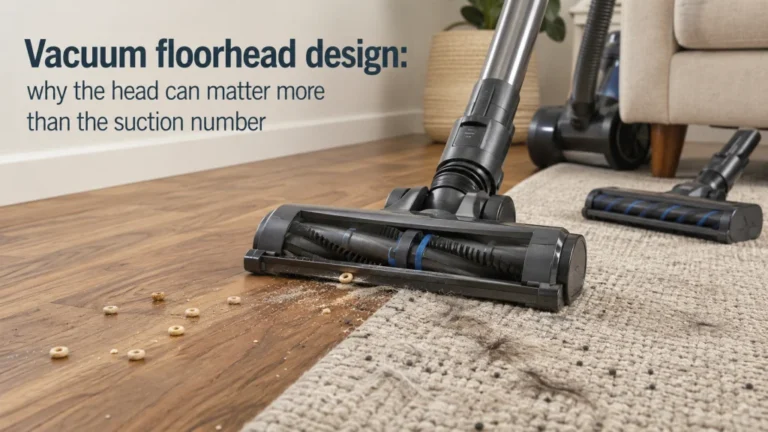
Pickup is not just a motor question because the floorhead controls how debris reaches the airflow path. A soft roller can be excellent at contacting fine debris on hard flooring, while a bristled brushroll can provide the agitation needed to work through carpet fibers and lift hair. Dual-roller and multi-surface heads aim to cover more than one flooring type, but a wider capability range can add weight, complexity, or bulk. The useful comparison is therefore not which head looks more advanced, but which one produces dependable pickup on the surfaces you clean most.
Pay attention to the mess that forces repeat passes in your own home. Large crumbs, gritty particles, fine dust, hair, and debris near edges can expose different weaknesses, so a single suction specification cannot predict every result. Thick rugs can also create excessive resistance for some floorheads, while a hard-floor-oriented roller may not provide enough carpet agitation. If you are still deciding between architectures rather than only cordless models, the broader stick vacuum vs upright vacuum comparison is the better place to settle that question first.
Balance weight in hand against bin size and cleaning distance
Total vacuum weight matters, but it does not tell you exactly how heavy the machine feels during use. Cordless stick designs place the motor, battery, and bin in different positions, so two machines with similar total weight can feel different when lifted for stairs, shelves, upholstery, or ceiling edges. A larger bin can reduce emptying stops but may add bulk near the handle, especially as debris accumulates. The right balance depends on whether your route is mostly open-floor pushing or includes frequent lifting and handheld work.
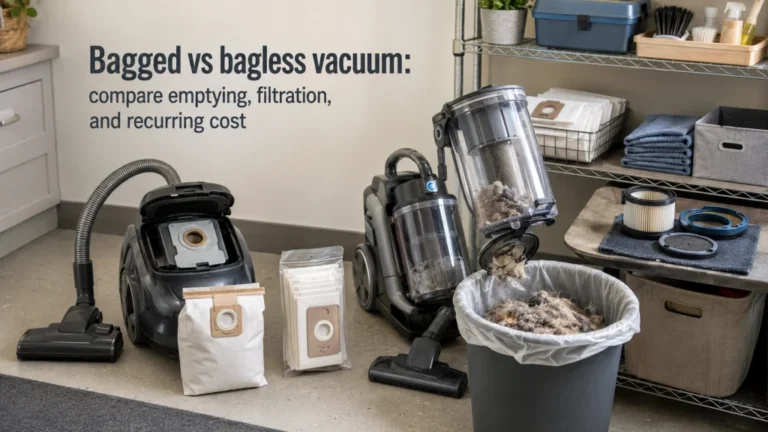
Bin size should be judged against debris volume rather than room count alone. A small home with shedding pets can fill a compact bin faster than a larger low-debris home, and fine dust can occupy less visible volume while still demanding filter maintenance. Emptying frequency also changes the ownership experience because many cordless vacuums are bagless and require direct contact with the dust cup. A comfortable vacuum that needs one predictable emptying stop may be a better fit than a larger machine that becomes tiring long before the bin fills.
| Handling pattern | Weight priority | Bin priority | Best fit signal |
|---|---|---|---|
| Mostly open floors | Moderate | Moderate to high | The vacuum steers easily and finishes the route without repeated emptying |
| Frequent stairs | High | Moderate | The machine remains controlled when lifted and carried between steps |
| Frequent handheld cleaning | Very high | Low to moderate | The motor unit stays comfortable during upholstery, car, and above-floor work |
| High pet-hair volume | Moderate | High | The bin and brushroll can handle repeated hair pickup without constant interruption |

The CleanView XR Pet 3797V uses a lightweight cordless design that converts to handheld cleaning for stairs, upholstery, and other lifted tasks. BISSELL lists three cleaning modes and up to 40 minutes of runtime from its removable 24V Max battery. Its FurBrush and wall-mount charging setup support pet-hair pickup and compact storage without adding a large floor dock.
Check On AmazonIf you click this link and buy, we earn a commission at no additional cost to you.
Check charging, storage, and battery replacement before the final shortlist
A cordless vacuum only stays convenient if its charging arrangement fits where you can realistically store it. Wall mounts can keep the machine off the floor, freestanding docks can simplify parking, and removable batteries can make charging more flexible when the storage location lacks a nearby outlet. None of those arrangements is automatically better because each one consumes a different kind of space and may require tools, wall clearance, or a permanent floor footprint. Picture the vacuum, charger, attachments, and spare battery together rather than judging the main unit alone.
Battery replacement deserves a separate check because removable does not always mean easily replaceable for the life of the vacuum. Confirm that the battery can be purchased through a supported channel, that the correct part is clearly identified, and that replacement does not require service work beyond what the manufacturer allows the owner to do. If the household relies on one cordless machine for most floor cleaning, battery availability can matter more than a rarely used accessory. A second battery is most valuable when the first battery would otherwise stop a normal route, not simply because the vacuum accepts one.

This aftermarket rechargeable battery is marketed for BISSELL CleanView XR and CleanView XR Pet cordless vacuums, including models 3789U and 3797V, as a replacement for the 4054 battery. It offers an option for owners who need to replace an aging battery or keep an additional pack ready between cleaning sessions. The listing advertises a 6.5Ah capacity, although actual runtime may vary. Confirm your vacuum model, connector, and charger compatibility before ordering, and follow lithium-ion battery handling and charging instructions carefully. This is not an original BISSELL-branded battery.
Check On AmazonIf you click this link and buy, we earn a commission at no additional cost to you.
Treat self-empty docks as ownership features, not proof of better cleaning
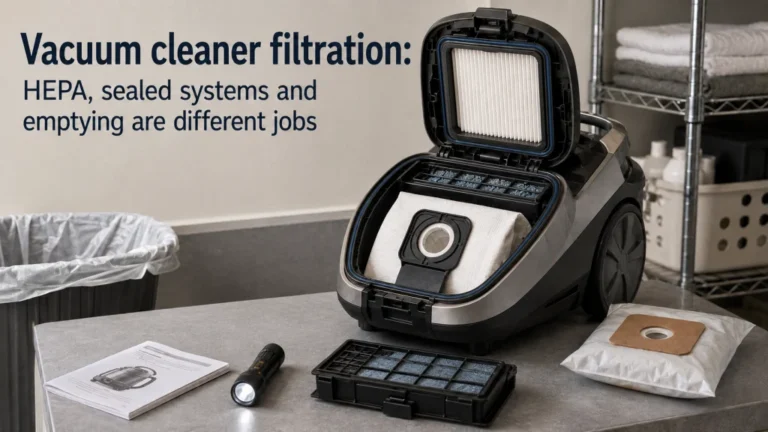
The Samsung pick shows both the value and the limit of a self-empty dock. Its Clean Station can move debris from the small onboard bin into a larger bag, and RTINGS found that this arrangement releases far less dust during emptying than the usual open bagless process. That is a meaningful ownership benefit for someone who dislikes frequent dust-cup handling. It still does not make the Samsung the strongest cleaner in this shortlist or erase the severe battery penalty at its highest setting.
The dock also becomes a permanent part of the room rather than a small accessory you can ignore. It needs floor space, power, clearance, and access for replacing the collection bag, while the vacuum still needs its own brushroll and filter maintenance. A household that empties a normal cordless bin without much annoyance may gain very little from that extra footprint. A household that vacuums shedding debris often and strongly prefers bagged disposal may find the ownership trade worthwhile even when another vacuum has the better performance-to-price case.

The BU3521 returns to its base to empty debris and recharge automatically. Shark lists up to 40 minutes in ECO mode measured at the hand vacuum, and the unit converts to a removable hand vac for above-floor work. Its multi-surface system automatically adjusts for different floor types, making the dock a convenience feature layered onto a full cordless cleaner.
Check On AmazonIf you click this link and buy, we earn a commission at no additional cost to you.
Verify price and availability only after the performance fit is clear
The four picks occupy very different price positions, so value depends on which compromise you are paying to remove. The BISSELL is the easiest to justify when hair pickup is the main problem, while the two Dysons charge more for a broader performance or lower-weight case. The Samsung sits at the premium end because the Clean Station and automated ownership features are a major part of what you are buying. A discount should not move a lower-fit model above a better-fit one unless the performance and workflow trade still make sense at the new price.
Live stock and bundle contents can change faster than the performance evidence, so verify the exact configuration immediately before checkout. Dyson sells several V15 and V12 packages with different tools, and Samsung bundles can vary by market even when the core vacuum name looks similar. Confirm the floorheads, charger or dock, battery count, and supported replacement battery before treating two listings as equivalent. If a recommended configuration disappears, replace it only with a model that still passes the same pickup, runtime, weight, bin, and floor-fit tests rather than substituting the nearest product name.

The PowerClean FurFinder 4052 is a self-standing cordless configuration with a removable battery and wall mount. This exact listing also includes an upholstery tool and bright headlights, details that matter when comparing similarly named bundles. Checking the specific model number and included accessories keeps the retail configuration aligned with the features being evaluated.
Check On AmazonIf you click this link and buy, we earn a commission at no additional cost to you.
Reconsider cordless if the cleaning session keeps fighting the battery
Cordless convenience is strongest when the battery comfortably covers the work you want to do without making you manage power constantly. If your home has a long carpet-heavy route, repeated deep-cleaning sessions, or a pattern of using stronger power for much of the job, a cord may remove more friction than it creates. That does not make cordless weak, and it does not make corded machines automatically stronger in every other respect. It simply means the power source should match the duration and intensity of the cleaning session.
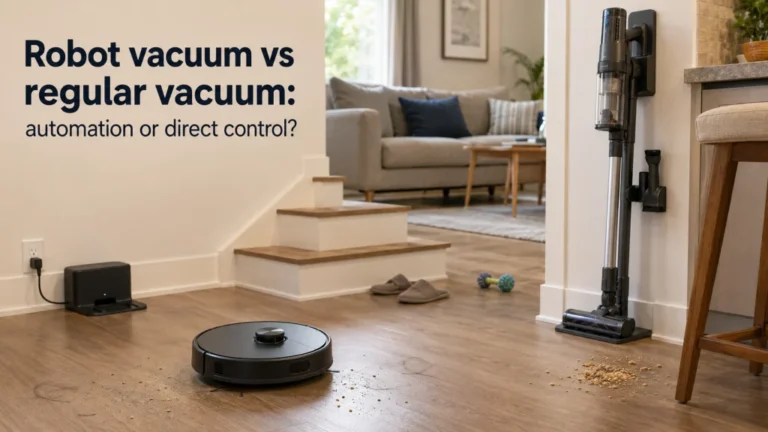
Within home cleaning appliances, cordless vacuums are only one way to solve the floor-cleaning job. If you are unsure whether battery management is a reasonable trade for quick retrieval and unrestricted movement, use the corded vs cordless vacuum comparison before narrowing the shortlist further. If the uncertainty is broader and you have not settled the machine architecture at all, start with types of vacuum cleaners. Readers comparing current choices across more than one vacuum type can also move to best vacuum cleaners. Solving the architecture question first prevents a cordless ranking from answering a purchase question you have not actually settled.

The corded NV352 uses a Lift-Away pod for stairs and above-floor cleaning while the main head handles carpet and hard floors. Brushroll shutoff lets the floorhead switch between carpet agitation and bare-floor cleaning. Because it runs from AC power rather than a battery, it directly fits a section about removing runtime management from longer cleaning sessions.
Check On AmazonIf you click this link and buy, we earn a commission at no additional cost to you.
Final thoughts
For the broadest mixed-floor case, the Dyson V15 Detect is the first model I would compare against the rest of the shortlist. Move to the V12 Detect Slim when lower weight matters enough to accept a much smaller bin and weaker carpet results. Choose the BISSELL PowerClean FurGuard when repeated hair pickup is the job that keeps bringing the vacuum out. Consider the Samsung Bespoke AI Jet Ultra only when the self-emptying workflow solves a real ownership problem that is worth its cost and permanent dock space.
The runtime numbers explain why those recommendations separate instead of collapsing into one winner. High-power cleaning can shrink a long advertised battery claim into a much shorter session, while a light vacuum can earn its keep even when another model has better carpet pickup. Use the source-labeled measurements to find the compromise your household can live with, then verify the exact retail configuration before buying. That produces a shortlist tied to real cleaning behavior rather than a ranking built around the largest specification on the box.
Frequently asked questions
Cordless vacuum questions often sound simple because shoppers are given one runtime number, one weight, and a short list of features. In practice, those figures only become useful after they are connected to power mode, floor type, floorhead, debris load, and the amount of lifting in the cleaning route. Battery and bin limits can also be more important in one household than another. The answers below focus on those practical differences rather than treating one specification as a universal cutoff.
Use the answers as filters rather than fixed purchasing rules. A home with mostly hard flooring can tolerate a different floorhead and runtime balance than a home with carpet, stairs, and shedding pets. Likewise, a lighter vacuum can justify a smaller bin when handheld comfort matters more than uninterrupted whole-house cleaning. The best result comes from matching the machine to the route instead of trying to maximize every specification at once.
🔋 How much cordless vacuum runtime do I really need?
Enough to finish your normal route at the power level you actually use, with a reasonable margin. Do not size the battery from the lowest-power maximum alone if carpet or repeated debris regularly pushes you into stronger modes.
🧹 Is stronger suction always better for a cordless vacuum?
No. Pickup depends on airflow, floorhead contact, brush action, debris type, and surface resistance as well as available suction. Extra power can also reduce runtime, so the useful question is whether the vacuum clears your floors efficiently without needing maximum mode for ordinary cleaning.
⚖️ How important is cordless vacuum weight?
It becomes especially important on stairs, during handheld use, and when cleaning above the floor. Total weight is only part of the story because weight distribution near the hand can change how tiring the vacuum feels.
🗑️ Is a bigger dust bin always better?
No. A larger bin can reduce emptying stops, but it can also add bulk and weight where the vacuum is being held. Match bin volume to the amount of hair, crumbs, and dust you usually collect in one session.
🔄 Is a removable battery worth having?
It is useful when you need flexible charging or when a second battery would genuinely extend a normal cleaning route. Also verify that a correct replacement battery is supported and obtainable rather than assuming removability alone guarantees easy long-term replacement.
🏠 Is a self-empty dock worth the extra space?
It can be when frequent dust-cup emptying is one of the main chores you want to reduce. The dock should still be judged by its floor space, power requirement, collection system, and maintenance rather than treated as evidence that the vacuum cleans better.
References and sources
These references are included because the recommendations depend on current model testing, measured runtime, pickup, weight, bin behavior, and model-specific battery conditions. RTINGS provides the common measurement framework for the Dyson and Samsung comparisons, while Good Housekeeping adds floorhead-attached runtime and task-specific observations from its stick-vacuum testing. BISSELL support is used only where a manufacturer-specific mode breakdown is needed for the FurGuard. The recommendations above keep those test conditions visible instead of turning unlike measurements into one artificial score.
The source list is intentionally limited to evidence that changes the buying verdict. Retail prices and stock can move quickly, so they are not frozen into the recommendation table as if they were permanent specifications. Check the exact package before buying because battery count, tools, floorheads, and dock contents can differ between listings. If future testing or model availability changes the performance case, the source-labeled shortlist should be updated rather than leaving an old winner in place.
- RTINGS cordless vacuum recommendations and measured comparison: Supports the current broad ranking and the comparison framework for pickup, runtime, weight, filtration, and portability.
- RTINGS Dyson V15 Detect review: Supports the V15 pickup results, 8-to-75-minute measured runtime range, tested weight, dirt-compartment size, battery serviceability, and thick-rug limitation.
- RTINGS Dyson V12 Detect Slim review: Supports the V12 pickup scores, runtime range, total and in-hand weight, dirt-compartment size, and battery serviceability.
- RTINGS Samsung Bespoke AI Jet Ultra review: Supports high-power floorhead runtime, low-power runtime, weight, self-emptying behavior, filtration, storage, and the dock trade-offs.
- Good Housekeeping cordless stick vacuum testing: Supports the task-specific recommendations for the V12 Detect Slim, PowerClean FurGuard, and Bespoke AI Jet Ultra, plus its floorhead-attached testing approach.
- BISSELL PowerClean FurGuard battery guidance: Supports the floorhead-attached eco, medium, and turbo runtime figures used in the pet-hair recommendation.