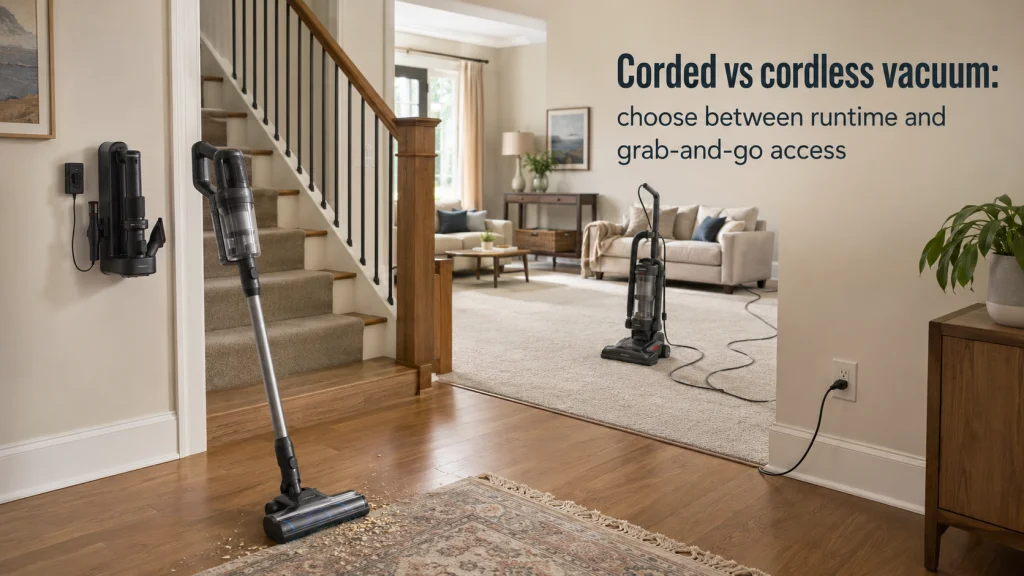
A corded vacuum removes battery planning but adds outlet changes and cord management, while a cordless vacuum removes the cord but puts the cleaning session on a battery budget. The better choice depends less on a simple power claim and more on whether your normal route can finish without the kind of interruption you dislike most. Large carpeted cleaning sessions tend to expose runtime limits sooner, while stairs, scattered messes, and frequent room changes make grab-and-go access more valuable. The goal is to match the power source to your actual cleaning route, then compare pickup, weight, noise, storage, and replacement support at the model level.
Start with the interruption you would rather manage
The corded vs cordless vacuum decision is easiest when you stop treating one format as powerful and the other as convenient. A corded machine can keep running as long as the cleaning job continues, but its route is broken into outlet-sized zones. A cordless machine lets you cross rooms, stairs, and furniture paths without unplugging, yet the entire session depends on the charge available in the mode and floorhead you actually use. Both designs interrupt cleaning, but they interrupt it in different places.
That distinction matters because household frustration is rarely caused by the power source in isolation. A person who cleans one room at a time may barely notice battery limits, while someone who prefers a long whole-home session may find charge management irritating even with good pickup. The opposite can happen in a multi-level home where a long cord repeatedly catches on corners or forces outlet changes before the dirt bin is even close to full. Choose the interruption pattern that fits your routine first, then judge the machine that delivers it.
| Cleaning situation | Corded interruption | Cordless interruption | What to verify |
|---|---|---|---|
| One long whole-home session | Outlet changes and cord repositioning | Charge remaining before the route is complete | Actual route length, outlet reach, and runtime in the intended mode |
| Frequent small messes | Plug-in setup can feel larger than the job | Battery must already be charged | Storage location and how quickly the vacuum can be put into use |
| Stairs and multiple floors | Cord routing and available outlets can break the route | Carried battery and motor weight remain with the user | Complete carried weight, stair tool setup, and charging location |
| Carpet-heavy cleaning | Power is continuous but the floorhead still controls real pickup | Higher-power operation can shorten usable session length | Carpet pickup testing and runtime with the powered head attached |
The table is not a scorecard with a universal winner. It is a way to identify where your session is most likely to stop, slow down, or become annoying. Once that is clear, the remaining comparison becomes much more concrete. You can then reject models whose runtime, reach, or handling does not fit the route.

This corded stick vacuum weighs under 9 pounds and converts to a handheld vacuum for stairs, furniture, car interiors, and tight spaces. Swivel steering and low-profile reach help it move through furniture paths, while crevice and upholstery tools cover smaller jobs. It gives readers a concrete corded example for judging continuous power against outlet changes and cord routing.
Check On AmazonIf you click this link and buy, we earn a commission at no additional cost to you.
Separate the power source from the vacuum architecture
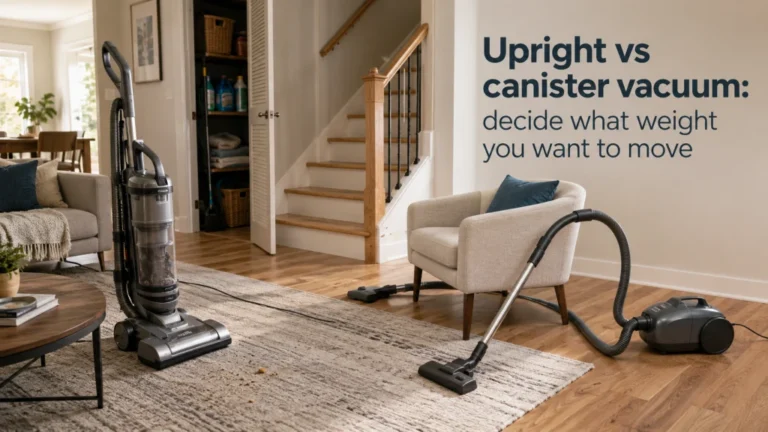
A common mistake is to compare a cordless stick with a corded upright and then attribute every difference to the battery or cord. Power source and architecture are separate decisions. Within home cleaning appliances, the power source is only one layer of household fit. A vacuum can place weight in the hand, on the floor, in a canister, or in an upright body, and those layouts change steering, storage, carrying, hose use, and floorhead behavior. The broader overview of vacuum cleaner types and household layouts is the better place to sort those structural differences.
This article stays focused on cord versus battery because that is the part that changes session continuity. If you are also deciding whether you want a stick or upright body, compare stick and upright vacuum layouts separately instead of letting the power source decide both questions at once. A lightweight corded stick can behave very differently from a full-size corded upright, just as a cordless machine with a heavy motor unit can feel different from another battery-powered design. Keeping those decisions separate prevents an easy but misleading shortcut.

This corded upright uses Lift-Away functionality so the pod can detach for stairs, furniture, and other above-floor cleaning. It includes HEPA filtration, swivel steering, brushroll shutoff, a dusting brush, and an 8-inch crevice tool. The layout makes it a useful example of how vacuum architecture changes handling and tool use independently of the corded power source.
Check On AmazonIf you click this link and buy, we earn a commission at no additional cost to you.
Compare measured pickup instead of assuming corded always means stronger
The old shortcut that corded always cleans better is too broad for current vacuums. Independent testing now shows that some cordless machines can deliver strong debris and pet-hair pickup on both bare floors and carpet, while individual corded machines can still vary widely by floorhead design, sealing, brush action, and airflow path. That means the power source alone does not prove how much dirt a vacuum will remove from your specific surface. For buying decisions, measured pickup under stated test conditions is more useful than a generic corded-versus-cordless claim.
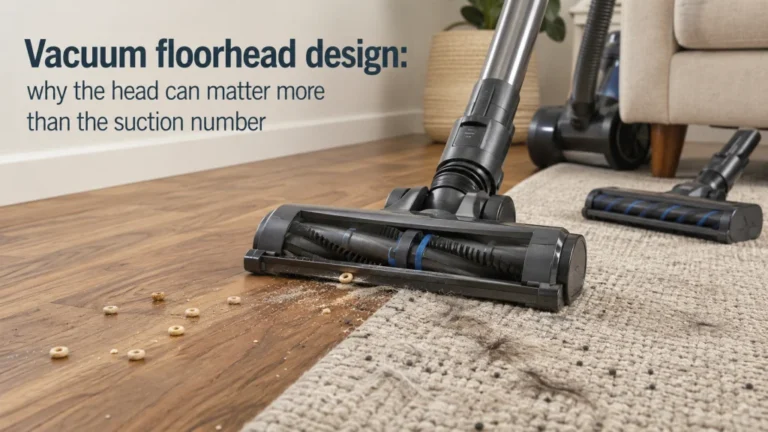
Suction numbers also need context because a vacuum does not clean a floor with a motor specification alone. Head design, brush roll behavior, seals, airflow, floor type, and how the machine controls power all affect what reaches the bin. If a product page leads with air watts, pascals, motor watts, or another power number, use vacuum suction power and airflow measurements to understand what that number can and cannot tell you. Then return to pickup testing that matches the surfaces you actually clean.

This upright combines a detachable Lift-Off canister with a tangle-free brush roll for floor and above-floor cleaning. Its sealed HEPA system and pet-hair-focused floor cleaning features give readers model-specific details beyond a simple corded label. That makes it relevant beside a section that tells readers to compare actual pickup design and test results instead of assuming the power source determines cleaning strength.
Check On AmazonIf you click this link and buy, we earn a commission at no additional cost to you.
Treat advertised battery life as a range of operating conditions
Unlimited plugged-in runtime is straightforward: the corded vacuum can keep operating while power is available and the machine is otherwise ready to use. Cordless runtime is more conditional because the battery draw changes with power mode, motorized attachments, automatic adjustments, and sometimes the surface being cleaned. Independent battery testing commonly separates low-power maximum runtime from high-power minimum runtime for exactly this reason. A single maximum-runtime number should not be treated as the amount of time available for demanding carpet cleaning.
The practical check is to estimate how long your normal route takes when you are actually cleaning, not when the vacuum is simply running. Include furniture moves, edge work, stairs, tool changes, and the surfaces that make you raise the power level. If your routine regularly needs a higher-output mode, compare runtime in that condition rather than the most favorable marketing condition. A battery that technically lasts through light hard-floor work may still be the wrong fit for a carpet-heavy session.

The LVAC-200 lists up to 50 minutes with the crevice or pet tool in Eco mode, 30 minutes with the vacuum head, and 12 minutes in Turbo mode. Its anti-tangle design and 180-degree lay-flat body support carpet, hard-floor, and under-furniture cleaning. Those mode-specific runtime figures directly show why a single maximum battery-life number should not be treated as the usable runtime for every cleaning condition.
Check On AmazonIf you click this link and buy, we earn a commission at no additional cost to you.
Match large homes and carpet-heavy routes to the full cleaning session
Home size matters because it usually increases route length, not because a particular square-foot threshold automatically requires a cord. A larger home with mostly hard floors, frequent spot cleaning, and a short routine may still work well with a cordless machine. A smaller home with thick carpet, pets, and one long weekly cleaning session can place a much heavier demand on runtime and the powered floorhead. The workload is the combination of area, surface, debris, and cleaning style.
Carpet is especially important because it can push a cordless vacuum toward the operating mode that uses more energy. The right comparison is therefore not maximum battery life versus unlimited corded runtime in the abstract. It is usable runtime in the mode that delivers acceptable carpet pickup versus the time your normal carpet route requires. If those numbers are close, the machine may feel fine when new and still leave little room for a second pass, stairs, or unexpected messes.
| Your household pattern | Runtime question | Corded route question | Decision signal |
|---|---|---|---|
| Mostly quick room-by-room cleaning | Can the battery easily cover the usual short job? | Would plugging in be more setup than the job deserves? | Cordless convenience may carry more value |
| Long whole-home session | Can the intended mode finish the complete route with reserve? | How many outlet changes does the route actually require? | Compare battery stoppage with outlet friction |
| Heavy carpet load | What happens to runtime in the carpet mode you need? | Does the corded floorhead perform well on that carpet? | Pickup and continuity both matter |
| Mixed floors across several levels | Does carrying and tool switching reduce the cordless advantage? | Can the corded setup reach stairs without awkward cord routing? | Handling may matter as much as runtime |
Write down the route before shopping instead of trying to remember it while comparing specifications. Note which rooms are carpeted, where stairs occur, where outlets are inconvenient, and where you usually stop to move furniture or change tools. That worksheet turns “large home” into a real cleaning sequence that a power source can either support or fight. It also exposes whether the real problem is runtime, outlet reach, handling, or floor performance.

This corded upright is designed for carpet and hard-floor cleaning and uses Lift-Away functionality for above-floor tasks. It includes swivel steering, brushroll shutoff, a 1.04-liter dust cup, a wide upholstery tool, and a 12-inch crevice tool. Its continuous wall-powered format and multi-surface setup make it a useful model for comparing long carpet-heavy routes with cordless runtime limits.
Check On AmazonIf you click this link and buy, we earn a commission at no additional cost to you.
Use stairs and room-to-room movement to judge real portability
Cordless freedom is most valuable when the cleaning route crosses spaces where a cord repeatedly gets in the way. Stairs, landings, entry areas, cars, and scattered crumbs are obvious examples because the next cleaning point may be only a few steps away but outside the current outlet zone. Removing the plug-and-replug step can make those jobs happen more often because the vacuum is ready with less setup. That convenience is real even when it does not improve measured pickup.
Still, cordless does not automatically mean effortless. Many battery-powered designs place the motor and battery near the handle, so the user may carry more of the machine’s mass in the hand during stairs, overhead work, or tool use. A corded canister can be heavier overall yet leave much of that mass on the floor, while a corded upright may be easy to push but awkward to lift between levels. Compare the weight where it is supported during the task, not just the number printed on a specification sheet.

The NES215A weighs 4 pounds and converts among stick, handheld, and stair-vacuum configurations. Its swivel steering and onboard crevice tool support room changes, stairs, and tighter cleaning points without adding a heavy full-size body. That combination makes it directly relevant to the section on judging portability by the weight and layout carried through the actual route.
Check On AmazonIf you click this link and buy, we earn a commission at no additional cost to you.
Add charging, storage, and battery replacement to the ownership check
A cordless vacuum is easiest to live with when charging happens automatically as part of storage. If the charger is across the house, the dock has no practical place near an outlet, or the machine must be unpacked to charge, grab-and-go convenience can disappear into a different routine. A corded vacuum avoids that charging habit but still needs a place for the cord, hose, wand, and tools. Compare the complete stored footprint rather than the main vacuum body alone.
Battery replacement also belongs in the buying decision because the battery is a wear component, yet its service life and replacement path vary by exact model. Do not assume a replacement will always be available or that two batteries from the same brand are interchangeable. When comparing exact models, look at the upfront price together with the current cost and availability of a compatible replacement battery, rather than assuming cordless is always more expensive over time. Check the current part number, official compatibility information, replacement price, warranty terms, and whether the battery is user-removable before you treat future replacement as easy. Those checks are part of ownership cost, not an optional technical detail.
- Confirm where the vacuum will live and whether that location has practical charging access.
- Check whether the battery is removable and whether an official replacement path exists for the exact model.
- Compare the upfront price with model-specific battery replacement cost and availability when that difference could affect long-term value.
- Count every item that needs storage, including the charger, extra battery, floorheads, hose, wand, and small tools.
- Follow the exact manual for charging, storage, damaged cords, damaged batteries, overheating, or other safety-related conditions.
The goal is not to make cordless ownership sound complicated. It is to make sure the convenience survives once the vacuum has to be charged, stored, emptied, and maintained in a real room. A power source fits best when its routine is easy enough that you actually keep using it. If storage or charging adds repeated friction, include that cost in the decision before buying.

This cordless stick vacuum includes a wall mount and can transform into handheld or high-reach configurations. The listing specifies up to 50 minutes of cordless cleaning and includes an upholstery tool plus bright headlights. Its charging-based power source, wall-storage hardware, and convertible layout give readers a concrete ownership setup to evaluate before deciding where a cordless vacuum will live.
Check On AmazonIf you click this link and buy, we earn a commission at no additional cost to you.
Compare noise and weight only after you narrow the exact models
Noise and weight are often used as shortcuts in a cordless vs corded vacuum comparison, but neither characteristic belongs reliably to one power source. A compact cordless model may be easy to carry yet feel hand-heavy because the battery and motor sit above the wand. A corded model may weigh more on paper while keeping much of that weight on wheels or the floor during normal use. The relevant measurement is the weight you push, pull, lift, or hold for the task that bothers you most.
Noise varies for the same reason. Motor design, airflow, floorhead contact, brush speed, seals, and power mode can all affect what you hear, so battery power is not a reliable proxy for quiet operation. If noise matters in your home, compare tested sound levels or listen to the exact model under the setting and floorhead you expect to use. Do not buy a cordless vacuum because you assume it will be quieter, and do not reject a corded model because you assume it will be louder.

This compact upright weighs 7.7 pounds and uses a 10.5-inch cleaning path. Its quick-release handle works with the crevice tool or dusting brush for above-floor cleaning, while the 1.7-liter dust cup supports longer cleaning before emptying. The verified model weight gives readers a concrete number to compare instead of assuming that corded or cordless designs are inherently lighter.
Check On AmazonIf you click this link and buy, we earn a commission at no additional cost to you.
Build a corded, cordless, or mixed outcome from your routine
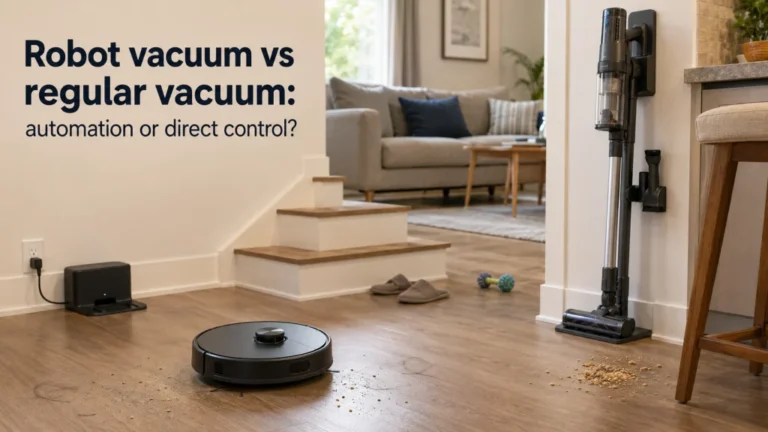
A corded or cordless vacuum choice does not have to end with one format replacing every other cleaner in the home. Corded makes the most sense when your priority is a long, predictable cleaning session and outlet management is a tolerable interruption. Cordless makes the most sense when cleaning happens in short bursts, across stairs or multiple rooms, and the battery can comfortably cover the real job. A mixed setup is reasonable when the household has both kinds of work and neither format handles both without creating repeated friction.
The mixed outcome is not automatically an excuse to buy more equipment. It is useful only when the second machine removes a recurring job that the first one handles badly, such as quick pickups that feel too small for a full corded setup or long carpet sessions that repeatedly exhaust a battery. If one machine already covers the routine without meaningful interruption, adding another creates storage, maintenance, and cost without much benefit. The right endpoint is the smallest setup that reliably covers the jobs you actually do.
- Choose corded when long sessions, demanding carpet work, and freedom from charge planning matter more than cord handling.
- Choose cordless when quick access, stairs, room changes, and low setup friction matter more than unlimited runtime.
- Choose a mixed setup when quick daily cleaning and long deep-cleaning sessions are both frequent enough to justify separate tools.
- Keep what you have when the current vacuum already finishes the route with acceptable pickup and manageable ownership work.
That last outcome deserves equal weight because a new power source is not an upgrade unless it fixes a real limitation. If the current problem is actually poor floorhead fit, clogged airflow, awkward architecture, or the wrong tool for the surface, changing from corded to cordless may simply move the frustration. Diagnose the job before replacing the machine. A new vacuum should solve the identified constraint rather than create a different one.

This rechargeable handheld vacuum is designed for portable home and vehicle cleanup. Its rotating slim nozzle and pull-out crevice tool reach tight spaces, while the compact body stores on its charging station. As a smaller second cleaner, it fits the mixed-setup outcome when quick pickups are frequent enough that bringing out a full-size vacuum creates unnecessary setup.
Check On AmazonIf you click this link and buy, we earn a commission at no additional cost to you.
Compare current models only after the power-source decision is clear
Once you know that battery power fits your cleaning route, current model testing becomes useful because cordless pickup, runtime, filtration, and portability can differ substantially. Use the comparison of current cordless vacuums for different household needs to narrow models by the surfaces, runtime demands, and handling requirements you already identified here. That keeps a flashy battery claim from restarting the entire decision. The model still has to fit the route you planned. A shortlist that ignores the route simply recreates the original problem at the model level.
If you are not committed to either power source, start instead with current vacuum choices across different household setups . Compare pickup and usability first, then check whether the cord or battery creates the more acceptable ownership routine. Comparing cordless and corded vacuums is useful only until it identifies the better operating pattern for your home. After that point, exact model evidence should take over.

The IX141 is a cordless stick vacuum with a removable handheld mode, LED headlights, an XL dust cup, a crevice tool, and a pet multi-tool. Amazon lists up to 40 minutes of runtime measured at the hand vacuum in standard mode. It gives readers an exact-model example to compare by floor type, tool setup, runtime condition, and portability after the power-source decision is clear.
Check On AmazonIf you click this link and buy, we earn a commission at no additional cost to you.
Final Thoughts: choose the interruption you can live with
The corded vs cordless vacuum choice comes down to whether your routine is more disrupted by outlet management or by a battery limit. Long carpet-heavy sessions tend to reward continuous power, while stairs, room changes, and frequent small jobs make untethered access more valuable. Start with the route, surfaces, and session length before you compare features. That keeps the power-source choice tied to work you actually do instead of a broad claim about which format is better.
Then verify the exact model rather than carrying broad assumptions into the final purchase. Look for measured pickup on your floor types, runtime in the operating mode you expect to use, carried weight where it matters, practical storage, and a credible replacement path for wear parts and batteries when applicable. If your current vacuum already handles those jobs without repeated friction, there is no need to complicate the setup. Choose the machine that covers the route cleanly with the least ownership work you are likely to resent.

This compact corded upright weighs less than 10 pounds and includes a quick-release extension wand for above-floor cleaning. The listing positions it as full-size suction in a compact design intended for apartments and dorms. It gives readers another exact model to evaluate against the route, storage, handling, and pickup requirements summarized in the final decision framework.
Check On AmazonIf you click this link and buy, we earn a commission at no additional cost to you.
FAQs
The questions below focus on the points that most often change the decision after the basic cord-versus-battery tradeoff is understood. They are not shortcuts around model-specific verification, because runtime, pickup, weight, storage, and battery support can vary substantially. Use them to identify which specification or test result deserves your attention next. Then verify that point for the exact vacuum you are considering.
The most useful answer is usually conditional rather than absolute. A large home does not automatically require a cord, and a cordless machine is not automatically the better stair vacuum. The route, floor type, cleaning frequency, power mode, and physical layout determine which limitation becomes important. If those conditions change, the recommendation can change with them.
🔋 Can a cordless vacuum replace a corded vacuum for whole-home cleaning?
Yes, if its tested pickup and usable runtime cover your full cleaning route in the mode and floorhead you actually need. Large carpeted routes are more likely to expose battery limits, so compare the demanding condition rather than the longest advertised runtime.
🏠 Is a corded vacuum automatically better for a large house?
No. A corded vacuum removes charge limits, but a large home with convenient outlets and short room-by-room cleaning may not need that advantage. Compare your real session length with cordless runtime and your outlet route with cord reach.
🧶 Is corded always better for carpet?
No. Carpet results depend on the exact floorhead, brush action, airflow, suction, and test conditions. Corded runtime can support long carpet sessions, but the machine still needs proven pickup on the carpet type you have.
🪜 Is cordless always easier on stairs?
Not always. Cordless removes cord routing, but some designs place the battery and motor weight in your hand. Compare the complete stair setup, including carried weight, tool security, balance, and whether a corded hose or canister arrangement would keep more weight off your arm.
🔌 Should I buy a vacuum with a removable battery?
A removable battery is valuable when it extends a real cleaning session or makes future replacement practical. Verify the exact battery compatibility, current replacement path, storage needs, and cost before treating it as a must-have feature.
📦 Which type is easier to store?
It depends on the complete setup. Cordless machines may need a charging dock and nearby outlet, while corded machines may need more room for the body, cord, hose, and tools. Measure the stored footprint with every part you plan to keep together.
References and Sources
The performance claims in this comparison rely on independent testing rather than a blanket assumption that one power source always cleans better. Battery runtime is especially sensitive to power mode and attached tools, so the cited test methodology is more useful than a single marketing number. Current corded and cordless test roundups also show that strong pickup exists in both groups, with meaningful variation between individual machines. Those findings support the article’s model-level approach to performance.
The direct comparison source is used for the basic household tradeoff between continuous plugged-in operation and battery-based mobility. It also reinforces why home size, floor type, cleaning habits, and movement through the home matter to the decision. These sources do not prove that every corded or cordless vacuum behaves the same way. Exact product pages and manuals should still be checked for the model a reader is considering.
- RTINGS battery test methodology : explains how cordless runtime changes between high-power and low-power test conditions and with powered attachments.
- RTINGS cordless vacuum testing : supports the point that current cordless machines can combine strong pickup with meaningful differences in runtime and portability.
- RTINGS corded vacuum testing : supports the continuous-runtime advantage while showing that pickup and usability still vary by exact machine.
- TechRadar corded versus cordless comparison : supports the household tradeoff among runtime, movement, home size, floor type, and cleaning habits.