A stand mixer earns its place when it repeatedly removes work that your current tools make slow, tiring, or awkward. Baking frequency matters, but the harder test is whether the machine will be easy to access, useful for the batches you actually make, and acceptable to clean and store. Bread dough, long mixing jobs, and larger batches can push the decision toward buying, while occasional light mixing often leaves a hand mixer or manual method doing the job well enough. By the end, you should be able to choose one of three outcomes: buy now, wait until the routine is proven, or skip the stand mixer.
Define value by repeated work removed, not by capability
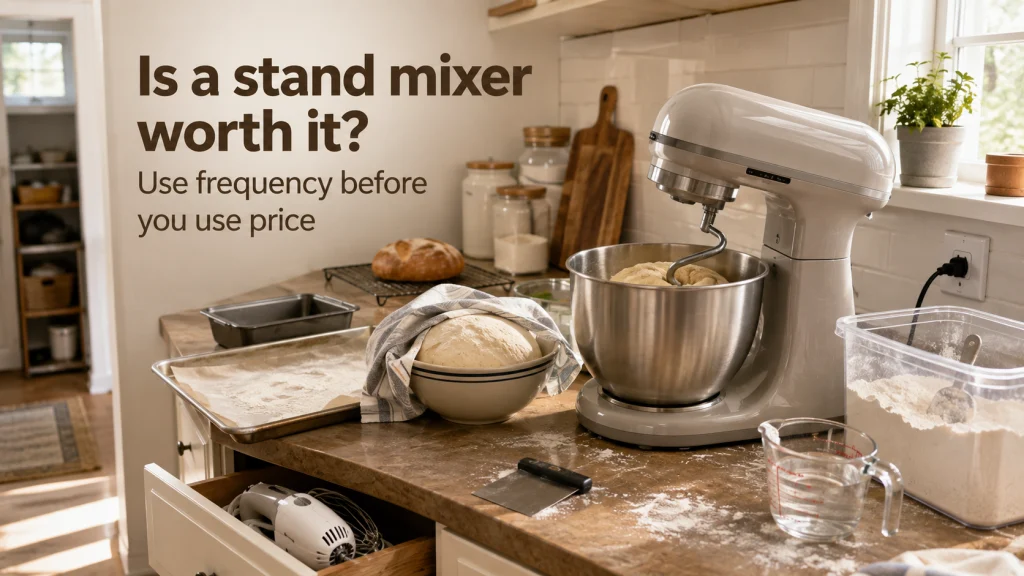
Is a stand mixer worth it? The useful answer starts with the work it removes from your normal kitchen routine, not with how many things the machine could theoretically do. A stand mixer can be excellent equipment and still be a poor purchase if it sits in an inconvenient cabinet, comes out only for a holiday batch, or replaces tasks that already feel easy. Price is only one part of the burden because the mixer also asks for storage space, lifting, bowl handling, attachment changes, and cleanup. A machine becomes easier to justify when those costs are paid back through repeated convenience.
That means the right unit of value is not features per dollar. It is recurring effort saved relative to the money, space, setup, cleanup, and access the machine requires. If ten minutes of light mixing with a hand mixer already feels effortless, transferring that job to a stand mixer may not change much. If you regularly hold a mixer through long beating, knead dough by hand, or stop other prep because both hands are occupied, hands-free support can remove a real bottleneck. That ownership test also helps place a stand mixer among other small kitchen appliances competing for counter space, storage, and regular use.

KitchenAid Classic K45SS pairs a 4.5-quart stainless steel bowl with 10 speeds and durable metal construction. Amazon lists 59 touchpoints around the bowl and capacity for up to eight dozen cookies in one batch. The model uses a tilt-head design and is compatible with KitchenAid attachments.
Check On AmazonIf you click this link and buy, we earn a commission at no additional cost to you.
Count the jobs that become meaningfully easier
Start with the recipes and prep jobs you already make, then separate them into tasks that need sustained mixing and tasks that are already comfortable with simpler tools. Whipped cream, cake batter, frosting, and many cookie recipes can often be handled with a hand mixer without creating much friction, especially in small batches. Longer beating, repeated batches, dense mixtures, and jobs that benefit from gradual ingredient additions make hands-free operation more valuable. The distinction is not whether a stand mixer can do the task, but whether using one changes the work enough to matter.
One mistake first-time buyers should avoid is counting every possible recipe as future value. Owning a mixer does not automatically turn occasional interests into weekly habits, and a capability you admire is not the same as a task you will repeat. Write down what you mixed during a normal month and note where you actually wished for another hand, more endurance, or less active attention. If most entries are quick jobs that already feel easy, the stand mixer has not yet crossed a strong ownership threshold.
Give long and heavy mixing more weight than light batter
Not all mixing minutes create the same amount of work. Bread dough, pizza dough, enriched dough, stiff cookie dough, and other demanding mixtures can make sustained machine support more useful because load and duration increase the effort required from the person doing the mixing. This does not mean every stand mixer is suitable for every dough, since model limits and manufacturer instructions still control what a specific machine should handle. It does mean that a household doing these jobs repeatedly has a stronger reason to consider stand-mixer ownership than a household mostly combining light batters.
Frequency and difficulty should be judged together. One heavy dough session every week may create more reason to buy than several monthly recipes that take only a minute or two with a hand mixer. The same logic applies to repeated large cookie batches, long whipping tasks, or recipes that need ingredients added gradually while mixing continues. If you are considering a stand mixer for bread dough or other demanding work, keep that need separate from model selection until you are sure the routine itself justifies ownership.
Put normal batch size and frequency ahead of price
A lower purchase price does not make an appliance valuable if it rarely leaves storage, and a higher price can be easier to justify when the machine removes work every week. The cleanest way to judge this is to compare routine frequency with the friction created by your current method. Normal batch size matters because a small household making one cake at a time has a different workload from someone preparing repeated loaves, double cookie batches, or several components in one session. Use the worksheet below to describe your real routine before thinking about what you might make after buying.
| Routine signal | What to record | Why it changes the decision |
|---|---|---|
| Frequency | How often sustained mixing actually happens | Repeated work gives convenience more chances to pay back |
| Batch size | Your normal batch, not the largest imagined batch | Larger or repeated batches can increase handling and mixing effort |
| Active effort | How long your hands must hold, stir, beat, or knead | Long active work makes hands-free operation more meaningful |
| Setup friction | How much effort it would take to retrieve and prepare the mixer | High setup friction can erase convenience before mixing starts |
| Cleanup friction | What bowl, tools, and surrounding mess must be cleaned | Extra cleanup can cancel time saved during a short task |
Do not turn this into an arbitrary rule such as needing to bake a certain number of times each month. A household can reasonably buy for one repeated demanding job, while another household can bake often and still prefer a lighter tool because the recipes are simple. What matters is whether the same friction keeps showing up often enough that you would notice its removal. If you have to invent future projects to make the worksheet look busy, waiting is usually the more disciplined choice.

KitchenAid KSMSFTA combines a sifter and digital scale in a stand-mixer attachment. It fits household KitchenAid stand mixers and uses a 4-cup ingredient hopper for hands-free sifting into the bowl. The included digital scale can also be used separately from the mixer on the countertop.
Check On AmazonIf you click this link and buy, we earn a commission at no additional cost to you.
Test whether the mixer can live where you will actually use it
Storage can decide this purchase before performance does. A stand mixer that lives on the counter is available with very little retrieval effort, while one stored deep in a cabinet adds a lifting and carrying step to every session. That does not automatically make cabinet storage a bad plan, but the location has to match your comfort, available shelf space, and how frequently the machine is expected to come out. If access is annoying before the first ingredient reaches the bowl, use frequency usually drops in practical terms.
Measure the intended location and think through the full path from storage to use. The question is not only whether the base fits on a shelf, but whether you can grip the machine securely, move it without rearranging half the cabinet, place it on a stable work surface, and put it away after cleanup. Permanent counter placement trades away work surface, while cabinet placement trades away convenience and adds lifting. If neither arrangement feels acceptable, the ownership problem is not solved by buying a more capable machine.

BAGSPRITE combines a stand-mixer cover with a slider mat for KitchenAid 6-, 7-, and 8-quart mixers. The slider mat is designed to make a heavy mixer easier to move across the counter. The cover includes pockets for KitchenAid mixer accessories and attachments.
Check On AmazonIf you click this link and buy, we earn a commission at no additional cost to you.
Add bowl handling, attachment changes, and cleanup to the math
Hands-free mixing can save active effort, but it does not make the rest of the process disappear. You still have to get the bowl and tool in place, add ingredients, scrape when a recipe requires it, remove the mixture, wash what became dirty, and return the machine or accessories to storage. For a long dough or repeated batch session, that trade can be very favorable because the mixer removes a large block of active work. For a tiny task, the setup and cleanup may take longer than the mixing you were trying to avoid.
Think in complete sessions rather than isolated mixing time. If your normal routine already uses one lightweight bowl and two beaters, switching to a larger bowl and more hardware should create a meaningful benefit somewhere else in the process. The benefit may be less arm effort, the ability to prepare another step while mixing continues, or better handling of a demanding batch within the exact model’s limits. If none of those benefits matters to you, a stand mixer can add ownership work without removing enough kitchen work.

KitchenAid KFE5T is a flex-edge beater for select 4.5- and 5-quart tilt-head KitchenAid mixers. Its flexible edge scrapes ingredients from the bowl while mixing, reducing the need for a separate scraping step. The beater is dishwasher-safe and fits models including K45SS, KSM75, KSM95, KSM150PS, KSM152PS, and KSM155GB.
Check On AmazonIf you click this link and buy, we earn a commission at no additional cost to you.
Count an attachment only when it replaces a real repeated task
Optional attachments are easy to overvalue because they make the mixer look like the center of an entire future cooking routine. That flexibility is useful only when the attachment replaces work or a separate appliance you genuinely use. A pasta-related attachment has no practical value to a household that rarely makes pasta, just as a food-prep attachment does not save space if a preferred dedicated tool is already easier to use. Treat every attachment as a separate ownership decision with its own cost, storage, cleanup, and compatibility requirements.
- Do you perform the attachment’s task now, without needing a new hobby to justify it?
- Would the attachment replace a separate appliance or repeated manual work you already use?
- Will it be stored close enough to the mixer that setup stays convenient?
- Is the attachment compatible with the exact mixer you may eventually buy?
- Does its cleanup routine still make sense for the amount of food you normally prepare?
If you can answer those questions with a real existing routine, the attachment may increase the value of the base machine. If the answers depend on imagined projects, leave that value out of the purchase calculation for now. Readers who already know attachments are central to their routine can continue with our stand mixer attachments article after deciding that the base appliance itself deserves a place in the kitchen. Compatibility still needs to be verified against the exact mixer and attachment rather than assumed from appearance or a generic product label.

KitchenAid KSMPRA is a three-piece pasta roller and cutter set powered by a household KitchenAid stand mixer. The set uses stainless-steel rollers and cutters and is designed to fit all household KitchenAid stand mixers. The set includes a cleaning brush for cleaning the pasta roller and cutters after use.
Check On AmazonIf you click this link and buy, we earn a commission at no additional cost to you.
Treat keeping your current tools as a legitimate outcome
Not buying is not the same as settling for an inferior kitchen. A hand mixer is compact, quick to retrieve, and well suited to many light mixing jobs, while manual tools can be entirely reasonable for short tasks that do not create fatigue or delay. If those methods already match your batch size and frequency, a stand mixer may solve a problem you do not actually have. The money and space can stay available for equipment that removes a more persistent source of work.
This article is not meant to become a full class comparison, because the ownership question comes first. If you know you want electric mixing but are still deciding which format fits your work, use the stand mixer vs hand mixer comparison for that decision. If you are earlier in the process and want to understand the broader types of mixers available for different kitchen jobs, start there instead. The important point here is that the stand mixer has to earn ownership on its own, not merely win a feature comparison.

Hamilton Beach 62682G uses a 250-watt motor with six speeds plus a QuickBurst control. It includes two traditional beaters and a whisk, and those attachments are dishwasher-safe. A snap-on storage case keeps the beaters and whisk with the hand mixer.
Check On AmazonIf you click this link and buy, we earn a commission at no additional cost to you.
Use a buy, wait, or skip path based on the routine you already have
Once the jobs, frequency, access, and cleanup are visible, the decision should become less emotional. A buy-now outcome needs repeated work that the machine clearly reduces and a storage plan that keeps the mixer accessible enough to use. A wait outcome fits households where the interest is credible but the routine is not yet established, such as someone planning to begin weekly bread baking but not doing it consistently now. A skip outcome fits households where the machine mainly serves rare possibilities, duplicates easy tasks, or creates more storage and lifting friction than it removes.
- Start with repeated work. If you already have recurring long, heavy, repeated, or hands-busy mixing jobs, continue to the access test. If those jobs are rare or hypothetical, wait or skip.
- Check access. If the mixer can live on the counter or in storage you can use comfortably, continue to the session test. If retrieval is likely to stop you from using it, wait until the storage problem is solved.
- Check the full session. If setup, bowl handling, and cleanup still leave a clear net reduction in work, buying becomes easier to justify. If the mixer only saves a minute of active mixing while adding several new steps, keep your current method.
- Check attachments last. Count only attachments tied to tasks you already perform. Do not rescue a weak base-machine case with hypothetical future uses.
This is a decision path, not a universal frequency rule. Someone who makes one demanding dough every week may have a stronger case than someone who bakes several light recipes but dislikes giving up counter space. Waiting is especially useful when you want the machine but cannot yet point to repeated work it would remove, because a few weeks of tracking your actual mixing routine can answer that without guessing. Skipping is equally valid when your existing tools already keep the process simple.
If the answer is buy, choose a mixer only after the ownership case is settled
Once the outcome is buy, the next question changes from whether you need the appliance to which stand mixer fits your actual work. That is where bowl capacity, mixer design, dimensions, weight, included tools, dough guidance, controls, storage clearance, and exact attachment compatibility become relevant. Those details should not be pulled forward to justify ownership because a perfect specification cannot create a routine that does not exist. First prove the work, then match the machine to it.
Use the stand mixer guide for that next stage rather than starting a model hunt inside this article. Bring your normal batch sizes, the jobs you identified as genuinely repetitive, your available counter or storage dimensions, and any attachment tasks that survived the checklist. That information gives you a requirement profile instead of a shopping wish list. It also makes it easier to reject machines that are impressive on paper but poorly matched to the way your kitchen actually works.

KitchenAid Artisan KSM150PS uses a 5-quart stainless steel bowl with a handle and durable metal construction. Amazon lists 59 touchpoints around the bowl and capacity for up to nine dozen cookies in one batch. The KSM150PS is a tilt-head model in the Almond Cream color variant.
Check On AmazonIf you click this link and buy, we earn a commission at no additional cost to you.
Final thoughts: let repeated use earn the space
A stand mixer is easiest to justify when it repeatedly removes meaningful work and is accessible enough that you will actually use it. Heavy or long mixing, repeated batches, and hands-free prep can create real value, but capability alone does not pay for the footprint, lifting, setup, and cleanup. If your current tools already make your normal recipes easy, keeping them can be the more efficient choice. If the same difficult mixing jobs keep returning, the ownership case becomes much stronger.
Make the decision from the routine you have, not the kitchen you imagine having after the purchase. Buy when the workload is proven and the storage plan supports regular use, wait when the routine is still forming, and skip when the machine mainly solves rare possibilities. That keeps price in its proper place as one cost among several rather than the whole definition of value. A stand mixer earns its cost through repeated use and workable access, not simply because it can do more.
Frequently asked questions
🥣 Do I need a stand mixer if I already own a hand mixer?
Not necessarily. Keep the hand mixer if it already handles your normal batches comfortably, and consider a stand mixer only when repeated long, heavy, or hands-busy tasks create enough friction to justify another appliance.
🍞 Is a stand mixer worth it mainly for bread dough?
It can be when dough is a repeated part of your routine and sustained kneading is the work you want to remove. The exact mixer still has to be suitable for your dough type and batch within its manufacturer guidance.
📦 Should I buy a stand mixer if I have to store it in a cabinet?
Cabinet storage can work if the shelf is accessible and you can move the mixer comfortably each time. If retrieval is awkward enough that you are likely to leave it stored, that friction weakens the case for buying.
🧁 Is a stand mixer worth it for occasional baking?
Occasional use can justify one when the jobs are unusually demanding, but light cakes, frostings, and small batches often do not create much work for simpler tools. Judge the effort removed, not just the number of baking days.
🧼 Does a stand mixer save time after cleanup is included?
Sometimes, especially during long or repeated mixing sessions. For very small tasks, setup and cleanup can cancel much of the time saved, so compare the whole session rather than mixing time alone.
🧩 Are stand mixer attachments a good reason to buy the mixer?
Only when an attachment supports a task you already do and would replace repeated manual work or another appliance. Verify exact compatibility later, and do not count attachments bought for hypothetical future interests.