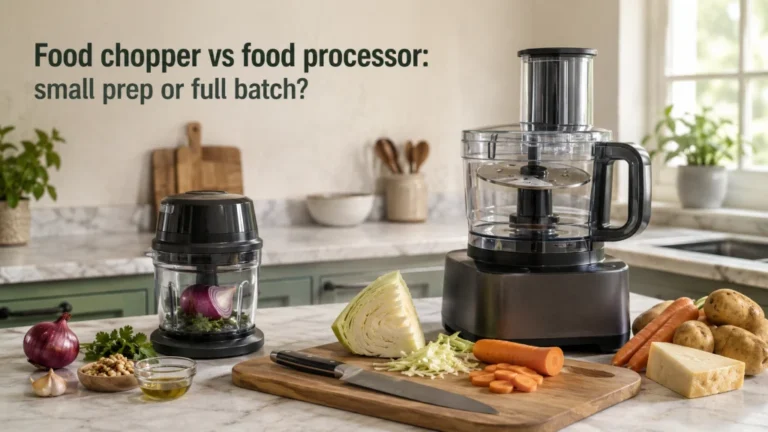
Choosing between a blender and a food processor is easiest when you start with the texture and prep work you repeat, not the motor label or a vague claim that one machine is more versatile. Blenders make the strongest case when smooth, pourable results such as smoothies, liquid-heavy sauces, and blended soups dominate your routine, while food processors add a different kind of value through chopping, slicing, shredding, and thicker prep. Dips, pesto, hummus, and some purees sit in the overlap, so desired texture, batch size, scraping, cleanup, and storage matter more there. By the end, you should be able to choose a blender, a food processor, or both without paying for duplicate equipment that leaves your real prep work unchanged.
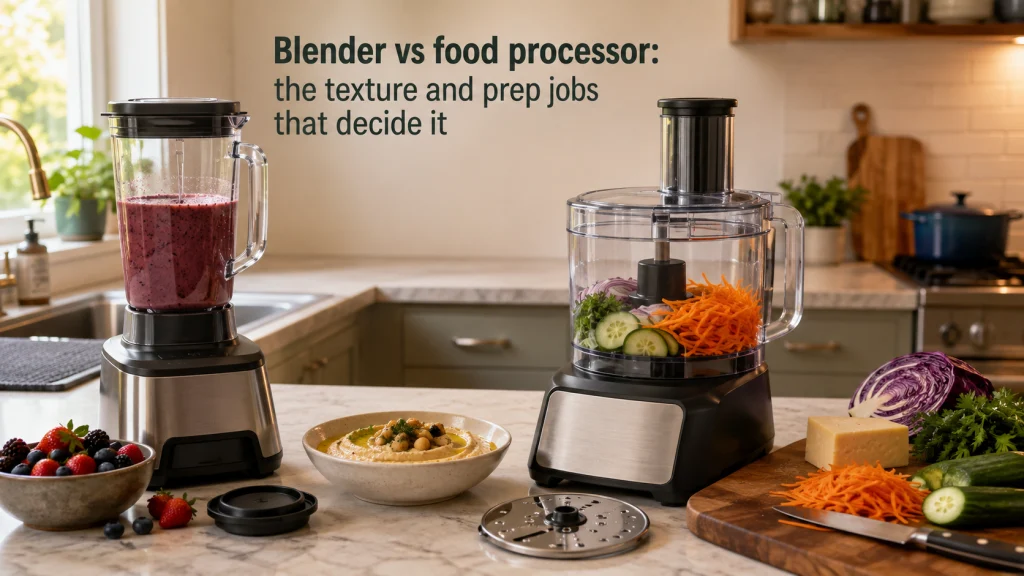
Start with the output, not a solids-versus-liquids slogan
Choosing between the two gets confusing with a thick dip because either appliance may handle it, while a smoothie makes the difference much clearer. That is why the simple rule that processors are for solids and blenders are for liquids is useful only as a first filter. The better question is what you want the finished food to feel like and what work has to happen before it reaches that texture. If smooth circulation is the repeated goal, the blender side gets stronger; if controlled cutting or repeated prep is the burden, the processor side gets stronger.
The same logic keeps a household from buying around one impressive demo that does not match normal use. Someone who makes smoothies several mornings a week but slices vegetables only occasionally has a different need from someone who batch-preps cabbage, carrots, cheese, onions, and thick dips. Both may make sauce, but sauce alone does not settle the choice because sauce can range from spoonable and textured to thin and pourable. Name the recurring outputs first, then use those jobs to decide which mechanism actually removes work from your routine.

Uses a 40-ounce glass jar, a 700-watt motor, and 12 blending functions including puree and ice crushing. The Wave Action system is part of this 58148AG model's blending design. Its tall-jar format is a straightforward fit for recurring smoothies and other smooth, pourable outputs.
Check On AmazonIf you click this link and buy, we earn a commission at no additional cost to you.
The mechanical workflow explains why the two appliances overlap without becoming interchangeable
A countertop blender generally works inside a tall jar around a fixed blade assembly, so ingredients need to keep moving toward the cutting area for an increasingly uniform result. A food processor generally uses a wider work bowl and can pair its main blade with slicing or shredding discs. That difference changes the workflow before it changes the recipe label. One machine asks the batch to circulate toward smoothness, while the other can also pass food through a tool that creates a specific shape.
This is why motor strength should not be the first comparison. More power cannot give a standard blender a feed tube and slicing disc, and a processor bowl does not automatically create a blender jar’s circulation pattern. Attachments, controls, bowl shapes, and capabilities vary by model, so verify the equipment you are considering. The table below maps the jobs, but it does not promise that every model performs every listed task equally well.
| Repeated job | Usually stronger fit | What decides it |
|---|---|---|
| Smoothies and other pourable blends | Blender | Smooth circulation and a uniform liquid texture are the main goals. |
| Slicing vegetables | Food processor | A slicing disc and feed-tube workflow create a different output from blade-only blending. |
| Shredding cheese or vegetables | Food processor | A shredding disc turns repeated grating into a feed-and-catch task. |
| Chopping solid ingredients | Food processor | Pulse control and the wide bowl support controlled size reduction. |
| Thick dips, pesto, hummus, and some purees | Overlap | Texture goal, minimum workable quantity, scraping, and cleanup decide the better fit. |
Use that matrix to identify the jobs that happen often enough to justify space, cleanup, and another motor base. A machine that can perform a task once matters less than one whose normal workflow matches the task you repeat. On the blender side, the output is usually defined less by a cutting shape and more by how smooth and pourable the mixture needs to be. From here, compare the work each design is built to simplify rather than the labels on the box.

The FP-8SV has an 8-cup work bowl, a 350-watt motor, and controls for High, Low, Off, and Pulse. Its reversible shredding and slicing discs work with a feed tube to create shaped cuts instead of only blade-driven blending. The removable parts are dishwasher safe for routine cleanup.
Check On AmazonIf you click this link and buy, we earn a commission at no additional cost to you.
Choose the blender side when smooth circulation is the repeated job
Smoothies are the cleanest example because the household is usually asking for a uniform, drinkable result rather than visible pieces or shaped cuts. Pourable soups, liquid-heavy sauces, and similar textures create the same basic demand: keep the batch moving through the blade area until the mixture is even enough for the intended result. That does not mean every blender handles every thickness, ingredient load, or quantity equally well. It means the blender format makes the most sense when repeated smooth blending is the job you would notice immediately if the appliance disappeared.
Think about frequency before you think about edge cases. If the machine would be used most often for a morning smoothie, a blended drink, or a pourable puree, a processor’s slicing disc does not solve the workload you actually have. On the other hand, owning a blender only because it can make one smooth sauce every few weeks may be hard to justify if chopping and shredding take far more of your prep time. For within-class questions such as jar size, controls, storage height, and which blender features matter, move from this comparison to how to choose a blender rather than trying to turn a cross-class decision into a model-shopping checklist.
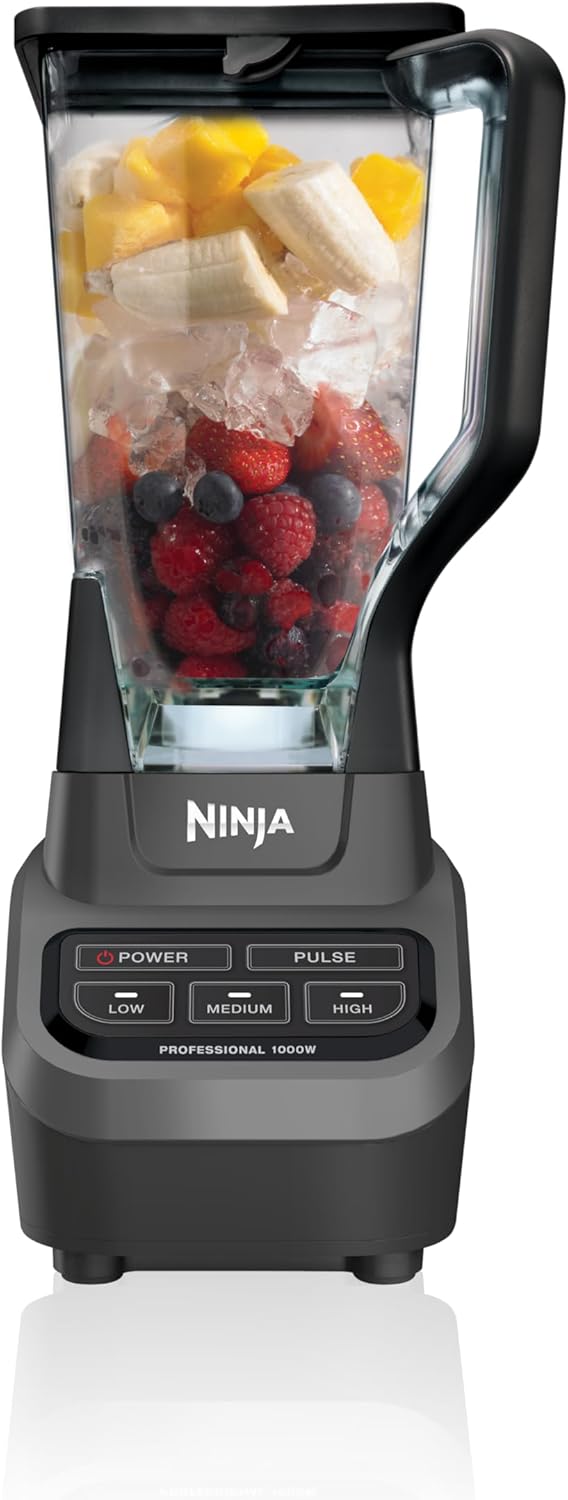
The BL610 uses a 1000-watt motor and a 72-ounce pitcher with Total Crushing blades. Amazon lists it for crushing ice and blending smoothies and sauces, which matches a smooth-output workflow. Its pitcher and other removable parts are listed as dishwasher safe.
Check On AmazonIf you click this link and buy, we earn a commission at no additional cost to you.
Choose the processor side when slicing, shredding, and solid prep keep repeating
A food processor earns its space differently. Its clearest advantage appears when the household wants to change the size or shape of solid ingredients repeatedly, especially when a disc can replace hand slicing or shredding. A pile of carrots for shredding, cabbage for slaw, cheese for grating, or vegetables for even slices is not just another version of blending. The feed-tube and disc workflow creates an output a standard blender is not designed to reproduce, so this is a capability difference rather than a contest over which motor sounds more powerful.
Chopping also belongs on this side when the goal is controlled pieces instead of a smooth puree. The processor becomes more compelling as the volume and frequency of that prep grow, but larger capacity still has to earn its storage footprint and cleanup burden. If you are leaning toward this class, the next step is a food processor guide that looks at size, feed tube, attachments, usable capacity, and ownership tradeoffs within the category. If you are still unsure whether the appliance would solve enough recurring work to deserve space, check whether you should buy a food processor before comparing specific models.

This 12-cup Stack & Snap processor uses a 450-watt motor with two speeds and an easy-stacking assembly. It includes a chopping and pureeing blade plus a reversible stainless-steel slicing and shredding disc. The large bowl and Big Mouth chute directly support repeated slicing, shredding, chopping, and other solid-prep jobs.
Check On AmazonIf you click this link and buy, we earn a commission at no additional cost to you.
Dips, pesto, hummus, and sauces belong in the overlap zone
The overlap is where comparing the two appliances becomes more useful than a one-line rule. Thick dips, pesto, hummus, sauces, and some purees can work in either class, but quantity, moisture, desired smoothness, and ingredient movement change the experience. A blender may suit a household that wants a smoother result and already uses that jar for liquid-heavy jobs. A processor may suit someone who prefers more texture and already values the bowl for chopping, slicing, or other prep.
Minimum workable quantity matters here because a small batch can behave differently from a larger one even when the nominal vessel capacity looks generous. Scraping matters too, because a mixture that repeatedly clings above or away from the active cutting area creates more interruption than the word “capacity” reveals. Do not solve that friction by automatically adding more liquid if doing so changes the food you wanted to make. Instead, compare the texture you want with the normal batch you make, then decide which vessel and workflow gets there with less intervention.
| Overlap task | Lean blender when… | Lean processor when… |
|---|---|---|
| Hummus | You prefer a very smooth result and the batch moves well in the jar. | You prefer a thicker texture or want more tolerance for a low-liquid mixture. |
| Pesto | You want a finer, more uniform sauce and the quantity suits the jar. | You want more visible texture or easier pulsing with a thicker mixture. |
| Thick dip | The recipe already has enough fluid movement for your desired result. | The mixture is dense and you want to avoid thinning it just to keep it moving. |
| Pourable sauce or puree | Smoothness and easy pouring are the priority. | You want to retain more texture or already need the processor for other prep. |
The point is not to assign every sauce to one machine. Notice which conditions match your batch: smooth or textured, fluid or dense, small or substantial, occasional or frequent. Either appliance may satisfy one overlap task while the household still has a clear winner overall. Let the jobs outside the overlap drive that decision because those are the ones most likely to remain unsolved with only one machine.
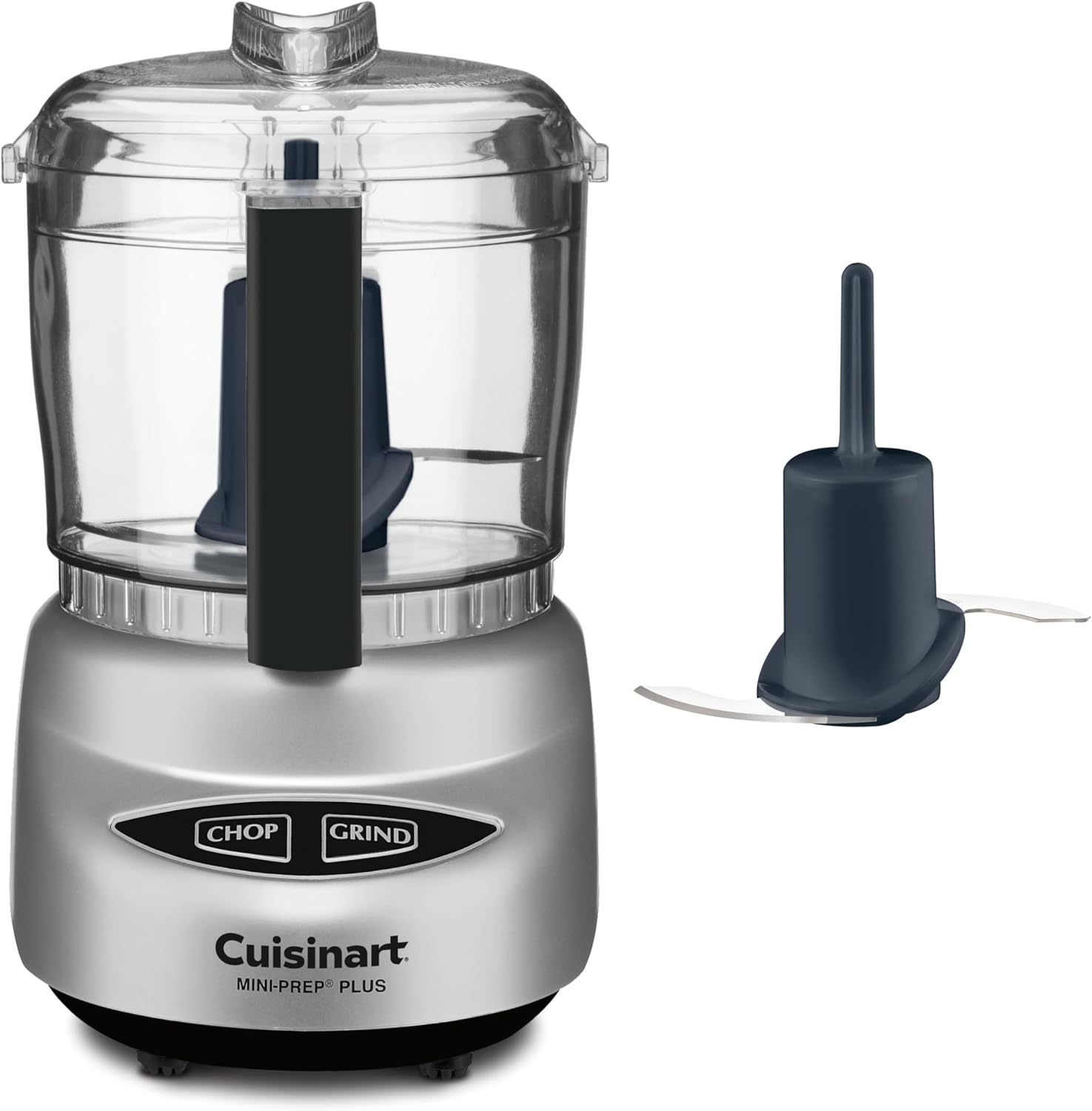
This compact processor uses a 24-ounce work bowl and a reversible stainless-steel blade with Chop and Grind controls. Its 250-watt motor is sized for small prep tasks such as herbs, vegetables, and cheese. The bowl and lid are dishwasher safe, making it a useful processor-side option for smaller batches.
Check On AmazonIf you click this link and buy, we earn a commission at no additional cost to you.
Treat dough as a secondary comparison, not the reason to rewrite the whole decision
Some food processors can mix or work certain doughs, which gives the category another task a standard blender usually does not target. That can matter if dough is an occasional extension of a processor you already want for chopping, slicing, and shredding. It should not automatically make the processor the answer for a household whose main problem is frequent bread or baking work. Once dough becomes the central buying decision, batch size, mixing action, motor load, bowl capacity, and hands-off kneading matter more than this blender comparison can responsibly cover.
Use dough as a tie-breaker only when it is genuinely secondary. If you already want a processor for prep and would occasionally use a supported dough function, that extra capability can improve the value of the appliance you were already leaning toward. If dough is the reason you are shopping in the first place, compare the intended equipment directly in stand mixer vs food processor and verify the exact model’s manual before assuming a bowl, blade, or motor is intended for your dough type and batch. Keeping that boundary prevents one side feature from distorting the much more common blender-versus-processor decision.

The BN601 pairs a 9-cup bowl with a 1000-peak-watt motor and Auto-iQ presets for chopping, slicing, pureeing, and mixing dough. It includes three blades plus a feed chute and pusher, so dough is only one part of a broader processor workflow. Its listed removable parts are dishwasher safe.
Check On AmazonIf you click this link and buy, we earn a commission at no additional cost to you.
Batch shape and vessel geometry matter more than the capacity number alone
Nominal capacity is easy to compare because it is printed as one number, but it does not tell you how a particular batch will behave around the blade. A tall jar and a wide work bowl can hold similar listed volumes while handling a small, thick mixture very differently. The ingredients still need to reach the active cutting area, and the way they move, pile up, spread out, or cling to the sides affects how often you stop and scrape. That is why usable capacity should be treated as a workflow question, not as proof that the larger number is automatically more capable.
Run the comparison using your minimum, normal, and occasional large batch rather than your largest imagined recipe. A household that usually blends one or two drink portions may care more about reliable small-batch circulation than the maximum fill claim, while someone processing a large pile of vegetables may care more about bowl area, feed-tube work, and how often the bowl must be emptied. Exact operating limits depend on the machine, so the product manual should settle maximum fill, processing restrictions, and any model-specific load guidance. Capacity is useful only after you know what the vessel needs to do with the quantity you actually prepare.

The QB3001SS uses a 700-watt base with two 16-ounce cups for compact personal blending. Amazon lists it for smoothies, shakes, and frozen drinks, so its vessel size makes small normal batches easy to visualize. The cups and removable parts are listed as dishwasher safe.
Check On AmazonIf you click this link and buy, we earn a commission at no additional cost to you.
Cleanup can reverse a close decision when the tasks themselves overlap
When both appliances can make the food you want, cleanup is one of the fairest tie-breakers. A blender may involve a jar, lid, and blade assembly or integrated blade area, while a processor may add a work bowl, lid, pusher, main blade, and separate discs depending on the task. More parts do not always mean more annoyance, because the processor may save enough slicing or shredding work to justify washing those parts. The useful question is whether the appliance removes more hands-on prep than it adds in assembly, scraping, washing, drying, and putting away.
Do not assume dishwasher compatibility or cleaning instructions are universal across either class. Exact parts, seals, blades, discs, lids, and motor-base cleaning rules are model-specific, so check the manual for the machine you own or plan to buy. In a close blender-or-processor choice, picture the whole cycle from taking the appliance out to returning every part to storage. If one machine would be used for a two-minute task but routinely creates enough cleanup that you would reach for a knife instead, its theoretical capability is not translating into household value.

The KFP0718 has a 7-cup work bowl, three speed settings, and a 2-in-1 feed tube. Its design includes all-in-one storage for blades and discs plus an Easy-Clean work bowl. Those features make assembly, accessory handling, and cleanup part of the product choice rather than an afterthought.
Check On AmazonIf you click this link and buy, we earn a commission at no additional cost to you.
Storage and duplication decide whether owning both is sensible
Owning both appliances makes sense only when the second one solves repeated jobs the first leaves awkward or impossible. The strongest case is a household that often wants smooth blended outputs and also slices, shreds, or processes thick solid prep. The non-overlapping work, not the overlap, is the reason to own two machines. If both would mostly make the same dips and sauces, the second base, vessel, cord, and accessory set may be buying duplication rather than capability.
Before adding another appliance, audit the jobs that would remain unsolved with only one. Also measure the storage path, because a machine buried behind heavier equipment often has a very different real-use frequency than a machine with an easy parking spot. This is the same practical filter worth using across small kitchen appliances: a useful feature or capability still has to justify the space and handling it adds. Run the checklist below before you decide that two motors are automatically better than one.
- List the five prep or blending jobs you do most often, then mark which appliance handles each one naturally.
- Circle any job that the other appliance cannot reproduce without changing the texture or adding extra manual work.
- Note which parts must be stored with each machine, including discs, pushers, lids, and extra vessels.
- Identify the appliance you already own and the exact recurring job it fails to solve well.
- Buy the second class only when that unsolved work happens often enough to justify another setup and cleanup cycle.
If the audit produces no meaningful unsolved job, keeping one appliance is rational. If smoothies are frequent and shredding is equally frequent, two classes can make sense because each removes different work. Storage still belongs in the buying decision because friction changes what gets used. Use the audit to turn those findings into a clear one-machine or two-machine outcome.

This adjustable tray expands from 6 x 11 inches to 11 x 20 inches to fit a range of countertop appliances. It uses 360-degree swivel wheels with locking brakes and non-slip base pads for controlled repositioning. The tray is designed to move appliances for access and countertop cleaning, directly addressing storage and handling friction.
Check On AmazonIf you click this link and buy, we earn a commission at no additional cost to you.
Choose processor, blender, or both from the jobs that would otherwise stay difficult
Choose a blender when smooth, pourable textures dominate and slicing or shredding is not a recurring burden. Choose a food processor when chopping, slicing, shredding, and thicker prep account for more of the work you want to remove. Choose both only when each appliance solves a distinct, frequent job that justifies its own footprint and cleaning routine. That keeps the choice tied to actual household work rather than a generic versatility claim.
Start with the most frequent task and ask whether the desired result depends on smooth circulation or controlled cutting and prep. Then test the overlap foods against your normal batch size. Storage, cleanup, and what you already own should settle any close call. That is enough to avoid buying a second machine for a problem you do not really have.
- Choose a blender: repeated smoothies, pourable blends, and smooth liquid-heavy textures clearly outweigh slicing and shredding work.
- Choose a food processor: repeated chopping, slicing, shredding, and thick prep are the larger time sink.
- Choose both: you repeatedly need both smooth blending and processor-only cutting workflows, and you have realistic storage for both.
- Choose neither for now: the tasks are occasional, your current tools handle them acceptably, or the second appliance would mostly duplicate what you already own.
This path leaves room for “neither” because buying nothing can be the correct equipment decision. Once the class is clear, compare size, controls, capacity, attachments, storage, and maintenance within that class. There is no need to keep scoring two different mechanisms against the same checklist. The comparison is finished once the repeated work points clearly to one direction.

The SS401 combines a 72-ounce blending and processing pitcher with an XL smoothie bowl maker and nutrient extractor. Amazon lists seven functions and dishwasher-safe parts, giving one motor system multiple preparation paths. That combined format is useful when both smooth blending and processor-style work are frequent enough to justify a multi-function system.
Check On AmazonIf you click this link and buy, we earn a commission at no additional cost to you.
Take the next shopping step inside the class you actually need
Once the class decision is settled, stop comparing feature lists that were never meant to match. Processor buyers should focus on usable bowl capacity, feed-tube size, disc usefulness, small-batch behavior, storage, cleanup, and included accessories. Blender buyers should focus on jar size and shape, controls, normal batch behavior, storage height, cleanup, and their usual textures. Those are within-class questions and belong in separate shopping paths.
That separation also protects you from paying extra for features that do not solve the main task. A premium blender does not become a slicing machine because it costs more, and a larger processor does not become the better smoothie choice because its bowl is bigger. Return to the food processor buying path if prep work won, or use the blender buying path if smooth blending won. From there, compare models only against the requirements that matter inside that class.

The E310 uses a 48-ounce container with ten variable speeds and a Pulse feature for texture control. Amazon also lists a self-cleaning routine using warm water and dish soap in 30 to 60 seconds. Its medium-batch container and control range make it a clear within-class blender example after the appliance class is already decided.
Check On AmazonIf you click this link and buy, we earn a commission at no additional cost to you.
Final thoughts: choose around the work and texture you repeat
A blender and a food processor overlap enough to make the choice look harder than it is, especially around dips, sauces, and purees. The cleaner decision comes from the jobs each design handles differently, then from whether that difference matters often enough to earn space in your kitchen. Batch behavior and ownership friction can settle a close call, but they should not replace the core task distinction. There is no need to force a universal winner.
Before shopping, write down the outputs you make in a normal week and the prep work you most want to remove. Match those jobs to the mechanism and confirm that your normal batch behaves well in that format. If a second appliance does not add a repeated capability or meaningfully reduce work, skip it. If it solves a distinct group of frequent tasks, you have a clear reason to give it space.

The BR601AMZ combines a 72-ounce pitcher, an 8-cup processor bowl, and two 18-ounce cups with a 1200-watt motor base. Amazon lists it for smoothies and frozen drinks as well as salsa and dough processing. That mix of vessels shows how one system can cover distinct repeated jobs without pretending the blender and processor mechanisms are identical.
Check On AmazonIf you click this link and buy, we earn a commission at no additional cost to you.
FAQs
🥤 Is a blender or food processor better for smoothies?
A blender is usually the more natural fit because the goal is a smooth, drinkable mixture with good circulation through the jar. Compare exact jar size, batch behavior, and cleaning instructions once you start choosing a model.
🥣 Can I use a blender instead of a food processor for hummus?
Often, but hummus sits in the overlap rather than proving the machines are interchangeable. Compare your preferred thickness, normal batch size, how much scraping is needed, and whether the blender requires you to change the mixture just to keep it moving.
🥬 Which appliance is better for slicing and shredding vegetables?
A food processor is the stronger class when the exact model includes the appropriate slicing or shredding disc and feed-tube setup. A standard blender does not use that same cutting workflow, so power alone does not make it equivalent.
🧄 Is a blender or food processor better for pesto?
Either may work, so choose by the texture you want and how your normal batch behaves in the vessel. A processor often makes sense when you prefer more texture or already need it for other prep, while a blender may fit if you want a finer sauce and the batch circulates well.
📦 Do I need both a blender and a food processor?
Only if each one solves a different group of jobs you repeat often. If the second machine would mostly duplicate dips, sauces, or occasional purees, the extra storage and cleanup may not be justified.
🧼 Which is easier to clean, a blender or a food processor?
There is no universal winner because part count, blade design, lids, discs, seals, and dishwasher instructions vary by model. Compare the exact cleaning routine for the task you will perform most often, not just the number of parts shown in a product photo.