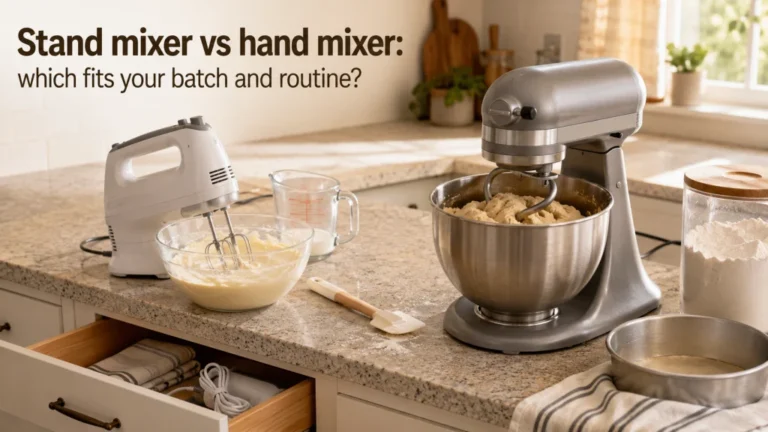
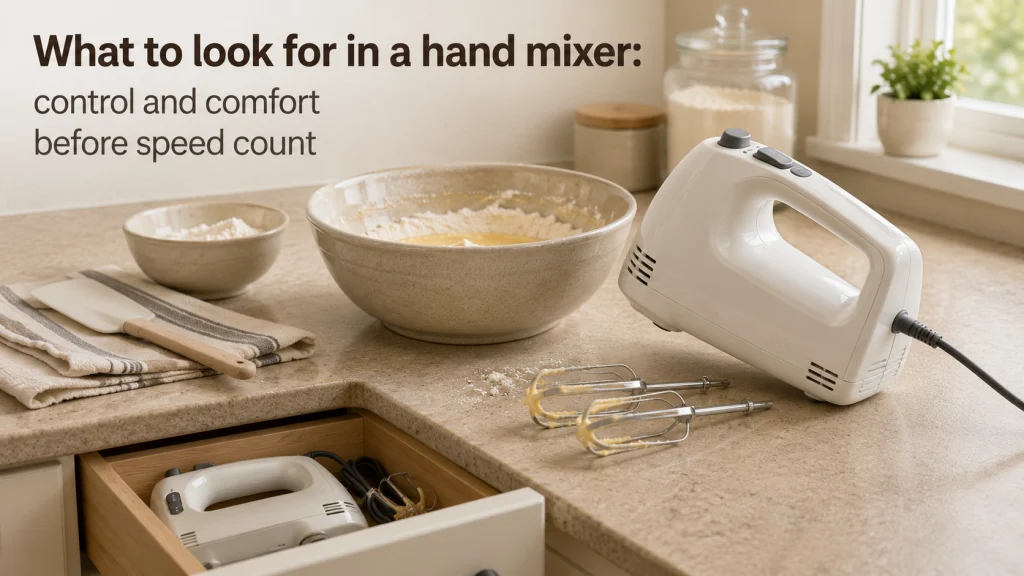
A good hand mixer should start gently, feel balanced in the hand, clean up without a fight, and be easy to retrieve for the short jobs that justify owning one. Speed count and wattage describe a mixer, but neither number proves that it will perform well or feel comfortable. Build the shortlist around low-speed control, handling, useful attachments, storage, cleanup, and the workload you actually expect it to handle. That makes it much easier to separate practical features from decorative specifications.
Set the buying filter before comparing specifications
If you are deciding what to look for in a hand mixer, begin after the hand-mixer decision itself has already been made. A compact mixer can still be frustrating if its lowest speed throws flour from the bowl, the handle forces an awkward grip, or the body feels poorly balanced once the motor is running. Those problems are easier to avoid when you define the job and the ownership constraints before comparing feature lists. The first pass should eliminate mixers that do not suit the work, the way you hold the tool, or the space where you will keep it.
Use the rest of the specifications as evidence for that filter rather than as a scorecard. Control tells you whether the machine can enter a mixture cleanly, handling tells you whether you can guide it comfortably, and attachments only matter when they support work you expect to do. If you are still choosing between mixer classes, start with the broader types of mixers overview instead. Once the class is settled, the useful question is which details change daily use enough to justify their cost, space, or maintenance. A hand mixer is one of the small kitchen appliances where control and handling can matter more than a longer specification list.

This five-speed hand mixer uses a high-performance DC motor and Slow Start for more controlled mixing. It includes stainless steel beaters and a whisk for everyday batter and whipping tasks. A snap-on storage case keeps the mixer and attachments together between uses.
Check On AmazonIf you click this link and buy, we earn a commission at no additional cost to you.
How to choose a hand mixer for the jobs you actually repeat
A hand mixer fits best when the household repeatedly needs quick, lighter mixing without the footprint and setup of a countertop machine. Whipping cream or egg whites, mixing many cake batters, combining frosting, and similar short jobs fit that pattern well. Its real advantage is not just small size, but the ability to use the bowl you already have and put the appliance away quickly. That advantage disappears when setup, holding time, or cleanup becomes larger than the job itself.
- List the three mixing jobs you expect to do most often.
- Mark which jobs are brief and light enough to hold the mixer comfortably.
- Flag any recurring stiff mixture, large batch, or long session.
- Keep the shortlist focused on those repeat jobs instead of every possible attachment.
The boundary matters because a premium handheld design does not remove the need to support and steer the machine. Consumer Reports places hand mixers mainly in lighter work and stand mixers in the more demanding end of mixing, which is a useful class distinction rather than a promise about every recipe. If your routine frequently involves stiff mixtures, large batches, or long sessions, revisit the stand mixer vs hand mixer comparison before paying more within the handheld class. The right choice is the tool that fits the repeated workload, not the one with the longest capability list.

This five-speed hand mixer pairs a high-performance DC motor with Slow Start for gentler entry into mixtures. Stainless steel beaters and a whisk cover common mixing and whipping jobs. The snap-on storage case keeps the white 62652 mixer and included attachments organized between uses.
Check On AmazonIf you click this link and buy, we earn a commission at no additional cost to you.
Prioritize the lowest controllable speed before counting the rest
The lowest speed often affects everyday use more than the total number of settings. Dry ingredients are especially revealing because an aggressive first speed can scatter flour or powdered sugar before the mixture has enough moisture to stay in the bowl. Consumer Reports specifically notes that a slower low setting helps reduce splatter and that a large number of speeds does not necessarily mean better performance. That makes genuine low-speed control a stronger buying signal than a long speed count.
- Can the mixer begin slowly enough for dry ingredients?
- Does the low setting stay low instead of only slowing briefly at startup?
- Are the speed steps meaningfully different?
- Can you change speed without disturbing your grip?
A slow-start function can help, but it should not be treated as a sustained low setting unless the exact model documentation shows that behavior. The controls also need to be reachable while you are holding the mixer, because a useful speed range still creates friction if changing it requires an awkward grip. Extra speeds can be valuable once the basic low setting is proven. For most households, a few clearly separated speeds are more useful than many settings that feel nearly identical.

This 220-watt hand mixer provides nine speed settings, including three low mixing speeds for gentler starts. Its XL dishwasher-safe beaters simplify cleanup after batter or frosting. The included storage case keeps the mixer and accessories organized when the job is finished.
Check On AmazonIf you click this link and buy, we earn a commission at no additional cost to you.
Treat wattage and motor labels as incomplete evidence
Wattage is easy to compare because it is a clean number, but it does not tell you how well two mixers will perform in the bowl. Motor design, gearing, speed control, beater geometry, and the actual mixture all affect what the appliance can do. Manufacturer guidance also acknowledges that wattage does not tell the whole story, while independent testing can reveal differences that a specification sheet cannot. Use headline power as a description of the machine, not as a ranking by itself.
The same caution applies to motor terminology. A manufacturer may document advantages for a particular design, but that claim belongs to the exact implementation rather than every mixer carrying a similar label. When two candidates look close on paper, give more weight to measured mixing results, usable speed control, convenience, and noise than to a simple watt comparison. Power matters when the rest of the design turns it into performance you can actually use.

This six-speed hand mixer uses a 250-watt motor and QuickBurst for added mixing power when needed. Traditional beaters and a whisk support common batter and whipping tasks. Bowl Rest and a snap-on storage case add practical handling and storage features beyond the motor specification.
Check On AmazonIf you click this link and buy, we earn a commission at no additional cost to you.
Judge balance, grip, and weight as one handling problem
A low listed weight can look ideal until the mixer feels front-heavy, the handle bends your wrist, or the controls force you to loosen your grip. Because the machine has to be supported and steered during use, weight should be judged together with balance and handle shape. Consumer Reports includes balance and comfort among the features worth considering, which is more useful than treating ounces alone as a comfort score. A slightly heavier mixer can feel easier to control if its weight sits more neutrally in the hand.
| What to audit | What to verify | Why it matters |
|---|---|---|
| Weight | Exact listed mixer weight | Sets the basic load your hand supports |
| Balance | How the body sits in the hand | Changes wrist correction during mixing |
| Grip | Handle width, angle, and control reach | Affects comfort and speed changes |
| Storage | Fit in the shelf, drawer, or bin | Determines how easy it is to retrieve |
Session length changes the answer too, because a short whipping job demands less from the grip than a longer batter or frosting session. If possible, hold the mixer before buying and check the handle, balance, control reach, and resting position together. If that is not possible, combine exact weight with clear product views and owner comments that describe handling rather than vague satisfaction. Comfort is the result of the whole handling system, not one number.

This five-speed hand mixer weighs 2 pounds, giving readers a concrete handling number to compare with grip and balance. Its lockable swivel cord can be positioned to stay out of the mixing path. Stainless steel Turbo Beaters and a single-button accessory release support straightforward everyday use.
Check On AmazonIf you click this link and buy, we earn a commission at no additional cost to you.
Evaluate beaters and whisks by workflow, not by quantity
Standard beaters will do most of the work for many households, so their shape, release mechanism, and cleanup deserve more attention than a long accessory list. Consumer Reports notes that wire beaters without a thick center post are generally easier to clean, which matters every time batter dries on the attachment. A separate whisk can be useful when you frequently aerate cream or egg whites, but it has little value if that is not part of your routine. An attachment that stays untouched in storage does not make the mixer meaningfully better.
- Keep attachments that support jobs you expect to repeat.
- Check whether they install and eject without forcing or awkward handling.
- Look for shapes that are easy to rinse and scrub after sticky mixtures.
- Verify dishwasher guidance in the exact model manual.
Also check whether left and right beaters must go into specific sockets and whether food can collect around collars or seams. The more often you use a mixer for quick jobs, the more cleanup friction matters because washing can take as long as the mixing itself. This helps answer which hand mixer to buy when two candidates differ mainly in bundled extras. Choose the package that improves work you already do instead of the one that makes the box look busier.

This six-speed KitchenAid hand mixer includes dishwasher-safe Flex Edge Beaters for bowl contact during mixing. A Pro Whisk handles whipping tasks, while the included beaters cover routine batter work. An integrated storage clip secures the accessories to the mixer without requiring a separate storage box.
Check On AmazonIf you click this link and buy, we earn a commission at no additional cost to you.
Do not let dough hooks redefine the safe task ceiling
Dough hooks are easy to overinterpret because their presence can make a hand mixer look more capable than the format really is. The attachment shows that the manufacturer intends the exact model to perform certain hook-compatible tasks under stated instructions, but it does not turn every hand mixer into a substitute for a stand mixer. Consumer Reports notes that hand mixers generally struggle more with heavy dough and require more effort to control. Treat the hooks as an intended accessory, not proof of unlimited workload.
If dough mixing matters, read the exact manual for permitted speeds, loads, operating limits, and attachment instructions before buying. Do not borrow guidance from a similar-looking mixer just because the hooks appear interchangeable. If heavy dough is a routine task and the documentation does not clearly support your workload, count that uncertainty against the hand mixer rather than filling the gap with optimism. Stop using any mixer that shows abnormal heat, burning odor, sparking, damaged wiring, or another condition the manual reserves for service.
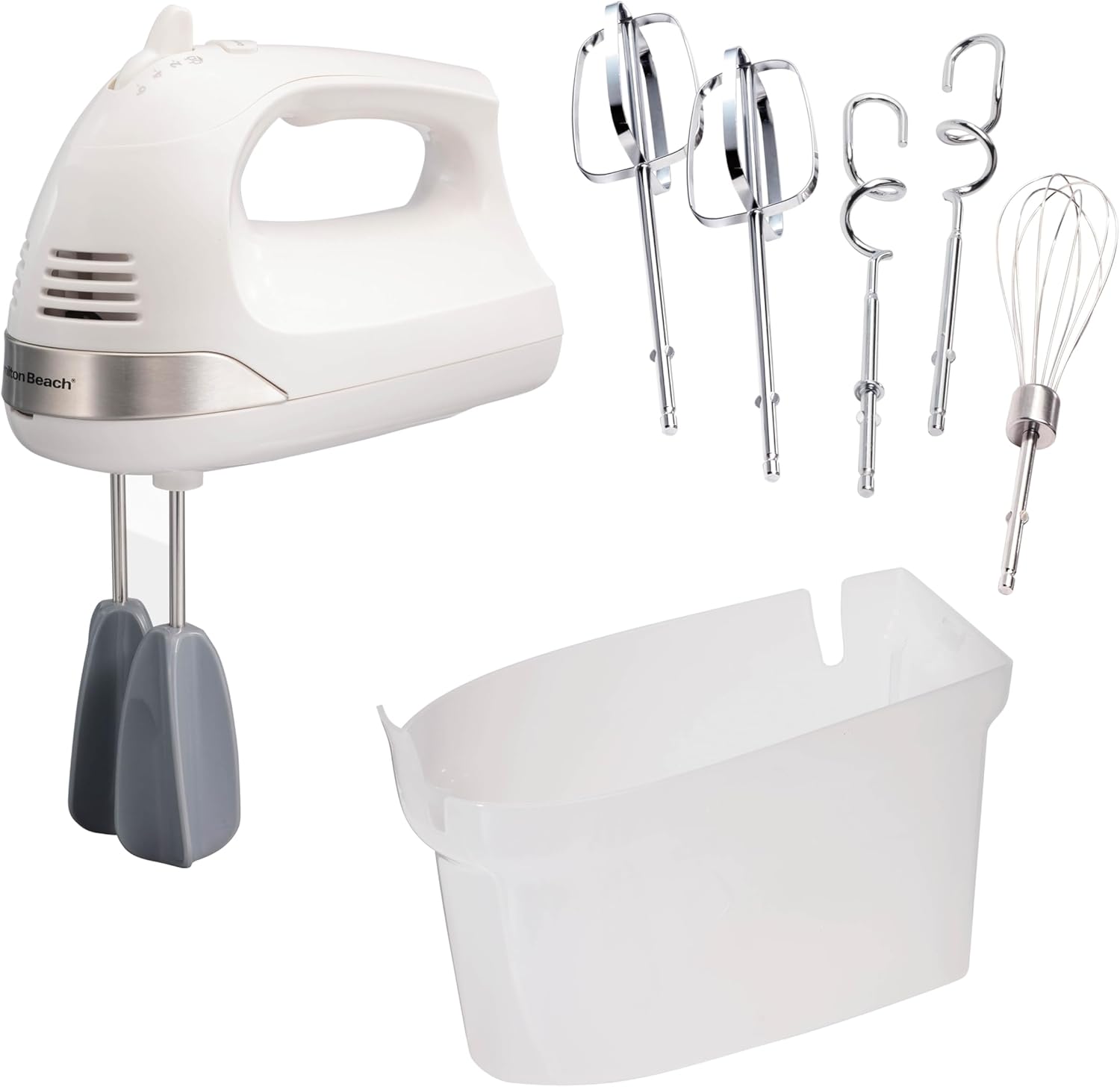
This six-speed hand mixer includes Easy Clean beaters, traditional beaters, dough hooks, and a whisk. Its 275-watt motor powers the included attachment set, while the dough hooks remain specific accessories for this exact model. A snap-on storage case keeps the mixer and tools together between uses.
Check On AmazonIf you click this link and buy, we earn a commission at no additional cost to you.
Compare corded and cordless designs by the friction they remove
Cordless mixing can be useful when outlets are awkward, the cord catches around bowls, or you regularly move between work areas. The trade-off is that the cord disappears from the task but charging becomes part of ownership. A cordless model only feels more convenient if it is charged when you reach for it, the battery state is easy to understand, and the charging equipment has a sensible home. If those conditions are not true, the appliance can turn a quick job into a battery check.
| Household condition | Corded may fit better | Cordless may fit better |
|---|---|---|
| Outlet beside the bowl | No charging routine | Freedom may add little value |
| Cord blocks movement | Only if routing stays easy | Removes the cord from the path |
| Infrequent use | Ready when plugged in | Battery state needs checking |
| Tight storage | Cord needs a tidy home | Battery or charger also needs space |
Corded mixers have their own friction, so check cord length, exit point, flexibility, and storage rather than assuming a cord is simple by default. A stiff cord can tug on a light mixer when you set it down, while a badly placed outlet can force an awkward working angle. Neither design is automatically better for every kitchen. Choose the one that removes the more frequent annoyance in your actual mixing and storage routine.

This cordless hand mixer provides seven speed settings and a Soft Start feature without a power cord crossing the work area. The package includes a removable 12V MAX battery, USB-C cable, wall adapter, and dishwasher-safe stainless steel beaters. Its cordless design makes battery charging part of the ownership workflow.
Check On AmazonIf you click this link and buy, we earn a commission at no additional cost to you.
Make storage part of the feature decision
A hand mixer is supposed to be easy to retrieve for a short job, so storage is part of the ownership decision. A compact motor body loses some of that advantage if the beaters live in another drawer, the whisk is buried behind pans, or the cord spills across the shelf. Storage cases, attachment holders, and cord systems can help when they keep the complete setup together. They are not automatically useful just because they look neat in a product photo.
Measure the space where the mixer will actually live and include the body, beaters, whisk, cord, battery, or charger that will be stored with it. A rigid case may organize everything but use more shelf volume, while loose storage may save space and make parts easier to lose. Frequent users may care most about fast retrieval, while occasional users may value keeping every piece together. The best storage feature is the one that removes a recurring annoyance without creating a new space problem.

This six-speed hand mixer includes a snap-on storage case designed to keep the mixer and attachments together. Traditional beaters and a whisk store with the black 62692, while Bowl Rest supports pauses during mixing. A 250-watt motor and QuickBurst cover common everyday mixing tasks.
Check On AmazonIf you click this link and buy, we earn a commission at no additional cost to you.
Use independent testing after the shortlist is already narrow
Independent testing becomes most useful after you have removed models that fail your task, storage, or handling requirements. Consumer Reports evaluates hand mixers on mixing tasks such as egg whites, whipped cream, and pancake batter, and it also scores convenience and noise. Those fields observe the machine doing work instead of simply repeating what is printed on the box. The limits still matter because a test result only proves performance under the conditions that were actually tested.
| Evidence field | What it can establish | What it cannot establish alone |
|---|---|---|
| Mixing tests | Performance on defined tasks | Comfort for your hand |
| Convenience testing | Control and attachment handling | Fit in your storage space |
| Noise testing | Relative sound under test conditions | How important noise is to you |
| Manufacturer documentation | Exact parts and instructions | Independent proof of better mixing |
| Owner feedback | Repeated frustrations to investigate | Controlled durability evidence |
Use testing to separate candidates that already fit your household rather than allowing a score to override bad fit. A mixer can perform well in a controlled test and still be wrong for you if the grip is awkward, the case will not fit your cabinet, or charging is a nuisance. Owner comments are useful for spotting repeated complaints, but they should not replace controlled evidence for performance claims. Assign each question to the evidence source that can actually answer it.

This Breville hand mixer provides nine speed settings plus Boost for control from gentle folding to high-speed whipping. Its scraper-beater system and multiple included attachments support a range of mixing tasks. The feature set gives readers a concrete current model to compare against independent mixing, convenience, and noise testing.
Check On AmazonIf you click this link and buy, we earn a commission at no additional cost to you.
Which hand mixer to buy after the shortlist is narrow
Once only a few candidates remain, rank them by the conditions that will repeat every time you use the appliance. Start with task fit and low-speed control, then compare balance, grip, attachment usefulness, storage, cord or battery workflow, cleanup, and independent performance evidence. Only after those requirements are clear should price become the tie-breaker. A higher price is easier to justify when it buys a noticeably better low speed, more comfortable handling, simpler cleanup, or a storage system you will use, while a less expensive mixer is the better value when it meets the same must-have requirements without paid extras you will ignore.
| Decision field | What to verify | Reject when |
|---|---|---|
| Task fit | Repeat jobs and workload | The routine is regularly too heavy or long |
| Low-speed control | Gentle sustained starting speed | The lowest usable speed is too aggressive |
| Handling | Weight, balance, grip, control reach | Ordinary sessions feel awkward |
| Attachments | Included parts and care instructions | Extras add clutter without useful work |
| Storage | Complete stored footprint | Parts are hard to keep together or retrieve |
| Cleanup | Beater shape and exact care guidance | Cleanup is excessive for short jobs |
Verify exact model details before the final choice, including included parts, weight, power arrangement, care instructions, and any operating limits that matter to your routine. Then compare the price difference against the benefits you have already marked as useful, rather than assuming the premium option is better because it offers more. If you want to compare current candidates after building these criteria, move to the site’s current hand mixers page with this requirement list already finished. A shortlist built this way makes it easier to choose the least expensive model that fully meets your requirements, or to see exactly why paying more is worthwhile.

This Cuisinart hand mixer provides nine adjustable speed settings for mixing and whipping tasks. Extra-long dishwasher-safe beaters simplify cleanup, and the beater-eject lever releases them from the mixer. Those practical controls and care features make the HM-90BCS useful for a final shortlist built around repeatable household needs.
Check On AmazonIf you click this link and buy, we earn a commission at no additional cost to you.
Know when your routine has crossed into stand-mixer territory
A premium hand mixer can improve control, comfort, attachment handling, or convenience, but the price does not change the basic architecture. You still support and guide the motor while the beaters work, and you still need the workload to stay within what the exact model is designed to handle. If your main complaint is that long or heavy mixing keeps the machine in your hand too long, a better hand mixer may solve the wrong problem. That is the signal to reconsider the equipment class rather than continue climbing the handheld price ladder.
Frequent stiff mixtures, large batches, repeated bread dough work, or a strong need for hands-free mixing are all reasons to reopen the hand mixer and stand mixer decision. If your jobs remain brief and lighter, staying with a hand mixer can still be the simpler choice. If your real need is pureeing, emulsifying, or blending directly in a container, the hand mixer vs immersion blender comparison may show that the task belongs to a different tool. The correct boundary keeps you from buying a premium version of the wrong format.
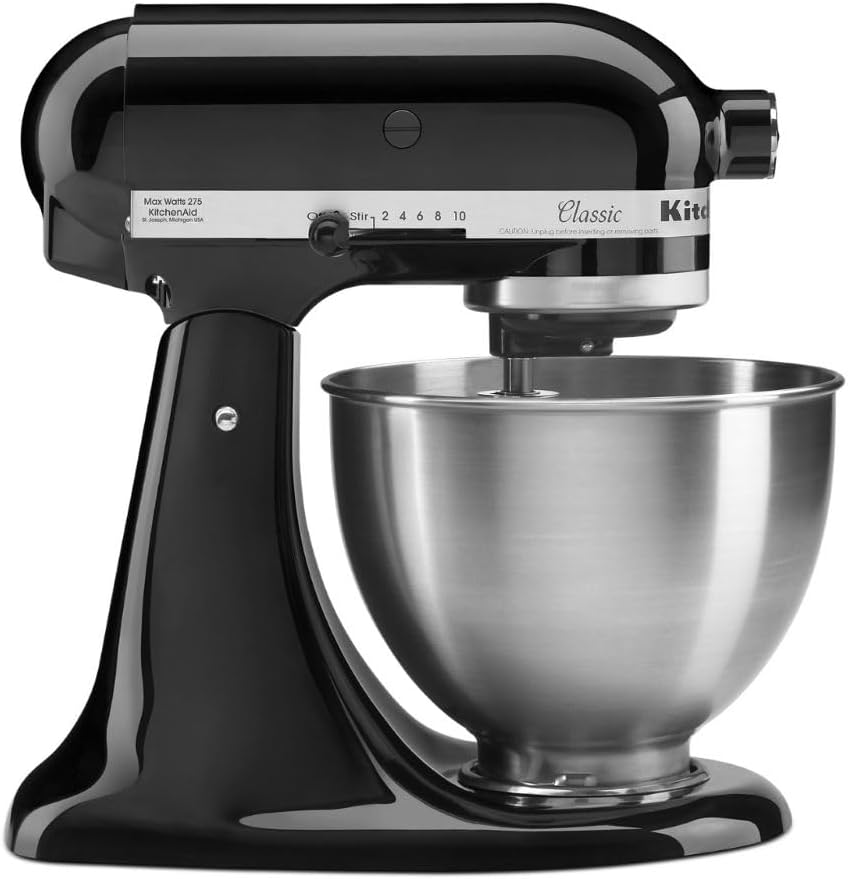
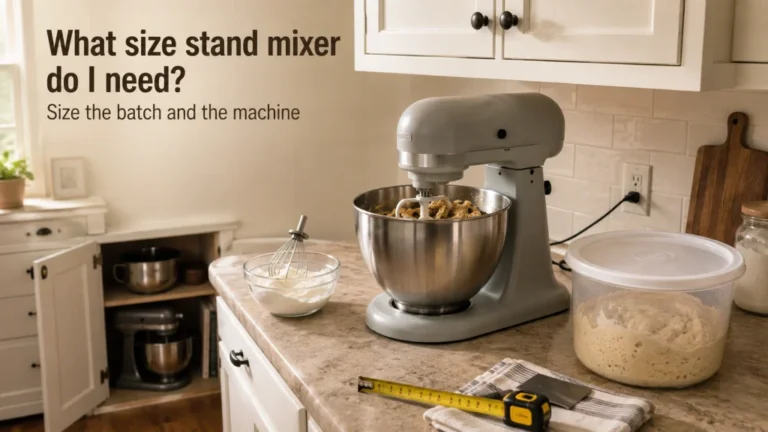
This KitchenAid Classic Series stand mixer combines a 4.5-quart bowl with 10 speed settings. Its tilt-head design keeps the mixer supported on the countertop instead of requiring the motor to be held during use. The K45SS is compatible with KitchenAid attachments for expanding the tasks handled by the machine.
Check On AmazonIf you click this link and buy, we earn a commission at no additional cost to you.
Final Thoughts: choose the mixer that is easy to use on ordinary days
The strongest shortlist is the one that survives ordinary use, not the one that wins the specification count. A controllable start, comfortable handling, useful attachments, practical storage, straightforward cleanup, and credible performance evidence should all support the same set of household jobs. Once those needs are met, extra features deserve money only when they improve something you will actually notice. That keeps both underbuying and unnecessary upgrades in check.
Before buying, confirm the exact model documentation and make sure the complete stored setup fits where you intend to keep it. If two candidates remain close, use independent mixing and convenience evidence, then compare the remaining price difference with the practical advantage it buys. A hand mixer should make brief mixing jobs feel simpler from setup through washing and storage. When the workload itself is the problem, change mixer classes rather than spending more to push a handheld design beyond the role you chose it for.
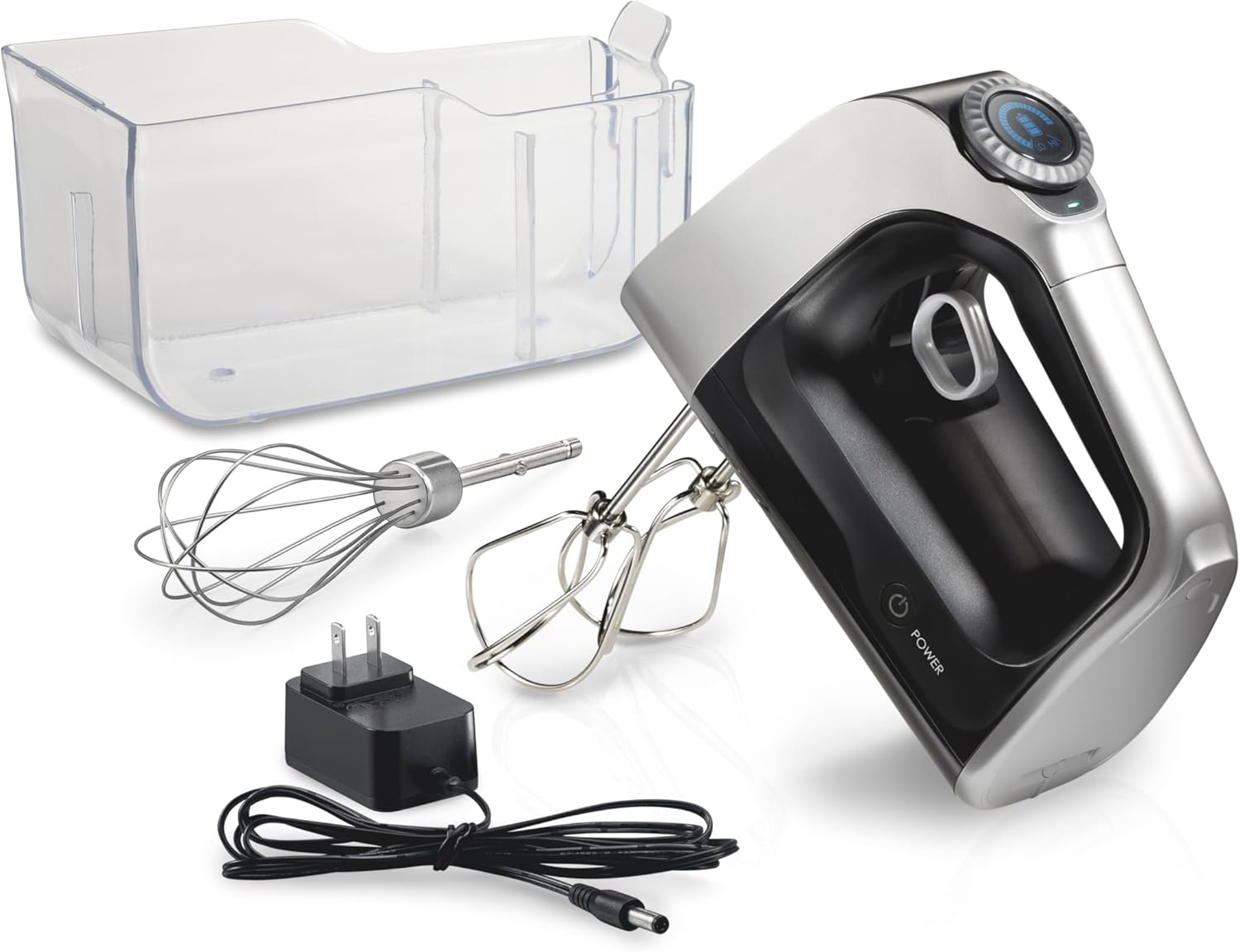
This rechargeable cordless hand mixer combines infinite speed control with a DC motor for flexible everyday mixing. An LCD screen shows operating information, while the included whisk expands the attachment set. Quick recharging and a storage case support the short-job convenience and organized storage emphasized in the final section.
Check On AmazonIf you click this link and buy, we earn a commission at no additional cost to you.
FAQs
🎚️ How many speeds does a hand mixer really need?
You need clearly separated useful speeds more than you need a large total count. A genuinely slow first setting, a practical middle range, and a fast whipping range can matter more than several settings that feel almost the same.
⚡ Does higher wattage mean a better hand mixer?
No. Wattage describes one part of the design, but it does not prove better mixing performance, control, comfort, or durability. Compare independent performance evidence and exact model behavior instead.
🥣 What should I check if I hate flour splatter?
Prioritize the lowest sustained speed and any documented slow-start behavior. Also check whether the control is easy to adjust while holding the mixer.
✋ Is a lighter hand mixer always more comfortable?
No. Balance, handle shape, control placement, and session length can matter as much as listed weight. A slightly heavier but better-balanced mixer may feel easier to guide.
🧼 Which beater style is easiest to clean?
Wire beaters without a thick center post are generally easier to clean than traditional beaters with more material in the middle. Still verify the exact attachment design and care instructions.
🔋 Is a cordless hand mixer worth it?
It can be if cord routing is a real nuisance and charging is easy to keep up with. If you use the mixer infrequently or dislike tracking battery state, a corded model may create less ownership work.
🍞 Do dough hooks mean I can knead bread with any hand mixer?
No. The hooks only show that the exact model includes that attachment for tasks allowed by its instructions. Check the manual for permitted loads, speeds, and limits.
📦 Is a storage case worth paying extra for?
Only if it keeps the mixer and useful attachments together without taking more space than you can spare. Measure the actual shelf or drawer and judge the complete stored setup.
References and Sources
- Consumer Reports mixer buying guide: Supports the discussion of task limits, low-speed usefulness, comfort, beater design, and why wattage or speed count alone does not prove performance.
- Consumer Reports hand-mixer testing: Supports the use of mixing performance, convenience, and noise as comparison fields after household fit is established.
- KitchenAid hand mixer buying guide: Supports documented speed, motor, attachment, weight, portability, and storage factors while showing why model-specific claims need exact verification.