Food processor sizes look precise on the box, but the cup label is only one part of the sizing decision. A useful choice starts with the smallest job you repeat, the batch you make most often, and the largest batch you actually care about, then checks how those jobs fit the bowl, feed tube, machine body, and accessory storage. Advertised bowl capacity should not be treated as guaranteed usable processing volume, especially for liquids or tasks that need room for ingredients to move. The goal is to choose enough working room for normal prep without buying a machine whose extra capacity mostly becomes cabinet weight and unused space.
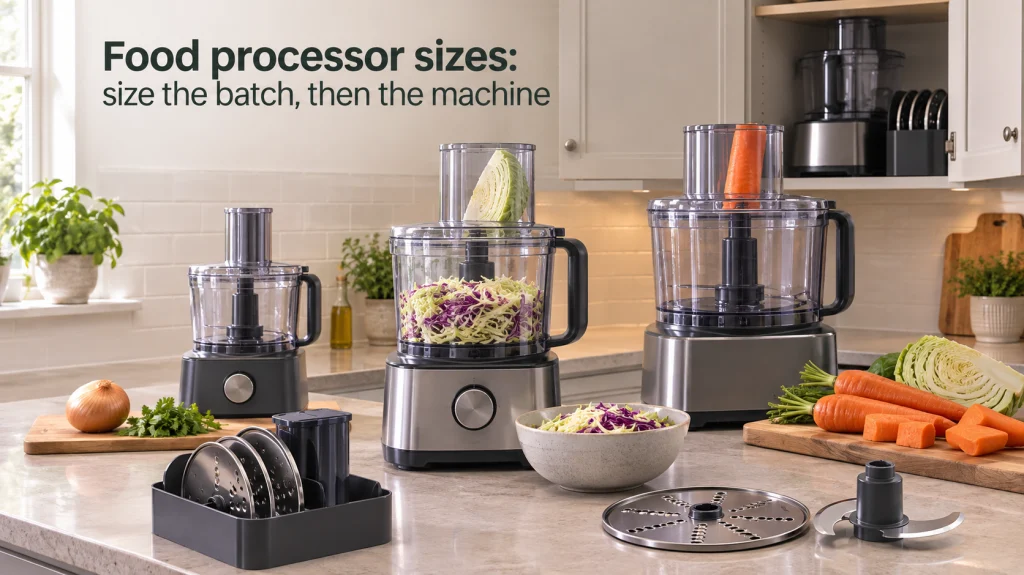
Separate bowl capacity, usable volume, and appliance footprint
A 9-cup, 11-cup, or 13-cup label makes food processor sizes look unusually precise, but it answers only one part of the decision. It identifies the advertised bowl capacity, not the amount every task can process well, the smallest quantity the blade can handle effectively, or the space the complete machine requires. Consumer Reports notes that claimed capacity can differ from actual measured volume, so the printed number is useful for orientation rather than as a guaranteed working amount. Start by separating the bowl label from the food you actually process and the space the machine must occupy.
Three measurements matter here: advertised bowl capacity, usable processing volume, and appliance footprint. Usable volume is task-specific and bounded by the exact manufacturer’s instructions, while footprint includes the height, width, and depth you must store, carry, and use. A bowl can be generous enough for a normal batch while the assembled processor is still too tall for the intended shelf or awkward to move through a cabinet opening. Discs, pushers, blades, lids, and storage cases can extend that physical burden beyond the motor base itself. That sizing decision also sits within small kitchen appliances, where capacity only matters when the machine still fits the kitchen and the repeated prep workload.
Task limits are the reason these measurements cannot be collapsed into one number. Dry chopped ingredients, dough, a thick puree, and a liquid mixture do not behave the same way, and some models publish separate maximum amounts or fill limits for certain jobs. Use those model-specific instructions as the operating boundary instead of assuming the full labeled bowl volume is available for every mixture. This article therefore stays focused on usable capacity, task fit, feed-tube work, and storage after the full food processor class has already been chosen.
| Size measure | What it tells you | What it does not prove |
|---|---|---|
| Advertised bowl capacity | The nominal size used to describe the work bowl | The amount every recipe or mixture can process safely and evenly |
| Usable processing volume | The practical amount for a specific task within model limits | That another processor with the same cup label behaves the same way |
| Appliance footprint | The physical space the machine needs on the counter or in storage | The extra space required for loose discs, blades, pushers, or cases |
Keep these three measurements separate while shopping. Write each one down instead of letting the cup label stand in for all three. That makes it easier to see whether a larger bowl is solving a real batch problem or simply making the machine harder to store. It also gives you a cleaner way to compare two processors that carry similar capacity labels but have very different physical dimensions.

The Ninja BN601 pairs a 9-cup processor bowl with a 1000-peak-watt motor and Auto-iQ programs for chopping, pureeing, dough, and slicing or shredding. It includes a chopping blade, dough blade, reversible slicing and shredding disc, food chute, and pusher. Its listed dimensions are 7.76 inches deep by 9.88 inches wide by 16.02 inches high.
Check On AmazonIf you click this link and buy, we earn a commission at no additional cost to you.
Record the smallest, normal, and peak batches you actually make
Household size is a weak shortcut because two households with the same number of people can use a processor very differently. One may process a small onion, herbs, and a dressing several times a week, while another may shred vegetables for freezer prep and make double batches on weekends. The better approach is to write down three quantities: the smallest repeated job, the normal batch, and the occasional peak. Your normal batch should carry the most weight because that is the amount the machine will live with most often.
The smallest repeated job matters because oversizing has a practical penalty. Small amounts may not circulate around a large blade and bowl the way you expect, and using a big machine for a tiny quantity also means washing, carrying, and storing more appliance than the job requires. The peak batch matters too, but it should not dictate the purchase if that job is rare and splitting it into two runs is acceptable. Protect the normal routine first, then decide how much inconvenience you are willing to accept at both ends of the batch range.
| Prep level | Write down | What to check |
|---|---|---|
| Minimum repeated job | The smallest quantity you expect the processor to handle regularly | Whether the blade and bowl can process that amount effectively without turning cleanup into the bigger job |
| Normal batch | The quantity you make most often | Whether it fits comfortably within the model’s task-specific limits in one run |
| Occasional peak | The largest quantity you care about processing | Whether one large bowl is worth the extra footprint or two batches are acceptable |
This worksheet keeps the rare large batch from overpowering the rest of the decision without forcing you to size down blindly. Buying too close to the normal batch can still be a mistake when a repeated task needs headroom or when sliced and shredded food accumulates quickly in the bowl. The right band gives normal work priority, then allows enough margin for the peak jobs whose frequency and task requirements genuinely justify it. That is more useful than choosing by household count or treating unused capacity as automatically harmless.

The Etekcity EK6015 weighs up to 11 pounds or 5 kilograms in 1-gram increments, making it useful for recording real batch quantities. Its tare function lets you zero a bowl or container before weighing ingredients. The stainless-steel platform supports grams, ounces, pounds and ounces, fluid ounces, and milliliters.
Check On AmazonIf you click this link and buy, we earn a commission at no additional cost to you.
The task changes how much capacity you can use
Slicing through a feed tube is not the same capacity problem as chopping with the multipurpose blade. With slicing and shredding, food enters through the feed tube and processed pieces accumulate in the bowl, so the important questions include how often the bowl must be emptied and how much trimming is needed before the food can enter the tube. With chopping or pureeing, the ingredients are already in the bowl and need enough room to move around the blade. The same nominal bowl size can therefore feel generous for one job and cramped for another.
Dough and wet mixtures deserve even more caution because their operating limits may be stated separately from the bowl’s advertised capacity. A large printed capacity does not mean the machine is designed to hold that same amount of liquid, flour, or dough. If dough is a major reason for buying the machine, the comparison in stand mixer vs food processor can help decide which type of appliance better matches the job before capacity becomes the deciding factor. Once the task is clear, use the exact processor manual to verify maximum amounts rather than applying a universal fraction of the bowl size.
Use manufacturer limits as boundaries, not cup-to-recipe formulas
A food processor manual may give separate instructions for liquids, dough, specific blades, or maximum ingredient quantities, and those instructions belong to that exact machine. They are more useful than a generic claim that a certain bowl size always handles a certain recipe amount. Two processors with similar advertised capacity can differ in bowl geometry, blade position, feed-tube design, seals, and operating instructions. Those differences are why usable volume should be verified model by model instead of inferred from the cup number alone.
This is also the point where internet sizing formulas become risky. A universal statement such as “this many cups feeds this many people” ignores recipe density, cut type, batch style, and how often the processor is emptied during a task. Manufacturer size guides can help show the broad market range, and KitchenAid, for example, groups full-size processors into progressively larger cup ranges while separating smaller choppers from machines with feed tubes and processing discs. Use those ranges for orientation, then use the manual and your own batch worksheet to decide whether a particular size is actually enough.
Key point: Never infer a liquid limit, dough limit, or safe maximum fill from the advertised bowl capacity. Verify the exact model’s instructions for the task you plan to do. Treat any separate maximum-quantity instruction as part of the sizing decision, not as a detail to check after purchase. If the manufacturer does not support the amount or task you need, move to another size or machine rather than inventing your own limit.
The model-specific limit should control the final choice whenever the task has a published maximum or separate operating instruction. That keeps a convenient size comparison from turning into an unsupported operating assumption. It also lets you compare larger and smaller machines on the work they are actually allowed to do. Once those boundaries are clear, the remaining question is whether the extra capacity earns its space in your kitchen.

The Hamilton Beach 70730 combines a 10-cup bowl with a 450-watt motor, two speeds, and pulse control. It includes a chopping and pureeing blade plus a reversible slicing and shredding disc for different processing tasks. Its built-in bowl scraper moves ingredients toward the blade while the large feed chute reduces pre-cutting.
Check On AmazonIf you click this link and buy, we earn a commission at no additional cost to you.
Very small repeated batches may point to a different machine class
If the smallest repeated job is a few tablespoons of herbs, a small amount of nuts, or one quick aromatic prep, a full-size processor may be more machine than the job needs. That does not mean a smaller bowl is automatically better, because the decision also depends on whether you need slicing and shredding discs, a feed tube, dough capability, or other full-size functions. It does mean the minimum batch deserves attention before you jump from a medium processor to a larger one. A machine that is excellent for bulk slicing can still be an awkward choice for tiny chopping jobs.
This article stops at that boundary rather than turning the sizing question into a mini-machine comparison. If your repeated work is mostly small chopping, mixing, and pureeing, use food chopper vs food processor to decide whether you need a full processor at all. If you do need a processor’s feed tube and discs, come back to the minimum-normal-peak worksheet and size within the full processor range. The goal is not to make every possible batch perfect, but to avoid buying a large bowl to solve jobs that belong to another tool class.

The Cuisinart ECH-4SV is a 4-cup chopper and grinder for compact chopping, grinding, and pureeing jobs. Its 250-watt motor drives an auto-reversing SmartPower blade with separate Chop and Grind controls. The BladeLock system holds the blade in place during processing and pouring, and the removable parts are dishwasher safe.
Check On AmazonIf you click this link and buy, we earn a commission at no additional cost to you.
Measure the machine and the route from storage to the counter
Bowl capacity is easy to compare online, but the dimensions you live with are the processor’s assembled and stored height, width, and depth. Measure the shelf or cabinet opening, not just the empty interior, and check whether the lid, pusher, or feed tube changes the height. Then look at the route to the work surface: a machine that technically fits in a low cabinet may still be annoying if it must be tilted around a shelf lip or lifted past other appliances every time. A larger processor earns its space only when its extra capacity reduces enough prep work to justify that handling.
Counter storage has its own geometry. If the processor will live under upper cabinets, confirm that the machine can sit where you want it and that you have enough clearance to remove the lid or use the feed tube without dragging the base forward each time. If it will be stored elsewhere, think about weight together with the gripping points and the distance it must be carried. Storage friction is not a side issue because a processor that is unpleasant to retrieve tends to lose the convenience that justified buying it.
Storage measurement card: Record the complete processor dimensions, then measure the actual cabinet or shelf opening rather than the empty space behind it. Add the working clearance needed for the lid, feed tube, and pusher. Give blades, discs, and cases their own storage location instead of assuming they disappear into the machine. Finally, trace the route to the counter so a technically fitting processor does not become an awkward appliance to retrieve.
- Measure the storage opening at its narrowest usable point.
- Record the processor’s stored height, width, and depth, not only the bowl diameter.
- Check clearance for removing the lid and using the feed tube on the work surface.
- Trace the path from cabinet or shelf to counter for tight turns, shelf lips, and other appliances.
- Decide where the cord, pusher, blades, and discs will go before assuming the base has solved storage.
This is the appliance-plus-accessories storage check in practical form. If the machine fits only after its parts are scattered across several drawers, the real footprint is larger than the product dimensions suggest. A workable storage plan keeps the parts you use together and reachable without exposing sharp edges. That practical footprint should be compared alongside bowl capacity before you move to a larger size.

The CRAFTSMAN CMHT37225 provides a 25-foot retractable blade for checking cabinet openings, shelf depth, counter clearance, and the route between storage and use. Fraction markings are printed on the blade for quick readings. A self-locking blade and rubber overmold help keep measurements controlled while you check several kitchen dimensions.
Check On AmazonIf you click this link and buy, we earn a commission at no additional cost to you.
Count blades, discs, pushers, and cases in the storage footprint
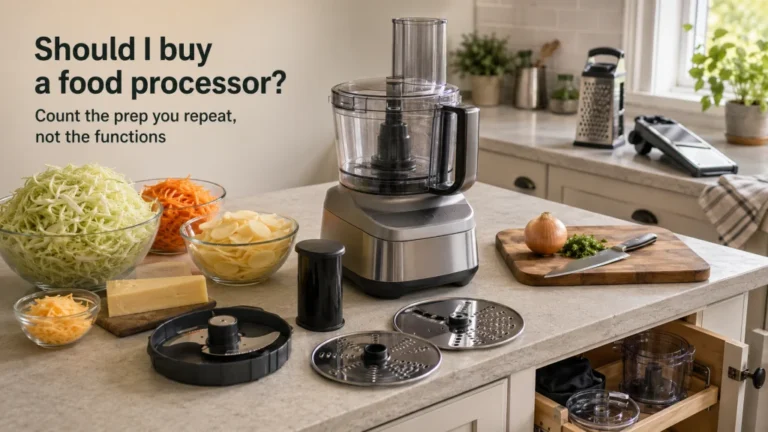
A processor with more capacity often comes with more ways to use that capacity, which can mean extra discs, blades, pushers, or accessory containers. Those parts may be valuable, but they still need a safe and convenient place to live. A sharp disc stored loose in a crowded drawer is not a good storage plan, and a dedicated case can occupy almost as much shelf area as another small appliance. Compare the complete storage package instead of judging footprint from the motor base alone.
Accessory value should also be tied to repeated work. A slicing disc that replaces a frequent knife task may easily justify its storage, while an attachment used once a year is harder to defend if it forces the whole system into a larger cabinet. This is where a slightly smaller processor with the right core tools can be more usable than a bigger package with attachments that never leave the case. The food processor guide is the better place to compare the broader feature and ownership tradeoffs once you know the size band that fits your kitchen.

The Cuisinart BDH-2 stores a steel blade, dough blade, detachable disc stem, and three cutting discs in one dedicated holder. Its tamper-resistant locking top must be pulled out and turned to access the cutting tools, then relocks when the lid closes. The high-impact plastic holder protects disc cutting edges instead of leaving sharp accessories loose in a drawer.
Check On AmazonIf you click this link and buy, we earn a commission at no additional cost to you.
Treat feed-tube width as a prep-time variable
A larger bowl does not automatically mean less prep. When slicing or shredding, feed-tube width can change how much trimming and pre-cutting happens before the machine ever starts. A wider opening may accept larger pieces of produce or cheese, while a narrow opening can require more knife work even when the bowl has plenty of room. That makes the feed tube a workflow measurement rather than a decorative specification.
There is still no reason to chase the widest opening in isolation. Some ingredients benefit from a smaller feed opening because it can help keep narrow pieces upright and controlled, and exact pusher arrangements vary by model. The useful comparison is your repeated ingredient shape against the tube and pusher system you will actually use. If a larger processor only adds bowl capacity while leaving your main pre-cutting burden unchanged, its size increase may not save as much time as the cup label suggests.

The Hamilton Beach 70725A uses a 12-cup bowl and 450-watt motor for chopping, slicing, and shredding. Its full-size feed tube accepts larger pieces, reducing the amount of trimming needed before processing. The Stack and Snap design includes an S-blade and slicing and shredding disc for comparing feed-tube workflow with the cuts you repeat.
Check On AmazonIf you click this link and buy, we earn a commission at no additional cost to you.
Build a realistic size band before comparing current machines
Once the batch worksheet, task limits, storage dimensions, and feed-tube needs are on paper, the answer should look like a range rather than one magical cup number. Common residential food processor ranges include roughly 6-9 cups, 10-13 cups, and 14-16 cups, while smaller 3-5 cup appliances are commonly positioned as choppers rather than full processors. Those ranges are useful for shopping orientation, but brands do not all define size classes identically. Your own band should be the smallest range that handles the normal batch, supports the required cuts, and fits the complete storage path without relying on rare peak use to justify extra bulk.
For example, someone whose normal work is slicing vegetables and shredding cheese for everyday meals may value a mid-size full processor with a feed tube more than a larger bowl that mostly sits empty. Someone who repeatedly prepares large batches may have a real reason to move into the larger range, provided the machine and accessories have a permanent storage plan. Once you have that size band, best food processors is the logical next step for comparing current full-size candidates without reopening the whole sizing question. If the worksheet instead shows that your recurring jobs are tiny, return to the chopper-versus-processor decision before shopping models.

The Cuisinart DFP-14BCNY represents the larger end of the full-size range with a 14-cup work bowl and 720-watt motor. It includes a stainless-steel chopping blade, 4 mm slicing disc, shredding disc, and a large feed tube. Its 11-inch depth, 7.9-inch width, and 14.8-inch height also make the storage cost of moving up in capacity concrete.
Check On AmazonIf you click this link and buy, we earn a commission at no additional cost to you.
Final Thoughts: Size for repeated work before rare capacity
Start with three quantities: the smallest job you repeat, the batch you make normally, and the peak you care about enough to accommodate. Then match those quantities to the type of processing you actually do, because chopping, slicing, shredding, dough, and wet mixtures do not use the bowl in the same way. Verify any liquid limits, maximum amounts, or task-specific boundaries in the exact manual before treating a candidate size as sufficient. That keeps the final choice tied to repeatable work rather than a single capacity number.
After capacity, measure the machine, the cabinet opening, the working clearance, and the accessories that need their own storage. A larger processor is worthwhile when its extra room repeatedly saves batching or prep work and still fits the way your kitchen operates. It is overbuying when the extra bowl mostly protects for rare peaks while making common jobs harder to store, retrieve, and clean. Choose the narrowest size band that handles the work you repeat, then compare machines inside that band.

The Cuisinart FP-110 uses a 10-cup Tritan work bowl and 950-watt motor in a mid-size full processor. It includes a chopping and mixing blade, reversible shredding disc, adjustable slicing disc, and medium and small pushers. Its removable hub lets included accessories nest together, tying capacity choice to the repeated work and storage footprint discussed in the final section.
Check On AmazonIf you click this link and buy, we earn a commission at no additional cost to you.
FAQs
🥣 Is advertised food processor capacity the amount I can always process?
No. Advertised bowl capacity is a nominal size, while usable amounts can change with the task and the exact model’s instructions. Check the manual for liquid, dough, and maximum-fill limits rather than assuming the cup label applies to every mixture.
📏 What size food processor do I need for everyday prep?
Choose from the smallest size band that handles your normal repeated batch, required cuts, and storage constraints without crowding the task. Use occasional peak batches as a secondary check rather than a universal household-size formula.
🧅 Can a food processor be too large for small jobs?
Yes, a large bowl can be inconvenient for very small repeated quantities, depending on bowl and blade design. If tiny chopping jobs dominate your routine, first decide whether a chopper or full processor is the better machine class.
🥕 Does a larger bowl always reduce prep time?
No. For slicing and shredding, feed-tube width and ingredient pre-cutting can matter as much as bowl capacity. Compare the food you prepare most often with the tube and pusher system of the exact model.
📦 What should I measure before buying a larger processor?
Measure stored height, width, and depth, the cabinet opening, working clearance, and the route to the counter. Also decide where blades, discs, pushers, and any accessory case will be stored.
References and Sources
- Consumer Reports food processor buying guide: Supports the distinction between claimed capacity and measured volume and the tradeoff between larger capacity and appliance bulk.
- KitchenAid food processor size guide: Supports the common residential size ranges, the chopper-versus-processor distinction, and the role of feed tubes, discs, and accessories.