Stand mixer attachments make the most sense when they replace a job your household repeats, not when they simply add another capability to a mixer you already own. The useful comparison is not attachment count but compatibility, setup, throughput, cleanup, storage, and whether a separate appliance would do the same work better for your routine. Included mixing tools, bowls and accessories, and powered optional attachments also belong to different compatibility checks, so they should not be treated as one interchangeable group. By the end, you should be able to classify an attachment, verify that it fits your exact mixer, and decide whether to buy it, skip it, or choose a standalone appliance instead.
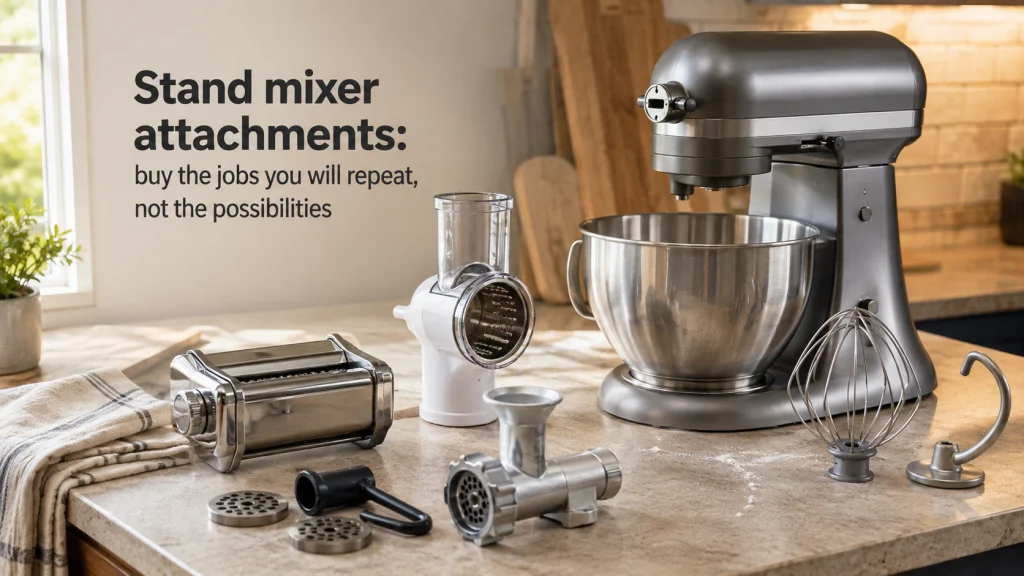
The mixer can do more, but that is not the same as needing more
A stand mixer can look like the center of an entire small-appliance system. Add the right stand mixer attachments and the same motor base may grind food, slice or shred ingredients, roll pasta, process food, or help make frozen desserts. That sounds efficient because the large motor base is already on the counter or in the cabinet. The catch is that every added capability still brings another purchase, another set of parts, another cleaning routine, and another compatibility question.
The better question is replacement value: what repeated household job will the attachment take over, and what equipment will it let you avoid buying or storing? An attachment that replaces a weekly prep task can be useful even if it has only one narrow function, while a highly versatile attachment can become dead weight if its task appears a few times a year. Storage matters too, because one motor base does not mean zero extra clutter once discs, cutters, plates, feed tubes, paddles, bowls, and covers start accumulating. If you are still deciding whether the mixer itself earns its footprint, resolve that first with the broader stand mixer value decision before pricing an ecosystem of extras. The attachment decision also affects how much space one mixer occupies within the broader small kitchen appliances setup, because every useful extra still needs storage and cleaning.

This Fresh Prep attachment fits KitchenAid stand mixers and uses three blades for slicing and shredding. Its 2-in-1 feed tube supports different ingredient sizes during prep. The set also includes a storage case, and the Amazon listing identifies it as dishwasher-safe.
Check On AmazonIf you click this link and buy, we earn a commission at no additional cost to you.
Separate included tools, bowls and accessories, and powered attachments
A useful stand mixer attachment guide should begin by separating items that are often discussed as though they were the same thing. The first group is the basic mixing tools used inside the bowl, commonly a flat beater or paddle, whisk or whip, and dough hook. The second group is bowls and stand mixer accessories such as extra bowls, pouring or splash shields, and specialized bowl-side mixing tools. The third group is powered optional attachments that connect to a dedicated powered interface and turn the mixer motor into the drive source for another food-prep job.
| Group | Typical role | Main buying check | Common mistake |
|---|---|---|---|
| Included mixing tools | Mix, whip, beat, or knead in the mixer bowl | Exact mixer and bowl fit | Assuming a similar-looking tool fits another size or series |
| Bowls and accessories | Add a second bowl, shield, or specialized bowl-side function | Bowl size, mounting geometry, clearance, and intended model | Buying by nominal capacity alone |
| Powered optional attachments | Use the mixer motor for a separate prep job | Powered-interface compatibility plus task value | Assuming the same interface makes every attachment universal |
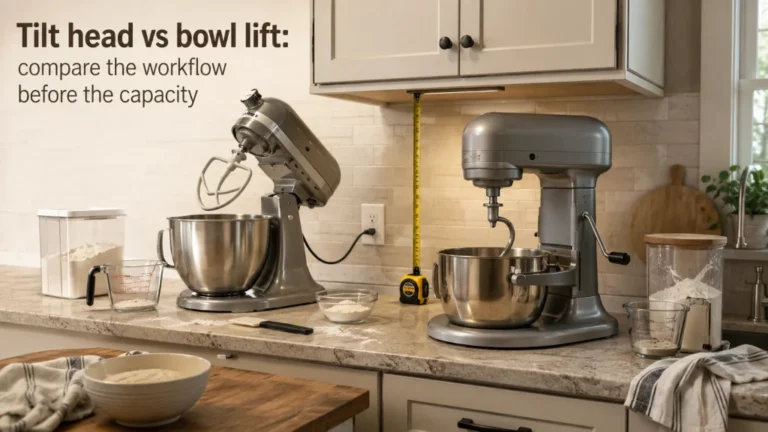
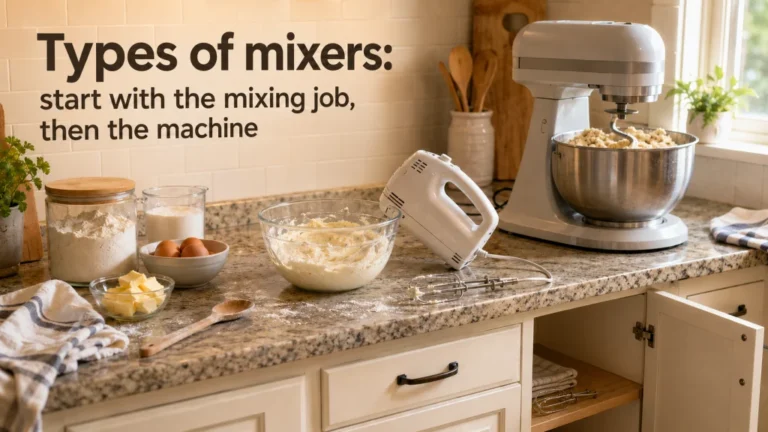
That taxonomy changes the decision because the evidence needed for fit is different in each group. A whisk that mounts at the bowl is not governed by the same fit rule as a grinder that connects to the powered attachment interface, and an ice-cream bowl may depend on bowl-lift or tilt-head geometry rather than the motor connection alone. Manufacturer documentation can also treat powered attachments and bowl-side tools differently, so broad claims such as “all attachments fit” are too loose unless the manufacturer defines exactly which attachment family it means. For a wider view of mixer designs before you evaluate accessories, the site’s comparison of mixer types keeps the attachment decision in the right equipment context.

This Flex Edge Beater is sized for 4.5- and 5-quart KitchenAid tilt-head mixers. Its flexible silicone edge scrapes the bowl while mixing, reducing the need to stop and scrape by hand. The beater is dishwasher-safe.
Check On AmazonIf you click this link and buy, we earn a commission at no additional cost to you.
Verify the exact interface and mixer compatibility before judging value
Compatibility is a stop-or-go check, not a detail to solve after purchase. KitchenAid, for example, describes broad compatibility for attachments that use its front powered interface, while its own attachment chart still lists exceptions and size-specific fit for some bowl-related items. Cuisinart documentation ties optional attachments to specified mixer series rather than presenting them as cross-brand or universal parts. Those two approaches are enough to show why the mixer brand name, exact model or series, attachment part number, and connection type should be checked together.
- Write down the exact mixer model or series from the rating label or manual.
- Identify whether the item mounts at the bowl, replaces a bowl-side tool, or connects to a powered attachment interface.
- Match the attachment part number or compatibility statement to the exact mixer documentation.
- Check whether mixer size, bowl style, bowl capacity, or generation creates an exception.
- Confirm any required adapter, bowl, drive piece, collar, plate, or other intermediate part.
- Use the exact attachment manual for installation, removal, operation, and cleaning boundaries.
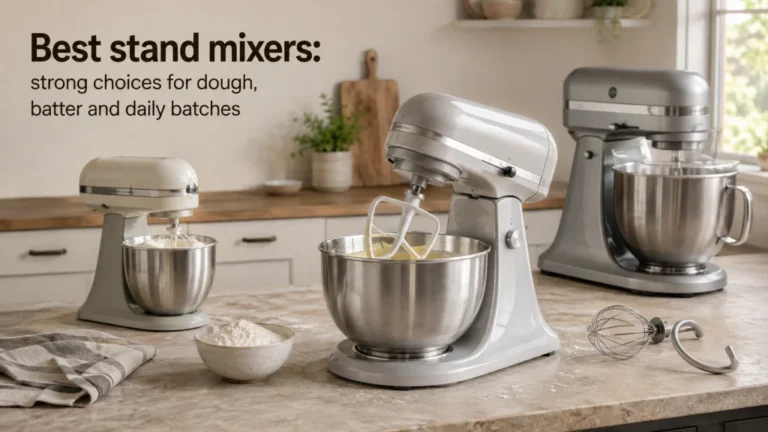
Visual similarity is weak evidence because a shaft, collar, bowl mount, or locking geometry can look close enough to tempt a purchase while still being wrong for the mixer. The same caution applies when a third-party listing uses broad phrases such as “fits most” without naming the models or interface standard that make the claim verifiable. If a fit statement cannot be traced to the mixer or attachment documentation, treat compatibility as unconfirmed rather than probable. The broader stand mixer buying framework is the better place to resolve mixer size and base-machine fit before building an attachment list around it.

This five-blade spiralizer fits KitchenAid stand mixers and handles peeling, coring, slicing, and spiralizing. Interchangeable blades let the same hub attachment cover multiple fruit and vegetable prep jobs. The blades are listed as top-rack dishwasher-safe.
Check On AmazonIf you click this link and buy, we earn a commission at no additional cost to you.
Start with the repeated household task, not the attachment catalog
The easiest way to overspend is to browse capabilities before naming the job. Start with something concrete, such as shredding several blocks of cheese each week, rolling pasta regularly, grinding ingredients in batches, or slicing a large quantity of vegetables for recurring meal prep. Then write down how you do that job now, what frustrates you about it, and what equipment already occupies space for the same purpose. An attachment deserves attention only if it removes enough repeated work to justify its own purchase, parts, and cleanup.
| Replacement-value question | What to write down | Weak-value signal |
|---|---|---|
| What job would this replace? | One specific repeated prep task | The answer is mainly “I might try it someday” |
| How often does that job happen? | Typical weekly, monthly, or seasonal pattern without forcing a fixed schedule | The task is rare and easy with existing tools |
| What equipment does it displace? | Current appliance, hand tool, or planned purchase | Nothing leaves the cabinet after the attachment arrives |
| What setup disappears? | Assembly, moving, plugging in, staging, or batch steps avoided | The attachment adds as much setup as the equipment it replaces |
| What cleanup disappears? | Parts, bowls, blades, discs, trays, or housings no longer washed | The attachment creates the same or greater washing burden |
| Where will every part live? | Actual cabinet, drawer, shelf, or bin space | Storage is undefined before purchase |
This worksheet prevents novelty from masquerading as utility. A household that already has a compact tool it likes may gain almost nothing from moving the same task onto the mixer, even when the attachment works well. Another household may free meaningful cabinet space if a powered attachment replaces a bulky single-purpose appliance and performs the repeated job with less friction. The attachment earns its place when the routine improves, not when the possibility list gets longer.

This food grinder attaches to KitchenAid stand mixers for repeated grinding jobs. The set includes a food tray, pusher, and grinding plates for preparing ingredients in batches. The Amazon listing identifies the housing as durable plastic and the attachment as compatible with all KitchenAid stand mixers.
Check On AmazonIf you click this link and buy, we earn a commission at no additional cost to you.
Compare an attachment with a standalone appliance by workflow
Price is only one line in the attachment-versus-standalone decision. Setup can favor the attachment when the mixer already lives on the counter, but it can favor a standalone appliance when the mixer must be lifted from storage and assembled for every use. Throughput matters when the task involves a large amount of food, because a compact attachment may require more feeding, smaller batches, or repeated stopping than a dedicated machine. Control matters too, especially when a standalone appliance offers a wider feed opening, larger working container, more speed choices, or purpose-built controls that improve the exact job.
| Workflow check | Attachment can make sense when | Standalone can make sense when |
|---|---|---|
| Setup | The mixer is accessible and the attachment installs quickly | The mixer is stored away or the dedicated appliance is faster to stage |
| Throughput | Household quantities fit the attachment’s feed and output pattern | Large batches make repeated feeding or stopping tedious |
| Control | The attachment provides the control needed for the repeated job | The task benefits from dedicated speed, size, or process controls |
| Counter use | The mixer already earns permanent or easy-access space | The standalone machine is smaller or more convenient for that job |
| Storage | The attachment and loose parts occupy less usable space overall | The attachment set is bulky enough that little space is actually saved |
Do not assume the mixer wins because its motor base is already paid for. The standalone appliance may still be the more convenient household tool if it processes the usual quantity with fewer passes, offers better control, or is easier to pull out and put away. Conversely, the attachment can be the cleaner choice when it handles the normal load without compromise and lets another appliance disappear entirely. The decision should follow the real routine from storage to finished food, not a spec-sheet comparison of motor power or feature count.

This standalone processor uses a 14-cup work bowl and a 720-watt motor. The package includes one chopping blade and two discs for common slicing and shredding work. Its dishwasher-safe parts make it a useful dedicated-machine comparison when evaluating mixer attachments by throughput and cleanup.
Check On AmazonIf you click this link and buy, we earn a commission at no additional cost to you.
Count cleanup and drying as part of convenience
An attachment does not save work if the prep step is faster but the sink fills with difficult parts afterward. Grinders, slicers, shredders, cutters, and processor-style attachments can include food-contact housings, blades, discs, feed components, plates, augers, pushers, or small pieces that must be separated before cleaning. Some components may tolerate machine washing while others may require hand washing or immediate drying, and that distinction depends on the exact attachment manual. The practical comparison is the full sequence: assemble, process, disassemble, wash, inspect, dry, and put away.
Small differences become important when the task repeats often. If two options produce similar results but one leaves fewer crevices, fewer sharp parts to handle, and fewer pieces that must air-dry across the counter, the lower-friction option may get used more often. With blades or powered moving parts, cleaning convenience never overrides the manufacturer’s safety instructions; do not reach into, clear, or wash an attachment in a way the manual does not allow. The value of an attachment should rise when it shortens the whole job, not merely the few minutes when food is moving through it.

This one-piece pouring shield is designed for select KitchenAid stand mixers. It sits at the bowl to help guide ingredients into the mixer and reduce splatter during mixing. The clear one-piece shield is dishwasher-safe, keeping its cleanup routine simpler than a multi-part powered attachment.
Check On AmazonIf you click this link and buy, we earn a commission at no additional cost to you.
Measure the attachment body and every loose part before calling it space-saving
“One base motor” sounds like a storage solution until the attachment pieces are laid out on the counter. A grinder may bring plates and feed parts, a slicer may bring multiple cutting pieces, and pasta equipment can include separate rollers or cutters that need protected storage. Even compact components can become annoying when they are scattered among drawers and boxes or when sharp edges need a safer dedicated location. Measure the real storage envelope as the attachment body plus every part you intend to keep with it.
Also think about retrieval, not just cubic volume. An attachment stored behind heavy cookware may technically fit in the cabinet but still be too inconvenient for a task you hoped to perform regularly. Keeping all related parts together usually reduces setup friction and lowers the chance that one required piece disappears into another drawer. If a supposed space-saving attachment needs its own large bin, multiple shelves, and protective cases while the standalone appliance would occupy one predictable footprint, the storage advantage may be smaller than the marketing suggests.

This sifter-and-scale attachment fits household KitchenAid stand mixers. It combines hands-free sifting with a digital scale and a 4-cup hopper. The included storage case keeps the attachment and its related parts together between uses, making the full storage footprint easier to judge.
Check On AmazonIf you click this link and buy, we earn a commission at no additional cost to you.
Price the attachment against expected use, not against the cheapest alternative
The cheapest purchase is not automatically the best value, and the most expensive attachment is not automatically the best replacement. Start with expected use frequency, then compare purchase cost with setup effort, cleanup burden, storage demand, likely throughput, and the price of the standalone alternative you would realistically buy. A low-cost attachment used twice and forgotten is poor value even if it was cheaper than a dedicated appliance. A more expensive attachment used constantly can make sense when it removes another machine and reliably reduces work.
Keep sunk costs out of the calculation as much as possible. Owning the mixer does not make every compatible accessory a bargain, just as owning a drill does not make every bit set useful. The money already spent on the mixer is not recovered by adding an attachment that creates a new hobby you do not actually pursue. Pay for repeated utility, reduced friction, and real replacement value rather than the feeling that the mixer should do more because it can.

This six-wire whip is designed for select KitchenAid tilt-head stand mixers. It is intended for aerating mixtures such as whipped cream, frostings, and cake ingredients. As a model-specific bowl-side tool, its value depends on repeated use and verified fit rather than simply adding another accessory.
Check On AmazonIf you click this link and buy, we earn a commission at no additional cost to you.
Treat an ice-cream bowl as a replacement-value example, not a separate buying system
An ice-cream bowl attachment shows why attachment value is more complicated than simply reusing the mixer motor. The bowl itself can require substantial freezer or cabinet space, and fit may depend on mixer style or bowl geometry rather than only the front powered interface. The household also has to consider freezing requirements, batch size, transfer and cleanup, and how often frozen desserts are actually made. If those conditions line up with the routine, the attachment may remove the need for another motor base; if they do not, the shared mixer base is not enough to make it the better system.
Keep this decision at the attachment level when the question is whether the bowl adds useful capability to a mixer already chosen. If the real question has shifted to compressor machines, freezer-bowl machines, capacity, batch flow, or dedicated frozen-dessert equipment, use the site’s ice cream maker buying framework instead. That prevents one attachment example from swallowing a separate appliance decision that has different storage, pre-freezing, capacity, and ownership trade-offs. The replacement test stays the same: judge the complete household workflow, not the fact that both options can make a frozen dessert.

This ice-cream maker attachment is made for select KitchenAid stand mixers. The Amazon listing specifies fit for tilt-head mixers 4.5 quarts and larger and bowl-lift mixers 6 quarts and larger. Its bowl-based design makes freezer space, exact fit, and repeated frozen-dessert use central to the purchase decision.
Check On AmazonIf you click this link and buy, we earn a commission at no additional cost to you.
Judge multifunctionality by what leaves the kitchen
Multifunctionality is valuable when one piece of equipment truly reduces the number of other tools a household needs. It is much less valuable when every added function arrives in a separate box while all existing appliances remain in place. Before buying another attachment, name the item that will be sold, donated, skipped, or no longer purchased because the mixer now covers that job well enough. If nothing changes in the equipment collection, the attachment is adding capability but not necessarily simplifying the kitchen.
This is also where marketing language needs the most skepticism. A mixer that can perform many jobs is not automatically the best tool for every one of them, and a household does not gain value from functions it rarely uses. The stronger portfolio is the one that covers repeated work with the least total friction across storage, setup, cleanup, maintenance, and cost. When the mixer’s main duties already justify ownership, attachments should be evaluated one by one rather than treated as a reason to fill every possible role.

This three-piece pasta set fits household KitchenAid stand mixers and includes a stainless roller plus cutters. The roller forms pasta sheets while the cutters handle common noodle shapes. A cleaning brush is included, letting one mixer base cover pasta rolling and cutting without adding another motorized appliance.
Check On AmazonIf you click this link and buy, we earn a commission at no additional cost to you.
Use three outcomes: buy, skip, or choose a standalone appliance
Every optional attachment should end in one of three outcomes instead of a vague verdict that it is “worth it.” Buy when the attachment fits the exact mixer, handles a repeated task at the household’s normal quantity, reduces setup or cleanup, has a defined storage place, and replaces another tool or planned purchase. Skip when the task is rare, the current tool already works with little effort, storage is unresolved, or the attachment mainly appeals because it creates a new possibility. Choose a standalone appliance when the dedicated machine offers meaningfully better throughput, control, access, cleanup, or storage for the way the household actually performs that job.
This three-way decision keeps both premium and budget choices honest. A household can reasonably choose the attachment even when it costs more if it removes enough recurring friction, and it can reasonably choose the standalone appliance even when that means owning another motor base. It can also choose neither when the task does not happen often enough to justify more equipment. Conditional decisions are more useful than a ranked list because the best outcome changes with frequency, quantity, space, and what the kitchen already owns.

This Gourmet Pasta Press fits household KitchenAid stand mixers and uses six quick-change discs. A built-in wire cutter lets the user cut extruded pasta as it exits the press. The included storage case makes it practical to weigh repeated pasta use, fit, and storage before choosing the attachment or a standalone alternative.
Check On AmazonIf you click this link and buy, we earn a commission at no additional cost to you.
Be especially careful when the attachment is meant to replace a food processor
Food-processor-style attachments create a tempting overlap because slicing, shredding, chopping, or dicing can sound close to what a standalone processor does. The meaningful comparison is not whether both machines can perform one named action, but whether the attachment handles the household’s normal volume, feed size, control needs, and cleanup with less total friction. A family processing large batches may value a dedicated bowl and wider workflow, while a smaller household may prefer an attachment that covers a narrow repeated prep task without storing another complete appliance. Neither outcome can be proved by the attachment label alone.
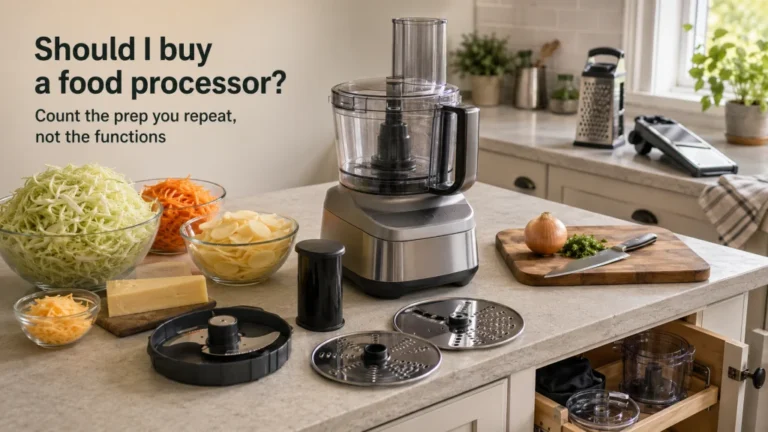
If you are deciding directly between the two equipment types, use the site’s stand mixer versus food processor comparison rather than stretching an attachment discussion into a full processor buying decision. Once a standalone processor has already been chosen, its capacity, feed system, blades, discs, controls, storage, and cleanup should be evaluated as a processor problem, not as a reason to keep adding mixer accessories. The attachment belongs here only while it is being judged as a substitute for a repeated task. That boundary keeps the decision focused on replacement value instead of turning the mixer into a default answer for every form of food prep.

This food processor attachment fits KitchenAid stand mixers and provides dicing, slicing, shredding, and julienne functions. It uses a wide feed tube and includes multiple processing discs plus a storage case. That combination makes it directly relevant when comparing a hub-powered attachment with a full standalone food processor.
Check On AmazonIf you click this link and buy, we earn a commission at no additional cost to you.
Final Thoughts: buy the attachment for a repeated replacement job
The strongest reason to buy a stand mixer attachment is simple: it replaces work your household already does and makes that work easier enough to justify the added parts. Compatibility comes first, followed by the repeated task, normal quantity, setup, throughput, cleanup, storage, and cost. If the attachment passes those checks and lets another appliance or tool disappear, the shared mixer base can be a real advantage. If it only adds another capability to admire, the kitchen has gained equipment without necessarily gaining convenience.
Before paying, write down the exact mixer model, the exact attachment fit statement, the job it will replace, how that job is done now, and where every new part will be stored. Then compare the complete routine with the standalone alternative from cabinet to cleanup rather than comparing feature lists. Buy when the attachment clearly improves a repeated workflow, skip when the task is too rare to matter, and choose a dedicated machine when it handles the real workload better. That approach keeps the mixer useful without turning its accessory system into a collection project.

This metal food grinder fits KitchenAid stand mixers and includes a food tray, pusher, grinding plates, and sausage-stuffing parts. Multiple grinding plates support different grinding results from one attachment. The included parts make it a concrete repeated-job example for deciding whether a mixer attachment can replace separate equipment.
Check On AmazonIf you click this link and buy, we earn a commission at no additional cost to you.
Explore more mixer decisions
Attachment value gets easier to judge once the rest of the mixer decision is settled. Use the related articles below when the unresolved question is really about mixer class, stand-mixer fit, bowl architecture, capacity, wattage, dough workload, or current model selection rather than the attachment itself. Each page owns a narrower decision, so you can move to the next question without turning one accessory choice into a full mixer-shopping exercise.
| Topic | What you’ll find |
|---|---|
| Stand mixer vs hand mixer | Choose the electric-mixer class from task load, batch size, hands-free value, storage, and cleanup. |
| What to look for in a hand mixer | Build a hand-mixer shortlist around low-speed control, comfort, attachments, storage, and realistic task limits. |
| Is a stand mixer worth it? | Decide whether stand-mixer ownership removes enough repeated work to justify its cost, footprint, lifting, and cleanup. |
| Stand mixer guide | Build a model shortlist from batch needs, architecture, usable capacity, kitchen fit, and credible performance evidence. |
| Tilt head vs bowl lift | Compare bowl access, ingredient access, working height, storage geometry, and workload without assuming one design is universally better. |
| What size stand mixer do I need? | Choose a realistic size range from minimum, normal, and occasional peak batches while accounting for body size and storage. |
| Stand mixer wattage | Separate what the electrical rating can establish from the performance questions that require better evidence. |
| Stand mixer for bread dough | Define a dough-first requirement profile from batch load, frequency, manufacturer limits, kneading evidence, and household fit. |
| Best stand mixers | Move from evergreen buying criteria to current stand-mixer choices matched to workload, space, and tested performance. |
| Best hand mixers | Compare current hand-mixer choices after the class decision has already been made. |
Return to the attachment decision only after the base mixer and the repeated job are clear. That keeps compatibility and replacement value in focus instead of letting a separate architecture, size, power, or current-model question distort whether an attachment deserves space in the kitchen.

This 6-speed hand mixer uses a 250-watt motor and includes traditional beaters. QuickBurst and Bowl Rest provide dedicated controls and handling that differ from a stand-mixer attachment workflow. Its snap-on storage case keeps the mixer and accessories together, making it a useful comparison point in the broader mixer decision.
Check On AmazonIf you click this link and buy, we earn a commission at no additional cost to you.
FAQs
🔌 Are all stand mixer attachments universal?
No. Compatibility depends on the brand, exact mixer model or series, attachment family, and where the part connects. Verify the manufacturer compatibility statement or manual for both the mixer and attachment before buying.
🥣 Do all mixing bowls fit every mixer from the same brand?
No. Bowl capacity, mounting style, lift or tilt geometry, and mixer series can change fit. Match the exact bowl part or compatibility statement to the mixer rather than buying by quart capacity alone.
🍝 Is a pasta attachment worth buying?
It can be when fresh pasta is a repeated job and the attachment reduces setup or storage compared with the alternative. For occasional use, the extra cutters, rollers, cleaning, and storage may not earn their space.
🧀 Is a slicer or shredder attachment better than a food processor?
It depends on the amount of food, feed size, control, cleanup, and equipment you already own. Compare the complete workflow rather than assuming the mixer attachment is better simply because it shares the motor base.
🧼 Are stand mixer attachments easy to clean?
Cleaning burden varies widely by attachment. Count every blade, disc, plate, tube, housing, and part that must be disassembled, washed, dried, and stored, then follow the exact attachment manual for safe cleaning.
📦 Do attachments really save cabinet space?
Only when their total stored parts take less useful space than the equipment they replace. Measure the attachment body, loose pieces, protective storage, and retrieval space before assuming that one shared motor means a smaller storage footprint.
References and Sources
- KitchenAid attachment buying guide: Supports the distinction between bowl-side accessories and powered optional attachments and documents the manufacturer’s compatibility framing.
- KitchenAid attachment fit information: Supports the manufacturer’s fit statement for attachments that use its powered mixer interface.
- Cuisinart stand mixer manuals: Supports the need to match optional attachments to specified mixer series rather than assuming cross-brand or universal compatibility.