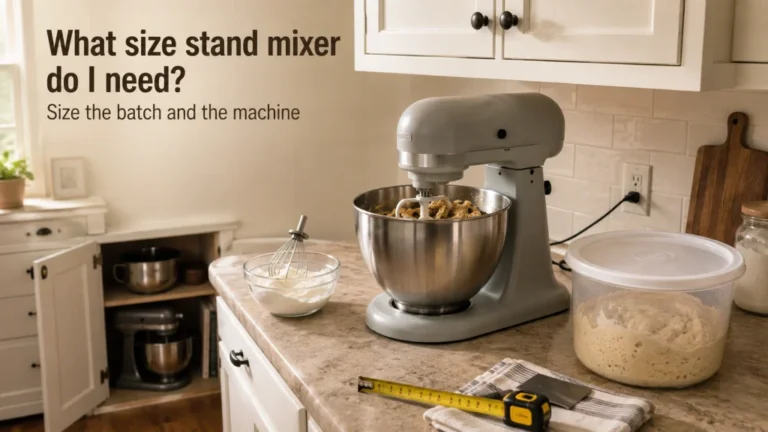
A stand mixer for bread dough should be chosen around the dough you actually make, the weight of a normal batch, and how often the machine will face that load. Bowl size and wattage can help describe a mixer, but neither proves that it will knead your usual dough comfortably or stay within the manufacturer’s operating limits. The useful comparison is a workload profile matched against exact load guidance, credible kneading tests, stability, cleanup, counter space, and the other baking jobs you still expect the machine to handle. This article stays with that buying decision and does not rank current models, teach bread recipes, or replace the instructions for an exact mixer.
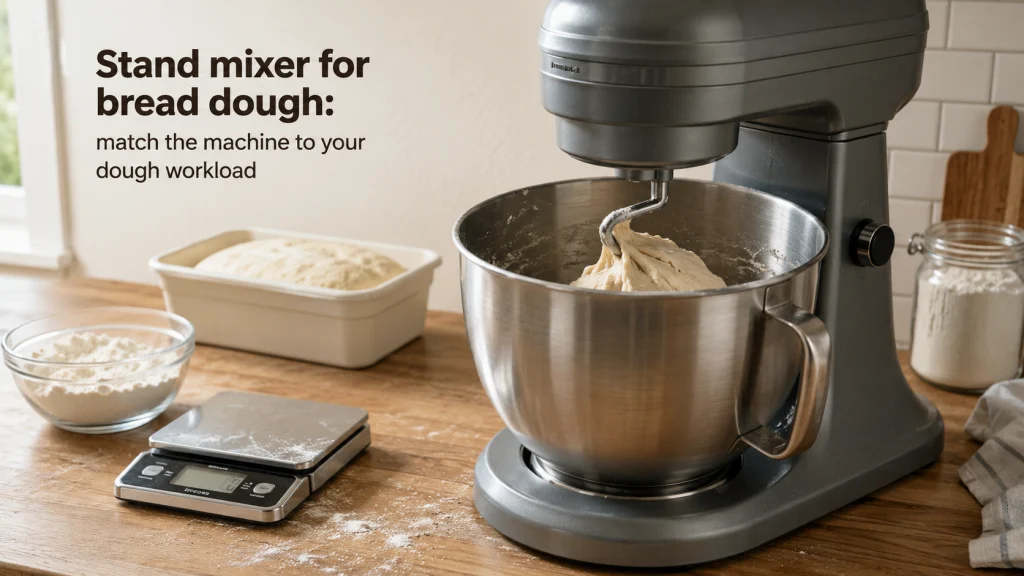
Define the dough workload that changes a stand-mixer purchase
A stand mixer for bread dough is not doing the same job as a mixer used mainly for cake batter, frosting, and whipped cream. Repeated dough work keeps resistance on the drive system, with the load changing again when the dough is stiff, the batch is large, or both. Before comparing brands, write down what you make, the normal finished dough mass, and how often that job repeats. That workload description is more useful than starting with a motor number or bowl size.
A first-time buyer mistake is treating “bread” as one workload. A soft sandwich loaf, a large pizza batch, and a dense bagel-style dough can load the same machine differently even when all fit in the bowl. A mixer for bread dough should be judged against the normal case first and the occasional peak second. If your needs are broader, the site’s stand mixer guide frames the full appliance decision before narrowing it to bread. Within small kitchen appliances, a bread-focused stand mixer should therefore be judged by the repeated dough workload rather than by generic mixer capability.
Stiff and softer doughs do not create the same resistance
Hydration, flour choice, enrichments, and recipe structure affect how dough behaves, so “pizza dough” does not create one universal mixer requirement. Stiffer doughs generally resist deformation more strongly, while wetter doughs can behave differently around the hook and bowl. Do not invent a hydration cutoff for every mixer; look for manufacturer guidance and independent tests that resemble your dough. Evidence from a soft white loaf does not automatically prove comfort with a much stiffer workload.
Normal batch mass matters more than bowl quarts alone
A bowl can be large enough for dough that exceeds the manufacturer’s intended load, and a large machine can also have a meaningful lower batch limit. One spiral mixer illustrates the point: its maker lists a 7.3-quart bowl with a 2-pound minimum and an 11-pound maximum dough capacity. Bowl volume is therefore only one part of fit, not a substitute for a documented dough range. For the broader capacity question, use the stand mixer size comparison rather than assuming more quarts always mean more useful bread capacity.
Frequency changes whether dough capability is worth living with
An occasional loaf can justify a different compromise from repeated bread or pizza sessions. If bread is infrequent, a general-purpose mixer that handles the normal batch within its documented limits may be the better household fit. When dough dominates, extra weight, a larger footprint, or an unfamiliar mixing system can be easier to justify because the benefit is used repeatedly. Frequency turns a feature from an impressive specification into something that earns its counter space.
| Workload question | Your normal case | Your occasional peak | Evidence to verify |
|---|---|---|---|
| Dough type | Soft, medium, stiff, or mixed range | The most demanding dough you realistically make | Manufacturer instructions and tests using similar dough |
| Finished dough mass | Weight of the batch you make most often | Largest batch that actually matters | Published minimum and maximum dough or flour guidance |
| Frequency | How often bread or pizza work repeats | Busy periods or batch-baking sessions | Whether repeated-load evidence matches your routine |
| Other baking | Cakes, cookies, whipping, or other regular work | Occasional specialty jobs | Independent tests beyond bread dough |
Fill this worksheet before shopping, then keep it next to the specifications for any mixer you consider. The goal is not to find the machine with the largest numbers, but to eliminate candidates whose documented working range does not match your routine. Once the workload is clear, manufacturer limits become the next filter because they define what the machine is actually intended to do. That is a harder boundary than marketing language about power or heavy-duty construction.

Escali Primo measures up to 11 pounds or 5,000 grams in 1-gram increments. Its tare function lets you zero a bowl before weighing ingredients or finished dough. The two-button controls and automatic shutoff keep batch-weight tracking simple while you define a repeatable bread workload.
Check On AmazonIf you click this link and buy, we earn a commission at no additional cost to you.
Treat exact manufacturer load and speed guidance as a hard boundary
Start with the manual, product support page, or other exact documentation for the mixer you are evaluating. Look for dough capacity, flour capacity when provided, approved dough tool, speed instructions, duty guidance, and any limits tied to a particular bowl or attachment. KitchenAid, for example, publishes speed 2 as its kneading guidance for dough-hook use on its stand mixers, which is useful evidence for those machines but not a universal rule for every brand or architecture. Another manufacturer may use a different control system, so borrowing a speed number from a familiar mixer can be a poor shortcut.
Manufacturer evidence also helps separate physical fit from permitted workload. A dough may fit below the rim and still exceed the documented load, while a dough hook that looks compatible may not be approved for a different bowl or mixer variant. If the machine repeatedly stalls, overheats, develops an abnormal burning smell, walks dangerously, or shows electrical damage, stop using it and follow the exact manual or qualified service path rather than treating the symptom as proof that the mixer merely needs more speed. Bread performance matters, but it never overrides the operating boundary set for the exact machine.
| Evidence level | What it can prove | What it cannot prove by itself |
|---|---|---|
| Exact manufacturer manual or support guidance | Approved attachment, load, speed, setup, and safety boundaries | How the mixer compares with every competing design |
| Independent kneading test with disclosed conditions | Observed pickup, development, stability, noise, and strain for that tested dough and batch | Performance on a different dough, larger batch, or longer ownership pattern |
| Retailer specification | Useful listing details when they match current manufacturer information | Durability or real kneading capability |
| Owner discussion | Recurring frustrations, learning curves, or questions worth investigating | A technical limit for every unit of that model |
Use the table as an evidence hierarchy rather than a scorecard. The manual sets the operating boundary, while a credible test shows what happened inside that boundary under stated conditions. Owner reports can tell you what to investigate next, but they should not replace technical documentation when the question is load, speed, compatibility, or safety. This approach keeps the buying decision grounded even when marketing pages use broad phrases such as “heavy duty” or “made for bread.”

KitchenAid K45DH is a coated metal replacement dough hook designed for mixing and kneading yeast doughs. Amazon lists compatibility with KitchenAid models including K45SS, KSM150, KSM96, and KSM97. The hook is top-rack dishwasher-safe and carries a one-year warranty.
Check On AmazonIf you click this link and buy, we earn a commission at no additional cost to you.
Compare mixer architectures through documented behavior, not labels
Planetary mixers, rotating-bowl systems, and spiral-style mixers move the bowl, tool, and dough in different ways. Those mechanical differences can change ingredient pickup, how the dough travels through the bowl, how stable the machine feels under load, and how intuitive the process is for a household used to another design. The useful question is not which architecture sounds more professional, but what the exact machine does with a batch close to yours. For a broader look at the families before you narrow the field, the types of mixers comparison separates the main mixer classes without assuming one design wins every job.
Independent testing shows why architecture should be judged with conditions attached. A spiral-style machine can perform very well on bread and pizza dough yet be less convenient for small quantities of cream, butter, or other general baking tasks, while a familiar planetary mixer may offer easier all-purpose use but have a different comfort zone under heavy dough. Rotating-bowl systems can also require a learning adjustment because the ingredient path and tool positioning do not behave like a conventional planetary setup. If you are specifically deciding between the two common KitchenAid-style form factors, the tilt-head versus bowl-lift comparison handles that narrower question without pretending the form factor alone proves dough durability.

Ooni Halo Pro uses a rotating bowl, spiral dough hook, and removable breaker bar rather than a conventional planetary layout. Its 7.3-quart bowl and 58 speed settings make the architecture itself a meaningful part of the comparison. The included flexible beater and geared whisk also let the machine handle non-dough mixing tasks.
Check On AmazonIf you click this link and buy, we earn a commission at no additional cost to you.
Wattage does not tell you whether a mixer fits your bread workload
Input wattage is easy to compare because it is printed as a single number, but that convenience makes it tempting to ask the number to prove more than it can. Wattage does not tell you the usable torque at the tool, the effect of gearing, the control strategy under load, the bowl-and-hook geometry, the allowed dough mass, or how the machine behaves when a stiff batch starts resisting. Two mixers with different motor ratings can therefore reverse expectations once the full mechanical system and test conditions are considered. That is why the stand mixer wattage explanation should be used as technical background, not as a bread-mixer ranking rule.
A stronger buying process keeps wattage in its proper place. Use it as one documented specification, then immediately look for load guidance and tests that show the machine kneading a known dough mass without unstable movement, repeated stalling, or obvious signs of strain. Be equally skeptical of claims that metal gears, a large bowl, or a bowl-lift layout automatically guarantee long-term dough performance, because those details still do not describe the complete system. The bread-first question remains simple: does the evidence match the dough, batch, and frequency you wrote down at the start?

Hamilton Beach model 63391 pairs a 300-watt motor with seven speeds and a 4-quart stainless steel bowl. It includes a dough hook, whisk, flat beater, and splash guard for different mixing jobs. The listing also identifies planetary mixing and a built-in carry handle, giving useful context beyond the wattage number alone.
Check On AmazonIf you click this link and buy, we earn a commission at no additional cost to you.
Look for kneading evidence that describes what happened in the bowl
A useful kneading test tells you more than whether the finished loaf looked acceptable. Look for the dough formula or at least the dough style, batch weight, tool used, speed or control setting, and enough process detail to understand what the mixer actually faced. Ingredient pickup, dough development, bowl coverage, machine movement, noise, and repeated manual intervention help show whether the machine handled that load cleanly or merely completed it. If the conditions are missing, the result is much harder to transfer to your own kitchen.
Transferability is the key filter. A strong result with a moderate batch of soft dough is evidence for that tested condition, not automatic proof for a larger or stiffer batch, and a dough specialist can still disappoint on small-batch whipping or creaming. Serious Eats, for example, found a current spiral stand mixer especially capable with bread and pizza dough while noting weaker performance on some non-bread tasks. Use evidence to reject candidates whose tested conditions do not resemble your workload, rather than treating every positive review as interchangeable proof.
- Prefer tests that identify the dough style and batch size instead of saying only “we made bread.”
- Check whether dry ingredients were incorporated cleanly or needed repeated scraping and manual correction.
- Watch for mixer movement, head movement, bowl movement, unusual noise, or slowing under the tested load.
- Look for a description of dough development rather than a claim based only on motor wattage.
- Compare non-bread tasks if the mixer must also handle cakes, cookies, whipping, or very small batches.
This checklist keeps independent testing tied to your workload rather than to the reviewer’s headline. A test of one soft loaf is useful evidence for that kind of batch, while a large low-hydration dough tells you something different. The closer the test conditions are to your normal work, the more confidently you can use the result. When the conditions are missing, treat the conclusion as weaker evidence and keep looking.

Etekcity Food Kitchen Scale measures in grams and ounces with an 11-pound capacity. Its tare function lets a bowl be zeroed before weighing a dough batch or ingredients. The stainless-steel platform gives you a repeatable way to record batch mass when comparing kneading tests.
Check On AmazonIf you click this link and buy, we earn a commission at no additional cost to you.
Do not evaluate bread capability in isolation from small-batch baking
A stand mixer for bread may still spend much of its life on tasks that barely challenge the dough system. If you routinely whip a small amount of cream, cream butter and sugar, mix cake batter, or make a modest cookie batch, the bowl shape and attachment reach need to work at that end of the range too. Some dough-focused designs have a meaningful minimum batch or behave differently with small quantities, so extra bread capacity can create a new inconvenience rather than a free upgrade. The right machine has to cover the work you actually repeat, not just the most demanding job on your list.
This is where a household can reasonably choose less specialized dough performance in exchange for easier everyday use. An occasional bread baker who makes many cakes and small batches may be better served by a versatile general-purpose mixer that stays within its dough limits, while a household making bread and pizza repeatedly can justify a more dough-focused compromise. Neither choice is universally better because the ownership value comes from frequency. If bread does not dominate the routine, the broader stand mixer buying decision deserves more weight than a single dough test.

Kitchen in the box uses a 3.2-quart bowl in a compact stand-mixer format. It provides six speeds and comes with an egg whisk, dough hook, and flat beater. That attachment mix makes it relevant when bread performance still has to coexist with whipping and everyday small-batch baking.
Check On AmazonIf you click this link and buy, we earn a commission at no additional cost to you.
Count bowl cleanup, machine weight, counter space, and the storage path
Heavy dough capability can bring physical costs that are easy to ignore on a specification sheet. A wider machine may claim permanent counter space, while a heavier one can make cabinet storage unpleasant. Large bowls and dough tools also need a realistic washing and drying path when sticky dough collects around posts, rollers, hooks, or bars. Those details do not make a mixer bad, but they can make it a bad household fit.
Measure counter depth, overhead clearance, and the route from storage to the work surface before choosing a larger design. If the mixer will move, judge the actual lift and grip points rather than shipping weight alone, and remember that accessories need a home. A bread-focused machine that stays buried may save less labor than a less specialized mixer that is ready to use. A capability earns its keep only when the household routine makes you use it.

Aieve Appliance Sliders are self-adhesive rollers made for small countertop appliances. This eight-piece set can be used under equipment such as mixers, coffee makers, and air fryers. The rollers let a heavy appliance slide forward for use or cleanup instead of being lifted every time it moves.
Check On AmazonIf you click this link and buy, we earn a commission at no additional cost to you.
Build a dough-requirement sheet before you compare current models
Once the workload and household constraints are clear, turn them into pass-or-fail requirements. Put normal dough mass first, then the stiffest dough you realistically make, frequency, and the exact manufacturer limit a candidate must cover. Add non-bread jobs, acceptable machine size, storage plan, cleanup tolerance, and any attachment needs that genuinely matter. The point is to stop a flashy specification from displacing a requirement you already know is important.
The sheet should also tell you when to reject a candidate. Strong dough results do not rescue a machine whose tested batch is unlike yours, whose documented range misses your normal workload, or whose size and general-baking behavior create a poor household fit. A less specialized mixer can still pass if it covers the work you actually repeat. A conditional pass or skip is more useful than a universal verdict because it ties the evidence directly to your workload.
| Bread-first profile | Buy direction | Skip direction |
|---|---|---|
| Frequent stiff or large dough batches | Favor candidates with exact load guidance and credible tests near that workload | Skip machines supported only by wattage claims or light-loaf testing |
| Occasional single-loaf bread plus broad baking | Favor all-purpose usefulness that still covers the normal dough within limits | Skip specialization that adds size or awkward small-batch performance you will rarely use |
| Large bread batches but limited counter space | Require both dough evidence and a realistic permanent or movable storage plan | Skip a machine that technically performs but is impractical to lift, place, or clean |
| Unclear dough routine | Define normal batch mass and frequency before spending for extra capability | Skip buying around a future workload that has not become part of the household routine |
Use this profile as the front page of your shopping notes. Behind it, keep the manual or support evidence and the most relevant independent test for each candidate so you can see exactly why it passed. If a candidate only looks attractive after you ignore a failed requirement, the sheet has already done its job. The next step is deciding whether a stand mixer is even the right appliance class for the bread routine you want.

Komelon SL2825 provides a 25-foot blade with a self-locking mechanism and push-button retraction. Its nylon-coated blade and impact-resistant case are designed for regular measuring work. A tape measure like this is directly useful for recording counter depth, overhead clearance, and storage-path dimensions on a mixer requirement sheet.
Check On AmazonIf you click this link and buy, we earn a commission at no additional cost to you.
Keep the bread-machine decision separate from stand-mixer selection
A bread machine and a stand mixer can overlap at the mixing and kneading stage, but they solve different household workflows. This page assumes you have already decided that a stand mixer is the appliance class you want and focuses on choosing one around bread workload. If your real question is whether you want an appliance that can mix, proof, and bake with more automation or a mixer that remains useful across many kitchen jobs, that is a different decision. Use the site’s bread machine versus stand mixer comparison before spending time comparing stand-mixer architectures.
Keeping those decisions separate prevents a common buying detour. A highly capable dough mixer may still be the wrong purchase for someone whose actual goal is reducing hands-on bread steps, while a bread machine may be too narrow for someone who also wants cake batter, cookie dough, whipping, and attachments. The correct first question is therefore which workflow you want to own, not which appliance has the stronger dough reputation. Once the stand-mixer class is settled, return to the workload sheet and judge candidates inside that class.

Zojirushi BB-PPC20BA is a breadmaker with dedicated programs that include dough, sourdough starter, cake, and jam. Its automated bread workflow is fundamentally different from owning a stand mixer for broader kitchen jobs. The machine gives readers a concrete bread-machine option to compare before they commit to the stand-mixer appliance class.
Check On AmazonIf you click this link and buy, we earn a commission at no additional cost to you.
Use a current shortlist only to supply candidates
This article stops before a live ranking because availability, variants, documentation, and independent test coverage can change. Once your requirements are fixed, a current shortlist has one job: give you models worth checking. It should not replace the manufacturer boundary or the evidence standard you already established. That keeps the shopping step from turning back into a search for a generic winner.
Use the site’s best stand mixers page to find current candidates, then reject any model that fails your documented workload or household constraints. A high ranking cannot make an unsupported dough load acceptable, and a strong dough reputation cannot make an oversized or poor all-purpose fit disappear. The shortlist supplies names. Your evidence sheet decides which names survive.

This Bosch Universal Plus bundle combines the 500-watt mixer with a 6.5-quart capacity, wire whips, dough hook, and NutriMill dough-hook extender. Amazon identifies this exact white Dough Hook Extender Bundle as ASIN B0CJCKHQGK. Its documented configuration makes it straightforward to compare against a written workload and attachment requirements.
Check On AmazonIf you click this link and buy, we earn a commission at no additional cost to you.
Final Thoughts: let evidence eliminate the wrong mixers
The strongest bread-dough purchase is not the mixer with the most impressive single specification. It is the candidate whose manufacturer limits cover your workload and whose credible test conditions are close enough to your dough to mean something. Use that evidence to remove weak fits early instead of explaining away conflicts after you like a model.
Among the survivors, choose the machine that also fits your general baking, cleanup, counter space, weight, and storage routine. Wattage, bowl size, and architecture can inform the comparison, but none should overrule the workload boundary. The right mixer is the one that passes both the dough test and the household test.

KitchenAid Classic K45SS has a 4.5-quart stainless steel bowl and ten speeds in a tilt-head format. It includes a coated dough hook, coated flat beater, and 6-wire whip for bread and general baking jobs. That combination makes it a useful final comparison point when a mixer has to satisfy both dough needs and the rest of the household baking routine.
Check On AmazonIf you click this link and buy, we earn a commission at no additional cost to you.
FAQs
🍞 What matters most when choosing a stand mixer for bread?
Start with dough type, normal finished dough mass, and how often you knead it. Then verify that the exact mixer documentation and credible tests cover a similar workload.
⚖️ Is a bigger bowl automatically better for bread dough?
No. Bowl volume does not prove the permitted dough load, and some large machines also have a practical minimum batch, so check the exact manufacturer range.
⚡ Does higher wattage mean a stand mixer will knead stiff dough better?
Not by itself. Wattage does not capture gearing, control strategy, tool geometry, load limits, or observed stability under a specific dough.
🥣 Should I choose a spiral mixer if bread is my main job?
Consider the architecture only after checking your batch range and other baking needs. A dough-focused design can be excellent for bread yet less convenient for small or non-bread tasks.
📦 How much should storage space affect the choice?
A lot if the mixer will not live on the counter. Measure the storage route, lifting path, counter clearance, and accessory space before paying for extra capacity you may avoid using because the machine is awkward to move.
🛑 What should I do if a mixer repeatedly stalls or smells hot while kneading?
Stop the machine and check the exact manual for load, speed, and service guidance. Do not keep increasing speed or repeating the same load when the mixer shows abnormal overheating, burning odor, dangerous movement, or electrical damage.
References and Sources
- KitchenAid dough-hook guidance: Supports the model-family example showing that kneading speed guidance should come from the exact manufacturer rather than a universal rule.
- Ooni Halo Pro specifications: Provides the current bowl size and published minimum and maximum dough capacity used to show why quarts alone do not define usable dough range.
- Serious Eats spiral mixer test: Supports the discussion of strong dough performance alongside weaker results in some non-bread mixing tasks.