The strongest stand mixer on a test bench is not automatically the strongest choice for your kitchen. A good pick has to match the batches you actually make, the space where the machine will live, the path you use to lift or store it, and the amount of dough work in your routine. Current independent testing gives useful performance evidence, but physical fit, bowl workflow, cleanup, controls, and attachment plans determine whether that performance stays useful after the purchase. The shortlist below treats test results as evidence, not as a universal badge.
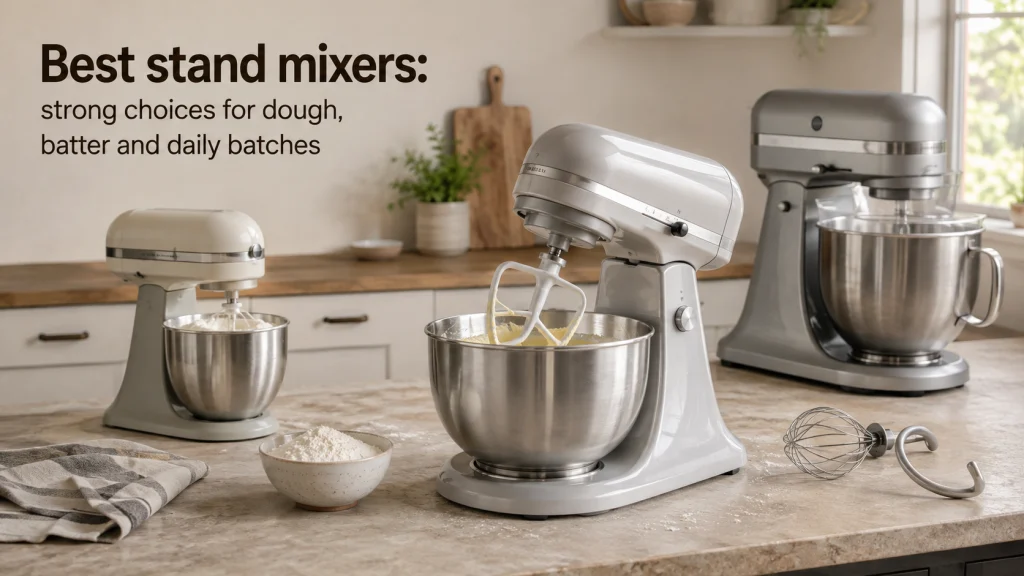
The same test winner can fit one kitchen and frustrate another
Put the same well-tested mixer into three kitchens. In the first, it stays on an open counter and only moves a few inches for use; in the second, it must be lifted from a lower cabinet for every batch; in the third, bread dough is the job that matters most. The machine has not changed, but the evidence that matters has. That is the useful way to compare the best stand mixers: start with the kitchen and workload, then decide which test result deserves the most weight.
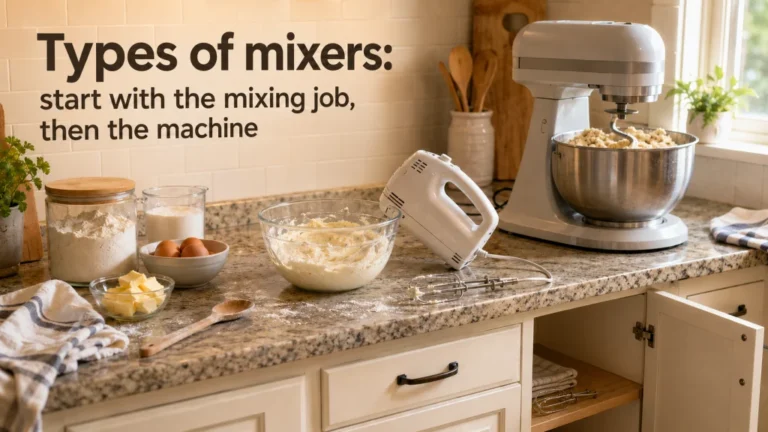
A balanced performer can be the sensible generalist for cakes, cookies, whipping, and occasional dough when it has a permanent counter spot. A smaller model can be the better choice when storage and lifting are the repeated friction, while a bread-first household should give more weight to dough behavior, manufacturer load guidance, and stability. None of those households needs the same winner for the same reason. If you are still deciding what style of machine belongs in the kitchen at all, the broader types of mixers overview is the better starting point. That household-fit approach matters across small kitchen appliances, where the same test winner can still be the wrong fit for a different kitchen routine.

Dash pairs a 3-quart stainless steel bowl with six speeds in a compact tilt-head stand mixer. Amazon lists the mixer at under 5 pounds and 10.4 inches tall. The smaller body is designed for limited countertop space and storage.
Check On AmazonIf you click this link and buy, we earn a commission at no additional cost to you.
Start with current test evidence, then verify the exact model
Independent mixer tests are most useful when the protocol is kept visible. Bon Appétit tested a field of current machines with cake batter, challah dough, and whipped cream, while Food Network evaluated cream, egg whites, cookie dough, brioche, assembly, controls, manuals, and cleaning. Good Housekeeping also used multiple baking tasks and ease-of-use checks, but its categories and scoring are its own. Those results can support a recommendation, yet they should not be blended into one imaginary score because the recipes, loads, judgments, and test conditions are different.
The second layer is exact-model verification. Bowl capacity, tools, dimensions, attachment interfaces, warranties, and operating guidance can change inside the same brand family. A familiar product name may also have a newer version with different controls or included parts. Confirm the full model number before matching a test result to the machine you plan to buy.
- Use independent tests to judge actual mixing, whipping, dough behavior, stability, controls, and cleanup.
- Use the manufacturer page or manual to verify dimensions, bowl capacity, included tools, attachment fit, speeds, and operating limits.
- Use your own cabinet, counter, storage route, and normal batch size to decide whether those strengths are useful in your kitchen.
- Do not rank two machines by wattage, bowl quarts, or attachment count alone.
This separation prevents a common first-time mistake: treating a larger number as proof of a better mixer. A larger bowl does not prove better small-batch reach, and higher wattage does not tell you how a mixer behaved with a particular dough load. The useful evidence is verified specifications plus performance under a task that resembles your own. Carry that rule through the entire shortlist.
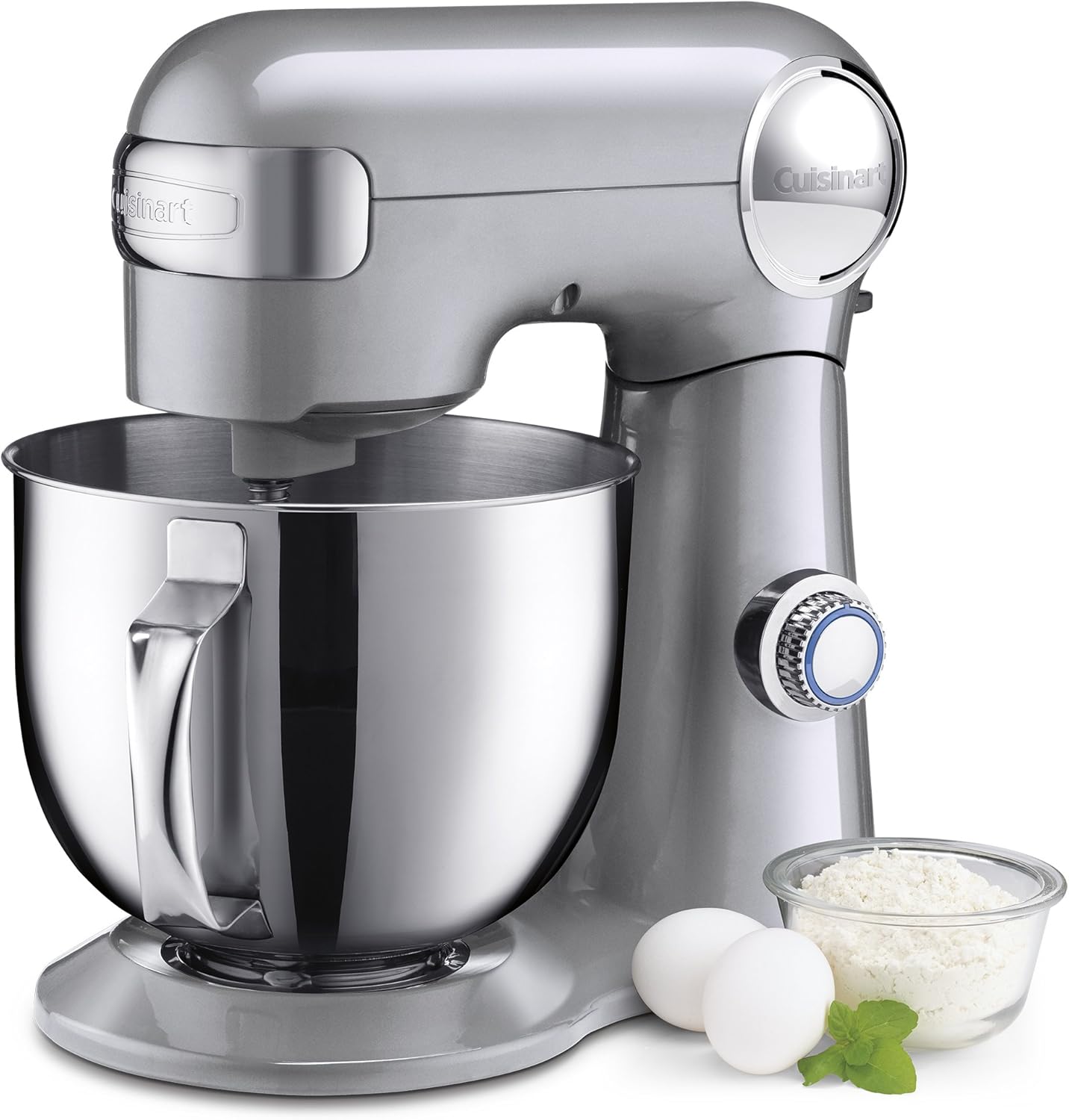
Cuisinart's SM-50BCNAS uses a 5.5-quart stainless steel bowl, 500-watt motor, and 12 speeds. The tilt-back head and power outlet support bowl access and optional attachments. It includes a chef's whisk, dough hook, flat mixing paddle, and splash guard with pour spout.
Check On AmazonIf you click this link and buy, we earn a commission at no additional cost to you.
Choose the buyer profile before you choose the mixer
A broad baking household usually needs balance more than specialization. The mixer should handle creaming, whipping, ordinary batters, cookie dough, and occasional dough without making bowl access or control frustrating. A household centered on cookies, cakes, frosting, and occasional enriched dough can reasonably favor convenient access over maximum bowl size. Repeated large bread batches are a different job and should be judged separately.
Space and budget change the weighting. A compact mixer earns its place only if it reduces a real storage, lifting, or counter problem without making normal batches too small. A value choice still needs credible core performance, while premium features should remove repeated work through controls, lighting, timing, or bowl workflow. Paying more for a feature that stays unused is not an upgrade.
| Buyer profile | What should carry the most weight | What should not decide the purchase by itself |
|---|---|---|
| Mixed everyday baking | Broad mixing consistency, useful speed control, small-to-medium batch handling, bowl access, cleanup | One bread test, wattage, or the largest available bowl |
| Space-constrained kitchen | Footprint, working height, weight, storage path, small-batch behavior | Capacity that will rarely be used |
| Value-focused buyer | Core test performance, included essentials, stable controls, reasonable cleanup | Premium finishes or low-use convenience features |
| Premium convenience buyer | Repeated use of timers, lighting, finer controls, extra bowls, or a useful accessory system | Feature count without a routine that benefits from it |
Use the selector as a filter, not a score. If two profiles fit, give priority to the constraint that causes the most repeated friction. A large mixer hidden in difficult storage may be less useful than a smaller one that is easy to set up. Once that condition is clear, the recommendations are easier to judge.

This Hamilton Beach mixer combines a 4-quart stainless steel bowl with seven speeds and planetary mixing action. A built-in easy-carry handle supports moving and storing the mixer between uses. The package includes a splash guard, dough hook, whisk, and flat beater.
Check On AmazonIf you click this link and buy, we earn a commission at no additional cost to you.
Current stand mixer recommendations by household profile
The models below are not a universal first through fourth place. The Artisan Plus is the broad generalist, the Bakery Chef favors convenience, the Precision Master SM-50 targets value, and the Artisan Mini targets limited space. Independent testing gets each model onto the shortlist. Physical fit then shows which kitchen can live with it comfortably.
Recheck the exact model number because variants can differ. The listed dimensions are resting dimensions, so every tilt-head design still needs extra overhead room when opened. Weight matters most when the mixer is stored after every use. Bowl material, extra bowls, and dishwasher-safe parts change storage and cleanup as well.
| Profile fit | Current model | Independent testing signal | Verified ownership details |
|---|---|---|---|
| Mixed everyday baking | KitchenAid Artisan Plus 5-quart tilt-head stand mixer | Bon Appétit and Good Housekeeping both place it at the top of their current broad stand-mixer testing. | Bon Appétit lists 14.1 inches deep, 8.7 inches wide, 13.9 inches high, and 28 pounds. KitchenAid lists a 5-quart bowl, 11 preset speeds, bowl light, double flex-edge beater, and dishwasher-safe stainless accessories. Repeated lifting is the main physical drawback. |
| Premium convenience | Breville Bakery Chef | Bon Appétit continues to rate it as a strong alternative after testing across mixing, whipping, and dough tasks. | Breville lists 11.4 inches wide, 14.4 inches deep, 14.6 inches high, and 22.35 pounds. Two bowls, a timer, illumination, and a scraper beater reduce changeover and monitoring. The glass bowl and second bowl add handling and storage. |
| Value-focused | Cuisinart Precision Master SM-50 | Good Housekeeping identifies the current SM-50 as its value pick in the tested field. | Cuisinart’s main SM-50 page lists 14.17 by 7.87 by 14.13 inches and 18.1 pounds, plus a 5.5-quart bowl and 12 speeds. The bowl and included accessories are dishwasher safe. Color-specific pages show inconsistent weight fields, so verify the exact SKU if lifting weight matters. |
| Space-constrained kitchen | KitchenAid Artisan Mini 3.5-quart tilt-head stand mixer | Bon Appétit and Food Network both single out the Mini for compact kitchens and smaller-batch work. | Bon Appétit lists 12.3 inches deep, 7.8 inches wide, 12.3 inches high, and 18 pounds. KitchenAid lists a 3.5-quart dishwasher-safe bowl and 10 speeds. Easier storage is the gain; extra batches are the tradeoff. |
The table intentionally leaves out a universal bread winner. Dough stiffness, batch mass, frequency, speed guidance, and manufacturer limits matter too much for a broad label to settle that choice. If bread is the main reason for buying, use the dedicated stand mixer for bread dough comparison. For mixed baking, look next at how each model’s physical ownership fits the routine.
KitchenAid Artisan Plus for mixed everyday baking
The Artisan Plus is the clearest generalist when cakes, cookies, whipping, and occasional dough all matter. Current testing places it at the top of broad groups, but its 28-pound listed weight changes the fit for a cabinet-stored kitchen. A permanent counter position makes that weight far less important. Its tilt-head design still needs overhead room beyond the 13.9-inch resting height.
KitchenAid lists the stainless accessories as dishwasher safe, and the double flex-edge beater can reduce manual scraping. The main ownership friction is moving the mixer and clearing space for the tilted head. Good Housekeeping also reported a head-lock issue with stiff dough, so broad strength should not be mistaken for dough specialization. This model fits best where frequent mixed baking justifies easy counter access.
Breville Bakery Chef for repeated convenience features
The Bakery Chef makes the most sense when its workflow features solve jobs you repeat. At 22.35 pounds, it is lighter than the Artisan Plus but still substantial for repeated cabinet lifting. Its two bowl sizes, timer, bowl light, and scraper beater reduce changeover and monitoring. Those gains matter most to a frequent baker.
The bowl setup creates both the benefit and the friction. A second bowl keeps multi-part baking moving but needs cabinet space. The larger glass bowl is also more cumbersome than a similar stainless bowl, while the scraper beater adds another part to wash. Choose this model when those conveniences replace work you already do.
Cuisinart Precision Master SM-50 for value-focused general baking
The Precision Master SM-50 is the value-oriented choice because Good Housekeeping places it in that role and Cuisinart lists a full general-baking tool set. The main product page lists 18.1 pounds, making it easier to move on paper than the Artisan Plus. Its tilt-back head still needs space above the 14.13-inch listed height. The bowl and included accessories are dishwasher safe, which helps frequent-use cleanup.
Cuisinart’s color-specific pages currently show inconsistent weight fields even when the chassis dimensions are similar. Recheck the 18.1-pound main-page figure against the exact SKU if the mixer will be lifted often. That discrepancy matters far less when the machine stays on the counter. Value still depends on whether the lower price and easier cleanup fit the routine.
KitchenAid Artisan Mini for limited counters and smaller batches
The Artisan Mini is the most defensible compact recommendation when counter space or lifting is the controlling limit. Bon Appétit lists it at 12.3 inches deep, 7.8 inches wide, 12.3 inches high, and 18 pounds. That makes the space advantage measurable rather than a vague compact label. KitchenAid lists a 3.5-quart dishwasher-safe bowl and 10 speeds.
The Mini’s ownership advantage is strongest when it moves often. Eighteen pounds is not weightless, but the smaller body is easier to clear from a counter and fit into storage. The smaller bowl also reduces cleanup bulk unless a larger recipe has to be mixed twice. Leave extra overhead room for the tilted head and tool changes.
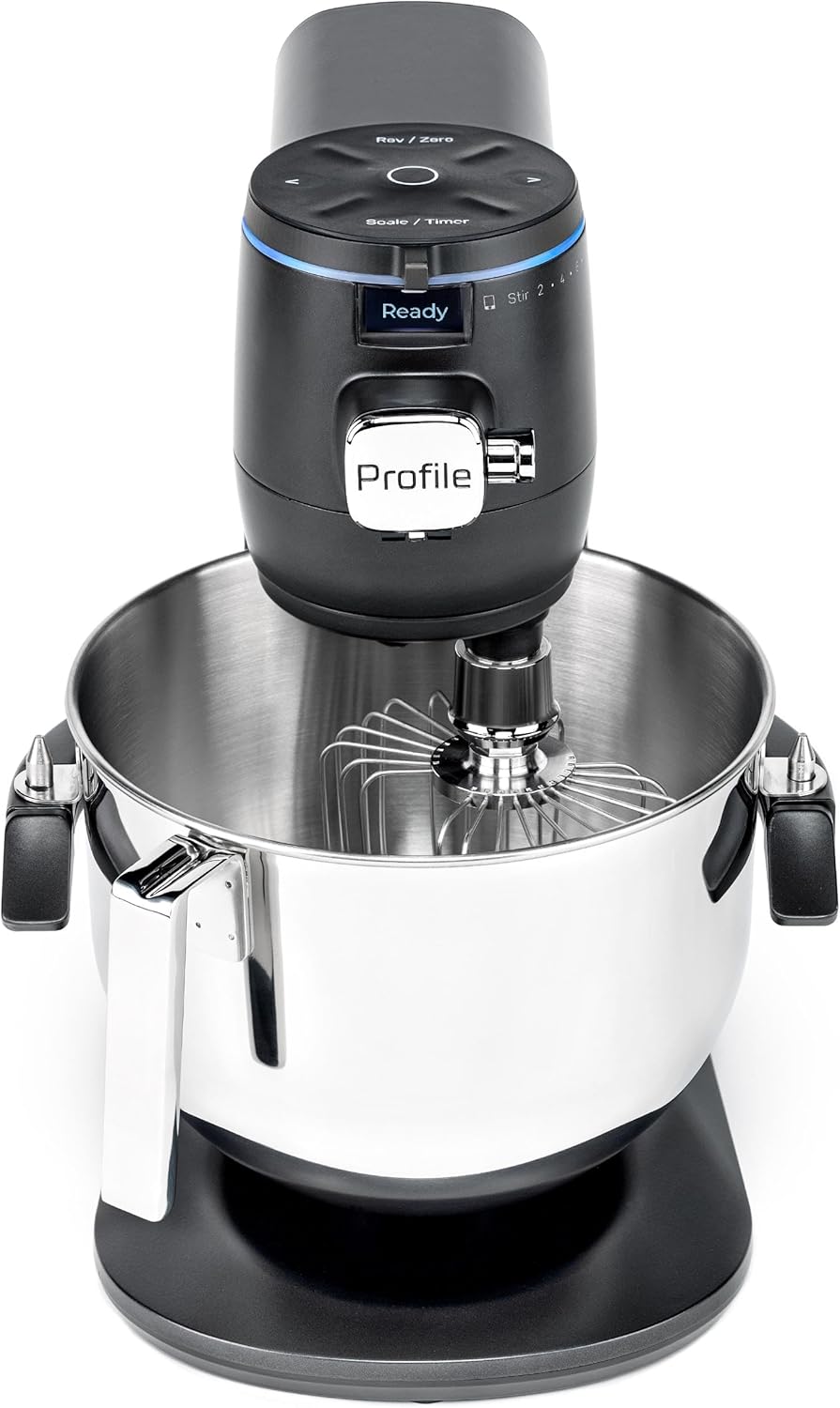
GE Profile pairs a 7-quart bowl with a 540-watt brushless DC motor and Auto Sense technology. A built-in scale, timer, reverse mode, and voice-control support add workflow features beyond basic speed selection. The mixer includes a dough hook, beater, and whisk.
Check On AmazonIf you click this link and buy, we earn a commission at no additional cost to you.
Compare bowl workflow and physical fit after performance
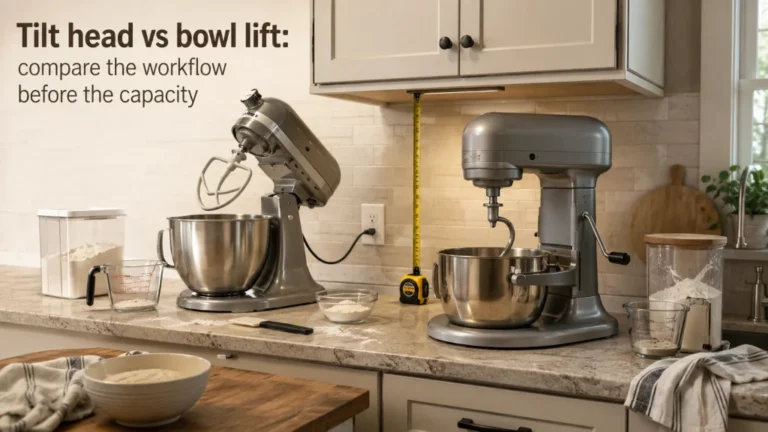
Performance gets a mixer onto the shortlist, but physical fit decides how easy it is to own. A tilt-head needs clearance for the head to rise, while a bowl-lift design keeps the head fixed but often uses a broader package. The bowl and tools still need a clean removal path. Small clearance problems become annoying when repeated through a baking session.
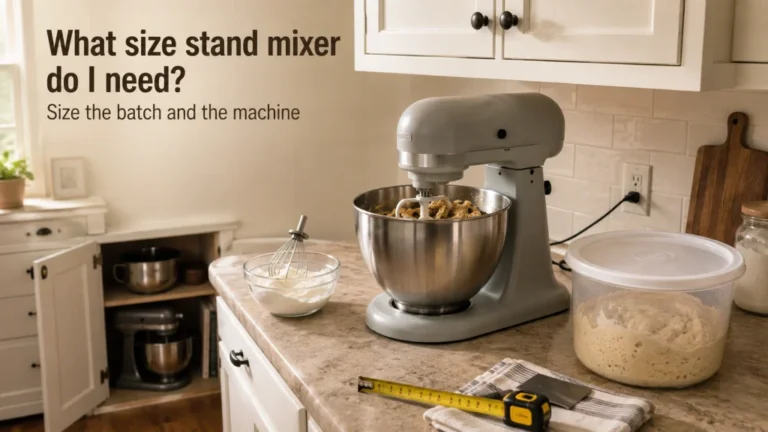
Measure the mixer in the position in which you will use it, not just by its resting footprint. Check counter depth, cabinet clearance, outlet reach, bowl movement, attachment removal, and the carrying path if it cannot stay out. If architecture is unresolved, use tilt head vs bowl lift. If capacity is the issue, use what size stand mixer do I need before paying for extra bowl volume.
Physical-fit check: Measure resting footprint, working height, bowl-removal space, attachment-removal space, outlet reach, and the full storage-to-counter carrying path before choosing the larger or heavier machine.
A closed mixer can fit under a cabinet and still fail the working-height test. Lower-cabinet storage can also be a bad fit when every lift is awkward. A heavier counter-permanent model may create less friction than a lighter one that moves daily. Use the actual kitchen path rather than a generic size label.

Aucma combines a 6.5-quart bowl with a 660-watt motor, six speeds, and a pulse function. Its tilt-head layout provides access to the bowl and mixing tools. The package includes a whisk, dough hook, mixing beater, and splash guard, with the three mixing accessories listed as dishwasher safe.
Check On AmazonIf you click this link and buy, we earn a commission at no additional cost to you.
Mixing, whipping, and dough evidence do not mean the same thing
A stand mixer can be excellent at one load and merely adequate at another. Creaming checks beater reach and incorporation, while whipping exposes small-volume reach and speed control. Cookie dough adds density, and bread dough adds resistance, stability, heat, speed guidance, and mechanical demand. That is why useful test programs use several recipes rather than one headline task.
For mixed baking, look for consistency across the tasks closest to your routine. Frequent frosting and meringue work makes small-volume whipping important, while dense cookies put more weight on scraping and low-speed incorporation. Bread needs more caution because hydration, flour amount, stiffness, batch mass, and speed guidance change the load. One successful dough test does not prove unlimited capability.
The same restraint applies to wattage. KitchenAid states that the Artisan Plus wattage change does not increase maximum yields, so a larger input number does not automatically create a larger safe batch. The stand mixer wattage article explains what that specification can and cannot prove. Bread-first households should give model-specific load and speed guidance more weight than a broad baking badge.
Keep the test fields separate. A machine can be a strong generalist while another makes more sense for repeated heavy dough or unusually small batches. Do not turn one successful task into a claim the evidence did not test. Give the most weight to the test that resembles your recurring workload.

Etekcity's digital kitchen scale weighs up to 11 pounds or 5 kilograms in 1-gram increments. It supports five units and includes a tare function for weighing ingredients in containers. The compact scale uses a 304 stainless steel surface and a backlit LCD display.
Check On AmazonIf you click this link and buy, we earn a commission at no additional cost to you.
Weight, cleanup, controls, noise, and attachments shape the ownership score
Two mixers can perform similarly and still feel very different to own. Weight matters when the machine moves, cleanup matters with frequent use, and controls matter when recipes need repeated low-speed starts. Current roundups do not share one standardized noise method, so treat noise as a model-specific observation rather than inventing a numerical winner. Ownership details matter when they become the reason a mixer stays in storage.
Cleanup should include the bowl, beater, whisk, dough hook, splash guard, scraper parts, and mixer body. Dishwasher-safe parts can reduce work, but only when the manufacturer approves the exact part for that method. A second bowl may reduce changeover while increasing storage demand. Finer controls can reduce splatter, but frequent bakers gain more from that convenience than occasional users.
Attachments are another place where feature count can outrun useful fit. An accessory system matters when you know which jobs you will repeat, while unused grinders, pasta tools, or slicers add cost, storage, and cleaning. Verify exact compatibility instead of trusting a brand name or similar-looking port. The stand mixer attachments article handles that decision in more depth.
List what happens before, during, and after each use. That includes carrying and setup, adding ingredients and changing speeds, then washing, drying, wiping, and storing the machine. A premium feature earns its cost when it removes work from that cycle often enough to matter. This is a better ownership test than counting features on a product page.

Hamilton Beach Professional combines a 5-quart stainless steel bowl with a 450-watt motor and 12 speeds. Its tilt-back head and specialty attachment hub expand the ownership workflow beyond basic mixing. The mixer includes a flat beater, dough hook, and whisk.
Check On AmazonIf you click this link and buy, we earn a commission at no additional cost to you.
Use the deeper comparisons when one variable is still unresolved
A current shortlist should not try to become every stand-mixer article at once. If you still need a framework for comparing models beyond these recommendations, the stand mixer guide is the better next step because it builds the selection criteria without tying the decision to one current test table. If the unresolved issue is architecture, size, wattage, attachments, or bread workload, use the dedicated comparison for that variable rather than letting a broad recommendation quietly answer a more specific question. That keeps the purchase grounded in the decision you are actually making.
Use these deeper comparisons only for the variable that is still blocking the purchase. They prevent a broad recommendation page from repeating an architecture tutorial, capacity tutorial, or accessory decision that needs its own evidence. Once that variable is resolved, return to the current shortlist and see which candidates remain. The strongest choice is the one that still fits after the unresolved constraint is tested.
| If your remaining question is… | Continue with… |
|---|---|
| How to build a full mixer shortlist | Stand mixer guide |
| Which architecture fits the kitchen | Tilt head vs bowl lift |
| How much bowl capacity is actually useful | What size stand mixer do I need |
| Whether motor wattage proves performance | Stand mixer wattage |
| Which accessories are worth owning | Stand mixer attachments |
| Which mixer fits a bread-dominant workload | Stand mixer for bread dough |
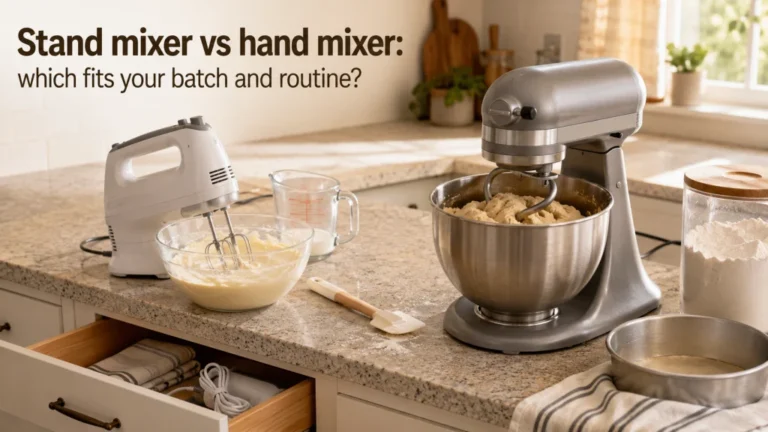
Do not buy extra capability simply because the shortlist exposes it. A hand mixer, manual tool, or smaller machine may still be enough for occasional work. Use these routes to resolve a real blocker rather than invent another reason to upgrade. Then compare only the models that still satisfy the household requirement.

Hamilton Beach's Classic model works as both a stand mixer and a detachable hand mixer. It uses a 4-quart bowl with six speeds, QuickBurst, and a 290-watt peak-power rating. A built-in bowl rest supports its hand-mixer workflow when mixing is paused.
Check On AmazonIf you click this link and buy, we earn a commission at no additional cost to you.
Final Thoughts: choose the mixer that fits the work and the kitchen
The Artisan Plus is the strongest broad generalist in the current evidence set, while the Bakery Chef, Precision Master SM-50, and Artisan Mini make stronger cases when convenience, value, or compact ownership becomes the leading requirement. The important difference is now measurable: footprint, listed weight, bowl setup, working clearance, and cleanup can change which tested strength is actually useful at home. That is why the same recommendation should not be copied from one kitchen into another. Performance gets a mixer onto the shortlist, but ownership fit decides whether it belongs there.
Before purchasing, verify the exact SKU and current manufacturer details, especially when a specification differs across variants. Match the most relevant independent test to the batches you repeat, then check whether the machine can stay accessible and whether its bowl and cleanup routine make sense. A smaller or less expensive model is the better choice when it clears those checks without giving up performance you genuinely need. Buy the machine that keeps earning its space through repeated use, not the one with the longest list of badges.

VIVOHOME pairs a 6-quart bowl with a 660-watt motor and 10 speed settings. The tilt-head design provides access to the bowl and includes a splash guard with a pouring opening. A whisk, dough hook, beater, and egg separator are included for common baking tasks.
Check On AmazonIf you click this link and buy, we earn a commission at no additional cost to you.
FAQs
🍪 What stand mixer size is enough for normal home baking?
A mid-size bowl suits many normal baking routines, but usable capacity depends on the exact model and recipe load. Check your normal batch and the manufacturer’s limits instead of buying by quarts alone.
📦 Is a smaller stand mixer better for a small kitchen?
Yes, when the smaller footprint or easier handling solves a real constraint. Do not downsize so far that normal recipes require extra batches.
🥖 Should I choose the broad top pick if I mostly make bread?
Not automatically. Bread-heavy use should prioritize dough load, stability, kneading speed guidance, and manufacturer limits over a general baking ranking.
⚡ Does a higher-watt mixer mean it mixes better?
No. Wattage alone does not prove usable batch size, mixing consistency, or dough performance. Use task-based testing and manufacturer limits.
🧁 Is tilt-head or bowl-lift better for everyday baking?
Either can work. Compare batch size, working height, bowl access, counter space, and how often the mixer must move.
🧼 How much should cleanup affect the choice?
It matters more as baking frequency rises. Compare the bowl, tools, guards, scraper parts, and manufacturer-approved cleaning method.
References and Sources
- Bon Appétit stand mixer testing: Supports current performance findings for the Artisan Plus, Bakery Chef, and Artisan Mini.
- Food Network stand mixer testing: Supports the comparative test method and compact-mixer evidence.
- Good Housekeeping stand mixer testing: Supports the Artisan Plus and Cuisinart recommendation signals and the stiff-dough caution.
- KitchenAid Artisan Plus specifications: Verifies capacity, controls, tools, bowl light, and model features.
- KitchenAid Artisan Plus FAQ: Verifies that increased wattage does not increase maximum yields.
- Breville Bakery Chef specifications: Verifies the two bowls, timer, illumination, speeds, and load sensing.
- Cuisinart Precision Master specifications: Verifies capacity, speeds, tools, dimensions, and attachment port.
- KitchenAid Artisan Mini specifications: Verifies bowl capacity, speeds, tools, and attachment support.