A hand mixer and a stand mixer can overlap on basic electric mixing, but they solve the work differently. A hand mixer favors quick setup, flexible bowl choice, easy storage, and smaller routine jobs, while a stand mixer becomes more useful as mixing gets longer, denser, or more hands-off. The choice should come from the batches you already make, the effort you want to remove, and the space and cleanup you can live with. This comparison starts after you have already decided that you want an electric mixer, so it focuses only on choosing the right mixer class.
Start with the work each mixer asks you to do
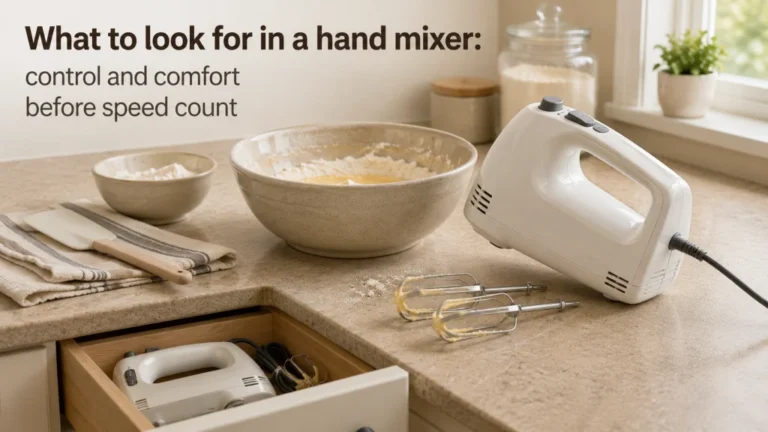
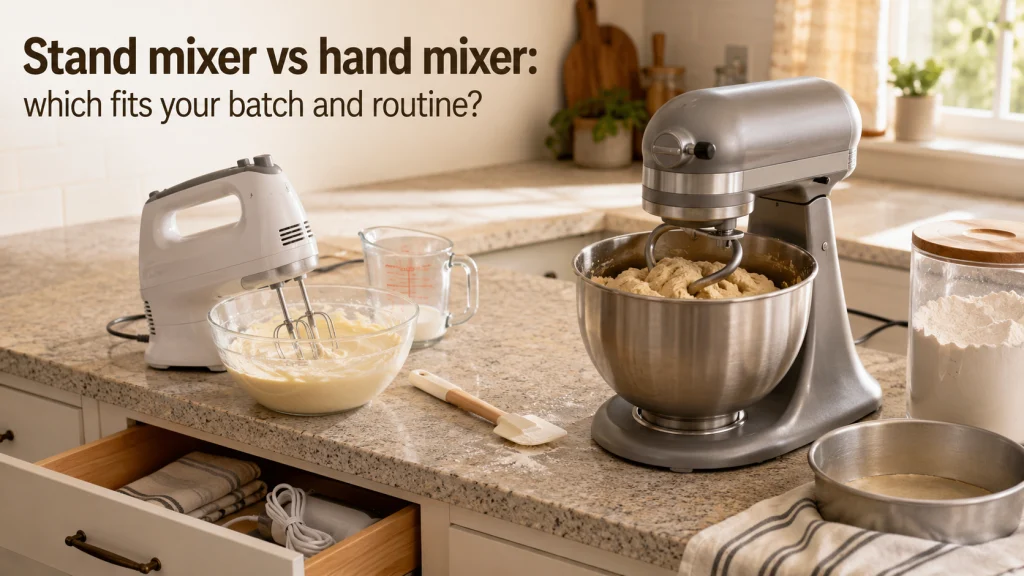
The stand mixer vs hand mixer decision is not really about which machine looks more capable on a counter. You have already decided that electric mixing belongs in your kitchen, so the useful question is how much support, movement, and attention you want the mixer to provide while a batch is being mixed. A hand mixer puts the motor in your hand and lets you move the beaters through the bowl, which gives you direct control but keeps you actively involved. A stand mixer supports the motor and attachment over a fixed bowl, so the machine carries more of the holding work while you supervise the process.
That difference changes more than arm effort. With a hand mixer, you choose the bowl, retrieve a compact appliance, hold and guide it, then wash the beaters and whatever bowl you used. With a stand mixer, you usually work around a dedicated bowl and a larger machine that may stay on the counter or need a deliberate storage spot, but longer jobs do not require you to hold the motor the entire time. Neither class is automatically better, because the better fit depends on whether your routine rewards portability and quick cleanup or stable support and hands-free mixing. This page does not decide whether a stand mixer is worth owning in the first place; it only helps you choose between the two electric-mixer classes after that broader decision is already settled. Both mixer classes sit within the broader small kitchen appliances decision, but the choice here is specifically about which mixing workflow fits better.

This five-speed hand mixer includes Turbo Beater accessories and a lockable swivel cord. The beaters release with a dedicated button and are dishwasher safe. The listed Black Matte variant is the KitchenAid KHM512 model.
Check On AmazonIf you click this link and buy, we earn a commission at no additional cost to you.
Quick, light jobs usually reward low setup friction
For whipped cream, cake batter, frosting, egg whites, and other lighter mixtures, a hand mixer often has a practical advantage because there is very little between deciding to mix and actually starting. You can use a bowl that already fits the batch, move the beaters where the mixture needs attention, and put the mixer away without clearing a permanent appliance footprint. That matters when the task itself is short, because a larger machine can save little active effort if retrieval, bowl setup, scraping, and cleanup take almost as much attention as the mixing step. For a household that mostly makes one normal batch at a time, convenience can come from having less equipment in the way rather than more machinery doing the work.
The important limit is that a light recipe name does not prove that every batch is light. A double batch of thick cookie dough, a long creaming stage, or a mixture that becomes progressively stiffer can turn a familiar recipe into a much more demanding job. The exact hand mixer still controls what it can safely handle, so attachment type, manual limits, operating instructions, and signs of strain matter more than a generic claim that hand mixers can handle a certain food. When your routine stays genuinely short and moderate, the hand mixer tends to preserve the very thing that makes electric mixing convenient: fast access without creating a second job around the appliance.

This three-speed hand mixer includes standard beaters, a whisk, and a milkshake attachment. Built-in side storage locks the beaters onto the mixer between uses. Non-electric parts are dishwasher safe, and the one-touch ejector releases the beaters for removal.
Check On AmazonIf you click this link and buy, we earn a commission at no additional cost to you.
Longer mixing and denser loads change the value of support
Once a task runs for several minutes or the mixture pushes back against the beaters, the physical design of the two mixer classes matters more. Holding a hand mixer through a long job means supporting its weight, controlling its position, and staying engaged for the full mixing time. A stand mixer shifts that support to the machine and bowl, which can make sustained mixing feel less like a hand-held task and more like something you supervise. The hands-free advantage is most useful when that freed attention lets you measure another ingredient, prepare a pan, or handle another safe prep step during a genuinely long mix. If the mixing stage is brief and you would simply wait beside the bowl, the practical gain is much smaller.
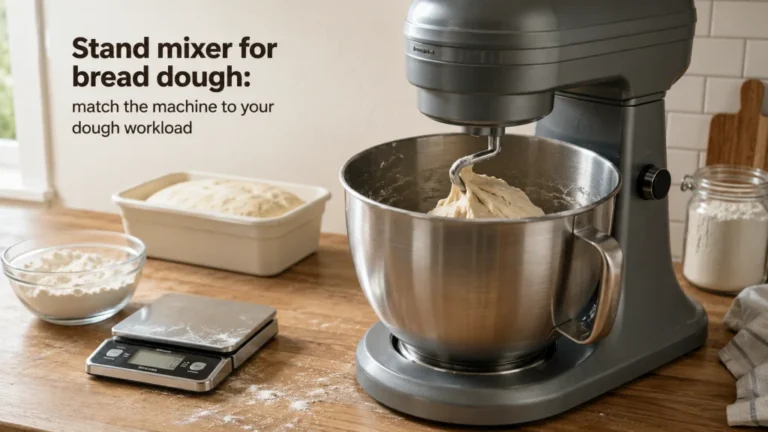
Dense dough is where careless comparisons become risky. Some stand mixers are designed for dough work, and some hand mixers include dough-style attachments, but that does not mean every machine can knead every dough at every batch size. Dough stiffness, flour quantity, hydration, speed limits, attachment design, and the exact manufacturer’s operating instructions can all change the safe workload. A stand mixer provides hands-off holding, not unattended operation, so heavier work still needs supervision and any scraping or repositioning should be done with the mixer stopped as directed by the manual. If bread or another dense mixture is a regular part of your routine, compare the exact mixer’s documented limits rather than assuming that wattage, appliance size, or a dough-hook label proves capacity.

This tilt-head stand mixer has a 6.5-quart bowl, six speeds, and a pulse function. It includes a dough hook, wire whip, and beater for different mixing tasks. The product listing identifies a 660-watt motor and a tilt-head design.
Check On AmazonIf you click this link and buy, we earn a commission at no additional cost to you.
Batch size matters, but usable mixing range matters more
Batch size is one of the easiest places to oversimplify hand mixer vs stand mixer comparisons. A larger stand-mixer bowl can accommodate more ingredients, but bowl volume alone does not tell you how well the attachment reaches a small quantity or how comfortable the machine is with a particular heavy batch. A hand mixer can be especially convenient for a modest amount because you can choose a smaller bowl and guide the beaters directly through the mixture. That flexibility can make a small batch easier even when the stand mixer has much more nominal capacity.
The opposite problem appears when batch size grows. A larger bowl, fixed support, and a mixer designed for sustained work can reduce the need to split a recipe or hold a hand mixer through a long, heavy session, but the exact machine’s stated limits still control the decision. Think in terms of the batches you actually repeat, not the largest batch you can imagine making once. A household that usually mixes one cake, one batch of frosting, or a modest cookie batch has a different workload from one that routinely doubles recipes or works through dense dough. That repeated load pattern is more useful than treating bigger capacity as a universal upgrade.
| Typical task pattern | Hand mixer fit | Stand mixer fit | What to verify |
|---|---|---|---|
| Short, light, single batch | Strong fit when setup and storage need to stay simple | Capable, but may add unnecessary setup | Bowl choice, beater reach, speed control, cleanup |
| Longer mixing with moderate resistance | Requires active holding throughout | Gains value from fixed support | Run instructions, attachment, batch size, supervision |
| Dense or repeated heavy batches | Only if the exact model allows the load | More suitable as a class, subject to exact limits | Manual limits, dough guidance, speed limits, capacity |
| Very small quantity | Flexible with a bowl matched to the amount | Depends on bowl geometry and attachment reach | Minimum quantity and attachment reach |
The table is a screening tool, not permission to exceed a mixer’s instructions. If your routine falls near a workload boundary, the manual for the exact machine should settle questions about attachment use, batch limits, speed, and operating time. That keeps a class-level comparison from turning into a false promise about every model sold under the same label. It also prevents a common first-time mistake: buying the larger-looking machine before checking whether its usable mixing range actually matches the batches made most often.

This compact stand mixer uses a 3.2-quart bowl and six speed settings. It weighs under 7 pounds and includes an egg whisk, dough hook, and flat beater. The product is designed with a compact, space-saving footprint.
Check On AmazonIf you click this link and buy, we earn a commission at no additional cost to you.
Retrieval, counter space, and storage are part of the mixing job
A mixer that is technically capable but awkward to retrieve can lose much of its advantage in ordinary use. Hand mixers are usually easier to place in a cabinet or drawer, and their smaller footprint means they can come out for one bowl without rearranging a work surface. Stand mixers demand a more deliberate location because the appliance, bowl, and attachments occupy more volume and the machine can be inconvenient to move repeatedly. The key distinction is not whether you have enough total kitchen space, but whether the mixer can be accessed without turning every use into a lifting and clearing routine.
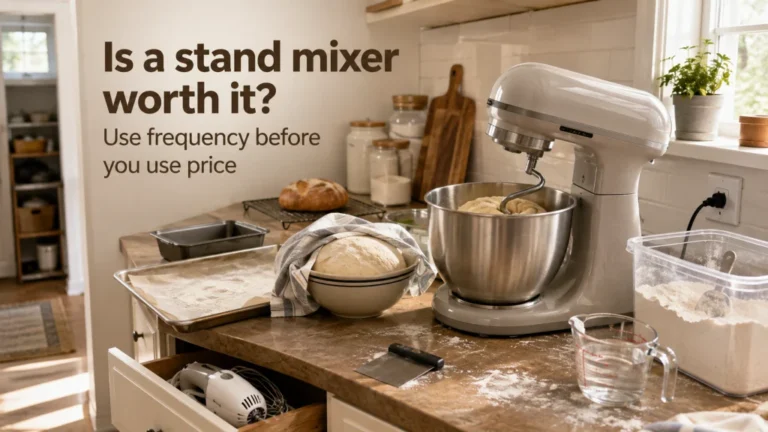
This is class friction, not a reason to declare that one appliance deserves purchase and the other does not. Hand mixers also tend to sit at the lower end of the upfront-cost comparison, while stand mixers generally require more initial spending as well as more physical space. That price difference should stay secondary to workload fit: paying less does not help if the jobs you repeat exceed the exact hand mixer’s documented limits, and paying more does not create value if quick, light batches dominate your routine. If a stand mixer has a stable, easy-to-use position, its larger footprint may barely register because setup is reduced to installing the needed attachment and bowl. Compare where each class would actually live, what each class generally asks you to spend, and whether the repeated work justifies those differences.

This six-speed hand mixer includes QuickBurst control, traditional beaters, and a whisk. Its snap-on storage case keeps the mixer and accessories together between uses. The first speed is designed to start more slowly to reduce splatter.
Check On AmazonIf you click this link and buy, we earn a commission at no additional cost to you.
Bowl freedom and cleanup can outweigh raw mixing capability
One of the hand mixer’s most useful traits is that the bowl is not part of the appliance. You can choose a vessel that suits the amount, switch bowls when a recipe already uses one, and often avoid transferring ingredients into a dedicated mixer bowl. That can reduce setup and washing for quick jobs, especially when the mixing itself takes only a short time. The trade-off is that you remain responsible for moving the mixer through the bowl, controlling splatter, and stopping when you need both hands for another step.
A stand mixer creates a different workflow because its bowl and attachment system are part of the operating setup. That can be efficient when ingredients are added in stages or when the mixer runs while you measure or prepare the next component, but it also means the dedicated bowl and attachment must be cleaned and stored. When the bowl needs scraping or ingredients need repositioning, stop the mixer first and follow the exact model’s operating instructions; hands-free does not mean unattended. When comparing stand mixers vs hand mixers, look at the whole sequence from retrieving the machine to putting the last clean part away. A class that saves a few minutes of active holding can still feel slower if it adds more setup and cleanup than your normal batch justifies.
| Workflow stage | Hand mixer | Stand mixer |
|---|---|---|
| Retrieve | Usually compact and easy to retrieve | Best with an accessible, stable location |
| Set up | Attach beaters and choose a bowl | Install bowl and attachment |
| Mix | Active holding throughout | Fixed support with supervision |
| Adjust | Move directly through the bowl | May require stopping to scrape |
| Clean and store | Beaters, bowl, exterior, cord | Bowl, attachment, exterior, accessories |
Use this full workflow rather than comparing only the few minutes when the motor is running. The easier class is the one that reduces effort across the repeated task, not the one that looks more automated in the middle of it. For a short bake, easy retrieval and a flexible bowl may dominate the decision. For a longer batch, fixed support may save enough active work to justify the larger setup.

This lightweight hand mixer offers five speeds plus Power Boost and uses a comfort grip. Its heel and bowl rest lets the mixer stand on the counter or rest at the bowl edge between steps. The listed removable parts are dishwasher safe.
Check On AmazonIf you click this link and buy, we earn a commission at no additional cost to you.
Owning both only makes sense when the jobs stay distinct
Keeping both classes can be sensible when one mixer repeatedly handles quick, small jobs and the other repeatedly handles longer or heavier work. In that situation, the hand mixer is not a backup stand mixer, and the stand mixer is not an oversized replacement for every small task. Each class has a clear place in the routine, which prevents the second appliance from becoming duplicate storage. The deciding question is whether you can name recurring jobs that become meaningfully easier with each machine.
If both mixers would be used for the same normal cake batter, the same frosting, and the same occasional cookies, owning both may simply add another motor, another set of attachments, and another storage problem. The case for two appliances gets stronger when the workflow splits cleanly, such as fast bowl-to-bowl mixing on one side and sustained dense mixing on the other. It gets weaker when the second machine exists mainly because it might be useful someday. This is why “why not both” should not be the default answer: two classes earn their space only when they solve two different repeated patterns.
- Start with your repeated heavy work: Do longer mixing, dense dough, or larger batches show up often enough that holding a hand mixer would be a regular burden?
- No: If most jobs are short, light, and small to normal in batch size, choose a hand mixer.
- Yes: Move to the next question instead of stopping at capability alone.
- Now check the quick jobs: Do you also make frequent small or fast batches where flexible bowls, quick retrieval, and minimal setup matter?
- No: Choose a stand mixer, then verify that the exact model is approved for your repeated loads.
- Yes: Consider both only if those quick jobs and the sustained heavy jobs are each frequent enough to justify separate storage, attachments, and cleanup.
If you cannot place your routine into one of those paths without using words such as “maybe” or “someday,” list the last several mixing jobs you actually completed and classify those instead. Real repeated work is a better predictor than an aspirational recipe list. The result should describe how you already cook or bake, not the person a new appliance is supposed to turn you into. That keeps the choice grounded in workload rather than equipment enthusiasm.

This four-quart stand mixer provides seven speeds and planetary mixing for full-bowl coverage. It includes a whisk, flat beater, dough hook, and splash guard. An easy-carry top handle is built into the mixer housing.
Check On AmazonIf you click this link and buy, we earn a commission at no additional cost to you.
Use a class-choice matrix instead of looking for one universal winner
A useful comparison should end with three possible outcomes: hand mixer, stand mixer, or both. There is no need to force every household toward the most capable-looking machine because capacity and feature range only matter when the routine actually uses them. Start with the task that creates the most repeated effort, then check whether the same choice still works for your smaller and more frequent jobs. If one class handles the hard job but makes the common job cumbersome, that tension is important rather than something to hide.
Give extra weight to frequency because a minor friction repeated every week can matter more than a major capability used a few times a year. Also separate class fit from model fit: deciding that a stand mixer suits your workload does not tell you which bowl size, design, or performance limits you need, and deciding on a hand mixer does not prove that every handheld model will tolerate the same mixture. The matrix below keeps those decisions in the right order. First choose the class from workflow, then compare exact products within that class using their documented specifications and instructions.
| Decision factor | Choose a hand mixer | Choose a stand mixer | Choose both |
|---|---|---|---|
| Most common jobs | Light batters, whipping, frosting, modest batches | Longer mixing, denser mixtures, larger batches | Both patterns occur often |
| Active effort | You are comfortable holding the mixer | You want fixed machine support | You want separate tools for heavy and quick jobs |
| Space | Storage is limited | An accessible position is available | There is room for both |
| Bowl workflow | You value flexible bowl choice | A dedicated bowl suits the workflow | You benefit from both bowl workflows |
| Cleanup pattern | You prioritize fast cleanup | Extra setup removes meaningful active work | Each appliance saves enough effort to justify cleanup |
No row should be treated as an automatic verdict by itself. A small kitchen can still justify a stand mixer if dense, long mixing is frequent and there is a workable storage solution, while a large kitchen does not need a stand mixer for a routine made almost entirely of quick light batches. Read across the matrix for the pattern that repeats, then verify the exact machine against that workload. This preserves the most important distinction in the comparison: class selection comes from workflow, but capability must still be proven at model level.
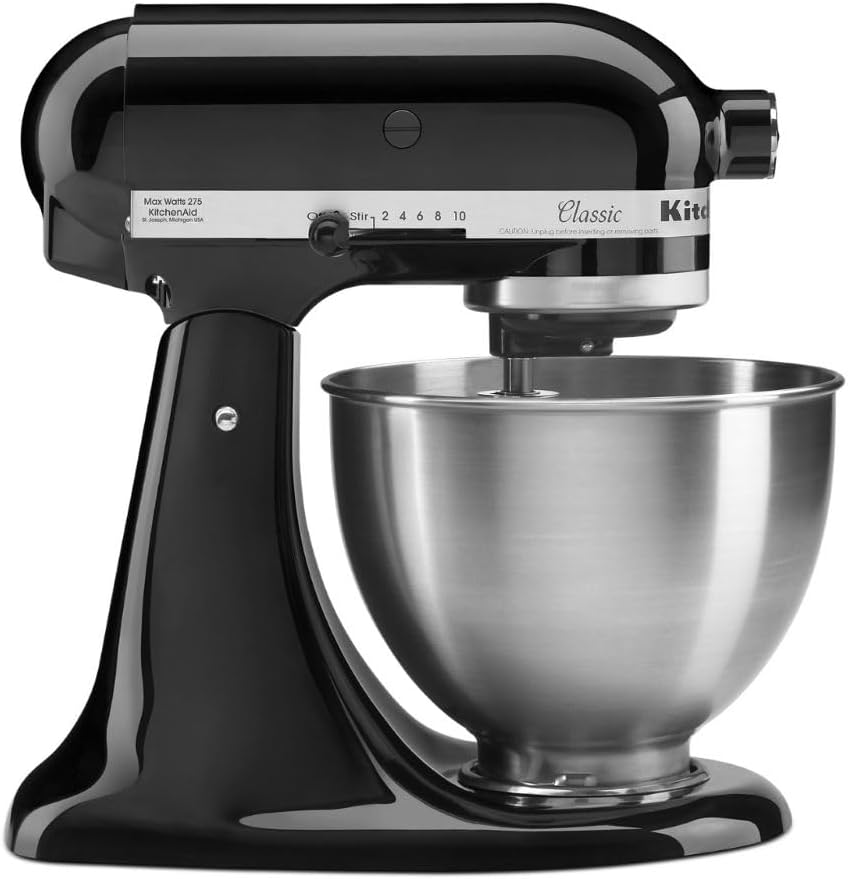
This tilt-head stand mixer uses a 4.5-quart stainless steel bowl and ten speed settings. Its metal construction and 59 bowl touchpoints are designed for thorough mixing around the bowl. The listed Onyx Black unit is model K45SS.
Check On AmazonIf you click this link and buy, we earn a commission at no additional cost to you.
Use the class choice to decide what to compare next
If you finish this comparison and still are not sure whether a stand mixer deserves space and money in your kitchen at all, that is a different decision. The next useful step is whether a stand mixer is worth it for your routine, because that question starts before class selection and weighs ownership against buying, waiting, or skipping. If you already know you want a hand mixer, move to what to look for in a hand mixer so the comparison shifts from class-level workflow to the features and fit evidence that separate individual hand mixers. Keeping those decisions separate prevents the same storage, budget, and workload questions from being answered twice in slightly different language.
If the stand-mixer class is already the clear fit, use the stand mixer guide to compare the factors that matter within that class rather than returning to hand-mixer trade-offs. Readers who want the broader landscape before making any mixer-class decision can start with the main types of mixers and how their jobs differ. The point of routing the decision this way is simple: first decide the kind of work you need the appliance to take over, then evaluate the exact class, and only after that compare individual machines. That order keeps specifications from distracting you before the household job is clear.

This six-speed hand mixer includes QuickBurst control, traditional beaters, a whisk, and a snap-on storage case. Bowl Rest lets the mixer sit at the bowl edge during pauses. The snap-on case stores the mixer and attachments together between uses.
Check On AmazonIf you click this link and buy, we earn a commission at no additional cost to you.
Final Thoughts: choose the mixer class that fits the work you repeat
A hand mixer is often the cleaner fit when your routine is built around quick, light, small to normal batches and you value flexible bowls, simple storage, and fast cleanup. A stand mixer becomes more compelling when the work is longer, denser, more repetitive, or meaningfully easier when the machine supports the mixing tool for you. Neither conclusion requires declaring one class universally better. It only requires being clear about which repeated task creates the most effort in your kitchen.
Once that class choice is made, stop comparing generic promises and verify the exact machine against the job. Check the manufacturer’s instructions for workload limits, attachments, speed guidance, and any capacity or operating conditions that apply to the mixtures you make. Then compare how the appliance will be retrieved, used, cleaned, and stored in the space you actually have. A mixer earns its place when the whole workflow fits, not when the spec sheet simply looks more impressive.

This hand mixer provides nine speed settings plus a boost function. The controls are intended to cover tasks from gentle folding to high-speed whipping. The listed Silver model is the Breville BHM800SIL Handy Mix Scraper.
Check On AmazonIf you click this link and buy, we earn a commission at no additional cost to you.
FAQs
🥣 Can a hand mixer replace a stand mixer for normal baking?
For many short, light, small to normal batches, it can. If your routine includes frequent dense dough, long mixing, or larger repeated batches, a stand mixer may fit the workload better, subject to the exact model’s limits.
🍞 Is a stand mixer automatically better for bread dough?
No. Stand mixers are generally the more appropriate class for sustained dough work, but the exact dough, batch size, attachment, speed, and manufacturer’s instructions still determine whether a specific machine is suitable.
🧁 Which mixer is better for small batches?
A hand mixer is often easier for small quantities because you can choose a bowl that matches the batch and move the beaters directly through it. Some stand mixers also handle small batches well, so attachment reach and bowl geometry should be checked on the exact model.
🧼 Is a hand mixer easier to clean than a stand mixer?
Often, especially after a quick job, because the setup may involve only the beaters and the bowl you already chose. A stand mixer can still be efficient when its hands-free operation saves meaningful work, so compare the full retrieve-to-clean workflow rather than washing alone.
📦 Should I own both a hand mixer and a stand mixer?
Only when they solve two recurring workflows. If one handles quick portable jobs and the other regularly handles sustained or dense mixing, both can earn their space; if they would duplicate the same ordinary batches, one is usually enough.
References and Sources
- KitchenAid mixer comparison: Supports the basic class distinction, storage differences, and hands-free operation.
- Serious Eats mixer comparison: Provides independent observations on portability, bowl control, and small-batch limitations.
- Chowhound small-batch comparison: Supports the workflow difference between quick setup and longer hands-free mixing.
- Homes & Gardens mixer comparison: Supports the class-level difference in typical upfront cost and storage burden.