A stand mixer should be shortlisted by the batches you actually repeat, the space the machine occupies while stored and in use, and the evidence that shows how it performs beyond the spec sheet. Bowl size, wattage, speed count, weight, and attachment compatibility can all matter, but none of them proves overall fit by itself. The most useful comparison separates verified specifications from performance questions that require independent testing, then adds the daily handling work that product pages often hide. By the end, you should have a short list built around usable batch range, kitchen fit, workflow, and recurring ownership friction rather than a pile of impressive-looking numbers.
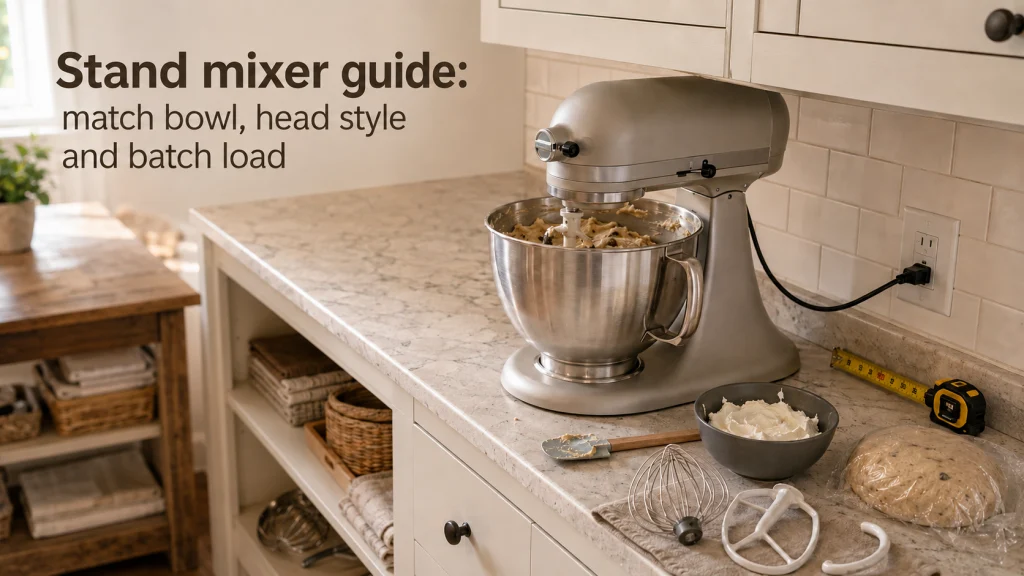
Start with the job, not the spec sheet
A useful stand mixer guide starts after you have already decided that a stand mixer belongs in your kitchen. Two machines can look similar on a retailer page yet create different routines because of bowl access, working height, weight, and load behavior. One may fit under a cabinet but need extra room to open, while another may stay planted but be unpleasant to move. Start with the work and the kitchen, not the specification printed in the largest type.
The first comparison is your normal batch, your realistic peak batch, available counter space, storage path, and likely attachment use. Published specifications can verify dimensions, weight, bowl capacity, included tools, speeds, and model compatibility. Mixing uniformity, small-batch reach, kneading behavior, stability, noise, and scraping needs require evidence from actual tests under stated conditions. Keeping those evidence types separate prevents a product card from answering questions it was never designed to prove. That same job-first filter is useful across small kitchen appliances, where dimensions and feature counts only matter when they improve the work you actually repeat.
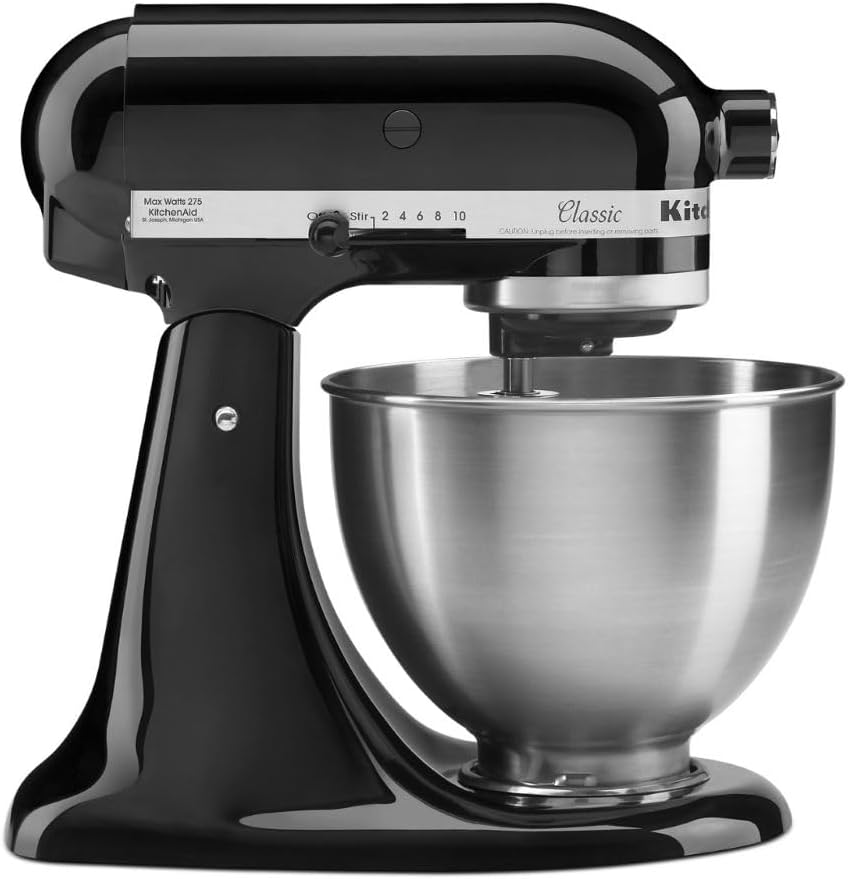
This tilt-head stand mixer has a 4.5-quart stainless steel bowl and 10 speeds for stirring, mixing, kneading, and whipping. It includes a coated flat beater, coated dough hook, and 6-wire whip for core mixing jobs. The tilt-head design provides access to the bowl for adding ingredients and changing tools.
Check On AmazonIf you click this link and buy, we earn a commission at no additional cost to you.
How to choose a stand mixer by repeated workload
Write down the jobs the mixer will handle most often instead of choosing around the hardest recipe you make once a year. Whipping cream, mixing cookies, and kneading dense dough place different demands on bowl reach, controls, and load handling. Frequency matters because an awkward bowl or heavy body becomes more important when you handle it every week. Let the normal workload set the baseline and use the occasional large batch as a boundary check.
The worksheet below turns recipes into requirements without pretending one number can summarize performance. Record what goes into the bowl, how often you make it, and whether you need reliable results at both small and large quantities. This catches a common first-time mistake: buying the largest bowl and assuming it will automatically work just as neatly with tiny batches. Once the jobs are clear, capacity, architecture, and test results have specific questions to answer.
| Repeated task | What to record | What the shortlist must prove |
|---|---|---|
| Whipping and aerating | Typical quantity, smallest quantity, frequency | Whisk reach, speed control, splash behavior, usable small-batch performance |
| Cake and cookie mixing | Normal batch, peak batch, scraping tolerance | Ingredient incorporation, bowl coverage, control at low speed, usable capacity |
| Dough kneading | Dough type, batch size, frequency | Manual limits, recommended speeds, stability, kneading behavior under the actual load |
| Attachment-driven jobs | Specific jobs you will really repeat | Exact compatibility, setup burden, storage, cleanup, and whether the attachment replaces another appliance |
Use the worksheet to eliminate mismatches before comparing finish or extra features. If a model lacks credible evidence for your normal batch or realistic peak load, a longer feature list does not rescue it. If your workload may need another mixer format, the overview of types of mixers can help settle that broader question. Here, the goal stays narrower: build a stand-mixer shortlist around work you will actually repeat.
Treat stand mixer types as workflow choices
Tilt-head and bowl-lift designs change the motions you repeat around the machine. A tilt-head opens by moving the head, while a bowl-lift keeps the head fixed and raises or lowers the bowl. That affects ingredient access, tool changes, upper-cabinet clearance, and bowl handling before and after mixing, especially when the same counter position must work for every recipe. Architecture can influence heavy-load workflow, but it does not by itself prove that one model will outperform another under your batches.
Use architecture as an early workflow filter, then verify the exact model. If you add ingredients in stages, check access with the bowl and tool in working position. If the mixer sits under a cabinet, measure the clearance needed to open or work around it with the bowl and tool attached. For the full decision, use the dedicated tilt-head vs. bowl-lift comparison instead of forcing that entire question into this shortlist.
Separate bowl capacity from usable batch range
Nominal bowl capacity tells you vessel size, not how well the mixer handles every quantity that fits inside it. A larger bowl adds headroom for peak batches, but the whisk or beater still has to reach a small batch effectively without constant scraping. At the other end, room below the rim does not prove the machine is approved for that load. Record bowl size as a specification and treat usable batch range as a separate performance question across your normal household baking recipes.
Look for evidence at both ends of the range you expect to use. Small-batch tests should show whether the tool reaches and incorporates ingredients without excessive intervention. Peak-load evidence should respect the exact manual and describe behavior under that mixture, including whether the machine stays stable and incorporates ingredients. If size remains unresolved, the deeper stand mixer size comparison explains why bowl quarts alone cannot settle it.

This tilt-head Artisan mixer uses a 5-quart stainless steel bowl with a handle and 10 speed settings. It includes a flat beater, C-shaped dough hook, 6-wire whip, and pouring shield for core bowl tasks and ingredient handling. The bowl is dishwasher safe, giving the section a concrete capacity reference without treating bowl size as proof of usable batch range.
Check On AmazonIf you click this link and buy, we earn a commission at no additional cost to you.
Measure stored fit, working fit, and the path between them
A mixer can fit on a counter and still be irritating to use there. Stored height may clear the cabinet while the working position needs more room for the head, bowl, or tools. Depth matters too if the machine must be pulled forward before you can use it comfortably. Measure the mixer as a working object, not as a box that never changes position.
The second fit problem is the route between storage and use. A mixer kept in a cabinet or pantry has to clear doors, shelves, counter edges, and whatever lift you must perform. If you will store it away after every use, that path belongs in the purchase decision before weight becomes a surprise. A larger machine can be easier to own when it has a permanent counter position than a smaller one that must be hauled out repeatedly.
- Measure body width and depth at the point where the mixer will actually sit.
- Check stored height and the extra working clearance required to access the bowl and tools.
- Compare the listed weight with the lift or carry required between storage and the working counter.
- Confirm that the cord reaches the intended outlet without creating a bad routing path.
- Trace the complete storage-to-counter path if the mixer will be moved after use.
- Check whether bowl removal, tool changes, and ingredient addition still work in the chosen position.
This checklist replaces vague labels such as compact or counter friendly with measurements from your own kitchen. Keep those measurements beside the model specifications so a strong performer cannot survive after failing the space. Also confirm that bowl removal, tool changes, and ingredient addition still work in the intended position. Physical fit matters because it determines whether the machine remains accessible enough to use.
Treat mixer weight as both stability and ownership friction
Weight is easy to misread because more can help in one part of ownership and hurt in another. A heavier base may contribute to a planted feel, but stability also depends on design, feet, load, speed, surface, and how the machine transfers force during mixing. Weight alone does not prove smooth kneading or resistance to movement. Independent tests should show actual behavior under a stated load rather than using the scale reading as a performance score.
The household cost appears when the mixer is not permanently parked. Repeatedly lifting a heavy machine from a cabinet can make a capable appliance easier to avoid using. If you will move it each time, compare listed weight with the real lift path, available grip points, shelf height, and landing space on the counter. If it stays on the counter, portability matters less and working stability can matter more during frequent home kitchen use.
Do not rank performance by wattage or speed count alone
Wattage is an electrical specification, not a universal score for torque, durability, or dough ability. Machines with different wattage can also differ in motor design, gearing, controls, cooling, bowl geometry, and manufacturer load limits, so the larger number may not answer the task. Speed count has the same weakness because ten positions do not reveal how smoothly a mixer starts or behaves under load. These numbers describe parts of the machine, but they cannot rank overall performance by themselves.
Translate each specification into a testable question. For low speed, ask whether dry ingredients begin mixing cleanly, whether the control is easy to set, and whether the machine avoids an abrupt start. For heavier work, ask whether the machine follows manual limits, stays stable, incorporates ingredients, and completes the task without repeated intervention. The dedicated article on stand mixer wattage explains the power question without turning one electrical figure into a buying shortcut.
Use independent tests to answer the questions specifications cannot
A useful independent test states what was mixed, how much was in the bowl, which tool and speed were used, and what happened. Established appliance testing commonly looks at whipping, batter mixing, kneading, ingredient incorporation, stability, noise, controls, cleanup, and how much manual help is needed during the task. Those fields matter because they describe the work between turning the mixer on and removing the finished mixture. A claim that a machine is powerful is far less useful without task conditions and observable results.
Intervention deserves special attention because it exposes workflow friction quickly. Frequent scraping, ingredients left at the bottom, counter movement, awkward controls, or difficult bowl access matter when they overlap with jobs you repeat. Noise also needs context because one reading at one speed cannot describe every task. Prefer evidence that matches your workload closely enough to inform the choice without stretching beyond what was actually tested.

The TS-501B measures sound from 30 to 130 dB with A- and C-weighting and displays readings on a 2.25-inch backlit LCD. MAX, MIN, and data-hold functions help capture readings during a defined mixer test. It includes three AAA batteries and a carry case, making it practical for structured noise checks while keeping test conditions explicit.
Check On AmazonIf you click this link and buy, we earn a commission at no additional cost to you.
Separate included bowl tools from optional attachment promises
Separate the tools used inside the bowl from optional attachments that add other food-prep jobs. The beater, whisk, and dough hook affect core mixing, while optional attachments matter only when you will use those jobs often enough to justify their cost and storage. A long accessory catalog can make a mixer look versatile without improving the three tasks you perform most, and every extra part still needs somewhere to live. Count only the ecosystem you realistically expect to buy and use.
Compatibility must be verified by exact model or interface because visual similarity and family names are not enough. Bowls and accessories can have size, generation, or architecture restrictions even within one brand, so the exact compatibility statement matters more than appearance. If an attachment replaces another appliance, count the saved space but also count its setup and cleanup. The dedicated stand mixer attachments article can settle compatibility before you pay for capability that may stay boxed.
Add cleanup, bowl handling, and accessory storage before finalizing
A stand mixer is not finished with a task when the motor stops. The bowl must come out, tools need cleaning, the body may need wiping, and loose parts need a sensible home. Bowl size and material can change handling, especially at the sink or dishwasher, where weight, grip, and available space become practical concerns. Use the exact documentation to verify which parts are dishwasher safe instead of assuming all metal tools are treated the same.
Decide where the dough hook, whisk, beater, shield, spare bowl, and optional attachments will live. A broad accessory ecosystem becomes a storage problem when pieces are scattered across several cabinets and the tool you need is never stored beside the mixer. Imagine the full sequence from taking out the first tool to putting away the last clean part. If one model saves mixing time but adds repeated lifting, washing, or storage friction, that trade-off belongs on the shortlist.
Give bread-first households a separate evidence path
Repeated dough work deserves its own path because dense mixtures can change which evidence matters most. The exact manual should set permitted tools, speeds, batch limits, and operating instructions for the model. Independent tests should then describe the dough load, hydration or dough type when available, incorporation, kneading behavior, stability, movement, and intervention. Do not assume that a larger bowl, higher wattage, or bowl-lift design automatically proves better bread performance.
If bread is the main reason for the purchase, use the dedicated stand mixer for bread dough article before finalizing. Some households also need to decide between a general-purpose mixer and a machine centered on bread making, which is where the bread machine vs. stand mixer comparison helps. That is different from occasional kneading in an all-purpose machine used mainly for lighter everyday mixing. Keeping the bread path separate prevents one demanding job from distorting the rest of the shortlist.

This digital kitchen scale weighs up to 11 pounds or 5 kilograms in 1-gram increments and supports five measurement units. Its tare function resets container weight so multiple ingredients can be measured in sequence. The stainless steel platform and compact form make it a practical tool for weighing bread ingredients before mixing or kneading.
Check On AmazonIf you click this link and buy, we earn a commission at no additional cost to you.
Build a claim-to-evidence sheet before anything reaches the cart
The final shortlist should make every purchase reason traceable. Manufacturer documentation can verify dimensions, weight, included tools, bowl size, and compatibility, while behavior under a task belongs in the independent-test column. Your cabinet clearance, storage path, lifting tolerance, and budget form a third evidence type that no lab can decide for you. Separating those columns stops a marketing claim from becoming a fact merely because it sits beside a precise number.
Fill in only what you can verify and write unknown when important evidence is missing. Remove a model when that unknown affects a requirement you cannot compromise on. Do not fill gaps with assumptions about wattage, bowl size, architecture, or brand reputation. A short list with a few defensible reasons is more useful than a long list built on untested guesses.
| Decision field | Evidence type | What to record |
|---|---|---|
| Dimensions, weight, bowl size, included tools | Verified specification | Exact model data from manufacturer documentation |
| Bowl and accessory compatibility | Verified compatibility | Exact model, part, interface, or compatibility statement |
| Small-batch reach and mixing uniformity | Independent performance evidence | Task, quantity, tool, speed, intervention required, result |
| Dough behavior, stability, noise | Independent performance evidence | Load conditions, movement, sound context, observed behavior |
| Cabinet clearance and storage path | Household constraint | Your measurements and movement routine |
| Premium feature value | Household judgment | Repeated step removed, frequency of use, added cleanup or storage |
Keep the evidence boundary visible even when you like a machine. A verified dimension proves size, not comfort, and one successful dough test proves that tested condition rather than every dough you might make. Exact model documentation should also control cleaning, warranty, compatibility, and safety instructions when requirements differ. The finished sheet should show why each finalist survived and which unanswered question could still remove it.
Resolve the last buying question, then move to current models
By this point, most models should have been eliminated by workload, usable range, fit, handling, or missing evidence. The remaining uncertainty is usually narrower than which stand mixer should I buy, and that is useful. Stop collecting generic buying tips once one variable clearly controls the decision. Use the focused comparison below, settle that variable, then return to the same claim-to-evidence sheet.
This step keeps one article from pretending to answer every stand-mixer question at full depth. Architecture, size, wattage, attachments, bread workload, and current model selection require different evidence. The table points to the article that owns each unresolved decision without turning this page into a ranked list. Once those questions are settled, you are ready for model-level comparison rather than more general criteria.
| If this is still unclear | Use this article next |
|---|---|
| How the two main head and bowl architectures change use | Tilt-head vs. bowl-lift comparison |
| Which bowl and machine size fits your real batches | Stand mixer size comparison |
| What wattage can and cannot tell you | Stand mixer wattage explained |
| Which optional tools are worth buying and storing | Stand mixer attachments |
| How repeated bread dough changes the evidence you need | Stand mixer for bread dough |
| Which current models deserve a closer look after the criteria are fixed | Best stand mixers |
Current recommendations should come last, not first. A model list becomes more useful after you know the batch range, architecture constraints, fit, and evidence fields that matter. That order also makes it easier to reject a well-reviewed machine that does not suit your counter or routine. The method should survive changing products because it is built on the job and the evidence.
The current stand mixer shortlist is the next step when you want specific tested models rather than more criteria. Bring your worksheet so the recommendation page becomes a filter instead of a substitute for your constraints, measurements, and repeated batch needs. If evidence for a critical job is missing, leave that field unresolved rather than borrowing confidence from unrelated tests. Strong performance also cannot erase a height, weight, storage, or compatibility problem in your own kitchen.
Final Thoughts: shortlist by actual batches, kitchen fit, and evidence
The cleanest shortlist starts with what you repeatedly mix, your normal quantity, and the largest batch you genuinely expect to make. Architecture, bowl capacity, dimensions, weight, tools, and price become useful only after each is tied to a household requirement. Independent testing fills the gaps that specifications cannot, especially for mixing, small-batch reach, kneading, stability, noise, and intervention. Anything unverified should remain unknown instead of becoming a confident purchase reason.
Choose the finalist that removes repeated friction without creating a larger problem in storage, lifting, cleanup, compatibility, or budget. A smaller machine can be the stronger choice when it fits the routine better, while a larger one can be justified when the workload repeatedly uses its advantages. The goal is not to collect the most features or highest numbers. It is to buy the mixer whose verified capabilities and physical fit match the work you actually want it to do.
FAQs
🥣 Which stand mixer should I buy if my batches vary a lot?
Choose by the range you actually use, not only the largest bowl you can afford. Look for evidence that the mixer works well with your smaller normal batches and also stays within the exact model limits for your larger ones.
📏 Does a bigger bowl always mean a better stand mixer?
No. Bowl capacity is only one specification, and a larger bowl does not prove better small-batch reach, stronger kneading, easier handling, or a better fit under your cabinets.
⚡ Is higher wattage better for bread dough?
Not by itself. Use the exact manual for dough limits and speeds, then look for independent testing that describes the dough load, stability, kneading behavior, and intervention required.
🏠 Should I keep a stand mixer on the counter?
That depends on its weight, how often you use it, and the storage path available in your kitchen. A heavier machine becomes much easier to own when it has a safe permanent position with enough working clearance.
🔧 Are stand mixer attachments interchangeable?
Do not assume they are. Verify the exact model, interface, bowl size, architecture, or part compatibility in manufacturer documentation before buying an accessory.
References and Sources
- KitchenAid stand mixer buying guide: Supports current terminology for tilt-head and bowl-lift designs, bowl access, capacity categories, dimensions, weight, and attachment considerations within the KitchenAid line.
- Good Housekeeping stand mixer testing: Supports the use of task-based evidence such as whipping, mixing, kneading, ease of use, and cleanup when comparing performance.
- Tom’s Guide stand mixer testing: Supports checking kneading behavior, ingredient incorporation, stability, noise, controls, and practical handling under stated test conditions.