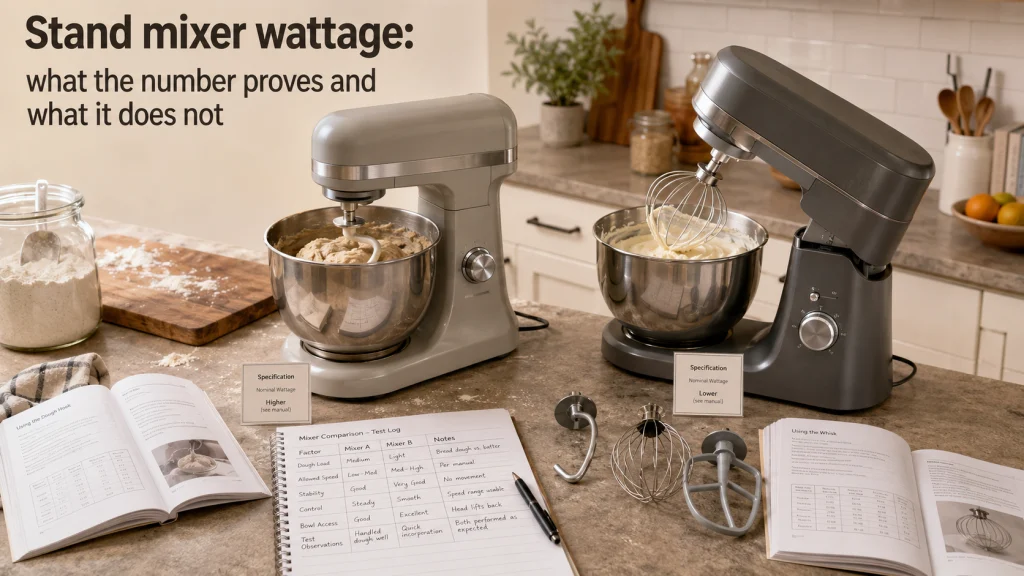
A stand mixer’s watt rating is useful as a published specification, but it is not a strength score. A larger number does not by itself prove more torque at the bowl, better dough handling, greater durability, or a better fit for your kitchen. The safer buying method is to keep wattage beside manufacturer load guidance, motor and drive information, and independent performance tests. By the end, you should know what the number can establish, what it cannot, and which evidence deserves more weight when two mixers look difficult to compare.
Why the bigger watt number looks more useful than it is
Put two mixers beside each other on a shopping page and stand mixer wattage is often the easiest number to compare. If the lower-priced machine says 1,000 watts while the more expensive one says 500 watts, the first reaction is understandable: the larger number must mean the stronger mixer. That shortcut feels especially convincing when the job in mind is bread dough, where the machine is expected to work against a heavy load. The problem is that the watt figure does not tell you, by itself, how much useful mixing performance reaches the attachment and bowl.
Independent mixer testing is a better reality check because it measures the work rather than treating one electrical label as the result. Consumer Reports says wattage and speed count do not necessarily translate into better mixer performance, and CHOICE likewise reports that wattage did not have a significant effect on performance in its kitchen-mixer testing. That does not make the watt number meaningless; it makes the number bounded. A buyer should read it as one specification on the model sheet, then move quickly to evidence that measures the jobs the mixer must actually complete. As with other small kitchen appliances, one electrical specification is useful only when it is tied back to measured performance and the actual job.

This 6.5-quart tilt-head stand mixer has a published 660-watt rating and six speeds. It includes a dough hook, wire whip, and beater for different mixing tasks. Those model-specific details make it useful for comparing the full specification set instead of treating wattage alone as a strength score.
Check On AmazonIf you click this link and buy, we earn a commission at no additional cost to you.
What the watt rating can and cannot establish
A published watt rating belongs in the electrical and motor information for a mixer, not in a universal performance ranking. It can help identify a model, confirm what the manufacturer publishes for that model, and make a limited comparison when two machines use genuinely comparable designs and rating methods. It does not automatically reveal delivered torque at the attachment, usable dough capacity, how well the beater reaches the bowl, or whether the machine stays stable under load. Those questions depend on the rest of the system and on how the mixer behaves during the task.
This distinction matters because a specification card compresses several different questions into one bold number. A household deciding among different types of mixers should first ask what work the machine must do, how often it will do it, and what batch size is normal. Only after that does motor information become useful in context. A mixer for occasional cake batter and whipped cream does not need to be judged by the same evidence as a machine expected to knead dense dough repeatedly.
| Question | What wattage can support | What wattage does not prove |
|---|---|---|
| Model identification | A published electrical or motor rating tied to the exact model | That another model with a lower number is weaker |
| Mixing performance | A specification to record beside test results | Faster incorporation, better whipping, or smoother batter |
| Dough work | One part of the model’s technical description | Safe batch size, kneading ability, or a universal bread threshold |
| Durability | No direct conclusion by itself | Gear life, motor life, heat management, or long-term reliability |
The useful habit is simple: never let a watt figure answer a question it was not designed to answer. If two products publish very different numbers, note the difference but resist turning it into a performance verdict without testing or manufacturer limits that connect the number to the actual workload. That keeps the comparison grounded in evidence rather than typography on a retail page. It also prevents a high number from hiding poor bowl geometry, unstable kneading behavior, awkward controls, or other ownership problems that matter every time the mixer is used.
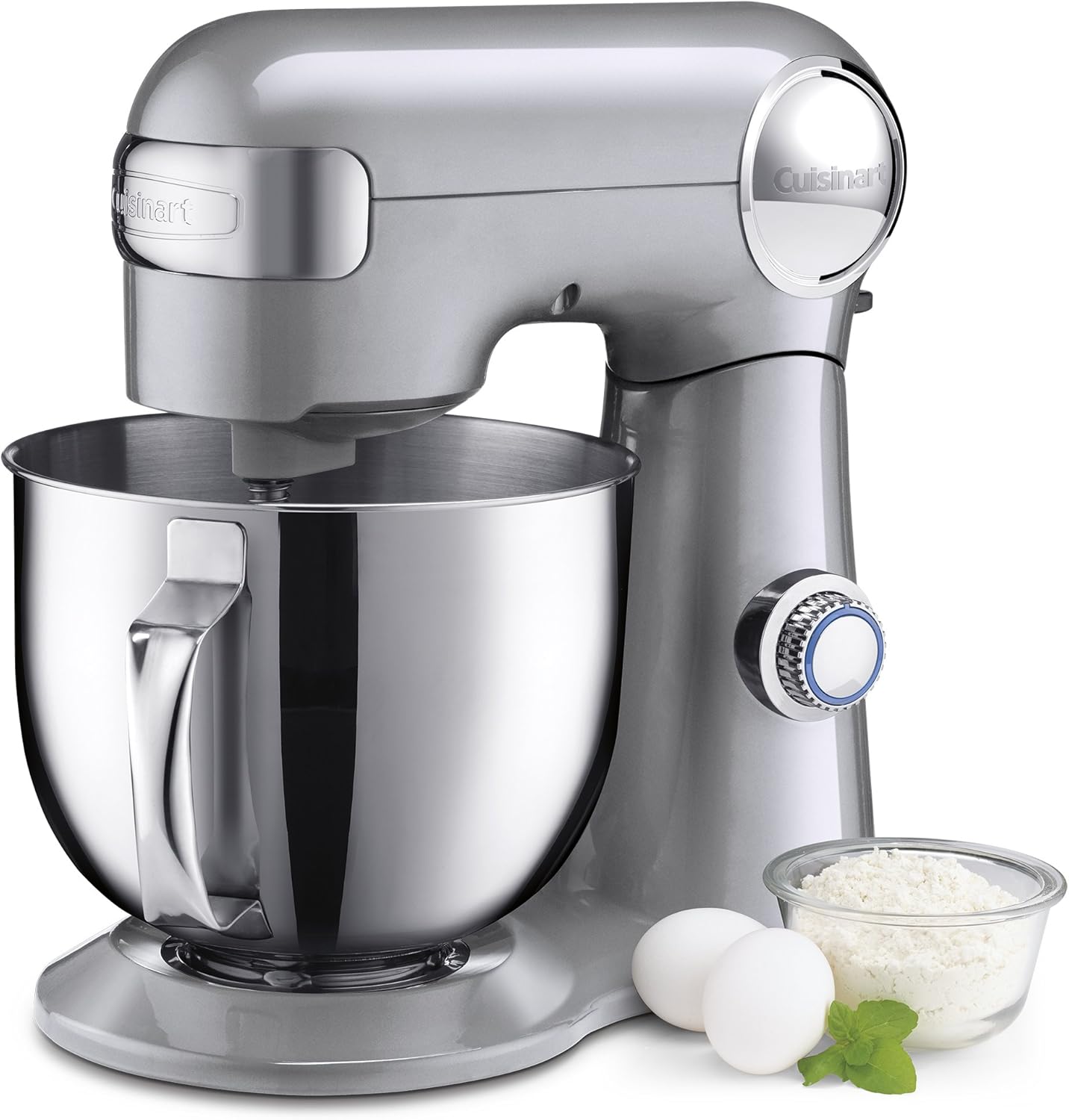
The SM-50BC pairs a 500-watt motor with a 5.5-quart stainless steel bowl and 12 speeds. Its included tools are a chef whisk, dough hook, flat mixing paddle, and splash guard with pour spout. These separate specifications give a fuller model picture than the watt rating by itself.
Check On AmazonIf you click this link and buy, we earn a commission at no additional cost to you.
Why electrical input is not a universal strength or torque score
The key engineering boundary for a buyer is that electrical input and useful mechanical output describe different parts of the system. Motors, control electronics, gears, drive paths, attachment geometry, and internal losses all affect what happens before force reaches the beater or dough hook. A simple watts-to-torque conversion therefore cannot be carried from one unrelated mixer design to another. Without measured output under defined load, speed, and attachment conditions, the conversion has no reliable buyer-level basis for comparing actual mixing work.
A manufacturer example makes that separation easier to see. KitchenAid’s commercial KSMC895 documentation lists a 500-watt figure and separately describes a high-efficiency DC motor, while its product material distinguishes motor horsepower from power delivered to the bowl. That does not prove this architecture is automatically better than another. It shows that input rating, motor design, drivetrain, and bowl output are separate data points that should remain separate in a comparison.

The P4400 is a plug-in electricity usage monitor rated for 115 volts and 15 amps. It lets you connect an appliance and view electrical energy-use information at the outlet. That makes it relevant to measuring electrical input while keeping that measurement separate from mechanical output such as torque at a mixer attachment.
Check On AmazonIf you click this link and buy, we earn a commission at no additional cost to you.
Motor design, gearing, and system efficiency change the comparison
Stand mixer motor power becomes easier to interpret when the surrounding design is known well enough to judge whether two machines are truly comparable. Motor type, gearing, control strategy, attachment path, and intended load can all differ, even between products sold under the same brand. A commercial bowl-lift platform and a smaller household tilt-head platform may be designed around different operating expectations. The more those systems differ, the less useful a direct comparison of their published electrical ratings becomes.
Marketing phrases such as high efficiency, direct drive, all-metal gears, or high torque still need context. They may identify meaningful design choices, but they do not tell you how the complete machine behaves with your batter, cream, or dough. When architecture is documented and independent testing shows the resulting behavior, the design details can help explain why two mixers perform differently. When that link is missing, the architecture claim should stay descriptive rather than becoming a performance conclusion.
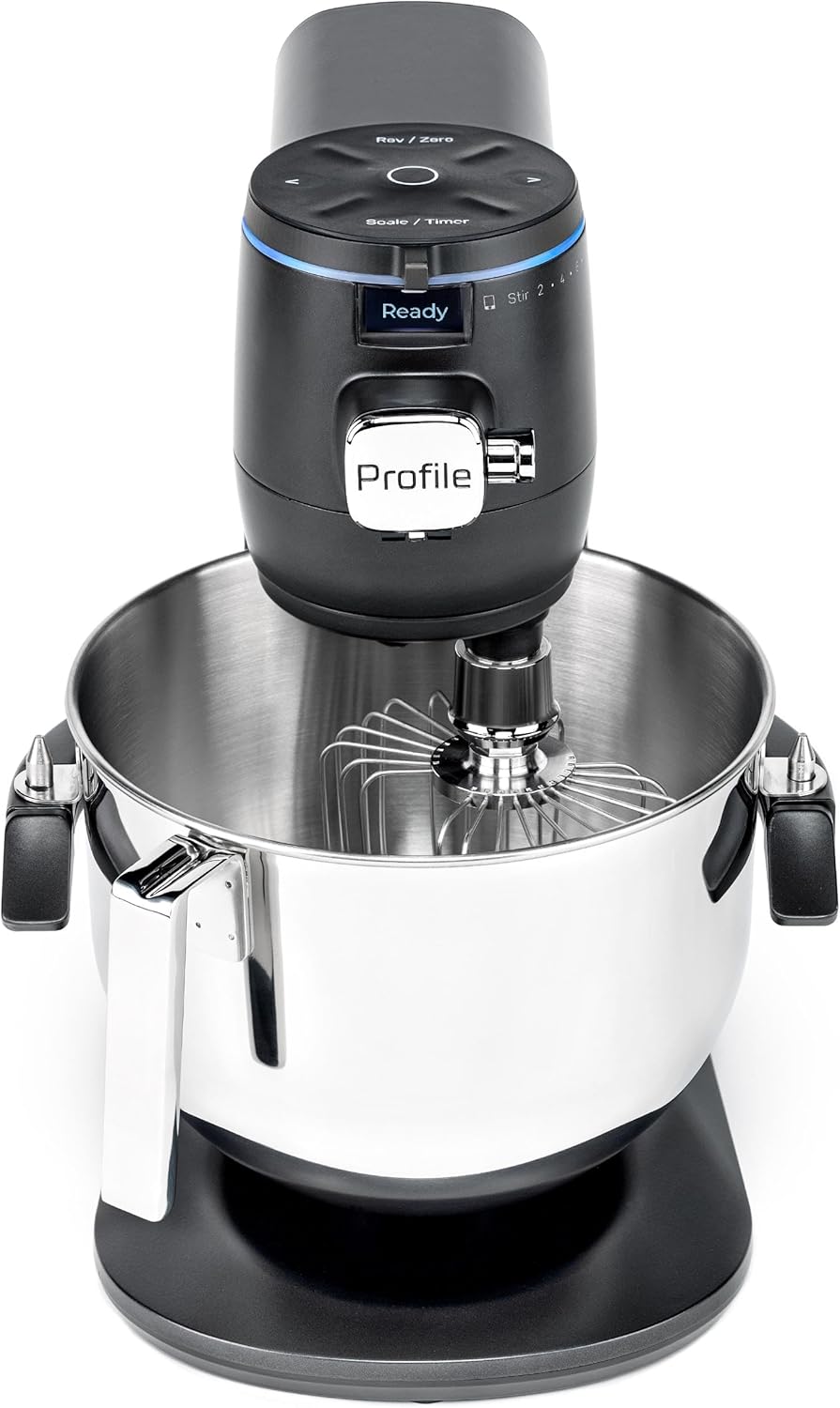
This GE Profile model uses a 7-quart bowl and a 540-watt brushless DC motor. It also integrates a built-in scale, Auto Sense, reverse mode, and a timer. Those architecture and control details show why motor type, system design, and operating features deserve separate consideration from the headline watt rating.
Check On AmazonIf you click this link and buy, we earn a commission at no additional cost to you.
Use performance tests instead of the watt shortcut
A useful mixer test starts with the food task and records what the machine actually does. Consumer Reports evaluates stand mixers with jobs that include batter preparation, whipping, emulsifying, kneading, noise, and convenience, which is much closer to the decision a household is trying to make. CHOICE also separates mixer performance from the size of the watt number, reinforcing the same evidence hierarchy. When two candidate machines disagree on specs, task-based testing should carry more weight than the larger headline figure.
The test still has to match the intended use. A machine that performs beautifully with cream and cake batter has not automatically proved that it is the right choice for repeated heavy bread dough, and one dough test does not establish every possible batch or hydration level. Look for the exact load, attachment, speed, duration, and result whenever the testing source provides them. That context lets you compare evidence rather than simply compare scores that may have been earned under different tasks.
For mixing and whipping, judge the finished result and control
For lighter and medium tasks, useful evidence includes ingredient incorporation, consistency, aeration, control at low and high speeds, and how well the tool works across the bowl. A lower watt figure is not a reason to reject a mixer that produces even batter and stable whipped results in a well-described test. Likewise, a high watt figure cannot rescue a model that leaves ingredients poorly incorporated or gives the user coarse speed control. The test result is the performance evidence; the wattage remains supporting specification data.
For kneading, look at dough development and the exact load
Kneading evidence should identify what kind of dough was used, how much was in the bowl, which hook and speed were used, and whether the machine remained stable. The finished dough matters too, because simply turning the hook is not the same as developing a smooth, consistent dough under the stated conditions. A buyer comparing mixers for bread should favor tests that describe the load and outcome rather than claiming that a certain watt number is enough. If the test load is far lighter than your usual batch, treat the result as limited rather than universal.
Stability, noise, and control are part of ownership quality
A mixer can complete a recipe and still be unpleasant to own if it walks across the counter, becomes difficult to control, or produces more noise than the household will tolerate. Those factors do not show up in a watt rating, yet they can determine whether the machine stays on the counter or ends up stored and rarely used. Independent test methods that include noise and convenience therefore add information the spec sheet cannot provide. Performance should answer both “can it do the job?” and “is the way it does the job acceptable in this kitchen?”
| Evidence level | What to look for | How much weight to give it |
|---|---|---|
| Independent task test | Defined ingredients, load, attachment, speed, result, stability, and control | High when the test resembles your use |
| Manufacturer operating guidance | Batch limits, dough guidance, required attachment, allowed speed, duty conditions | High for safe model-specific use |
| Manufacturer architecture information | Motor type, gearing, control system, drive description | Useful context, not a substitute for performance testing |
| Published wattage | The exact model’s listed rating | Limited without the evidence above |
Use this hierarchy in the same order when the shopping page tries to pull your eye back to the largest number. First ask whether the mixer has been tested doing your kind of work, then check the manufacturer’s limits and operating instructions, then use design information to understand why the results may differ. Wattage belongs at the bottom of that stack because it is easy to read but weak as a stand-alone predictor. This order makes a comparison slower than sorting by one number, but it is far less likely to produce the wrong machine.

This all-metal stand mixer has a published 450-watt rating and 12 speed settings. It includes a flat beater, dough hook, whisk, 5-quart stainless steel bowl, and attachment hub. Those controls and tools give task-based tests something concrete to evaluate beyond the watt number, including mixing behavior across different attachments and speeds.
Check On AmazonIf you click this link and buy, we earn a commission at no additional cost to you.
Read dough, batch, and speed guidance before inferring capacity
Dough is where wattage myths cause the most expensive mistakes because a buyer can easily assume that a larger motor label permits a larger or stiffer batch. Manufacturer guidance is more useful because it can specify the hook, mixing speed, batch amount, and other operating limits for the exact machine. KitchenAid’s bowl-lift guidance, for example, directs users to speed 2 for kneading yeast dough with the dough hook rather than treating maximum speed or wattage as the control. That kind of model-specific instruction should override a generic rule found in a comparison chart.
Capacity should also be read as a workload limit, not just the volume stamped on the bowl. A large bowl can make room for more ingredients while the manual still places boundaries on flour quantity, dough type, speed, or continuous work. The exact mixer manual is therefore part of the purchase evidence, especially if bread is a frequent task. If a candidate’s documentation is vague about the workload you care about, do not fill the silence with a wattage assumption.
- Check the exact dough hook or mixing tool specified for the task.
- Check the manufacturer’s allowed kneading speed rather than assuming faster is stronger.
- Check stated batch, flour, dough, or recipe limits for the exact model when available.
- Check whether heavy-load instructions change for a different bowl, accessory, or mixer variant.
- Stop at the manual’s boundary instead of treating extra wattage as permission to exceed it.
These checks also help separate a genuine bread-capable machine from a model that merely has a large number on its retail card. A first-time buyer often focuses on motor size before reading the operating section, yet the operating section is where the manufacturer tells you how the machine is expected to be used. That information is directly actionable and tied to the exact product. It deserves more weight than a generic claim that a certain number of watts is “good for dough.”

The Escali Primo is a digital kitchen scale with an 11-pound maximum capacity and 1-gram readout accuracy. Its tare feature lets you subtract container weight before weighing ingredients. That makes it useful for following model-specific flour, dough, or batch limits instead of estimating workload from bowl size or wattage.
Check On AmazonIf you click this link and buy, we earn a commission at no additional cost to you.
Keep wattage as one bounded field in the model evidence sheet
Wattage still belongs in a serious comparison, but its main job is recordkeeping. Note the exact published figure, the source that provides it, and the model or variant it belongs to, then place it beside bowl size, mixer style, motor or drive description, manufacturer workload guidance, and independent test results. This is the same evidence-first approach used in a broader stand mixer buying decision, where capacity, fit, storage, control, and ownership burden sit beside performance. Keeping the source and model identity attached to each figure also prevents ratings from neighboring variants from being mixed together.
This model sheet also exposes gaps before they become assumptions. One candidate may have detailed operating limits but no useful independent kneading test, while another may have strong test coverage but vague documentation for the exact variant you are considering. Those are different weaknesses, and the sheet makes them visible without forcing an artificial winner. The result is a cleaner record of what you know, what you can compare fairly, and what still needs verification.

This VIVOHOME model uses a 6-quart bowl and a tilt-head layout. The listing provides 10 speeds and includes a dough hook, beater, whisk, splash guard, and egg separator. Those concrete model fields are useful to record beside wattage, workload guidance, dimensions, and test results in an evidence sheet.
Check On AmazonIf you click this link and buy, we earn a commission at no additional cost to you.
There is no defensible universal minimum wattage for bread
The question of what wattage a stand mixer should have sounds as if it should have one clean answer, especially for bread. A true universal threshold would require the same relationship among electrical rating, motor design, gearing, bowl geometry, dough load, speed, and delivered performance across very different machines. Independent testing does not establish that kind of fixed relationship. A single cutoff therefore turns a model-specific workload problem into a number that looks more precise than the evidence allows.
A bread buyer gets a more useful answer by describing the workload instead. Define the usual dough type, batch size, frequency, and whether occasional larger batches matter, then compare manufacturer limits and tests that resemble that use. A claimed minimum becomes meaningful only when it is tied to a specific machine design and a defined workload. Otherwise, the practical question is whether the exact model has documented or demonstrated performance for the bread work you expect it to do.

The Dash Everyday is a compact tilt-head stand mixer with a 3-quart stainless steel bowl. It offers six speed settings for everyday mixing tasks. Its smaller format is a useful reminder to compare the intended workload and capacity of the exact model rather than applying one universal wattage threshold across every stand mixer.
Check On AmazonIf you click this link and buy, we earn a commission at no additional cost to you.
Build a two-model evidence checklist before choosing
When two mixers are finalists, put them in the same worksheet instead of jumping between retailer tabs. The worksheet should force each model to answer the same questions: what is published, what is tested, what is permitted by the manual, and what still remains unknown. This makes an apparently simple wattage advantage compete against stronger evidence such as tested dough behavior or a clearly documented batch limit. Unknowns stay visible instead of being silently converted into assumptions.
The most useful worksheet is short enough to fill in while shopping but strict enough to prevent apples-to-oranges comparisons. Write only what a source actually supports, and leave a cell blank when the manufacturer or independent test does not provide the answer. If the models use different architectures, say so rather than treating the watt columns as directly equivalent. A blank cell is better than a made-up conclusion, because it tells you exactly what still needs verification before purchase.
| Evidence to collect | Candidate A | Candidate B | Decision use |
|---|---|---|---|
| Published wattage and exact source | Record, do not interpret alone | Record, do not interpret alone | Model identification and bounded comparison |
| Motor and drive information | Type and documented design | Type and documented design | Shows whether watt comparison is even close to like-for-like |
| Manufacturer heavy-load guidance | Batch, tool, speed, limits | Batch, tool, speed, limits | Defines intended use boundaries |
| Independent mixing test | Task and result | Task and result | Shows real mixing behavior |
| Independent kneading test | Load and result | Load and result | Most important for frequent bread work |
| Stability, noise, and control | Observed test findings | Observed test findings | Separates task completion from ownership quality |
Once the worksheet is filled, choose based on the strongest evidence that matches your routine, not the column with the largest watt figure. If the two machines perform similarly in relevant tests, then size, storage, bowl access, cleanup, controls, warranty, or price may become the real tie-breakers. If one has clearer load guidance and better task results, that evidence can reasonably outweigh a lower headline watt number. The worksheet turns the purchase back into a household fit decision instead of a contest between spec-card numbers.

Model 63391 has a 4-quart stainless steel bowl, a published 300-watt rating, and seven speeds. It includes a dough hook, whisk, flat beater, splash guard, and an easy-carry handle. Those clearly separated fields work well in a two-model checklist that compares capacity, controls, included tools, and storage handling instead of wattage alone.
Check On AmazonIf you click this link and buy, we earn a commission at no additional cost to you.
Bread-first buyers need kneading evidence, not a watt threshold
If bread is the main reason for buying a stand mixer, wattage is only the beginning of the comparison. Dough density, batch size, hook design, bowl and machine stability, allowed kneading speed, and repeated workload all matter more directly to the job. That is why the next step is to compare models through the evidence used in a stand mixer for bread dough decision rather than trying to invent a universal minimum-watt rule. A bread-focused purchase needs bread-focused proof.
The distinction also prevents overbuying. A household that makes one moderate loaf occasionally may not need the same mixer architecture, capacity, or ownership burden as someone preparing heavy dough several times a week. Larger machines can add counter space, lifting weight, bowl size, and cleanup without solving a problem the household actually has. Start with the repeated workload, then use model limits and kneading tests to decide how much machine is justified.

Model 64651 combines a 4-quart stainless steel bowl with six speeds and a 290-watt peak-power specification. Its included set has two dough hooks, two traditional beaters, and a whisk, and Amazon describes the stand-mixer mode for thick mixtures including bread dough. That makes it a concrete bread-use candidate to check against batch guidance and kneading results rather than a universal watt threshold.
Check On AmazonIf you click this link and buy, we earn a commission at no additional cost to you.
Final thoughts: treat wattage as a specification, not a verdict
A mixer’s wattage number is clean, visible, and easy to compare, which is why it often gets more authority than it deserves. Keep the figure on the model sheet, but use manufacturer workload guidance and relevant independent testing to answer the questions that affect actual use. Torque, dough capacity, durability, and overall quality each require evidence beyond the electrical label. The point is not to ignore wattage, but to keep it in the part of the decision it can genuinely support.
When two models compete for the same spot in your kitchen, compare the jobs you repeat, the loads you expect, the manual limits, and the test results that resemble your routine. Then use size, storage, controls, cleanup, warranty, and price to separate machines that are otherwise close. If an important workload remains undocumented or untested, leave that uncertainty visible rather than guessing around it. A good buying decision comes from knowing both the evidence and its limits.

This Etekcity scale weighs up to 11 pounds or 5 kilograms in 1-gram increments and includes a tare function. Its compact 304 stainless steel platform supports five measurement units and is designed for easy storage and wipe-clean care. That makes it useful for documenting repeated ingredient loads while keeping storage and cleanup practical in the broader mixer decision.
Check On AmazonIf you click this link and buy, we earn a commission at no additional cost to you.
Frequently asked questions
⚡ Does a higher stand mixer watt rating mean more power?
Not in a way that lets you rank unrelated mixers reliably from wattage alone. Motor design, gearing, controls, and the rest of the drive system affect what the mixer does under load, so task-based tests and model-specific guidance are more useful.
🍞 What wattage should I look for if I mainly make bread?
Do not use a universal watt threshold. Compare the exact mixer’s dough limits, required kneading speed, hook, batch guidance, and independent kneading performance for a workload close to yours.
⚙️ Can two mixers with the same wattage perform differently?
Yes. Different motor types, gearing, controls, bowl geometry, and attachment systems can produce different results even when the published watt figures match.
🥣 Is bowl capacity a better performance measure than wattage?
Bowl capacity answers a different question, and it still does not prove usable heavy-load capacity by itself. Check the exact model’s batch guidance and performance under the load you plan to mix.
📋 What should I compare besides watts?
Compare manufacturer load limits, motor and drive information, independent mixing and kneading tests, stability, controls, noise, bowl access, storage fit, and cleanup. Give the most weight to evidence that matches your repeated workload.
References and sources
- Consumer Reports mixer buying guide: Supports the limits of wattage as a stand-alone performance predictor and describes task-based mixer testing.
- CHOICE kitchen mixer buying guide: Corroborates that wattage did not have a significant effect on performance in its mixer testing.
- KitchenAid KSMC895 specification sheet: Provides a bounded example that separates the model’s watt rating, motor architecture, and stated motor-output context.
- KitchenAid bowl-lift speed guidance: Supports the model-specific principle that kneading speed and operating instructions should be checked instead of inferred from wattage.