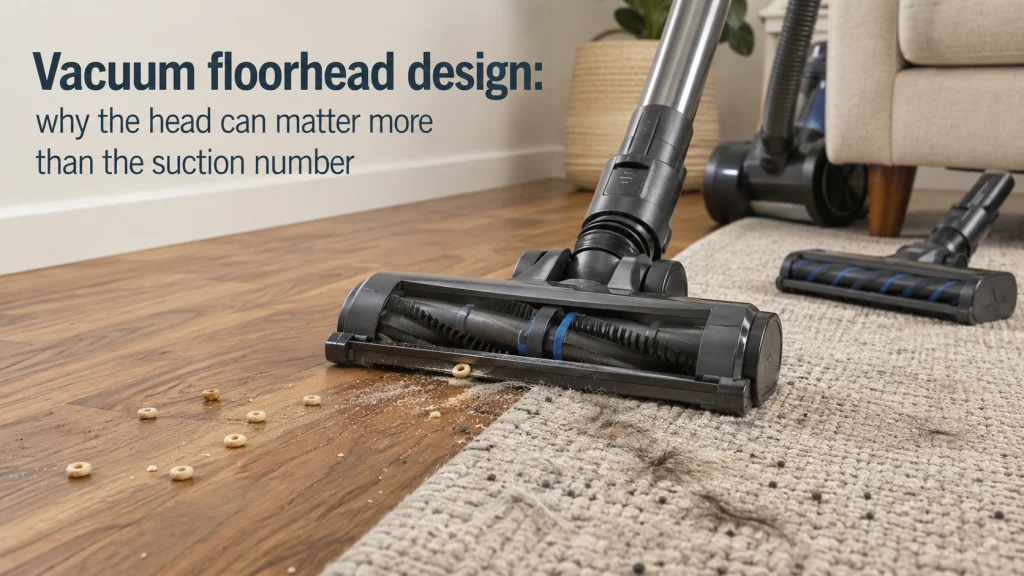
Vacuum floorhead design can change pickup more than a headline suction number suggests because the head controls how debris reaches the airflow path. Straight-suction heads, bristled brushrolls, soft rollers, dual rollers, and turbo heads each solve different floor-contact problems, and none is automatically best on every surface. The practical choice depends on floor mix, debris size, carpet pile, head clearance, roller behavior, and whether independent pickup testing matches the surfaces in your home. By the end, you should be able to judge the part touching the floor before treating motor power as the deciding specification.
Start with what happens at the floor
Two vacuums can post similarly strong suction claims while behaving very differently when a cereal piece sits in front of the nozzle. Vacuum floorhead design is often the reason: one head can admit the debris, agitate it, and keep it in the airflow path, while another simply pushes it ahead. Controlled testing from RTINGS has shown large pickup changes when different floorheads were fitted to the same vacuum body, which makes the head more than a secondary accessory. That is why a buyer comparing vacuum suction power should also ask what the primary floorhead actually does with the home’s floors and debris.
- Identify the surfaces that make up most of the cleaning route.
- Note the debris that causes trouble, especially large pieces, fine dust, hair, and embedded grit.
- Check whether the primary head is passive, air-driven, or electrically powered.
- Look for surface controls such as height adjustment or brushroll on and off.
- Use pickup testing on the relevant surface as the final performance check.
The useful first check is physical rather than promotional. Look at the opening in front of the head, the roller material, the space underneath, whether the roller is powered, whether it can be switched off, and whether the head height changes for carpet. Then compare those features with surface-specific pickup evidence instead of assuming that more airflow will rescue a poor floor interface. Within home cleaning appliances, floorhead design is one of the details that can materially change real pickup. If you are still deciding between basic vacuum formats, the broader overview of types of vacuum cleaners belongs before this more detailed floorhead decision.

The Triple Action Brush Roll loosens and lifts embedded dirt and pet hair across multiple surfaces. Scatter-Free Technology is designed to reduce debris scatter on hard floors. Swivel steering and an active extension wand add maneuverability and reach beyond the primary floorhead.
Check On AmazonIf you click this link and buy, we earn a commission at no additional cost to you.
The floorhead is the vacuum-floor interface
The motor creates airflow and pressure, but the floorhead decides how that energy meets the surface. Its front edge determines what can enter, its underside determines how closely it seals, and its roller or brush strips determine whether debris is moved, lifted, scattered, or simply passed over. Those details explain why vacuum head design can have a large effect on real pickup even when the head itself looks simple. For a buyer, that means the head should be evaluated as a working interface with the floor, not as a generic accessory attached after the main specifications are compared.
| Floorhead type | What it is trying to do | Where to check the trade-off |
|---|---|---|
| Straight-suction head | Move debris with airflow through a passive opening | Front clearance, brush strips, seal, and large-debris access |
| Bristled powered brushroll | Agitate carpet and move debris toward the intake | Carpet pile fit, scattering on hard floors, and brushroll controls |
| Soft roller | Contact hard flooring while admitting mixed debris sizes | Roller clearance, sealing, hair wrap, and floor-specific suitability |
| Dual roller | Combine front debris handling with a second agitating roller | Mixed-floor compromise, head bulk, and maintenance |
| Turbo head | Spin a brushroll using the vacuum’s airflow | Available airflow, carpet resistance, and roller speed under load |
Think of the head as a controlled compromise between access and sealing. A head that sits extremely close to hard flooring may preserve suction around fine particles, but a low front gate can block larger debris. A higher or more open head may admit cereal, crumbs, and litter more easily, yet excessive gaps can weaken useful airflow at the floor or let a spinning roller throw debris behind the head. The right design is the one whose trade-offs line up with the household’s actual surfaces and messes.

The LVAC-200 uses a tangle-resistant floorhead for pet hair and mixed-surface cleaning. It is designed for both carpets and hard floors and can lay flat to 180 degrees for low furniture. The cordless design is rated for up to 50 minutes of runtime.
Check On AmazonIf you click this link and buy, we earn a commission at no additional cost to you.
Straight-suction heads keep the mechanism simple
A straight-suction head has no powered brushroll, so debris pickup depends heavily on airflow, the shape of the opening, and any fixed brush strips around the head. On smooth floors, that simplicity can be useful because there is no rotating roller to wrap hair or require a drive system. The limitation appears when the head’s front edge or bristles sit too low for larger debris to enter cleanly. In controlled head testing, RTINGS found that a low-profile straight-suction design could handle fine material better than larger cereal-sized pieces, showing how geometry can become the bottleneck.
This type also makes sense only when the floor itself does not require strong agitation. On carpet, especially when debris is worked below the surface, a passive head may depend too much on airflow and repeated passes compared with a well-matched brushroll. On hard flooring, however, a well-designed passive head with generous debris openings can remain an efficient, low-maintenance choice. The buying question is not whether straight suction is old-fashioned, but whether the exact head admits your common debris and moves easily across your surfaces.

The NV356E is a Lift-Away upright for carpet and hard-floor cleaning. Its brushroll shutoff lets the floorhead operate without active brush agitation on bare floors. The detachable pod extends the same vacuum to stairs and above-floor cleaning.
Check On AmazonIf you click this link and buy, we earn a commission at no additional cost to you.
Bristled powered brushrolls are mainly about agitation
A powered bristled brushroll uses its own electrical drive to keep the roller turning while the vacuum moves across the floor. The main advantage is on carpet, where the bristles can disturb fibers and help release debris that airflow alone may leave embedded. RTINGS’ current test methodology treats high-pile and low-pile pickup as separate conditions, which is a useful reminder that “carpet” is not one uniform surface. A head that works well on short pile can still become hard to push, stall, or agitate poorly when the pile gets deeper.
| Surface condition | Roller behavior to look for | Evidence that matters most |
|---|---|---|
| Mostly smooth hard flooring | Gentle contact, suitable brushroll-off mode, soft roller, or effective passive head | Hard-floor pickup with fine and large debris |
| Low-pile carpet | Consistent powered agitation without excessive drag | Low-pile pickup and hair pickup |
| High-pile carpet | Height control or enough clearance to avoid choking the head | High-pile pickup plus maneuverability |
| Mixed hard floors and rugs | Easy surface switching or a genuinely competent mixed-floor head | Separate test results on each surface |
Vacuum brushroll types behave differently on hard flooring because aggressive bristles are no longer working against a carpet pile that can absorb their motion. Some designs let the user stop the brushroll for hard floors, while others rely on a separate head or a different roller. The correct choice should follow the vacuum maker’s floor guidance and the flooring maker’s care guidance rather than a blanket claim that bristles always scratch or never scratch. What matters for buying is whether the primary head gives you the control needed for the surfaces you actually clean.

The 2254 uses a Triple Action brush roll to loosen, lift, and remove pet hair from multiple surfaces. Scatter-Free Technology is intended to reduce debris scatter on hard floors. Swivel steering helps position the powered floorhead around furniture.
Check On AmazonIf you click this link and buy, we earn a commission at no additional cost to you.
Soft rollers solve a different hard-floor problem
Soft rollers are built around broad surface contact rather than stiff carpet agitation. A compressible roller can help carry both fine material and larger pieces toward the intake while allowing a taller front opening than some low-profile passive heads. RTINGS’ head-design testing found that well-designed soft rollers could outperform higher-suction alternatives on mixed hard-floor debris, showing how much the head architecture can change the result. The important phrase is well-designed, because roller material alone does not guarantee good pickup.
Clearance and sealing still matter around the roller. A soft roller with a restrictive housing can push large debris, while poor sealing behind the roller can allow material to escape or be projected away from the pickup path. Hair and threads can also turn the roller into a maintenance point if access is difficult, so removable parts matter for ownership even when pickup is strong. For households with hard floors, the useful question is whether the soft roller improves the debris sizes you actually encounter enough to justify its extra moving part and cleaning routine.

The AZ2002 uses a DuoClean PowerFins floorhead that pairs a soft roller with a PowerFins brushroll for hard floors and carpets. Its self-cleaning brushroll is designed to reduce hair wrap. Powered Lift-Away lets the pod detach while the floor nozzle remains powered.
Check On AmazonIf you click this link and buy, we earn a commission at no additional cost to you.
Dual rollers are a mixed-floor compromise, not a free upgrade
A dual-roller head usually places two different contact surfaces in the same floorhead so one can manage incoming debris while the other contributes agitation or secondary pickup. The appeal is obvious for a home that moves repeatedly between hard flooring and carpet because the user may not need to swap heads at every transition. The compromise is that both rollers must fit inside one housing, so head height, front clearance, sealing, weight, and steering can all change. A second roller also creates another place for hair, fibers, and debris to collect.
Good dual-roller performance therefore depends on coordination, not simply on having more moving parts. A front roller that blocks or pushes debris can undermine the rear roller, while a bulky head can become awkward under furniture even if pickup is strong in the open. Recent independent tests also show that some dual-roller arrangements can behave very differently on hard floors and carpet, which means the architecture itself is not proof of versatility. Treat “dual roller” as a design description, then demand evidence on each floor type you care about.

The LA555 uses DuoClean PowerFins HairPro, a two-brushroll floorhead for carpet and hard floors. A self-cleaning brushroll is designed for pet-hair pickup while reducing wrap. Lift-Away ADV detaches the pod for stairs, furniture, and other above-floor areas.
Check On AmazonIf you click this link and buy, we earn a commission at no additional cost to you.
Front opening and head height control large-debris behavior
Large-debris pickup often fails at the front edge of the head. If a cereal piece, pet-food pellet, or coarse litter cannot fit under that edge, the head may push it forward instead of admitting it into the pickup path. RTINGS changed its pickup approach specifically to avoid lifting the floorhead over larger debris, making the test more sensitive to how the head handles obstacles at normal floor contact. That method highlights a buyer-relevant truth: usable clearance is part of pickup performance.
The opposite extreme has a cost as well. Raising the whole head too far can reduce the seal and weaken useful airflow near fine dust, so an open mouth is not automatically better. Slots, flexible gates, roller compression, brush-strip spacing, and rear seals can all provide debris access without leaving the entire head floating above the floor. The most useful evidence is a surface-specific test that includes both fine and large debris because either size can expose a different weakness in the same head.

The NEU182A combines a 12.6-inch cleaning nozzle with five floor-height settings. Its dynamic motor and brush roll are intended for hard floors and carpet. The height adjustment gives the user a direct way to change how the head meets different floor surfaces.
Check On AmazonIf you click this link and buy, we earn a commission at no additional cost to you.
Carpet height adjustment and brushroll control change the usable range
Carpet pile changes how deeply the head sinks and how much resistance the brushroll meets. A height-adjustable floorhead can raise the intake and roller enough to move across thicker carpet instead of sealing too tightly or digging into the pile. RTINGS’ test process explicitly uses higher head settings on high-pile carpet when a vacuum provides that control, which shows that the setting is part of the product’s usable performance rather than a cosmetic feature. Without enough clearance, even a powerful vacuum can become difficult to push or fail to keep the brushroll working effectively.
Brushroll on and off is a different control with a different job. Stopping the roller can make one head more appropriate for certain hard floors or delicate surfaces when the manufacturer allows that use, while restarting it restores agitation for carpet. Neither control guarantees that the head will excel everywhere, because the opening shape and suction path remain unchanged. Still, these controls expand the number of surfaces one primary head can handle without forcing the owner to change tools.

The NV352 provides brushroll shutoff to switch between deep carpet cleaning and gentler bare-floor cleaning. Lift-Away detaches the pod for stairs and above-floor work. Swivel steering helps the floorhead maneuver around furniture and tight spaces.
Check On AmazonIf you click this link and buy, we earn a commission at no additional cost to you.
Powered heads and turbo heads drive the roller differently
An electrically powered head uses a dedicated motor to turn the brushroll, either directly or through a belt or gear system. An air-driven turbo head uses moving air from the vacuum to spin a small turbine, which then drives the roller. That distinction matters because a powered head does not need to divert suction airflow to create brushroll motion in the same way a turbo design does. It can also maintain roller drive more independently when carpet resistance increases, although the exact behavior still depends on the head and vacuum.
Turbo heads have their own appeal because they can add agitation without requiring electrical wiring through the wand or hose. They can be useful on rugs or lighter carpet when the vacuum provides enough airflow and the head remains easy to spin. The trade-off is that dense carpet, clogs, dirty turbine passages, or reduced airflow can weaken roller speed, so the cleaning system is more interdependent. Buyers should therefore compare the head’s intended surfaces and independent pickup results rather than treating “turbo” as another word for “powered.”

The HV301 uses a motorized floor nozzle rather than an air-driven turbine head. Its two floor settings change brushroll speed for bare floors and carpets. The stick vacuum also converts to a handheld for stairs, upholstery, and above-floor cleaning.
Check On AmazonIf you click this link and buy, we earn a commission at no additional cost to you.
Connect floorhead choice back to suction and pickup evidence
Suction and airflow still matter, but they should answer a different question from pickup testing. Suction measures the vacuum’s ability to create a pressure difference, while airflow describes moving air through the system under test conditions. Pickup testing asks whether the complete vacuum, head included, actually removes debris from a defined surface. When those results disagree, the floorhead is one of the first places to look for an explanation rather than assuming one measurement is wrong.
| Evidence | What it tells you | What it does not prove |
|---|---|---|
| Suction measurement | How strongly the vacuum can create a pressure difference under the test setup | That large debris can enter the floorhead or that carpet agitation is effective |
| Airflow measurement | How much air moves through the measured part of the system | That the head geometry will use that airflow efficiently on every surface |
| Hard-floor pickup | How the full head handles fine and larger debris on a smooth surface | That the same head will agitate carpet well |
| Carpet pickup | How head clearance and agitation work on the tested pile | That the head will move easily on every carpet thickness |
RTINGS’ head-design experiments are useful because they changed the head while keeping the vacuum body as a controlled part of the comparison. The pickup results changed substantially, showing that floor-contact design can limit or unlock the motor’s available performance. Their current methodology also separates hard-floor, low-pile, high-pile, and pet-hair pickup instead of collapsing everything into one score. A buyer should follow the same logic by matching evidence to the floor and debris that matter at home.

The NEN110A is a 960-watt bagless canister vacuum with integrated airflow control on the handle. The airflow control can be switched for carpet, upholstery, and hard-floor cleaning. It weighs 8.15 pounds and uses a telescoping metal wand with swivel steering.
Check On AmazonIf you click this link and buy, we earn a commission at no additional cost to you.
Maintenance burden belongs in the floorhead decision
Every moving roller creates a place where hair, thread, carpet fibers, and dust can accumulate. A removable brushroll can make routine cleaning easier, while a sealed or tool-dependent design can turn the same maintenance into a longer job. Dual rollers double the number of contact surfaces to inspect, and turbo heads add an air-driven mechanism that can lose speed if debris restricts the turbine path. This does not make complex heads bad, but the extra parts should earn their keep through better surface fit or easier cleaning.
- Check how the brushroll is removed or exposed for normal cleaning.
- Confirm whether roller material is washable, wipe-only, or not meant to get wet.
- Inspect the front gate and underside channels for lodged debris.
- Verify replacement roller or head compatibility by exact model or part number.
- Keep service-only disassembly outside normal maintenance.
Look beyond claims such as anti-tangle or self-cleaning and check what the owner can actually access. The useful questions are whether the roller comes out without opening the electrical body, whether wrapped hair can be cut away safely, whether the manual allows washing any roller material, and whether replacement brushrolls are available for the exact model. If a powered head behaves abnormally, overheats, smells burned, has damaged wiring, or remains locked after normal owner-level cleaning, stop and follow the manual or qualified-service route. Floorhead maintenance should stay at the level the manufacturer assigns to the owner.

The PowerClean FurGuard 4039 uses a self-cleaning brush roll designed to prevent hair wrap and clogging from hair up to 16 inches long. It has a removable battery and a self-standing design. Bright headlights and an upholstery tool extend cleaning beyond the main floorhead.
Check On AmazonIf you click this link and buy, we earn a commission at no additional cost to you.
Final Thoughts: judge pickup at the floorhead, not the motor label
A suction specification can tell you something real about a vacuum, but floor contact still determines whether debris can enter, whether carpet gets enough agitation, and whether material stays in the pickup path. Those outcomes depend on the vacuum floor head as a complete contact system. Start with the home’s floor mix and common debris, then compare opening geometry, roller type, surface controls, and independent pickup results. That approach makes the motor number useful without letting it dominate the decision.
The simplest head that performs well on your surfaces is often easier to own than a more complicated design bought for features you rarely use. Mixed-floor households may benefit from powered or dual-roller flexibility, while hard-floor-heavy homes may prefer a soft roller or a strong straight-suction design, depending on tested pickup and maintenance tolerance. Carpet-heavy homes should pay close attention to agitation, height adjustment, and how the head behaves on the relevant pile. The right answer is conditional, which is exactly why floorhead design deserves to be judged before the label on the motor.

The PowerClean FurFinder 4282K uses a tangle-free brush roll and bright headlights for floor cleaning. A 30-foot power cord supports longer corded cleaning routes without battery runtime limits. It also includes HEPA filtration and a self-standing design.
Check On AmazonIf you click this link and buy, we earn a commission at no additional cost to you.
FAQs
🧹 Does a soft roller always clean hard floors better?
No. Well-designed soft rollers can be very effective on mixed debris, but opening geometry, sealing, roller drive, and the exact floor still matter. Compare hard-floor pickup for the exact model instead of treating the roller material as a guarantee.
🌾 Why does my vacuum push cereal or litter instead of picking it up?
The front opening may be too low for the debris to enter at normal floor contact. Check head clearance and large-debris pickup evidence before assuming the vacuum needs more suction.
🪮 Is a bristled brushroll better for carpet?
It can be because active agitation helps release debris from carpet fibers. The result still depends on pile height, head adjustment, roller drive, and whether the head remains easy to move on that carpet.
⚙️ What is the difference between a powered head and a turbo head?
A powered head uses an electric motor to drive the brushroll, while a turbo head uses airflow through a small turbine. The difference affects how roller speed depends on airflow and carpet resistance.
🏠 What floorhead is best for a home with both hard floors and rugs?
Look for a head or head set that performs well on both surfaces without creating an annoying switching routine. Compare separate hard-floor and carpet pickup results, then weigh that against head weight, roller cleaning, and surface controls.
References and Sources
- RTINGS floorhead design research: Controlled comparisons show how head geometry, roller material, and clearance can change debris pickup even when the vacuum body remains the same.
- RTINGS vacuum testing methodology: Explains separate hard-floor and carpet pickup tests, normal floorhead contact, surface settings, and how maintenance and tools are evaluated.