Vacuuming stairs is mostly a handling problem: narrow treads make machine weight, hose reach, tool width, cord routing, and footing matter more than they do on an open floor. The safest workable setup usually keeps the heavy part of the vacuum on a stable floor or landing while a documented hose, wand, handheld, or detachable configuration does the cleaning. Work direction should follow the exact vacuum manual because general cleaning advice and model-specific safety instructions can differ. By the end, you should be able to plan a stair route, choose the right attachment for each surface, and recognize when the vacuum you already own is simply a poor fit for the job.
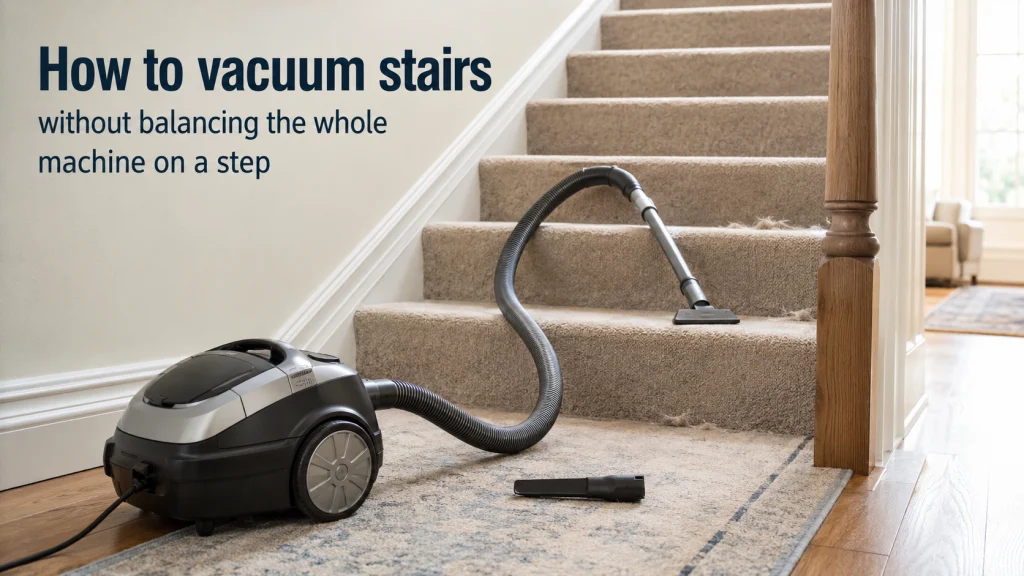
A narrow staircase exposes problems that an open floor hides
On a narrow staircase, the machine can become the problem before suction ever does. A floorhead can be wider than a tread, a canister can become awkward near an edge, and a full upright can demand attention that should stay on your footing. Learning how to vacuum stairs safely starts with placement, reach, and the next step you are going to stand on. The cleaning path matters as much as the cleaning power.
The basic goal is to move the lightest controllable part of the system through the staircase while leaving the heavier body somewhere stable whenever the design permits. A handheld setup, documented detachable pod, or hose-and-wand arrangement can keep more equipment out of the space your feet need. A corded machine adds another moving object to manage, while a cordless machine replaces cord routing with battery and weight-in-hand limits. Before you start vacuuming stairs, decide where the main machine can safely stay and whether the hose, wand, or handheld configuration actually reaches the entire section you intend to clean.

Miele Classic C1 Pure Suction is a bagged canister vacuum for hard floors and low-pile carpet. It offers six suction settings and a 29.5-foot operating radius. The included combination floorhead, dusting brush, crevice tool, and upholstery tool give you several options for controlled stair cleaning.
Check On AmazonIf you click this link and buy, we earn a commission at no additional cost to you.
Clear the stair route before powering the vacuum
Remove shoes, baskets, toys, loose clothing, charging cables, and anything else that turns a tread into a partial foothold. Check runners and mats for loose edges because a tool can catch an unsecured corner and shift it underfoot. Look at both landings too, since one of them may need to hold the vacuum body, a detached pod, or the attachments you plan to use next. A staircase should be a cleaning surface before the machine turns on, not a storage path you are trying to clean around.
Set out only the attachments that have a real job so you are not carrying a collection of tools up and down the stairs. Confirm that the hose and wand lock together normally, the bin or bag is not already overloaded, and the floorhead or small tool can move without a jammed brush or wrapped cord. If the vacuum uses a detachable or handheld mode, check the manual before separating parts because similar designs do not all detach the same way. This preparation is short, but it removes several reasons people end up reaching, twisting, or moving the machine after they are already standing on the staircase.
- Clear every tread and both landings before plugging in or switching on.
- Choose a machine position where the entire body is supported on a level floor or landing.
- Confirm that the hose or documented detachable configuration reaches the section without pulling the machine toward the stairs.
- Keep the cord, unused tools, and attachments outside the active walking path.
- Reposition the machine before the hose becomes taut, and stop if the setup requires balancing the main body on a narrow step.
That last check is the useful dividing line. If the vacuum reaches the middle of the flight only when its full body sits on a tread, technique is no longer solving the equipment problem. You either need a different documented configuration, a different outlet or landing position, or a different vacuum architecture for this task. The staircase should not have to become a shelf for the machine.

BLACK+DECKER Dustbuster AdvancedClean CHV1410L is a cordless handheld vacuum for portable home and vehicle cleaning. Its rotating slim nozzle and pull-out crevice tool reach tight spaces and stair edges. The compact design keeps the cleaning unit in hand without adding a power cord to the stair route.
Check On AmazonIf you click this link and buy, we earn a commission at no additional cost to you.
Work from the top down only when the manual allows it
Top-down cleaning has a practical debris advantage because dust and grit dislodged from an upper tread can fall toward steps that have not been finished yet. When the manual allows that direction, use a repeatable route on each step: clean the inside edges and corners first, cover the flat tread, clean the nosing, finish the riser, then move down one step. Keeping that order prevents you from repeatedly reaching back over a section you already finished and makes loose debris easier to track. That does not make top-down movement a universal safety rule for every vacuum.
Some manufacturer manuals explicitly tell owners to vacuum stairs from the bottom up for that machine and floor-tool arrangement. When the exact manual gives a stair direction, that instruction outranks a generic sequence because it reflects the manufacturer’s intended setup. If the manual does not address stair direction, choose the route that keeps the vacuum body stable, the cord outside your stepping path, and your reach short. The important point is not to defend one direction in every house, but to keep debris flow and machine safety from being treated as the same question.

Bissell Featherweight 2033 is a corded stick vacuum that converts to a hand vacuum. It weighs under 4 pounds and uses a 15-foot power cord. The included crevice tool and floor nozzle support a controlled edge-to-tread cleaning sequence without moving a full-size upright.
Check On AmazonIf you click this link and buy, we earn a commission at no additional cost to you.
Keep the main machine on a stable landing or floor when the design allows
A stable lower floor or landing is usually more forgiving than a narrow tread for an upright body, canister, or detachable collection unit. The machine should sit fully supported, not angled against a riser, resting on a stair edge, or held in place by hose tension. If the hose reaches only part of the flight, clean that section before repositioning from another stable location. Stretching the hose until it pulls the machine toward the stairs defeats the reason for leaving the main body off the steps.
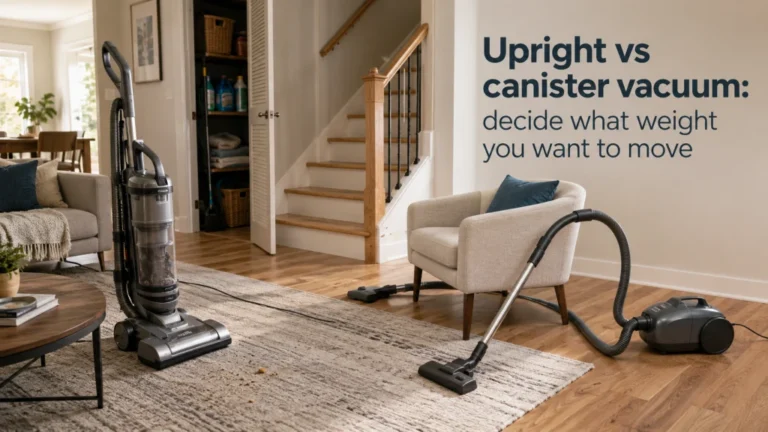
Canister and detachable designs can be useful here because they separate the weight you hold from the weight that contains the motor and debris. An upright with a sufficiently long hose can also work well if the manual allows stair tool use while the body stays parked below or on a landing. A full-size body that must be carried and repeatedly placed on treads is a different proposition, especially on a narrow staircase. When comparing upright and canister vacuum layouts, stair reach is one of the places where architecture changes the job more than a headline suction number does.
Before moving to the next section of the staircase, look at the machine rather than assuming it stayed put. Wheels can shift, a hose can tighten as you change angle, and a detachable body can move unexpectedly. Reposition before the hose becomes taut, not after it starts dragging the machine. Good placement turns stair cleaning into a tool-handling task instead of a balancing task.

Eureka 3670M is a lightweight bagged canister vacuum for carpets and hard floors. It includes a crevice tool and combination tool for corners, furniture, and other tight areas. The hose-and-canister layout lets the cleaning end move independently from the main body when the body can stay on a stable landing.
Check On AmazonIf you click this link and buy, we earn a commission at no additional cost to you.
Use handheld, detachable, or hose configurations only as documented
A convertible vacuum is helpful on stairs only if the conversion is actually intended for owner use. Some stick vacuums become handheld units, some uprights release a pod while the hose remains connected, and some full-size machines are designed to clean stairs only through their accessory hose. Those arrangements can look interchangeable, but latches, powered-tool connections, brush behavior, and supported positions differ. Use the exact manual to confirm how the machine is meant to be carried, parked, detached, and connected before treating a removable part as a stair feature.
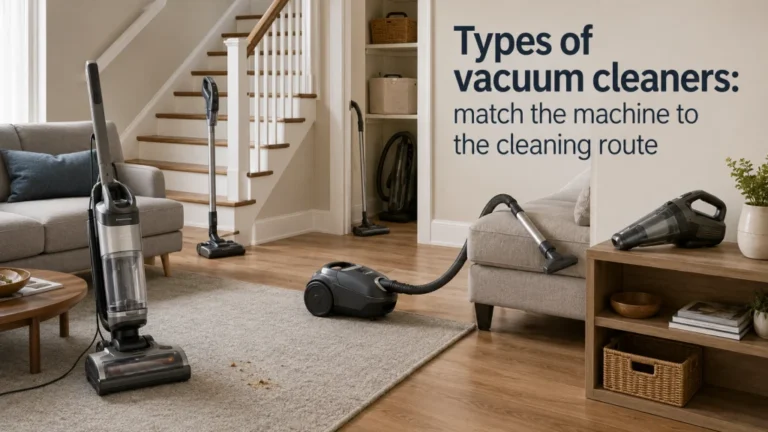
This is also where the broader home cleaning appliances category and the types of vacuum cleaners decision become concrete. A light stick may reduce carried mass but put more weight in your hand, a canister may keep the handpiece light but need a safe place for the body, and an upright may clean carpet well while depending heavily on hose reach for stairs. If you are comparing stick and upright vacuum designs, do not reduce the choice to storage size or open-floor performance. Ask which documented configuration lets you clean the whole staircase without turning the full machine into something you have to lift, park, and catch repeatedly.

Shark Navigator Lift-Away NV352 is an upright vacuum with a Lift-Away configuration for carpet and hard-floor cleaning. It includes a wide upholstery tool and a 12-inch crevice tool. Brushroll shutoff and swivel steering add surface and handling options beyond the detachable cleaning configuration.
Check On AmazonIf you click this link and buy, we earn a commission at no additional cost to you.
Match the attachment to edges, flat treads, runners, and hair
A stair packs several cleaning surfaces into a small area, so one oversized floorhead rarely suits all of them. The crevice tool is usually the first choice for the line where the tread meets the riser, inside corners, and narrow gaps beside a runner. An upholstery or compact stair tool gives better control over a carpeted tread because it covers more area than a crevice nozzle without hanging far over the step. A small powered or air-driven brush can help with carpet hair, but only when the vacuum supports it and the textile tolerates the agitation.
Hard steps usually favor a non-scratching tool that picks up grit without a stiff rotating brush working against the finish. Painted risers and trim may also need a softer brush than the tread, especially when the goal is dust removal rather than embedded debris extraction. The vacuum cleaner attachments page explains these roles in more detail, but the stair decision is simple: choose the smallest tool that still cleans efficiently and stays controllable. If a tool is so wide that half of it hangs over the nosing, its open-floor speed advantage is not helping here.
| Stair area or condition | Useful tool type | What to verify |
|---|---|---|
| Tread-to-riser seam and corners | Crevice tool | Enough hose or handheld reach without stretching the main machine |
| Flat carpeted tread | Upholstery or compact stair tool | Tool width, carpet compatibility, and manageable pull |
| Hair on carpet or runner | Supported mini powered or turbo tool | Exact tool compatibility and brush suitability for the textile |
| Hard tread | Soft or non-scratching floor tool | Floor-finish guidance and whether the brush can be stopped or changed |
| Painted riser or trim | Soft dusting or upholstery brush | Bristle softness and surface condition |
The matrix is a tool-selection shortcut, not permission to attach anything that happens to fit the tube. Powered accessories may need a specific electrical connection, and other tools can change weight, brush behavior, or fit. Use the stair surface to decide which tool family makes sense, then use the exact model documentation to decide which actual attachment is supported. That keeps a cleaning convenience from becoming a compatibility guess.

Bissell Pet Hair Eraser 2390A is a cordless handheld vacuum powered by a 14V lithium-ion battery. It includes a motorized brush tool, upholstery tool, and crevice tool for stairs, furniture, and vehicle interiors. The specialized tools cover embedded pet hair, flat upholstery-like surfaces, and narrow stair seams.
Check On AmazonIf you click this link and buy, we earn a commission at no additional cost to you.
Manage cords and battery limits without creating a new hazard
With a corded vacuum, the cord should never become the object you step over, stand on, or pull tight across the active part of the staircase. Start from a position that keeps the cord outside your walking path, and stop to reposition if that path breaks down. Do not rely on the cord to stop a rolling or falling machine, and do not pull the vacuum by its cord to gain another step of reach. If the manual gives cord-unwinding or stair-placement instructions, follow them before general routing advice.
Cordless machines remove the trailing cable but add a different limit: the useful runtime in the mode and tool you are actually using. A powered mini brush or higher suction setting may shorten runtime, so start with enough charge to finish a logical section rather than assuming the advertised maximum applies. Battery state also matters if you are halfway through a flight with debris already loosened from edges and risers. A cordless setup can make stair cleaning easier to manage, but freedom from a cord does not prove that the machine is light enough or lasts long enough for your staircase.

Shark WANDVAC WV201 is a cordless handheld vacuum that weighs 1.4 pounds. It comes with a charging dock and uses a detachable dust cup with single-touch emptying. Its cordless format removes cord routing from the stair task while keeping the carried unit compact.
Check On AmazonIf you click this link and buy, we earn a commission at no additional cost to you.
Separate carpeted stair technique from hard-step technique
Carpeted stairs hold hair and grit in fibers, seams, and nosing, so they usually need more than a fast pass across each tread. Clean the edges first, then use a compact surface tool in controlled overlapping passes across the tread, and finish the riser if it is carpeted. A supported mini brush can be useful for hair because agitation reaches debris that suction alone may leave in the pile. If the tool grabs the carpet, lifts a runner edge, or pulls harder than you can comfortably control, switch tools or settings rather than forcing the pass.
Hard stairs shift the priority from agitation to grit pickup and surface protection. Use a tool and brush setting the flooring manufacturer permits, and pick up coarse debris before it can be dragged across the finish. Edges still matter because dust collects where the tread meets the riser and along trim, but a narrow crevice pass may do most of that work without a powered brush. The first-time mistake is assuming the tool that feels strongest on carpet must also be the right tool for finished wood, laminate, or another hard step surface.
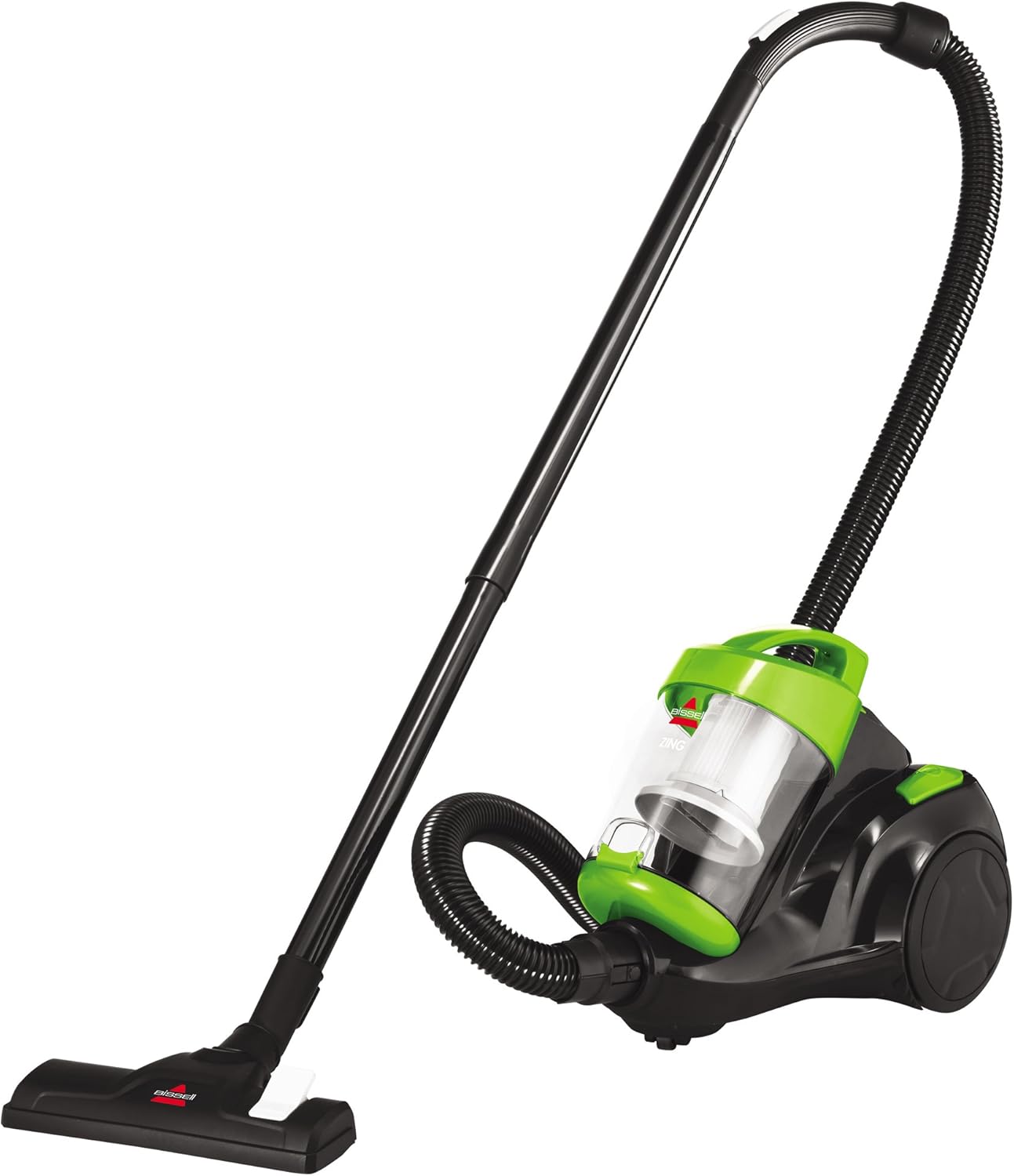
Bissell Zing 2156A is a bagless canister vacuum with cyclonic suction for carpets and hard floors. It includes a multi-surface floor tool, crevice tool, and dusting brush. A 15-foot retractable cord and air-flow regulator add reach and control when moving between hard treads, carpeted areas, and edges.
Check On AmazonIf you click this link and buy, we earn a commission at no additional cost to you.
Recognize when weight or reach makes the vacuum a poor stair fit
Technique has limits, and stairs reveal them quickly. If the hose cannot reach from a stable position, the detachable body is too heavy to control, or the floorhead barely fits the tread, the vacuum is fighting the staircase. Repeatedly lifting the whole machine to compensate is not a clever workaround for short reach. It is evidence that this architecture may be acceptable on the main floor but poorly matched to the stairs.
A second sign is excessive setup friction: repeated outlet changes, heavy components, constant tool swaps, or a cord that keeps entering the walking path. None of those issues means the vacuum is a bad machine overall, but they are legitimate ownership costs if the staircase is cleaned often. A household with one short flight may tolerate more setup than a multilevel home where stair cleaning is a routine part of every vacuuming session. The right conclusion can be to keep the current machine for open floors and use a simpler supported configuration for stairs, rather than demanding that one design be ideal everywhere.

Eureka WhirlWind NEN110A is a lightweight corded canister vacuum for carpets and hard floors. It weighs 8.15 pounds and uses a telescoping metal wand with swivel steering. The handle-mounted airflow control supports carpet, upholstery, and hard-floor cleaning while keeping the canister architecture separate from the cleaning end.
Check On AmazonIf you click this link and buy, we earn a commission at no additional cost to you.
Feed the stair constraint back into your next vacuum choice
If stair cleaning repeatedly exposes the same problem, record the limitation before you compare another vacuum. Useful notes include required hose reach, whether a small powered brush matters, acceptable weight in hand, and where the main body can sit. Also note whether the trouble comes from carrying weight, a short hose, an oversized head, cord routing, or the lack of a documented detachable mode, because each points to a different design requirement. Those details are more actionable than writing down that the current vacuum is simply “bad on stairs,” and they turn an awkward household task into fit requirements you can check before buying again.
Independent vacuum testing treats stairs as a distinct use case because portability, configuration, attachments, cord behavior, and pickup interact differently there. A machine can clean carpet well and still be inconvenient on stairs if too much weight moves with you. Likewise, a very light handheld can reduce carrying effort but still leave trade-offs in bin capacity, runtime, or carpet agitation. The next purchase should solve the specific stair limitation you have measured without sacrificing the main cleaning jobs that still matter elsewhere in the home.

Shark Rocket HV302 is a corded stick vacuum weighing under 9 pounds that converts to a hand vacuum. It includes a crevice tool, pet multi-tool, and precision duster for different cleaning tasks. The convertible architecture provides a concrete option when stair fit depends on carried weight, attachment access, and handheld use.
Check On AmazonIf you click this link and buy, we earn a commission at no additional cost to you.
Final Thoughts: move the tool through the stairs, not the whole machine when you do not have to
Good stair vacuuming is less about wrestling a full-size machine into every step and more about separating the cleaning tool from the weight you do not need to carry. Clear the route, choose a stable machine position, verify the documented configuration, and use a tool sized for the surface in front of you. Let the exact manual control any model-specific stair direction, placement, cord, or detachable-mode instruction. That approach keeps cleaning efficiency from overriding the more important question of whether the setup is physically manageable.
If the current vacuum still requires awkward lifting, stretched hoses, unsafe cord routing, or a main body balanced on a tread, treat that as a fit problem rather than a technique failure. Measure the reach and handling limitation so the next vacuum decision can address it directly. A staircase is one of the best places to discover whether a vacuum’s architecture matches the way the household actually cleans. The useful outcome is not a perfect stair-cleaning trick, but a repeatable route you can carry out without fighting the machine.

Eureka Blaze NES215A is a lightweight corded 3-in-1 stick and handheld vacuum. Its onboard crevice tool supports quick switches between broader cleaning and narrow edges. The convertible layout gives you a smaller handheld configuration for stairs instead of requiring the full stick setup for every tread.
Check On AmazonIf you click this link and buy, we earn a commission at no additional cost to you.
FAQs
🪜 Should I vacuum stairs from the top or the bottom?
Use the direction specified in your exact vacuum manual when it gives one. General cleaning advice often favors top-down debris flow, but some manufacturer manuals explicitly require bottom-to-top stair cleaning for safety.
🧹 Can I use a full-size upright vacuum on stairs?
Only in the stair-use configuration documented for that model. If the upright must be balanced on individual treads or repeatedly lifted to gain reach, its design is a poor match for that staircase.
🔌 How do I keep a vacuum cord out of the way on stairs?
Choose an outlet and machine position that keep the cord outside your active stepping path, and reposition before the cord becomes taut or crosses the route. Follow any model-specific cord and stair instructions in the manual.
🧵 What attachment works best on carpeted stairs?
A compact upholstery or stair tool is useful for the flat tread, while a crevice tool handles seams and corners. A supported mini powered or turbo tool can help with hair when the exact vacuum and carpet are compatible with it.
🪵 What should I use on hard stairs?
Use a non-scratching floor or brush tool that matches the flooring manufacturer’s care instructions. Avoid assuming that a stiff or powered carpet tool is automatically suitable for finished wood, laminate, or another hard surface.
⚖️ When is a vacuum too heavy for stair cleaning?
The practical limit is reached when you cannot keep stable footing and normal control while holding the part that must move with you. If the design forces you to carry or balance the full machine on the stairs, use another documented configuration or treat stair handling as a requirement for your next vacuum choice.
References and Sources
- Consumer Reports stair-vacuuming guidance: Supports the top-down debris workflow, attachment use, and the handling problems created by full-size vacuums and cords on stairs.
- RTINGS stair vacuum testing: Supports treating weight, handheld configuration, attachments, surface performance, cord length, and battery life as separate stair-use criteria.
- Miele vacuum operating instructions: Demonstrates why exact-model manuals take priority by specifying bottom-to-top stair vacuuming for the documented floor-tool setup.