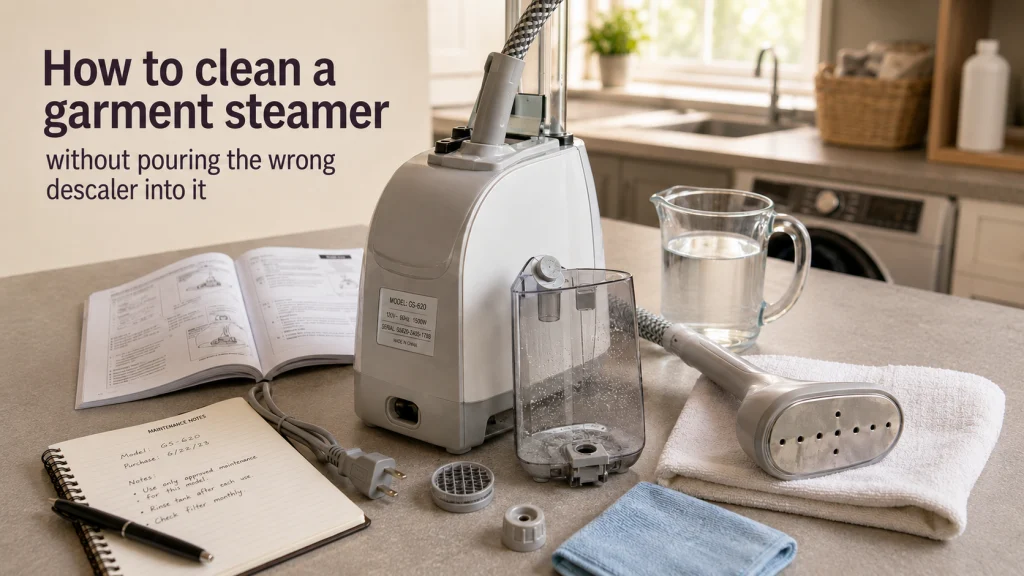
Cleaning a garment steamer safely starts with the exact model, not a generic vinegar or descaling recipe. Some steamers use a rinse or anti-calc function, some permit a specific descaling method, and others prohibit additives in the water system. Routine tank and exterior cleaning should stay separate from model-specific scale management. The goal is to clean what the owner is meant to access, then stop when the symptom points to troubleshooting or service instead.
The wrong descaling recipe can create the problem you were trying to solve
If you are searching for how to clean a garment steamer, generic advice often jumps straight to vinegar. That shortcut ignores differences in water paths, scale controls, tank designs, and owner-accessible parts. Philips tells owners of covered models not to put vinegar or descaling agents into the appliance, while Rowenta documents a vinegar procedure for one specific upright model. The useful lesson is simple: the exact manual decides the method, not the ingredient that appears most often online.
If the real question is how to descale a garment steamer, start by separating routine cleaning from an actual scale-removal procedure. A dirty removable tank, weak steam, brown droplets, and a blocked-looking steam head are different observations, even when they appear together. This article stays at owner level and does not cover opening housings, exposing wiring, or forcing cleaners through inaccessible passages. If the steamer only needs normal operating help, use the separate article on how to use a garment steamer. Cleaning rules can differ just as sharply across garment care products, so the exact maintenance procedure should stay tied to the model.
Find the exact model number and maintenance section before adding anything
The brand name on the front is not enough because one manufacturer can use several maintenance systems across its steamers. Find the model or reference number on the rating label, packaging, order record, or official support page. Match that identifier to the correct manual before deciding whether the appliance needs rinsing, draining, anti-calc care, filter care, or a true descaling procedure. If you cannot confirm the model, limit yourself to conservative exterior and removable-part cleaning until you can verify the correct manufacturer documentation.
| Decision point | If yes | If no |
|---|---|---|
| Can you confirm the exact model or reference number? | Open the matching official manual or support page and continue to the maintenance instructions. | Stop before putting any cleaner or descaler into the water system. Limit care to conservative exterior and removable-part cleaning that does not depend on a model-specific chemical procedure. |
| Does the documentation name a rinse, anti-calc, drain, self-clean, filter-care, or descaling procedure? | Follow that named procedure exactly, including the listed opening, removable part, liquid, and sequence. | Do not invent a chemical descale. Continue only with routine cleaning the manual clearly permits. |
| Does the procedure explicitly permit a liquid other than the model’s normal water? | Use only the named treatment, concentration, and route stated for that exact model. | Keep vinegar, citric acid, fragrance, essential oils, starch, and generic descalers out of the water path. |
| Is the residue or symptom reachable through an owner-accessible tank, drain, filter, cap, or other listed maintenance point? | Complete the documented owner-maintenance step, reassemble the steamer correctly, and judge the result before repeating anything. | Stop at the service boundary rather than opening the housing or forcing liquid into an inaccessible passage. |
That sequence creates a real model-first decision path: identify the product, confirm the maintenance system, check what liquid is permitted, then stop if the next step is outside owner access. Similar-looking steamers can differ in water recommendations, scale controls, and which openings the owner is supposed to use. The same caution applies to water choice, especially when hard water is part of the problem. Check what water to use in a garment steamer when recurring scale may be linked to the water itself.
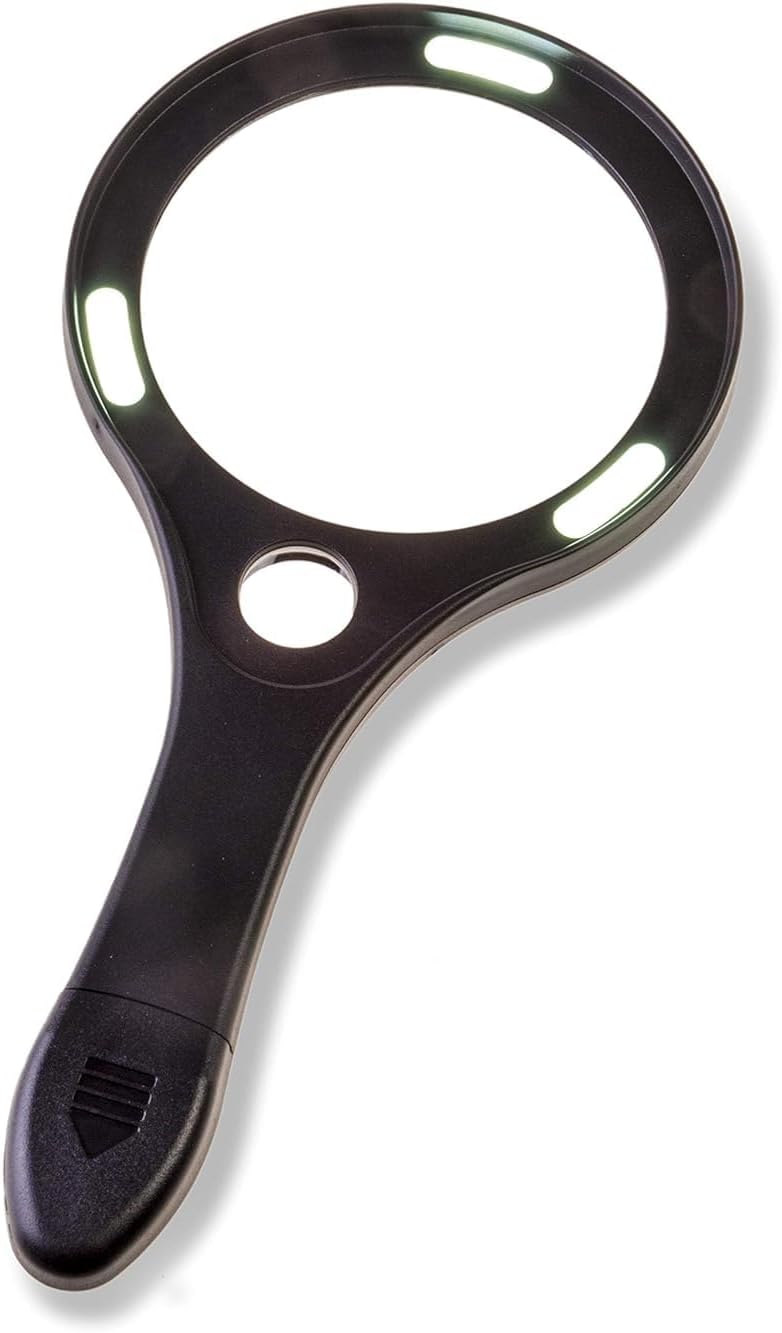
The Carson Lume AS-90 uses a 2.5x aspheric lens with a 7x spot lens for reading small labels and fine print. Three COB LEDs provide two brightness settings for closer inspection. Its handheld format makes it useful for checking a steamer rating label or model marking before matching maintenance instructions.
Check On AmazonIf you click this link and buy, we earn a commission at no additional cost to you.
Power off, unplug, and let the steamer cool before owner maintenance
A garment steamer combines electricity, heated surfaces, hot water, and steam, so maintenance starts by removing power and heat from the situation. Turn it off, unplug it, and place it where draining water cannot reach the plug, cord connection, or powered housing. Follow the model’s cooling instruction before removing parts or wiping near a heated steam head. A merely warm exterior does not prove that internal water or heated metal parts are fully safe to handle.
Do not turn cleaning into disassembly because you suspect scale deeper inside. If reaching the residue requires opening the housing, exposing wiring, defeating a lock, or accessing a part not listed for owner care, stop. Damaged cords, exposed electrical areas, smoke, burning odor, uncontrolled heating, or water leaking into powered sections belong with manufacturer support or qualified service. The safe maintenance boundary is whatever the exact manual identifies as removable, drainable, wipeable, or owner-serviceable.

This Dritz rest is made from heat-resistant silicone to provide a protective resting surface for a hot iron or heated tool. Raised dots help separate the hot surface from the rest and aid cooling. It can serve as a heat-resistant landing area beside the unplugged steamer while you wait for the manufacturer-specified cooling period.
Check On AmazonIf you click this link and buy, we earn a commission at no additional cost to you.
Empty or drain residual water according to the model
Residual water can remain in a removable reservoir, a base, or another section of the water path, depending on the design. Use the emptying or drain route the manual describes instead of turning the whole appliance upside down by default. A removable tank may simply lift out, while an upright model may use a dedicated drain or anti-calc opening. Pouring from an undocumented opening can send water into areas that were never designed to get wet.
- Use only the documented tank, drain, rinse, or anti-calc opening.
- Keep drained water away from plugs, switches, seams, and cord connections.
- Inspect owner-accessible caps, valves, and seals for loose residue or obvious damage.
- Stop if draining reveals leaking into the housing or residue you cannot safely reach.
While the tank is empty, look for sediment, mineral film, staining, trapped lint, or residue that can be reached without tools. If the manual permits rinsing, use that method and make sure the valve or cap seats normally afterward. Emptying is still routine care and does not automatically mean the appliance needs a chemical descale. Use what you observe here to decide whether the next step is simple cleaning, a documented scale-control procedure, or troubleshooting.

The Rubbermaid Commercial standard bus and utility box is a sturdy plastic tub for collecting dishes, organizing supplies, transporting lightweight kitchen items, and consolidating cleanup tasks. The open-top rectangular design makes the contents easy to access, while integrated handholds simplify carrying between work areas. It can be useful in restaurants, break rooms, workshops, and household utility storage. Rounded interior corners make routine cleaning easier than in containers with many narrow crevices. This listing is for a standard individual bus box rather than the original two-pack, so order the required quantity separately and confirm the dimensions.
Check On AmazonIf you click this link and buy, we earn a commission at no additional cost to you.
Clean removable tanks only by the methods and cleaners the manual permits
A removable reservoir looks simple, but its cap, valve, gasket, sensor interface, and plastic can still be part of the steamer’s water-control system. If the manual permits a water rinse, rinse it as directed and use a soft cloth only where you can reach without damaging seals or valves. If the instructions restrict detergents, acids, abrasives, or other cleaners, keep those products out. A cleaner that works on a sink or glass pitcher is not automatically suitable for a steamer tank.
Visible scale on the tank wall also does not prove that the same treatment belongs inside the heater, pump, hose, or steam chamber. A removable reservoir may be easy to rinse completely, while an internal path may not be designed for owner flushing at all. That is why cleaning the steamer and descaling the steamer are related but different jobs. Clean the part you can verify, and do not use visible mineral film as permission to send an undocumented chemical deeper into the appliance.

These 12 x 12-inch microfiber cloths are soft, non-abrasive, reusable, and washable. The microfiber material absorbs liquid and is designed for lint-free, streak-free wiping. For a removable steamer tank, use a cloth only on surfaces the manual permits and pair it only with water or a cleaner specifically approved for that model.
Check On AmazonIf you click this link and buy, we earn a commission at no additional cost to you.
Wipe the exterior and steam head without immersing powered components
Once the unit is unplugged and cooled as directed, clean accessible exterior surfaces using the cloth and moisture level the manufacturer allows. Pay attention to lint, dried droplets, residue around the steam head, and grime where a removable tank seats into the body. Do not submerge the powered unit, rinse it under running water, or let liquid enter switches, vents, cord openings, or electrical seams unless the instructions explicitly permit it. Keeping water in the intended water system is more important than making the housing look freshly washed.
A metal steam face or heated soleplate can collect residue, but aggressive scrubbing can create a second problem. Abrasive pads, sharp tools, and undocumented cleaners may scratch coatings or push debris into steam openings. Clean the accessible surface as instructed, then inspect the openings rather than poking into them. If a passage looks blocked and the manual gives no owner-cleaning method for it, treat that as a troubleshooting or support issue.

This 12-pack includes reusable 11.5 x 11.5-inch microfiber cloths designed to be lint-free, scratch-safe, and absorbent. They can clean delicate household surfaces with water or another suitable cleaner. On a garment steamer, use one only on cooled exterior surfaces and only with the moisture or cleaner level allowed by the manufacturer.
Check On AmazonIf you click this link and buy, we earn a commission at no additional cost to you.
Separate routine rinsing from actual descaling or anti-calc functions
Routine care removes residual water, loose debris, lint, and accessible surface residue. Descaling is different because it targets mineral buildup in a path or chamber the manufacturer expects to accumulate scale. Some steamers provide a drain or rinse procedure, others use a dedicated anti-calc function, and some do not call for a traditional descaling cycle. Use the maintenance term in the exact manual instead of treating every scale-related search result as the same procedure for every appliance and water path.
| Maintenance type | Typical purpose | Evidence needed first |
|---|---|---|
| Emptying or draining | Remove residual water | Documented tank or drain path |
| Tank rinsing | Remove loose reservoir residue | Manual-approved rinse method |
| Exterior or head cleaning | Remove accessible lint or grime | Approved surface-cleaning method |
| Anti-calc or descaling | Manage mineral buildup in a designated path | Exact model procedure and permitted liquid |
This matrix prevents both under-cleaning and over-cleaning. Wiping a tank may not address scale in a manufacturer-designated anti-calc path, but adding acid to a water-only system can create unnecessary residue or damage. First identify the maintenance type, then follow the procedure written for that component. If the documentation never tells the owner to begin a chemical descale, do not invent one from a generic household cleaning recipe found elsewhere online.
Use hard water and symptoms as reasons to check guidance, not as permission for a homemade acid recipe
Hard water can increase scale buildup, so it is useful evidence when weak steam, leaking, or mineral residue appears. It still does not tell you which cleaning liquid is safe for the appliance. Philips notes faster scale buildup with hard water on covered models while also warning against vinegar and descaling agents in those products. The presence of scale creates a reason to check the exact model maintenance instructions, not a blank check for household acids.
Symptoms need the same restraint because weak steam or dripping can have more than one cause. Check the documented basics, including water level, tank seating, and any model-specific operating or maintenance indicator, before blaming scale. If approved cleaning does not improve the problem, move to garment steamer troubleshooting instead of repeating a stronger treatment. A maintenance symptom that survives the correct maintenance procedure may be a fault, not a request for more aggressive cleaning chemistry.

The Varify kit uses dip-and-read strips with an oversized color chart to show water hardness. The chart covers 0 to 25 GPG and 0 to 425 PPM, giving a quick reading without sending a sample away. That makes it useful for confirming whether hard water is a real factor before you revisit the steamer model's own water and maintenance guidance.
Check On AmazonIf you click this link and buy, we earn a commission at no additional cost to you.
Do not assume vinegar, fragrance, starch, essential oils, or generic descalers are steamer-safe
The clearest reason to reject universal additive advice is that official manufacturer instructions disagree across models. Philips support for covered steamers prohibits perfumed water, vinegar, starch, descaling agents, ironing aids, chemically descaled water, and other chemicals. Rowenta support for the IS9530Q1, by contrast, includes a specific white-vinegar descaling procedure for that exact model. The correct conclusion is model-specific permission, not a universal yes or no that can be transferred to every garment steamer.
| Additive or cleaner | Safe universal assumption? | What to verify |
|---|---|---|
| Vinegar | No | Exact model descaling instructions |
| Citric acid | No | Explicit manufacturer permission |
| Generic descaler | No | Approved product type and procedure |
| Perfume or essential oil | No | Water-additive restrictions |
| Starch or ironing aid | No | Whether the water system permits it |
Fragrance and garment treatments are especially easy to rationalize because they can seem harmless in small amounts. A heated water path is not a general-purpose diffuser, and residue from oils or treatments may later appear as spitting, staining, or odor. If the manual names an additive and gives a procedure, that permission belongs to that model and process. If it prohibits the additive or says nothing about it, keep the substance out of the reservoir and internal water path.
Follow the exact anti-calc, rinsing, or descaling cycle when one is provided
When the manual gives a maintenance cycle, follow that sequence instead of combining it with a second recipe from another appliance. Use only the openings, removable parts, liquid type, fill level, controls, drain points, and rinse steps the manufacturer identifies. Details such as an anti-calc cap, self-clean control, rinse mode, or tank position are part of the product design. Do not add extra acid, extend a soak, or repeat the process more aggressively unless the instructions call for it.
Manufacturer differences can be substantial even within one product category. Some Philips steamer families use calc-release or rinse procedures that specifically reject added vinegar, while the Rowenta IS9530Q1 has a documented vinegar method. Another Rowenta garment-care design focuses routine care on emptying its tank and cleaning a filter rather than using the same traditional descaling path. Never borrow the cleaner from one model, the fill instruction from another, and the rinse sequence from a third.

Norpro's clear 2-cup measuring cup has both U.S. and metric markings, a sturdy handle, and a pour spout. Its graduated format makes small liquid volumes easier to measure consistently. Use it only to measure the liquid and fill amount named in the exact steamer maintenance procedure, not to introduce an unapproved descaler.
Check On AmazonIf you click this link and buy, we earn a commission at no additional cost to you.
Dry tanks and parts, then store the steamer only as the manual instructs
Cleaning is not finished when the last rinse water leaves the reservoir. Dry or drain owner-removable parts as the manufacturer permits, make sure valves and caps are free of trapped debris, and reassemble only when everything seats normally. Do not force a gasket, filter, cap, or tank that no longer fits correctly after cleaning. A poor seal can create leaks later and make a simple reassembly problem look like another scale problem.
Storage affects what you see at the next use, so keep the appliance in the orientation and condition the manual permits. Protect the cord and hose from sharp bends, hot surfaces, and positions that trap moisture around powered areas. If the same sediment or residue keeps returning, revisit water guidance and the model’s own maintenance indicator or instruction. Do not create a universal descaling calendar when water hardness, use frequency, and product design can materially change the need.

These Command Cord Bundlers are designed to organize cables and cords and can be opened and closed for repeated access. The selected pack includes two bundlers and three adhesive strips, with each bundler rated to hold up to 2 pounds. They can help keep a stored steamer cord controlled after the appliance is cool, dry, and put away in the orientation its manual allows.
Check On AmazonIf you click this link and buy, we earn a commission at no additional cost to you.
If weak steam, dripping, or stains remain, move from maintenance to fault diagnosis
Cleaning has a stopping point. If the correct water is being used, the tank is seated properly, approved maintenance is complete, and the steamer still produces weak steam, persistent dripping, or brown staining, ordinary scale may not be the whole problem. Repeating a rinse or adding a stronger cleaner can hide that distinction and introduce new residue. Move to symptom-based troubleshooting and compare the behavior with the exact manual’s fault guidance.
For weak steam, note whether the unit heats, whether water feeds normally, and whether the behavior changed after maintenance. For dripping or stains, note whether the issue began before or after a cleaner or additive entered the tank. Those observations are more useful than escalating chemical strength because they separate an ownership issue from a likely fault. If you are still deciding which steamer design creates the most manageable maintenance burden, the garment steamer buying guide keeps that buying decision separate from repair.
Stop and seek support for damaged cords, abnormal heat or smell, inaccessible leaks, or chemical damage
Some signs move the problem beyond routine care immediately. A damaged cord or plug, smoke, sparks, burning odor, abnormal overheating, exposed wiring, uncontrolled operation, or water reaching electrical areas should end the cleaning attempt. Do not plug the steamer back in merely to see whether drying fixed it. Use the manufacturer’s documented support path or qualified service for the exact product instead.
- Stop for damaged cords, plugs, switches, or exposed electrical parts.
- Stop for smoke, burning odor, abnormal heat, sparks, or uncontrolled operation.
- Stop for leaks that reach the powered housing or come from inaccessible areas.
- Stop if chemical use is followed by new residue, odor, spitting, or damage.
- Stop when the manual reserves the suspected work for service personnel.
Chemical damage deserves the same caution because adding a second substance may make the original problem harder to identify. If an undocumented chemical is followed by burnt smells, brown residue, or continuing weak steam, treat the new behavior as evidence to stop experimenting. If an undocumented cleaner has already been used, tell support exactly what entered the tank and what changed afterward rather than trying to neutralize it with another product. The goal is to stop experimentation before a cleaning mistake becomes a larger electrical or material problem.
Build a maintenance record around manufacturer indicators and instructions
A universal descaling calendar sounds convenient, but it ignores the variables that actually drive maintenance. Water hardness, steaming frequency, tank design, heating path, anti-calc features, and the intended water type can all change what the appliance needs. Record the exact model, water type, maintenance action, visible symptom, and what changed afterward. That small history makes recurring problems easier to interpret without pretending every steamer should be cleaned on the same schedule.
| Record | Why it matters |
|---|---|
| Exact model or reference | Keeps future maintenance matched to the right documentation |
| Water type | Connects recurring scale with the model’s water guidance |
| Maintenance action | Prevents accidental mixing or repetition of procedures |
| Observed symptom | Shows whether maintenance changed the problem |
| Manufacturer indicator or instruction | Replaces a made-up calendar with model-specific evidence |
If weak steam keeps returning despite correct water and approved maintenance, that pattern supports troubleshooting or service instead of ever-more-frequent cleaning. If the tank stays clean and the manual does not call for a chemical descale, there is no benefit in inventing one. The record preserves which method was used on which model and why, which is exactly what generic cleaning advice usually loses. It also gives manufacturer support a clearer starting point if owner maintenance stops solving the problem.

This equipment maintenance log book provides fields for date and time, maintenance or remarks, who performed the work, signature, cost, and extra notes. It also includes an index and uses an 8.5 x 11-inch page size. Those fields fit a steamer record that tracks model, water choice, maintenance action, symptoms, and what changed afterward.
Check On AmazonIf you click this link and buy, we earn a commission at no additional cost to you.
Final Thoughts: the safest descaler is the one the exact steamer manufacturer actually allows
The safest way to clean a garment steamer is to separate ordinary owner care from model-specific scale treatment. Empty and clean the parts the manual identifies, keep powered components out of the sink, and treat weak steam or staining as reasons to check documentation rather than invent a stronger recipe. Official instructions prove why this matters because one steamer can prohibit vinegar while another can prescribe it in a specific procedure. If the exact manual does not authorize a chemical or internal cleaning step, do not turn generic advice into permission.
After approved maintenance, judge the result instead of repeating the process automatically. If normal steam returns and no leak, stain, or odor remains, the maintenance path did its job. If the problem persists, or if there is cord damage, abnormal heat, burning smell, electrical leakage, or suspected chemical damage, stop at the owner-service boundary. A clean steamer is useful, but a correctly maintained steamer is the real goal.
Frequently asked questions
🧴 Can I use vinegar to clean a garment steamer?
Only if the exact model instructions explicitly allow it and give a procedure. Some official steamer instructions prohibit vinegar, while other model-specific instructions permit it for descaling.
💧 How do I remove limescale from a garment steamer?
Identify the exact model and use its documented rinse, anti-calc, drain, self-clean, or descaling method. Do not substitute a homemade acid recipe when the manual specifies a different process or no chemical process at all.
🟤 Why is brown water coming out of my steamer?
Mineral buildup or unapproved additives can contribute to brown staining or spitting, but the cause is model-dependent. Stop using the steamer on clothing, check the water and maintenance guidance, and move to troubleshooting if approved cleaning does not solve it.
🌸 Can I put perfume or essential oils in a clothes steamer?
Do not assume so. Many steamers are designed for water only, and additives can leave residue, cause spitting, or damage the appliance unless the manufacturer expressly permits them.
🧼 How often should I descale a garment steamer?
Use the exact model’s maintenance indicator or manufacturer instruction rather than one universal calendar. Water hardness, use frequency, and the steamer’s scale-control design can all change the need.
🔌 When should I stop cleaning and contact support?
Stop for damaged cords, sparks, smoke, burning odor, abnormal overheating, exposed wiring, water in electrical areas, inaccessible leaks, or new abnormal behavior after chemical use. Also stop when the manual reserves the suspected work for service personnel.
References and Sources
- Philips water guidance: Verifies water guidance and the additive restrictions used in this article.
- Philips steamer cleaning guidance: Shows model-family differences in calc-release, rinse, and automatic scale-management methods.
- Rowenta IS9530Q1 support: Verifies a model-specific vinegar descaling method and relevant maintenance and safety guidance.
- Rowenta AeroSteam care: Supports the distinction between routine tank and filter care and traditional descaling.