The right water for a garment steamer depends on the exact model, not on a universal rule about tap, distilled, or purified water. Some manufacturers approve untreated tap water, some specify a hard-water mixture, and some recommend purified water to reduce scale. The practical move is to identify the steamer, read its water instruction, and keep fill-water choices separate from descaling or cleaning procedures. That approach protects the appliance without turning one brand’s rule into advice for every steamer.
Check the exact model before choosing the water
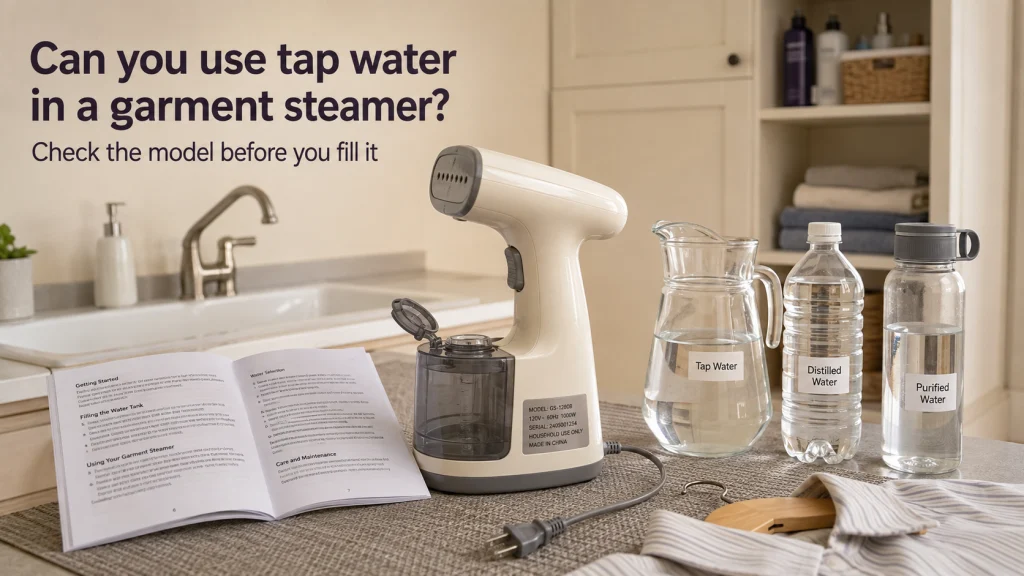
Can you use tap water in a garment steamer? Sometimes, but the answer can change from one steamer to another, which is why the model number should come before any household shortcut. Philips support says the covered STH3000/20 steamer is designed for tap water, while Xiaomi tells owners of its Handheld Garment Steamer to add purified water. Tefal’s Origin Travel DT1034G0 guidance also permits untreated tap water but adds a specific hard-water instruction. Those differences are enough to make a blanket “always use distilled” or “tap is always fine” rule unreliable.
Start by finding the model number on the appliance label, packaging, manual, or manufacturer support page, then match the water instruction to that exact product. If the manual is missing, use the manufacturer’s support system rather than assuming that another steamer from the same brand has identical requirements. This is the same model-first habit that matters when following a broader garment steamer operating routine. Once the approved water type is known, normal filling and use become much simpler because you are no longer guessing at the compatibility rule. Water choice is one of the maintenance details that can differ across garment care products, so model-specific instructions should outrank a household rule of thumb.
| Documented example | Water instruction | What not to generalize |
|---|---|---|
| Philips STH3000/20 support guidance | Designed for tap water; hard water can increase scale, and distilled or demineralized water may be used under the stated guidance. | Do not assume every steamer requires pure distilled water. |
| Tefal Origin Travel DT1034G0 | Untreated tap water is allowed; very hard water calls for the stated 50/50 tap and distilled mixture. | Do not apply that ratio to a model whose manual gives a different rule. |
| Xiaomi Handheld Garment Steamer | Purified water is recommended to reduce scale buildup and white powder. | Do not replace a model-specific purified-water recommendation with generic tap-water advice. |
The comparison is useful because the products are not agreeing on one universal garment steamer water type. What they do agree on is that water choice belongs to the appliance’s design and maintenance instructions, not to a generic cleaning hack. A new owner should therefore treat the exact manual as the controlling evidence when it differs from broad web advice. That keeps the decision narrow, practical, and tied to the equipment actually sitting on the counter.

This 1875-watt handheld steamer heats in about 40 seconds and uses a 7.3-ounce water tank. Amazon lists up to 20 minutes of continuous steam and five steam settings. It includes a silicone band, delicate-fabric spacer, and bristle brush for different garment-care tasks.
Check On AmazonIf you click this link and buy, we earn a commission at no additional cost to you.
Water hardness changes scale risk, not the need to read the manual
Hard water contains more dissolved minerals that can remain behind as water is heated and converted to steam. Manufacturers commonly connect harder water with faster mineral buildup, reduced steam performance, white residue, or a greater cleaning burden. That explains why a model may allow ordinary tap water in one home yet give a different instruction for a hard-water area. It does not create a universal hardness cutoff that can safely replace the model’s own directions.
If your steamer’s instructions mention hard water, use the wording and remedy they actually provide rather than inventing a threshold from another appliance. A household water report or hardness test can help you understand your supply, but it still does not tell you which water the steamer’s internal design expects. The important distinction is between identifying a condition and choosing the manufacturer’s approved response to that condition. If water hardness is creating a maintenance issue, the next step belongs with the steamer’s cleaning procedure, not with an improvised fill-tank chemistry experiment.

This kit contains 150 strips for checking water hardness from sources including household faucets and taps. The test uses a simple dip-and-compare process with a color chart. It is designed to identify water hardness, which can help a household understand its supply before following the steamer manual's model-specific hard-water instructions.
Check On AmazonIf you click this link and buy, we earn a commission at no additional cost to you.
When tap water is permitted, understand what that permission means
A manual that permits tap water is telling you the steamer was designed to operate with that water under the stated conditions. Philips says its covered steamer can use tap water, and Hamilton Beach also says tap water is recommended for its garment steamers while giving a separate hard-water adjustment. That is stronger evidence than a generic claim that minerals automatically make tap water unsuitable for every steamer. Permission still has limits because the same documentation may set different instructions when local water is hard or when deposits begin affecting performance.
Tap-water approval also does not mean every water-based liquid is acceptable in the reservoir. Scented water, softened water, water collected from another appliance, or a bottle labeled “purified” can each fall under different manufacturer rules. If your model approves tap water, use clean water from the source described in its instructions and follow the normal emptying or maintenance routine it specifies. For readers still deciding which steamer format fits their routine, the broader garment steamer buying guide covers ownership factors beyond the water question.
Use a hard-water mixture only when the manufacturer specifies it
Some steamer instructions solve hard-water concerns with a defined mixture rather than with pure distilled water. Tefal tells owners of the Origin Travel DT1034G0 to mix 50 percent untreated tap water with 50 percent distilled water when the local water is very hard. Hamilton Beach gives a similar 50/50 distilled-and-tap instruction for hard-water areas in its garment steamer FAQ. Those examples show that a mixture can be a legitimate model or brand instruction, but they do not turn 50/50 into a category-wide formula.
Follow the exact ratio only when it appears in the documentation that applies to your machine. Do not strengthen the mix because the water seems especially hard, and do not switch to pure distilled water merely because half distilled sounds like it should be improved by using more. Internal design can differ between steam appliances that look similar from the outside. The safest interpretation is narrow: a stated mixture belongs to the steamer for which it was documented.
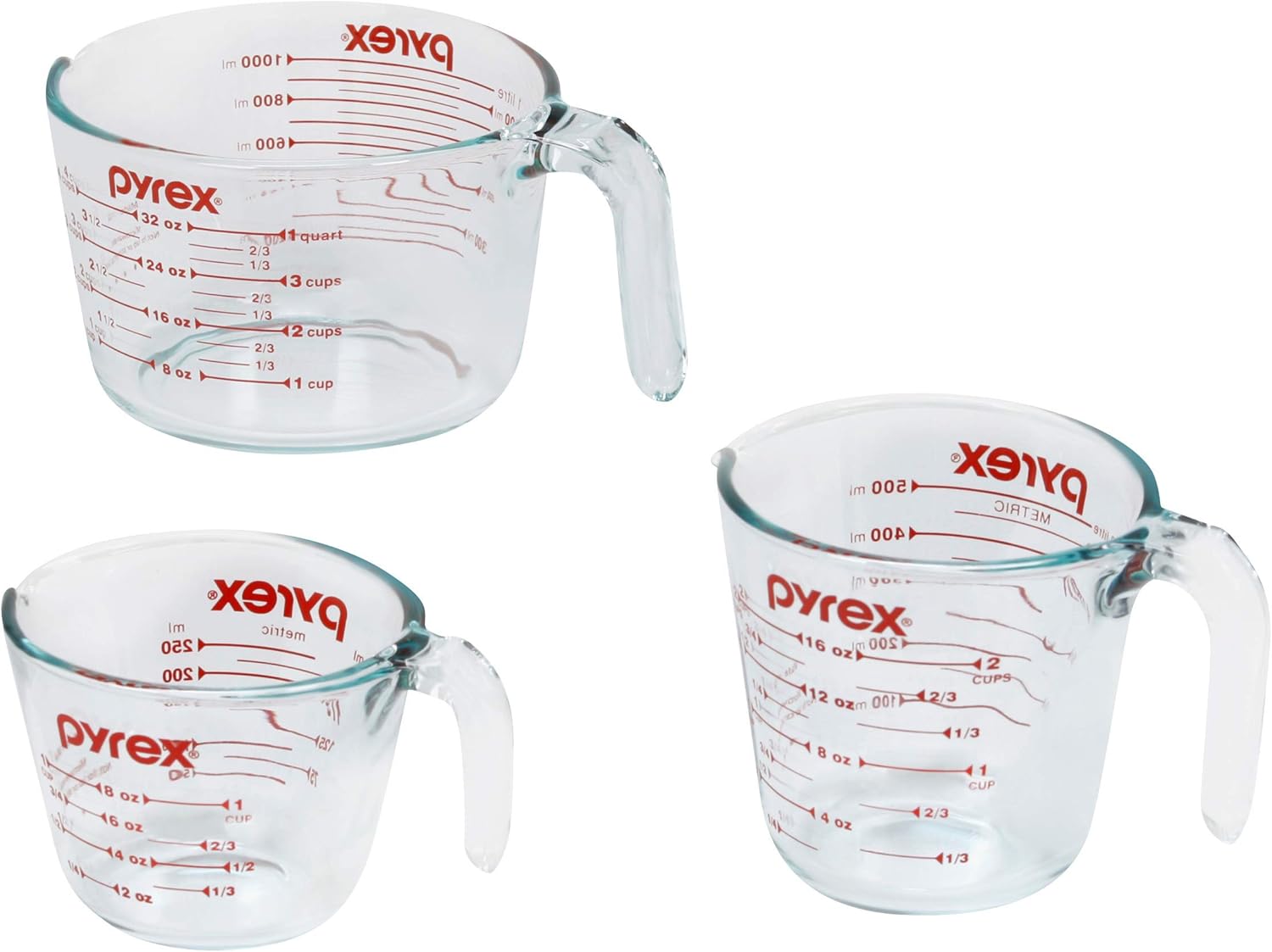
This clear glass set includes 1-cup, 2-cup, and 4-cup measuring cups. Large markings show both ounces and milliliters, while curved spouts and easy-grip handles support controlled pouring. The tempered-glass cups are dishwasher, freezer, microwave, and preheated-oven safe.
Check On AmazonIf you click this link and buy, we earn a commission at no additional cost to you.
When purified water is recommended, keep the rule model-specific
Xiaomi’s Handheld Garment Steamer support page tells owners to add purified water and connects that recommendation with reducing scale buildup and white powder. That is a clear example of why the question of what water to use in a garment steamer cannot be answered from the appliance category alone. A household following Xiaomi’s published instruction would make a different refill choice from one following Tefal’s untreated-tap-water instruction. Neither rule should be exported to the other product without evidence that the manufacturer permits it.
The word “purified” also deserves careful reading because product labels and local water products can use broad marketing language. The steamer manual may not define every retail water category, so avoid treating any bottle with a clean-looking label as automatically compatible. Use the specific term in the manufacturer’s instructions and contact support if the available water product does not clearly match that term. This keeps a simple refill decision from turning into guesswork about filtration methods that the steamer documentation never addressed.
Pure distilled or demineralized water is not automatically the safest choice
Putting distilled water in a garment steamer can sound like the conservative choice because it contains fewer minerals that can form scale. The problem is that some manufacturers do not present pure distilled or pure demineralized water as their default fill rule. Tefal’s published guidance for the Origin Travel model starts with untreated tap water and uses distilled water as part of a specified hard-water mixture. Hamilton Beach goes further by saying tap water is recommended because its minerals help “season” internal parts, then gives a mixed-water instruction for hard-water areas.
The lesson is not that distilled water is bad, but that purity alone does not prove compatibility with every steam system. Philips documentation allows distilled or demineralized water under its stated guidance, while another manufacturer may direct the owner toward tap or purified water instead. When a manual names a specific water type, use that instruction rather than upgrading it according to a general idea of cleaner water. Steam irons can have different water and anti-calc systems, so use the separate steam iron water guidance for that device class instead of transferring a steamer rule.
Do not assume bottled, softened, filtered, or collected water is safer
Alternative water sources create one of the easiest mistakes because they can look cleaner than ordinary tap water. Tefal’s Origin Travel guidance specifically lists several water types not to use, including scented or softened water, rainwater, and boiled, filtered, or bottled water. Philips also warns against water from a tumble dryer and several chemically altered or additive-containing liquids. A bottle, filter pitcher, or collected condensate therefore needs model-specific approval rather than a visual judgment about clarity.
The same rule applies to water from refrigerators, air conditioners, dryers, or other household equipment. These sources can contain minerals, residues, or contaminants that the steamer manufacturer did not design the fill system around. If the approved water is unavailable, the better move is to check the manual or manufacturer support rather than substitute whichever alternative happens to be nearby. That is less convenient than a universal list, but it is also less likely to create scale, staining, spitting, or damage that the documentation explicitly warns about.
- Match the water term to the exact manual rather than to a generic idea of purity.
- Do not treat bottled water and purified water as interchangeable unless the manufacturer does.
- Do not use collected condensate, rainwater, or softened water merely because it appears clear.
- When the wording is ambiguous, ask the manufacturer instead of inventing a substitute.
This check matters most when a household has several convenient water sources and assumes the most processed one must be the best. A steamer is not evaluating water by taste or appearance; it is operating with whatever mineral and chemical profile reaches its heated water path. The manual is where the manufacturer tells you which profile it expects or prohibits. Keep that evidence ahead of convenience when choosing the refill source.
Keep perfume, starch, oils, vinegar, and descaler out of the fill tank unless instructed
Water choice and fragrance are separate decisions, even when a scented tank sounds like an easy way to freshen clothing. Philips warns against perfumed water, vinegar, starch, descaling agents, ironing aids, and other chemicals in the covered steamer system. Tefal likewise says not to add descaling chemicals or additives to the water tank, and Xiaomi tells owners not to add detergent, perfume, starch, or other chemicals. Hamilton Beach also says its garment steamers are designed to be used with water only and warns against chemicals such as starch, descalers, or fragrance in the reservoir.
The practical reason is simple: a liquid that is useful during a manufacturer-approved cleaning process is not automatically suitable as normal fill water. Heating additives can contribute to spitting, brown staining, residue, premature wear, or other behavior the manufacturer is trying to prevent. Do not turn a descaling recipe into everyday tank water, and do not use essential oils as a substitute for a fragrance feature that the steamer does not have. If scent is the goal, keep it outside the reservoir and follow garment-care instructions instead of modifying the steamer’s water system.
Warning: Use only the liquids the exact steamer manual approves for normal filling. Do not add perfume, essential oil, starch, fabric softener, vinegar, descaler, detergent, or another chemical to the reservoir unless the manufacturer explicitly instructs that product and procedure for your model.
This boundary is especially important because cleaning instructions can look similar to fill instructions when both involve the same reservoir. Hamilton Beach, for example, publishes a vinegar-and-water cleaning procedure while separately saying the steamer should use water only during normal operation. The reservoir may be the same physical part, but the purpose, sequence, and follow-up steps are different. Treat each procedure as its own instruction instead of carrying one liquid from maintenance into everyday steaming.

This pack contains 24 reusable microfiber cleaning cloths measuring 16 by 12 inches. Amazon describes them as ultra-soft, non-abrasive, absorbent, and suitable for cleaning dry or with liquid cleaners. The cloths are machine washable for repeated household cleaning use.
Check On AmazonIf you click this link and buy, we earn a commission at no additional cost to you.
Treat spitting, staining, and rapid scale as symptoms, not invitations to improvise
Spitting water, brown marks, white powder, or declining steam output can point toward deposits, unsuitable additives, incomplete heating, installation problems, or another model-specific issue. Tefal links additives and descaling chemicals in the tank with spitting and brown staining, while Xiaomi connects scale with white powder and gives separate troubleshooting for water spray. Hamilton Beach also notes that deposits can block internal pathways and reduce steam output. Those symptoms justify checking the water rule and maintenance instructions, but they do not prove that one homemade chemical treatment is appropriate.
Start with the simplest documented checks: correct water, correct tank installation, adequate fill level, normal preheating, and the manufacturer’s cleaning procedure. If the steamer still has weak steam, persistent leakage, abnormal heating, smoke, a burning odor, or another serious fault, stop using it and follow the service guidance for that model. The garment steamer troubleshooting article covers those operating symptoms without turning this water-selection page into a repair manual. Keeping the scopes separate also prevents a refill question from drifting into unsafe internal repair.
Keep normal fill water separate from descaling and cleaning
Normal fill water is the liquid the steamer is designed to heat while you are using it on garments. Descaling or cleaning is a maintenance procedure with its own ingredients, sequence, rinsing steps, and frequency, and those details can differ by manufacturer. Confusing the two is how vinegar or another cleaner can migrate from a legitimate maintenance instruction into the tank during ordinary use. The safer rule is to follow the fill-water section for steaming and the cleaning section only when performing the documented maintenance procedure.
That separation also makes ownership easier because you do not need to solve every mineral question at every refill. Use the approved water, empty or dry the tank as instructed, and perform maintenance when the manual or performance condition calls for it. If you need the maintenance steps rather than the refill rule, use the separate garment steamer cleaning instructions. This page stops at water compatibility because descaling chemistry should come from the exact appliance documentation, not from a universal household recipe.
The distinction is easy to overlook because the reservoir is involved in both jobs. What changes is the purpose and the manufacturer’s required sequence, including whether the system must be rinsed afterward. A cleaning procedure can be safe only because it is temporary and followed by specific flushing steps. Normal steaming does not automatically include those safeguards, so the two instructions should never be merged.
Use a model-first water check before every refill
A refill decision should take less than a minute once the steamer’s rule is known. Keep the manual or support page bookmarked, especially if several people in the household use the appliance or if the steamer is only used occasionally. The check is not about memorizing which water is supposedly best for all steamers. It is about making sure the water in your hand matches the instruction for the steamer in front of you.
If the water source or household changes, repeat the check instead of carrying the old assumption forward. A move to a harder-water area, a switch from tap to softened water, or a replacement steamer can all change what the correct refill choice is. This is also a useful ownership question when comparing steamers because a special water requirement can add a small recurring chore even when the appliance itself is easy to use. The goal is not to make water complicated, but to keep one avoidable compatibility mistake from becoming a maintenance problem.
- Start with the exact model instruction.
- If it says untreated tap water is permitted, use tap water under the stated conditions.
- If it changes the rule for hard water, follow the exact alternative or mixture the manufacturer gives.
- If it recommends purified water, use the water type named for that model rather than substituting a generic rule.
- If it permits distilled or demineralized water, follow any limits or mixing instructions that come with that permission.
- If the available water source is not clearly covered, stop and verify with the manufacturer instead of guessing.
- Then screen the water you are about to pour.
- If the manual prohibits softened, bottled, filtered, collected, scented, or other alternative water, do not use it.
- If the water contains perfume, starch, fabric softener, vinegar, descaler, detergent, essential oil, or another additive, do not treat it as normal fill water unless the exact manual explicitly instructs that use.
- Finally, separate refill choice from a performance problem.
- If the steamer works normally, keep using the approved fill water and follow routine tank care.
- If it spits, stains, leaks, produces weak steam, or builds scale quickly, move to the model’s cleaning or troubleshooting instructions rather than changing the tank chemistry on your own.
That sequence replaces a universal water recommendation with a repeatable compatibility check. It works whether the manual approves tap water, calls for a mixture, or recommends purified water because the decision starts from the same evidence. It also keeps water selection connected to real ownership work such as scale prevention, tank care, and troubleshooting. Once the rule is verified, there is no benefit in re-litigating the distilled-versus-tap debate at every refill.
Final Thoughts: the correct water is the water your steamer was designed to use
There is no single water type that can be declared safest for every garment steamer. Philips, Tefal, Xiaomi, and Hamilton Beach publish materially different instructions, which is exactly why the model number matters more than a generic household rule. Use tap, purified, distilled, demineralized, or a mixture only when the documentation that applies to your steamer supports that choice. That keeps the advice inside the evidence instead of treating a water preference as a universal appliance fact.
For day-to-day ownership, the routine is straightforward: identify the model, follow its fill-water instruction, keep prohibited additives out, and move scale or spitting problems into the correct maintenance or troubleshooting procedure. If the manual and a general web article disagree, the exact manufacturer instruction should control. Water selection is only one part of ownership, but it is an easy one to get right when the rule is checked once and kept with the appliance. The simplest good habit is also the most reliable one: verify before you fill.

This white handheld garment steamer uses 1000 watts and heats in about 30 seconds. Its foldable design includes a storage bag, and Amazon specifies 120V use for the listed variant. An electronic pump supports multi-angle steaming, giving readers a concrete model whose own instructions should control water choice and care.
Check On AmazonIf you click this link and buy, we earn a commission at no additional cost to you.
FAQs
💧 Can I use regular tap water in my garment steamer?
Use tap water only if the instructions for your exact steamer allow it. Some models approve tap water, while others recommend purified water or change the rule when local water is hard.
🧴 Is distilled water better for every garment steamer?
No. Distilled water can reduce mineral input, but some steamer instructions call for tap water, a specified mixture, or another water type, so the manual should control the choice.
🚰 What should I do if I have very hard water?
Check whether the manufacturer gives a hard-water instruction for your model. Follow its stated mixture or alternative water rule rather than applying a universal ratio.
🫙 Can I use bottled or filtered water in a steamer?
Only when the exact manufacturer guidance permits it. Some steamer instructions specifically exclude bottled or filtered water, so clearer-looking water is not automatically more compatible.
🌸 Can I add perfume or essential oil to steamer water?
Do not add fragrance, essential oil, or other chemicals unless the exact steamer manual explicitly approves them. Multiple manufacturers warn that additives can contribute to spitting, staining, residue, or damage.
🧼 Is vinegar safe to put in a garment steamer?
Vinegar may appear in a manufacturer-specific cleaning procedure, but that does not make it normal fill water. Use it only when the instructions for your exact steamer specify the cleaning method and follow every rinse or flush step.
References and Sources
- Philips water guidance: Supports the covered model’s tap-water rule, hard-water guidance, and prohibited additives.
- Tefal Origin Travel support: Supports untreated tap water, the specified hard-water mixture, excluded water sources, and additive warnings for DT1034G0.
- Xiaomi garment steamer support: Supports the purified-water recommendation, scale guidance, and warnings against additives for the Xiaomi Handheld Garment Steamer.
- Hamilton Beach garment steamer FAQs: Supports tap-water guidance, the hard-water mixture, deposit-related performance notes, and the separation between normal fill water and cleaning procedures.