A compact electric chopper is usually the better fit when the recurring job is a small amount of onion, herbs, nuts, dressing, or another quick chop-and-purée task. A full-size food processor earns its extra bowl, feed tube, discs, storage space, and cleanup when slicing, shredding, or larger batch prep happens often enough to matter. The useful comparison is not which machine has more features, but which one removes more repeated knife work without creating more setup and washing than the job deserves. If your routine contains both tiny jobs and regular bulk prep, owning both classes can be more sensible than forcing one machine to handle every quantity.
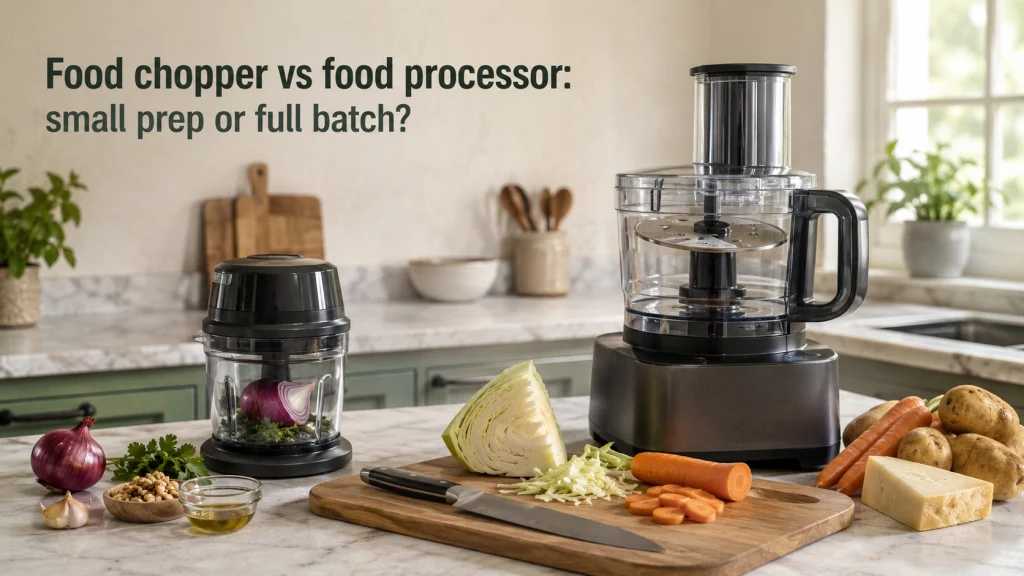
Start with the amount of food and the cut you repeat
The simplest way to settle the food chopper vs food processor question is to picture two prep sessions. In the first, you have one onion, a small handful of herbs, or a modest amount of nuts that needs a few pulses and then goes straight into the pan or bowl. In the second, you have a cabbage to slice, a block of cheese to shred, several vegetables to prep, or enough ingredients that repeated small batches would become its own chore. Those are not just different quantities; they ask the machine to perform different kinds of work.
A compact chopper can be ideal when the machine only needs to replace a few minutes of repetitive knife work and then disappear back into a cabinet. A full-size processor becomes more convincing when a feed tube and removable discs eliminate a whole stage of slicing or shredding rather than merely speeding up chopping. The larger machine also asks for more counter room during use, more room in storage, and more pieces to handle afterward. Start with what repeats in your kitchen, because the longer feature list is useful only when those extra functions actually replace work. Both machines belong within small kitchen appliances, but the useful choice here comes from prep scale, cut type, and how much setup the job deserves.

This compact KitchenAid chopper uses a 3.5-cup work bowl with a stainless steel multipurpose blade for chopping, mixing, and puréeing. Two speeds plus pulse give simple control for small prep jobs. The dishwasher-safe work bowl and integrated cord wrap support quick cleanup and tidy storage.
Check On AmazonIf you click this link and buy, we earn a commission at no additional cost to you.
Know what each class is designed to do before comparing labels
Electric food choppers and mini processor-style machines occupy a fuzzy part of the market because manufacturers do not always use the same label in the same way. The useful practical pattern is a compact bowl with a multipurpose blade, simple controls, and an emphasis on chopping, mixing, and puréeing small quantities. A full-size food processor usually adds a larger work bowl, a feed tube, and interchangeable discs or blades for additional cut types. Exact accessories still vary, so the name on the box should never replace a check of the included parts.
That distinction matters because two machines can both claim to chop and still create very different prep routines. The smaller machine is usually built around placing food directly in the bowl and processing it with the main blade, while the larger machine may also let food travel through a feed tube to a slicing or shredding disc. That class split is useful as a practical starting point, but it should never be treated as a promise about every model because compact and hybrid designs can cross the usual boundaries. If an individual machine blurs the line, judge it by its bowl, feed system, included cutting tools, and cleaning routine rather than by whether the label says chopper, mini processor, or processor.

The Hamilton Beach 72850 uses a 3-cup bowl with a 350-watt motor and stainless steel chopping blade for small prep jobs. Its Stack and Press design starts processing by pressing the lid, keeping the control scheme simple. The removable bowl, lid, and blade are dishwasher safe, supporting the low-friction setup and cleanup that make compact machines useful dedicated tools.
Check On AmazonIf you click this link and buy, we earn a commission at no additional cost to you.
Small chopping and puréeing jobs reward a smaller bowl
A tiny prep job can make a full-size machine feel larger than the food it is supposed to process. Small quantities have to stay close enough to the blade to be caught repeatedly, and a wide bowl can leave light ingredients moving around without being processed as evenly as expected. A compact chopper puts a modest amount of food into a smaller working area, which is why it often makes more sense for a few aromatics, a small portion of nuts, or a limited batch of sauce ingredients. The advantage is not that a chopper is universally stronger at chopping; it is that the bowl scale can match the amount of food better.
Retrieval matters just as much as blade action when the quantity is small. Scraping a few tablespoons or a small mound of chopped food out of a large bowl can take almost as much attention as retrieving it from a compact machine, while the larger lid, bowl, and blade still need washing. If the job is over in a few pulses, every extra part becomes a larger share of the total workflow. That is why a compact machine can remain the better dedicated tool even when a full-size processor is technically capable of producing a similar texture.

The Cuisinart MCH-4 uses a 4-cup work bowl and an auto-reversing stainless steel SmartPower blade for chopping and grinding. Its compact bowl keeps small quantities close to the working blade instead of spreading them across a full-size processor bowl. Dishwasher-safe removable parts help keep cleanup proportional to the short prep task.
Check On AmazonIf you click this link and buy, we earn a commission at no additional cost to you.
Slicing and shredding are where a full-size processor changes the job
Chopping is the area of greatest overlap, but slicing and shredding can make the two classes meaningfully different. A processor fitted with the appropriate disc can turn repeated hand slicing or grating into a feed-and-collect task, which changes the workflow rather than merely changing the speed of the blade. That can matter with slaw vegetables, potatoes, carrots, cheese, or other ingredients prepared in enough quantity to make repetitive cuts tedious. Do not assume every processor includes every disc, though, because the exact package and supported functions remain model-specific.
A compact chopper usually does not reproduce that workflow simply by running longer. Its main blade is designed to cut food inside the bowl, so continued processing tends to make pieces smaller rather than send each ingredient through a fixed slicing or shredding surface. If uniform slices or shreds are a frequent requirement, the feed tube and disc system may be the strongest reason to move up to a full-size processor. If those jobs happen only a few times a year, the extra parts may spend far more time in storage than they save at the counter.

The Ninja BN601 uses a 9-cup work bowl with a feed chute and pusher for full-size prep. Its included reversible disc supports slicing and shredding, while separate tools handle chopping and dough mixing. That disc-based workflow directly addresses repeated cuts that a compact bowl chopper cannot reproduce simply by running longer.
Check On AmazonIf you click this link and buy, we earn a commission at no additional cost to you.
Compare batch size by repetition, not by household head count
Household size is a weak shortcut for choosing between these machines because cooking habits can vary more than the number of people at the table. One person who batch-preps vegetables every week may use a full-size processor more heavily than a larger household that mostly chops one onion at a time. A compact chopper is strongest when small quantities repeat, while a larger bowl becomes useful when stopping, emptying, and reloading a small bowl would interrupt the job again and again. The quantity that matters is the quantity you repeatedly process in one session.
Think in three bands: small jobs that fit comfortably in one compact bowl, normal jobs that may fit either class, and larger jobs that would require multiple compact batches. The middle band is where cut type becomes decisive, because a modest quantity that needs shredding may still favor a processor while a similar quantity that only needs rough chopping may not. Before buying any full-size machine, the next step is to compare its actual work bowl and physical footprint rather than guessing from family size; our article on food processor sizes handles that sizing decision separately. Keeping class choice and capacity choice separate prevents a large bowl from becoming the automatic answer to every busy kitchen.
| Repeated job | Compact chopper or mini processor style | Full-size food processor |
|---|---|---|
| One onion, herbs, nuts, small sauce base | Usually a natural fit because setup and bowl scale stay modest | Can work, but may be more machine and cleanup than the quantity needs |
| Several ingredients that only need chopping or puréeing | Good if the whole job fits without repeated emptying | Useful when the larger bowl meaningfully reduces batching |
| Repeated slicing or shredding | Usually the wrong class unless the exact machine includes a true compatible system | Strong fit when the required disc is included and used regularly |
| Large prep session | Multiple small batches can erase the convenience advantage | Larger bowl can reduce stops, transfers, and reloads |
The table is a starting point, not a capacity promise. Ingredient shape, fill limits, blade geometry, and the exact machine can change what processes cleanly in one batch. The practical question is whether the chosen class completes your repeated job with fewer interruptions. If it does not, extra nominal capacity on a spec sheet will not rescue the workflow.

The Breville BFP810 provides a 16-cup bowl for prep sessions where repeated emptying of a small bowl would interrupt the job. It is designed to chop, slice, and shred larger batches with a 1450-watt motor. The large-capacity format makes it a strong example for comparing batch repetition rather than choosing solely by household size.
Check On AmazonIf you click this link and buy, we earn a commission at no additional cost to you.
Count the knife work that happens before the motor starts
A processor can save time during cutting and still demand prep before the food ever reaches the blade or disc. Feed-tube width and shape determine whether a potato, wedge of cabbage, chunk of cheese, or long vegetable can go in with minimal trimming or must first be cut into smaller pieces. That pre-cutting is easy to ignore when comparing feature lists, but it can decide whether the processor actually removes work from a repeated task. A feed tube that fits your usual ingredients well is more useful than an impressive accessory that requires almost as much knife work as doing the job manually.
Compact choppers have a different kind of pre-cutting burden because ingredients must usually fit inside the bowl and move freely enough for the blade to reach them. Large or awkward pieces may need to be reduced before loading, even if the final goal is only a rough chop. This does not make the chopper a poor choice; it simply means its advantage is strongest when the starting pieces and total quantity are already compatible with its small bowl. When comparing classes, include every cut made before loading, because motor time alone does not represent the real prep time.

This 13-cup KitchenAid processor uses a 3-in-1 feed tube to accommodate ingredients of different sizes before they reach the cutting system. Its adjustable slicing setup lets the user change slice thickness for repeated prep work. An included storage caddy keeps blades and discs together, addressing both pre-cutting workflow and accessory storage.
Check On AmazonIf you click this link and buy, we earn a commission at no additional cost to you.
Setup, washing, drying, and storage can reverse the obvious choice
The machine that finishes the cutting fastest is not automatically the machine that finishes the job fastest. A compact chopper may need only a bowl, blade, lid, and motor unit, while a processor may add a work bowl, lid, pusher, spindle, and one or more discs depending on the task. More parts are reasonable when they remove a substantial amount of prep, but they are harder to justify for a tiny job that takes seconds to chop. The right comparison begins when you take the appliance out and ends when the clean, dry parts are back where they belong.
Storage can also decide which machine gets used rather than merely owned. A compact unit that fits on an easy-to-reach shelf may come out for everyday prep, while a larger processor stored behind heavy cookware can become a special-occasion appliance even if it performs more tasks. Disc and blade storage deserves its own space check because loose sharp accessories are not something to treat casually. Follow the exact model manual for assembly, cleaning, dishwasher use, blade handling, and any interlock requirements, since those details vary by design.
| Workflow stage | Compact chopper or mini processor style | Full-size food processor |
|---|---|---|
| Retrieve | Usually lighter and easier to fit on a reachable shelf | May need more lift space and a larger landing area |
| Assemble | Often fewer working parts for basic chopping | May require the correct bowl, lid, pusher, spindle, blade, or disc |
| Load and process | Efficient for small quantities that fit the bowl well | More efficient when larger batches or feed-tube jobs repeat |
| Retrieve food | Small bowl can be convenient for small yields | Large bowl is useful when the yield is large enough to justify it |
| Wash and dry | Fewer pieces can reduce cleanup for simple jobs | Extra cutting tools can add washing and drying steps |
| Store | Compact footprint is easier in tight kitchens | Needs space for both the machine and its accessories |
This workflow is also the best defense against overbuying. If the larger machine saves several minutes of cutting but adds enough setup, washing, and storage friction that you stop using it, the theoretical advantage does not survive ordinary ownership. Conversely, a processor used several times a week for discs and larger batches can justify every extra piece. Compare the whole routine, not the moment when the motor is running.

The Hamilton Beach 70725A uses a Stack and Snap design to simplify bowl-and-lid assembly on its 12-cup processor. A wide feed chute and reversible slicing and shredding disc support larger prep jobs with fewer manual steps. Dishwasher-safe removable parts make it relevant to comparing the complete workflow from setup through washing and storage.
Check On AmazonIf you click this link and buy, we earn a commission at no additional cost to you.
A compact machine can remain the better dedicated tool
There is no rule that says the more capable appliance must replace the simpler one. If most of your powered prep is a small onion, a handful of herbs, nuts, a dressing, or another small mixture, a compact bowl may be the machine you actually reach for. Its value comes from low retrieval friction, an appropriately sized work area, and a short path from setup to cleanup. Paying for slicing and shredding hardware does not improve those tiny jobs if you rarely use the extra functions.
This is especially important when cabinet space is limited or the appliance must be carried from storage every time. A full-size processor that technically handles small chopping jobs may still be the less practical choice if its bowl scale is awkward for the quantity or its accessory set creates unnecessary handling. If your real question is whether powered prep help is worth buying at all, start with whether you should buy a food processor before assuming the larger class is necessary. A compact machine earns its place when it solves a repeated small job with less total work than both the larger machine and your current manual method.

The KitchenAid KFC0516ER uses a 5-cup work bowl with a stainless steel multipurpose blade for chopping and puréeing. Two speeds plus pulse provide control for coarse or fine results, and the compact footprint includes simple cord storage. Its small-batch format fits a dedicated everyday tool when larger processor hardware would add unnecessary setup and handling.
Check On AmazonIf you click this link and buy, we earn a commission at no additional cost to you.
Repeated slicing, shredding, and batch prep make the larger class clearer
A full-size processor becomes easier to justify when its additional hardware replaces work you genuinely dislike and repeat. Regularly shredding cheese or vegetables, slicing a pile of produce, or processing a batch too large for a compact bowl creates a different workload from chopping one small ingredient. In those cases, the feed tube, discs, and larger work bowl are not decorative extras; they are the parts doing the job you are buying the machine to remove. The more often that workload appears, the easier it is to justify the extra storage and cleanup.
The stronger buying signal is repeated task type, not enthusiasm for having more options. If slicing happens weekly but puréeing only occasionally, prioritize the processor’s slicing workflow and the exact disc you need rather than counting every included accessory. If your task list is broad enough that a full-size processor is clearly the right class, use our broader food processor guide to continue from class choice into the rest of the buying decision. Current model shopping belongs later, after class and size are settled, which is why the best food processors comparison is a separate step.

This Cuisinart processor pairs a 14-cup work bowl with a 720-watt motor for larger prep sessions. Its cutting system supports chopping and shredding, and the machine can also knead dough. The larger bowl and disc-based functions fit readers whose repeated prep regularly goes beyond the quantity and cut types suited to a compact chopper.
Check On AmazonIf you click this link and buy, we earn a commission at no additional cost to you.
Choose compact, choose full-size, or keep both jobs separate
The decision gets easier when you stop asking one machine to win every category. Choose the compact class when small chopping and puréeing dominate, the bowl size fits those quantities, and quick setup and storage matter more than slicing or shredding. Choose a full-size processor when a larger batch or disc-based cut repeats often enough to pay back the added pieces and space. Choose both only when each machine has a distinct repeated job, not because two appliances sound more complete than one.
Before buying, write down the three prep tasks you expect the machine to perform most often and run each through the same short test. Note the amount of food, the required cut, the pre-cutting needed, the number of batches, the pieces you will wash, and where the appliance and sharp accessories will live. If one class wins all three tasks, the choice is straightforward; if the jobs split between tiny chopping and regular slicing or shredding, two specialized workflows may be more convenient than compromise. This keeps the decision grounded in work removed rather than features accumulated.
- Choose a compact chopper or mini processor style when small quantities dominate and you rarely need disc-based cuts.
- Choose a full-size food processor when slicing, shredding, or larger batches repeat often enough to justify the larger setup.
- Choose both when tiny daily jobs and larger disc-based prep are both frequent, and you have sensible storage for two separate machines.
- Choose neither for now when your current knife, grater, or other simple tool already handles the workload with less total effort.
That last outcome matters because an appliance should remove a recurring burden, not create a new one. A seldom-used machine still occupies storage, needs cleaning, and asks you to manage parts safely. If the task does not repeat, the smaller or no-purchase option can be the more efficient kitchen decision. The best class is the one whose workflow keeps making sense after the novelty wears off.

The Hamilton Beach 70730 has a 10-cup bowl, a large feed chute, and a reversible slicing and shredding disc for full-size prep. Its built-in bowl scraper moves ingredients from the sides toward the blades without requiring the lid to be removed. The combination gives readers a concrete full-size option to compare against compact chopping or manual prep.
Check On AmazonIf you click this link and buy, we earn a commission at no additional cost to you.
Settle the class first, then move to size or current shopping
Once the class decision is clear, do not reopen it every time you see a different capacity or accessory package. If a compact chopper solves the actual job, compare compact machines on their own terms: usable small-batch performance, controls, cleanup, storage, and the exact functions included. If a full-size processor is the better class, capacity and physical fit become the next questions because a processor can be right in principle and still be wrong for your cabinet, counter, or batch pattern. Separating those decisions keeps a large specification list from pulling you toward a machine that does not fit the routine.
For a full-size processor, measure the storage path and work area before treating nominal bowl capacity as proof of fit. Check how the lid opens, where accessories go, how much pre-cutting the feed tube requires, and whether the pieces you expect to use are actually included with the exact machine. Price matters after that because a cheaper machine that omits the function you repeatedly need is not the better value, while an expensive package full of unused accessories can be just as wasteful. Class first, then size, then model selection is the cleaner path from vague appliance shopping to a decision tied to actual prep work.

The KitchenAid KFP0718 uses a 7-cup work bowl, a 2-in-1 feed tube, and a reversible medium slicing and shredding disc. Its multipurpose blade and three-speed control cover basic chopping while the disc handles repeated slicing and shredding. All-in-one accessory storage keeps the included blade and disc with the machine, making it practical for model comparison after class choice is settled.
Check On AmazonIf you click this link and buy, we earn a commission at no additional cost to you.
Final Thoughts: choose by repeated quantity and cut type
A compact electric chopper is not simply a lesser food processor, and a full-size processor is not automatically the more sensible purchase. The small machine wins when small chopping or puréeing jobs repeat and low setup, cleanup, and storage friction matter most. The larger machine wins when its bowl, feed tube, and required discs repeatedly eliminate batching, hand slicing, or shredding. The class that removes the most recurring work without adding disproportionate ownership friction is the better fit.
Before buying, picture the food on the counter rather than the appliance on a product page. Count the quantity, name the cut, include the pre-cutting, and finish the mental test with washing, drying, and storage. That process also makes it easier to reject features you will not use and recognize when two separate machines genuinely serve two separate jobs. A clear workload is a better buying signal than a long feature list.

The Breville BFP638 combines a 9-cup processor bowl with tools for chopping, slicing, shredding, and dicing. That range makes it a useful model-selection example after the reader has already decided that a processor is the right class. Its 9-cup capacity keeps the comparison focused on actual bowl size and included cutting functions rather than a generic feature count.
Check On AmazonIf you click this link and buy, we earn a commission at no additional cost to you.
FAQs
🔪 Can a food chopper replace a food processor?
It can replace one for small chopping, mixing, or puréeing jobs if the exact chopper supports those tasks. It usually does not replace a processor workflow when you regularly need a feed tube, slicing disc, shredding disc, or larger batch capacity.
🥣 Is a mini food processor the same as a food chopper?
The labels overlap in the marketplace, so do not rely on the name alone. Check the bowl size, feed system, blade or disc set, controls, and listed functions of the exact machine.
🥕 Which is better for chopping one onion?
A compact chopper often fits that small quantity more naturally and can involve fewer pieces to wash. A full-size processor may still do the job, but its extra size is useful only if it also serves other repeated prep tasks.
🧀 Do I need a food processor if I shred cheese often?
A processor becomes much more useful when shredding is frequent and the exact machine includes the disc you need. Compare the time saved against setup, washing, disc storage, and the amount you typically shred in one session.
📦 Which option is easier to store?
A compact chopper usually takes less space and has fewer accessories to manage. A full-size processor needs room for the base, bowl, lid, and any sharp discs or blades you expect to use.
🧼 Which one is easier to clean?
For a simple chopping job, a compact chopper often creates fewer parts to wash. Cleaning requirements vary by exact model, so follow its manual for dishwasher use, blade handling, and safe disassembly.