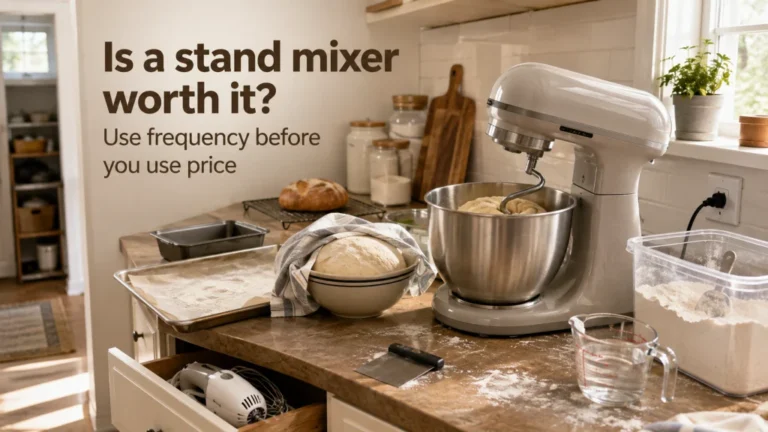
A stand mixer size decision is not just a bowl-capacity decision. The right range has to cover the smallest batch you expect to mix well, the batch you repeat most often, and the occasional larger batch that is genuinely worth planning around. After that, the machine still has to fit the counter, cabinet clearance, lifting routine, and storage path. The goal is to buy enough usable capacity without storing a larger, heavier machine for work you rarely do.
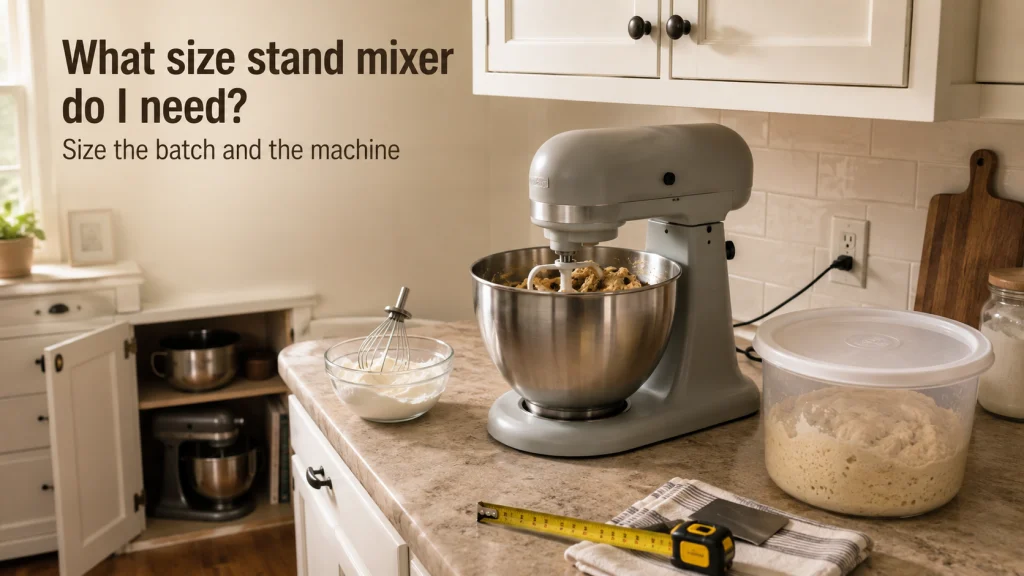
Start with the batches you actually make
The question “what size stand mixer do I need?” is easiest to answer when the hypothetical holiday feast is taken off the table for a moment. A larger bowl can look like sensible future-proofing, but the extra capacity often arrives with a larger mixer body, more weight, more counter demand, and a less convenient storage routine. That trade can be reasonable when large batches are regular, but it is harder to justify when the larger load appears only once or twice in a typical year. Start with the work that repeats, because that is the work that will determine whether the mixer feels appropriately sized on an ordinary week.
Think about size as three separate questions rather than one quart number. First, what is the smallest batch you want the mixer to handle without leaving ingredients below or beyond the useful reach of the attachment? Second, what is the normal batch that should feel easy and routine rather than close to the machine’s stated limit? Third, what is the occasional maximum that matters enough to influence the purchase instead of simply being split into two batches? Keeping those three points separate prevents “bigger is safer” from becoming the default answer. Sizing a stand mixer within the wider small kitchen appliances category should therefore begin with repeated batch needs rather than maximum advertised capacity.

The OXO 2-Cup Angled Measuring Cup uses an angled surface so measurements can be read from above. It has both standard and metric markings and a non-slip handle. The cup is made from BPA-free food-safe Tritan Renew.
Check On AmazonIf you click this link and buy, we earn a commission at no additional cost to you.
Separate bowl capacity, machine size, and usable batch range
Bowl capacity is the easiest number to compare, but it does not tell you how large the machine is or how well a specific batch interacts with the bowl and attachment geometry. Two mixers with similar bowl capacities can differ in height, width, depth, weight, head movement, bowl shape, and the distance between the attachment and the bowl. Those differences affect whether the mixer fits under a cabinet, whether you can add ingredients comfortably, and whether a small amount of cream or batter is actually picked up well. Treat the quart figure as one specification inside a fit decision, not as a complete description of mixer size.
The useful batch range is narrower than the raw volume printed beside the bowl because the machine still has to mix the load effectively. At the upper end, the controlling limit may be dough type, attachment, speed guidance, or a manufacturer-stated capacity rather than the bowl simply being full. At the lower end, the issue is whether the whisk, paddle, or beater actually reaches and moves the ingredients. Size therefore has to cover both the physical bowl volume and the quantities the exact mixer is designed to handle well.

The KitchenAid Classic uses a 4.5-quart stainless steel bowl in a tilt-head format. It has 10 speeds and durable metal construction. The White K45SSWH measures 14.1 inches deep, 8.7 inches wide, and 13.9 inches high.
Check On AmazonIf you click this link and buy, we earn a commission at no additional cost to you.
What size stand mixer should I get for my real batch range?
Write down three batches before comparing machines, using your own repeat recipes rather than a generic family-size chart. The minimum should be something you genuinely make in a small quantity, such as a modest amount of whipped cream, frosting, or a single cake batter. The typical batch should be the load you expect the mixer to handle most often, because this is where convenience matters most. The maximum should be realistic enough that you would be annoyed by splitting it, not merely a possible future project that has never made it into your normal routine.
| Batch point | What to record | What it tests |
|---|---|---|
| Minimum | Your smallest repeated quantity and the attachment normally used | Small-batch reach, bowl geometry, and scraping burden |
| Typical | The batch you make most often, including dough or batter type | Everyday capacity, handling, cleanup, and working comfort |
| Occasional maximum | The largest load you realistically expect to make often enough to matter | Model-specific capacity ceiling and whether splitting a batch is acceptable |
Once those three rows are filled in, the stand mixer size comparison becomes much less abstract. A larger bowl earns its space when it solves a maximum-batch problem that would otherwise create repeated extra work, while still handling your minimum and typical loads well. If the large batch appears rarely, making two batches may be a cheaper and more storage-friendly compromise than moving up to a much larger machine. The worksheet is deliberately recipe-led because household size alone does not reveal whether one household makes a single cake at a time while another routinely mixes dense dough or multiple batches.

The Pyrex Essentials set includes 1-cup and 2-cup glass measuring cups. It uses large ounce and milliliter markings and curved pouring spouts. The nonporous glass cups are safe for microwave, freezer, and dishwasher use.
Check On AmazonIf you click this link and buy, we earn a commission at no additional cost to you.
Use manufacturer batch claims as model-specific ceilings, not universal formulas
Manufacturer batch statements are useful when they name the exact mixer or mixer family and explain the conditions behind the claim. KitchenAid, for example, separates its stand mixers into smaller, medium, and larger size groups rather than treating every quart increase as equivalent, and it publishes different cookie-batch claims for those groups. The brand also states the cookie-dough piece weight behind some of its capacity examples, which is exactly why those numbers should not be converted into a universal “quarts equal this many cookies” rule. A different dough size, ingredient mix, attachment, or mixer design can change the practical ceiling even when the bowl volume looks similar.
| KitchenAid size example | Brand-listed bowl range | Brand-listed height | Brand-listed weight | How to use the example |
|---|---|---|---|---|
| Mini tilt-head group | 3.5 qt | 13.3 in | 18 lb | Evidence that smaller capacity can also reduce body size and lifting burden |
| Full-size tilt-head group | 4.5 to 5 qt | 14.5 in | 26 lb | Shows that a modest bowl increase is only part of the physical-size change |
| Bowl-lift group | 5 to 7 qt | 16.5 in | 29 to 32 lb | Shows the added height and lifting cost that can accompany larger capacity |
This table is an evidence example, not a product ranking or a rule for other brands. Its value is showing that added bowl capacity can arrive with more height and weight, so the physical cost belongs in the same comparison. For another brand, use that brand’s own dimensions and batch claims rather than transferring KitchenAid’s relationship between size classes. Then check whether the stated batch example resembles the load you actually intend to make.

The KSM150PS is a 5-quart tilt-head stand mixer in Empire Red. Amazon lists durable metal construction with 59 touchpoints around the bowl. The 5-quart stainless steel bowl is listed for both small and large batches.
Check On AmazonIf you click this link and buy, we earn a commission at no additional cost to you.
Check small-batch reach before assuming a larger bowl is better
A large bowl can provide useful headroom, but small-batch performance depends on the relationship between the bowl and the attachment. Independent stand-mixer testing from Serious Eats uses a one-cup whipped-cream test specifically to see how mixers handle a small amount, and its testing notes that poor attachment fit can leave liquid at the sides or bottom of the bowl. That is a useful evidence point because it shifts the question from “is this bowl too large?” to “does this exact bowl and attachment geometry work at my minimum quantity?” The answer has to come from model-level testing, documentation, or a clearly demonstrated small-batch result rather than bowl volume alone.
This is one of the easiest first-time buying mistakes because extra capacity feels like a one-way upgrade. A larger mixer can still be a good fit when independent testing or manufacturer documentation shows that it reaches the small quantities you make regularly. Smaller bowls or specialized attachments may help on some systems, but compatibility has to be confirmed for the exact mixer rather than judged by appearance. If your minimum batch matters every week, treat demonstrated small-batch reach as a purchase requirement instead of assuming an accessory will fix it later.

The KN3CW includes a 3-quart stainless steel bowl and a combi-whip. Amazon lists compatibility with select KitchenAid bowl-lift models in the KB26, KD26, KG25, KL26, KM25, KP26, KS26, and KT26 families. The bowl is dishwasher safe.
Check On AmazonIf you click this link and buy, we earn a commission at no additional cost to you.
Add dough type and density before interpreting loaf counts
Loaf counts are especially easy to misuse because two doughs with similar finished volume can create very different loads for a mixer. Hydration, flour type, enrichment, batch weight, and the resistance of the dough all affect what the motor and mixing mechanism are being asked to do. That means a claim about a certain number of loaves should be treated as a statement about the tested or specified dough conditions, not as permission to fill the bowl with any bread formula up to a similar volume. The exact manual or manufacturer capacity guidance should control when it places limits on flour weight, dough weight, speed, or kneading duration.
If bread is only one occasional job among cakes, cookies, frosting, and lighter mixing, bowl size can still be selected around the broader batch range. If dense dough is the main reason for buying the machine, the decision becomes workload-specific and deserves the separate stand mixer for bread dough analysis. A roomy bowl is useful only when the mixer is also designed for the dough load you plan to make. Keep size and workload connected, but let the model’s published dough guidance set the boundary.

The Nicewell scale measures from 0.1 ounce to 22 pounds and reads in 1-gram or 0.1-ounce increments. It includes a tare function and backlit LCD. The platform combines stainless steel and tempered glass.
Check On AmazonIf you click this link and buy, we earn a commission at no additional cost to you.
Measure the footprint and the height required during actual use
A mixer that fits on the countertop while parked can still be awkward to use if the head, bowl, or ingredient path needs more room than the static dimensions suggest. Measure the available width and depth where the mixer will stand, then check the published body dimensions for the exact model. After that, account for the operating movement that applies to its architecture, including head movement, bowl removal, attachment changes, and the room needed to pour ingredients without hitting an upper cabinet. The working-height check is especially important when the mixer will live beneath wall cabinets rather than on an open island.
- Measure the clear counter width and depth, not just the empty rectangle visible from above.
- Measure from the counter surface to the lowest cabinet, shelf, or trim above the intended position.
- Check the exact mixer’s published height, width, and depth rather than a generic size class.
- Allow room for the head or bowl to move according to the model’s design.
- Confirm that the bowl and attachments can be removed without shifting the whole machine.
Do this measurement before deciding that a larger size is acceptable simply because the base fits. A mixer that must be dragged forward every time the head is raised or the bowl is removed may technically fit but still create daily friction. If architecture is the part you are trying to choose between, use the separate comparison of tilt-head vs. bowl-lift mixers rather than turning this size article into an architecture verdict. Here, the practical test is simpler: the machine needs enough room to be used, not merely enough room to be stored.

The STANLEY FATMAX 33-725 is a 25-foot tape measure with a 14-foot reach rating. It uses a high-impact case and a full blade coating. BladeArmor reinforces the tape near the hook.
Check On AmazonIf you click this link and buy, we earn a commission at no additional cost to you.
Add mixer weight and the entire storage-to-counter path
Weight becomes a size issue the moment the mixer does not have a permanent counter position. KitchenAid’s own size guide illustrates the scale of the difference, listing its mini group at 18 pounds, its full-size tilt-head group at 26 pounds, and its larger bowl-lift group at 29 to 32 pounds. Independent testing also notes that heavier mixers can be more stable during demanding work, so lower weight is not automatically better. The household question is whether the weight and size make the machine easy enough to retrieve, place, use, and put away for the frequency you expect.
Trace the full movement instead of judging weight while imagining a simple lift from waist height. A mixer stored in a deep base cabinet may need to be pulled forward, cleared over a shelf lip, turned, carried to the work surface, and then returned after cleanup. A mixer stored on a pantry shelf may require a different reach and grip problem even if the distance is short. If that path feels awkward with the exact published weight and dimensions in mind, a slightly smaller machine that gets used regularly can be a better fit than unused capacity that makes every session harder to start.

The set includes eight small self-adhesive appliance sliders. Amazon positions them for countertop appliances including stand mixers, coffee makers, and air fryers. The sliders attach around the bottom of an appliance or to a wooden board.
Check On AmazonIf you click this link and buy, we earn a commission at no additional cost to you.
Decide how much unused capacity is worth storing
Future flexibility has value, but it should be priced in space and handling rather than treated as a free benefit. Suppose your normal work sits comfortably in a mid-size mixer and the only argument for moving larger is one unusually ambitious baking day. The larger machine may save you from splitting that single event into two batches, but you will store its extra width, height, and weight every time the mixer is not being used. That can still be a good trade, but only when the occasional maximum is important enough to justify the everyday penalty.
A useful rule is to protect for a realistic peak, not for every imaginable peak. If you host often, freeze large batches, bake for groups, or routinely scale recipes upward, the extra capacity may be doing real work rather than sitting idle. If your larger-batch scenario is vague, splitting a rare batch can be a simpler compromise than oversizing the entire machine. This is where a stand mixer guide can help with the broader purchase decision once your acceptable size range is clear, because size should narrow the field rather than decide every other feature for you.

The KSM70SKXX is a 7-quart bowl-lift stand mixer with 11 speeds. It includes a half-speed setting for folding delicate ingredients. The Cast Iron Black configuration includes a double flex edge beater plus four other accessories.
Check On AmazonIf you click this link and buy, we earn a commission at no additional cost to you.
Build a realistic size range before comparing models
By this point, you should be able to describe an acceptable range instead of naming the largest bowl your budget allows. The lower boundary comes from your typical workload and the smallest physical machine that can handle it without living near its model-specific ceiling. The upper boundary comes from your occasional maximum, small-batch requirements, counter dimensions, working clearance, weight tolerance, and storage route. Any model outside that range should have to solve a clear problem before it earns reconsideration.
This approach also keeps capacity from swallowing the rest of the buying decision. Once two or three size classes remain, compare exact models for attachment reach, bowl handling, dimensions, weight, controls, cleanup, compatibility, and the jobs you actually expect to perform. If you are still deciding whether a stand mixer is the right mixer format at all, the broader types of mixers overview is the better next step. The important sequence is size range first, model comparison second, because comparing every available mixer at once encourages feature creep and makes the biggest machine look safer than it really is.

The KSM55SXXX is a 5.5-quart bowl-lift stand mixer with 11 mixing speeds. The Porcelain White configuration includes a stainless steel bowl, flat beater, dough hook, and wire whip. Its bowl uses a three-point locking design.
Check On AmazonIf you click this link and buy, we earn a commission at no additional cost to you.
Keep size separate from architecture and power claims
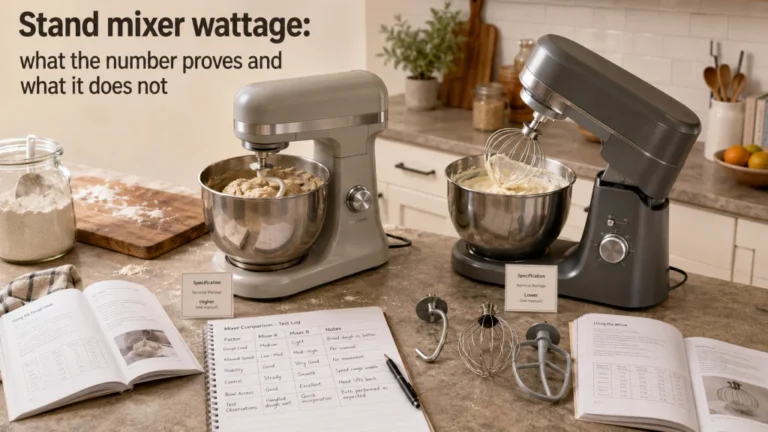
Stand mixer size overlaps with several other buying questions, but combining them too early makes the answer less precise. A bowl-lift machine is often physically larger than a tilt-head machine, yet the architecture question includes access, bowl mounting, stability, and workflow issues that are not reducible to quarts. Wattage is also a poor shortcut for usable capacity because motor ratings, gearing, speed instructions, and mixer design differ across brands and models. Size should tell you the batch and physical range that fits your household, then the other decisions can be evaluated inside that range.
The same boundary applies to product rankings and recipe-specific instructions. This page does not rank individual mixers or tell you to exceed published capacity, speed, or dough guidance. Once the size range is established, use the exact product documentation and the relevant architecture or workload article for the next decision. That keeps a size comparison focused on what it can actually prove: batch range, physical fit, and the handling cost of moving larger.

The KSMVSA is a slicer and shredder attachment designed for KitchenAid stand mixers. Amazon lists compatibility with any KitchenAid stand mixer and includes three slicing and shredding blades. It also has a 2-in-1 feed tube and storage case.
Check On AmazonIf you click this link and buy, we earn a commission at no additional cost to you.
Final Thoughts: size for the batch you repeat
The most useful stand mixer size is the one that handles your repeated batch comfortably without creating avoidable problems at either end of the range. Verify the minimum batch with model-specific evidence, size the normal batch with enough working room, and use the occasional maximum only when it happens often enough to deserve influence. Then check the machine itself: footprint, working height, weight, cabinet clearance, and the path between storage and the counter. This turns a vague quart comparison into a household fit decision you can actually verify before buying.
There is no penalty for choosing a smaller machine when it covers the work, and no advantage in paying the daily space and handling cost of unused capacity. Move larger when the extra room solves a repeated batch problem and the machine still fits your kitchen and your smallest regular tasks. Keep manufacturer limits and accessory fit tied to the exact model rather than to bowl size alone. Size the routine first, protect for a realistic peak second, and let the machine earn every extra inch and pound.

The OXO Mini Angled Measuring Cup has angled markings that can be read from above. It includes standard and metric markings plus tablespoon and ounce measurements. The cup is dishwasher safe and BPA free.
Check On AmazonIf you click this link and buy, we earn a commission at no additional cost to you.
FAQs
🥣 Is a 5-quart stand mixer big enough for most home baking?
It can be, but bowl size alone does not prove fit. Check your typical batch, the exact model’s stated limits, small-batch behavior, dimensions, and storage needs before treating 5 quarts as the answer.
📏 Should I buy the largest stand mixer that fits my counter?
No. A larger mixer can add useful capacity, but it can also add weight, working-height requirements, storage friction, and possible small-batch compromises.
🍪 Can I use cookie-count claims to compare mixer sizes?
Use them only as model-specific examples under the manufacturer’s stated conditions. Do not convert one brand’s cookie count into a universal quarts-to-batch formula.
🍞 Does a bigger bowl mean a mixer can knead more bread dough?
Not automatically. Dough type, dough weight, hydration, mixer design, attachment, speed guidance, and the exact model’s published limits matter more than bowl volume alone.
🧁 Can a large stand mixer handle very small batches?
Some can, but the answer depends on bowl and attachment geometry. Look for model-specific small-batch testing or documentation instead of assuming a larger bowl will reach a small quantity well.
🏠 What should I measure before buying a stand mixer?
Measure counter width, depth, and vertical clearance, then compare those numbers with the exact mixer’s dimensions. Also allow room for head or bowl movement, adding ingredients, removing attachments, and moving the mixer from storage if it will not live on the counter.
References and Sources
- KitchenAid stand mixer buying guide: Supports the brand-specific bowl ranges, height, weight, and batch-capacity examples used in the article.
- KitchenAid bowl compatibility information: Supports the warning that bowl and attachment compatibility depends on the exact mixer system.
- Serious Eats stand mixer testing: Supports the small-batch reach discussion, bowl and attachment fit, handling observations, and weight considerations.