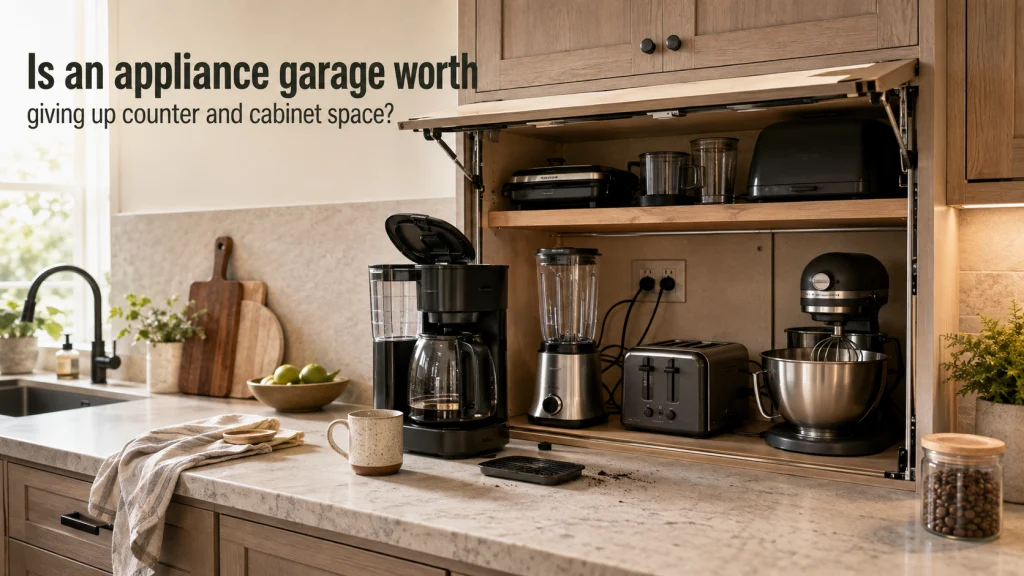
An appliance garage is worth the space when it keeps frequently used appliances close without making them harder to use. The decision depends on exact appliances, operating requirements, door paths, space consumed, and cleanup access. Separate storage-only appliances from those that may operate in place because those are different design problems. The goal is calmer storage without added setup work.
Run one normal appliance routine before you plan the cabinet
An appliance garage can look perfect with the doors closed and still make breakfast harder. Picture opening it, filling the coffee maker, moving a toaster, reaching the outlet, and finding space for loose parts. If one appliance blocks another, the cabinet creates work before the task even starts. Judge the layout by that routine, not by the closed-door photo.
This matters most when an appliance garage sits directly on valuable counter space. A tall concealed station can preserve open counter elsewhere, but it may add reach and shelf-access problems. The right design gives daily equipment a stable home. If constant shuffling is required, the cabinet only hides clutter.

This bamboo appliance slider measures 14.5 inches deep by 9.5 inches wide and uses rubber wheels for countertop movement. The listing positions it for coffee makers and other small kitchen appliances that benefit from easier forward access. Its rolling tray format supports a routine where an appliance can stay parked under cabinetry and slide forward when needed.
Check On AmazonIf you click this link and buy, we earn a commission at no additional cost to you.
Know what an appliance garage is, and what it is not
A kitchen appliance garage is cabinetry that conceals countertop appliances while keeping them near their work area. It may sit at counter height or inside a tall station. That differs from an ordinary pantry cabinet, where storage is primary. It also differs from a freestanding microwave stand, which does not consume built-in cabinet volume.
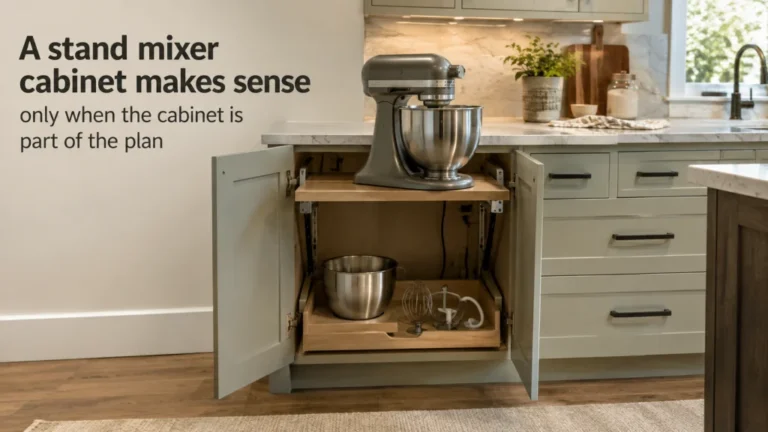
An appliance lift solves another problem by moving heavy equipment from lower storage to working height. That can matter for a mixer, but it belongs with stand mixer storage choices rather than general appliance-garage planning. The garage earns its space when concealment and quick access share one zone. If the household only needs occasional storage, simpler cabinetry may be enough.

This Rev-A-Shelf wood pullout drawer is designed for base kitchen cabinets and uses BLUM soft-close slides. The listing specifies a minimum cabinet opening of 20.75 inches wide for this 4WDB-21SC-1 model. It is a cabinet-installed storage component rather than a freestanding appliance stand.
Check On AmazonIf you click this link and buy, we earn a commission at no additional cost to you.
Decide whether concealment is worth prime counter or cabinet volume
Clear sightlines help, but an appliance garage is not automatically space-saving. A countertop enclosure may hide equipment while permanently occupying the surface beneath it. A tall station may free counter while consuming cabinet width and depth. Compare the usable kitchen before and after the enclosure, not just the visual difference.
Frequency should drive that trade before style does. Daily appliances benefit most from near-instant access, while occasional equipment can waste prime space. A household with several daily machines may accept the volume cost because it reduces carrying. A household with one compact appliance may gain little from dedicating cabinetry to concealment.
Space trade-off: Count the counter area that becomes usable, then subtract the footprint or cabinet volume claimed by the enclosure. Include the door hardware and required appliance clearance in that cost. Hidden counter is not always recovered counter. The feature earns its space only when the remaining kitchen works better.
That comparison should happen before finishes or door hardware are chosen. It prevents a cabinet from being labeled efficient simply because it looks tidy. The next question is which appliances deserve the prime space. That requires an exact inventory rather than a generic appliance list.

The Klein Tools 9225 uses a 25-foot double-sided blade with a double hook and nylon reinforcement. A metal belt clip is built into the case for carrying the tape between measurement points. Its long blade is suitable for comparing counter width, cabinet volume, and the space a proposed enclosure would claim.
Check On AmazonIf you click this link and buy, we earn a commission at no additional cost to you.
Inventory the exact appliances before choosing the cabinet
Start with the appliances you own or have firmly chosen. Record storage dimensions, then note what changes during use. Lids, reservoirs, jars, mixer heads, bowls, and doors can enlarge the working envelope. Weight, cord direction, plug shape, and removable parts also matter.
Rank the list by frequency before assigning positions. Daily equipment should be reachable without unloading a shelf. Weekly equipment can sit farther back, while occasional items should not displace daily tools. This keeps the appliance garage cabinet focused on use.
Rank daily, weekly, and occasional use
Put appliances that create repeated carrying at the top. Then check whether the garage removes those steps. A daily machine trapped behind other equipment has poor placement. Frequency should control position more than matching sizes.
Record both closed and operating dimensions
Measure stored width, depth, and height, then add every movement needed for use. Include lids, raised heads, removable parts, cord space, and required clearance. The operating shape determines whether the station feels open or cramped. A parked fit can still fail during use.
| Inventory item | What to record | Why it matters |
|---|---|---|
| Stored size | Width, depth, and height | Sets the storage envelope |
| Operating movement | Lids, heads, doors, jars, and removable parts | Shows extra working space |
| Weight and handling | Weight and movement distance | Shows handling burden |
| Power connection | Cord, plug, disconnect access, and manual rules | Exposes power conflicts |
| Routine access | Water, sink, ingredients, and landing area | Connects placement to the task |
Complete this worksheet before finalizing cabinet dimensions. It gives a cabinet designer useful conditions instead of appliance names alone. Leave reasonable tolerance where a future replacement is unknown. Then classify each appliance as store-only or potentially usable in place.

A compact laser distance measure with a working range up to 165 feet and accuracy up to plus or minus 1/16 inch. It provides real-time measurement, a backlit color display, and multiple measuring functions for distance, area, volume, and indirect measurements. The IP65-rated housing and included belt clip and pouch make it suitable for both household measuring tasks and more demanding jobsite use.
Check On AmazonIf you click this link and buy, we earn a commission at no additional cost to you.
Separate store-only appliances from use-in-place appliances
Storing an appliance inside proves only that it fits while off. Operation introduces heat, steam, movement, loading space, ventilation, and power requirements. Good storage can still be a bad operating location. Treat each appliance as store-only until its instructions and the layout support operation there.
The distinction changes what convenient access means. Store-only equipment needs a clear move to a permitted work position. Use-in-place equipment needs the cabinet, door, outlet, and surroundings to remain compatible. An internal outlet alone does not settle that question.
Store-only means the appliance still needs an easy work position
Measure the move from parked to usable, not just the opening. The appliance should reach an open work position without collisions. Repeated lifting matters more with heavier, frequently used equipment. An awkward path usually means the storage position is too deep or crowded.
Use in place only when the exact appliance permits it
Do not assume open cabinet doors make enclosed operation acceptable. One Breville countertop oven manual says that oven is not suitable for use in a small appliance enclosure. The same manual recommends at least 4 inches of space around that model. This is a model-specific example, not a universal appliance-garage clearance.
| Decision | What must be true | Planning consequence |
|---|---|---|
| Store only | Fits while off and moves easily to an approved work position | Prioritize handling, landing space, cord access, and return |
| Operate in place | Instructions and finished geometry permit operation there | Verify clearance, heat, steam, doors, power, and cleanup |
| Not a fit | Operating requirements conflict with the enclosure | Choose another position |
This table separates the workflow choices rather than granting operating permission. A store-only choice still needs an easy move to the work surface. A use-in-place choice must survive the full operating-envelope check that follows. If neither path works comfortably, choose another location.

This Bruvoalon set includes three rolling sliding trays for kitchen countertop appliances. The listing names coffee makers, toasters, mixers, blenders, and air fryers among its intended appliance uses. The trays provide a movable base that can make a store-only appliance easier to pull forward before transfer to its approved work position.
Check On AmazonIf you click this link and buy, we earn a commission at no additional cost to you.
Protect the operating envelope instead of measuring only the appliance box
Closed dimensions tell you whether a machine can park, not whether it can work. The operating envelope includes clearance plus room for lids, doors, reservoirs, bowls, and controls. Heat or steam can add limits that a cabinet drawing does not show. A tight box fit is weak evidence of a functional fit.
Do not solve this with one generic clearance number. Appliances differ in movement, heat, and ventilation needs. The full process belongs in appliance garage dimensions and operating clearance planning. Here, identify every dimension that changes during use.
Heat and ventilation stay model-specific
Heat-producing appliances need extra attention because heat can leave different products through different surfaces. Similar-looking machines may behave differently even when their parked dimensions are close. Cabinet sides, shelves, and doors can therefore become part of the operating envelope. Verify the exact model requirements before finalizing that envelope.
Steam and top-opening parts need their own space
A coffee maker may fit until its reservoir opens. A blender may fit until the jar lifts out. Steam can also reach nearby cabinet surfaces. Measure refill, removal, and vapor paths with the working envelope.
Moving heads, front doors, and toaster slots change usable space
A mixer head can need more height during setup. A countertop oven adds a front door and loading path. A toaster needs access above its slots. Resting dimensions can hide all three conflicts.
Map these movements before cabinet size is locked. That separates a real operating station from a storage cabinet at counter height. It also shows which appliances must move out before use. Door selection should follow the same operating logic.

This QWORK folding wood rule measures 6 feet 6 inches and carries both US and metric scales. Its segmented folding design collapses into a compact form while extending for longer cabinet measurements. A rigid folding rule is useful for checking interior depth, vertical opening room, and clearance around moving appliance parts.
Check On AmazonIf you click this link and buy, we earn a commission at no additional cost to you.
Choose the door family by what must stay clear while it is open
The best door stays out of the task. Lift-up, pocket, tambour, bifold, and hinged fronts all consume space. Some use vertical room, others use cabinet depth or side width. Choose the family after appliance movement and landing space are known.
Hardware has technical limits too. Blum lists AVENTOS HL top for cabinet heights from 11 13/16 inches to 22 13/16 inches and widths up to 72 inches. REVEGO uses a dedicated pocket for the open fronts, so hidden doors still consume cabinet volume. See appliance garage door style comparisons for the full mechanism decision.
Lift-up fronts can clear the work zone but need hardware space
A lift-up front moves the door above the opening. Its mechanism still needs compatible cabinet dimensions. Nearby trim or cabinetry can affect the path. Check the exact hardware rather than assuming all lift doors behave alike.
Pocket fronts hide the doors but consume cabinet volume
Pocket systems move fronts away from the station. The doors and mechanism still need a pocket. That can reduce usable width or depth. The loss matters when appliances already push the cabinet limits.
Tambour and bifold doors trade projection for tracks and folds
A tambour limits outward swing but needs a track. A bifold reduces swing but leaves folded-door thickness near the opening. Both can affect cleaning and access. Judge them by the space they occupy during use.
Side-hinged fronts are simple until they block the work zone
Side-hinged doors use familiar hardware. Their swing can block drawers, counter space, or a narrow aisle. Wide fronts make that conflict worse. A simple mechanism still fails if it occupies the landing area.
| Door family | Why it can work | What to verify |
|---|---|---|
| Lift-up | Moves the front above the active opening | Hardware range and vertical path |
| Moves fronts away from the work zone | Pocket size and interior loss | |
| Tambour | Limits outward projection | Track space and cleaning access |
| Bifold | Reduces the swing of a full-width front | Folded thickness and side clearance |
| Side-hinged | Uses familiar cabinet hardware | Door swing and landing area |
Use the table to remove mechanisms that invade workflow. The door should open without becoming something the user must work around. Hardware limits must also match the finished cabinet. Decorative choices come after those conditions are satisfied.

The Klein Tools 935DAG measures and sets angles across 0 to 90-degree and 0 to 180-degree ranges. It can also function as a digital level, with a reverse-contrast display for visibility. Those angle functions make it useful for checking how a lift-up or hinged front moves relative to the cabinet and nearby work zone.
Check On AmazonIf you click this link and buy, we earn a commission at no additional cost to you.
Keep a real landing and preparation zone
An appliance garage can look empty while removing useful work surface. A coffee station still needs room for a mug and refill parts. A toaster or oven needs landing space for food and accessories. A blender needs room for ingredients and its removed jar.
Measure the station with the door open and appliance in use. Check drawers, traffic paths, and where loose parts will land. Hiding one more machine is not worth losing the only prep area. Keep enough open counter for the task.
- Confirm landing space for cups, bowls, ingredients, hot accessories, or removable parts.
- Open the garage door and nearby drawers to expose conflicts.
- Trace the route to the sink, trash, refrigerator, and pantry items used in the same routine.
- Check that loading, refilling, and cleaning do not require moving unrelated equipment first.
- Keep access to unplug or disconnect the appliance as its instructions require.
The checklist exposes problems that an empty-cabinet measurement misses. It shows whether the garage creates a compact station or moves congestion behind a door. A small clear landing area may be more useful than one extra stored appliance. Decide that balance before interior fittings are finalized.

This dark gray AMOAMI mat measures 12 by 19 inches and is made for countertop use beneath coffee makers and similar equipment. The listing describes an absorbent surface with rubber backing for managing drips around the station. Its flat footprint can define a landing area for a coffee setup without adding another rigid organizer.
Check On AmazonIf you click this link and buy, we earn a commission at no additional cost to you.
Plan power as an appliance requirement, not permission to operate inside
An internal receptacle improves convenience but does not prove an appliance may operate inside. The manual still controls grounding, cord placement, location, and circuit guidance. The Breville example calls for a grounded outlet and recommends a dedicated circuit for that oven. Those instructions belong to that model, not every garage.
Reserve space for the actual plug and cord without pinching them. Keep the disconnect point reachable. New receptacles or circuit changes belong with a qualified professional under applicable local requirements. If power conflicts with the station, change the plan instead of improvising.
Start with the exact appliance instructions
Check the manual for the appliance that will actually occupy the station. Another model can have different placement or power instructions. Keep those requirements attached to the appliance choice. The cabinet does not replace the appliance documentation.
Keep cords, plugs, and disconnect access in the finished geometry
A rear plug can consume usable cabinet depth. A cord exit can also change how far an appliance sits from the back panel. Draw both into the layout before final measurements. Easy access matters for normal disconnection and cleaning.
Power planning should remain an owner-level verification step here. Confirm requirements, preserve access, and use qualified help for electrical work. Do not use extension-cord workarounds to rescue a bad layout. After power, the next recurring burden is cleaning the station.

This package includes eight white Command cord bundlers and 12 medium adhesive strips. The bundlers install without tools and are intended to keep appliance and electronics cords grouped and out of the way. Command states that the strips adhere to surfaces including paint, wood, and tile and remove without leaving holes or sticky residue.
Check On AmazonIf you click this link and buy, we earn a commission at no additional cost to you.
Plan for crumbs, splashes, and residue before choosing the interior
Concealment does not remove appliance mess. Crumbs, grounds, water drips, and splashes can collect around feet, cords, tracks, hinges, and back corners. A deep station packed with appliances can make those areas hard to reach. If every wipe-down requires unloading the garage, the cabinet has created a maintenance penalty.
Choose an interior that can be reached with ordinary owner-level cleaning. Removable appliance parts should travel easily to the sink, and tracks should not sit directly in heavy crumb or splash paths. Heat or steam residue is another reason to follow exact operating instructions. Cleanability affects daily ownership more than the closed-door appearance suggests.
- Reach the back and side surfaces without removing every appliance.
- Check tracks and hinges for crumb or splash exposure.
- Leave room to remove water tanks, drip trays, crumb trays, bowls, and jars.
- Keep cord areas reachable for cleaning without strain.
- Preserve service access without dismantling unrelated cabinetry.
A useful station should reset with few steps. Crowded corners make small messes harder to deal with. That friction repeats most often around daily appliances. Easy cleaning also makes future appliance changes less troublesome.

The OXO Good Grips Deep Clean Brush Set includes one large brush and one small brush with a built-in wiper blade. Both brushes use durable nylon bristles and non-slip grips, while the smaller brush is designed for tight spaces. The two sizes suit cleaning around cabinet tracks, appliance feet, corners, and other areas where crumbs or residue collect.
Check On AmazonIf you click this link and buy, we earn a commission at no additional cost to you.
Leave replacement tolerance so the cabinetry can outlive the appliance
Built-in cabinetry often lasts longer than a coffee maker, blender, toaster, or countertop oven. A garage fitted tightly to one appliance can become obsolete when the replacement is slightly taller or deeper. Controls, cord exits, lids, and refill access can also change between models. The cabinet should fit today’s equipment without depending on one exact silhouette forever.
Do not solve that problem by oversizing every dimension. Extra width and depth still consume cabinet volume and can reduce reach. Identify the dimensions most likely to constrain replacement, then preserve practical tolerance there. Removable shelves or simple interior organizers can add flexibility without making the station wasteful.
Replacement check: Ask what happens if the tallest appliance grows taller or the deepest one needs more plug space. Consider whether a future reservoir could open upward instead of outward. Keep reasonable tolerance around the dimensions that control fit. Do not use that tolerance to override a future appliance manual.
Keep appliance measurements separate from cabinet measurements in the planning notes. That makes later replacement decisions easier to evaluate. A future appliance may still need to operate elsewhere even if it fits in storage. Flexibility should simplify replacement, not create false permission for use.

This Cerpourt kit contains 104 nickel-plated shelf supports in four styles. The assortment includes both 5 mm and 1/4-inch sizes, so the cabinet hole diameter must match the selected pin. Multiple support positions can help adjustable shelving accommodate a replacement appliance with a different height.
Check On AmazonIf you click this link and buy, we earn a commission at no additional cost to you.
Know when another storage architecture is better
An appliance garage is one answer to accessible concealment. Freestanding support may work better when flexible placement matters. Lower-cabinet storage can suit occasional equipment when lifting is manageable. A mixer-specific mechanism can make more sense when one heavy machine is the real problem.
Follow the appliance and routine rather than one storage idea. If concealment consumes prep space, compare a freestanding appliance support setup; if a heavy mixer drives the choice, compare ways to store a stand mixer. Use the household equipment storage framework for broader storage decisions, and small kitchen appliance choices when the real question is what machine to buy. The household utility section covers related equipment-support decisions beyond this cabinet.
Use freestanding support when flexibility matters more
A freestanding stand or cart can be moved or replaced without rebuilding cabinets. It may also provide a more open operating location. The trade is visible equipment and occupied floor space. That can still be preferable to sacrificing prime built-in storage.
Use mixer-specific storage when one heavy appliance drives the problem
A heavy stand mixer creates a handling problem that is more specific than general countertop clutter. KitchenAid distinguishes appliance-garage storage, under-cabinet storage, and mixer-lift storage in its own storage guidance. Those routes solve different access problems. Choose by lifting, counter access, cabinet capacity, and the exact mixer setup.
Routing the problem correctly prevents expensive cabinetry from answering the wrong question. Some households will be better served by a simpler cabinet or freestanding support. Others need a heavy-appliance solution rather than a general hidden station. The right choice is the one that reduces repeated work without creating a worse space trade.

A heavy-duty cabinet appliance lift designed for stand mixers and other bulky kitchen appliances. It uses a spring-assisted mechanism with soft-close dampening and a locking system to make raising and lowering stored appliances easier and more controlled. The lift mounts inside a full-height base cabinet and is intended to free countertop space while keeping heavier appliances accessible.
Check On AmazonIf you click this link and buy, we earn a commission at no additional cost to you.
Use inspiration only after the constraints are known
Photos are useful for seeing countertop, tall-cabinet, and coffee-station arrangements. They rarely reveal the exact appliance model, interior depth, operating clearance, outlet layout, or door hardware limits. Copying the appearance first can lock the household into guessed measurements. Treat images as layout ideas rather than specifications.
Once the constraints are known, appliance garage ideas with practical layout context become more useful. You can compare arrangements while already knowing the required opening, door path, landing space, and store-only appliances. That turns inspiration into a filtered set of compatible possibilities. Specify the cabinet from the inside out, then style it from the outside in.

The Milescraft 1316 CabinetMate is a shelf-pin drilling jig for creating straight cabinet holes. The Amazon listing says it can drill eleven holes spaced 32 mm apart in one setting and includes a 1/4-inch self-centering drill bit. It can be used on assembled cabinets, cabinet sides before assembly, and both face-frame and frameless cabinets.
Check On AmazonIf you click this link and buy, we earn a commission at no additional cost to you.
Final Thoughts: an appliance garage is worth the space when access gets easier
An appliance garage is worth giving up counter or cabinet volume for when it shortens the path from stored to usable. The strongest cases involve frequently used equipment that would otherwise stay out or require awkward carrying. Weak designs start with concealment and handle clearance, power, doors, landing space, and cleaning later. If every routine begins with rearranging machines, the cabinet is doing more hiding than helping.
Make the final decision with the exact appliance list in front of you. Separate storage from operation and follow each manual where heat, steam, ventilation, outlet use, or placement matters. Choose a door that stays out of the task and preserve cleaning, disconnect, service, and replacement access. If those conditions fit the kitchen, the garage can reduce visual clutter without making the household work harder.

This black Ibyx appliance slider measures 16 by 13 inches and uses a bamboo platform. The listing rates the tray for loads up to 40 pounds and positions it for coffee makers and other heavy kitchen appliances. Its sliding design lets an appliance move forward from beneath cabinetry without repeatedly lifting the full appliance.
Check On AmazonIf you click this link and buy, we earn a commission at no additional cost to you.
Continue the appliance garage decision
The storage concept is only the first decision. The next step depends on whether the unresolved issue is fit, door movement, or layout inspiration. Each article below develops one of those questions at the level of detail it needs. Use the topic that matches the constraint still blocking the plan.
| Topic | What you’ll find |
|---|---|
| Appliance garage dimensions | A measurement process for stored size, operating movement, clearance, cords, and usable geometry. |
| Appliance garage door styles | A comparison of lift-up, pocket, tambour, bifold, and hinged mechanisms by open-door space. |
| Appliance garage ideas | Layout examples to consider after fit, operating rules, landing space, and door clearance are known. |
Start with dimensions when an exact appliance has not been proven to fit. Move to door styles when the opening mechanism is the main conflict. Use layout ideas only after the operating envelope is clear. That order keeps inspiration from becoming an accidental specification.

This LEXIVON LX-206X3 set includes three 25-foot tape measures with 1-inch-wide nylon-coated blades. The dual-sided blades use white and yellow scale printing with feet, inches, fractions, and metric markings. Each tape has a rubberized ABS case, a bottom speed brake, and a true-zero multi-catch hook for internal and external measurements.
Check On AmazonIf you click this link and buy, we earn a commission at no additional cost to you.
FAQs
📦 What is an appliance garage used for?
It conceals small appliances near their work area. It is most useful for frequently accessed equipment.
🔥 Can I run a toaster oven inside an appliance garage?
Only when the exact instructions and installation permit it. Some countertop ovens specifically restrict enclosure use.
📏 How deep should an appliance garage be?
There is no universal depth. Measure the appliance, plug, movement, and required clearance.
🚪 Which appliance garage door style takes up the least work space?
It depends on the open door path. Lift-up and pocket systems still require space for their mechanisms.
🔌 Does an outlet inside the cabinet mean I can use appliances there?
No. The appliance manual still controls location, clearance, ventilation, grounding, and other requirements.
🧹 Are appliance garages hard to keep clean?
They are easier to maintain when surfaces, tracks, cords, and parts remain reachable. A crowded station adds unnecessary cleanup work.
References and Sources
- Decora appliance garage cabinet: Supports the cabinetry format for concealed appliance storage.
- Blum AVENTOS HL top: Documents the lift application and stated cabinet size range.
- Blum REVEGO: Documents the pocket architecture for retracting fronts.
- KitchenAid stand mixer storage: Supports the different stand mixer storage routes.
- Breville Smart Oven Air Fryer Compact manual: Supports the enclosure, clearance, grounding, and circuit example.