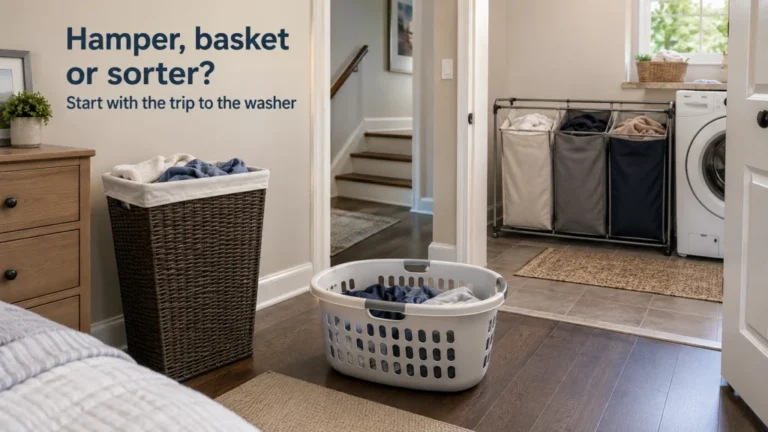
A laundry sorter only earns its floor space when its compartments match loads your household actually runs. Start with recurring wash categories, then compare how quickly each one accumulates, how much you normally wash at once, and whether each bag can move to the washer without creating another transfer step. Two useful compartments can be more efficient than four sections that leave one bag overflowing while another sits nearly empty. The right choice is the smallest sorting system that keeps your normal laundry flow clear without wasting capacity, space, or effort.
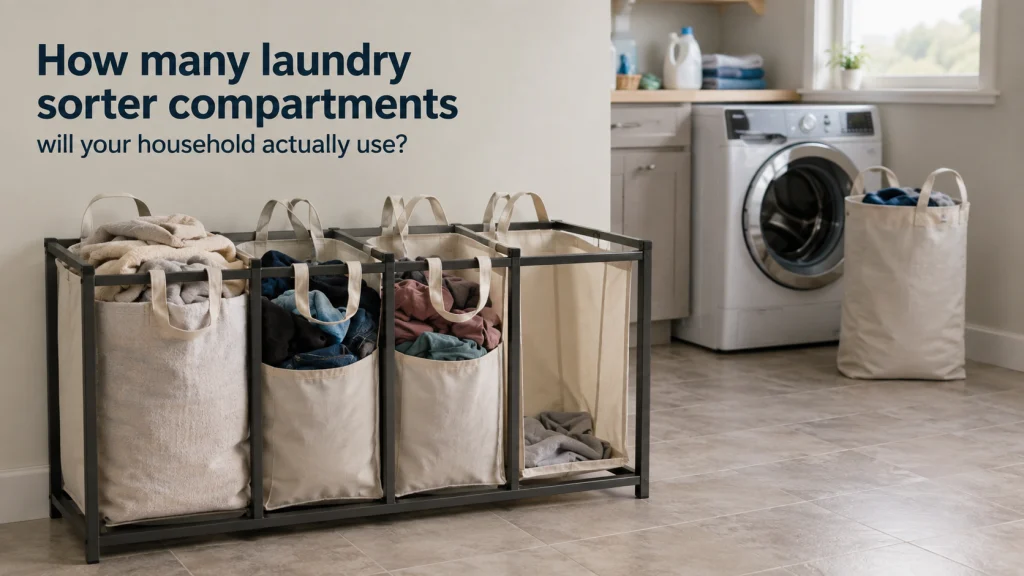
An unused compartment is not extra organization
Picture a four-bag laundry sorter with one section filling rapidly, two filling at a manageable pace, and the last one almost never reaching a useful load. That last compartment is not helping just because it has a label on the front. It is permanent floor space devoted to a category your household rarely washes separately. A better sorter starts with the loads that actually recur, not the number of sections that looks most organized in a product photo.
The main question is not how many people live in the home. It is how many distinct loads reliably accumulate before you want to run the washer. A household that repeatedly runs two clear load types may be better served by two compartments than by a larger clothes sorter with four. If you are still deciding how this equipment fits into the rest of your storage setup, start with home storage planning, then use the broader laundry hamper decision to decide whether sorting should happen during collection.

This black double hamper uses two compartments and includes two removable mesh bags with handles. Its 600D polyester body has a water-resistant surface, while supporting rods and panels help it stay upright. A flip-top lid keeps laundry contained, making it a practical fit for households that genuinely use two recurring sort groups.
Check On AmazonIf you click this link and buy, we earn a commission at no additional cost to you.
A laundry sorter should pre-sort loads, not invent new ones
A laundry sorter is a dirty-laundry collection system with two or more sections intended to keep recurring wash groups separate before laundry reaches the washer. Retail assortments include divided hampers, framed units with removable bags, rolling designs, and versions with shelves or lids. Those features change space and transport, but they do not tell you how many sections your routine needs. The useful starting point is whether each compartment corresponds to a load you already run often enough to matter.
This selection decision does not require a universal rule for sorting by color, fabric, or garment type. Care labels, washing instructions, and the exact items in a load still control how particular garments should be washed, and that is separate from choosing the container architecture. Here, the sorter is only being judged as collection equipment: how many sections you will use, how much each section holds, how much floor area the frame claims, and how easily the contents reach the washer. If a single container already works and you prefer to sort only when loading the machine, a divided sorter may add complexity without reducing meaningful work.

This 120L rolling sorter divides laundry into three sections within a 26.8 by 13.8 by 29.1-inch frame. It uses a removable washable liner with an alloy-steel frame, canvas, PVC mesh, wheels, and a metal handle. The three-section layout suits routines with three recurring load groups that need to stay separated before wash day.
Check On AmazonIf you click this link and buy, we earn a commission at no additional cost to you.
Write down the loads you already run before choosing a section count
Before shopping, list the groups that repeatedly leave your hamper as separate washer loads. Use your actual routine, not an ideal system you hope everyone will adopt after a new sorter appears. One household may repeatedly separate everyday clothing from towels, while another has a third regular group with different wash requirements. The labels matter less than whether each group consistently becomes its own load.
Next, compare how quickly those groups accumulate. If one fills rapidly while another takes much longer, equal-size compartments can create a mismatch. The faster-growing group may need more room even when both groups are equally legitimate washer loads. This worksheet is more useful than choosing compartment count from household headcount alone.
| Recurring load group | How quickly it becomes a load | Typical amount at wash time | Needs a permanent section? |
|---|---|---|---|
| Group 1 | Frequent / moderate / occasional | Small / normal / bulky | Yes / maybe / no |
| Group 2 | Frequent / moderate / occasional | Small / normal / bulky | Yes / maybe / no |
| Group 3 | Frequent / moderate / occasional | Small / normal / bulky | Yes / maybe / no |
| Group 4 | Frequent / moderate / occasional | Small / normal / bulky | Yes / maybe / no |
Fill it in from memory. Watch normal laundry cycles if the answer is unclear. The point is not perfect balance. It is to expose sections that would rarely help and groups that would repeatedly overwhelm their assigned space.

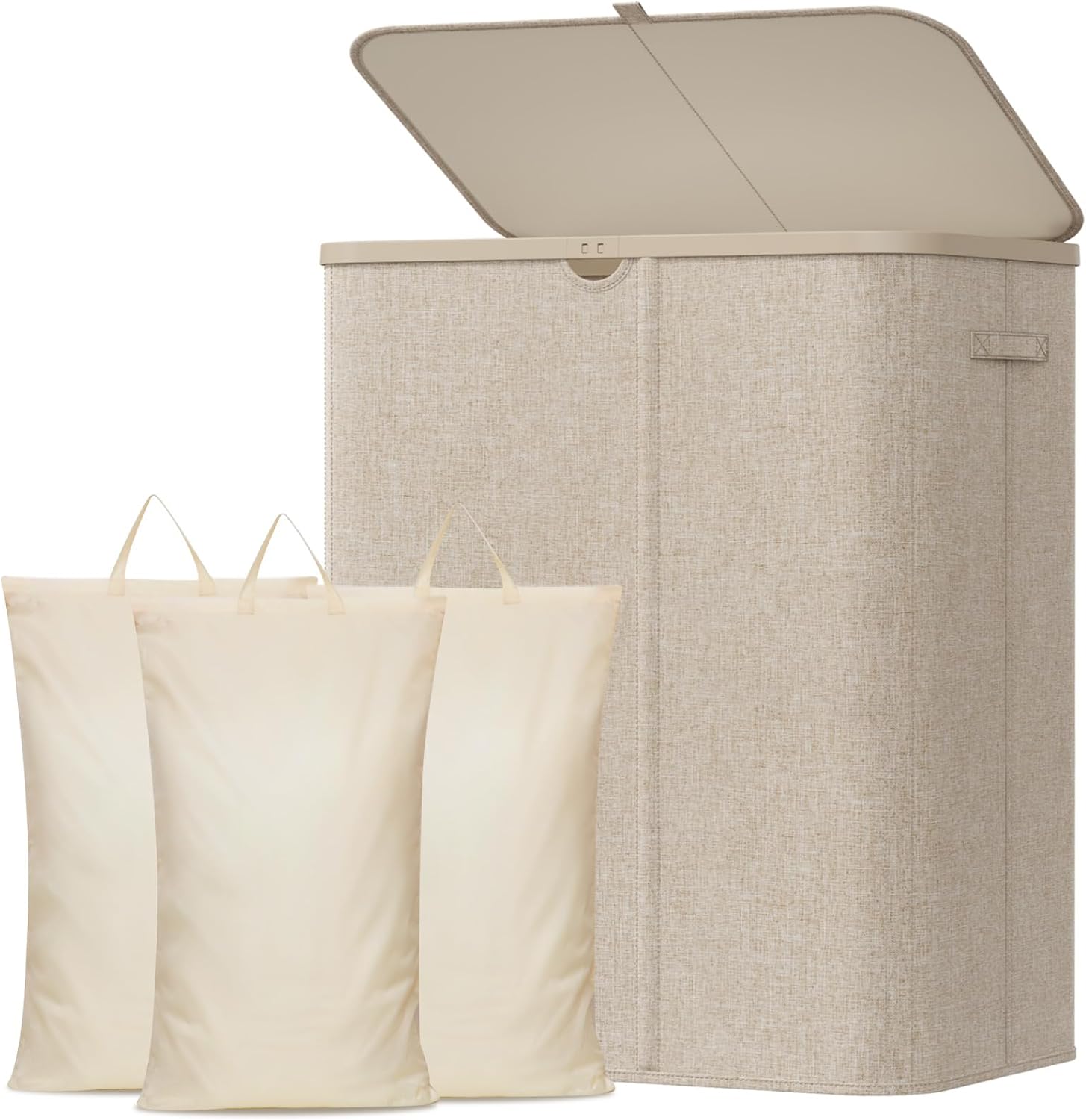
This 136L beige hamper uses two compartments and individual removable laundry bags for pre-sorting. A lid keeps dirty laundry out of sight, while the collapsible body is supported by internal rods for an upright shape. Its two-section format gives each recurring category a dedicated collection space without moving to a larger multi-bag frame.
Check On AmazonIf you click this link and buy, we earn a commission at no additional cost to you.
Compare two, three, and four-plus compartments by utilization
Two compartments fit routines with two stable collection groups and keep the divided footprint relatively simple. Three make sense when a third group appears often enough to become its own washer load instead of an occasional exception. Four or more can work when several distinct categories genuinely recur, but every added section brings more frame, bag hardware, or stacking to manage. Choose the number of useful permanent sections, not the most sections you can fit.
Household size alone does not decide this. More people can increase laundry volume without increasing the number of load types, while a smaller household may still have several recurring categories. An occasional category can share a collection section and be separated only when needed. Judge the extra compartment by whether it removes repeated sorting work, not by whether there is room to add it.
- Choose two when two recurring groups dominate and both fill at a useful pace.
- Choose three when a third group repeatedly becomes its own load and would otherwise require re-sorting.
- Choose four or more only when each added section solves a repeated collection problem.
- Use a single hamper when pre-sorting does not reliably reduce work.
The count should make the routine more obvious. It should not make the process ceremonial. Watch what happens after the sorter is in use. If people ignore labels or use whichever bag is open, the system has more theoretical organization than practical value.
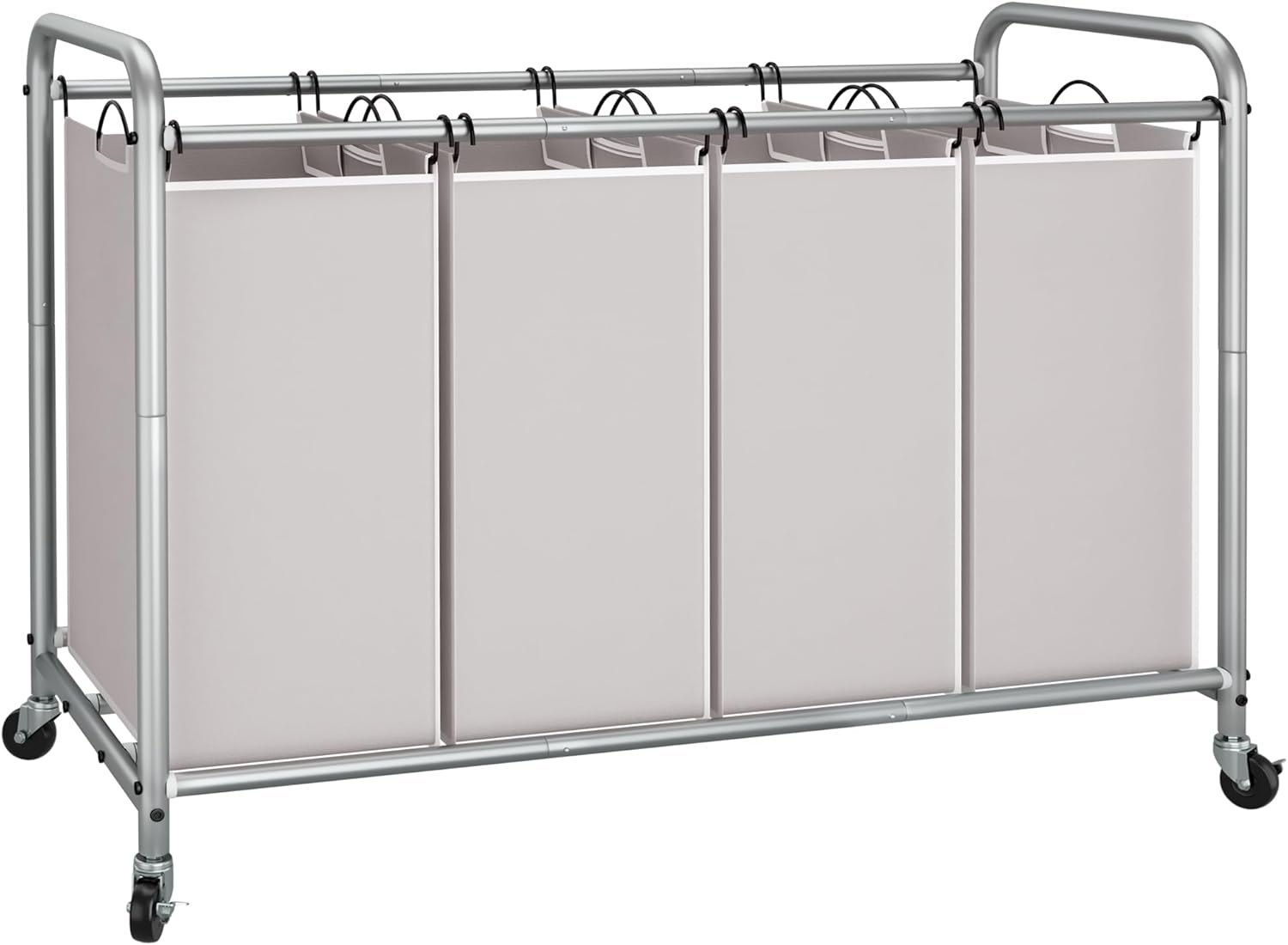
This rolling sorter provides four removable 45L bags for a combined 180L capacity. Each Oxford-fabric bag has a waterproof inner lining and metal handles, while the cart rides on four casters with two locking wheels. The four-section format gives households a concrete way to test whether every added compartment will actually be used.
Check On AmazonIf you click this link and buy, we earn a commission at no additional cost to you.
Compare each compartment with what you normally wash at once
Total capacity can make a sorter look generous while hiding the size of each section. At wash time, what matters is whether one compartment holds the amount you normally want to wash as that category. A large total split among small bags can make one busy category overflow while the others remain partly empty. Total liters or gallons therefore do not prove that the sorter matches your load pattern.
Use your normal washer loads as the reference point rather than chasing one universal container number. A frequently washed category needs enough room to avoid constant spillover or a second holding pile. A small, slow-growing category may not deserve equal capacity unless the layout provides another real benefit. Capacity only helps when it is distributed where laundry actually accumulates.
Total capacity can hide an awkward split
Imagine a large combined volume divided into four equal bags. If about half of your dirty laundry belongs to one recurring group, that group still receives only one bag unless you ignore the dividers. The combined number is accurate but incomplete because assigned compartments are not fully interchangeable. Check per-bag dimensions or capacity when available, and verify the detail before buying if the listing leaves it unclear.
| Capacity claim | What it tells you | What it does not prove |
|---|---|---|
| Total sorter capacity | Combined storage across sections | That the busiest category fits one section |
| Per-compartment capacity | Storage available to one assigned group | That it matches your washer load or carry preference |
| Exterior dimensions | Physical space the unit occupies | That internal space is distributed usefully |
This avoids a common first-time mistake. A bigger combined number can look reassuring while hiding an awkward split between bags. In a divided system, the individual compartment is usually the useful unit to evaluate. Judge each assigned bag before judging the total.
This 185L hamper measures 23.6 by 15.7 by 30.3 inches and divides storage across three sections. Three removable inner bags let one category travel to the washer without moving the full hamper. The polyester body, lid, handles, and foldable design make it useful for comparing total capacity with the way capacity is distributed among recurring loads.
Check On AmazonIf you click this link and buy, we earn a commission at no additional cost to you.
Price every extra section in permanent floor space
A sorter stays in the room when laundry day is over. Its width, depth, access clearance, and bag-removal space are permanent, which makes unused sections costly in floor area. Measure the real location, including doors, trim, cabinets, appliance doors, and the room needed to remove a bag. A frame can fit the wall and still be awkward if one compartment cannot come out cleanly.
This is where a larger clothes sorter can lose to a smaller divided hamper. A shelf or fourth bag may look useful online, but not if it narrows the path or collides with a nearby door. Measure the loaded workflow, not just an empty rectangle on the floor. The best footprint gives recurring loads enough space while keeping access simple.
Wide side-by-side layouts trade wall length for direct access
Side-by-side bags keep every category visible and usually provide direct access. The trade-off is width, which can be difficult in a narrow laundry room, closet opening, or bedroom corner. Check walking clearance and nearby doors before assuming the frame belongs in that spot. A wide layout earns its space when direct access reduces handling.
Tall layouts save width but change access
Vertical sorters can reduce wall width by stacking containers, but width is only one fit dimension. Check depth, overall height, how each section opens, and whether a full container can be removed comfortably. Reach height also matters when several people use it. Pick the orientation that works with the room and users, not simply the narrowest measurement.
For either layout, verify exact exterior dimensions. Check the specific item you are considering. Product photos are poor scale references. Generous staging space can make a sorter look smaller than it is.

This 75L beige hamper uses a narrow 17.4 by 9.8-inch footprint and stands 27.6 inches tall. It includes a lid, removable inner bag, and bamboo handles in a single-compartment design. The slim proportions make it useful for checking whether a laundry container fits a narrow wall, closet, or appliance-side space without claiming unnecessary floor area.
Check On AmazonIf you click this link and buy, we earn a commission at no additional cost to you.
Judge removable bags by the trip from sorter to washer
Removable bags matter when they eliminate a transfer step. If a full compartment lifts out, goes directly to the washer, empties, and returns to the frame, the sorter handles both collection and transport. That beats a fixed divider that still needs a separate carrying basket. Check handle comfort, attachment method, opening size, and loaded shape rather than judging the bag while empty.
Removable does not always mean convenient. Bags may slide, hang, hook, or fasten into a frame, and the release method can become awkward when the bag is full. Look at the exact attachment and the clearance needed to remove it. Independent hamper testing also considers portability and removable liners, which reinforces why transport deserves attention alongside capacity.
Lift-out bags make sense when the frame stays put
A stationary frame with lift-out bags fits homes where laundry is collected in one place and carried to a nearby washer. The bag becomes the carrier, so the whole frame can remain parked. You can move only the category that is ready while leaving the others in place. Make sure the bag clears shelves, walls, and neighboring compartments during removal.
Rolling the whole frame changes the job
If the whole loaded sorter moves, caster quality, frame rigidity, handle position, route, and parking space become more important. That differs from carrying one bag at a time. It can work on a clear, level path, but both ends need parking room. When movement, folding, hanging, or supply storage becomes the main job, the purchase is closer to a larger laundry workstation than a simple sorter.
| Transport pattern | What should work well | Main fit check |
|---|---|---|
| Carry one removable bag | Handles, attachment, loaded shape | Clear lift-out path and comfortable carry |
| Roll the whole frame | Casters, rigidity, steering | Clear level route and parking space |
| Transfer into another basket | Open section access | Whether the extra transfer is acceptable |
Dirty laundry may still need to move from the sorter into another carrier. Count that transfer as part of the routine. A simpler laundry basket vs hamper setup may fit better. That is especially true when carrying matters more than permanent pre-sorting.

This 105L tall hamper includes a lid and a removable inner bag that can be carried separately to the washer. Its foldable body measures about 16.9 by 13 by 29.5 inches and uses side handles for moving the hamper itself. The detachable bag directly supports a workflow where the collection container stays put and only the ready load travels.
Check On AmazonIf you click this link and buy, we earn a commission at no additional cost to you.
Treat wheels as a secondary feature when sorting is the main job
Retail assortments make wheels easy to notice because rolling frames look flexible, but mobility should not rescue a poor compartment layout. First decide whether the sections match real loads, whether each bag has useful capacity, and whether the sorter fits its permanent location. Then ask whether wheels reduce a repeated movement step on a clear, level route. A sorter that spends nearly all of its time parked does not need mobility to justify extra width, frame weight, or hardware.
If you do plan to roll the unit, check the exact caster arrangement, locking method, loaded stability, and the path between the collection point and laundry area. Small wheels that work on smooth flooring may behave differently at raised transitions, rugs, or tight turns, so product-specific construction matters. Keep the evaluation at normal owner level and do not treat a rolling sorter as equipment for stair transport. The wheel question is simply whether the feature reduces a real repeated task in the space where the sorter will be used.
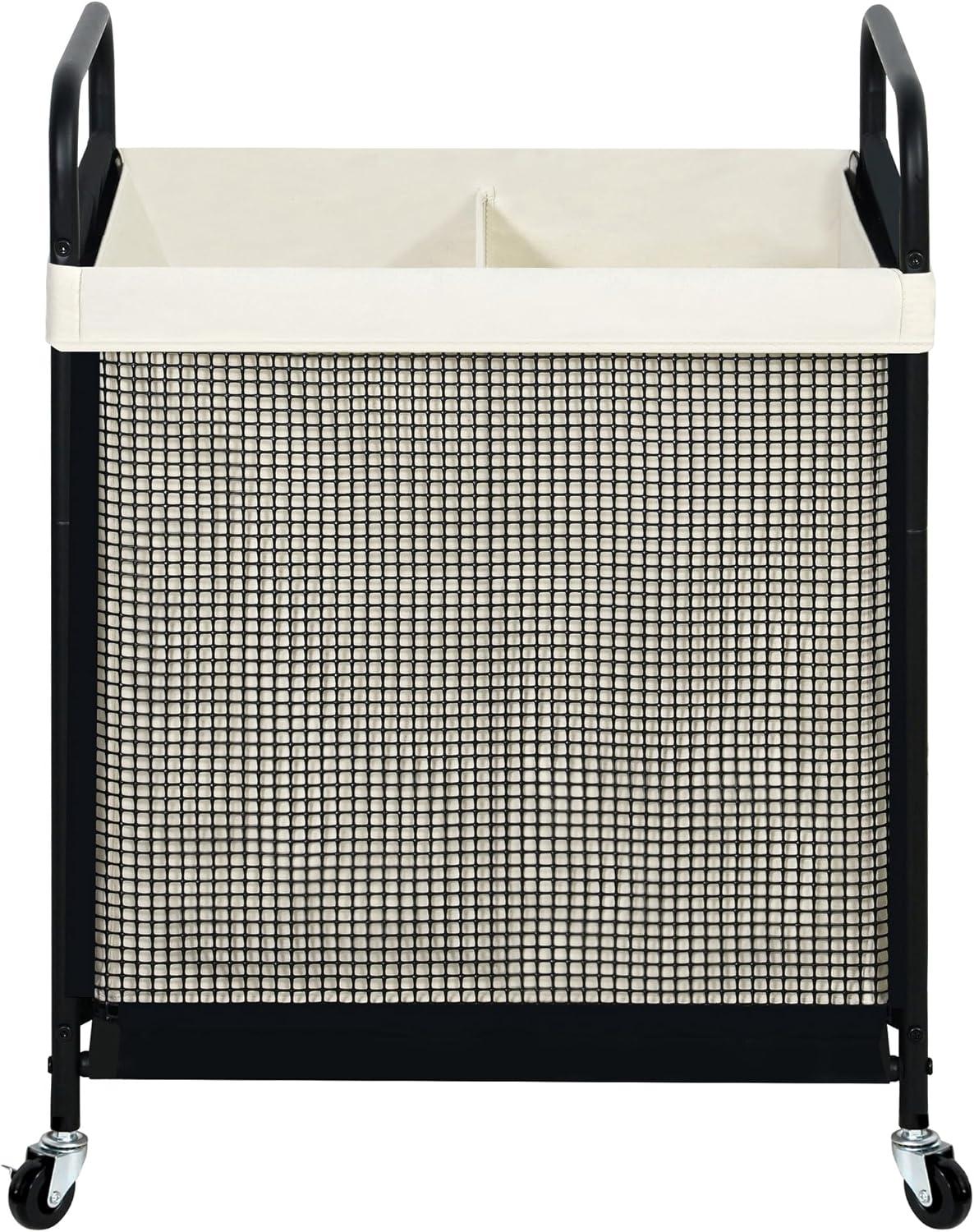
This 100L sorter combines two laundry sections with a wheeled metal-frame cart. Its liner bag is removable and washable, and the cart includes multidirectional wheels with locking capability. That makes it a relevant example when mobility is useful only after the compartment layout already matches the household's real sorting routine.
Check On AmazonIf you click this link and buy, we earn a commission at no additional cost to you.
Check frame stability, bag sag, cleaning, and replacement parts
A divided frame can face uneven loads because several bags may fill at different rates. One compartment may be full while the others are light, so a frame should remain steady under uneven loading during normal use. Check how bags attach, whether their bottoms are supported, and whether a full bag is likely to sag into wheels, lower shelves, or neighboring sections. These details are more decision-relevant than decorative finishes if the sorter will be loaded and unloaded constantly.
Cleaning also deserves a look before purchase. Verify whether the bags or liners can be removed, what cleaning method the manufacturer allows, and whether rigid surfaces can be wiped without disassembling half the frame. If the design uses proprietary bags, hooks, rods, or other removable parts, see whether replacements are available rather than assuming a visually similar part will fit. Exact model documentation should control cleaning, replacement, assembly, and load guidance whenever instructions vary by design.

This 3-section sorter uses three removable polyester-canvas bags on a metal frame with reinforced horizontal support bars. Four rolling casters include two locking wheels, and the bags use waterproof inner lining for routine wipe-down care. Product documentation also identifies a replacement-bag option, which makes the model useful for checking stability, cleaning, and parts availability before purchase.
Check On AmazonIf you click this link and buy, we earn a commission at no additional cost to you.
Lids, shelves, and hanging bars should replace a real nearby task
Extra features are worthwhile only when they remove a real task or replace something else you need. A lid can keep dirty laundry visually contained, a top shelf can hold supplies that already need a home, and a hanging bar can support a real garment-handling step near the washer. None of those features fixes compartments that are too small or categories that nobody follows. Start with the sorting architecture, then decide whether the add-on earns the extra size, cost, and cleaning surfaces it introduces.
A shelf is especially easy to overvalue because it makes a sorter look like efficient furniture in a product image. Measure what you intend to place on it, check the shelf clearance above the bags, and make sure stored items do not block bag removal. The same logic applies to lids and bars: identify the repeated job first, then verify that the exact design performs that job without interfering with collection. If the feature has no specific task in your laundry area, simpler construction is usually easier to own.

This VASAGLE sorter combines two pull-out removable 46L bags with a top shelf and metal frame. Its construction uses steel, MDF, and Oxford fabric, and the unit measures 28.8 by 13 by 28.4 inches. The shelf adds usable storage above the bags, so it is a good example of an extra feature that should earn its space by replacing a real nearby storage task.
Check On AmazonIf you click this link and buy, we earn a commission at no additional cost to you.
Labels only help when everyone uses the same sorting system
Labels can reduce decision friction when several people add dirty laundry to the same sorter, but only if the category names make sense to everyone using it. A beautifully labeled four-section system fails quickly when people are unsure where an item belongs or simply use the nearest open bag. Keep the number of choices low enough that the routine is obvious without explanation. If the sorter needs a long set of household rules to work, the architecture may be more complicated than the laundry process requires.
Choose labels around established load groups rather than prescribing a universal lights, darks, and whites formula. Your recurring categories might be based on care requirements, household routines, or another practical division that already exists. The exact garment label and washing instructions still take priority when an item needs special handling. The sorter should make a known routine easier to follow, not make people guess at fabric-care rules every time they drop in a shirt or towel.

This Bluetooth thermal label maker prints without ink or toner and supports labels for home organization. The app offers 30 fonts and more than 660 icons, and the set includes three label tapes. It is useful when a shared laundry sorter needs clear, consistent category labels that everyone in the household can understand at a glance.
Check On AmazonIf you click this link and buy, we earn a commission at no additional cost to you.
Choose a single hamper, a sorter, or separate baskets from the workflow
Once you know recurring loads, per-compartment needs, available space, and transport method, the container choice becomes clearer. A single hamper is enough when pre-sorting does not save meaningful work or when space is too tight for permanent divisions. A multi-compartment sorter is strongest when two or more categories recur predictably and the sections can each hold a useful amount. Separate baskets can work when the categories live in different rooms or when portable containers fit the collection route better than one fixed frame.
None of these is automatically more organized than the others. The better system is the one that keeps dirty laundry contained, makes the next washer load obvious, and does not create overflow piles or unused capacity elsewhere. It should also match who actually does the carrying and loading, because a system that looks efficient but adds awkward transfers will not stay efficient for long. Use the outcome table as a final check before comparing individual products.
| Decision path | Choose | Why |
|---|---|---|
| If you normally sort only when loading the washer | Single hamper | Permanent dividers would not remove a repeated collection step |
| If two or more recurring loads need to stay separate before wash time | Multi-compartment sorter | Each useful section can hold a known load group until it is ready |
| If collection points are spread across rooms or carrying is the main job | Separate baskets | Portable containers may fit the route better than one fixed frame |
A simple single container is not a failed organization system. It may be the most efficient answer. It removes permanent dividers your household does not need. It also gives that floor space back to the room.

This set includes two separate 75L laundry baskets rather than one fixed divided frame. Each basket is freestanding, collapsible, waterproof, and fitted with reinforced handles for carrying. The pair is a practical comparison point when portable containers in different rooms fit the collection route better than a permanent multi-compartment sorter.
Check On AmazonIf you click this link and buy, we earn a commission at no additional cost to you.
Define your requirements before comparing current sorter models
Product selection should come after the section count and workflow are settled. Listings change, and retailers may carry two-section hampers, three-bag rolling frames, four-bag units, vertical systems, and shelf or lid designs. That variety is useful only after you know the architecture you are trying to buy. Otherwise, feature-rich listings can turn a simple two-load routine into an oversized purchase.
Write down your required compartment count, maximum exterior width and depth, preferred transport method, per-bag capacity evidence, and any feature that replaces a real task. Then compare exact dimensions, bag construction, cleaning instructions, wheel design if relevant, and replacement availability on the specific item. If you are ready to move from requirements to current options, the best laundry hampers article is the appropriate next step for model-level recommendations. This page stops at defining what a sorter should do for your household rather than naming a product before the fit is known.

This ROMOON sorter uses four removable Oxford-fabric bags on an alloy-steel rolling frame. Four swivel casters provide mobility, with two lockable wheels to keep the cart stationary during loading and unloading. The current four-section configuration gives shoppers a model-level example to compare against required compartment count, transport method, and permanent space.
Check On AmazonIf you click this link and buy, we earn a commission at no additional cost to you.
Final thoughts: buy only the compartments your laundry routine will use
A good sorter makes the next load easier to see and easier to move, without turning unused sections into permanent furniture. Count recurring loads first, compare each bag with what you normally wash at once, measure the real footprint, and decide whether you carry individual bags or move the whole frame. Treat wheels, shelves, lids, and labels as supporting features rather than reasons to buy a larger system. If a section would rarely fill or would routinely be ignored, remove it from the plan before you spend money and floor space on it.
The simplest useful system is usually the safest buying target because every compartment has a job you can explain. That may be one hamper, two sorter bags, three recurring categories, or separate portable baskets in different collection points. The number itself is not the goal. The goal is a collection setup that reflects the way your household actually creates and washes laundry.

This 60L basket is handwoven from cotton rope and works as a single portable laundry container. Its collapsible construction can be reshaped after unpacking, and the woven body provides a softer alternative to a rigid sorting frame. It fits the article's final decision path when one simple hamper is more useful than paying for permanent compartments the household will not use.
Check On AmazonIf you click this link and buy, we earn a commission at no additional cost to you.
FAQs
🧺 Is a two-compartment laundry sorter enough?
Yes, if your routine has two recurring load groups that both fill at a useful pace. Do not add a third section unless it repeatedly prevents re-sorting or overflow.
📦 Should one sorter compartment equal one washer load?
It is a useful comparison, but do not assume an exact one-to-one match from capacity labels alone. Compare the compartment with the amount you normally wash in that category and follow the washer’s own loading guidance.
📏 Are vertical laundry sorters better for small spaces?
They can save wall width, but you still need to check depth, height, access, and how full containers are removed. A narrow footprint is not a win if lower or upper sections are awkward to use.
🛞 Do I need wheels on a laundry sorter?
Only if you regularly move the loaded frame on a clear, level route. If the frame stays parked and you carry removable bags, wheel quality is secondary.
🏷️ Should I label laundry sorter compartments?
Labels help when they reflect load groups the household already understands. If people regularly ignore or confuse the labels, simplify the categories rather than adding more instructions.
🧼 Can removable sorter bags go in the washing machine?
Only when the exact manufacturer’s care instructions allow it. Materials, coatings, stiffeners, handles, and attachment hardware vary, so verify the specific bag rather than assuming all removable liners are machine washable.
References and sources
- Target laundry sorters: Confirms current two-, three-, and four-section formats plus removable bags, wheels, shelves, and other common retail configurations.
- Good Housekeeping hamper testing: Supports evaluating size, portability, compartments, and removable liners as practical ownership fields.
- Household laundry-system discussion: Provides community evidence that desired sorting categories often exceed available space or change with household routines.