A hamper, basket, and sorter can all hold laundry, but they solve different parts of the same household route. The right choice depends on where dirty clothes collect, how far each load travels, whether sorting happens before wash day, and how much floor space the container permanently occupies. A stationary hamper favors containment, a basket favors carrying, and a sorter earns its footprint only when its compartments remove a repeated sorting step. The goal is to choose the container that makes the whole trip from clothing drop-off to washer and back easier, not the one with the most features.
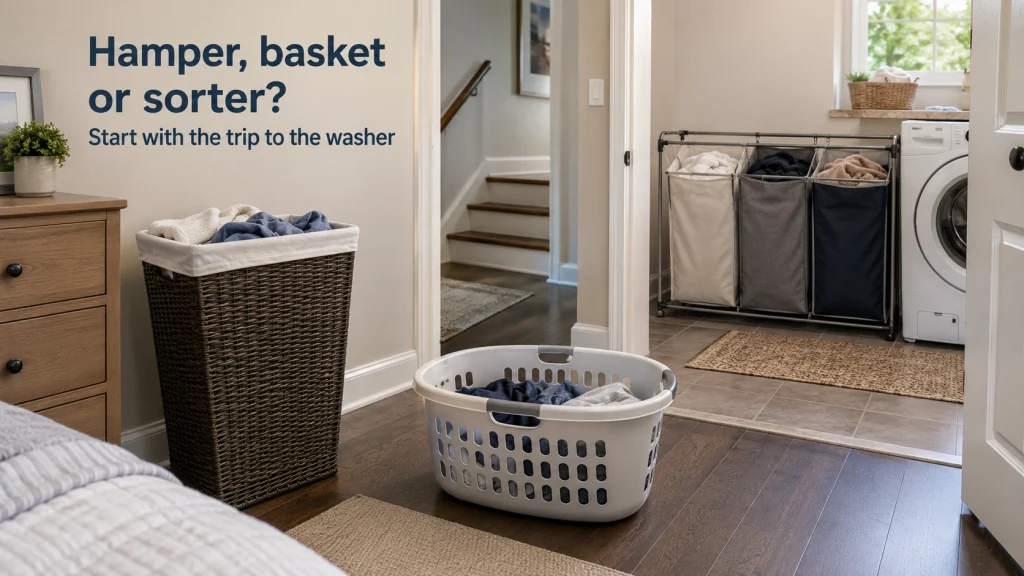
Start with the trip to the washer, not the label on the container
A laundry hamper can look perfect beside a dresser and still be the wrong tool if every full load has to be carried down a long hallway, through a narrow doorway, and to a washer on another floor. Follow one shirt instead: it comes off, lands somewhere, waits with other dirty clothes, moves to the washer, gets cleaned, and eventually comes back. That route reveals whether the household mainly needs a place for clothes to wait, a container that travels well, or a system that sorts loads before they move. The product name matters less than the step that keeps creating extra work.
The same household may need more than one container because dirty-laundry collection and clean-laundry transport are not automatically the same job. A tall bedroom hamper can stay put while a lighter basket carries a wash load, or a sorter near the washer can receive clothes from several rooms without being the thing that returns clean laundry upstairs. That is why the first decision should be about movement, space, and repeated steps rather than appearance or nominal capacity. If the larger question is how storage systems fit around household routines, the broader home storage and organization section provides the surrounding context.

This 90L hamper measures 15 x 15 x 31 inches including the handle. Its aluminum handle has a soft EVA grip, and the 600D oxford fabric has a thickened PE coating inside. It folds for storage and should be wiped clean rather than machine washed.
Check On AmazonIf you click this link and buy, we earn a commission at no additional cost to you.
Define hamper, basket, and sorter by primary job rather than retailer naming
Retailer labels overlap, so rigid definitions are less useful than the job each container performs. A clothes hamper usually holds dirty laundry in place, a basket usually favors carrying, and a sorter adds compartments for pre-sorting. Major retailers still separate those product classes even though individual designs blur the lines. A wheeled hamper, for example, can act like stationary storage in one home and a transport container in another.
| Type | Primary job | Key checks | Reason to skip |
|---|---|---|---|
| Hamper | Stationary collection | Footprint, opening, liner, lid, ventilation | The full shell is awkward to move |
| Basket | Carrying | Handles, width, weight, storage | It uses too much floor area |
| Sorter | Pre-sorting | Compartments, bags, frame footprint | The separation is rarely used |
Independent testing also looks beyond capacity at carrying, ventilation, cleaning, assembly, and storage use. That matters because shape and feature count do not prove household fit. A hybrid product should be judged by the job it performs most often, not by the word on its listing. Once that job is clear, the route to the washer becomes the more important filter.

This two-pack provides 75L of capacity per basket, with each measuring 15.7 x 11.8 x 24.4 inches. Reinforced handles support carrying, while the fabric uses a PEVA-coated interior. The baskets collapse for storage, and the manufacturer recommends wiping the coated surface clean instead of machine washing.
Check On AmazonIf you click this link and buy, we earn a commission at no additional cost to you.
Map the collection-to-washer route before choosing a container
Start where laundry actually appears, not where you wish everyone would carry it. Note the collection point, washer location, doors, stairs, and any shared laundry area between them. Then ask whether the full container moves or only a liner leaves the room. Those observations reveal whether the system mainly needs stationary collection, easier transport, or pre-sorting.
| Route check | What to observe | Likely implication |
|---|---|---|
| Collection | Where clothing accumulates | Put collection close to that point |
| Travel | Doors, halls, shared areas, stairs | Favor manageable loads and useful handles |
| Sorting | Drop-off or washer area | Use a sorter only when it saves work |
| Clean return | How clean laundry goes back | Add a clean basket if roles conflict |
Trace the clean trip too because it may need different equipment. Clean folded items often benefit from a wide basket even when dirty clothes collect in a tall hamper. Wheels can help on suitable level flooring, but they do not make a large container appropriate for stairs. If a full load is awkward on the real route, reduce the load, change the container type, or use assistance.
Where dirty laundry accumulates
A container far from the natural drop point often loses to the floor or a chair. That may be a placement problem rather than a capacity problem. Several smaller collection points can work better than one oversized central hamper.
How far it travels and whether stairs, narrow doors, or shared laundry rooms matter
Distance changes which dimensions matter most. A wide basket may load easily yet fight a narrow doorway, while a tall hamper may save floor space but be awkward to move full. Measure the tight parts of the route and judge portability with the expected load in mind.
Whether clean laundry returns in the same container
One container can work in both directions when load timing rarely overlaps. When clean laundry waits while new dirty clothes accumulate, the shared container becomes a bottleneck. A dedicated clean basket is worthwhile when it removes that repeated conflict.

The 48L efluky hamper measures 15.5 x 7.5 x 23 inches, giving it a narrow rectangular footprint. Four support rods hold it upright and can be removed when the hamper needs to fold down. Its slim shape is designed for tighter spaces such as closets or gaps around a laundry area.
Check On AmazonIf you click this link and buy, we earn a commission at no additional cost to you.
Choose a stationary hamper when containment and room fit matter more than carrying the full shell
A stationary hamper earns its place when the outer container can stay where dirty clothes collect. This favors tall designs that use floor space efficiently in bedrooms, closets, or bathrooms. Check the opening, footprint, and clearance needed to remove the laundry before assuming a larger shell is better. A hamper that crowds a door or encourages oversized loads is solving the wrong problem.
A removable liner can separate collection from transport because the frame stays put while the load moves. In that setup, liner handles matter more than decorative handles on the outer shell. The liner also has its own care requirements, so verify its washing instructions rather than assuming it is machine washable. If removal and reinstallation are fussy, the feature may add more work than it removes.
Use removable liners and usable handles when the outer hamper is meant to stay put
A useful liner should lift without catching on the frame and keep its handles accessible as it fills. Judge the route using the liner’s shape and expected load because that is the part that actually travels. Treat the shell and liner as a two-part system, with both parts needing to fit the routine.
Treat lids and ventilation as separate trade-offs
A lid hides contents and changes access, while ventilation affects how enclosed the container is. More enclosure is not automatically better, especially when damp items need prompt handling. Choose the lid for visibility and access, then judge airflow as a separate feature.
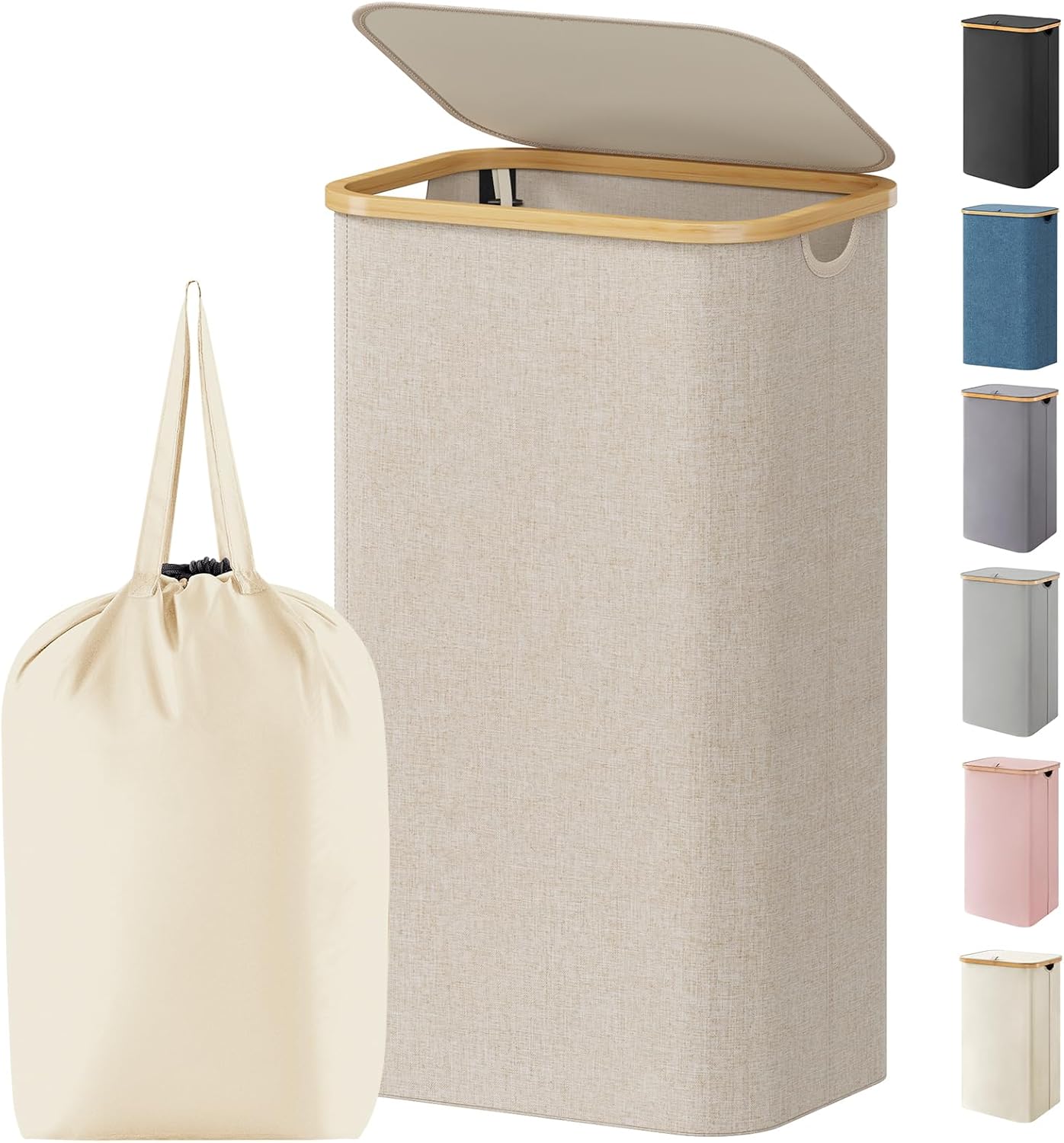
This 100L Lifewit hamper measures 16.93 x 12.6 x 29.53 inches. It includes a lid and a removable inner bag, separating the stationary outer hamper from the part that carries laundry. The polyester hamper also uses bamboo handles and folds when not in use.
Check On AmazonIf you click this link and buy, we earn a commission at no additional cost to you.
Choose a laundry basket when the container itself must carry a load
A basket makes the most sense when transport is the repeated job rather than simply holding dirty clothes out of sight. Handle position, empty weight, width, and how the basket behaves when partly full can matter more than whether it has a lid or matches the room. A wide opening also makes it easier to place folded laundry flat on the return trip, which is one reason a basket can serve clean laundry especially well. The trade-off is that the same wide footprint may be harder to leave permanently beside a bed or inside a tight closet.
The direct comparison becomes clearer when you separate stationary storage from movement. If you are deciding between those two roles rather than comparing every laundry container at once, the laundry basket vs hamper comparison takes that decision further. For this broader article, the useful rule is that a basket should be judged while imagining the full route, not merely while checking how many clothes fit inside. A basket that nests or collapses can also earn back storage space between uses, but only if the mechanism remains convenient enough that you actually use it.
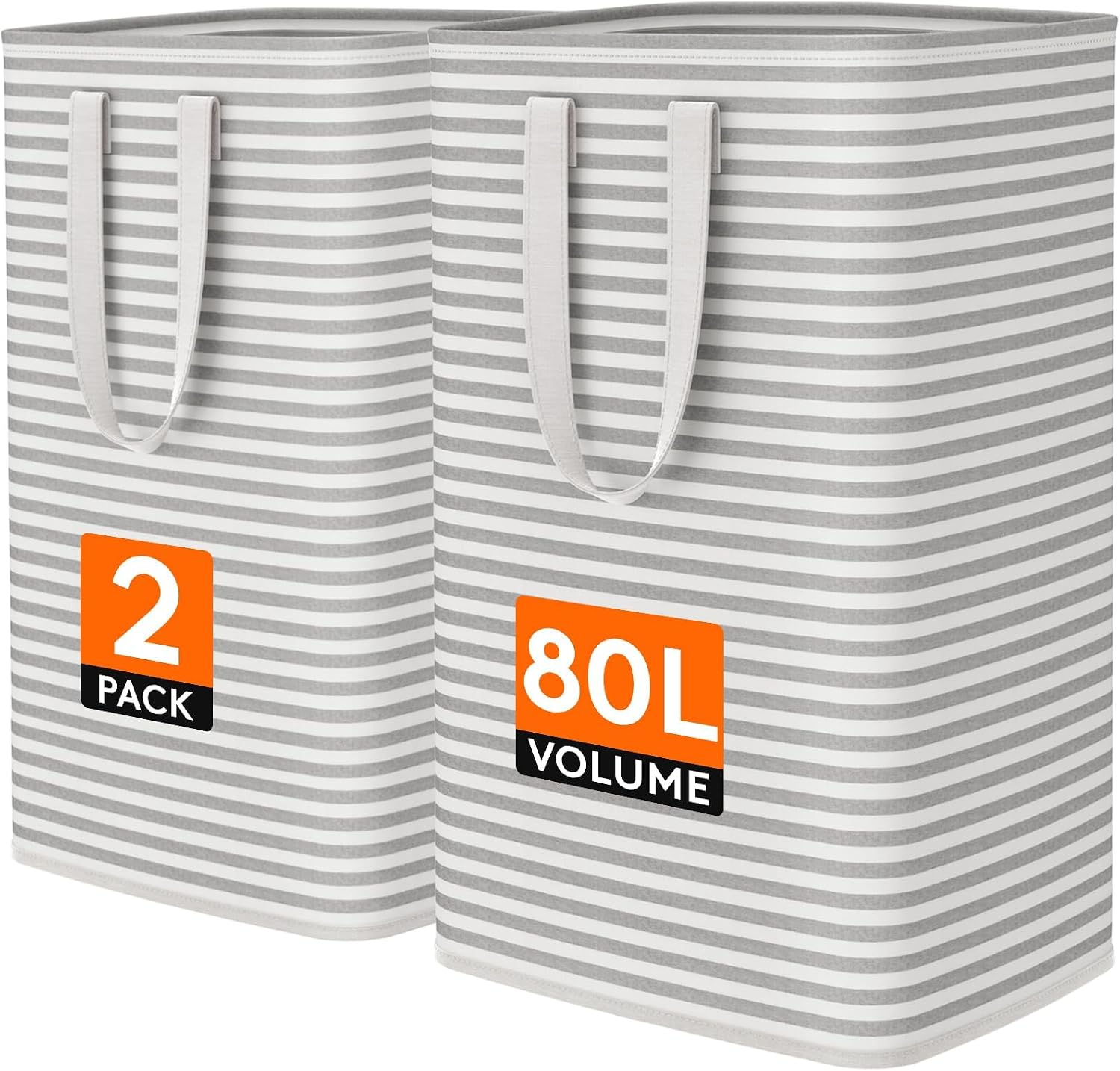
This set includes two 80L hampers, each measuring 15.7 x 11.8 x 26.4 inches. Reinforced handles support carrying, while a wire frame at the top helps each hamper stand upright. The polyester design is collapsible and uses a moisture-resistant inner coating.
Check On AmazonIf you click this link and buy, we earn a commission at no additional cost to you.
Choose a laundry sorter when pre-sorting removes a repeated step
A sorter is useful when the household already separates laundry in a repeatable way and would otherwise create the same sorting pile before each wash. The compartments should match real wash categories, not an idealized system that nobody follows after the first week. Two well-used sections can be more useful than four half-understood ones, especially when a larger frame consumes more floor space. The question is not how many labels the sorter can hold; it is how many distinct loads the household actually runs often enough to justify dedicated space.
Each compartment also has its own usable capacity, which matters more than the impressive total volume printed for the whole unit. If one category fills quickly while two others stay nearly empty, the frame may be large without reducing much work. Removable bags can help because only the ready load needs to move, while a fixed-frame sorter may be better suited to a laundry room where the washer is nearby. For a deeper look at compartment count and pre-sorting logic, see the dedicated laundry sorter article.

This sorter has three removable laundry bags and an overall frame measuring 29.5 x 16.9 x 31.5 inches. Each 45L bag lifts out by two metal handles and is rated for up to 25 pounds. Rolling wheels and the divided frame make it suited to separating loads before they reach the washer.
Check On AmazonIf you click this link and buy, we earn a commission at no additional cost to you.
Separate advertised total capacity from the useful amount in one normal wash category
Capacity numbers can create false confidence because they describe the container, not necessarily the load you are ready to wash. A large single hamper may hold several washer loads, while a divided sorter may advertise a large total even though each compartment is much smaller. What matters is how much laundry usually accumulates before you want to run a load and whether the container encourages you to overfill beyond what is comfortable to move. Useful capacity is therefore a workflow number as much as a volume number.
Start with the household’s wash rhythm instead of searching for the biggest number. If towels are washed frequently but other clothing waits longer, the towel compartment may need more practical space than the others, and a symmetrical sorter may not match that pattern. If a bedroom hamper routinely contains multiple loads, a removable liner or smaller transfer basket can be more useful than simply buying a larger shell. Nominal liters, bushels, or gallons are comparison clues, not proof that the container fits the household’s normal load size.

This iEGrow hamper provides 110L of capacity in a tall single-compartment design. A bamboo handle supports carrying, while the removable inner bag lets laundry move without taking the whole hamper. The inner bag is machine washable, and the hamper includes a lid.
Check On AmazonIf you click this link and buy, we earn a commission at no additional cost to you.
Price the container in permanent floor space as well as stated capacity
A low-priced container can still be expensive in floor area if it crowds a closet, hallway, or laundry zone. Sorters need special scrutiny because more compartments usually mean a wider permanent footprint. A tall hamper may use less floor width, but that shape can be less convenient if the whole shell must move. Measure the parking spot and include clearance for lids, liners, and wheels.
| Design | Space effect | Carry effect |
|---|---|---|
| Tall hamper | Uses less width | Best when the shell stays put |
| Wide basket | Uses more floor area | Often better for transport |
| Sorter | Needs dedicated width | Removable bags can limit what moves |
| Collapsible container | Can reclaim space | Useful if setup stays convenient |
Carryability pushes the choice in the other direction because wider baskets can be easier to load and handle. Collapsible designs can reclaim space, while rigid frames stay ready with no setup. A larger footprint is justified only when the handling or sorting benefit is used often enough. Compare the permanent space you spend with the work the design actually removes.

This 70L pop-up hamper uses breathable polyester mesh and a wide opening for loading laundry. Reinforced handles support carrying, and a side pocket provides a separate small storage area. The frame twists down to an 8-inch disc for compact storage between uses.
Check On AmazonIf you click this link and buy, we earn a commission at no additional cost to you.
Check handles, liner removal, wheels, and collapsibility against the exact movement path
Movement features should make handling simpler rather than add setup. Handles need to remain reachable when full, liners should travel without becoming awkward sacks, and collapsible frames should open and stow without turning every load into a chore. Check these details against the point where the container is hardest to lift, turn, transfer, or store. A feature that looks convenient in a product photo still has to solve that specific movement problem.
- Check handle access with the expected load.
- Measure the narrowest doorway or closet opening.
- Confirm whether a liner can travel without the frame.
- Count only the level floor where wheels can help.
- Decide whether collapsibility will be used often enough to matter.
Walk through where the container will be lifted, turned, parked, or transferred. If any part of that movement depends on an awkward load, reduce the load, change the container type, or use assistance. A strong handle or clever folding mechanism cannot compensate for a frame that will not fit the collection point. Prioritize the feature that fixes the most troublesome handling point rather than collecting conveniences that rarely matter.
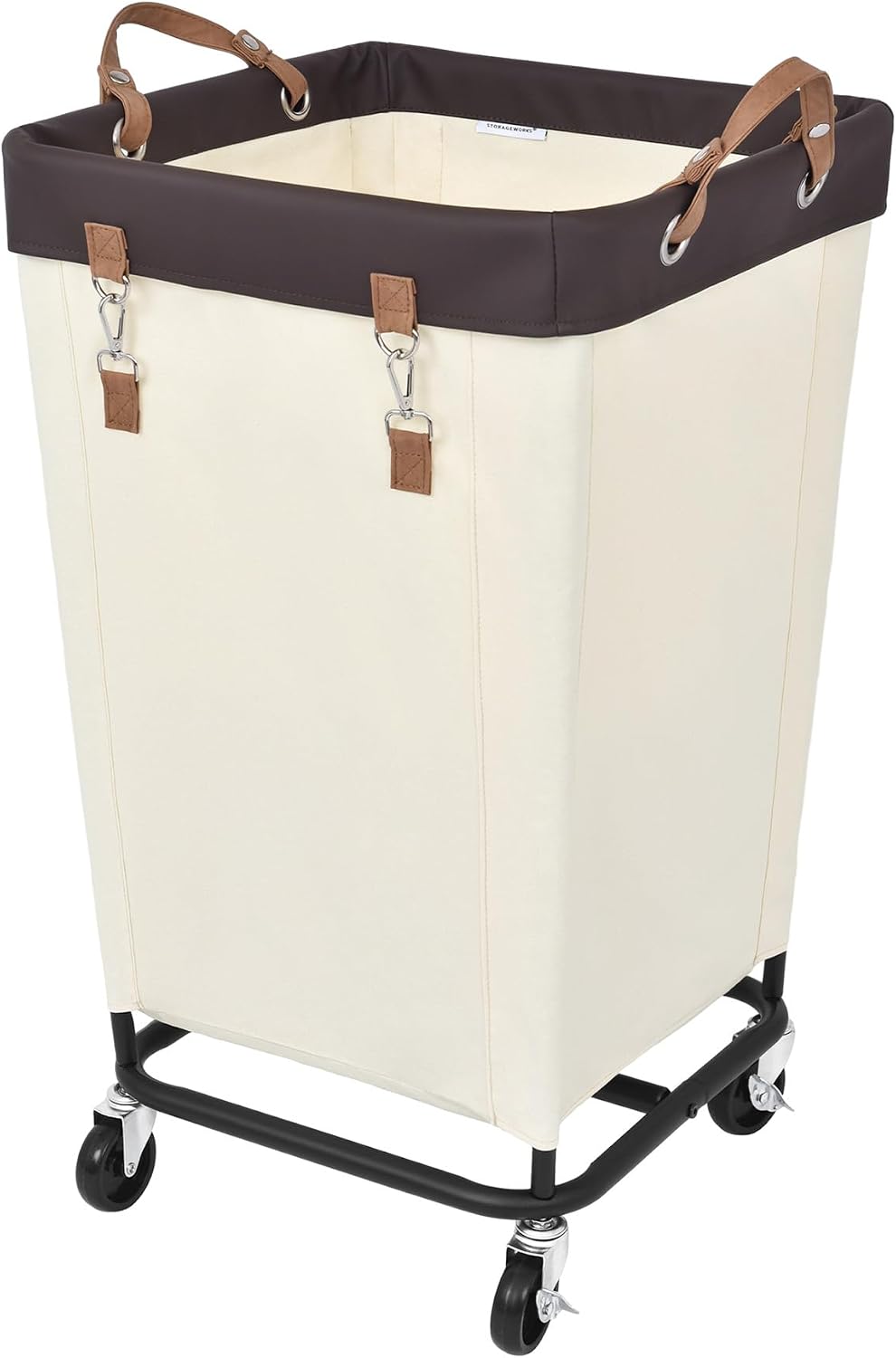
This rolling hamper provides 160L of capacity and uses 360-degree wheels for movement across level floors. A soft leather handle gives a dedicated grip for pushing or pulling the basket. Its metal frame keeps the large fabric hamper upright while it is being used.
Check On AmazonIf you click this link and buy, we earn a commission at no additional cost to you.
Keep wheeled hampers and sorters in this decision when wheels only assist transport
Adding wheels does not automatically turn a hamper or sorter into a larger laundry workstation. If the product still exists mainly to collect dirty clothes, pre-sort them, and move them a short distance on level flooring, it belongs in the same decision as other hampers and sorters. The wheels are simply one transport feature to evaluate alongside handles and removable bags. Their value depends on the route, floor surface, thresholds, and whether the unit actually needs to move while full.
The boundary changes when the product’s primary purpose expands into folding space, shelving, hanging storage, or a mobile work surface. At that point, the household is no longer choosing only a laundry container; it is choosing a more permanent utility system with different space and workflow costs. Do not buy the larger system merely because it can also hold dirty clothes. Keep the decision here only while containment, sorting, and simple transport remain the main jobs.

This 75L Goodpick hamper combines four wheels with a sturdy pull handle for room-to-room movement. The inner mesh bag is removable and machine washable, so laundry can be lifted out without moving the outer hamper. A metal top frame helps the basket stay upright, and two of the wheels include brakes.
Check On AmazonIf you click this link and buy, we earn a commission at no additional cost to you.
Decide whether one container should handle both dirty and clean laundry
One-container simplicity works only when the same container is available in both directions. If it sits in a bedroom collecting dirty clothing, taking it away leaves that collection point empty. If it stays full of clean laundry waiting to be folded, new dirty clothing may end up elsewhere. A separate clean basket can remove that timing conflict without multiplying stationary hampers.
| Workflow | Best fit | Main trade-off |
|---|---|---|
| One container | Little timing overlap | May be unavailable when needed |
| Dirty hamper plus clean basket | Collection continues while clean laundry travels | Needs storage for a second item |
| Sorter plus clean basket | Sorting and clean transport both repeat | Largest footprint |
The choice also changes cleaning expectations because a clean-laundry basket should be easy to keep reasonably clean. A dirty hamper may benefit more from a removable liner or wipeable interior. Separate the roles only when doing so prevents a repeated conflict. The better system is the smallest set of containers that keeps the route from fighting itself.

This two-section sorter has a frame measuring 18.5 x 16.9 x 30.9 inches. Each removable bag measures 14.76 x 8.66 x 21.65 inches and is rated for up to 25 pounds. Four casters move the frame on level floors, and two of the wheels lock to hold it in place.
Check On AmazonIf you click this link and buy, we earn a commission at no additional cost to you.
Include cleaning, liner washing, and worn parts in the ownership cost
Laundry containers are simple equipment, but they still create maintenance work. Fabric liners may need washing according to their care labels, plastic or coated surfaces may need wiping, and woven or framed designs can have seams and corners that are harder to clean. Removable bags, handles, casters, and frames also take repeated load and movement, so inspect how replaceable or serviceable those parts are before assuming the lowest purchase price is the lowest long-term cost. A container that is easy to maintain can be worth more than one with extra decorative features.
Do not invent a universal replacement schedule for liners, handles, or frames because materials and use vary too much. Replace or stop using damaged parts when they no longer support the load or movement the product is meant to handle, and follow the exact care instructions for washable components. If a handle tears, a frame deforms, or a wheel assembly becomes unreliable, the right question is whether the affected part can be safely replaced or whether the container should be retired. Maintenance should preserve a useful routine, not turn a basic laundry container into a repair project.

This selected beige Lifewit variant provides 105L of capacity and measures 16.9 x 13 x 29.5 inches. The hamper uses a plastic frame with four support rods and includes a lid plus a detachable inner bag. Side handles provide a grip for moving the outer hamper when needed.
Check On AmazonIf you click this link and buy, we earn a commission at no additional cost to you.
Shop current options only after the container architecture is clear
Once the main job is clear, product shopping becomes much easier. You can reject a hamper that fails the route, a basket with nowhere to park, or a sorter whose extra compartments will not be used. Only then do dimensions, handle layout, liner construction, ventilation, collapsibility, wheels, and price become useful comparison fields. Fit comes before feature count because a feature cannot repair the wrong basic form.
Current baskets, stationary laundry hampers, and sorters can all belong in a broader shortlist when the evidence supports their intended role. The best laundry hampers article is the next step when you are ready to compare current products. If the unresolved question is about washers, dryers, steamers, or other treatment equipment, move to laundry and garment care equipment instead. Keeping those choices separate prevents a storage problem from turning into unrelated appliance shopping.
Let the unresolved role decide what you compare next
If stationary versus carry-first is still unclear, solve that before opening product pages. If the role is clear but sorting is not, focus on the wash categories that actually repeat. Once both workflow and form are settled, current specifications have the context needed for a useful comparison.

This SpaceAid hamper provides 110L of capacity and measures 17.5 x 13.25 x 29 inches. The tall design includes a lid and bamboo handles for a defined stationary-hamper architecture. Its collapsible construction allows the body to be stored more compactly when it is not in use.
Check On AmazonIf you click this link and buy, we earn a commission at no additional cost to you.
Final Thoughts: Choose the container for the whole route
The useful distinction is not which word sounds most correct on a product page. Choose a hamper when clothes mainly need a place to wait, a basket when the container itself needs to travel, and a sorter when pre-sorting consistently saves work before washing. Then check whether the chosen form fits the permanent floor space, doorway path, load size, cleaning routine, and return trip for clean laundry. That sequence keeps a simple purchase tied to the job it is supposed to do.
Do not force one container to do every job if that creates more handling or timing conflicts. A stationary hamper plus a clean-laundry basket can be simpler than a single oversized compromise, while a sorter only earns its space when its compartments are actually used. Measure the space and movement constraints, then decide which part of the routine deserves dedicated equipment. Once that is clear, the specifications on a product page become much easier to judge.

This EpicTotes set contains two 75L laundry baskets, each measuring 15.7 x 11.8 x 24.4 inches. Reinforced handles support carrying, while the freestanding bodies hold their shape during use. The baskets use a waterproof inner coating and collapse for more compact storage.
Check On AmazonIf you click this link and buy, we earn a commission at no additional cost to you.
Continue with the laundry-container decision that is still unresolved
The broad choice becomes easier once the remaining question is isolated. Some households still need to decide whether the container should stay put or travel, while others already know they want pre-sorting. Current-product shopping belongs after those questions are settled. Use the table to move directly to the next decision.
| Topic | What you’ll find |
|---|---|
| Laundry basket vs hamper | Stationary collection versus a container designed to carry the load. |
| Laundry sorter | Compartment count, pre-sorting logic, removable bags, and footprint. |
| Best laundry hampers | Current product comparisons after the container role is clear. |
If the first topic resolves the transport question, you may not need a sorter. If the second confirms that pre-sorting earns its space, shopping can focus on designs that support those exact compartments. The third is for readers who already know the form they need. Keeping that order prevents product features from taking over before the basic container role is settled.
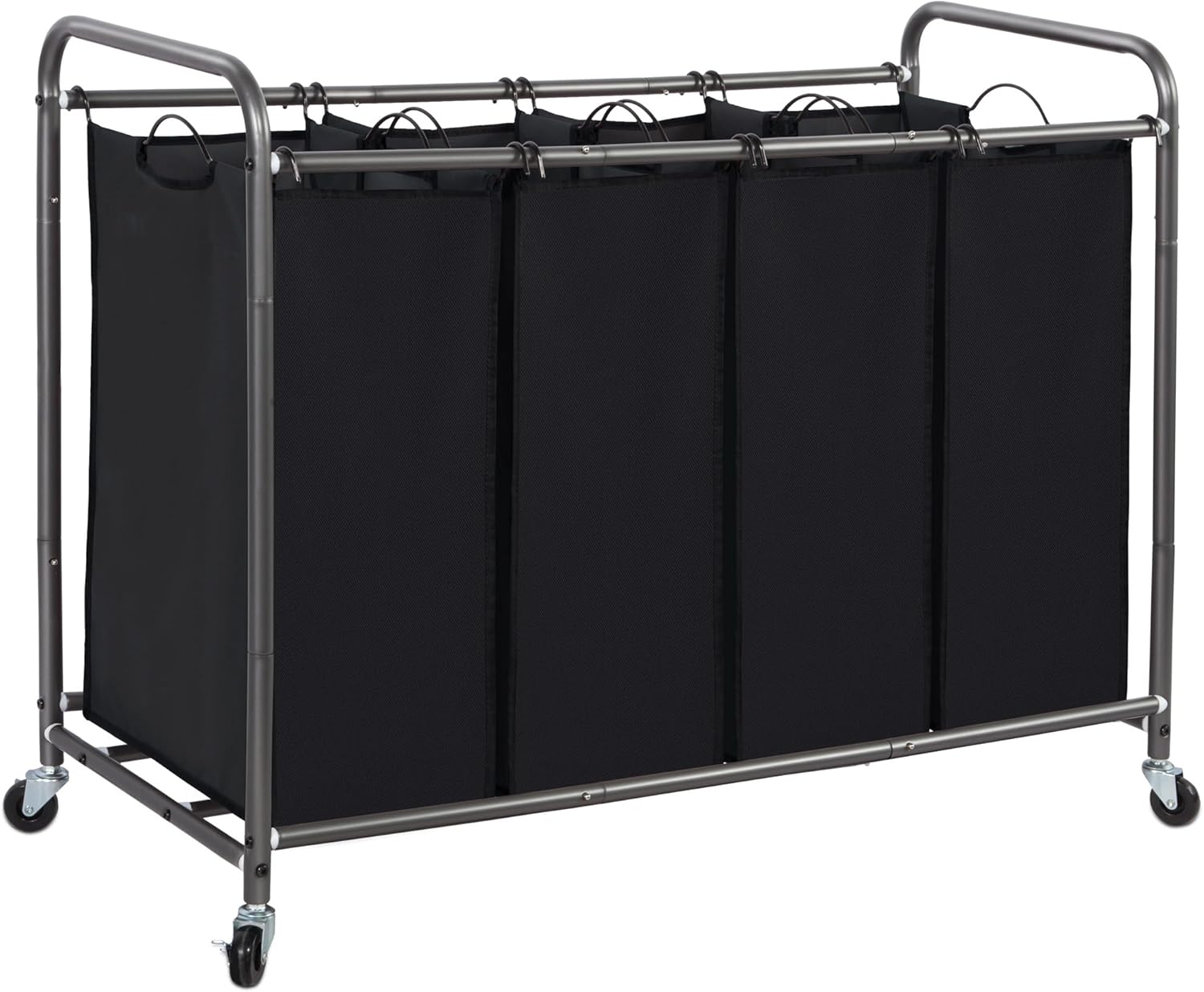
This four-section sorter has a frame measuring 39.4 x 16.9 x 31.5 inches. Its four removable bags have waterproof, wipe-clean linings, and each bag is rated for up to 25 pounds. The wheeled frame keeps four sorting categories together while allowing each bag to lift out separately.
Check On AmazonIf you click this link and buy, we earn a commission at no additional cost to you.
FAQs
🧺 Is a hamper for clothes different from a laundry basket?
Usually, a hamper is more useful for stationary collection while a basket is more useful for carrying, but retailer labels overlap. Judge the product by where it sits, how often it moves, and whether the full container must travel to the washer.
🚪 Should I choose a tall hamper or a wide basket for a small space?
A tall hamper usually saves floor width, while a wide basket may be easier to load and carry. Measure the parking spot, doorway route, and clearance needed to remove laundry before deciding which shape is actually smaller in use.
🧼 Is a removable hamper liner worth having?
It is useful when the outer hamper should stay in place and only the laundry needs to travel. Check the liner’s handles, removal path, and care instructions so the feature does not create more work than carrying the shell would.
🧦 How many sections should a laundry sorter have?
Use the number of wash categories your household actually separates consistently. Extra sections only help when they remove a repeated sorting step and each compartment has enough useful capacity for the loads you normally run.
🪜 Do wheels make a large hamper a good choice for stairs?
No. Wheels can help on suitable level floors, but they do not make a container appropriate for stairs. Choose a manageable load and container for the actual route, and use assistance when moving the load would otherwise be awkward.
References and Sources
- Target laundry storage: Supports the distinction among laundry baskets, laundry hampers, and laundry sorters as separate retail product classes.
- Good Housekeeping laundry-container testing: Supports using practical fields such as carrying, ventilation, cleaning, assembly, and storage use when judging household fit.