A humidifier is worth considering only when room humidity stays low enough to justify adding moisture, not simply because the air feels dry. A small hygrometer, checked under ordinary room conditions and in another location when needed, is usually a better first purchase than another water appliance. Household clues such as static electricity or seasonal wood movement can support the decision, but they should not replace the sensor or become a medical diagnosis. By the end, you should know whether to wait, humidify one room, consider a larger portable approach, or get a whole-home moisture assessment.
Put a hygrometer ahead of the shopping cart
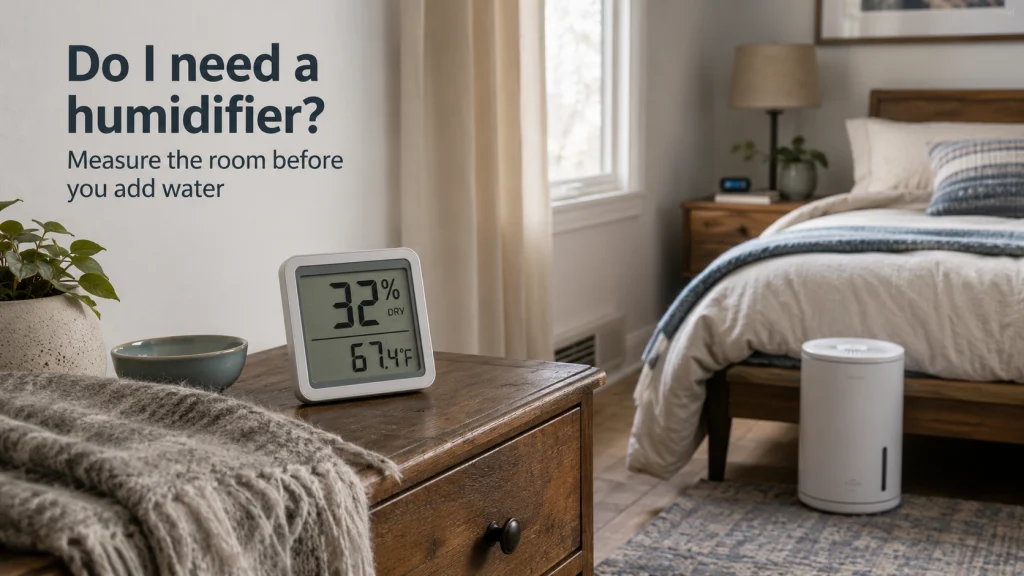
If you are asking, “do I need a humidifier?”, start with a humidity reading rather than a shopping page. A room can feel dry because of heating, airflow, temperature, personal comfort, or a temporary weather change, and those situations do not all call for the same equipment. The useful question is whether the air stays dry enough, often enough, that adding moisture would solve a household condition rather than a vague feeling. That is why I would rather spend a little time measuring first than commit to refilling and cleaning a machine that may not be needed.
The EPA advises using a humidifier only when conditions require it and adjusting moisture to the conditions in the home, which is a sensible boundary for this decision. One number can mislead if the sensor is beside a supply vent, near steam, or in a spot that behaves differently from the rest of the room. Take the appliance question off the table long enough to see whether low humidity persists during ordinary use. When the room consistently supports the same conclusion, the purchase decision becomes simpler and much less likely to turn into overbuying. A humidifier is only one of several air quality appliances, so the purchase should follow evidence that added moisture is actually the needed direction.

TempPro TP50 measures indoor temperature and relative humidity and refreshes readings every 10 seconds. Its display includes comfort indicators plus high and low records for both measurements. A tabletop stand and magnetic back provide flexible placement for checking ordinary room conditions.
Check On AmazonIf you click this link and buy, we earn a commission at no additional cost to you.
Know what a humidifier changes and what it does not
A humidifier has one basic household job: it adds moisture to indoor air. It does not remove airborne particles, diagnose why someone feels uncomfortable, repair air leaks, correct an HVAC distribution problem, or fix a building moisture issue. That distinction matters because the same room can have dry-feeling occupants while its actual moisture level is normal or even variable. If the problem is not consistently low room humidity, adding more water can be the wrong response.
This is also why symptom lists make a weak purchase threshold. Dry lips, a scratchy throat, irritated eyes, or skin discomfort may be reasons someone starts searching, but they are not reliable proof that the room needs more moisture. This article stays on the household-equipment side of the decision: measure the room, look for repeatable environmental clues, and separate local dryness from a broader pattern. Medical concerns belong with an appropriate health professional, while persistent building moisture or condensation belongs with the right home assessment rather than a stronger humidifier.

Dreo HM311S is a 4-liter cool-mist humidifier rated for rooms up to 300 square feet. Its sensor supports automatic humidity control, while the Dreo app plus Alexa and Google Assistant provide remote-control options. The top-fill tank is rated for up to 36 hours of runtime, and published operating noise is as low as 28 dB.
Check On AmazonIf you click this link and buy, we earn a commission at no additional cost to you.
Measure relative humidity across more than one normal moment
A hygrometer is most useful when it shows how the room behaves under normal conditions rather than giving you one dramatic number. Check the space during ordinary use, then check again after the household conditions have changed enough to show whether humidity stays low or moves around. Avoid placing the sensor directly beside a humidifier, vent, radiator, open window, steamy bathroom doorway, or another spot that can distort the local result. If one room feels noticeably different from the rest of the house, compare locations instead of assuming one sensor represents everything.
For interpretation, a general indoor relative-humidity range of 30% to 50% is useful context, not a purchase switch. If the room stays below the lower end during normal use, that is a reason to investigate further, but one low result does not automatically mean you should buy a humidifier. The EPA advises against humidifying above 50%, and condensation on windows or other surfaces is a practical warning that the space may already have enough moisture; colder conditions can also make a lower target more appropriate. Read the number together with season, heating, ventilation, room location, and visible dampness before deciding that added moisture is the right response.
- Check the same room under more than one ordinary household condition.
- Keep the hygrometer away from direct mist, supply vents, windows, and steam sources.
- Compare another room if the issue seems localized.
- Notice whether humidity changes sharply with heating, ventilation, showers, cooking, or open doors.
- Treat a result below the general indoor range as a reason to investigate, not an automatic reason to buy.
A checklist cannot replace judgment, but it prevents a common first-time mistake: treating the lowest number as the whole story. Humidity that stays low under ordinary conditions gives you stronger evidence that moisture addition may be useful, while a room that returns to the general range on its own may need no appliance at all. Condensation or damp surfaces push the decision in the opposite direction and should make you more conservative about adding water. The next step is to separate what the room shows from what a person happens to feel.

Govee H5075 measures temperature and humidity and refreshes readings every two seconds. Bluetooth connectivity lets the Govee Home app provide remote readings, alerts, and up to two years of data storage and export. The app also displays historical trends, keeping repeated measurements available for review instead of limiting you to one current reading.
Check On AmazonIf you click this link and buy, we earn a commission at no additional cost to you.
Separate a dry-feeling person from a consistently dry room
Personal discomfort can start the investigation, but it should not finish it. Someone may notice dryness in one bedroom while another person in the same home feels fine, and that difference does not tell you whether the air itself is consistently too dry. The equipment decision should follow the room measurement and the household pattern, not a medical interpretation of symptoms. If a humidifier is eventually chosen, it should be because the space needs moisture, not because an appliance is being asked to explain a health concern.
This boundary also keeps the purchase proportional. A bedroom that stays dry while nearby rooms do not may justify a room-level solution, while broad discomfort with normal humidity points away from blindly adding water. Conversely, several parts of the house can run dry even if only one person noticed the issue first. Treat the person as the signal to investigate, the hygrometer as the tool that checks the room, and the house as the thing you are actually deciding how to manage.

Govee H5074 is a compact Bluetooth temperature and humidity sensor with app-based monitoring. The selected one-pack supports notification alerts, historical data storage and export, and a stated connection range up to 262 feet. The compact sensor can stay in the room while readings and alerts are viewed through the Govee Home app.
Check On AmazonIf you click this link and buy, we earn a commission at no additional cost to you.
Use household clues as supporting evidence, not proof
Static shocks, unusually dry-feeling indoor air, gaps that appear in woodwork, or seasonal movement in wooden furniture can all support a dry-air pattern. The EPA also notes that added moisture can reduce common dry-air nuisances such as static electricity and drying effects on household materials. These clues are useful because they connect the sensor reading to something happening in the home, but they are still not precise measuring instruments. A crack in wood, for example, can have more than one cause, so it should never be treated as a stand-alone command to run a humidifier.
The strongest case comes from agreement between several pieces of evidence. If humidity stays low, static is frequent, and the same condition shows up mainly while the heating system is working hard, the case for moisture addition becomes more convincing. If household clues disagree with the hygrometer, trust the measurable room condition first and keep investigating. That approach prevents a household annoyance from turning into a permanent appliance routine without enough evidence to justify it.

TempPro TP49 is a compact digital thermometer and hygrometer for indoor temperature and humidity. It refreshes readings every 10 seconds and uses comfort indicators to label the measured conditions. The unit supports tabletop, magnetic, and hanging placement, giving you several ways to position the sensor in a room.
Check On AmazonIf you click this link and buy, we earn a commission at no additional cost to you.
Do you need a humidifier for one room or the whole house?
Once dryness is confirmed, location becomes the next decision gate. A single bedroom, office, or nursery that stays drier than nearby rooms is a different job from several areas across multiple floors doing the same thing. A portable unit can make sense when the need is local and the room’s usual door position and airflow let that unit serve the space it is meant to humidify. Trying to make one modest room unit solve widespread dryness can create constant refilling, high output settings, noise, and disappointment without fixing distribution.
Widespread dryness deserves a broader look before you simply buy a larger tank. Compare different floors, notice whether doors are usually open or closed, and pay attention to whether central heating or air movement connects the spaces. If most of the house is involved, a large portable console or whole-home assessment may be more appropriate than stacking several small machines around the house. The separate comparison of whole-house and portable humidifiers is the next step once you know the problem is not confined to one room.
Scale check: One room that stays dry points toward a local solution. Several rooms showing the same condition point toward a larger portable approach or a whole-home assessment. Multiple small units can also turn refilling and cleaning into a larger household routine than expected. Let the spread of the problem determine how broad the solution needs to be.
This scale check is intentionally simple because the real decision depends on your house, not a universal floor-plan rule. Open layouts, closed bedroom doors, separate HVAC zones, and strong differences between floors can all change how moisture spreads. Compare rooms to see what your own home is doing before choosing the scale of equipment. That keeps a local comfort problem from becoming an unnecessarily large installation.

Dreo HM524 is a 6-liter cool-mist humidifier rated for rooms up to 500 square feet with output up to 300 milliliters per hour. Its tank is rated for up to 60 hours in sleep mode, and published operating noise is 28 dB. A built-in humidity sensor, Auto mode, three mist settings, and an adjustable nozzle provide several ways to manage output.
Check On AmazonIf you click this link and buy, we earn a commission at no additional cost to you.
Check whether the house is actually too humid or simply variable
Adding moisture is a bad default when the house already shows signs of excess moisture. Persistent window condensation, damp surfaces, a musty area, or readings that spend substantial time on the humid side should stop the humidifier purchase until you understand the cause. The EPA warns that excess moisture can encourage biological growth in the home, so more output is not a harmless experiment. A room that alternates between dry and damp conditions may need better control or a different moisture strategy rather than a machine that only adds water.
If you cannot tell whether moisture should be added or removed, use the humidifier vs dehumidifier comparison before buying either appliance. That decision is about direction first: humidifiers add moisture, dehumidifiers remove it, and neither should be chosen from comfort language alone. Visible condensation or a suspected building moisture problem also deserves more than appliance shopping because the cause may sit outside the room itself. In other words, “when do you need a humidifier” has an equally important companion question: when should you not add moisture at all?

Midea MAD22C1AWS is a 22-pint-per-day dehumidifier designed for spaces up to 1,500 square feet. The selected WiFi variant uses a 0.8-gallon bucket, a reusable filter, and four wheels for moving the unit. Its controls support humidity adjustment, automatic dehumidification, and a timer when the household needs moisture removal rather than added humidity.
Check On AmazonIf you click this link and buy, we earn a commission at no additional cost to you.
Account for heating, ventilation, and air leakage without pretending to diagnose the HVAC system
Indoor humidity often changes with the way a home is heated and ventilated, so the same room may behave differently as household conditions change. Long heating operation can coincide with noticeably drier indoor air, while cooking, showers, outdoor air, ventilation, and occupancy can push humidity in the other direction. That does not mean a homeowner should diagnose ductwork or building leakage from a hygrometer alone. It means the appliance decision should be made in context rather than from a number stripped of what the house was doing.
Look for simple relationships you can observe without opening equipment or making technical assumptions. If several rooms become dry mainly while heating runs heavily, that connection is useful; if one closed room stays dry while nearby rooms do not, room-level conditions may matter more. Large swings after normal activities also tell you that the house is not behaving like a permanently dry box. These observations help you choose whether to manage one room, consider a larger system, or wait until the need is clearer before spending money.

Govee H5179 monitors temperature and humidity through both WiFi and Bluetooth connections in the Govee Home app. The sensor refreshes every two seconds, supports user-set alerts, and is rated to ±0.54°F for temperature and ±3% RH for humidity. The app stores a 20-day online view and can export up to two years of historical data for tracking changes over time.
Check On AmazonIf you click this link and buy, we earn a commission at no additional cost to you.
Price the ownership burden before calling a humidifier worthwhile
A humidifier is not just a purchase price and a water tank. Portable units create a recurring routine around refilling, emptying, cleaning, drying, filter or wick replacement on some designs, water choice on some designs, noise, and finding a stable place where mist or moisture will not create a new problem. Consumer Reports also treats convenience, noise, humidistat behavior, maintenance, and room-size fit as meaningful parts of the buying decision rather than side details. If the room only occasionally measures dry, that ownership work may be more annoying than the problem you were trying to solve.
The burden also changes with scale. A small unit can be easy to lift but need frequent refills, while a larger portable can reduce refill frequency yet become heavier, bulkier, and harder to clean or store. Whole-home equipment can reduce daily carrying but introduces installation, system compatibility, and service considerations that do not belong in a casual room-appliance decision. Before you say yes, imagine the complete routine from filling to cleaning to storage and ask whether you will realistically keep doing it.
| Ownership burden | What changes in real use | Reason to pause before buying |
|---|---|---|
| Refilling water | Smaller tanks may need more frequent attention | You already avoid appliances that need daily tending |
| Cleaning and drying | Water-contact parts need routine care according to the manual | You are unlikely to keep up with the cleaning routine |
| Consumables and water choice | Some designs use wicks, filters, or have water-quality considerations | Recurring cost or sourcing will become a nuisance |
| Noise | Fan-based or high-output operation may be noticeable | The target room is used for sleep, calls, or quiet work |
| Floor or counter space | Larger capacity usually asks for more permanent space | The unit would block traffic, furniture, or a usable surface |
The table is not an argument against buying a humidifier. It is a reminder that a useful appliance still has to fit the routine that comes with it. If confirmed dryness is frequent and the maintenance feels manageable, the ownership cost may be justified. If the need is occasional and the routine already sounds irritating, waiting can be the more sensible choice.

Dreo DR-HPA020 is a three-pack of demineralization cartridges for compatible HM311, HM311S, HM524, and HM524S humidifiers. Its three-layer ion-exchange system is designed to reduce hard-water minerals and white-dust buildup. Each cartridge is rated to treat up to 150 liters of water, making the consumable requirement a concrete part of the ownership routine.
Check On AmazonIf you click this link and buy, we earn a commission at no additional cost to you.
Turn the evidence into one of four next steps
By this point, you should be able to make a decision without treating one humidity number as a universal threshold for every house. What matters is whether low humidity persists, how much of the home is affected, whether condensation or dampness ever appears, and whether the maintenance burden fits your routine. Those factors produce four practical outcomes instead of a vague yes or no. The goal is to choose the smallest response that actually matches the household condition.
- No humidifier yet: humidity is not consistently low, the cause is unclear, or the house sometimes trends damp.
- Portable room humidifier: one room stays dry and a local water-and-cleaning routine is acceptable.
- Large portable or console path: several connected rooms stay dry, but you still want a portable solution rather than an installed system.
- Whole-home assessment: dryness is broad, persistent, and difficult to manage room by room, so system-level options deserve evaluation.
These outcomes are deliberately conditional because home layout and household routine change what is sensible. A portable machine that is perfectly adequate for one closed bedroom can be a poor answer for multiple floors, while an installed system would be needless complexity for a short-lived local problem. Let the scope and persistence of the dryness control the scale of the solution, not the other way around. Once you have landed on a path, you can move into sizing and feature selection without reopening the basic need question.

Dreo HM713S is a 6-liter smart warm-and-cool-mist humidifier for rooms up to 550 square feet. It supports app, touch, and voice control and is rated for up to 60 hours of runtime. The model combines a humidity sensor, warm and cool mist options, and a larger tank for readers considering a large portable humidifier.
Check On AmazonIf you click this link and buy, we earn a commission at no additional cost to you.
If the answer is yes, choose size and system only after the need is confirmed
Confirmed need is the point where product selection should finally begin. The humidifier buying guide takes over once you already know that adding moisture is the right job, because that decision involves mechanism, controls, maintenance, noise, room fit, and other ownership tradeoffs. If you are trying to match output to the actual space, use what size humidifier do I need rather than assuming a larger machine is automatically safer or more effective. Size should follow the room and the required moisture job, not a desire to buy extra capacity just in case.
If dryness spans much of the house, compare portable and installed approaches before committing to either. The right next step may still be a large portable unit, especially when the need is seasonal or the household values simple removal and replacement, but persistent whole-home dryness can justify a broader assessment. Either way, keep model-specific maintenance, water requirements, controls, placement, and safety instructions tied to the exact product manual. The important thing is that shopping comes after evidence, so you are selecting equipment for a confirmed job instead of using equipment to discover whether the job exists.

Levoit LV600S is the selected 6L Smart White warm-and-cool-mist humidifier with stated coverage up to 753 square feet. It uses a built-in smart sensor and VeSync controls for humidity monitoring, schedules, and timers. Sleep Mode is rated below 28 dB, adding a verified noise consideration to the room-size and feature decision.
Check On AmazonIf you click this link and buy, we earn a commission at no additional cost to you.
Final Thoughts: add moisture only after the room proves it needs moisture
The best answer to “do I need a humidifier” is not a symptom list or an automatic yes during heating season. Use the hygrometer to establish whether the room is genuinely dry, then interpret the result beside season, heating, airflow, and any condensation or dampness. Static, wood movement, and personal discomfort can support the investigation, but they should not overrule the room condition. If the evidence does not hold together, waiting is a valid decision and may save you from unnecessary maintenance.
If the dryness is real, match the response to how much of the home is affected. One dry room may need a portable unit, several connected rooms may justify a larger portable approach, and widespread persistent dryness may be worth a whole-home assessment. Keep an eye out for condensation or dampness because adding moisture to the wrong situation can make the house harder to manage, not easier. The smart purchase is the one that solves a confirmed moisture problem and still fits the water, cleaning, noise, space, and maintenance routine you are willing to own.

AcuRite 00613B measures indoor temperature and relative humidity on a compact digital display. It records daily high and low readings and uses a humidity-level icon to indicate high, low, or ideal conditions. The unit can stand on a surface, hang on a wall, or attach to metal with its magnetic back for continued room checks.
Check On AmazonIf you click this link and buy, we earn a commission at no additional cost to you.
FAQs
💧 How do I know if my room actually needs a humidifier?
Use a hygrometer and look for humidity that stays low during normal room use, not one isolated number. A result below the general 30% to 50% indoor range deserves context, and condensation or dampness is a reason to stop adding moisture rather than chase a higher number.
🌡️ Can a room feel dry even when the humidity reading looks normal?
Yes. Temperature, airflow, heating, and personal comfort can affect how a room feels, which is why sensation alone is a weak buying threshold. Use the measured room pattern to decide whether adding moisture is actually the right equipment response.
🏠 Should I humidify one room or the whole house?
Compare readings in several rooms. A local dry pattern favors a room-level solution, while repeated dryness across multiple areas is a reason to consider a larger portable approach or whole-home assessment.
🪟 Should I run a humidifier if I see window condensation?
Do not automatically add more moisture when condensation is already present. Check the room conditions and moisture source first, because the home may already be on the humid side or have a separate moisture issue.
🧼 Is humidifier maintenance a good reason not to buy one?
It can be. If the need is occasional and you are unlikely to keep up with refilling, cleaning, drying, and any required consumables, waiting may be more practical than adding another water appliance.
References and Sources
- U.S. EPA humidifier guidance: Supports the use-only-when-needed boundary, moisture-risk caution, and routine care principles used in this article.
- Consumer Reports humidifier buying guide: Supports the practical emphasis on hygrometers, room fit, controls, noise, and cleaning burden when choosing equipment.