Choosing between a portable humidifier and an installed whole-home system is less about which one is “bigger” and more about where you want the water, equipment, and maintenance burden to live. Portable and console units keep control in the room but require visible equipment, refilling, cleaning, and storage, while an installed system trades those chores for HVAC compatibility, a water connection, model-specific maintenance, and professional service. A mixed strategy can also make sense when only part of the home needs added moisture or when the HVAC layout cannot serve every space equally. The practical goal is to match the system scale to the rooms that actually need humidity and to the ownership work your household will reliably accept.
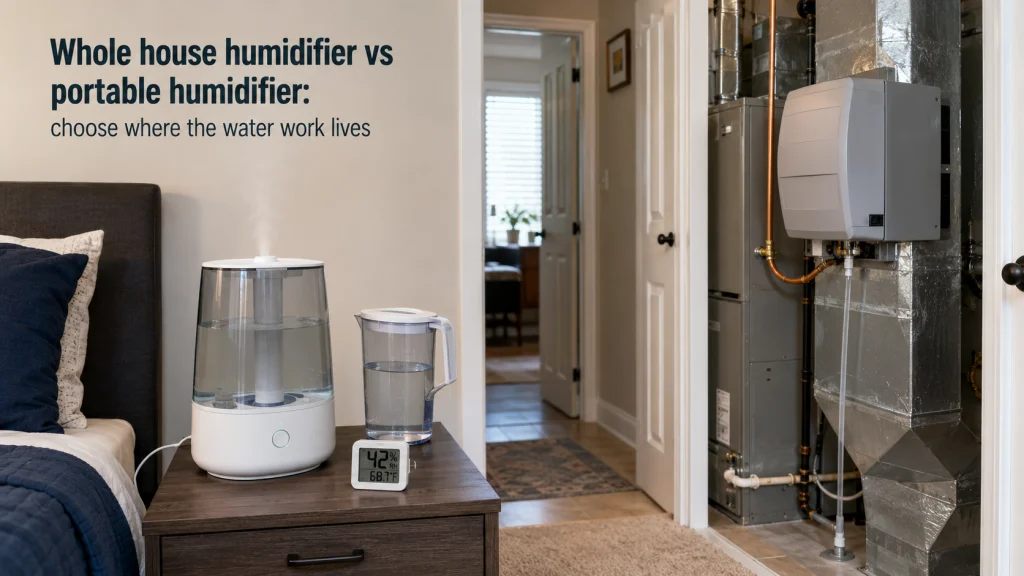
The real choice is where the water work lives
The choice between a whole-house humidifier and a portable unit often starts after someone gets tired of carrying water from the sink to one or more rooms. Installing a water-fed system can remove those refill trips, but it does not remove maintenance or create humidity without constraints. Instead, the work moves from tanks and countertops to HVAC equipment, water delivery, controls, replaceable media, drainage, and service access. That shift is the useful comparison because it tells you what ownership will feel like after the purchase excitement is gone.
If only one bedroom or office repeatedly needs added moisture, moving the chore into the HVAC system may be more commitment than the problem requires. If several occupied rooms need the same treatment and portable tanks are constantly empty, an installed option becomes more reasonable to assess. Neither choice proves that every room will reach the same relative humidity, because distribution still depends on the home, airflow, doors, temperature differences, and system design. Start by identifying the true scope of the problem, then decide whether the equipment should stay in the room or become part of the house system.

The LEVOIT Classic 300S uses a 6-liter top-fill tank with cool-mist operation and smart app control. Its listing specifies up to 60 hours of runtime, 26 dB operation, Auto Mode, and Sleep Mode. The larger tank and top-fill layout make it a relevant room-unit example when comparing refill work with an installed water-fed system.
Check On AmazonIf you click this link and buy, we earn a commission at no additional cost to you.
Separate portable, console, and whole-home humidifiers before comparing them
Portable and console humidifiers are both self-contained room equipment, but they serve different scales. The EPA describes portable units as smaller and readily moved, while console units are cabinet-style units intended for floor use, and central humidifiers are built into heating and air-conditioning systems. That distinction matters because a large console can serve more space than a small tabletop unit without becoming an installed HVAC appliance. Treating every non-central unit as the same choice hides differences in tank size, footprint, refill handling, and storage.
A whole-home humidifier is not simply a portable machine with a larger coverage label. It normally depends on a compatible heating or air-distribution arrangement, a water source, controls, and installation details that the exact system documentation must confirm. If you are still deciding among room-unit types rather than system scale, the broader humidifier buying guide is the better place to sort mist method, tank handling, cleaning, and other portable-unit features. Once the question becomes room equipment versus installed equipment, compatibility and ownership burden deserve more weight than a headline coverage number.
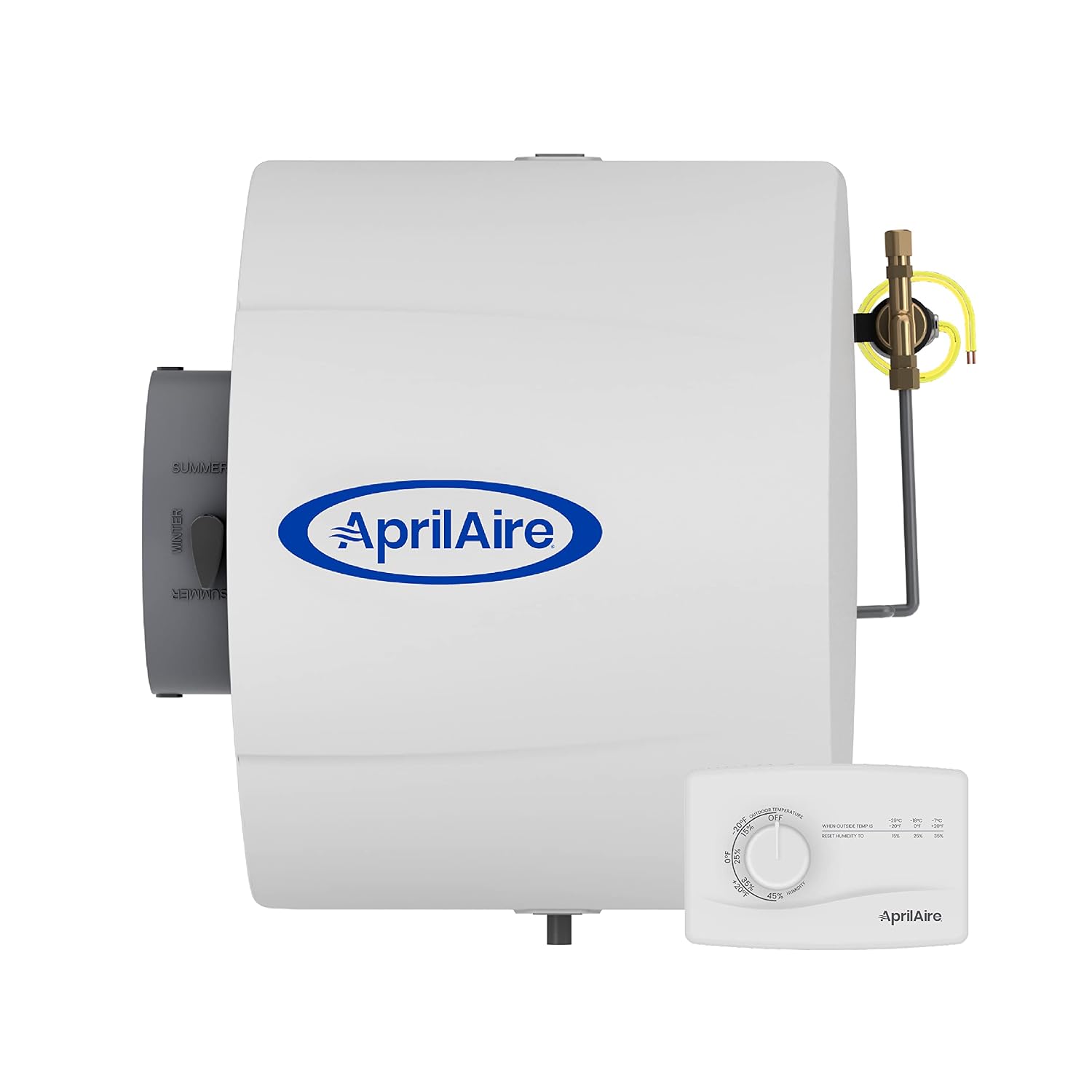
The AprilAire 600M is a manual whole-house furnace humidifier designed for homes up to 5,000 square feet. The selected listing is the humidifier-only style rather than an installation-kit bundle. It provides a concrete installed-system example for comparing room equipment with permanent HVAC-connected humidification.
Check On AmazonIf you click this link and buy, we earn a commission at no additional cost to you.
Start with how many rooms actually show a persistent need
The choice between a room humidifier and a whole-house system should begin with the number of spaces that repeatedly need added moisture, not the total square footage printed on a listing. A household may have a dry bedroom with the rest of the home staying acceptable, or it may find that several regularly occupied rooms fall short under the same conditions. Those are different problems in the same home. Use a separate humidity reading in the rooms that matter instead of assuming one central reading describes the entire house.
The next question is whether those rooms need moisture at the same time and under the same operating conditions. Two bedrooms used overnight may be manageable with two small units, while several rooms across multiple levels can turn refilling and cleaning into a repeated household job. A console may cover a larger connected area without changing the HVAC system, but doors, floor plans, and airflow can still limit how evenly moisture moves. Count persistent need first, then choose the smallest system scale that serves it without creating an unrealistic routine.

The TempPro TP50 combines an indoor thermometer and hygrometer in one compact monitor. It displays temperature and relative humidity so separate rooms can be checked instead of relying on one central reading. This makes it useful for identifying which spaces repeatedly need added moisture before choosing system scale.
Check On AmazonIf you click this link and buy, we earn a commission at no additional cost to you.
Compare room-by-room control with whole-home distribution carefully
Portable equipment gives you direct control over where moisture is added because the unit sits in the space you are trying to change. That is useful when one room needs attention, when sleeping areas need different settings, or when the rest of the home does not justify humidification. An installed system distributes moisture through the arrangement it is designed to use, which can reduce the need for separate machines. It does not guarantee perfectly uniform relative humidity, especially with closed doors, uneven airflow, additions, or spaces outside the main duct path.
A whole-home humidifier vs portable setup therefore changes the control model as much as the equipment location. Portable units can be adjusted by room, while a central control usually manages a broader portion of the home. That broader control can be convenient when the moisture need is widespread, but it may be unnecessarily blunt when the need is isolated. If room measurements differ substantially, solve the distribution question before assuming a larger central system is automatically the more precise answer.
| Decision area | Portable or console equipment | Installed whole-home equipment |
|---|---|---|
| Where the equipment lives | In the occupied room or nearby | At compatible HVAC equipment |
| Where water handling lives | Tank filling and carrying remain household tasks | Installed plumbing supplies water |
| Where control lives | Per unit and often per room | Central or system-specific control |
| Where maintenance appears | Tank and owner-accessible water-contact parts | Panel, canister, drain, controls, and service items |
The table does not claim that one side is easier everywhere. It shows where the recurring work moves, which is the part that simple coverage comparisons often miss. A system that removes visible room equipment may create new service obligations in the mechanical area, while a portable unit avoids installation but keeps the water routine in your hands. Choose the burden location as deliberately as the moisture location.

The Govee H5075 tracks temperature and humidity and connects to its app over Bluetooth at up to 164 feet. The listing specifies a 3-inch display, app alerts, and stored temperature and humidity graphs. It supports room-by-room comparisons when you need to see whether humidity differs across occupied spaces.
Check On AmazonIf you click this link and buy, we earn a commission at no additional cost to you.
Portable humidifiers keep installation simple but keep the routine in the room
Portable ownership is easy to start because there is no duct modification, installed water line, or HVAC integration to arrange. The trade-off is tank filling, water-contact cleaning, and placement that does not leave nearby materials damp. EPA guidance specifically emphasizes emptying and drying portable tanks, using appropriate water for the design, and cleaning according to the recommended care routine. With several units, every additional tank adds another fill, clean, inspect, and store cycle.
Placement also becomes part of the ownership workload. A larger tank may reduce how often you visit the sink, but it can be heavier to carry and may demand more floor or furniture space. A console uses larger containers and a more permanent floor footprint, useful when a connected area needs moisture but installation is impractical. The best portable choice is the one whose refill path, cleaning access, placement, cord location, and off-season storage still make sense after you picture the routine rather than just the first setup.

The DREO 3L humidifier uses a top-fill tank and cool-mist ultrasonic operation for room use. Its listing specifies up to 30 hours of runtime, 26 dB operation, a humidity sensor, and a night light. The top-fill design and removable room placement fit a section focused on the refill, cleaning, and placement routine of portable humidifiers.
Check On AmazonIf you click this link and buy, we earn a commission at no additional cost to you.
Whole-home ownership replaces tank trips with installed-system responsibilities
Installed humidification changes the chore. Carrier describes whole-house systems as integrating with HVAC equipment and requiring professional installation that can involve water, drainage, electrical work, ductwork, and control setup depending on the type. Once installed, the unit can draw water without someone carrying a tank through the house. The recurring burden becomes inspection, model-specific panel or canister service, drainage and control checks, and qualified HVAC service when required.
That trade can be attractive when tank care has become the main ownership friction, but it is not automatically lower maintenance in every sense. Mineral buildup, water quality, drain condition, exact humidifier design, and system use can all change what the installed equipment needs. A neglected central unit can create water or equipment problems beyond an empty portable tank. Out of sight should never become out of mind. Before buying, ask who maintains it, which owner tasks the manual allows, what it consumes, and whether service access is practical.
| Recurring work | Portable or console path | Whole-home path |
|---|---|---|
| Water supply | Carry and refill the tank as needed | Installed water connection supplies the humidifier |
| Water-contact care | Clean tank, basin, wick, filter, or other specified parts | Service the model-specific panel, canister, or related parts |
| Storage | Dry and store the unit when it is not in regular use | Equipment stays installed and must remain accessible for service |
| Problems beyond owner care | Stop at the manual boundary | Use qualified service for reserved installed-system work |
Use this matrix to compare the work you will perform, not the work you hope to eliminate. Portable ownership favors people who accept frequent hands-on care in exchange for flexibility and no installed modification. Whole-home ownership favors households that accept permanent equipment, compatibility checks, consumables, and service for automated water delivery and broader distribution. Neither is maintenance-free, so the right choice depends on which maintenance pattern fits the household better.

The AprilAire 35 is a genuine replacement water panel sold here as a two-pack for compatible whole-house humidifiers. The listing includes compatibility with AprilAire 600M, 700M, and other specified models in the 300, 500, 600, and 700 families. It is a concrete example of the recurring consumable responsibility that remains after tank refilling is removed.
Check On AmazonIf you click this link and buy, we earn a commission at no additional cost to you.
Understand bypass, fan-powered, and steam types only far enough to choose a path
Whole-home systems are not one mechanical design. Carrier currently groups common installed options into bypass, fan-powered, and steam humidifiers, and the differences affect airflow, power needs, water handling, installation, and maintenance. A bypass design uses HVAC airflow through an evaporative section and a bypass path, while a fan-powered design adds its own fan to move air through an evaporative medium. A steam design generates steam and introduces it through the system arrangement specified by the manufacturer, which creates different electrical, drainage, and service requirements from an evaporative unit.
You only need those distinctions for shopping. Ask whether the home and HVAC arrangement support the type, whether mechanical space works, and what water, drain, and electrical requirements apply. Steam can also have a different service boundary from evaporative designs, so do not assume the same owner maintenance applies across all three. If the answer depends on modifying ducts, wiring, plumbing, drainage, or controls, that is the point to move from general comparison into model-specific documentation and qualified assessment.

The AprilAire 800 is an automatic whole-house steam humidifier for installed applications. The listing identifies it as a steam model with large-capacity whole-home coverage rather than an evaporative room unit. It is a useful example when separating steam equipment from bypass and fan-powered paths before model-specific installation review.
Check On AmazonIf you click this link and buy, we earn a commission at no additional cost to you.
Compare visible room clutter with hidden mechanical-room equipment, not universal noise claims
A portable humidifier takes up living-space real estate, and the larger the tank or console, the harder that footprint is to ignore. It also puts fan noise, mist, display light, cord, and water handling near occupied space. An installed system can move most of that visible equipment to a mechanical area, which may be a real convenience in bedrooms or small living spaces. That does not make it silent; noise depends on humidifier type, HVAC blower, duct behavior, mounting, controls, and equipment location.
Use the same discipline with clutter. Hiding equipment near the furnace is useful only if the mechanical area has the space, clearances, drainage access, and service access the exact system requires. A compact room unit may actually be less intrusive than adding equipment to an already crowded utility closet, especially when only one room needs moisture. Compare the space that disappears from the room with the permanent space you commit near the HVAC system. The better solution is the one that fits both the occupied space and the service space without pretending either footprint is free.

The LEVOIT 2.5L top-fill humidifier is a compact cool-mist room unit with a 2.5-liter tank. Its listing specifies 28 dB operation, up to 25 hours of runtime, and automatic shutoff. The smaller footprint and quiet-operation specification make it relevant when comparing visible bedroom equipment with hidden mechanical-room hardware.
Check On AmazonIf you click this link and buy, we earn a commission at no additional cost to you.
Compare cost categories instead of trusting one installed-price number
A portable humidifier usually has a lower barrier to entry because the household can buy the unit without paying for HVAC installation. That purchase price is only the first line, though, because water treatment choices, wicks or filters where used, cleaning supplies, replacement units, and the labor of maintaining several machines can matter over time. A whole-home system adds a larger installation decision that may include the unit, labor, plumbing, drainage, electrical work, controls, duct changes, and any access work needed for the specific house. Those variables are why a single national installed price can be more misleading than useful.
Recurring costs differ by architecture. Evaporative whole-home systems may use replaceable water panels or similar media, while steam systems can use service parts such as canisters and may have different electricity demand because they generate steam. Portable units may use filters, wicks, cartridges, or distilled water depending on the exact design and manufacturer guidance. Compare purchase, installation, consumables, energy, water handling, cleaning, and service separately so a cheap-looking option does not hide its real burden.
The AprilAire 35 Water Panel is a genuine replacement humidifier consumable sold here as a single panel. The Amazon variant data lists compatibility with specified AprilAire whole-house models including 600M and 700M. It gives readers a concrete recurring-media cost to include when comparing purchase, installation, consumables, cleaning, and service.
Check On AmazonIf you click this link and buy, we earn a commission at no additional cost to you.
Renters and homes without suitable ducted HVAC have a different decision
Permanent HVAC integration is usually the wrong starting point for a renter who cannot authorize building changes. Portable and console units keep the decision reversible, make moving easier, and avoid tying the moisture solution to equipment you do not own. The same logic applies to many homes that use radiators, hydronic systems, mini-splits, or other layouts where a furnace-mounted bypass or fan-powered humidifier is not a straightforward fit. Other configurations may be possible, but they need a qualified, system-specific assessment rather than a generic compatibility assumption.
Homeowners with compatible ducted equipment have more options, but ownership alone does not make an installed system sensible. Mechanical space, drainage, water access, electrical capacity, duct geometry, service access, and actual room need can still favor portable equipment. If the broader HVAC arrangement is part of the decision, the site’s heating, cooling, and air quality section keeps the equipment choice connected to the rest of the home system. Compatibility should narrow the shortlist before convenience claims are allowed to sell the installation.
This card is not a rule that renters need small units or homeowners need central equipment. A large console can be a practical middle ground, and a homeowner with one dry bedroom may still be better served by a room unit. The point is to eliminate choices that conflict with the building before comparing convenience. Once compatibility is clear, the maintenance and control trade-offs become much easier to judge.

The AquaOasis AO-101 is a 2.2-liter cool-mist humidifier with adjustable output and a rotating nozzle. The listing identifies automatic shutoff and filter-free operation, keeping the unit self-contained for room use. Its portable format suits renters or homes where permanent HVAC modification is not the practical starting point.
Check On AmazonIf you click this link and buy, we earn a commission at no additional cost to you.
Choose among four workable system-scale outcomes
The answer does not have to be a small room unit or a central system. Most households fall into four practical outcomes once room count, refill tolerance, HVAC compatibility, installation tolerance, and control expectations are considered. Thinking in outcomes prevents buying a larger system before confirming the problem is truly whole-home in scale. It also leaves room for a mixed approach when a central system serves most spaces but one isolated area behaves differently.
- Portable-only: choose this path when the persistent need is limited to one or two rooms. If targeted control solves the problem and the refill and cleaning routine is acceptable, there is little reason to add permanent system complexity.
- Console or larger portable: move to this path when more than one nearby or connected space needs moisture, but the home is not a good candidate for installed humidification or the household does not want permanent HVAC work. The trade is a larger tank and footprint in exchange for keeping the system reversible.
- Whole-home assessment: move here when the need is broad, the HVAC arrangement appears compatible, and repeated tank work is the burden you most want to remove. Continue only if permanent installation, consumables, service access, and model-specific maintenance are acceptable.
- Mixed strategy: use this path when an installed system can serve most of the home but one room, level, or isolated area still behaves differently. Keep local equipment only where separate control solves a real distribution gap rather than duplicating equipment by default.
Do not treat the mixed option as a failure to choose. Houses often have uneven airflow, closed rooms, additions, and different temperature zones, so one piece of equipment may not solve every location equally. The right outcome is the smallest ownership system that reliably handles the actual problem without creating a new burden you are unwilling to maintain. If two options remain, compare their cost and work instead of restarting from coverage claims for the household.

The DREO 4L humidifier is a top-fill cool-mist room unit with a 4-liter tank. Its listing specifies 28 dB operation, up to 36 hours of runtime, a night light, and a 300-square-foot floor-area rating. It represents the larger-portable path between a small room unit and permanent whole-home installation.
Check On AmazonIf you click this link and buy, we earn a commission at no additional cost to you.
Separate system-scale choice from portable sizing and model selection
This comparison decides where the humidification system should live and how broadly it should serve the home. It does not replace sizing, because a portable unit still needs enough output for the room conditions and a whole-home system still needs professional sizing and compatibility work for the house and HVAC arrangement. If you have already chosen a room-unit path but are unsure about output or space served, use what size humidifier do I need to work through room and output sizing. That keeps sizing separate from ownership and avoids using one oversized coverage claim as a substitute for fit.
If sizing is settled and you are ready to compare current portable options, the best humidifiers page is the appropriate next step for model selection. Use that page after you know whether you need a small room unit, larger portable, or another class. A good shortlist should then be checked for tank handling, cleaning access, consumables, placement, noise behavior, controls, and exact manufacturer instructions. Keeping these decisions in order prevents the product list from deciding the household strategy for you.

The DREO HM524 uses a 6-liter top-fill tank and is rated for spaces up to 500 square feet. Its listing specifies up to 60 hours of runtime, 28 dB operation, adjustable humidity control, and three mist settings. Those concrete size and output-related specifications make it useful after the household has already chosen a portable system path.
Check On AmazonIf you click this link and buy, we earn a commission at no additional cost to you.
Stop before wiring, plumbing, drainage, or duct modification
A whole-home comparison can tell you when an installed assessment makes sense, but it should not turn into a do-it-yourself installation manual. Carrier’s installation overview shows that whole-house work can involve mounting at HVAC equipment, water supply, drainage, electrical connections, controls, duct openings, and system checks. Those tasks vary by home and humidifier, and the exact manual may reserve work for qualified installers or technicians. Treat compatibility, connections, space, and service access as pre-purchase checks, then let installation documentation control the next step.
The same boundary applies to maintenance after installation. Owner-accessible tasks vary, and steam equipment can carry hot-water and electrical hazards that require stricter service procedures than a room humidifier. Stop and use qualified service for leaks near electrical areas, damaged wiring, abnormal heating, burning odors, uncontrolled operation, or any task the manual assigns to service personnel. The buying decision is complete once you know the system class and the household trade-off; professional wiring, plumbing, duct modification, and internal service are separate jobs.

A smart water leak detection system with a Wi-Fi gateway and four sensors for monitoring areas such as kitchens, bathrooms, basements, and laundry rooms. The sensors use top and bottom probes to detect both dripping and standing water, while the system can send app, email, and SMS alerts when a leak is detected. It also provides a loud 100dB local alarm, IP66 water resistance, and long-range wireless communication for broader household coverage.
Check On AmazonIf you click this link and buy, we earn a commission at no additional cost to you.
Final thoughts: choose where you want the water and maintenance burden to live
A portable humidifier keeps the equipment and control close to the room, which is a strong fit when the need is local and the household can keep up with filling and cleaning. A console extends that idea to a broader connected area without committing the home to HVAC installation. A whole-home system becomes more compelling when several rooms need moisture and the household would rather accept permanent equipment, consumables, and service than manage multiple tanks. None is automatically the premium or correct answer because each relocates work instead of eliminating it.
Before buying, write down the rooms that actually need moisture, the refill routine you will tolerate, whether the HVAC layout is compatible, and whether you are comfortable with installed service. Then compare the smallest portable, console, whole-home, or mixed setup that meets those conditions. Keep humidity control tied to measured household conditions and exact equipment instructions, not medical promises. The best outcome is the one that solves the real moisture problem while leaving you with a maintenance routine you will actually follow.

The LEVOIT 3L humidifier is a quiet cool-mist room unit with a top-fill tank and 360-degree nozzle. The listing also identifies 25-watt operation and an essential-oil diffuser function. Its straightforward portable format fits a final decision point for households that choose to keep humidity control local rather than commit to installed whole-home equipment.
Check On AmazonIf you click this link and buy, we earn a commission at no additional cost to you.
FAQs
💧 Is a whole-house humidifier better than a portable humidifier?
Not automatically. Whole-home equipment suits broad need and compatible HVAC, while portable equipment often fits one or two rooms better.
🏠 Can one portable humidifier handle an entire house?
Sometimes, but walls, closed doors, levels, airflow, and output can limit distribution. Measure the rooms that matter instead of assuming one placement works everywhere.
🔧 Does a whole-home humidifier eliminate maintenance?
No. It replaces tank refilling with model-specific inspection, panel or canister care, drainage checks, controls, and professional service when required.
🏢 What is the better option for a renter?
A portable or console unit is usually more practical because it avoids permanent building changes. Any installed option needs property-owner approval and building-specific evaluation.
🌬️ Do I need ducted HVAC for a whole-home humidifier?
Many bypass and fan-powered designs work with ducted HVAC equipment. Verify the exact architecture because whole-home types do not fit every heating setup.
🧼 Which choice is easier to keep clean?
The maintenance is different, not universally easier. Portables need water-contact cleaning, while installed systems shift attention to panels, canisters, drains, controls, and service.
References and sources
- EPA humidifier use and care: Supports humidifier class distinctions and portable water-care guidance.
- Carrier whole-house humidifiers: Supports installed humidifier architectures and water, drain, and service considerations.
- Carrier humidifier installation overview: Supports the professional installation boundary and common system connections.
- Trane whole-house maintenance overview: Supports model-dependent maintenance and steam-service boundaries.