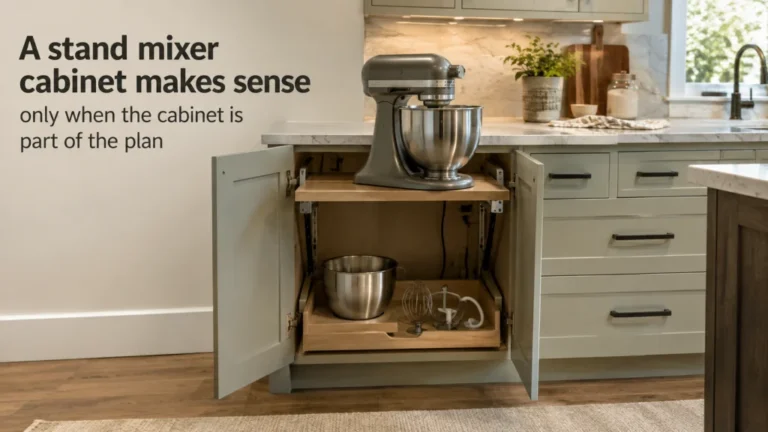
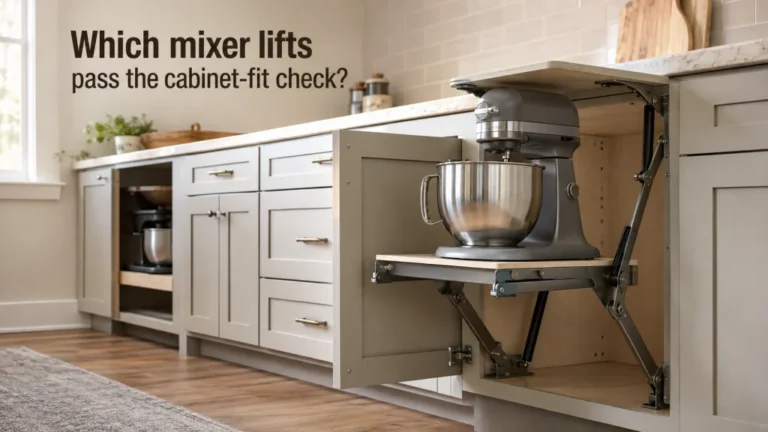
A mixer lift can reduce the repeated effort of bringing a heavy stand mixer out of a base cabinet, but only when the mixer, cabinet, platform, raised position, and exact hardware rules all match. Weight capacity alone does not prove fit, and a platform that locks at counter height is not automatically approved for appliance operation. The useful decision is to verify the complete storage and transfer path before giving up cabinet space and paying for installed hardware. This article shows what to measure, what documentation must confirm, and when a simpler storage route makes more sense.
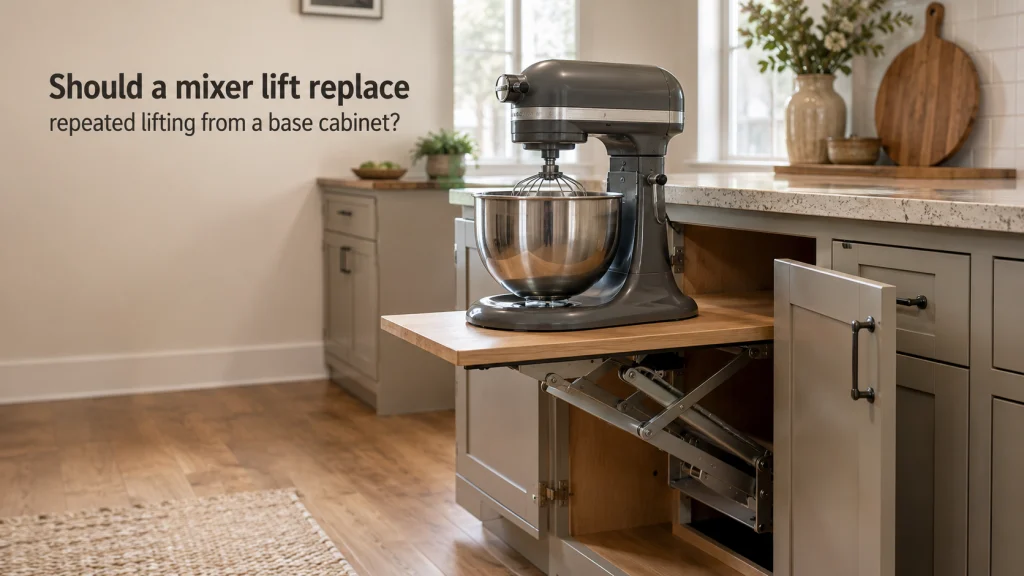
A mixer lift trades repeated lifting for a permanent cabinet commitment
A mixer lift can make a heavy stand mixer easier to retrieve from a low base cabinet. The less obvious trade is the cabinet space, hardware cost, and travel clearance it requires. Some systems are only for storage and transfer, even when the platform locks in a raised position. Start with compatibility and exact-system permission, not with the appeal of the lifting motion.
Use frequency matters because the benefit repeats every time the mixer comes out and goes back. A frequent baker may value that access much more than someone who uses the mixer a few times a year. If the mixer must still move to the countertop, the lift can still replace a deep vertical lift with a short transfer. Compare that outcome with the broader choices in how to store a stand mixer before committing the cabinet. This is another case where home storage solutions should be chosen around the repeated route and storage location instead of a generic room label.
Separate vertical lift hardware from a horizontal pull-out shelf
An appliance lift moves a stored appliance upward and outward from a base cabinet. A pull-out shelf mainly moves the appliance forward at the same height. A stand mixer lift can therefore remove much of the vertical lifting, but it adds pivoting hardware and a defined travel path. That difference affects cabinet fit, aisle space, storage below the platform, and the final transfer.
A mixer lift for cabinet storage is not simply a stronger shelf. Current systems differ in assist method, platform arrangement, cabinet requirements, raised height, and use restrictions. A pull-out shelf can be enough when the mixer is still comfortable to lift once it is brought forward. If you want a fully planned cabinet solution instead, compare the broader trade-offs in stand mixer cabinet options.

Kitstorack's pull-out organizer expands from 12 to 20 inches wide for base-cabinet storage. The white unit uses a heavy-duty slide-out drawer design and adhesive nano film for installation. It provides a clear example of horizontal cabinet retrieval rather than a vertical appliance-lift mechanism.
Check On AmazonIf you click this link and buy, we earn a commission at no additional cost to you.
Decide whether your use frequency justifies dedicated hardware
A lift earns its space by reducing the same awkward movement over and over. Frequent use makes that benefit easier to justify because the access problem keeps returning. Occasional use changes the math because the hardware still occupies the cabinet every day. Judge the system by how much repeated work it removes, not by how impressive it looks when raised.
Count the full routine, not only the moment when the platform moves. Include opening the cabinet, raising the lift, transferring the mixer if required, reaching the outlet, cleaning, and putting everything away. A lift that blocks the aisle or still requires an awkward transfer may solve only part of the problem. If counter storage or an appliance garage already gives easy access, installed hardware may not be worth the cabinet loss.

This 8-piece set uses small self-adhesive PTFE sliders for countertop appliances. Each round slider measures about 0.79 inches across, and the listing includes mixers, coffee makers, and air fryers among intended uses. The sliders are intended to make appliances easier to move on surfaces such as hardwood and tile.
Check On AmazonIf you click this link and buy, we earn a commission at no additional cost to you.
Record mixer weight and the full operating envelope first
Start with the exact mixer rather than the lift. Record its weight, maximum width, front-to-back depth, stored height, and any extra room needed to tilt the head or raise the bowl. The mixer must fit the platform, clear the hardware while moving, and end in a useful position. A lift capacity number answers only the load question.
Check the mixer manual for surface and clearance requirements before treating any raised shelf like a countertop. A physical fit can still fail if the bowl cannot come out, the cord is trapped, or the controls sit at an awkward height. Attachments can also change the space needed around the machine. For mixer-specific dimensions and operating considerations, use the stand mixer guide when the exact model needs another check.
| Compatibility check | What to record | Why it matters |
|---|---|---|
| Mixer weight | Exact model with the bowl and normally stored attachment | Must stay within the exact lift and platform rating |
| Stored footprint | Maximum width and depth | Must clear the platform, hardware, doors, and opening |
| Stored height | Highest point in storage position | Must clear the cabinet during travel and storage |
| Operating envelope | Room for head, bowl, controls, cord, and attachments | Shows whether the raised position is usable |
| Transfer path | Height and distance from platform to counter | Shows how much manual handling remains |
Fill this worksheet with measurements, not memory. One uncertain dimension can change the entire hardware choice. Verify any missing number before comparing models. Cabinet changes are much harder to undo than a spec check.

This digital scale has a 440-pound capacity and an 11.81-inch square aluminum anti-skid platform. A separate backlit LCD shows readings in pounds, ounces, kilograms, or grams, and the tare function resets the display to zero. It can run from two AAA batteries, USB power, or the included AC adapter.
Check On AmazonIf you click this link and buy, we earn a commission at no additional cost to you.
Compare spring-assisted and gas-assisted lift architectures
The assist mechanism changes how the platform moves, but it does not remove the need for correct loading. Current Rev-A-Shelf families use spring assistance, with versions that add shock dampening and soft close. Current Knape & Vogt HAL documentation describes gas-cylinder assistance, while Wood Technology uses heavy-duty spring action. These are mechanism differences, not automatic rankings.
Compare assist type beside load rating, platform arrangement, cabinet geometry, and raised position. A smoother return cannot fix a mixer that is too large or a cabinet that blocks the mechanism. The mechanism should first be judged by whether it physically fits the appliance, cabinet, and intended movement path. Exact manufacturer instructions remain the controlling evidence for how the system may be used.
Spring-assisted systems with adjustable loading
Spring-assisted systems balance part of the appliance load through mechanical springs. Some current systems provide multiple load settings, but those settings do not increase the published maximum capacity. Adjustment and installation should follow the exact manufacturer instructions or be handled by a qualified installer.
Gas-cylinder-assisted systems
Gas-assisted hardware uses a gas cylinder to help raise and lower the loaded platform. Current Knape & Vogt documentation also shows more than one raised position for its HAL-20 family. That flexibility still does not override its separate storage-use-only restriction.
Soft close is a convenience feature, not a fit guarantee
Soft close or dampening can make the lowering motion gentler. It does not correct an overloaded mechanism, poor cabinet fit, or inadequate clearance. Treat it as a convenience feature only after the core compatibility checks pass.
| Architecture | Current manufacturer example | What it changes | What it does not prove |
|---|---|---|---|
| Spring-assisted | Rev-A-Shelf heavy-duty family | Assisted lift; some variants add dampening and soft close | Exact fit or usable clearance |
| Spring-assisted | Wood Technology mixer lift | Assisted movement with locking catches | That every mixer within the rating clears the hardware |
| Gas-assisted | Knape & Vogt HAL-20 family | Assisted movement with documented raised positions | That the raised height suits the transfer path |
The useful comparison is not spring versus gas by itself. It is whether the exact mechanism fits the mixer and cabinet while supporting the intended workflow. Convenience features can matter after those conditions are met. Before that, they are secondary.
Verify the cabinet opening, interior depth, height, and construction
Nominal cabinet size can hide the measurements that actually control fit. Face frames, hinges, doors, mounting brackets, and drawer structures can reduce the usable opening. Measure clear width at the narrowest point, usable depth, and vertical clearance. Compare those numbers with the exact current hardware documentation.
Manufacturer examples show why one universal minimum would be misleading. Wood Technology lists different interior requirements depending on the shelf configuration, while Rev-A-Shelf directs buyers to check actual width, depth, and height. Knape & Vogt ties the available width and depth to its platform and mechanism envelope. The cabinet must fit the complete moving system, not just the mixer body.
| Current example | Width check | Depth check | Height check | Qualifier |
|---|---|---|---|---|
| Wood Technology with 18-inch-cabinet shelf | 16-1/2 in minimum inside width | 20 in minimum inside depth | 20 in minimum inside height | Uses its 13 in by 18-3/4 in shelf |
| Wood Technology with 24-inch-cabinet shelf | 22-1/2 in minimum inside width | 20 in minimum inside depth | 20 in minimum inside height | Uses its 18-7/8 in by 18-3/4 in shelf |
| Wood Technology with user-provided shelf | 13 in minimum inside width | 15 in minimum inside depth | 20 in minimum inside height | Custom shelf still has to clear the hardware |
| Rev-A-Shelf heavy-duty family | Check exact opening | Check exact depth | Check exact height | Use the current fit selector and exact variant |
| Knape & Vogt HAL-20 family | Platform plus mechanism clearance controls fit | Platform depth and mechanism travel control fit | Mechanism travel must clear the cabinet | Current documentation also restricts use to storage |
Use the table as a method example, not a universal sizing chart. Product families can contain different variants. Measure first and select the exact variant second. Then compare the two line by line.

This 16-foot tape measure includes both inch and metric scales with MID accuracy. Its self-locking mechanism holds the blade extended until the push-button release is used. The housing adds a belt clip and wrist strap, making it convenient for checking cabinet opening width, depth, and vertical clearance.
Check On AmazonIf you click this link and buy, we earn a commission at no additional cost to you.
Check whether a drawer above changes the raised position
A drawer above the storage bay can change both fit and final height. It consumes vertical space and may leave the raised platform below the surrounding countertop. Wood Technology specifically states that its shelf can reach countertop level without a drawer, while a drawer configuration sits lower. That changes the transfer distance even when the mechanism still fits.
Do not rebuild cabinet parts simply to make an assumed setup work. Some lift families are intended for full-height base cabinets, while others allow a drawer only with stated clearance. If keeping the drawer matters, treat it as a hard requirement before selecting hardware. A lower platform can still help, but that result should be known before installation.
Verify whether the platform is included and what it must support
The platform is part of the compatibility system, not an afterthought. Some kits include a shelf, while mechanism-only products require a separate or custom platform. The shelf must fit the hardware, support the mixer footprint, and travel through the opening without interference. A shelf that fits the mixer but violates the mechanism requirements is still the wrong shelf.
Count anything normally stored on the platform with the mixer. A bowl or attachment can change both load and clearance. Manufacturer-supplied shelf dimensions are useful for checking footprint, but they do not guarantee every mixer fits. Platform fit remains a three-way match among mixer, hardware, and cabinet.
Shelf included versus hardware only
A complete kit reduces one compatibility variable because the shelf and mechanism are designed together. Hardware-only systems provide more flexibility but require closer attention to the shelf specification. Follow the manufacturer requirements for dimensions, thickness, mounting, and permitted material.
Custom shelf dimensions still need manufacturer approval
A custom shelf can help match an unusual appliance footprint, but only within the lift design. Changing width, depth, or thickness can affect travel and clearance. If the documentation does not support the proposed platform, do not improvise it.
Verify whether the raised platform is for storage, transfer, or operation
This check is easy to miss because product photos often show a mixer sitting on the raised shelf. A lock, counter-height position, or high load rating does not establish permission to run the appliance there. Current Knape & Vogt HAL documentation explicitly states that the lift is for storage use only. For that system, the raised position should be treated as access for storage and transfer.
Other systems can be described differently, so verify the exact current documentation. Language such as raised, retrieved, or brought to counter height is not the same as explicit operation permission. If the documentation is silent, permission has not been established. Do not convert a marketing photo into a use rule.
Treat the Knape & Vogt HAL-20 as storage and transfer only
The current Knape & Vogt catalog removes ambiguity for the HAL-20 family. Its storage-only restriction still applies even though the platform locks in a raised position. Use the raised position for access and transfer rather than appliance operation.
Never infer permission from the lock or raised height
A locking mechanism holds the lift in a defined position for its intended workflow. It does not tell you how the system handles mixer vibration or changing dough loads. Permission must come from the manufacturer, not from appearance.
If operation is permitted, verify the mixer requirements too
Lift permission is only half of the check. The mixer may require a stable, level surface and enough room around its bowl, controls, cord, and moving parts. Both sets of requirements must agree before use-in-place makes sense.
| Manufacturer evidence | Status to record | What the household should plan |
|---|---|---|
| Explicit storage-use-only statement | Storage and transfer only | Plan a short transfer to an approved surface |
| Explicit permission to operate the appliance | Operation permitted under stated conditions | Also verify the mixer’s surface and clearance rules |
| Documentation is silent | Permission not established | Do not assume the platform is a work surface |
Permission check: The exact current manufacturer instructions control whether an appliance may be operated on the raised platform. A locking mechanism, load rating, or product photo is not a substitute for that statement.
Write this field down before installation. If the answer is storage only, the transfer path becomes a primary measurement. If operation is permitted, the raised position still has to meet the mixer’s requirements. This distinction can decide whether the lift is suitable at all.
Compare the final raised height with the normal countertop
A raised platform is useful only when its height supports the intended workflow. A flush position can create an almost level transfer, while a lower position may still require lifting the mixer several inches. Current manufacturer documentation shows that raised height can vary by system and cabinet configuration. Treat final height as a purchase measurement, not an installation surprise.
Measure from the floor to the top of the raised platform and compare it with the nearby counter. Consider how you will grip the mixer base during any transfer. A small height change across two close surfaces can be manageable, while a large step or gap can restore much of the handling burden. The useful result is the one that matches the actual motion in the kitchen.
Transfer workflow: Open the cabinet, raise and lock the lift as instructed, clear the destination surface, transfer the mixer when the platform is not approved for operation, then return it after use according to the mixer and lift instructions.
Walk through that sequence with measurements before buying hardware. A sink gap, corner, counter lip, or blocked standing area can make the transfer awkward. A short level transfer can still be a strong outcome. Judge the whole path rather than the lift motion alone.

The BOSCH GLM165-40 measures distances up to 165 feet with accuracy within 1/16 inch. It provides real-time measurement plus distance, area, volume, and indirect measurement modes, with memory for up to 10 readings. Its backlit display and compact body make it useful for comparing a raised platform height with the adjacent countertop.
Check On AmazonIf you click this link and buy, we earn a commission at no additional cost to you.
Measure aisle projection with the lift fully raised and extended
A base-cabinet lift moves into room space, so its stored footprint is only part of the story. Open doors, lift arms, the platform, and the mixer can all project into the aisle together. That may be harmless in a wide kitchen and disruptive in a narrow galley. Measure from the cabinet face to the furthest point of the loaded raised system.
Check nearby drawers, dishwasher doors, islands, and normal traffic at the same time. A mechanism can fit the cabinet yet still create a poor working area. This matters even more when the mixer must be transferred to the counter because the user needs standing room in front of the lift. Clear movement space is part of fit.

This 33-foot tape measure uses both inch and metric scales and a self-locking mechanism with push-button release. Its anti-skid ABS and soft-rubber exterior is designed for impact protection, and it includes a belt clip and wrist strap. The longer blade is useful for measuring the full projection of a raised lift into an aisle and checking nearby clearances.
Check On AmazonIf you click this link and buy, we earn a commission at no additional cost to you.
Count the base-cabinet capacity the mechanism takes away
A lift reallocates storage around one heavy appliance. The mechanism occupies side and vertical space, while the platform and travel path must remain clear. Some systems leave limited room below the platform, but that space can be shallow or interrupted by moving hardware. Count what the cabinet can actually hold in the stored position.
Compare that loss with the space the mixer would use elsewhere. Giving up a base cabinet can be reasonable when counter space is tight and lower cabinets are plentiful. It can be a poor trade when cookware and baking supplies already compete for every shelf. Cabinet volume is part of the cost even when it has no price tag.
Treat outlet placement and installation as exact-system boundaries
A lift combines a heavy appliance, moving hardware, cabinet structure, and an electrical cord. Installation should therefore stay within the exact manufacturer instructions. Do not improvise spring settings, gas hardware, reinforcement, or mounting locations from generic advice. Use a qualified cabinet installer when required cabinet work falls outside normal owner-level tasks.
Outlet placement deserves the same restraint. Confirm cord reach without routing the cord through moving hardware or assuming an internal outlet changes the platform’s use permission. Adding or relocating electrical service is outside this selection article. Use a qualified electrician when electrical work is needed.
Compare the lift with simpler storage routes before committing
A lift is strongest when repeated vertical lifting is the main problem and the household can dedicate the cabinet to solving it. A pull-out shelf is simpler when bringing the mixer forward removes most of the access difficulty. Counter storage removes setup movement but occupies work surface, while an appliance garage can keep a mixer accessible behind a door. A cart can move the appliance between zones but uses floor space.
Choose the arrangement that removes the most repeated friction with the fewest new constraints. A lift loses value if it blocks the aisle, removes essential storage, or still leaves a long transfer. If a purpose-built cabinet is being planned, the stand mixer cabinet comparison may fit better than retrofit hardware. Keeping the mixer on the counter and buying nothing can also be the right answer.

This compact Yaheetech cart has a 22 x 18-inch tabletop rated for 77 pounds. Four 360-degree swivel wheels provide mobility, with two wheels that lock, and the cart includes a drawer, cabinet, open storage, and six hooks. Its movable surface fits the cart alternative discussed in this section while keeping floor-space use visible as the trade-off.
Check On AmazonIf you click this link and buy, we earn a commission at no additional cost to you.
Use the compatibility audit before comparing current lift models
Once the mixer and cabinet pass the fit checks, model selection becomes much narrower. Compare only systems that support the exact load, fit the measured cabinet, provide a workable raised position, and use an approved platform arrangement. Record the permitted workflow before comparing convenience features. Soft close, finish, shelf material, and accessory storage matter only after the fundamentals pass.
Specifications and availability can change, so model-level comparison belongs on a page that can be updated separately. Use current mixer lift options only after completing the measurements and permission check here. Do not select a mechanism first and then force the cabinet to accommodate it. The compatibility audit should remove unsuitable choices before price enters the decision.
Final Thoughts: buy only when the whole storage path fits
A mixer lift makes sense when it reduces repeated lifting from a low cabinet without creating a worse problem elsewhere. The mixer must fit the platform and travel path, and the cabinet must fit the exact mechanism. The raised position must support the real transfer or use routine. Manufacturer documentation must also define whether the platform is for storage, transfer, or appliance operation.
Resolve any uncertainty before buying or modifying cabinetry. A pull-out shelf, counter position, appliance garage, cart, or purpose-built mixer cabinet may require fewer compromises. The value of a lift is not the movement itself. It is a complete storage-to-use path that becomes easier while staying within documented limits.
FAQs
⚖️ Does the lift weight rating prove my stand mixer will fit?
No. Weight is only one check; the mixer footprint, height, operating envelope, platform size, and cabinet travel clearance also have to match.
📐 What cabinet size do I need for a mixer lift?
There is no universal minimum. Measure clear width, usable depth, vertical clearance, cabinet construction, and obstructions, then compare those numbers with the exact current lift documentation.
🧰 Is the shelf normally included with the lift mechanism?
It depends on the product family and variant. Some kits include a shelf, while mechanism-only systems require a separate or approved custom platform.
🔒 Can I run the mixer if the raised platform locks in place?
Only when the exact manufacturer documentation explicitly permits appliance operation there. A lock holds the mechanism in position; it does not establish an approved work surface.
🗄️ Can a mixer lift work under a drawer?
Some systems can, but the drawer can reduce clearance and leave the platform below counter height. Check the exact lift requirements before choosing hardware.
↔️ Is a pull-out shelf a simpler alternative?
Often, yes, when bringing the mixer forward solves most of the access problem. A lift earns its added complexity when reducing the vertical movement changes the routine enough to matter.
References and Sources
- Knape & Vogt functional hardware catalog: verifies HAL-20 gas assistance, raised positions, platform dimensions, and the storage-use-only restriction.
- Rev-A-Shelf heavy-duty mixer lift: verifies the current spring-assisted family, adjustable spring tension, dampening, soft-close variants, load rating, and cabinet-measurement process.
- Wood Technology kitchen mixer lift: verifies current spring assistance, shelf options, cabinet-clearance examples, drawer compatibility, and platform dimensions.