A laundry basket usually fits a carry-first job, while a hamper usually fits stationary dirty-laundry collection. Retail labels overlap, so handles, loaded shape, footprint, lid or liner, and empty storage matter more than the name. Capacity matters only after you know the normal carried load and where the container lives between uses. Some households need one versatile container, while others work better with separate collection and transport tools.
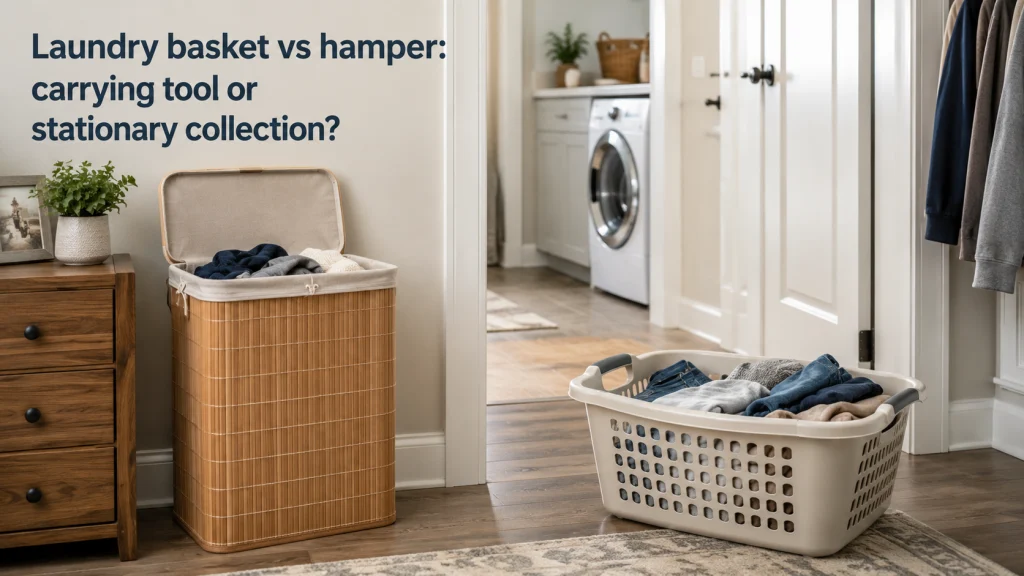
Start with one question: does the container wait or travel?
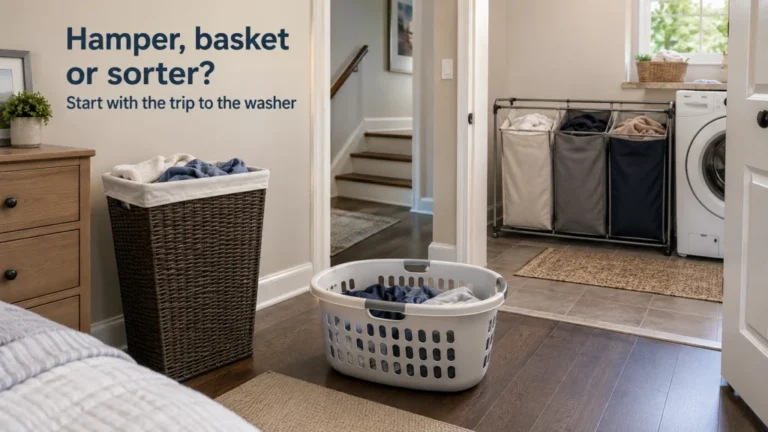
The useful way to settle laundry basket vs hamper is to ignore the label for a moment. Ask whether the container will mostly stay in a bedroom, bathroom, closet, or laundry area, or repeatedly travel to the washer and back. A container that mostly waits can favor a smaller floor footprint, greater height, a lid, or a removable liner. A container that mostly travels needs usable handles, manageable dimensions, and a shape that works through the trip to the washer.
That one fork explains why similar stated capacities can behave very differently at home. A tall container may collect efficiently but be awkward to carry, while a wide basket may travel easily but consume more storage space. If you are choosing a laundry basket or hamper, decide the dominant job before comparing materials, colors, or extra features. The broader laundry hamper overview covers the wider collection-and-transport choice; this comparison stays focused on basket-style carrying versus hamper-style stationary collection. That same fit-first rule matters across home storage solutions, where a product is only useful if its dimensions and access pattern work in the exact space.
- Mostly waits: prioritize stable placement, easy drop-in access, a useful liner, and optional concealment.
- Mostly travels: prioritize handles, doorway fit, low empty weight, and practical empty storage.
- Must do both: choose a hybrid only if it remains easy enough to carry and still fits its permanent location.
- One object creates conflict: separate dirty-laundry collection from transport and clean-laundry return.
The list is a decision fork, not a claim that every product must fit a rigid definition. Modern containers often combine basket and hamper traits successfully. The problem is a hybrid that combines a bulky stationary body with poor carrying features, or an easy-to-carry shape with nowhere sensible to stay. Judge the compromise by the job that happens most often.
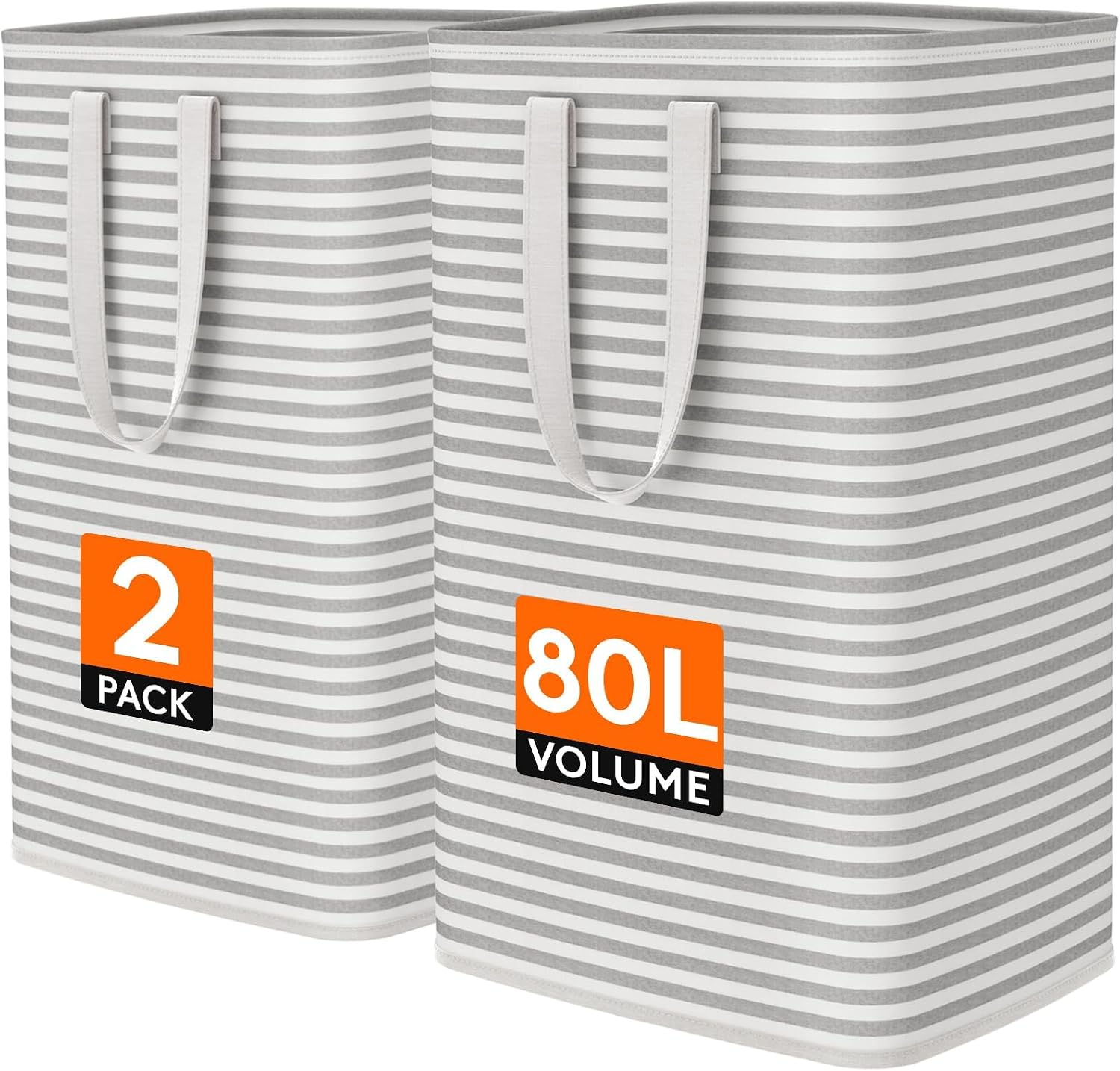
Each grey basket holds 80 liters, giving the two-pack 160 liters of total stated capacity. Reinforced handles are built into the collapsible freestanding design for carrying. The listing describes the material as waterproof and positions the baskets for bedroom and laundry-room use.
Check On AmazonIf you click this link and buy, we earn a commission at no additional cost to you.
Treat basket and hamper as job descriptions, not universal labels
Retail naming is inconsistent enough that the word on the listing should be treated as a clue, not a specification. A low open container with large handles may be called a hamper even though it functions like a carry-first basket. A tall fabric container may be called a basket even though it is clearly meant to remain beside a closet. The safer comparison is what the design permits at a typical fill level, not whether the seller chose one familiar noun or the other.
The conventional distinction is still useful as a starting point. Basket-style designs usually emphasize access and movement, while hamper-style designs usually emphasize collection, vertical storage, concealment, or a liner. Modern products blur those traits, which is fine when the blend fits the routine. When you see hamper vs laundry basket, translate it into movement, footprint, access, and workflow before comparing style.
| Decision field | Carry-first basket | Stationary hamper | What to verify |
|---|---|---|---|
| Primary job | Moves laundry between locations | Collects laundry where it is discarded | Which action happens most often |
| Shape | Often wider for loading and unloading | Often taller to save floor area | Filled dimensions and permanent footprint |
| Handles | Central to the design | May be secondary or absent | Grip access when normally filled |
| Top | Usually quick open access | May add a lid or liner | Whether concealment is worth the extra action |
| Empty storage | May nest, flex, or collapse | Usually keeps a permanent location | Where it goes after laundry is put away |
Use the table as a priority check rather than a dictionary. A basket can stay in one room, and a hamper can move, but the design should make its frequent job easy rather than merely possible. If the product name and the construction disagree, trust the construction. That keeps a fuzzy label from controlling a practical household decision.

This set includes two grey 75-liter laundry baskets. A metal frame is embedded in the top edge to help each basket stand upright, while reinforced side handles support carrying. The collapsible design uses a waterproof PEVA-coated interior and folds for compact storage.
Check On AmazonIf you click this link and buy, we earn a commission at no additional cost to you.
Choose a hamper when stationary collection is the dominant job
A hamper makes sense when dirty laundry needs a dependable collection point and the outer container does not have to make every trip to the washer. A taller shape can use floor space efficiently by storing volume vertically. A lid can be worthwhile in a visible room, while an open top removes one action from every drop-in. The right choice is the one that makes daily collection easy without adding features the household will constantly work around.
A removable liner can change the job more than the outer label suggests. If the liner is genuinely designed to lift out and carry a typical wash load, the hamper frame can stay in place while the laundry travels inside the bag. That arrangement can work well when the outer frame is tall, decorative, or awkward to move through a doorway. Check how the liner attaches and comes out, because a removable bag is useful only when removal is simple with the usual amount of laundry inside.
Check footprint, lid, and liner logic together
Measure the actual floor or closet space before treating larger capacity as an automatic upgrade. Make sure the height still allows comfortable loading and liner removal in the chosen location. A lid earns its place when concealment matters enough to justify opening it every time laundry goes in. For cleaning and damp-item care, follow the exact instructions for the specific container instead of assuming all lined or closed designs should be treated the same way.
A stationary hamper is strongest when its permanent placement removes more friction than its size or features create. If the whole frame must still be carried every wash day, test that assumption against the route before buying. If only the liner travels, judge the liner as the carrying tool and the frame as the collection tool. That separation often makes the decision clearer.
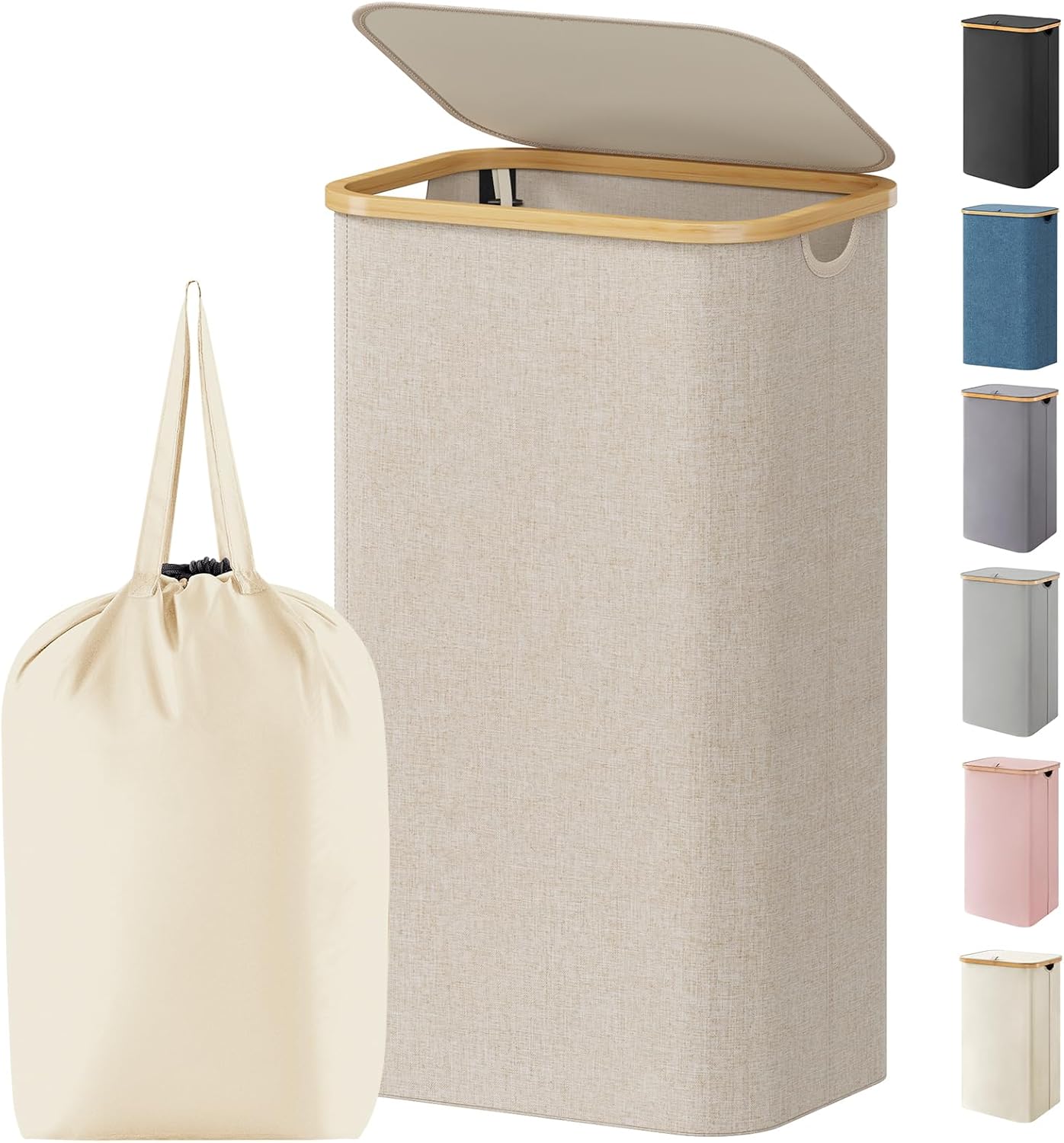
This beige hamper has a stated 100-liter capacity, a lid, and bamboo handles. One removable inner bag separates from the outer hamper for laundry handling. The foldable rectangular design uses polyester construction and is listed for laundry-room, bedroom, bathroom, and dorm use.
Check On AmazonIf you click this link and buy, we earn a commission at no additional cost to you.
Choose a basket when the container itself must carry normal loads
A basket earns its place when the shell itself repeatedly moves laundry between rooms. That makes handle position and loaded shape more important than how attractive the basket looks while empty. Handles should remain reachable at the fill level you normally carry, and the sides should not bulge so far that the basket becomes difficult to pass through the path to the washer. A light empty basket can still be a poor carrier if the rim twists, the grips pinch, or the loaded body becomes awkward.
Open access is useful for both loading dirty laundry and returning clean clothing from the dryer or folding surface. The trade-off is that a wide rigid basket may need a permanent shelf, closet floor, or laundry-room parking spot after the clothes are put away. In a small home, nesting, flexible sides, or collapsibility can be more valuable than extra maximum capacity. The carrying job does not end when the load reaches the washer; the empty basket still has to live somewhere.
Judge handles, loaded width, and empty storage
Imagine the handles with the basket full, not with a listing photo’s light load. A side cutout can be comfortable when empty but harder to use if clothing blocks the grip, while long handles can stay accessible but change how the load moves. Rigid and flexible bodies also behave differently through doorways and in storage. Choose the construction that keeps a usable shape through the trip you make most often and then stores without becoming a permanent obstacle.
A short same-floor trip may tolerate a wider rigid basket. Shared laundry can make a narrower profile more important through doors or elevators. Neither situation requires a special product label. It requires a basket whose loaded form matches the real trip.
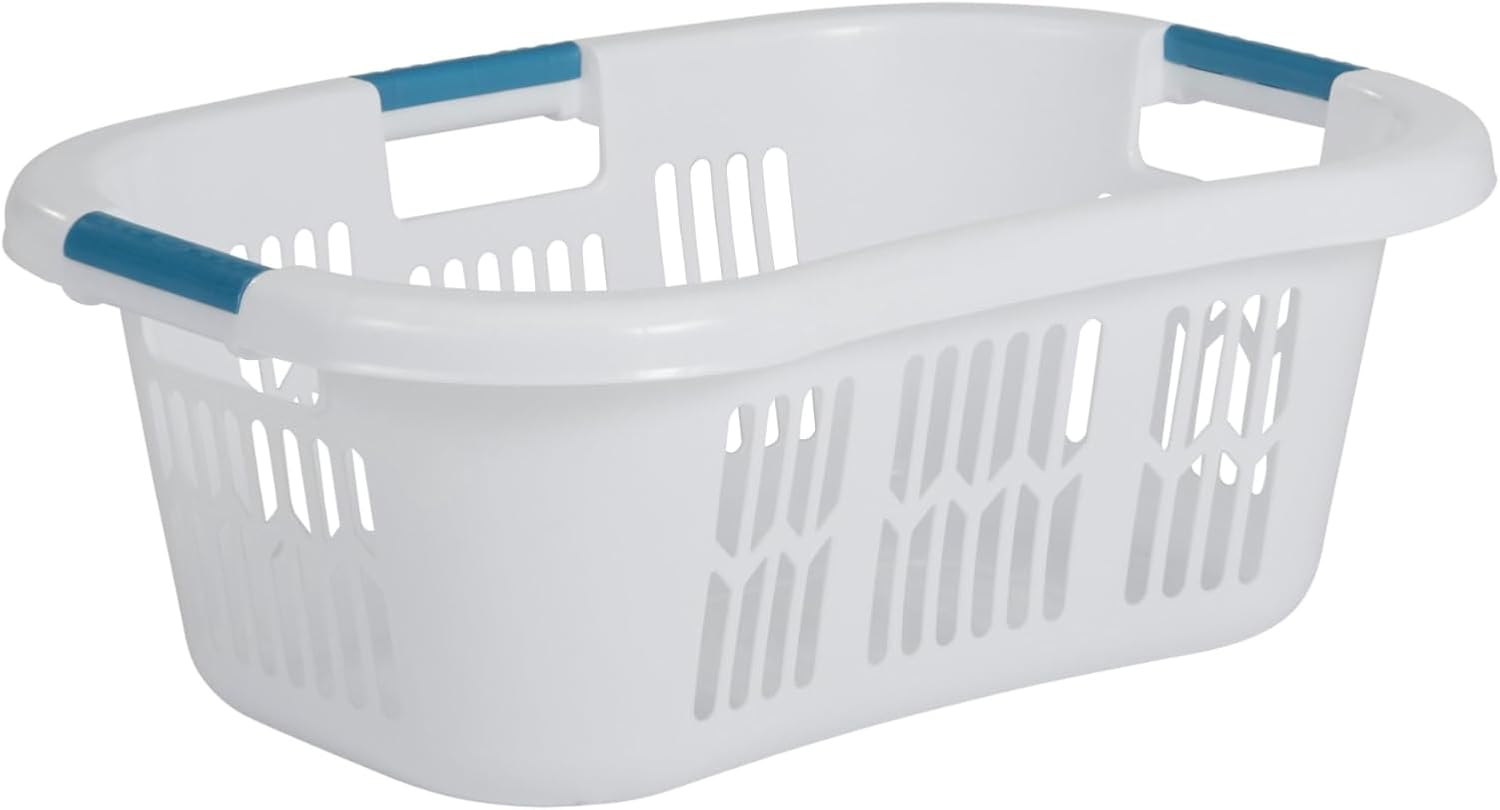
This white Rubbermaid Hip-Hugger has a stated 1.5-bushel capacity. The listing identifies it as a laundry basket or hamper and as a stackable storage bin. It is marketed for bathroom, bedroom, dorm, and general home use.
Check On AmazonIf you click this link and buy, we earn a commission at no additional cost to you.
Compare maximum capacity with what you realistically carry in one trip
Large capacity sounds efficient because it suggests fewer trips, but the household limit may be the amount you are willing and able to move comfortably at once. If a container holds far more than your normal carried load, the extra space may simply encourage a wider, heavier trip. A smaller container can be more useful when it naturally matches one washer load or one manageable trip. The relevant capacity is the amount you actually move through the home, not the most fabric the container can physically contain.
Laundry also changes character from load to load. Lightweight clothing can fill a lot of volume without the same weight as towels, jeans, or bedding, and bulky items can change how far the basket extends above the rim. Instead of copying a universal capacity target, use your usual laundry loads as the reference. If a container only works well when filled partway, treat that point as its usable carrying capacity for your household.
| Write down | Your normal condition | Why it matters |
|---|---|---|
| Typical load | Clothing, towels, bedding, or mixed laundry | Bulk and carried weight change |
| Comfortable fill level | Partly filled, near the rim, or another normal level | Reveals usable capacity |
| Narrowest route point | Doorway, hall turn, elevator, or laundry-room entry | Filled dimensions may control fit |
| Handle access | Side grips, liner handles, rim, or long handles | Grip can change once the load rises |
| Empty parking spot | Closet, shelf, laundry room, or nested storage | The carry tool still needs storage |
Use the worksheet before comparing capacity claims. You do not need a perfect formula; you need the usual load, fill level, and tightest passage. Those three details expose whether a larger container is genuinely useful or merely larger. Capacity becomes meaningful only after it survives that household check.

This beige efluky model has a stated 48-liter, or 12.7-gallon, capacity. Its tall narrow form includes handles and is sold as both a slim laundry basket and a dirty-clothes hamper. The collapsible design is listed for laundry rooms, dorms, and bedrooms.
Check On AmazonIf you click this link and buy, we earn a commission at no additional cost to you.
Decide whether one container should handle both directions
One container costs less, takes less storage, and can be perfectly adequate when it returns to its collection spot after each load. The conflict appears when clean laundry is still sitting in the basket while new dirty laundry has already started accumulating. Then one object is being asked to collect dirty clothes, transport them, return clean items, and act as temporary clean storage at the same time. If that overlap happens often, the apparent simplicity of one container can create more clutter elsewhere.
A two-container system separates those jobs. The stationary hamper can keep collecting dirty clothes while a different basket carries washed laundry back from the laundry area. The trade-off is another object to buy and store, which matters in a small home. The benefit is continuity when folding or putting away clean laundry does not always happen immediately.
Workflow check: Use one versatile container when it is normally empty again before dirty laundry needs a collection point. Use two containers when clean laundry commonly remains in the transport basket, when the hamper stays in one room, or when the outer hamper is awkward to carry. The second container only needs to perform the transport job well; it does not need to duplicate the first container’s size or features. Do not add it unless it removes a recurring conflict.
Stationary hamper plus a separate carry basket
This setup lets the hamper prioritize footprint, drop-in access, concealment, and liner design while the basket prioritizes handles, width, cleanability, and storage. Because each object has a narrower job, neither has to compromise as much. Clean-laundry return also remains possible while dirty clothing continues to collect. The extra basket is justified when that separation prevents recurring floor piles or container conflicts.
When one container genuinely works for both jobs
A single container works well when the trip is simple, the shape is easy to carry, and the household normally empties it after each load. An open handled basket can collect, transport, and return laundry without much friction if it has a permanent parking spot. The main check is whether clean laundry sitting in it leaves dirty clothing without a sensible collection point. If that conflict is rare, a second container may solve a problem you do not actually have.

This listing is a two-pack of 75-liter laundry baskets. The freestanding bags use a collapsible waterproof design with reinforced handles. They fold down when not in use and are listed for dorms, bathrooms, and other rooms.
Check On AmazonIf you click this link and buy, we earn a commission at no additional cost to you.
Use stairs, doors, and shared laundry as route constraints
The route from collection point to washer can rule out an otherwise sensible container. A basket that works across one open floor may become awkward when its filled shape catches a narrow doorway, while a tall hamper may be fine to reposition but poorly suited to repeated trips. Shared laundry can add hallways, elevators, or additional doors. These are equipment-fit constraints, not reasons to turn the choice into advice about how a person should carry a heavy load.
Keep the decision at owner level. If the trip makes a large load difficult to move, choose a smaller normal load, a container with handles that remain usable when filled, or a setup that leaves the stationary hamper behind. Wheels only help where the floor plan actually allows rolling, and a removable bag only helps if its handles and shape work from collection point to washer. The container should fit the route without asking the user to compensate for poor design.
- Check the narrowest doorway or turn against the container’s filled dimensions.
- Check whether handles remain reachable at the usual fill level.
- Check whether the empty container must make the return trip or can stay near the washer.
- For difficult transitions, reduce the load or change the container setup rather than relying on awkward movement.
Those checks are enough for most households because the home layout itself supplies the practical limit. Do not assume the largest container is the most efficient if it makes every trip harder. A smaller carry-first basket or a stationary hamper with a removable liner may fit the same laundry volume through more trips with less friction. The better architecture is the one that works from collection point to washer at the fill level you actually use.
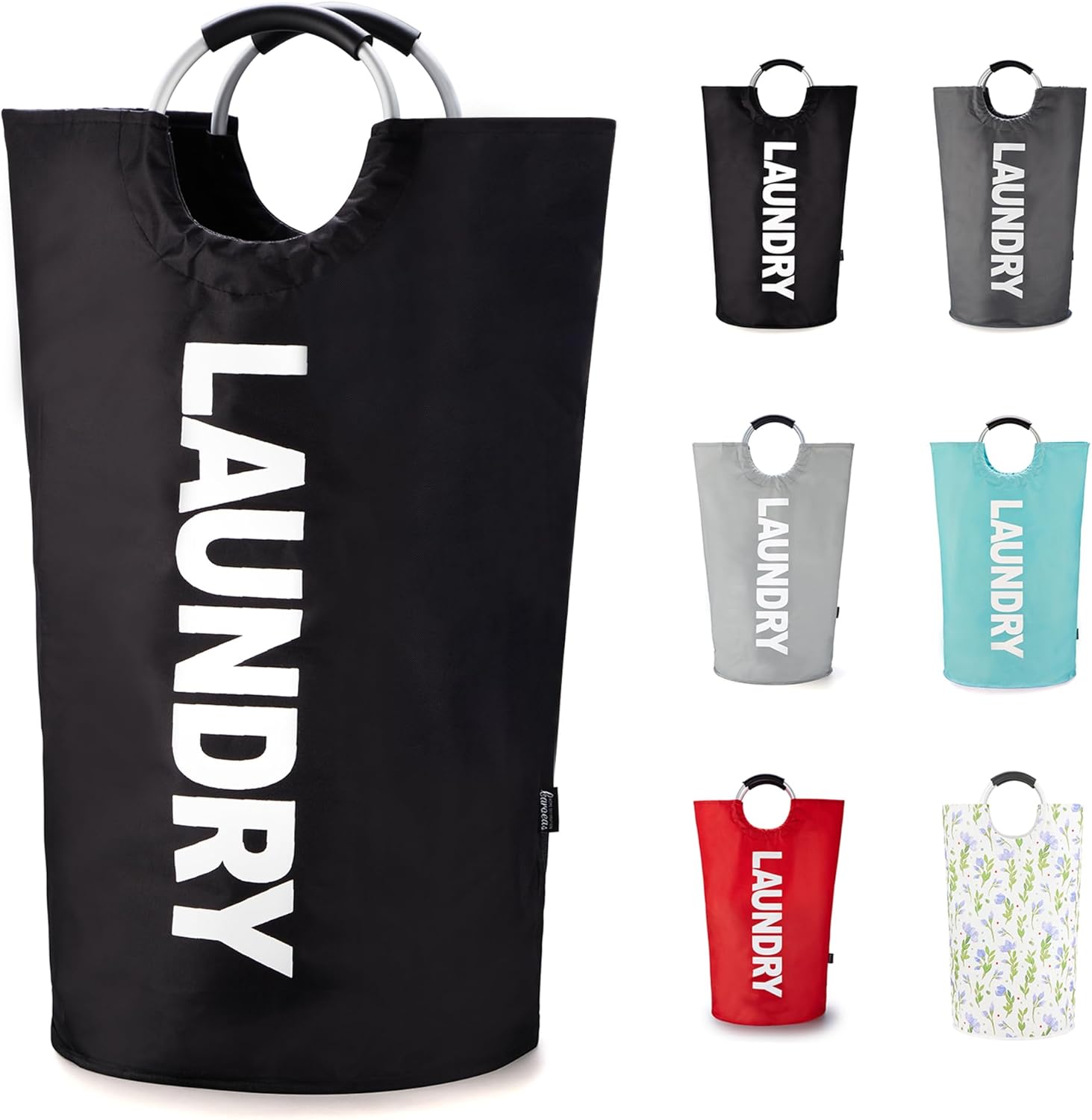
This Caroeas hamper has a stated 90-liter capacity and a tall freestanding form. The collapsible bag uses waterproof Oxford material and padded handles. The listing specifically names dorm, laundromat, and travel as use settings.
Check On AmazonIf you click this link and buy, we earn a commission at no additional cost to you.
Keep pre-sorting separate from the basket-versus-hamper choice
Pre-sorting asks whether laundry should be divided before wash time, not whether the container mostly waits or travels. A single hamper can be stationary without sorting anything, and a basket can be excellent for transport without useful compartments. Once the decision depends on divided bags, multiple bins, or separate wash categories, the architecture has changed. Adding those features here would blur a direct comparison and make a simple choice look more complicated than it needs to be.
If the real frustration is sorting a mixed pile before each wash, move to the laundry sorter decision instead of choosing a basket by compartment count. That page covers whether pre-sorting at collection time saves enough work to justify extra footprint, bags, and a more fixed setup. This article stays with stationary collection versus carry-first movement. You can combine a sorter with a carry basket later, but that is a two-tool workflow rather than another name for the same object.
Keeping the boundary clear also prevents overbuying. A household that rarely sorts in advance does not gain much from extra compartments simply because the larger unit looks organized. A household that already separates several wash categories should not expect one open carry basket to replace a dedicated sorting system. Choose the work that needs to disappear before choosing the extra structure.
Removable liners do not change that boundary by themselves. One liner that lifts out for transport is still one collection stream, while divided liners begin to serve a sorting function. Count the jobs, not the number of fabric pieces inside the frame. That keeps the basket, hamper, and sorter choices distinct and easier to evaluate.

This ROMOON sorter provides four sections with a stated 180-liter total capacity. The rolling frame uses lockable wheels and separate removable bags. The multicolor configuration is designed as a laundry-room organizer for keeping dirty clothes divided before wash time.
Check On AmazonIf you click this link and buy, we earn a commission at no additional cost to you.
Choose the architecture before comparing current product recommendations
Product recommendations become useful after you know which job should dominate. A stationary choice should be judged by footprint, liner access, lid usefulness, cleanability, and whether occasional movement is realistic. A carry-first choice should be judged by handles, filled dimensions, weight, shape retention, and empty storage. Starting with products before making that choice turns the decision into a feature contest between items designed for different routines.
Keep the evidence boundary clear when you shop. Listing photos can show general shape, but they do not prove that a handle remains comfortable at your usual fill level or that a collapsible frame stays convenient in repeated use. Exact dimensions matter, yet filled shape and doorway clearance can still decide fit. Verify the specific item’s dimensions, materials, liner care, and construction instead of transferring one product’s details to another.
When the architecture is settled, the current laundry hamper recommendations are the more appropriate next step for model-level shopping. Go there knowing whether you need a stationary collector, a carry-capable design, or a hybrid that truly performs both jobs. A highly rated stationary hamper is still wrong when the outer shell must travel every load. A highly portable basket is still wrong when your main problem is a permanent bedroom collection point.
That order makes price easier to judge too. Paying more for a lid, liner, collapsibility, wheels, reinforced handles, or a larger frame only makes sense when the feature reduces work in your routine. If a simple open basket fits the trip and storage spot, extra stationary features may add cost without solving anything. If the container never leaves the room, paying for elaborate portability may be equally unnecessary.

This DEWALT ATOMIC compact tape measure has a 30-foot metal blade. Model DWHT38130S uses a slide lock and is listed with measurement accuracy of plus or minus 1/16 inch. Its compact case measures about 6.1 by 3.7 inches and weighs 16 ounces.
Check On AmazonIf you click this link and buy, we earn a commission at no additional cost to you.
Final Thoughts: choose the object by whether it mostly waits or mostly travels
The basket-versus-hamper decision becomes easier once the product label stops being the starting point. Choose a stationary hamper when collection location, footprint, concealment, or a removable liner matters more than carrying the outer shell. Choose a carry-first basket when the container itself repeatedly moves laundry repeatedly and therefore needs useful handles, practical dimensions, and sensible empty storage. If one object performs both jobs without creating clean-versus-dirty conflict, there is no reason to buy two.
When one container is constantly occupied, awkward to carry, or poorly suited to its permanent location, separating the jobs can be cleaner. Measure the storage spot, check the path to the washer, think about the amount you usually carry, and decide where clean laundry waits before comparing capacity or style. Those checks expose the real trade-offs without pretending every basket or hamper follows the same design rules. The right choice is the one that makes the complete laundry workflow easier, not the one whose label sounds more correct.

This black DOKEHOM hamper has a stated 90-liter capacity and an open top. The freestanding round fabric body measures about 15 by 15 by 31 inches and folds when not in use. The listing includes a handle and describes the product for carrying and storing laundry.
Check On AmazonIf you click this link and buy, we earn a commission at no additional cost to you.
FAQs
Most questions come from the same naming problem: product labels are often treated as if they settle the job. The useful answer is tied to movement, typical fill level, and permanent storage. Capacity and appearance still matter, but they do not replace those checks. Use the questions below as quick filters before comparing a specific item.
Verify the exact dimensions, handles, liner care, and construction of the item you are considering. A product can cross the basket-and-hamper line when its design fits both jobs. It can also fail both jobs despite a familiar label. The household workflow remains the final test.
🧺 What is the main difference between a laundry basket and a hamper?
A basket is usually carry-first, while a hamper is usually collection-first. Retailers often use the names interchangeably, so check the design.
🚪 Can I use a laundry basket as a hamper?
Yes, if it has a stable parking spot and works for daily collection. A wide basket may use more floor space and leave laundry visible.
👜 Can I carry a hamper to the washer instead of buying a basket?
Yes, if its handles, filled dimensions and shape work between the collection point and washer. A removable liner can also let the frame stay in place.
📦 Is a larger laundry container always better?
No. Larger capacity helps only when the filled container still fits the available path, remains manageable, and has a permanent storage location.
🔄 Do I need both a hamper and a laundry basket?
Not always. Two help when clean laundry occupies the transport basket while dirty laundry keeps accumulating. One can work when it is routinely emptied.
🪜 What should I consider if laundry has to move past stairs or tight doors?
Use a smaller load, usable handles, and a filled shape that clears the path. If movement remains awkward, change the container setup.
References and Sources
The basket-versus-hamper distinction here is a practical convention, not a universal naming rule. Current comparisons support baskets favoring transport and hampers favoring collection. Testing also supports checking handles, carrying comfort, size, and collapsibility beside capacity. Those findings support the decision fields without turning this into a model recommendation page.
Only sources that materially support the comparison are included. Retail naming is not proof because similar designs can use either label. One product’s test result is not transferred to every basket or hamper. Exact fit, dimensions, care, and construction still require item-level verification.
- HGTV laundry baskets and hampers: supports the common transport-first basket and storage-first hamper distinction, plus size, portability, and storage considerations.
- Real Simple laundry basket testing: supports treating carrying comfort, handles, collapsibility, size, and durability as practical decision fields rather than relying on capacity alone.
These sources support the functional distinction and handling factors, not individual products. Product naming remains inconsistent, so the household job is the better classifier. One tested feature is not automatically equal in another design. Check the exact item against your storage spot, travel path, and usual fill level.