Cool mist and warm mist humidifiers do the same basic job, but they create moisture with different household trade-offs. The first decision is whether you want a heating element and hot water in the system, because that changes burn exposure, energy use, placement, and maintenance. Cool mist then splits into evaporative and ultrasonic designs, which behave differently for noise and mineral handling. Choose the mist system that fits the people, room, water, and cleaning routine, then compare individual models.
Start with the heating element, not the symptom list
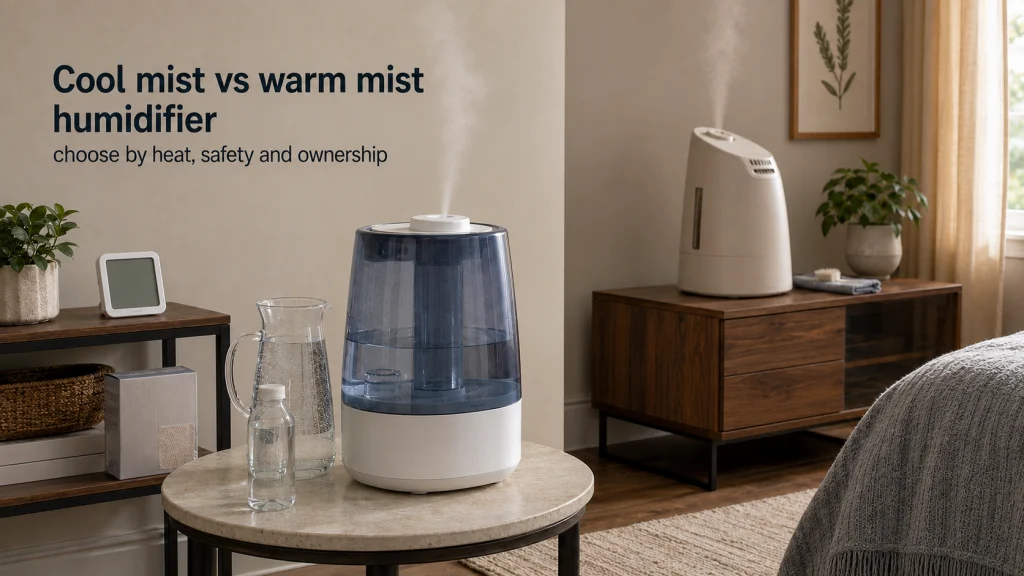
A cool mist vs warm mist humidifier decision is clearer when both machines are treated as tools for adding moisture to room air, not as competing health treatments. A warm mist design heats water before releasing moisture, while a cool mist design does not keep a hot reservoir for that purpose. That difference changes what can be spilled, touched, powered, cleaned, and placed near normal household traffic. It is a more useful first fork than asking which mist is universally “better.”
This comparison stays at the household-equipment level and does not rank either type for treating colds, asthma, allergies, sinus problems, or other medical conditions. If you already know you want a room humidifier, use heat exposure, placement, sound, energy, water quality, and cleaning effort to narrow the type. If you are still deciding whether a humidifier fits the room at all, start with the broader humidifier buying guide. For the wider equipment context around humidity, heating, cooling, and indoor air, see heating and air quality. Once the room need is clear, mist type becomes a practical equipment decision instead of a symptom-based guess.

The Classic 300S uses a 6-liter top-fill tank and cool-mist operation. VeSync smart controls let the unit support app-based humidity management and scheduling. Its large-capacity design is intended for bedrooms and other home spaces.
Check On AmazonIf you click this link and buy, we earn a commission at no additional cost to you.
Cool mist, warm mist, and steam vaporizers create moisture differently
“Cool mist” is a broad label, not one mechanism. An evaporative humidifier uses a fan to move air through a wet wick or similar material, while an ultrasonic humidifier uses vibration to create fine droplets. Both avoid boiling reservoir water as the primary humidification method. Two products with the same cool-mist label can therefore differ sharply in sound, consumables, and mineral behavior. That difference is why the mist temperature alone cannot predict the ownership routine.
| Type | How moisture is produced | Main ownership consequence |
|---|---|---|
| Evaporative cool mist | Fan moves air through a wet wick or filter | No hot reservoir, but fan noise and wick replacement may matter |
| Ultrasonic cool mist | Vibration turns water into a fine mist | Often quiet, but water minerals can be carried into the room |
| Warm mist or steam vaporizer | Water is heated to create steam or warm vapor | Hot water and heating energy become part of ownership |
Warm mist units use heat, and a steam vaporizer is the clearest form of that approach. The U.S. Environmental Protection Agency describes warm mist humidifiers as a type of steam vaporizer in which steam is cooled before leaving the machine. Retail wording can blur those terms, so the mechanism is more useful than the front label. Before buying, verify whether the unit boils water, uses evaporation, creates ultrasonic droplets, or combines methods in a hybrid design.

The Dual 200S uses a 3-liter top-fill tank with ultrasonic cool-mist operation. Its built-in humidistat supports automatic humidity control, and the unit can be managed through app or voice controls. The blue model is designed for quiet bedroom use.
Check On AmazonIf you click this link and buy, we earn a commission at no additional cost to you.
Compare burn exposure and placement before convenience features
Warm mist changes the placement problem because the machine contains heated water and produces hot vapor. The EPA warns that steam vaporizers should be kept out of children’s reach because steam and boiling water can cause burns. A stable surface is not enough if a child or pet can reach the unit, pull the cord, or collide with the supporting furniture. In a busy room, safe placement should be decided before tank size, controls, or extra modes.
Cool mist removes the hot-water burn mechanism, which can make it the simpler choice where children or pets move freely. It still needs safe cord routing, a firm water-resistant surface, and enough control to prevent nearby materials from becoming damp. Walk the likely refill route and check who can reach the unit during normal use, not only where it looks convenient on a product page. If the only workable warm-mist location is hard to reach for cleaning or easy to bump, the household setup is already arguing for cool mist.

This Vicks model is a warm-mist humidifier with a 1-gallon tank for small to medium rooms. It uses heated water to create warm vapor and does not require a replacement filter. Automatic shutoff turns the unit off when the tank is empty.
Check On AmazonIf you click this link and buy, we earn a commission at no additional cost to you.
Heating water adds an energy load and can change how the room feels
A warm mist humidifier must spend energy heating water, so that heating process becomes part of operating cost. Traditional steam-based warm-mist designs use extra energy to heat or boil water, while some hybrid units warm an ultrasonic mist instead of operating like a classic steam vaporizer. The exact difference depends on the model, output setting, run time, and cool-mist technology being compared. Type tells you the direction of the trade-off, not the exact utility cost. Compare actual power information when energy cost could change your purchase.
| Decision field | Cool mist | Warm mist |
|---|---|---|
| Hot water in normal operation | No boiling reservoir required | Yes for steam-based designs |
| Energy direction | Usually lower without a water-heating load | Usually higher because water is heated |
| Room feel | Does not intentionally add warm vapor | Can add a small warming effect near operation |
| Primary safety concern | Placement, moisture, electrical safety, and cleanliness | The same concerns plus hot water and steam exposure |
| Noise pattern | Varies sharply between fan-based evaporative and quieter ultrasonic designs | Often avoids fan noise but can include heating, boiling, or water sounds |
| Maintenance pattern | May involve wick replacement or mineral-sensitive water handling | Still requires reservoir cleaning and scale removal from heated parts |
The heat can also change how a room feels, although a humidifier is not a substitute for a space heater. Some households may welcome a little warmth in a cold room, while others gain nothing from paying to heat water. The difference matters more with frequent or long operation than with occasional use. If warmth has no value in your room, compare cool-mist designs before paying for a heating function you may not want.

The P4400 plugs between a household appliance and a wall outlet to measure electrical use. It displays volts, amps, watts, and kilowatt-hours so operating draw can be checked directly. The meter is designed for standard 115-volt household circuits.
Check On AmazonIf you click this link and buy, we earn a commission at no additional cost to you.
Noise depends on the mechanism, not simply on mist temperature
The shortcut that cool mist is noisy and warm mist is quiet collapses different technologies into one bucket. Evaporative humidifiers need a fan, so fan speed can become the main nighttime sound. Ultrasonic humidifiers do not need that fan to create mist and are often quieter, although water movement, controls, and other components can still be audible. Warm mist can avoid fan noise but may produce soft boiling or gurgling sounds instead. Automatic cycling can also matter more than a single maximum-noise figure.
- Use measured or documented model noise when available, not a generic mist label.
- Expect evaporative designs to include fan sound because the fan is part of the process.
- Do not assume ultrasonic means silent; pumps, water movement, and automatic modes can still be noticeable.
- Do not assume warm mist is automatically the quietest option without checking the exact design.
For a bedroom, decide whether you want near-silence, steady fan sound, or simply no abrupt cycling near the bed. A light sleeper may prefer ultrasonic cool mist over evaporative cool mist even though both share the same broad label. Someone who likes steady fan noise may have the opposite preference. Sound should narrow the mechanism after safety, not erase the water and maintenance trade-offs that come with it.

The HT-80A measures sound levels from 30 to 130 dB. Its handheld digital format makes it suitable for spot checks around household appliances and room equipment. It can be used to compare noise levels across different humidifier settings under the same room conditions.
Check On AmazonIf you click this link and buy, we earn a commission at no additional cost to you.
Cool mist still requires a choice between evaporative and ultrasonic designs
Choosing cool mist removes the hot-water question, but it does not finish the decision. Evaporative and ultrasonic humidifiers handle water, sound, and recurring work differently enough to deserve a separate comparison. Evaporative designs usually trade fan noise and wick replacement for less direct mineral dispersion into room air. Ultrasonic designs often trade lower sound for more sensitivity to the mineral content of the water in the tank. The recurring burden can therefore move from filters to water handling.
Once heat exposure is settled, move the detailed cool-mist decision to the evaporative vs ultrasonic humidifier comparison. Hard water may make mineral handling more important than tank size, while dislike of replacement wicks may push the decision the other way. Distilled-water access can also become a recurring cost and carrying chore for ultrasonic ownership. The better cool-mist technology is the one whose noise, water, and maintenance requirements you will actually support. That routine matters more than the broader cool-mist label.
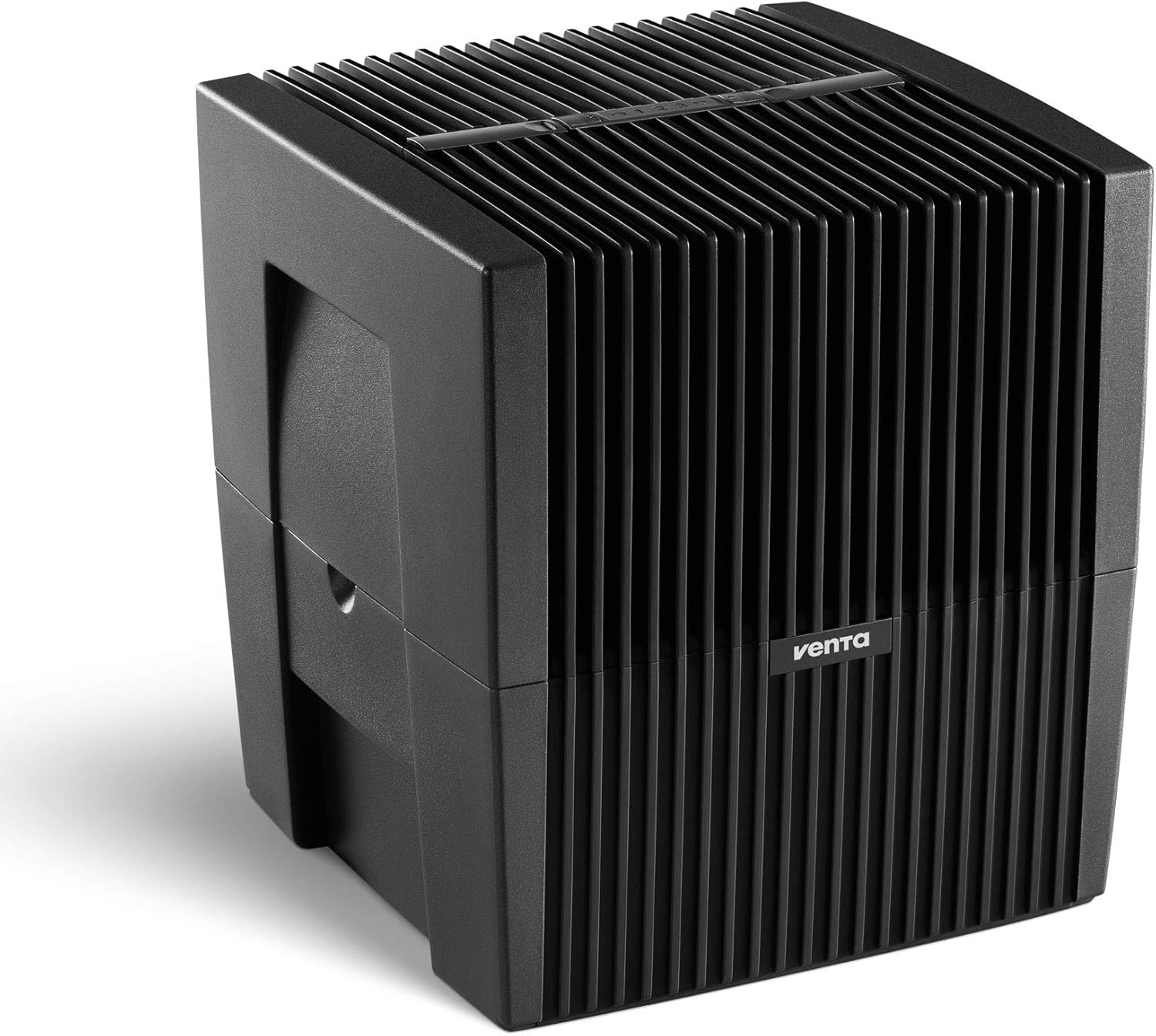
The Venta LW25 is a filter-free evaporative humidifier designed for spaces up to 430 square feet. It uses evaporative operation rather than ultrasonic mist or heated steam. The black model is intended for whole-room use in home spaces.
Check On AmazonIf you click this link and buy, we earn a commission at no additional cost to you.
Water minerals behave differently across the main mechanisms
The claim that all cool mist creates white dust is too broad. EPA guidance identifies ultrasonic and impeller humidifiers as designs that can disperse minerals from tank water into indoor air, while evaporative and steam vaporizer designs are not expected to disperse substantial mineral amounts in the same way. An ultrasonic unit turns tank water into fine droplets, so dissolved minerals can travel with those droplets and settle on surfaces. Water quality therefore becomes an operating input, not a minor accessory choice.
An evaporative unit leaves more mineral material in the wick or machine, which shifts the burden toward wick condition and replacement. A steam vaporizer also leaves mineral deposits behind as scale, so the cleanup problem moves inside the heated water path rather than disappearing. A filter-free ultrasonic unit may look simpler until distilled-water purchases become its real consumable cost, while an evaporative model may show its consumable cost openly as a wick. Compare where the minerals go, what you must buy, and what you must clean instead of treating every cool-mist product as the same.

The TDS-EZ measures total dissolved solids from 0 to 9,990 ppm. It provides 1 ppm resolution with a stated readout accuracy of 3 percent. The handheld tester is useful for comparing dissolved-solids levels between water sources before they are used in a humidifier.
Check On AmazonIf you click this link and buy, we earn a commission at no additional cost to you.
Boiling water does not make warm mist maintenance disappear
Warm mist can change what leaves the tank with the vapor, but it does not make the appliance self-cleaning. Minerals can remain behind as scale on heated surfaces, and standing water still creates a cleaning responsibility. The EPA recommends regular emptying, drying, and cleaning of portable humidifiers, while the exact model instructions control approved cleaners and disassembly. A heating element changes the mechanism, not the need to maintain the reservoir and water path. Scale can also make heated surfaces harder to inspect if cleaning is postponed.
- Check whether the tank opening is large enough for practical cleaning.
- Check whether the base has narrow channels or fixed parts that trap residue.
- Check whether a wick, cartridge, or other consumable is required.
- Check the manual for approved cleaners, descaling steps, and parts that must stay dry.
- Plan a drying location so cleaned parts can dry before reassembly.
Cool-mist cleaning also depends on mechanism. Ultrasonic tanks and bases need attention to film and deposits, while evaporative models add a wick or filter that may need replacement according to the manual. A larger tank can reduce refills but may also be heavier to carry and harder to reach inside. Before paying for extra modes, make sure the parts you must wash are easy enough to reach that the routine will actually happen.

The Holikme Bottle Brush Cleaning Set includes long-handle brushes for narrow bottles, sports bottles, straws, tubes, and small spouts. Its 16-inch bottle brush reaches deep containers, while the sponge and firmer-bristle brushes cover different bottle shapes and cleaning needs. The smaller straw and spout brushes handle narrow openings and other areas that a standard bottle brush cannot easily reach.
Check On AmazonIf you click this link and buy, we earn a commission at no additional cost to you.
Hybrid warm and cool modes add flexibility, not automatic superiority
A dual-mist humidifier can be useful when the household genuinely wants both operating modes. Two mode buttons do not erase the trade-offs of each mechanism, because the machine still has one reservoir, one cleaning system, and a specific method for making warm output. Some hybrids warm an ultrasonic mist rather than behaving like a classic steam vaporizer. The exact manual matters before you assume what “warm” means inside a particular design.
The case for a hybrid is strongest when you can name when you would switch modes and why. If you plan to use cool mist all the time because hot water does not fit the room, a heating feature adds complexity without solving a problem. If both modes fit real situations and the unit remains easy to clean, the flexibility may justify the extra cost or parts. Verify the warm-mode mechanism, placement requirements, and maintenance routine before treating a hybrid as a best-of-both-worlds answer.

This DREO model combines warm and cool mist in one 6-liter humidifier. Amazon lists up to 60 hours of runtime, 500 mL per hour output, and a smart humidity sensor. App control plus Alexa and Google support provide remote access to the unit's settings.
Check On AmazonIf you click this link and buy, we earn a commission at no additional cost to you.
“Humidifier” and “vaporizer” are overlapping labels, not separate household goals
A vaporizer is best understood as a heated humidification design rather than an appliance with a completely different household job. Both vaporizers and cool-mist humidifiers add moisture to room air. The useful distinction is how the water becomes airborne through evaporation, ultrasonic droplets, or heated steam. That mechanism controls the hot-water risk, mineral behavior, sound profile, and maintenance pattern. It also tells you which parts or consumables deserve attention before purchase. A mechanism-first check prevents loose terminology from hiding real ownership differences.
Terminology check: If the machine heats water to create steam, treat it as a warm-mist or steam-vaporizer system for safety and ownership decisions. If it does not, identify the actual cool-mist mechanism instead. Do not rely on the retail label alone when the water path is unclear. Check the technical description or manual before deciding which trade-offs apply.
Shoppers often phrase the question as humidifier versus vaporizer, but the same ownership checks still apply. If a listing uses “vaporizer” without making the heating method clear, look for the manual or technical description before assuming it boils water. Product names can be loose, while the water path is concrete evidence. Once the mechanism is known, the same safety, energy, noise, water, and cleaning comparison can finish the choice. There is no need to invent a separate buying logic for the vaporizer label.

The DREO HM311 uses a 4-liter tank and is rated for up to 36 hours of runtime. Amazon lists a 28 dB operating level along with an easy-refill and easy-clean design. The blue model also includes a nightlight and is marketed for bedroom use.
Check On AmazonIf you click this link and buy, we earn a commission at no additional cost to you.
Choose cool, warm, or hybrid by the household system you can support
Start with the hot-water condition because it can eliminate an option before noise, features, or tank size matter. If heated water and steam cannot be kept reliably out of reach, choose cool mist and then decide between evaporative and ultrasonic operation. If hot water can be managed safely but you do not specifically want heated output, cool mist is still the simpler route. Warm mist only becomes the stronger fit when heated output is something you actually want and the placement and scale-cleaning burden are acceptable.
A hybrid belongs at the end of the decision, not at the beginning. It makes sense when both cool and warm modes have a real role in the household and the exact model’s warm mode, power use, placement rules, and cleaning routine have been verified. If you would leave the heating feature off most of the time, the extra mode is unlikely to justify added complexity. If you expect to use only warm output, a dedicated warm-mist design may be the cleaner comparison.
- Hot water cannot be kept safely out of reach: choose cool mist.
- Hot water can be managed safely, but heated output is not important: choose cool mist.
- Hot water can be managed safely and heated output is wanted: choose warm mist for one-mode use, or hybrid when both modes have a real job.
This branching path keeps the decision tied to household conditions instead of treating three labels as equal menu choices. After the branch is chosen, compare model-level noise, tank handling, cleaning access, water requirements, and room guidance. Those details decide which specific unit fits inside the mist system you already selected. The result should be fewer plausible products, not a longer list of features to sort through.

The LEVOIT Classic 160 uses a 2.5-liter top-fill tank and cool-mist operation. Amazon lists a 28 dB operating level for the current listing. Its top-fill layout is designed for easier refilling and cleaning access.
Check On AmazonIf you click this link and buy, we earn a commission at no additional cost to you.
After choosing the mist system, compare room fit and current options
Mist type should narrow the field, not finish the purchase. You still need to match output and manufacturer room guidance to the space, check tank handling, verify cleaning access, and decide whether the operating sound fits where the unit will run. A large tank can reduce refills but become awkward to carry, while a compact tank can be easy to wash but require more trips to the sink. Model fit matters after the mechanism is settled.
- Verify the exact humidification mechanism, not just the front label.
- Measure the intended operating surface and follow the manual’s required clearances.
- Check full-tank carrying weight and the path from sink to room.
- Confirm cleaning steps and replacement consumables before comparing convenience features.
- Use model-specific room guidance rather than assuming a larger tank means stronger or better-suited output.
For a current shortlist across categories, move to the best humidifiers comparison and judge options against the room and ownership profile you now understand. Bedroom shoppers should pay particular attention to nighttime sound, display behavior, refill burden, and safe placement around the bed and normal foot traffic. This page does not recommend individual products because the class-level choice comes first. Once heat, water, and maintenance fit are clear, current model comparisons become far more useful.

The TP50 displays indoor humidity and temperature together on one screen. It records high and low readings so room conditions can be checked over time. The compact unit can sit on a tabletop or use its magnetic back for flexible placement.
Check On AmazonIf you click this link and buy, we earn a commission at no additional cost to you.
Final Thoughts: choose the heat and maintenance system that fits the household
Cool mist and warm mist humidifiers both add moisture, so the better buying question is how you want that moisture created. Warm mist adds a heating element, hot water, and a different scale pattern to the system. Cool mist removes the hot-water concern but then splits into evaporative and ultrasonic designs with different noise, consumable, and mineral trade-offs. The right choice is the one whose safety conditions and maintenance routine remain realistic in the room where you will use it.
Before buying, check the exact mechanism, placement instructions, cleaning access, water recommendations, and room guidance for the model in front of you. If warm water cannot be kept reliably out of reach, remove that option early. If hard water or replacement consumables will shape ownership, account for those costs before feature count or tank size. A simpler humidifier that fits the household routine is more useful than an elaborate one whose mist system creates work or risk you did not plan to accept.

The OXO drying mat is made from flexible silicone with a ribbed surface that promotes drainage and airflow. It measures about 16.9 by 12.5 inches and can be rolled or hung for storage. The mat is dishwasher safe and provides a dedicated surface for air-drying cleaned removable parts.
Check On AmazonIf you click this link and buy, we earn a commission at no additional cost to you.
FAQs
🔥 Is warm mist safer because the water is heated?
No. Heating changes the humidification process, but it also creates hot water and steam that can cause burns. Keep steam-based units out of reach and follow the exact placement instructions in the manual.
💧 Do all cool mist humidifiers make white dust?
No. Mineral dispersion is mainly a concern with ultrasonic and impeller designs, not every cool-mist mechanism. Evaporative units handle minerals differently because water evaporates through a wick or similar material.
🔊 Is warm mist always quieter than cool mist?
No. Evaporative cool mist uses a fan and can be more audible, while ultrasonic cool mist is often very quiet. Compare the exact model and mechanism rather than assuming mist temperature determines sound.
⚡ Does warm mist use more electricity?
Usually, because the unit must heat water to create warm vapor or steam. Actual energy use still depends on the model, output setting, and how long it runs.
🧼 Does boiling water mean I can clean a warm mist humidifier less often?
No. Warm mist units still need their reservoir and water-contact parts cleaned, and minerals can remain behind as scale. Follow the exact maintenance instructions for the model you own.
🧒 Which mist type makes more sense around children or pets?
Cool mist removes the hot-water and steam burn mechanism from normal humidification. You still need stable placement, safe cord routing, moisture control, and regular cleaning.
🔁 Is a warm and cool mist hybrid automatically the better choice?
No. A hybrid is useful only if both modes serve a real need and you can use the warm mode safely. Verify how the exact model produces warm output because not every hybrid works like a classic steam vaporizer.
References and Sources
- U.S. EPA humidifier use and care guidance: Supports the mechanism, mineral-dispersion, cleaning, humidity-control, and steam-burn safety distinctions used here.
- Consumer Reports humidifier buying guide: Supports current type-level comparisons involving warm mist, cool mist, ultrasonic operation, sound, energy, and room fit.
- Good Housekeeping cool mist and warm mist comparison: Supports current consumer trade-offs involving heat, noise, energy, and dual-mist designs without relying on medical superiority claims.